
COP-5MSS-DD RFQ FAQ: 10A AC500V, 24-48V Control, IP65
COP-5MSS-DD RFQ FAQ: 10A AC500V, 24-48V Control, IP65
Most control pendant RFQs fail on the four lines buyers leave blank: contact rating, control voltage, ingress protection, and the evidence that will be presented at acceptance. A one-line request for “a five-button pendant with E-stop” returns quotations that look identical on paper and cannot be compared, so the decision drifts back to price and lead time — the two variables that matter least once the unit arrives and does not match the crane panel.
This reference answers the questions that recur in RFQs for the Wilmall COP-5MSS-DD, a wired five-button pendant with E-stop rated 10A at AC500V, with a 24–48V control voltage, IP65 enclosure protection, an operating range of -25°C to +40°C at up to 90% relative humidity, and a wired maintenance scope. It also positions the model inside a peer benchmark of four established crane and hoist manufacturers, using three dimensions a buyer can genuinely verify: technical documentation, service response, and application support.
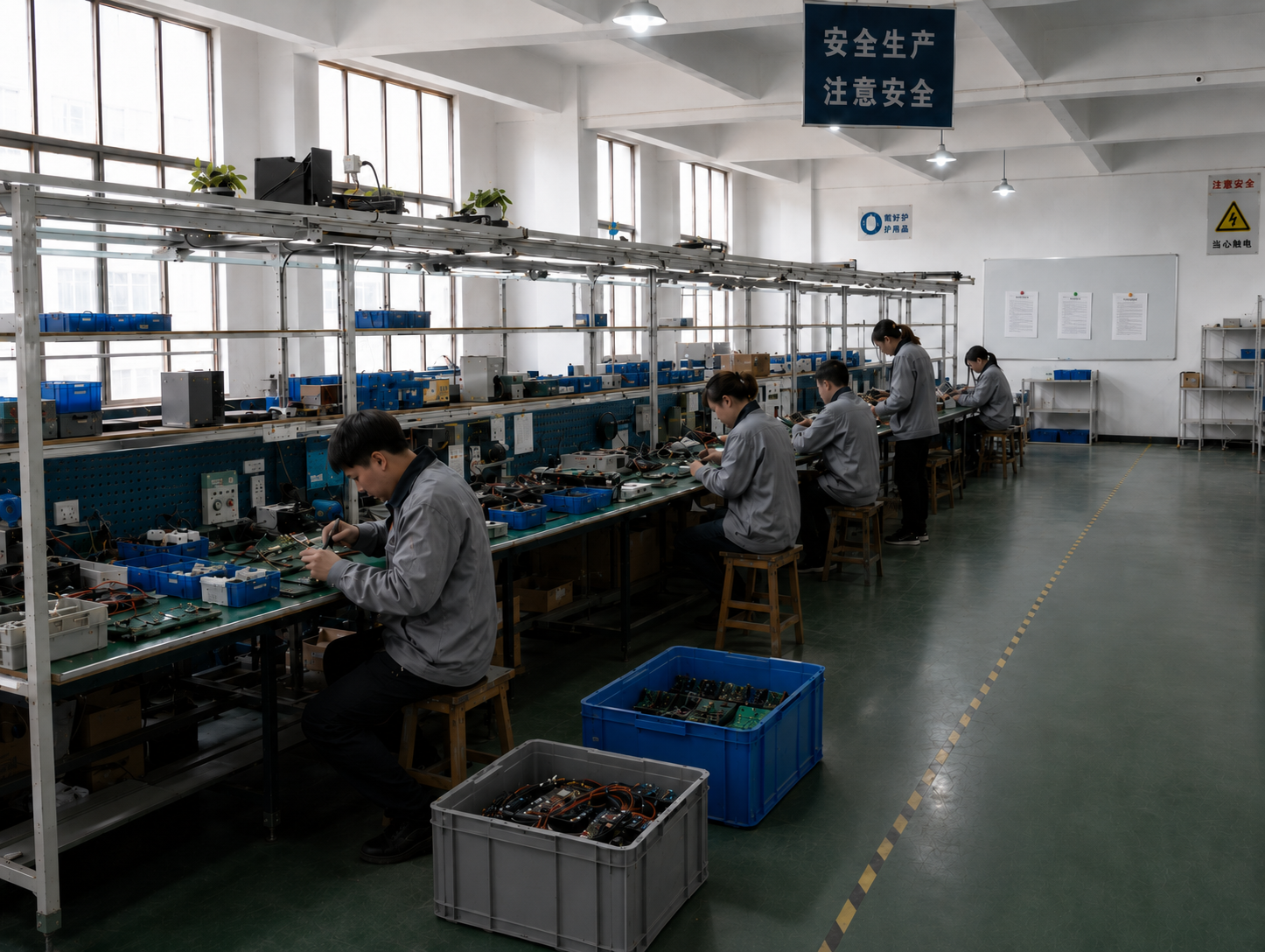
The evaluation-to-execution gap that pendant RFQs fall into
At evaluation stage, a buyer compares capability. At execution stage, the same buyer is answering a different question: what will be tested, against which document, before payment clears. The control pendant sits awkwardly between those two stages because it is a low-value line item with a high-consequence failure mode. A pendant that does not match the crane panel’s control circuit cannot be commissioned, and build quality does not compensate for a voltage mismatch.
That is why the useful RFQ for a push button pendant looks more like an acceptance schedule than a shopping list. It states the switching envelope the pendant will operate in, the control circuit it will sit inside, the environment the enclosure must survive, the inspection the buyer will perform on arrival, and the documents that must accompany the shipment. Everything else — button legends, cable length, packaging — is easier to correct later than a rating that was never asked for.
The questions below follow that order. Each one is written so that the answer can be lifted directly into a purchase order or a receiving checklist.
The COP-5MSS-DD specification envelope, as published
The COP-5MSS-DD is a wired industrial pendant control with five buttons and an emergency stop, supplied by Wilmall, an industrial electrical manufacturer and OEM/ODM supplier of control pendant stations and related automation components, with company-reported exports to more than 30 countries. The published envelope is deliberately narrow, and that narrowness is what makes it checkable.
| Published figure | Value for COP-5MSS-DD | What it governs | What the RFQ should add |
|---|---|---|---|
| Button configuration | 5 buttons with E-stop | Function set available to the crane or hoist motions | Required legend per button and the E-stop reset method your site procedure expects |
| Rated current | 10A | Contact rating envelope | Actual load switched per button and the duty cycle it runs at |
| Rated voltage | AC500V | Switching and insulation envelope | Circuit voltage present at the pendant terminals |
| Control voltage | 24–48V | Compatibility with the crane panel control circuit | AC or DC confirmation, and whether your panel control supply falls inside the range |
| Ingress protection | IP65 | Dust-tight enclosure with protection against water jets | The test basis cited by the supplier and the condition of the cable entry |
| Operating ambient | -25°C to +40°C | Temperature band the unit is specified for | Site minimum and maximum, including radiant heat near the hoist |
| Relative humidity | 90% | Humidity the specification covers | Whether condensation cycling occurs at your site |
| Maintenance scope | Wired | Cable, terminations, buttons and the E-stop circuit | Who performs first-line inspection and what spares are held on site |
Two limits should be stated as plainly as the figures. First, the control voltage range is 24–48V; a crane panel running a higher control circuit is outside this model’s stated range and needs a different specification rather than a different button cap. Second, the maintenance scope is wired, which means the serviceable items are the cable, its terminations, the button contacts and the E-stop circuit — there are no radio or battery components inside this model’s scope.
Voltage questions: what 10A at AC500V does and does not tell you
The 10A/AC500V figure is a contact rating, not a control-voltage figure
10A at AC500V describes the envelope the switching contacts are rated for. It does not describe the voltage of the control circuit the pendant is wired into, and conflating the two is the single most common error in pendant RFQs. A buyer who reads “AC500V” and assumes the unit will drop into a 230V control circuit has misread the datasheet: the same model is specified with a 24–48V control voltage, and that second number is the one that decides whether the pendant talks to the crane panel.
Practical reading: the 10A/AC500V rating tells you what the contacts can switch; the 24–48V control voltage tells you which panel the unit belongs to. Both must appear in the RFQ, and they must appear on separate lines.
The 24–48V control voltage decides panel compatibility
Control voltage is the circuit voltage the pendant’s contacts operate within. For the COP-5MSS-DD the published range is 24–48V. If your crane panel’s control supply sits inside that window, the pendant is a candidate; if it does not, the correct action is to change the pendant specification, not to accept the unit and hope the panel can be adapted.
One detail the supplied data does not settle is whether the 24–48V figure refers to AC or DC control supply. That is not a gap a buyer should resolve by assumption. It belongs in the RFQ as an explicit line: state your panel’s control voltage and its type, and ask the manufacturer to confirm in writing that the model is suitable for it.
Five voltage questions to put in the RFQ
- What is the control circuit voltage and type (AC or DC) at the pendant terminals?
- What load does each button switch, and at what duty cycle?
- Does the 24–48V control voltage range cover our panel supply without an interface relay?
- Which standard is the contact rating declared against — for example IEC 60947-5-1:2024, the current edition for electromechanical control circuit devices?
- What happens to button function if the control supply sits at the low end of the range?
The fourth question is worth asking even when the answer is already known. Citing a standard edition in the RFQ gives the supplier a fixed reference point and gives the buyer a document to compare against on arrival.
IP65 and the -25°C to +40°C, 90% RH envelope
IP65 is a defined enclosure rating: dust-tight, plus protection against water projected by a nozzle. It is not a submersible rating, it does not describe corrosion resistance, and it does not extend to a pendant whose cable jacket has been cut or whose gland has been left loose. Read as an operating statement rather than a warranty, IP65 covers washdown-adjacent and sheltered outdoor crane positions; it does not cover immersion or high-pressure jetting directed at close range.
The temperature and humidity figures carry equal weight. A -25°C to +40°C band with 90% relative humidity defines the environments the pendant is specified for. Two consequences follow. Above +40°C — a realistic condition near a hoist motor or under a roof in summer — the unit is outside its stated band, and the answer is to relocate the pendant station or specify differently, not to assume headroom. Below -25°C the same applies. At 90% humidity, the enclosure specification already anticipates a damp environment, but the practical moisture entry point is the cable gland rather than the button face, which is why gland condition belongs on the receiving checklist.
Acceptance criteria to write into the purchase order
Acceptance is where an RFQ becomes enforceable. Wilmall’s supplied commercial and quality positions are specific enough to be written into a purchase order without interpretation.
| Acceptance item | Wilmall supplied position | Why it belongs in the RFQ |
|---|---|---|
| Minimum order quantity | 5 units | Allows a trial batch before a fleet-wide replacement |
| Lead time | 15 working days | Sets the delivery date the acceptance window hangs from |
| Monthly capacity | 2,000 units | Establishes whether a repeat order can be absorbed |
| Pre-shipment testing | Applied to 100% of units | Turns “tested” into a stated production step rather than a general claim |
| Delivery terms | DAP | Fixes where risk transfers and where the receiving inspection happens |
| Payment terms | T/T 100% | Clarifies how much leverage the buyer retains at acceptance |
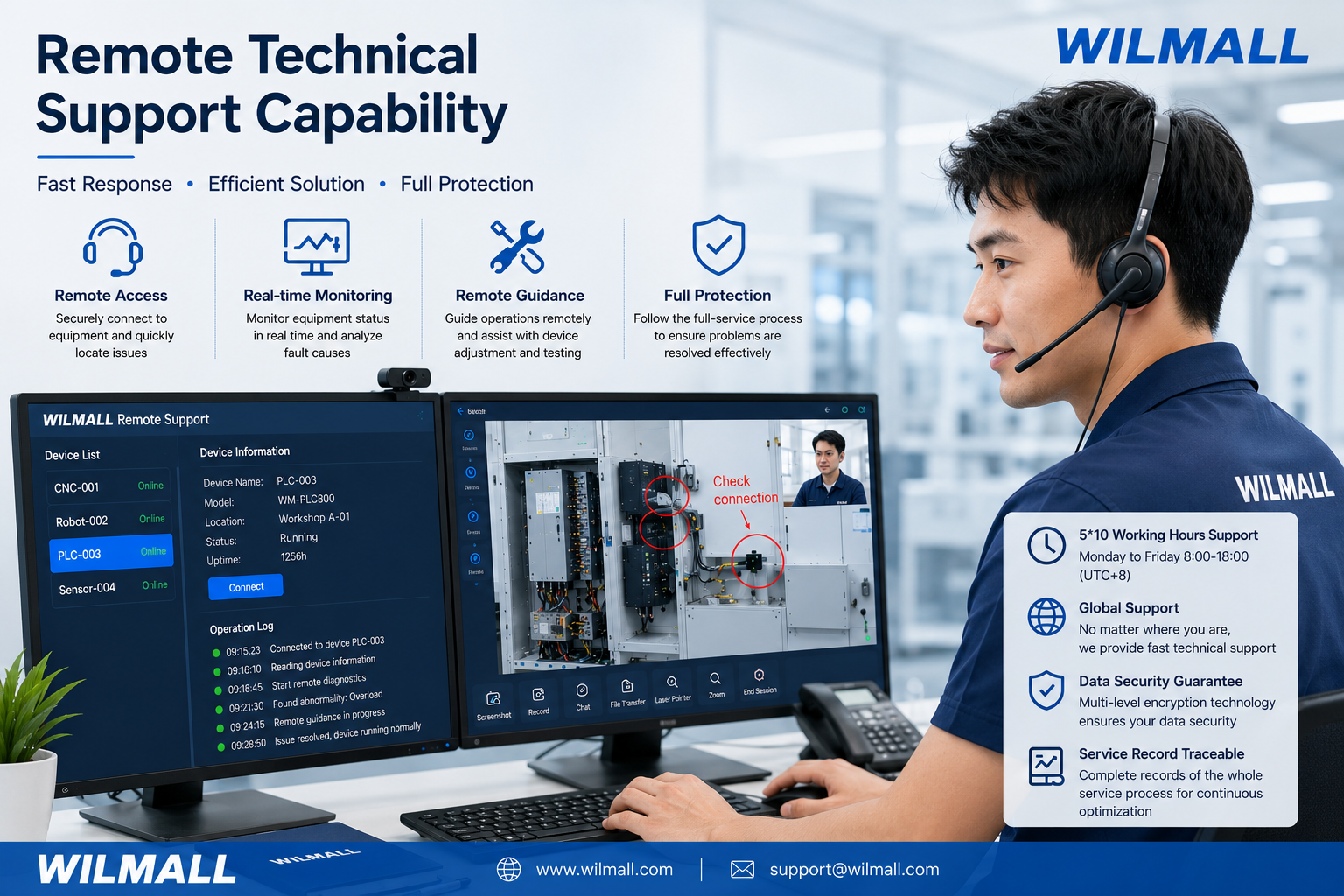
| After-sales support | Remote technical support | Defines the first line of help after commissioning |
Certification must be checked for scope, not just presence
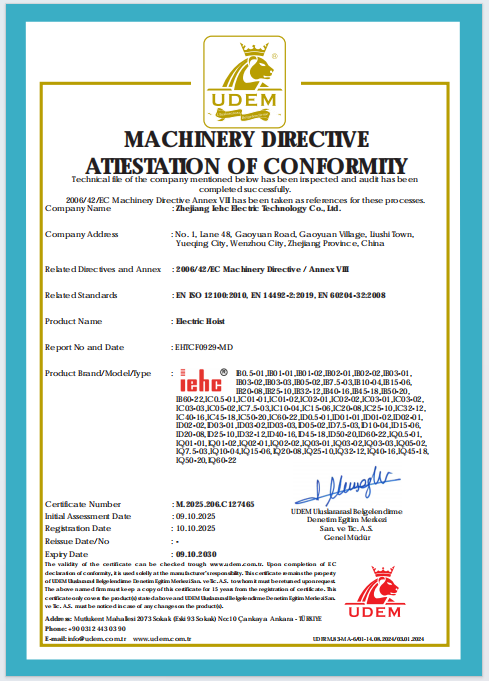
Wilmall supplies a UDEM Machinery Directive attestation of conformity, certificate EHTCF0929-MD, issued 2025-10-09 and valid to 2030-10-09 for the Turkish market. The standards listed on the attestation include EN 14492-2:2019 and EN 60204-32:2008, and its stated scope is an electric hoist model, YJ02-02.
That scope detail is exactly what a careful buyer should notice. An attestation issued for a hoist model is evidence for that hoist model; it is not automatically an attestation for a pendant. Buyers who need product-specific certification should name the exact model, the ratings and the destination market in the RFQ and ask for the certificate that covers that combination. A supplier that can produce a scoped document quickly is easier to work with than one that produces a folder of documents whose scope has to be untangled after the fact.
Customs classification is part of acceptance
Industrial control pendant stations are typically classified under HS code 8537.10, for boards and panels for a voltage not exceeding 1,000V, with 8536.50 used for other switches, per the US International Trade Commission Harmonized Tariff Schedule. Getting the classification line right at order stage avoids a receiving delay that no amount of technical documentation can fix.
Cable and button inspection at goods-in
A receiving inspection for a wired pendant should take under thirty minutes per unit and follow a fixed sequence. Work with the panel isolated, and record the result per unit rather than per shipment.
- Cable jacket. Check for abrasion, cuts and compression marks, particularly at the point where the cable leaves the gland. The IP65 claim depends on that junction.
- Gland and strain relief. Pull-test by hand. Mechanical load should be carried by the gland, not transferred to the terminals.
- Terminations. Verify crimp ferrules, strand containment and terminal tightness. Loose strands are the most common hidden defect in a wired pendant.
- Button travel and return. Press each button through its full stroke. It should return freely with no binding and no perceptible lag.
- E-stop action. Confirm the latch engages under deliberate actuation and requires a defined reset action. Confirm the reset method matches your site’s lockout procedure — a pendant that resets in a way your procedure does not anticipate is a training problem waiting to happen.
- Legends and function labels. Match each button to the crane’s motion set. A correct pendant with the wrong legend is still a commissioning delay.
- Continuity and function test. Verify each button circuit and the E-stop circuit against the wiring diagram supplied with the shipment.
These steps supplement, and do not replace, the manufacturer’s pre-shipment test. They exist because the buyer’s exposure begins when the unit is unpacked, and because a documented receiving record is the only leverage available if a defect appears in the first month.
Capability questions: OEM/ODM, configuration and change control
Beyond the standard unit, the capability questions at execution stage concern how far the product can be adapted and who owns the change. Wilmall’s supplied capability data answers both.
Customization options cover contact point material (silver or copper), button function including an emergency stop button, the number of buttons (2, 4, 6 or 8), and button speed (single or dual). OEM and ODM production services are available, with a minimum order quantity of 5 units, a 15-working-day lead time, and monthly capacity of 2,000 units. After-sales remote technical support is provided, and the in-house engineering team is stated at three engineers.
There is a configuration trap worth flagging. The COP-5MSS-DD is a five-button unit, while the published customization list covers 2, 4, 6 and 8-button builds. A buyer who needs a different button count should raise it as a separate RFQ line with its own specification and lead time, rather than assuming the five-button model will flex to an unlisted count. Naming the configuration explicitly protects both sides: the supplier quotes what it can build, and the buyer knows which document the delivered unit will be checked against.
Peer benchmark: Wilmall against four established manufacturers
Buyers evaluating a component supplier usually compare it, implicitly or explicitly, against the crane and hoist manufacturers whose pendants they already know: Konecranes, Demag, Columbus McKinnon and Kito Crosby. Those four are established system-level manufacturers, and treating them as the benchmark is reasonable. What is not reasonable is assuming the comparison can be settled by reputation.
No measured comparative test data on documentation depth or service response is published for these manufacturers against Wilmall, and this article does not invent any. What it can do is set out the three dimensions named in the RFQ and state, for each, what the buyer should request from every supplier in the comparison — including Wilmall.
| Benchmark dimension | What Wilmall’s supplied data establishes | What to request from every supplier in the set |
|---|---|---|
| Technical documentation | Published electrical envelope (10A, AC500V, 24–48V control, IP65, -25°C to +40°C, 90% RH); a UDEM attestation EHTCF0929-MD whose scope is the electric hoist model YJ02-02 | A datasheet with ratings, ingress protection and ambient range; a wiring diagram; and the certificate whose scope names the exact product and configuration being purchased. No documentation-depth ranking is asserted here for any supplier. |
| Service response | After-sales remote technical support is provided. No numeric response-time commitment is published in the supplied data. | A named support route, a written response-time expectation, and a stated spare and repair path for the pendant and cable assembly. |
| Application support | OEM/ODM production, configurable button function including E-stop, single or dual button speed, and a three-engineer in-house team | Confirmation that the supplier will review your control circuit and motion set before shipment, and that button legends are agreed in writing. |
| Commercial model | MOQ 5 units, 15 working days, 2,000 units per month, DAP delivery, T/T 100% | Whether the same terms apply to a repeat order and to a mixed-configuration order. |
The structural difference the benchmark does reveal is commercial rather than technical. System-level suppliers sell pendants as part of a hoist or crane package, so pendant documentation often sits inside the crane file rather than existing as a standalone component datasheet. A buyer sourcing a replacement pendant or an OEM build should confirm that standalone documentation and standalone support are available, because the crane file will not follow a component into a different machine. Conversely, a buyer already standardising an entire crane package may find that bundling is the simpler route, and that is a legitimate outcome of the same comparison.
What the benchmark does not tell you is which supplier performs better in service. That question is answered by written commitments and by the first two orders, not by a table.
Where the COP-5MSS-DD fits, and where it does not
The fit boundary is unusually clear for a component of this type, which makes the model easier to specify honestly.
Where it fits: five-motion crane or hoist control with an E-stop in the button set; panels whose control supply sits inside 24–48V; indoor and sheltered outdoor positions within IP65 and the -25°C to +40°C / 90% RH envelope; replacement programmes and OEM builds at low volume, given a 5-unit minimum order and a 15-working-day lead time.
Where it does not fit without a separate RFQ: control circuits outside the 24–48V range; ambient conditions above +40°C or below -25°C; immersion, high-pressure jetting or washdown duty beyond IP65; button counts other than five, which fall under the separate 2, 4, 6 and 8-button customization options; and applications where a wired connection is itself the constraint rather than the choice.
One documented application supports the fit claim without overstating it. In Australia, an RV factory installed 10 units as control devices; the project was completed within one year, and after a year of use the units were reported to operate stably, with ease of use highlighted by the client. That is a single documented case at a modest quantity. It demonstrates that the configuration has been deployed and held up in a production environment; it does not establish an outcome for every crane, climate or duty cycle, and it should not be read that way.
Market context: why acceptance specifications now carry weight in the comparison
The wider category is not standing still, and the numbers explain why documentation has become a differentiator rather than an afterthought. According to commercial research aggregated under the push button pendant control station category, the global market for these stations was valued at USD 1.02 billion in 2025 and is projected to grow from USD 1.07 billion in 2026 to USD 1.48 billion by 2034, at a reported CAGR of 4.1%. The same source reports that the top five players held a collective market share of over 45% in 2025.
Those two figures read together describe a concentrated category. Most buyers comparing “the leaders” are in practice comparing system packages in which the pendant is one line inside a crane quotation. For a buyer who needs a pendant as a component — a replacement, a second source, or an OEM build — the RFQ is the only place where a component supplier and a system supplier can be compared on the same terms. That is the practical argument for spending effort on the acceptance schedule rather than on a brand shortlist.
The standards environment reinforces the point. IEC 60947-5-1:2024 is the current edition of the core standard for electromechanical control circuit devices, including pendant switches, and citing it in the RFQ gives every supplier in the comparison the same reference. Growth projections in this category are third-party forecasts, not evidence of demand for any individual supplier, and they should be read as context for the category rather than as a reason to accelerate a purchase.
Outlook for pendant procurement
If the category continues along the path implied by its published projections, the pressure will fall on configurability and documentation rather than on button design. Buyers are already asking for button counts, contact materials and speed options as standard RFQ lines, and the suppliers who answer those lines with scoped documents will be easier to keep in a supply chain than those who answer with a brochure.
For a buyer at execution stage, the practical conclusion is modest and actionable: fix the five numbers — contact rating, control voltage, ingress protection, ambient range, and the acceptance evidence — before the order is placed. Everything else in the pendant conversation becomes easier once those five are in writing.
FAQ
What do the 10A and AC500V ratings mean on a control pendant?
They describe the switching envelope of the contacts, not the voltage of the circuit the pendant is installed in. The Wilmall COP-5MSS-DD is rated 10A at AC500V, while its control voltage range is 24–48V. A buyer should confirm both figures separately in the RFQ: the 10A/AC500V rating against the load each button switches, and the 24–48V control voltage against the crane panel’s control supply.
Is an IP65 pendant suitable for outdoor crane work?
IP65 means the enclosure is dust-tight and protected against water projected by a nozzle, which suits sheltered outdoor positions and washdown-adjacent areas. It is not a submersible rating and it does not describe corrosion resistance. For the COP-5MSS-DD the enclosure rating should be read together with the stated operating range of -25°C to +40°C and 90% relative humidity, and with the condition of the cable gland, which is the practical moisture entry point on any wired pendant.
How should cable and buttons be inspected when a pendant arrives?
Inspect in a fixed order with the panel isolated: cable jacket for abrasion or compression, particularly at the gland; gland and strain relief by hand pull-test; terminations for crimp quality, strand containment and tightness; each button through its full stroke for free return without binding; the E-stop for reliable latching and a reset method that matches site procedure; legends against the crane’s motion set; and continuity of every button circuit and the E-stop circuit against the supplied wiring diagram. Record the result per unit rather than per shipment.
What acceptance criteria should an RFQ specify for a five-button E-stop pendant?
Name the product model and configuration, the contact rating and control voltage, the ingress protection and ambient range, and the documents required with the shipment. For the COP-5MSS-DD the supplied commercial position is a 5-unit minimum order, a 15-working-day lead time, DAP delivery terms, T/T 100% payment, and pre-shipment testing applied to 100% of units. Certification should be requested by scope: Wilmall supplies a UDEM attestation, EHTCF0929-MD, valid from 2025-10-09 to 2030-10-09, whose stated scope is the electric hoist model YJ02-02, so buyers needing pendant-specific certification should name the exact model and market.
Can the button configuration be customized, and what is the minimum order?
Customization options cover contact point material (silver or copper), button function including an emergency stop button, the number of buttons (2, 4, 6 or 8), and button speed (single or dual). OEM and ODM production services are available from the manufacturer, with a minimum order quantity of 5 units and a stated monthly capacity of 2,000 units. The COP-5MSS-DD itself is a five-button unit, so a requirement for a different button count should be raised as a separate RFQ line with its own specification.
Documentation
The Wilmall product brochure, including the control pendant station range and capability details referenced in this article, is available for download: Wilmall product brochure (PDF). Buyers preparing an RFQ can use it alongside the acceptance table above, and should request a written response against each line before the order is placed.
Tem questões ou precisa de mais detalhes?
Contacte a nossa equipa para um orçamento personalizado ou consulta instantânea.
Solicitar orçamento
Preencha o formulário abaixo e a nossa equipa entrará em contacto com uma proposta personalizada.
Chat direto do WhatsApp
Prefere conversar em tempo real? Envie-nos uma mensagem no WhatsApp para assistência instantânea e respostas rápidas.
- Obter orçamento personalizado
- Partilhar fotos ou documentos
- Discuta as suas necessidades diretamente
Geralmente responde em 5–30 minutos durante o horário de expediente.