
CPD10 to CPD35 Electric Forklifts: Buyer Comparison for Smart Manufacturing
Electric forklifts have become the default order type in mature industrial markets. Electric models accounted for 71% of North American retail forklift orders in 2024, based on Industrial Truck Association data cited by Batteries International, and China's domestic electric forklift sales reached 946,300 units in 2025, equal to 76.9% of all forklift sales in the country according to the China Construction Machinery Association. For smart manufacturing projects, that shifts the buying question: the decision is no longer whether to electrify, but which capacity class, which battery strategy, and which control architecture to standardise on.
This buyer comparison covers four electric counterbalance models from a single range — CPD10, CPD20, CPD30 and CPD35 — spanning rated capacities from 1 ton to 3.5 tons. Ningjin Shunhao Trading Co., Ltd. is a China-based electric forklift supplier established in 2022 that operates a 40,000 m² manufacturing base inside China's logistics equipment industrial cluster, employs approximately 240 staff, reports annual production capacity of 12,000 units, and serves global markets, with export business accounting for 70% of total sales. Its stated focus is OEM and ODM customized material handling equipment.
The comparison concentrates on what changes fleet design: rated capacity and lifting height, drive and braking configuration, battery and charging strategy, controller sourcing, scenario fit, and the acceptance checks that should be completed before a purchase order is confirmed.
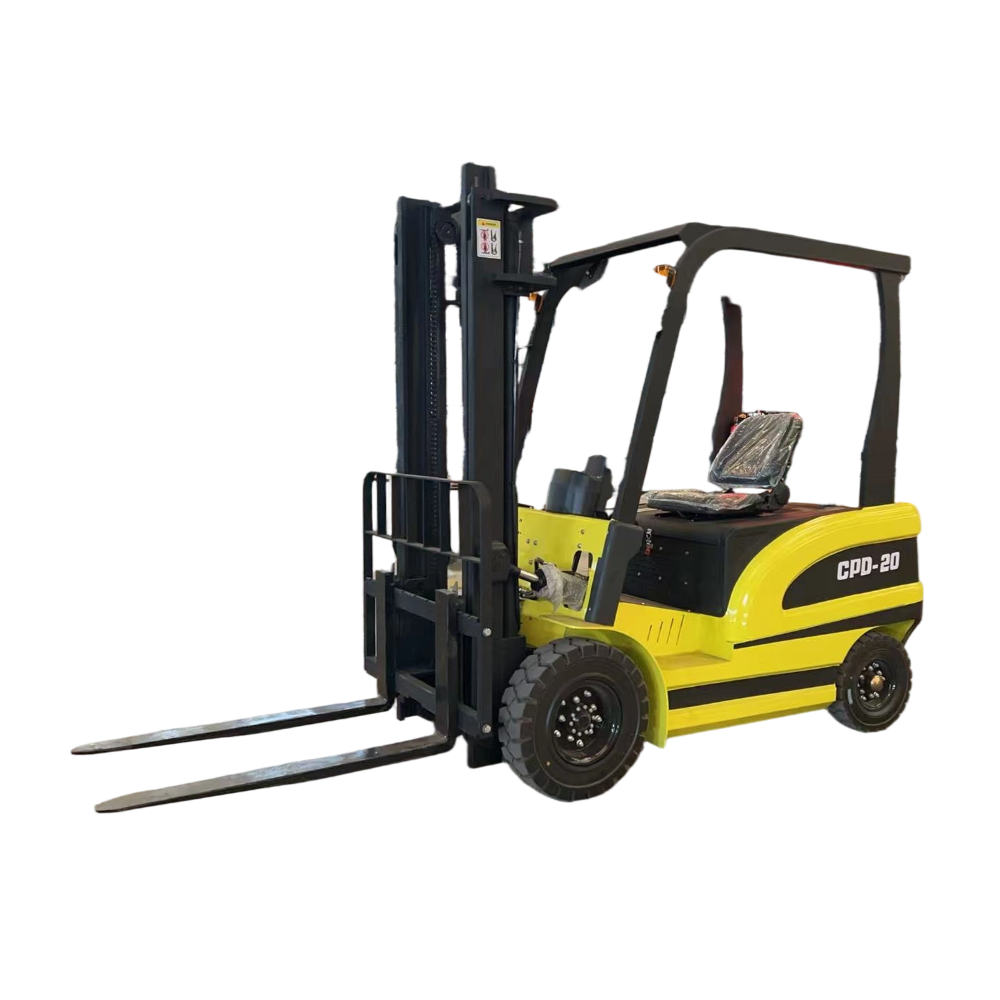
CPD20 2-ton electric forklift truck — one of four capacity classes in the CPD10–CPD35 range used for smart manufacturing and warehouse fleets.
Why Capacity Class Comes Before Brand in Smart Manufacturing
Smart manufacturing material flow is continuous. Pallets move from inbound receiving to staging, then to line-side buffers, then to finished-goods dispatch. Each of those handoffs has a different load weight, a different lift height, and a different aisle geometry. A fleet standardised without checking those three variables usually ends up either under-specified — with restricted attachment options and extra trips — or over-specified, carrying a larger footprint and higher energy draw than the work requires.
Rated capacity is only the first filter. The published selection guidance for this class of electric forklift states that buyers should confirm pallet weight, load centre, aisle width, mast height, floor capacity and local charger voltage before selection. Where attachments such as fork positioners, side shifters or approved clamps are used, the assessment must also cover surface condition, slope, weather exposure, load dimensions, attachment compatibility and rated residual capacity — because effective capacity falls once attachment weight is added ahead of the load centre.
For a smart manufacturing project, the practical sequence is therefore: define the heaviest recurring load, define the highest lift point, define the narrowest aisle, and only then compare models. The CPD10, CPD20, CPD30 and CPD35 differ in ways that map cleanly onto those three variables.
The CPD Range at a Glance: Four Capacity Classes, One Architecture
All four models share a common design baseline. Each is a battery-powered electric forklift built on brushless AC drive and pump motors, each offers controller brand options of SANTROLL, CURTIS, INMOTION or ZAPI, and each ships with a heavy-duty lead-acid battery as standard with a lithium battery available as an option. All four operate with zero emissions at the point of use and low noise, and all four are documented for warehousing and logistics, e-commerce warehouses, workshops, supermarkets and department stores, and cold chain fruit and vegetable wholesale markets.
What differs is capacity, lifting envelope, drive and braking layout, operator assistance, and service access. The table below reflects the published specification set for each model.
| Model | Rated capacity | Standard & extended lifting height | Drive, steering and control highlights | Battery configuration |
|---|---|---|---|---|
| CPD10 | 1000 kg (1 ton) | Not stated in the published specification set for this model | Battery-electric drive with brushless AC drive motor and pump motor | Heavy-duty lead-acid standard; lithium optional |
| CPD20 | 2000 kg (2 tons) | Not stated in the published specification set for this model | High-power front dual drive motors; electric steering with cargo-sensing smooth control; automatic electromagnetic parking brake and AI brake assist; internationally sourced brand controller | Heavy-duty lead-acid standard; lithium optional |
| CPD30 | 3000 kg (3 tons) | 3000 mm – 7000 mm | High-power electric drive system with intelligent MOSFET; large-angle adjustable steering wheel; voice prompts; large-flow cyclone air filter system | Heavy-duty lead-acid standard; lithium optional |
| CPD35 | 3500 kg (3.5 tons) | Not stated in the published specification set for this model | Front wheel dual drive motors; P.E.S three-speed efficiency regulation; lateral side battery extraction layout; ergonomic right-positioned control valves | Heavy-duty lead-acid standard; lithium optional |
Reading the table correctly: the 3000–7000 mm lifting range is published for the CPD30 only. For CPD10, CPD20 and CPD35, mast height must be confirmed against the actual racking or stacking requirement rather than assumed from the family specification.
Technical Differences That Change Daily Operation
Capacity and lifting envelope
The CPD30 is the only model in the range with a published lifting height band of 3000 mm to 7000 mm in standard and extended configuration. That band matters in high-bay and double-deep racking, where a truck that reaches the first two levels efficiently may still be unable to service the top level without a different mast. The CPD10 at 1000 kg and the CPD20 at 2000 kg cover lighter pallet flows, while the CPD35 at 3500 kg is positioned for heavy cargo transport where lifting stability under load is the controlling requirement.
Drive, steering and braking layout
The CPD20 uses a high-power front dual drive motor layout combined with electric steering and cargo-sensing smooth control. In practice, that combination targets dock-to-staging duty, where the truck starts and stops constantly and load stability under acceleration matters more than top speed. Its automatic electromagnetic parking brake and AI brake assist address the same operating pattern.
The CPD35 also uses front wheel dual drive motors, but adds P.E.S three-speed efficiency regulation, which lets an operator trade travel speed against energy draw within a shift. Its lateral side battery extraction layout and ergonomically positioned right-side control valves are service and maintenance features rather than performance features: they shorten battery change and access time in fleets that run multi-shift.
The CPD30 pairs a high-power electric drive system with intelligent MOSFET control, a large-angle adjustable steering wheel, voice prompts and a large-flow cyclone air filter system. The air filtration detail is relevant in workshops where airborne dust is normal and where a standard filter would load quickly.
Battery, charging and cold-chain behaviour
All four models are offered with a heavy-duty lead-acid battery as standard and lithium as an option. That single option decision has more operational consequence than most specification differences. Opportunity charging — short 15 to 30 minute top-ups during breaks — does not degrade lithium-ion cycle life, whereas the same pattern significantly harms lead-acid battery longevity, according to charging-method analysis published by Toyota Forklifts. A fleet that intends to opportunity charge is therefore making a lithium specification decision at order stage, not a later retrofit decision.
Cold environments add a second consideration. Lithium-ion batteries in cold storage applications down to -20°C retain significantly more capacity than lead-acid batteries, a performance gap that Mordor Intelligence links to an 11.6% CAGR in the food industry segment. Lithium adoption across new global forklift shipments reached 35% in 2024, up from 22% in 2021 according to LiTrue Analysis.
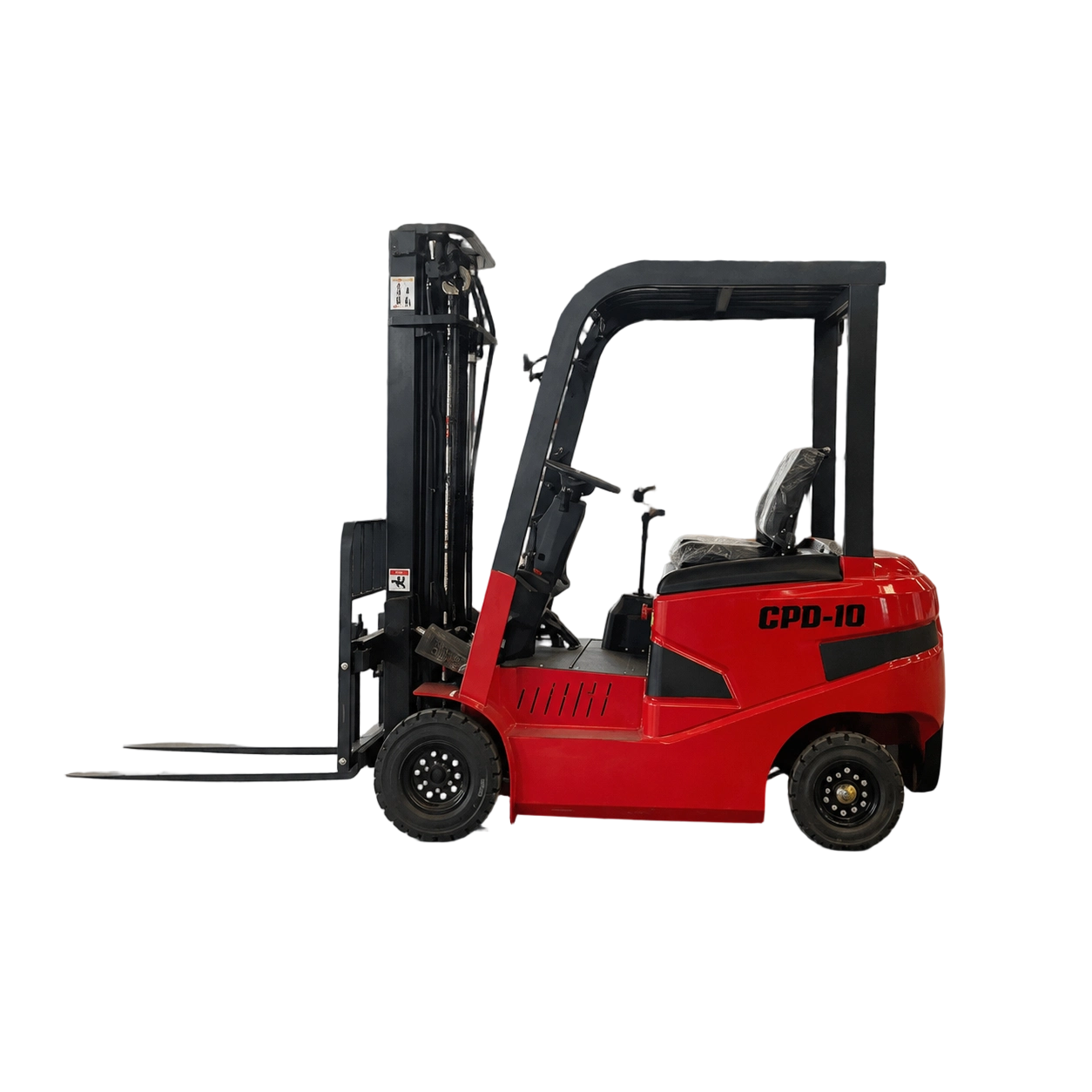
The 1-ton CPD10 class is aimed at light pallet receiving, put-away and dispatch rather than heavy-load yard work.
Matching Models to Real Operating Scenarios
Scenario fit is where the four models separate most clearly, because each capacity class has documented operating conditions attached to it.
- Zero-emission indoor workshop. All four models are battery powered with zero emissions at the point of use and low noise operation, which is what allows them to work inside enclosed production areas. The CPD30 is explicitly documented for indoor workshop use, with voice prompts supporting operator awareness in mixed pedestrian and truck traffic.
- Light-duty warehouse and e-commerce flows. The documented light-duty warehouse deployment pattern is indoor pallet receiving, put-away and dispatch on level floors, with single- or multi-shift operation based on the battery and charging plan. The CPD10 and CPD20 fit this pattern; matching equipment typically includes pallet racking, a dock leveler, a charger and a warehouse management system.
- Cold chain and cold storage. The CPD30 and CPD35 are documented for cold chain fruit and vegetable wholesale markets, and the CPD35 is described as suitable for cold storage environments because of its battery options and low noise operation. In these sites the lithium option is not a performance upgrade so much as a duty-cycle requirement.
- Heavy pallet handling across workshops, yards and loading bays. This is the documented use case associated with the heavier end of the range, where a front dual-drive layout and side battery extraction support heavy-load fleet operation and service access. Routes here mix indoor and outdoor segments and should be subject to site assessment for surface condition, slope and weather exposure.
- Supermarket, department store and wholesale distribution. All four models are documented for supermarkets and department stores, where noise and exhaust constraints inside the building are usually the deciding factor rather than travel speed.
A common planning mistake is to standardise the whole fleet on the largest model for simplicity. The heavier the truck, the larger its turning envelope and the higher its energy draw, so in aisles that were designed around a 2-ton class, a 3.5-ton standardisation can reduce rather than increase throughput.
Market Context: What the Adoption Numbers Actually Show
The global electric forklift market was valued at USD 53.01 billion in 2024 and is projected to reach USD 94.55 billion by 2032, according to Maximize Market Research. That figure should be read as directional rather than precise: published 2025 valuations range from about USD 49.98 billion (Mordor Intelligence) to USD 56.9 billion (Grand View Research) depending on whether services and battery replacement are included, while Fortune Business Insights publishes a broader USD 86.57 billion figure that covers internal combustion trucks as well.
Segment-level signals are more useful for fleet planning than headline market size. Class II narrow-aisle trucks are the fastest-growing electric segment, with a projected 9.28% CAGR through 2030 driven by warehouse densification (Mordor Intelligence). That trend pushes counterbalance fleets toward tighter turning geometry and higher lift, which is the pressure the CPD20-to-CPD30 band addresses. The global supply base remains tiered: Toyota Industries Corp. reported USD 16.32 billion in 2023 revenue, while the two largest Chinese manufacturers, Anhui Heli and Hangcha Group, reported USD 2.45 billion and USD 2.30 billion respectively, according to Fleetman Consulting and Modern Materials Handling. Between those tiers sit OEM and ODM suppliers that compete on configuration flexibility rather than scale.
Where These Trucks Meet Their Limits
An honest comparison has to state boundaries as clearly as capabilities, and four matter here.
Battery standard versus battery intention. The standard configuration across the range is heavy-duty lead-acid. Lithium is an option, not the default. Fleets that plan opportunity charging must resolve that at specification stage, because lead-acid and lithium respond very differently to partial charging.
Capacity is rated, not guaranteed under attachments. Published selection guidance requires residual capacity to be assessed once fork positioners, side shifters or clamps are fitted, together with load dimensions and load centre. A 3000 kg rating does not automatically mean 3000 kg at every attachment configuration.
Explosive atmospheres need a separate compliance route. ATEX Directive 2014/34/EU is mandatory for electric forklifts used in explosive atmospheres such as chemical or food processing environments inside the European Union. Explosion-proof refitting is offered as a customization on this platform, which means it must be specified and documented as a project, not assumed from a standard catalogue unit. Equally, EN 1175:2020 is the current harmonised European standard for electrical and electronic safety requirements in self-propelled industrial trucks, and it is a prerequisite for CE marking.
Fixed infrastructure is still required. Compared with diesel or LPG trucks, battery-electric fleets trade refuelling speed for charging infrastructure, charging time and shift planning. Where a site has no viable charging area or charger voltage compatibility, that constraint precedes any model comparison.
Set against conventional internal combustion trucks, the trade-off is straightforward: electric models remove tailpipe emissions at the point of use and reduce noise, which is what makes indoor and cold-chain operation practical, while internal combustion retains an advantage where rapid refuelling and long uninterrupted range are the dominant requirements and charging infrastructure cannot be installed.
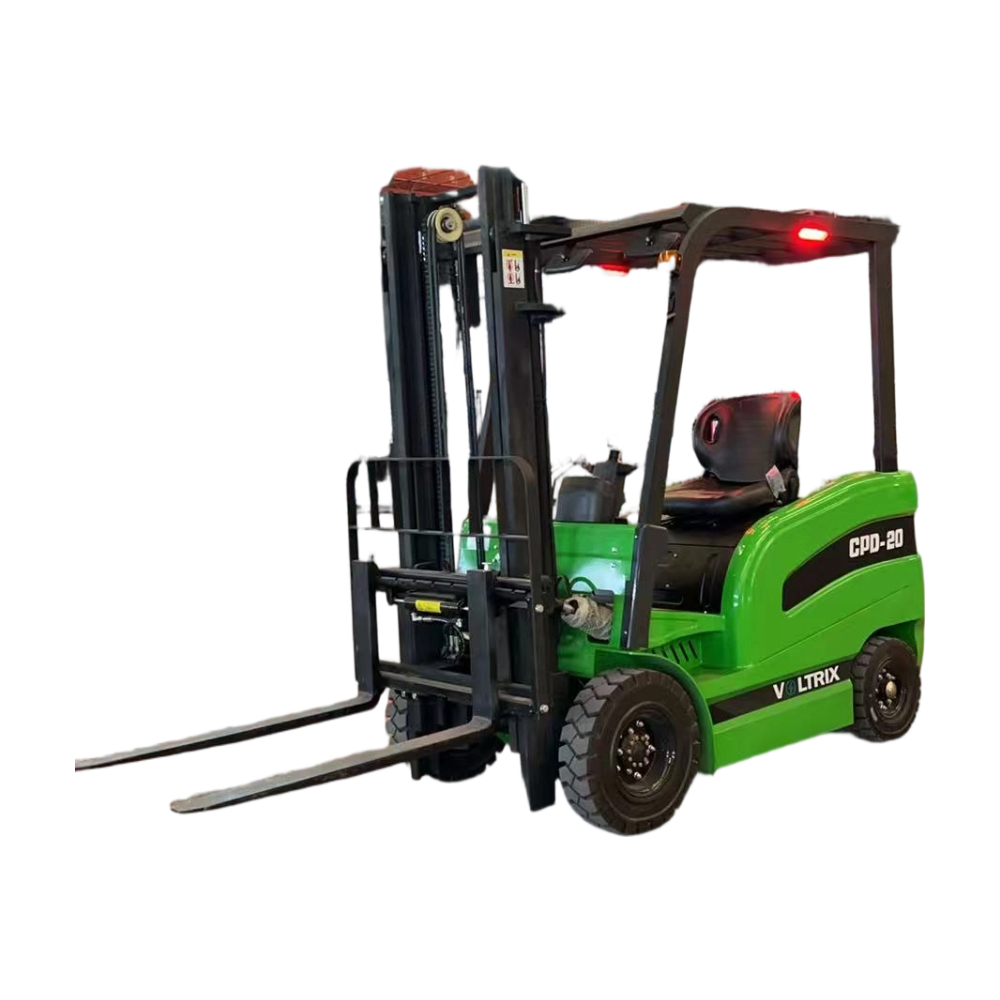
Front dual drive motors and cargo-sensing electric steering target frequent dock-to-staging duty cycles rather than long-haul yard travel.
Procurement Terms and Acceptance Criteria Buyers Should Confirm
Because the CPD10 to CPD35 range is supplied with OEM and ODM customization, the commercial conversation should convert operational requirements into specified, verifiable line items before signature. The following checks derive from the published selection guidance for this truck class and from the supplier's stated quality process.
- Load and site verification. Confirm pallet weight, load centre, aisle width, mast height, floor capacity and local charger voltage, and assess surface condition, slope and weather exposure for any mixed indoor and outdoor route.
- Attachment definition. If fork positioners, side shifters or approved clamps are required, state the attachment before quoting so residual capacity can be calculated rather than estimated afterwards.
- Battery and charging specification. Decide lead-acid versus lithium based on shift pattern, opportunity charging intent and operating temperature, and confirm charger compatibility with the site supply.
- Controller specification. The range offers SANTROLL, CURTIS, INMOTION or ZAPI controllers; the selected brand should be named in the order because it determines the diagnostics and service toolchain the buyer will use downstream.
- Pre-shipment testing. The supplier states that every finished unit undergoes continuous load, braking and waterproof tests before shipment. Buyers should request these records as part of the acceptance pack.
- Documentation set. Certification coverage stated for the manufacturer includes ISO 9001, ISO 14001, CE and UN38.3. UN38.3 in particular governs lithium battery transport and is required before shipping lithium-configured units.
- Service access and parts. Confirm battery extraction method for the chosen model — the CPD35's lateral side extraction is a serviceability feature — and confirm spare parts coverage against the operator's multi-shift schedule.
On the supply side, the stated production capacity of 12,000 units per year and a 40,000 m² manufacturing base are the relevant continuity indicators for fleet-scale orders, since both affect whether a mixed CPD10/CPD20/CPD30/CPD35 order can be delivered as one programme rather than as separate batches.
Future Outlook
Three developments shape how this range will be specified over the next few years. First, lithium continues to displace lead-acid in new orders — from 22% of global forklift shipments in 2021 to 35% in 2024 — which means the optional lithium configuration in the CPD range is likely to become the default planning assumption for multi-shift sites. Second, warehouse densification is pushing Class II narrow-aisle growth at a projected 9.28% CAGR, which increases demand for trucks that combine higher lift with tight turning geometry; the CPD30's 3000–7000 mm band sits directly in that demand. Third, ISO 3691-4:2023, which sets safety requirements for driverless industrial trucks and their systems, signals that manual counterbalance trucks will increasingly be specified alongside automated vehicles in the same facility, making controller choice and system-reservation capability part of the electrical architecture decision rather than an afterthought.
For smart manufacturing buyers at the research stage, the practical implication is to specify capacity, mast, battery and controller as four separate decisions backed by four separate pieces of evidence, rather than choosing a truck class and inheriting the rest.
FAQ
What is the difference between the CPD10, CPD20, CPD30 and CPD35 electric forklifts?
They are four capacity classes in the same electric counterbalance family. The CPD10 is rated at 1000 kg (1 ton), the CPD20 at 2000 kg (2 tons), the CPD30 at 3000 kg (3 tons) and the CPD35 at 3500 kg (3.5 tons). All four are battery powered and use brushless AC drive and pump motors, all four offer SANTROLL, CURTIS, INMOTION or ZAPI controller options, and all four ship with a heavy-duty lead-acid battery as standard with lithium available as an option.
What lifting height does the CPD30 offer?
The CPD30 has a published standard and extended lifting height range of 3000 mm to 7000 mm. It is the only model in the CPD10–CPD35 range with an explicitly published lifting height band, and it also features a high-power electric drive system with intelligent MOSFET control, a large-angle adjustable steering wheel, voice prompts and a large-flow cyclone air filter system.
Which battery options are available, and when should lithium be specified?
Every model in the range offers a heavy-duty lead-acid battery as standard and a lithium battery as an option. Lithium becomes relevant in two specific cases. The first is opportunity charging: short 15 to 30 minute top-ups do not degrade lithium-ion cycle life, but the same charging pattern significantly harms lead-acid battery longevity. The second is low-temperature operation, where lithium batteries in cold storage applications down to -20°C retain significantly more capacity than lead-acid batteries.
Which controller brands can be specified across the CPD10 to CPD35 range?
Controller brand options for the CPD10, CPD20, CPD30 and CPD35 are SANTROLL, CURTIS, INMOTION and ZAPI. The CPD20 specification additionally describes the control unit as an internationally sourced well-known brand controller. Because the controller determines the diagnostics and service toolchain, the selected brand is normally named explicitly in the purchase order.
Which models are documented for cold storage, cold chain or indoor workshop use?
All four models list cold chain fruit and vegetable wholesale markets among their applicable industries. The CPD35 is described as suitable for cold storage environments because of its battery options and low noise operation, and the CPD30 is documented for low noise indoor workshop use with high lift capability. Suitability for a specific temperature profile should still be confirmed against the site's operating conditions rather than assumed from the family specification.
What checks should be completed before accepting delivery of an electric forklift?
Buyers should verify rated capacity at the stated load centre with the intended attachment fitted, confirm mast height against actual racking, confirm charger voltage compatibility with the site supply, and request the pre-shipment test records. The manufacturer states that every finished unit undergoes continuous load, braking and waterproof tests before shipment, and that its certification coverage includes ISO 9001, ISO 14001, CE and UN38.3. For units used in explosive atmospheres within the European Union, ATEX Directive 2014/34/EU compliance must be specified separately, and EN 1175:2020 is the harmonised European electrical safety standard underlying CE marking for self-propelled industrial trucks.
Tem questões ou precisa de mais detalhes?
Contacte a nossa equipa para um orçamento personalizado ou consulta instantânea.
Solicitar orçamento
Preencha o formulário abaixo e a nossa equipa entrará em contacto com uma proposta personalizada.
Chat direto do WhatsApp
Prefere conversar em tempo real? Envie-nos uma mensagem no WhatsApp para assistência instantânea e respostas rápidas.
- Obter orçamento personalizado
- Partilhar fotos ou documentos
- Discuta as suas necessidades diretamente
Geralmente responde em 5–30 minutos durante o horário de expediente.