
Cable-Guided vs Adjustable Side-Rail Zip Screens: Buyer Fit Check
Cable-Guided vs Adjustable Side-Rail Zip Screens: Buyer Fit Check
A wind-exposed balcony or facade reduces the zip screen decision to one question before fabric, colour or motor: how will the fabric edge be held in place? NEWHOO answers that question with two different architectures. The Cable-Guided Zip Screen, model DK120-63, deletes the aluminium side rail entirely and tensions a 4.0 mm stainless steel cable along the fabric edge. The Adjustable Side-Rail Zip Screen, model WR120E, keeps a side rail but mounts it on adjustable brackets so its angle can follow a wall that is not perpendicular. The two are not grades of the same idea. They document different specifications, they are commissioned differently, and each has a site condition under which it is the weaker choice.
Both models belong to the outdoor range of NEWHOO zip screens, made by Guangzhou Newhoo Technology Co., Ltd., a shading manufacturer established in 2015 whose product line covers windproof roller blinds, awnings and sliding screen doors, with exports to Europe, the USA, Australia and Southeast Asia. This comparison relies only on what the two product listings state, and it marks clearly where a listing is silent — because the silent fields are usually where procurement risk sits.
Why the Guidance Method Decides a Wind-Exposed Project
The most useful part of each listing is the failure mode it was designed against. The cable-guided unit is positioned against side-rail systems whose V-shaped plastic rail opening deforms under wind and lets the zipper pop out. The adjustable side-rail unit is positioned against fixed side rails that must be chiselled and reworked on site when the wall is not perpendicular. One design removes the rail opening; the other keeps the rail and gives it freedom to align.
That difference changes what a buyer has to verify. With no side rail, there is no rail plane to true and no rail slot to accumulate dust — but cable tension becomes the commissioning item that decides whether the fabric edge stays guided for the life of the fabric. With an adjustable rail, wall deviation is absorbed by the bracket — but the rail, its opening and its fixings stay part of the assembly and must be inspected over time.
On a sheltered inland window the distinction is minor. On a balcony or facade that takes sustained wind, it determines which maintenance task the owner will actually be performing in year three, and whether the fix is a five-minute adjustment or a site visit with tools.
The Two Systems at a Glance
The table below reproduces only stated values. Where a field is not given for a model, it is marked as not stated rather than inferred, because an inferred value is not a specification.
| Characteristic | Cable-Guided Zip Screen (DK120-63) | Adjustable Side-Rail Zip Screen (WR120E) |
|---|---|---|
| Guidance element | 4.0 mm stainless steel cable guides control the fabric short edge; no aluminium side rail | Side rail on adjustable bracket; rail angle adjustable to compensate wall non-perpendicularity |
| Cassette / body | 120×120 body mounting bracket in #45 high-quality steel plate; decorative panel optional | 120×120 mm cassette, 2 mm wall, 4 mm reinforced end cap; patented metal rail opening with curved seal |
| Roller tube | Φ63 | Φ63 aluminium, 78 double-layer aluminium, 70 steel or 80 steel |
| Bottom rail | 50×20 semi-circular; rear or side mount, two seal options | Not stated in the listing |
| Stated size range | Width 0.7–3 m; height up to 5 m | Width up to 5.4 m; height below 3.2 m; Φ63 tube height below 5 m |
| Wind class | No numeric class stated | Stated as above Class 12 |
| Fabric tensile stated | Above 2000N | Above 2500N |
| Cycle life stated | Above 10,000 | Above 10,000 |
| Operation modes | Motorized, bead chain, hand crank | Motorized, motor plus manual, spring push |
| Working temperature | Not stated | −20 to 65 °C |
| Stated service life | Aluminium frame 15–20 years | Aluminium frame 15–20 years; outdoor motor 8–12 years |
| Stated after-sales task | Check cable tension and zipper | Clean rail dust |
| Smart interface | Optional Wi-Fi / Zigbee / 485 | Optional Wi-Fi / Zigbee / 485 |
What Each Listing States — and What It Leaves Open
Cable-Guided Zip Screen (DK120-63)
This model is documented as a side-rail-free system for lightweight facade shading. Its stated fit is width 0.7–3 m with height up to 5 m, across home, hotel and office outdoor shading and blackout, and residential or commercial building facades. The 4.0 mm stainless steel cable controls the fabric short edge in place of an aluminium rail, which the listing says saves rail material and installation cost. Three operation modes are offered — motorized, bead chain and hand crank — and the two manual modes need no wiring, which the listing presents as a cost-control option.
What the listing leaves open matters as much as what it states. There is no numeric wind class, no working temperature range and no cassette dimension, because the design has no cassette. A buyer cannot, from the document alone, place this model on the same wind-class scale as the adjustable side-rail unit.
Adjustable Side-Rail Zip Screen (WR120E)
This model is documented as a heavy-duty outdoor system built around a 120×120 mm cassette with a 2 mm wall and a 4 mm reinforced end cap. The adjustable bracket is the defining feature: rail angle can be adjusted to compensate wall non-perpendicularity, which the listing contrasts with fixed side rails that require on-site chiselling where the wall deviates. A smart balancer provides floating support to protect the zipper, and four roller tube options are offered — Φ63 aluminium, 78 double-layer aluminium, 70 steel and 80 steel — with motorized, motor-plus-manual and spring-push operation.
The listing states width up to 5.4 m and height below 3.2 m, separately noting that a Φ63 tube reaches below 5 m height, a wind rating above Class 12, a working range of −20 to 65 °C and fabric tensile above 2500N. It also states that the smart balancer is pre-adjusted at the factory, so no on-site debugging is required.
The wind-class asymmetry buyers should not skip
One model states a wind class and the other does not. That is a documentation gap, not a performance verdict. The cable-guided listing instead documents cable diameter, roller tube, height capability, cycle count and fabric tensile — engineering inputs rather than a class result. Reading those as equivalent to a stated class would be an assumption.
Width, Height and the Aspect Ratio Trap
The two models serve opposite opening shapes, and this is the fastest way to eliminate one of them. The cable-guided unit covers 0.7–3 m in width and up to 5 m in height: tall and relatively narrow. The adjustable side-rail unit covers up to 5.4 m in width but stays below 3.2 m in height. A full-height balcony return wall of 2.5 m width and 4 m height sits inside the first model's stated envelope and outside the second's height limit. A 4.5 m wide terrace front at 2.6 m height sits inside the second model's envelope and outside the first model's width limit.
Two details deserve confirmation before either is specified. First, the adjustable side-rail listing states a model height below 3.2 m and separately notes that a Φ63 tube reaches below 5 m; which limit governs a specific tube-and-width combination should be confirmed in writing rather than assumed from the larger figure. Second, neither listing describes a split or spliceable cassette, so where the ordered width exceeds what the site lift or stairwell can carry, transport and access should be resolved before the order rather than after delivery.
Fabric, Seal and Openness Checks for Outdoor Use
Guidance decides how the edge is held; the fabric and seal decide what is being held. Three supplied points change the specification conversation on a wind-exposed facade.
Seal route depends on fabric. NEWHOO's guidance on its zip screen range states that the #3 zipper is used for ordinary solar fabrics, while T-tape is used for full-blackout 0% or 1% openness and for special fabrics thinner than 0.5 mm, where it produces a flatter fabric — and that T-tape zip screens can be used indoors only. For an outdoor facade, that means the seal solution cannot simply be copied from an indoor blackout job. A buyer specifying 0% or 1% blackout outdoors should have the seal route confirmed in writing for that fabric, not inferred from the openness figure.
Openness is a shading decision, not a wind decision. The supplied selection guidance maps full blackout 0% to maximum heat and light blocking for hot, heavily sun-exposed elevations; semi-transparent 3%–5% to a balance of heat insulation, insect protection, view and ventilation for pergolas, terraces and outdoor dining; and transparent above 5% to the best view and natural ventilation. None of those bands is presented as a wind-resistance variable, so choosing a more open fabric should not be treated as a substitute for confirming the guidance and class evidence.
Tensile figures are not directly comparable. The cable-guided listing states fabric tensile above 2000N and the adjustable side-rail listing above 2500N. Different figures can simply reflect different fabric grades being quoted, so a wind comparison made across the two numbers compares fabrics, not systems. Equalise the fabric first, then compare the guidance evidence.
Installation Tolerance: Wall Deviation, Measuring and Access
Wall quality is the second elimination criterion. Where rendered, tiled or otherwise uneven walls make a fixed rail plane unachievable without chiselling, the adjustable bracket is the documented answer: the listing states it removes on-site wall repair and the structural rectification cost that comes with it. A side-rail-free system approaches the same problem from the other direction — with no rail to true against the wall, there is no rail-plane conflict to resolve, but the cable becomes the alignment-critical component.
Measuring allowances need the same care. NEWHOO's installation guidance for zip screens gives inside mounting as width reduced by 2–3 mm with the minimum door or window height taken, and outside mounting as width plus 4–20 cm depending on side-rail width and height plus 7–20 cm depending on cassette height. Those allowances are written around a side-railed system. For a side-rail-free model the width allowance has no side rail to reference, so the correct allowance should come from the supplier for that specific system rather than being carried over.
Site preconditions apply to both. The same guidance requires hollow walls to be reinforced, wall load capacity to be confirmed, a safe power supply location to be identified, and exterior facade installation to comply with property-management requirements. For a wind-exposed high-rise facade those are not formalities: they decide whether the fixing, not the guidance method, becomes the weak point of the installation.
Serviceability and Whole-Life Replacement Logic
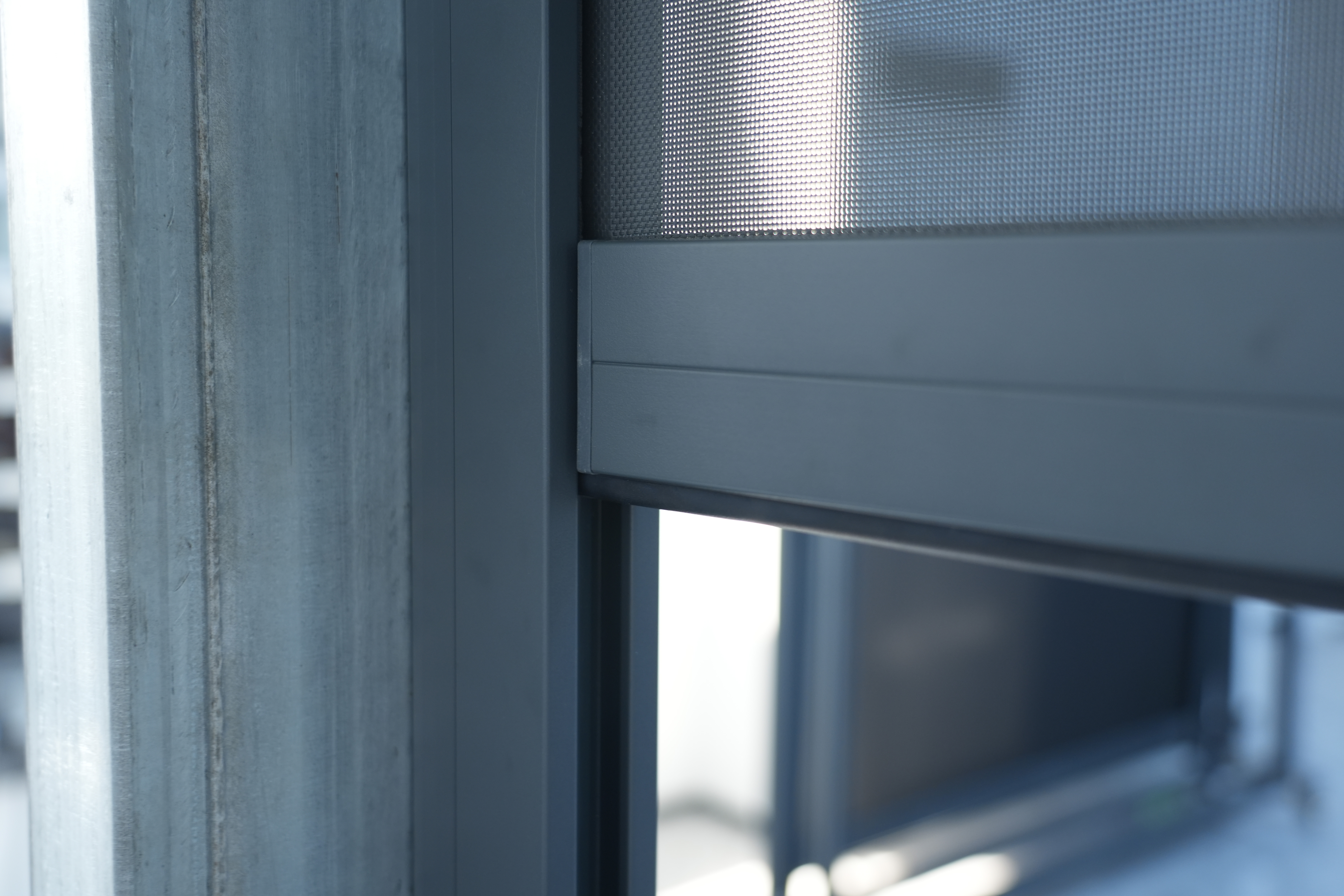
The two systems generate different routine tasks. The cable-guided listing states that the tensioned cable guide leaves no slot for dust accumulation and requires no side-rail maintenance, with after-sales limited to checking cable tension and the zipper — and that the multiple operation modes mean fewer failure points. The adjustable side-rail listing states that the smart balancer is factory pre-adjusted so no on-site debugging is needed, with after-sales limited to cleaning rail dust.
Fault diagnosis overlaps. NEWHOO's troubleshooting guidance for a fabric edge that leaves the side rail sets a sequence: check whether the zipper is damaged, re-insert it into the track if not, and after derailment in strong wind check whether the track has deformed, replacing the part if damage is found. The guidance for jamming or noise during raising and lowering lists three checks in order — foreign matter such as sand, dust or insects in the track, fabric out of the side rail, and motor limit drift. Motor limits and overload protection exist for the same reason: outdoor wind loads vary, and overload protection stops the motor when it meets resistance such as strong wind or a foreign object, protecting both motor and fabric.
Whole-life arithmetic favours neither model outright. NEWHOO's stated component life is an aluminium frame of 15–20 years, zipper-edged fibreglass fabric of 7–10 years and a heavy-duty outdoor motor of 8–12 years, with overall stable use of 8–10 years and 5–7 years in coastal salt-spray environments, all with individually replaceable consumables and a reusable frame. That means the guidance decision outlives at least one fabric cycle. A buyer choosing on first-cost alone is choosing the component that will still be in service when the second fabric set is ordered.
Application Fit: Balconies, Facades and Pergolas
On a wind-exposed balcony, the deciding measurement is usually the return wall. A narrow, full-height return within 3 m width and up to 5 m height is the cable-guided model's stated territory, and removing the rail removes the rail-opening failure mode at the same time. A wide balcony or terrace front up to 5.4 m at under 3.2 m height, particularly where the wall is out of plumb, points to the adjustable side-rail model.
On a commercial facade, both listings claim the application: the cable-guided model for lightweight facade shading within its width and height envelope, and the adjustable side-rail model for commercial facades up to 5.4 m wide where wall deviation is likely on a refurbishment. Where the elevation is irregular across several bays, the adjustable bracket reduces per-bay rework; where the elevation is tall and narrow, the cable-guided model avoids rail alignment altogether.
Pergolas and skylights need a separate check rather than an assumption. NEWHOO lists dedicated pergola-specific and skylight models elsewhere in the range, so fixing conditions to pergola posts, and the geometry of sloped glazing, should be confirmed against the intended model instead of being extrapolated from either of these two.
How the Two Approaches Compare With Conventional Options
Against a conventional rail-hung roller with no seal, both models add edge retention, and the difference is easier to state than to measure. The cable-guided listing contrasts itself with rail-hung non-sealed rollers that carry no wind rating, and specifically with side rails whose V-shaped plastic opening deforms and releases the zipper. The adjustable side-rail listing contrasts itself with fixed side rails that require on-site chiselling where walls deviate, and with export zipper rollers rated at Class 8 where it states above Class 12.
The fit boundary is where these comparisons stop being useful. Neither architecture converts a sheltered shading product into a storm-rated one, and neither removes the need to confirm wall load capacity, facade approval and fixing suitability. A stated class describes a tested configuration; it does not describe an untested wall.
A Neutral Buyer Checklist
Confirm these in writing before either system is ordered. The checklist is ordered by the cost of getting the answer wrong, not by product.
- Opening geometry. Record width and height. Above 3 m width, the cable-guided model falls outside its stated range; above 3.2 m height, the adjustable side-rail model does.
- Wall plumb and finish. If the wall cannot present a true vertical plane without chiselling, the adjustable bracket has a documented advantage; if a rail-free edge is acceptable, cable guidance avoids the question.
- Wind evidence basis. Request the test basis, specimen size, fabric grade and applicable tube-and-width combination behind any stated class, and ask the same four questions of both suppliers.
- Fabric and seal route. Confirm whether the #3 zipper or T-tape applies to the chosen openness, and note that T-tape is stated as indoor use only.
- Equalised fabric for comparison. Compare guidance systems at the same fabric grade; a 2000N versus 2500N difference may describe two fabrics, not two systems.
- Governing height limit. For the adjustable side-rail model, confirm which limit governs the selected tube and width.
- Transport and access. Confirm how the ordered width reaches the installation level; neither listing describes a split cassette.
- Site preconditions. Hollow-wall reinforcement, wall load capacity, power location and property-management approval for facade work.
- Commissioning owner. Cable tension for the cable-guided model; rail angle and fixing inspection for the adjustable model.
- Lifecycle plan. Budget the second fabric set at 7–10 years against a 15–20 year frame, and note the shorter 5–7 year outlook in coastal salt-spray conditions.
Conditional Outlook: What Would Change the Choice
The choice is stable only while the site conditions are. Four changes would reopen it. If the measured height rises above 3.2 m, the adjustable side-rail model leaves the comparison on its stated envelope. If the measured width rises above 3 m, the cable-guided model does. If the wall is found to be significantly out of plumb after survey, the adjustable bracket becomes the lower-rework route regardless of the earlier preference. If the building sits in a coastal salt-spray environment, the stated 5–7 year overall life shifts the weight of the decision from first cost toward part availability and access for replacement.
A fifth condition is documentary rather than physical. If either supplier can produce comparable wind evidence for its system at the specified fabric and size, the comparison improves; until then, the honest position is that one model states a class and the other states its inputs, and the buyer is comparing evidence quality as well as hardware.
Frequently Asked Questions
Which guidance method suits a wind-exposed balcony?
It depends on the opening shape and the wall. The Cable-Guided Zip Screen covers width 0.7–3 m with height up to 5 m, which fits tall, relatively narrow return walls, and it removes the side rail and its rail-opening failure mode. The Adjustable Side-Rail Zip Screen covers width up to 5.4 m with height below 3.2 m, and its adjustable bracket compensates walls that are not perpendicular. Where the wall is significantly out of plumb, the adjustable bracket avoids on-site chiselling; where the opening is tall and narrow, cable guidance avoids rail alignment altogether.
Does the cable-guided zip screen carry a wind class?
The DK120-63 listing does not state a numeric wind class. It documents a 4.0 mm stainless steel cable guide, a Φ63 roller tube, cycle life above 10,000 and fabric tensile above 2000N, and positions itself against rail-hung non-sealed rollers that carry no wind rating. Because the adjustable side-rail model states a class above Class 12, the two cannot be placed on the same scale from the documents alone. Buyers should request the test basis, specimen size, fabric grade and applicable size combination before treating the two as equivalent.
What maintenance does each system require?
The cable-guided model requires checking cable tension and the zipper, and its listing notes that a tensioned cable guide leaves no rail slot for dust accumulation and requires no side-rail maintenance. The adjustable side-rail model requires cleaning rail dust, with its smart balancer pre-adjusted at the factory so no on-site debugging is needed. Both share the same basic fault sequence: after strong wind, check whether the track has deformed and whether the zipper is damaged; for jamming or noise, check for foreign matter in the track, fabric out of the rail, and motor limit drift.
Can full-blackout fabric be used outdoors on either system?
The seal route depends on the fabric rather than the model. NEWHOO's range guidance states that the #3 zipper is used for ordinary solar fabrics, while T-tape is used for full-blackout 0% or 1% openness and for special fabrics thinner than 0.5 mm, and that T-tape zip screens are for indoor use only. For an outdoor facade, a 0% or 1% blackout requirement should therefore have its seal solution confirmed in writing for that specific fabric, rather than assumed from an indoor blackout specification.
What installation conditions must be confirmed first?
NEWHOO's zip screen installation guidance requires hollow walls to be reinforced, wall load capacity to be confirmed, a safe power supply location to be identified, and exterior facade installation to comply with property-management requirements. Measuring allowances also differ by mounting: inside mounting reduces width by 2–3 mm and takes the minimum opening height, while outside mounting adds 4–20 cm to width depending on side-rail width and 7–20 cm to height depending on cassette height. For a side-rail-free system the width allowance has no side rail to reference and should be confirmed for that system.
Neither guidance approach is the safer default. The cable-guided design removes a component and its failure mode at the cost of a commissioning step and a 3 m width ceiling; the adjustable side-rail design absorbs wall deviation and states a higher width range at the cost of keeping the rail, its opening and its fixings in the maintenance plan. Matching the opening shape, the wall condition and the required evidence to the model that documents them is a more reliable route than comparing headline numbers across two listings that do not measure the same things.
For buyers who need the full component and model context before specifying, the NEWHOO product catalogue collects the range documentation, and the manufacturer's site at NEWHOO lists current product information.
Tem questões ou precisa de mais detalhes?
Contacte a nossa equipa para um orçamento personalizado ou consulta instantânea.
Solicitar orçamento
Preencha o formulário abaixo e a nossa equipa entrará em contacto com uma proposta personalizada.
Chat direto do WhatsApp
Prefere conversar em tempo real? Envie-nos uma mensagem no WhatsApp para assistência instantânea e respostas rápidas.
- Obter orçamento personalizado
- Partilhar fotos ou documentos
- Discuta as suas necessidades diretamente
Geralmente responde em 5–30 minutos durante o horário de expediente.