
Cable Mesh vs. Stainless Steel Curtain Wall Mesh: Buyer Guide
Architectural metal mesh has become a specification category with its own comparison logic, and two products keep arriving in the same facade tender package: architectural cable mesh and stainless steel curtain wall mesh. They look related in photographs. Technically they are different systems. Cable mesh is a flexible, cable-based structure defined by cable diameter and aperture. Curtain wall mesh is a panel-based decorative skin defined by sheet thickness, open area and panel size. Buyers who compare them by appearance instead of by parameter usually discover the difference at shop-drawing stage, which is the most expensive place to find it.
The short answer for buyers in evaluation and execution: cable mesh fits curved, large-span and barrier-adjacent roles where a flexible structure and a wide aperture are acceptable. Stainless steel curtain wall mesh fits flat, modular facade bays where a defined open ratio and panelised installation are required. Neither substitutes for the other, and neither replaces the primary weather wall behind it.
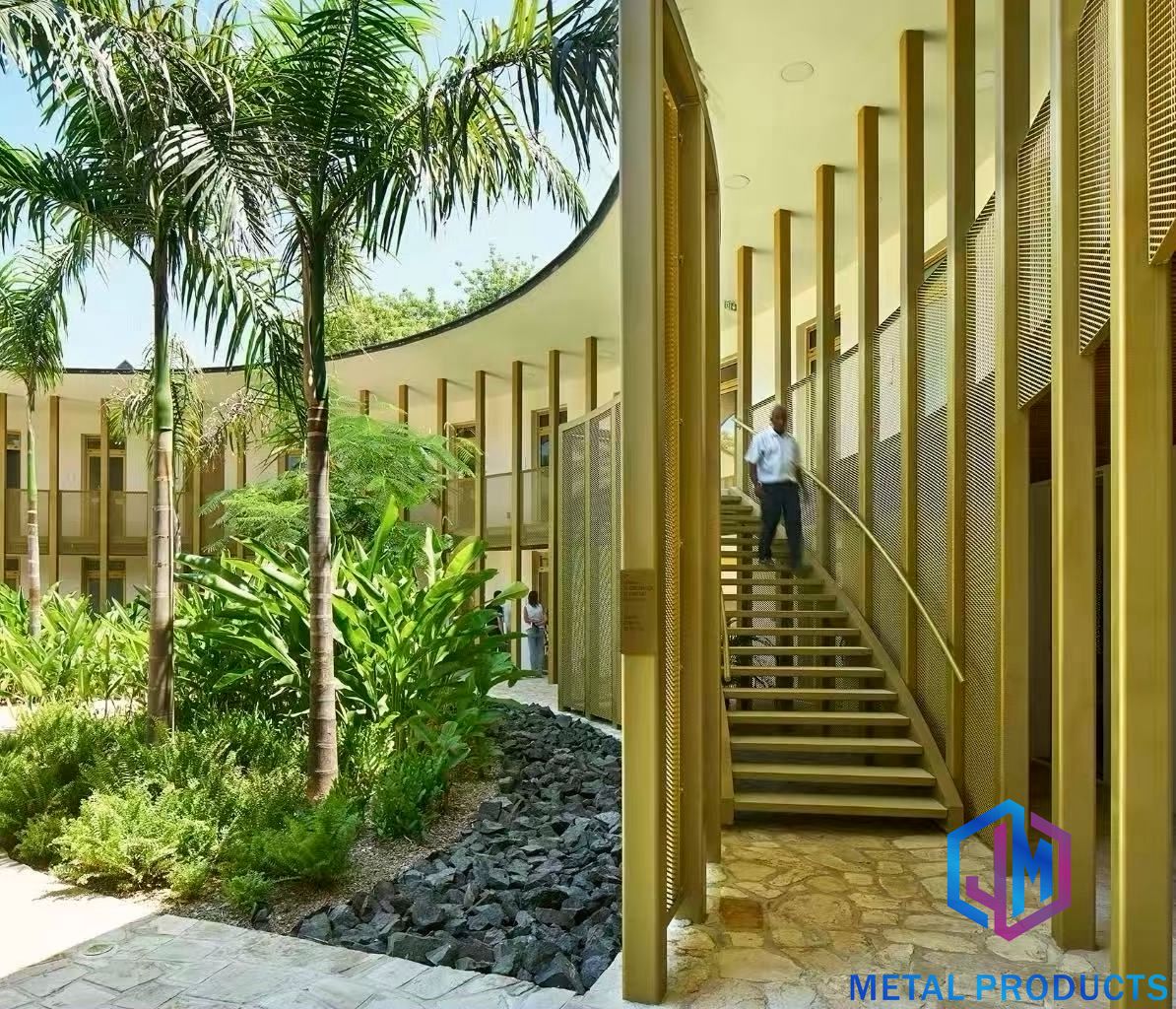
Exterior metal mesh cladding specified as a secondary facade skin over a primary wall assembly.
Why this comparison keeps appearing in facade packages
Facade teams are being asked to justify every layer of the building envelope. Mesh returned to that conversation through the shading and screening route rather than the decorative route, and the demand data reflects it. The global architectural metal mesh panel market was valued at USD 1.2 billion in 2024 and is projected to reach USD 2.5 billion by 2034, according to Reports and Data. Growth Market Reports estimates the metal mesh facade segment at USD 10.59 billion by 2034, growing at a CAGR of 6.2%. The two figures measure different scopes, which is itself a useful warning: market numbers in this category are only comparable when the product boundary is stated.
Supply is equally dense. China accounts for an estimated 65% of global wire mesh supply, per IBISWorld industry reporting for 2024, and the Anping cluster in Hebei hosted more than 3,600 specialised factories as of late 2024, according to Anping County Government industry statistics. Density produces choice, and choice pushes serious buyers away from brand adjectives and towards parameter evidence. That is the practical reason a head-to-head between cable mesh and panel-based curtain wall mesh is worth doing properly.
The two systems at a glance
The table below uses only the product data attached to each item. Every row is a specification question a buyer will eventually be asked to close out in a technical submittal.
| Comparison parameter | Architectural Cable Mesh (JM-w-013) | Stainless Steel Curtain Wall Mesh (JM-WF-7667) |
|---|---|---|
| Construction basis | Flexible cable mesh with custom shape capability | Panel-based decorative mesh |
| Primary dimension | Cable diameter 1.5 mm – 3 mm | Material thickness 1.2 mm |
| Aperture / open area | Mesh opening 25 mm – 100 mm | Opening ratio 30% – 60% |
| Material | Cable material stainless steel 316; 304 and aluminium listed among material options | Stainless steel |
| Panel sizing | Custom shape available | Panel size customised |
| Stated application range | Zoo enclosures, building facade, safety barrier, landscape design | Commercial buildings, office towers, transportation buildings |
| Fixing logic | Flexible structure; fixing is defined at system level (the facade cable variant JM-W-014 is supplied with a tension fixing system) | Panel fixing coordinated with frame or sub-frame |
Read the table as a set of constraints rather than a set of features. A 25 mm – 100 mm opening range tells a specifier how the mesh will read at distance and how much visual screening it can deliver. An opening ratio of 30% – 60% on a 1.2 mm panel tells a specifier how repeatable the visual density will be across a modular bay. These are different kinds of control, and the choice between them is usually made by the facade concept before any supplier is contacted.
Application fit: where each mesh is typically specified
Architectural cable mesh
Cable mesh earns its place where geometry or span works against rigid panels. The product record lists custom shape capability and a flexible structure, and names zoo enclosures, building facade, safety barrier and landscape design as its application range. In practice that combination points to three recurring roles: curved or non-repeating facade features, large open spans where a rope-like visual language is intended, and barrier-adjacent situations where the mesh is part of a larger safety or containment assembly rather than a sealed skin.
The 1.5 mm – 3 mm cable diameter range is the lever that matters most commercially. Heavier cable reads as a structural element and suits larger apertures; lighter cable reads as a delicate screen and suits tighter visual rhythms. Because the aperture range extends to 100 mm, cable mesh is fundamentally an open, transparent layer. That is a strength in shading and screening, and a limitation wherever privacy or containment is the actual requirement.
Stainless steel curtain wall mesh
Curtain wall mesh works on the opposite principle. It is supplied as customised panels of 1.2 mm stainless steel with an opening ratio between 30% and 60%, and it is listed for commercial buildings, office towers and transportation buildings. Those are building types with regular structural grids, repetitive bay modules and a strong preference for panelised installation that can be sequenced floor by floor.
The practical advantage is predictability. A stated opening ratio lets the design team forecast how the facade will read from the street, how much of the glazing behind it will remain visible, and how the pattern will align with mullion spacing. The practical constraint is equally clear: a 1.2 mm panel system follows the frame that carries it, so it does not naturally resolve complex curvature. Where a project needs both, the two products are usually used in different zones rather than blended into one component.
The overlap zone
There is a genuine middle ground on flat facades where both products could physically be installed. In that zone the deciding factors are usually visual density, fixing strategy and the maintenance regime the building operator will accept. A wide-aperture cable mesh at 60 mm – 100 mm opening will pass more light and more view than a panel system at 40% open area, and it will require tension or frame coordination that a panel grid does not. Buyers who document those three factors early avoid re-tendering later.
System integration with the Architectural Metal Mesh Facade System
Most projects do not buy a mesh in isolation; they buy it inside a facade system. The Architectural Metal Mesh Facade System (JM-E-529) is specified with aluminium 1100 as its base material, customised mesh thickness and customised panel width, an aluminium frame as the fixing system, and an optional PVDF coating for the surface finish. Its stated application range is commercial facades, cultural buildings and luxury architecture.
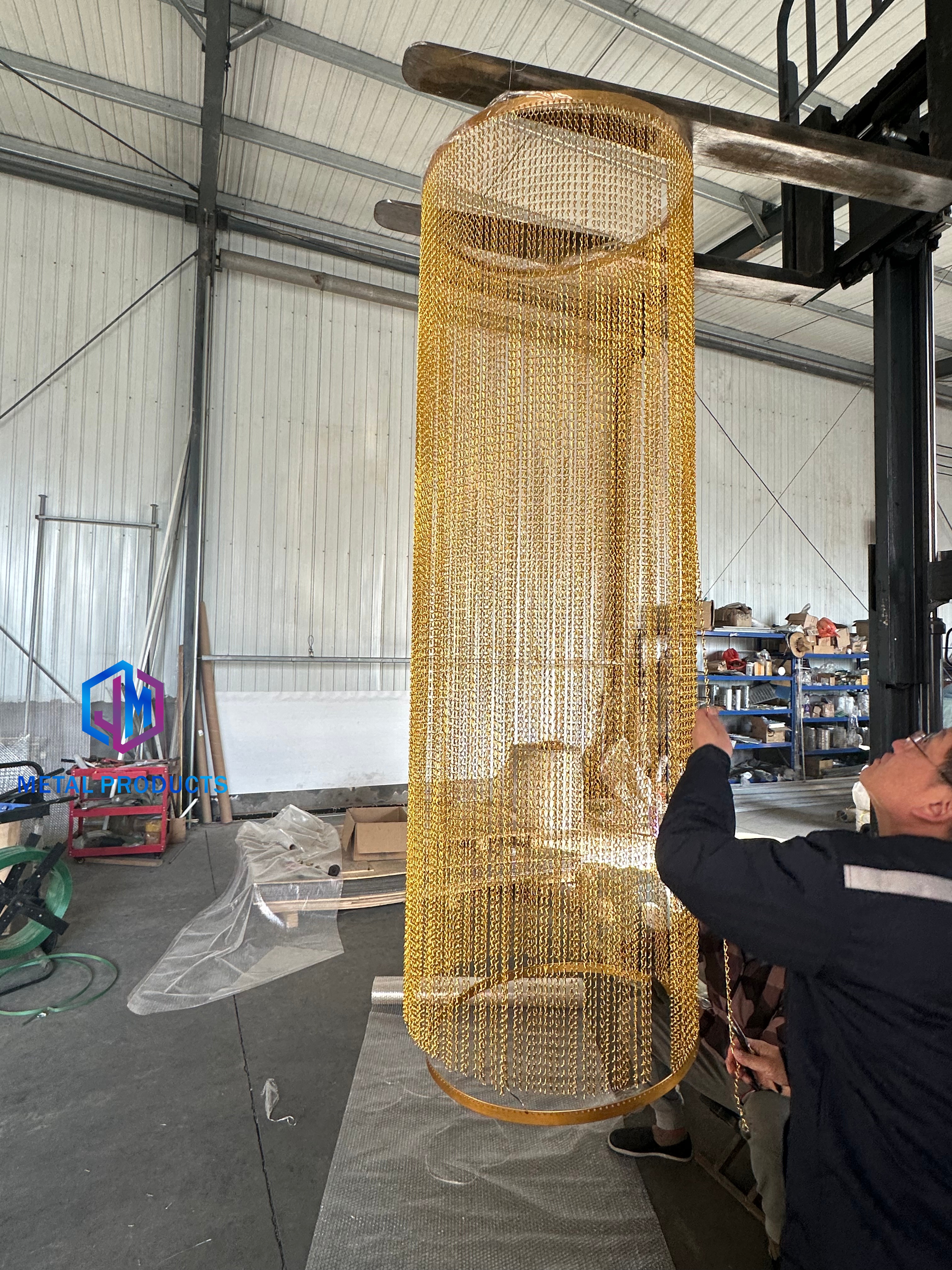
Frame and structure interfaces determine whether a mesh system is a panel grid or a tensioned curtain.
Integration works differently for the two products. A panel-based curtain wall mesh maps onto the aluminium frame logic directly: panels are dimensioned to the frame module, and the optional PVDF finish supports colour consistency across an exterior elevation. A flexible cable mesh needs its own interface design. The adjacent facade cable variant (JM-W-014) is supplied with a tension fixing system, which is the honest signal that flexible mesh transfers load through anchors and tensioning rather than through a rigid panel edge. Where a project uses the broader facade solution (JM-E-7736), the same programme covers expanded mesh, woven mesh, cable mesh and perforated panel types in stainless steel, aluminium or copper alloy, with frame mounting, direct fixing or tension system installation and customised engineering support.
Adjacent alternatives for interior and semi-outdoor roles
Two further options appear in the same tender packs and are worth separating before the comparison gets confused.
Metal Coil Drapery (JM-M-907) is a flexible metal curtain in stainless steel 304 or aluminium, with 1.0 mm – 1.5 mm wire, coil diameter of 3 mm – 15 mm, an opening ratio of 50% – 80%, track hanging installation and customised height. Its stated applications are hotels, restaurants, shopping centres and exhibition halls. It is an interior product with a drape aesthetic, not an exterior cladding system, and should not be evaluated against a facade mesh on weather performance.
Decorative Aluminum Mesh Screen (JM-P-1987) is an aluminium screen at 2 mm – 10 mm thickness with 30% – 60% opening ratio, PVDF or powder coating, a weather-resistant coating and custom pattern availability. Its stated applications are residential buildings, landscape design and balcony screening. It sits closer to semi-outdoor work: a balcony screen or a residential privacy element, not a curtain wall component.
Where each option stops: real boundaries
A comparison that only lists strengths is a sales document. The following boundaries are as important as the specifications above.
- Cable mesh is not a privacy or fall-arrest system by specification. With mesh openings from 25 mm to 100 mm, the product is an open, transparent layer. Where a tighter visual or containment requirement exists, a smaller-aperture variant such as the facade cable mesh JM-W-014 at 8 mm opening, or a panel system, is the correct route.
- Curtain wall mesh is a decorative skin, not a weather wall. At 1.2 mm thickness with 30% – 60% open area it is detailed in front of a primary wall assembly; it does not by itself deliver weather tightness.
- Flexible systems depend on tension and anchor design. Site tolerance, structural interface and access for tensioning are project-specific inputs. A cable system specified without an anchor strategy is an incomplete specification.
- Coil drapery is interior-rated in the product data. Its track-hanging installation and stated application range place it indoors; it should not be substituted for exterior cladding on a value-engineering exercise.
- Compliance is scope-bound. ASTM E2016 covers industrial woven wire cloth, EN 10088 covers stainless steel materials, and NAAMM EMMA covers expanded metal. Each applies to a product category, not automatically to every mesh in a package.
- Wind load, deflection and fire classification are submittal items. They follow from the project's structural, fixing and coating specification rather than from a catalogue constant, and should be confirmed in the technical submittal for the selected system.
Market context: why buyers are comparing more carefully
Regionally, Asia-Pacific is identified as the fastest-growing area for facade systems, including metal mesh, driven by urbanisation and infrastructure investment, according to Market Research Future. Product mix matters too: Dataintelo puts woven wire mesh at approximately 43.2% of total metal mesh revenues in 2025, making it the dominant segment even where cable and panel systems attract the design attention.
Performance arguments have strengthened alongside the market. Architectural sun shading metal mesh can reduce solar heat gain by up to 50% depending on mesh aperture and material, per Cambridge Architectural. That figure explains why building facade screening is increasingly specified as a performance layer rather than a decorative one, and why the aperture range of a cable mesh or the open ratio of a curtain wall panel now appears in energy discussions rather than only in visual mock-ups.
Material convention reinforces the split between exterior and interior use. Standard practice for facades typically specifies Grade 316 stainless steel for corrosive exterior environments and Grade 304 for interior applications, according to stainless steel industry reporting. That convention should be read as a starting point: the curtain wall mesh record lists stainless steel without fixing a grade, so grade must be confirmed per elevation and per exposure condition.
Procurement signals: what a supplier's capability record should show
Shenzhou City Jumao Metal Products Co.,Ltd (Jumao) is an architectural metal mesh manufacturer based in Anping, Hebei, China, operating a 3,000 m² production facility and supplying stainless steel and aluminium architectural mesh, facade cladding mesh, partition screens and ceiling metal fabric for commercial building projects.
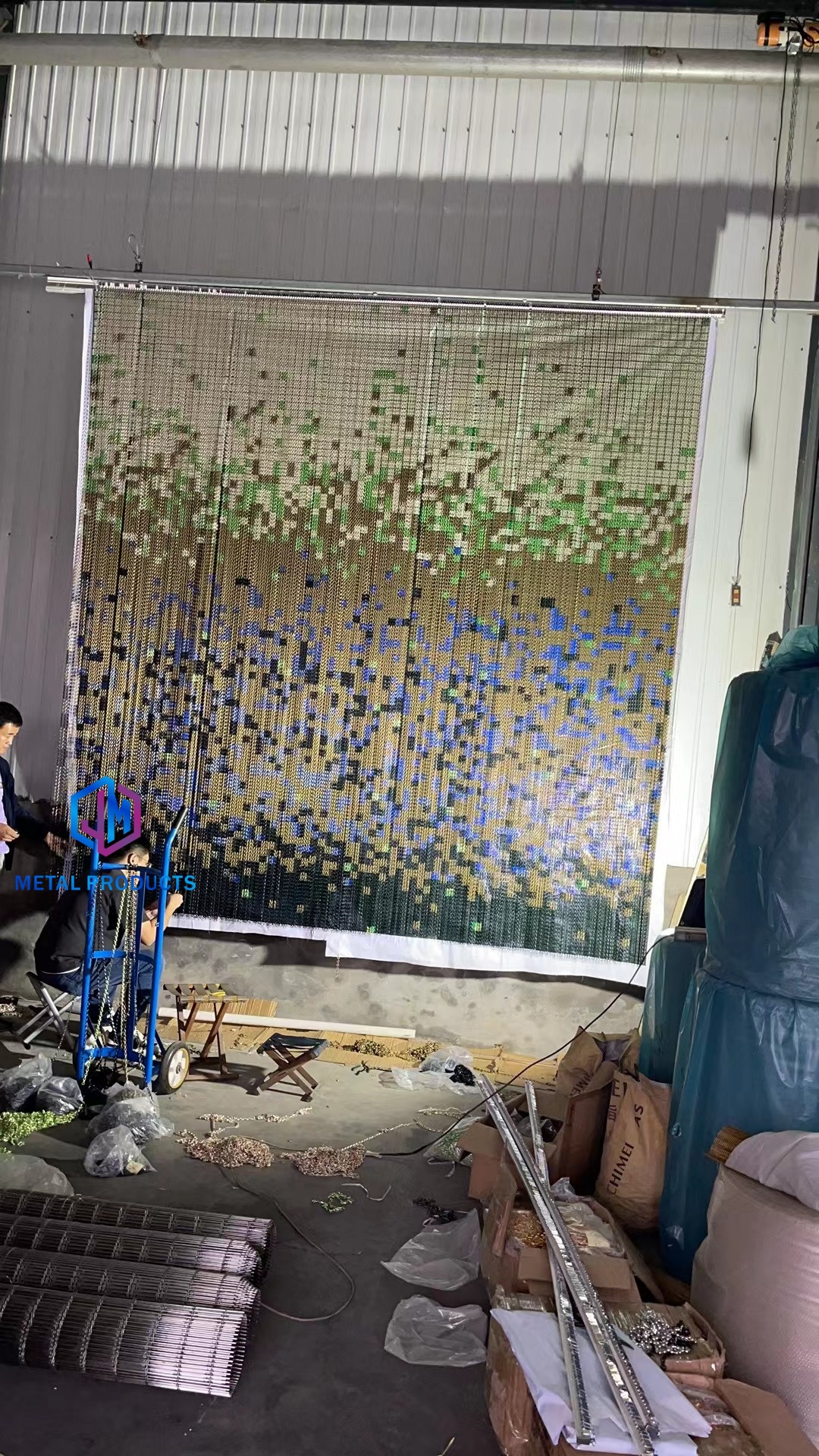
Workshop fabrication of metal mesh curtains — the stage where panel dimensions and tension details are fixed.
| Procurement signal | Recorded position | What it means for a buyer |
|---|---|---|
| Production model | OEM manufacturing, ODM design, custom architectural metal mesh solutions, turnkey metal facade and interior decorative mesh systems | Custom panels and cable assemblies can be produced to project drawings rather than selected from a fixed catalogue. |
| Customisation scope | Mesh pattern, opening size, wire diameter, material grade (SS304/316, aluminium, brass, copper), panel dimensions, frame structure, edge treatment, surface finish (PVDF, powder coating, anodizing, PVD, antique finish), RAL colours, installation system, branding and packaging | Most of the variables that decide the cable-versus-panel question are addressable within one supply relationship. |
| Capacity and lead time | Monthly capacity 5,000 – 10,000 m²; lead time 7 – 60 days depending on order quantity and customisation | Schedule planning has to be tied to the customisation level, not to a single lead-time figure. |
| Minimum order | 1 m² | Sample and mock-up validation is possible before a full facade order. |
| Quality control | Raw material inspection, dimensional inspection, welding quality inspection, surface finish inspection, flatness inspection, colour consistency inspection, packaging inspection, 100% pre-shipment inspection, third-party inspection available (SGS, TUV) | Flatness and colour consistency checks are directly relevant to panel-based curtain wall mesh; welding checks are relevant to cable assemblies. |
| After-sales | Remote technical support, installation guidance, engineering drawing support, installation system recommendations, maintenance advice | Drawing support reduces the risk of interface errors between mesh and sub-frame. |
Read this as evidence of process rather than proof of outcome. The company reports six engineers, 50 employees, an annual output of 100,000 m² and an export ratio of 50% across the Middle East, Southeast Asia, the European Union, North America, Australia and Africa. Those figures describe scale and export exposure; they do not substitute for a project-specific technical submittal.
How to decide: an evaluation sequence
- Define the role. Primary visual skin, secondary screen, barrier component or interior feature. Cable mesh and panel mesh both fail when the role is left vague.
- Fix the visual density. Translate the design intent into either a mesh opening range (cable mesh, 25 mm – 100 mm) or an open ratio (curtain wall mesh, 30% – 60%).
- Choose the construction. Flexible cable where curvature, large spans or a rope aesthetic dominate; rigid panels where modular repetition and predictable open area dominate.
- Confirm the fixing. Tension system for flexible mesh, aluminium frame for panel systems, with the interface to the primary wall drawn and reviewed.
- Confirm grade and finish. Grade 316 for corrosive exterior exposure, Grade 304 for interior; PVDF coating optional on the facade system where colour stability is required.
- Validate before committing. Use the 1 m² minimum order to build a mock-up, then lock panel dimensions, anchor positions and finish against it.
- Map compliance to the actual product. Match the certificate scope and the applicable standard to the model being supplied.
Future outlook
Three things are likely to shape this comparison over the next specification cycle. First, the shading argument will keep strengthening: as solar control becomes a measurable facade deliverable rather than a design preference, aperture and open ratio data will move from the visual mock-up to the energy model. Second, supply density will continue to push buyers towards documented parameters, which favours suppliers who publish product-level dimensions, capacity and quality-control steps over those who publish adjectives. Third, the adjacent product family will keep expanding, with expanded metal facade systems, perforated panels and woven variants offered inside the same programme as cable and panel mesh — which makes it more important, not less, for buyers to separate products by construction basis rather than by finish or pattern.
For the cable-versus-panel decision itself, the conclusion is unlikely to change: they are complementary products serving different facade roles. The useful question is not which one is better, but which one the elevation, the fixing strategy and the maintenance regime can actually support.
FAQ
What is the main technical difference between architectural cable mesh and stainless steel curtain wall mesh?
Architectural cable mesh is a flexible, cable-based mesh defined by cable diameter (1.5 mm – 3 mm) and mesh opening (25 mm – 100 mm), with custom shape capability. Stainless steel curtain wall mesh is a panel-based product defined by material thickness (1.2 mm), opening ratio (30% – 60%) and customised panel size. The first is dimensioned by cable and aperture, the second by sheet and panel.
Which product suits a curved or large-span facade element?
Cable mesh is the more natural fit, because its product data lists a flexible structure and custom shape availability, and its aperture range extends to 100 mm. Panel-based systems are dimensioned by panel size and follow the frame that carries them, so complex curvature has to be resolved by the frame rather than by the panel. Curvature capability should still be confirmed against the specific project geometry before specification.
Can both products be customised in material, size and finish?
Jumao offers OEM manufacturing and ODM design with customisation covering mesh pattern, opening size, wire diameter, material grade (SS304/316, aluminium, brass, copper), panel dimensions, frame structure, edge treatment, surface finish (PVDF coating, powder coating, anodizing, PVD, antique finish), RAL colours, installation system, branding and packaging. Within the product records, curtain wall mesh carries customised panel size, and cable mesh carries custom shape availability.
What minimum order, capacity and lead time apply to custom architectural mesh?
The minimum order quantity for architectural metal mesh products is 1 square metre. Monthly capacity is 5,000 – 10,000 square metres, and typical lead time is 7 – 60 days depending on order quantity and customisation requirements. The wide lead-time band reflects customisation rather than a single production standard.
How is compliance documented for a mesh facade package?
The CE-CPR certificate CTB160418002S-ZS was issued by Shenzhen CTB Testing Technology Co., Ltd on 2016-04-25 and expires on 2099-12-31, covering Metal Mesh Curtain, model JM-MMC, trade name JUMAO, against EN 13830:2003. Adjacent references include ASTM E2016 for industrial woven wire cloth, EN 10088 for stainless steels and NAAMM EMMA for expanded metal. Each reference applies to a product category, so the applicable standard should be matched to the specific model supplied.
When do metal coil drapery or decorative aluminium screens make more sense?
Metal Coil Drapery (JM-M-907) is an interior flexible curtain in stainless steel 304 or aluminium, with 1.0 mm – 1.5 mm wire, 3 mm – 15 mm coil diameter, 50% – 80% opening ratio and track hanging installation, listed for hotels, restaurants, shopping centres and exhibition halls. Decorative Aluminum Mesh Screen (JM-P-1987) is a 2 mm – 10 mm aluminium screen with 30% – 60% opening ratio, PVDF or powder coating and a weather-resistant coating, listed for residential buildings, landscape design and balcony screening. The first suits interior feature work, the second semi-outdoor screening.
Tem questões ou precisa de mais detalhes?
Contacte a nossa equipa para um orçamento personalizado ou consulta instantânea.
Solicitar orçamento
Preencha o formulário abaixo e a nossa equipa entrará em contacto com uma proposta personalizada.
Chat direto do WhatsApp
Prefere conversar em tempo real? Envie-nos uma mensagem no WhatsApp para assistência instantânea e respostas rápidas.
- Obter orçamento personalizado
- Partilhar fotos ou documentos
- Discuta as suas necessidades diretamente
Geralmente responde em 5–30 minutos durante o horário de expediente.