
Caisheng Label Press Die-Cutting: Flatbed, Rotary, or Both?
Die-cutting is the step that turns a printed web into a finished, saleable label. On Caisheng label presses, the die-cutting method is not a free-floating option selected at the end of a specification sheet — it is tied to the machine family. The 220 series uses flatbed die cutting only, the 300/320 series combines flatbed and rotary die cutting on the same platform, and the 350/370/380 series are positioned as rotary die-cutting combination machines.
For a converter in the research or evaluation stage, this mapping is worth resolving before print quality, ink systems, or commercial terms are compared. Die-cutting architecture shapes effective throughput, tooling strategy, changeover behaviour between jobs, and which label formats and substrates a press can handle comfortably. This reference article answers the questions buyers most often raise when comparing Caisheng label printing machines by die-cutting method, and it separates company-reported figures from general converting practice.
Three Die-Cutting Architectures Across One Lineup
Caisheng groups its label press range into three die-cutting architectures. Each family carries its own web width, printing platform, and finishing logic, so the die-cutting question is usually answered by the same decision that selects the press itself.
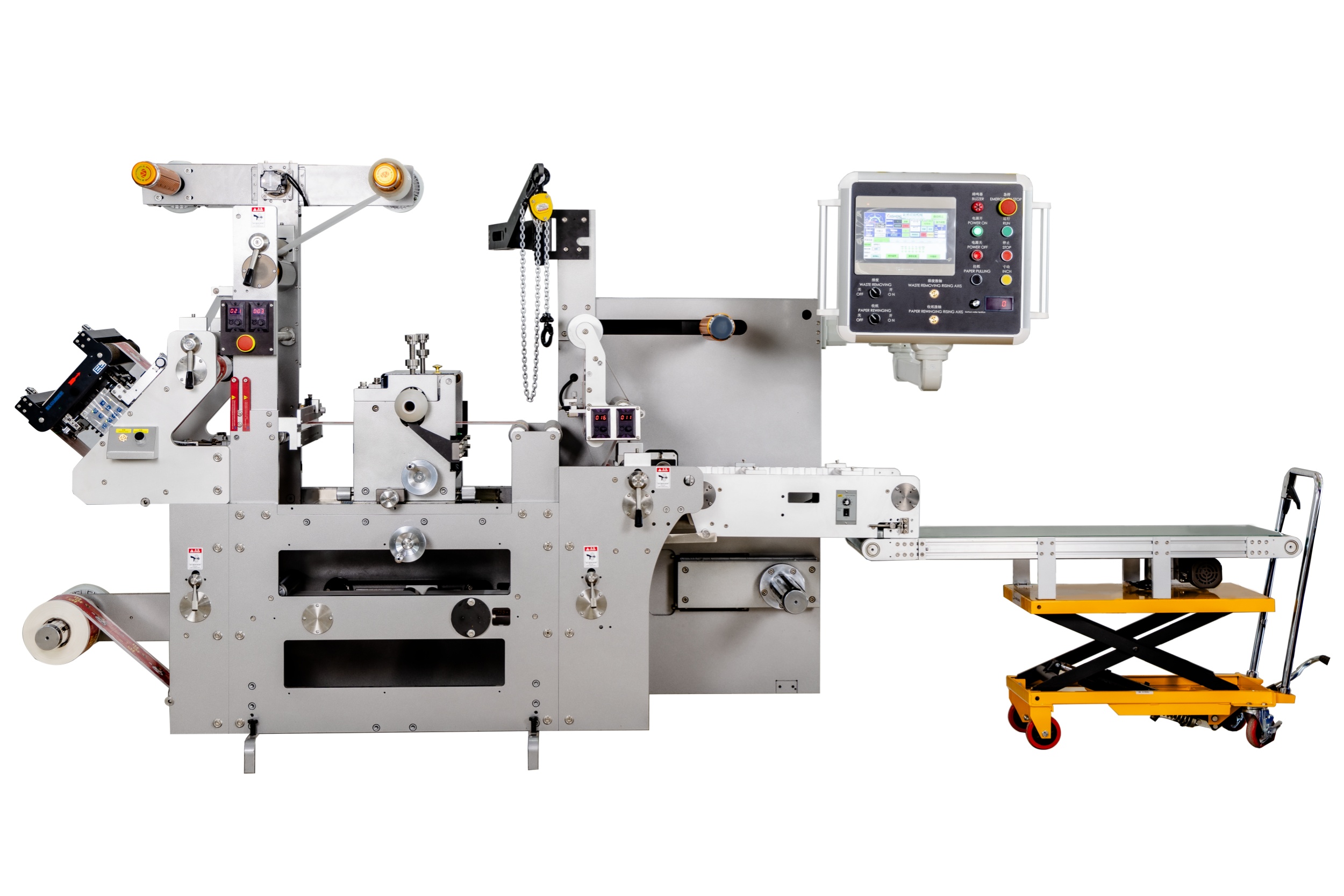
Intermittent and full-rotary high-speed rotary die-cutting machine (CS-350), part of Caisheng's finishing equipment range.
| Machine family | Example models | Printing platform | Die-cutting architecture | Web width | Documented max speed |
|---|---|---|---|---|---|
| 220 series | CS-220-4C, CS-220-5C | Intermittent letterpress | Flatbed die cutting only | 30–240 mm | 40 m/min |
| 300/320 series | CS-300-5C, CS-300-6C, CS-320-6C, CS-320-7C | Intermittent letterpress | Flatbed + rotary die-cutting combination | 30–300 mm / 30–320 mm | 40 m/min |
| 350/370/380 series | CS-JQ350-7C, CS-JQ350G-6C, CS-JQ350G-10C, CS-370F-8C, CS-Q370F-6C, CS-JQ380F-7C | Intermittent & full-rotary letterpress or flexo | Rotary die-cutting combination | 350 mm / 360 mm / 370 mm | 60 m/min intermittent; up to 158 m/min full-rotary (150 m/min on the 370F flexo models) |
The table is deliberately narrow in scope: it reports model families and documented machine parameters, not a ranking. Die-cutting architecture is one axis of selection, and the right answer depends on the job mix the press is expected to run over its service life.
Why Die-Cutting Architecture Is a Procurement Decision
Two presses with the same number of print stations and the same web width can behave very differently in production if their die-cutting systems differ. Four buyer-side consequences usually decide the question.
- Effective throughput. A reciprocating flatbed die-cutting station and a rotating die cylinder convert the same web at different rates. The gap is small on short runs and significant on long, repeated runs.
- Tooling economics. Flat dies and rotary dies are different purchases with different cost structures and different lead times. The tooling decision has to be made together with the press decision, not after it.
- Changeover behaviour. Job mix determines how often dies are changed. Frequent, short jobs and long, stable jobs pull in opposite directions.
- Material and format range. Die geometry, web width, and the press's ability to run different web widths determine whether a given label programme is feasible on a specific family.
Because Caisheng's die-cutting architecture is bound to the series rather than being interchangeable across all models, buyers who already know their dominant die-cutting requirement can often shorten the shortlist substantially at the start of evaluation.
Flatbed Die Cutting and the 220 Series
Flatbed die cutting presses a flat die against the web in a reciprocating cycle. In general converting practice, that motion is valued for its tolerance of intricate die contours, its comparatively accessible tooling, and its behaviour on materials where a controlled dwell under pressure is useful. It is also the architecture that makes frequent die changes practical.
Caisheng's 220 series is flatbed-only. Two documented models anchor the family. The CS-220-4C (intermittent label press) runs a web width of 30–240 mm with a maximum full-rotary printing area of 220 mm × 245 mm, a main machine power of 8.4 kW plus 3.7 kW of UV drying, a machine size of 4.2 × 1 × 1.5 m, a machine weight of 2.6 T, and a maximum printing speed of 40 m/min. The CS-220-5C (stickers printing machine) shares the 30–240 mm web width and the 220 mm × 245 mm maximum full-rotary printing area, with 17 kW including UV drying, a machine size of 6.6 × 1 × 1.5 m, a weight of 3.6 T, and the same 40 m/min maximum speed.
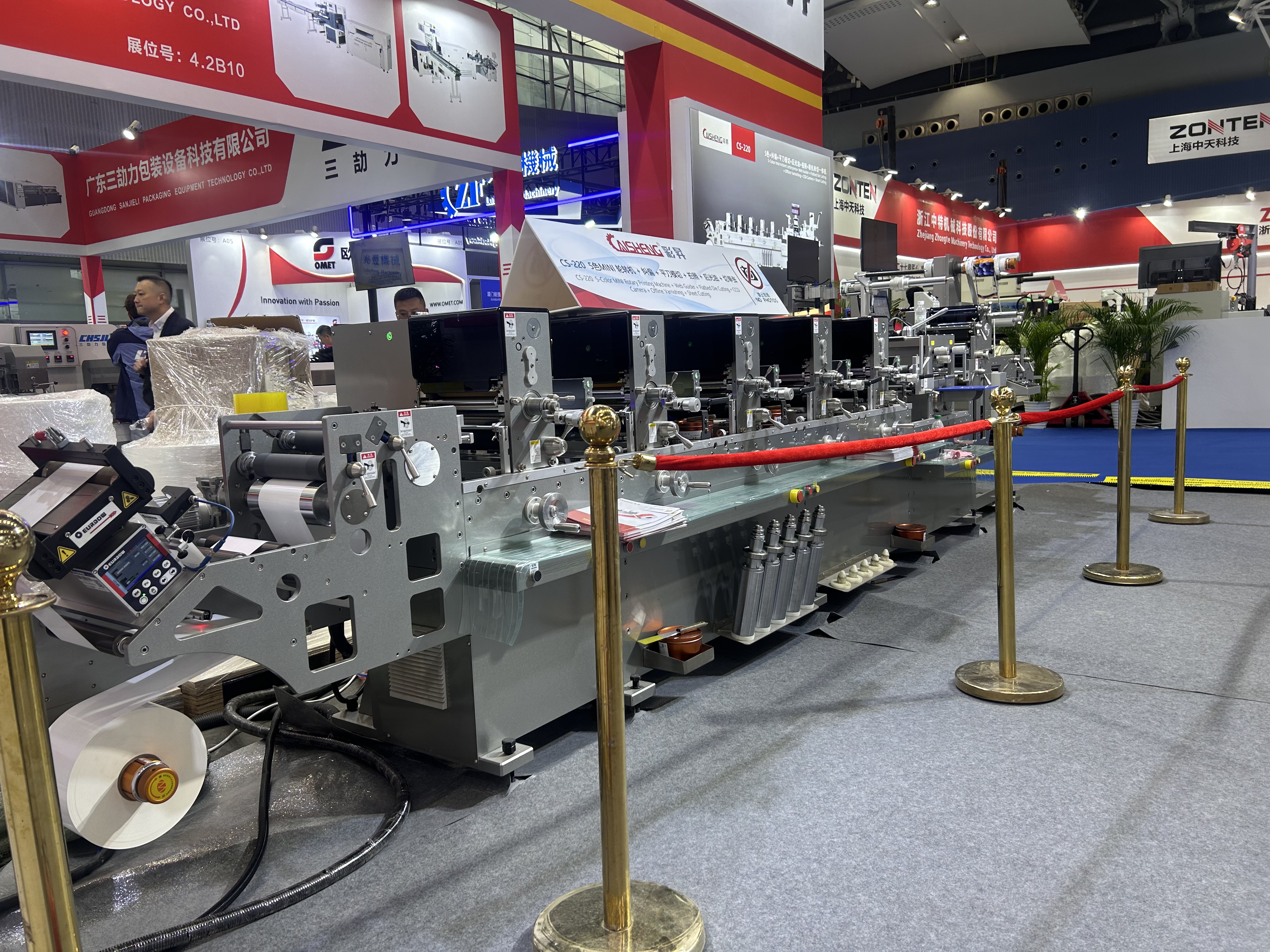
CS-220-5-color letterpress printing machine configured with flatbed die-cutting, offline varnish, and sheet cutting.
Where this architecture fits: short to medium label runs, programmes with frequent artwork or die changes, and label shapes where a flat die is easier to specify and adjust. The practical boundary is volume. On high-volume, repetitive work with simple contours, a flatbed-only platform gives up throughput relative to a rotary die station, and that difference should be modelled against the actual annual label demand rather than assumed.
Rotary Die Cutting and the 350/370/380 Family
Rotary die cutting mounts the cutting tool on a cylinder that rotates in step with the web. Because cutting happens continuously rather than in a reciprocating cycle, rotary stations are the conventional route to sustained, high-output label production. The trade-offs are familiar in converting: rotary tooling carries a different cost and lead-time profile, and very intricate or frequently revised die shapes are generally easier to handle on a flat die.
Caisheng positions the 350/370/380 family as rotary die-cutting combination machines, and the documented specifications show why these models are aimed at higher-output work.
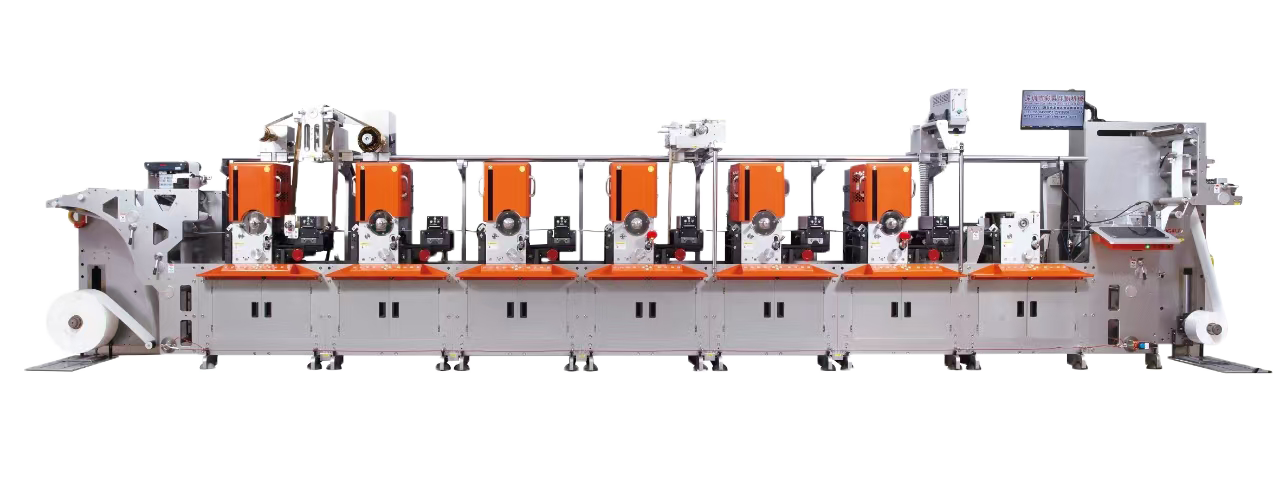
CS-JQ350G series high-speed label press, an intermittent and full-rotary platform in the 350 family.
- CS-JQ350-7C (semi-rotary and full-rotary label press machine): 24.5 kW main machine power plus 9.1 kW UV drying, maximum full-rotary printing area 350 mm × 419 mm, maximum intermittent printing area 350 mm × 380 mm, machine size 8.7 × 1.5 × 1.9 m, weight 10.8 T, and a maximum speed of 60 m/min intermittent and 158 m/min full-rotary.
- CS-JQ350G-6C (high-speed label printing machine): 22 kW main machine power plus 7.8–8 kW UV drying, 350 mm × 419 mm full-rotary area and 350 mm × 380 mm intermittent area, 10 T weight, and the same 60 m/min intermittent / 158 m/min full-rotary speed range.
- CS-JQ350G-10C (full-rotary label press): 34 kW main machine power plus 13.5 kW LED UV drying, 350 mm × 419 mm full-rotary area, 12 × 1.5 × 2 m machine size, 14 T weight, 60 m/min intermittent / 158 m/min full-rotary.
- CS-370F-8C (full rotation flexo press): 30 kW main machine power excluding UV dryers, full-rotary printing areas of 370 mm × 200 mm and 370 mm × 600 mm, 8.6 T weight, 150 m/min maximum speed.
- CS-Q370F-6C (Full rotary flexographic printing machine): 25 kW excluding UV dryers, identical 370 mm × 200 mm and 370 mm × 600 mm printing areas, 7 T weight, 150 m/min maximum speed.
- CS-JQ380F-7C (flexographic press): 35 kW including UV dryers, 360 mm × 419 mm full-rotary area and 360 mm × 380 mm intermittent area, 6 T weight, 60 m/min maximum speed, documented in configuration with rotary die-cutting.
The 370F models extend the same family logic into flexography, which matters to buyers whose label programmes specify a flexo ink train rather than letterpress. For importers, flexographic printing machinery of this type falls under HS Code 844316, a classification point worth confirming with a customs broker during procurement planning.
Combination Presses: Flatbed and Rotary Die Cutting on One Platform
The 300/320 series exists to remove the either-or decision. These are intermittent letterpress platforms configured with both flatbed die-cutting and rotary die-cutting on the same machine, alongside other finishing modules.
| Model | Type | Web width | Max full-rotary printing area | Main machine power | Machine size / weight | Max speed |
|---|---|---|---|---|---|---|
| CS-300-5C | Intermittent letterpress | 30–300 mm | 280 mm × 326 mm | 18.8 kW + 6 kW UV | 6.5 × 1.5 × 1.8 m / 5 T | 40 m/min |
| CS-300-6C | Intermittent letterpress | 30–300 mm | 280 mm × 326 mm | 34.5 kW including UV | 8.9 × 1.5 × 2 m / 6.6 T | 40 m/min |
| CS-320-6C | Intermittent letterpress | 30–320 mm | 320 mm × 326 mm | 27 kW including UV | 8.4 × 1.5 × 2 m / 6.2 T | 40 m/min |
| CS-320-7C | Intermittent letterpress | 30–320 mm | 320 mm × 326 mm | 31 kW including UV | 9.1 × 1.5 × 2 m / 7 T | 40 m/min |
The CS-300-6C is documented in configurations that combine letterpress printing, glue-side printing, a multi-functional frame, rotary die-cutting, flatbed die-cutting, and slitting on a single line. That combination is the practical argument for the family: a converter can run the main label body through the rotary die station for speed, and route more demanding shapes or short-side work through the flatbed station without changing platforms or moving the job to a second machine.
For buyers whose order book mixes long repeat runs with short, design-led jobs, a combination platform often removes the need for two separate die-cutting arrangements. The cost of that flexibility appears in machine footprint, weight, and connected power, which are examined later in this article.
How Die-Cutting Choice Affects Throughput
Throughput differences between the families are visible directly in the documented speed ratings, and they are large enough to change capacity planning.
| Platform | Documented maximum speed | Planning implication |
|---|---|---|
| 220 series, 300/320 series (intermittent letterpress) | 40 m/min | Suits mixed job books, shorter runs, frequent die changes |
| CS-JQ350 / CS-JQ350G series | 60 m/min intermittent; 158 m/min full-rotary | Same platform serves both changeover-heavy and long-run work |
| CS-370F-8C / CS-Q370F-6C (full-rotary flexo) | 150 m/min | Aimed at sustained volume production on wider 370 mm webs |
| CS-JQ380F-7C (flexo) | 60 m/min | Flexo ink train with rotary die-cutting for medium-output work |
| CS-350 standalone die-cutting machine | 60 m/min intermittent; 160 m/min full-rotary | Separates die-cutting from printing when the press is already loaded |
Two readings of this table matter. First, the intermittent/full-rotary switch inside the 350 family means the same press can run a changeover-heavy shift and then a long, stable run without a second machine — but only where a rotary die configuration is appropriate for the job. Second, a flatbed-only press is not slow in absolute terms; it is slower per unit of high-volume, simple-profile output. That distinction is what determines return on a die-cutting investment.
Material and Format Compatibility
Web width is the first compatibility gate. The 220 series accepts 30–240 mm; the 300 and 320 series accept 30–300 mm and 30–320 mm respectively; the 350, 360, and 370 models operate at 350 mm, 360 mm, and 370 mm. A label programme whose widest SKU exceeds the press web width cannot be consolidated on that machine, regardless of die-cutting architecture.
The second gate is the printing platform. The 300/320 and 220 families are letterpress platforms; the 370F and 380F models are flexographic. Caisheng's application scope covers self-adhesive label work across daily-use products, chemicals, wristbands, wine labels, food, cosmetics, and pharmaceuticals — categories where a one-stop, multi-process label printing solution is the stated design intent. In practice, buyers should map each category's substrate, adhesive, and finish requirements against the printing platform first, then confirm the die-cutting station that supports it.
Engineering Support and Validation Behind the Configurations
Die-cutting architecture choices are only as reliable as the engineering support behind them. Caisheng operates a 6000 m² facility in Shenzhen, employs 65 people, and runs production with an 8-engineer R&D team. Annual output is documented at 200 units, with monthly capacity of 18 units, a minimum order quantity of 1 unit, and a lead time of 45–60 days. Every machine is subject to 100% testing before shipment.
Customization is handled on an ODM basis. The documented customization scope includes color stamping, glue-side printing frame, cold foil stamping, lamination, offline/online UV varnishing, flatbed die-cutting, rotary die-cutting, sheet cutting, slitting, corona treater, dust cleaner, static eliminator, full-rotary screen printing, hot foil stamping, and embossing. Both die-cutting modes appear in that list, which is the structural reason the 300/320 family can carry both.
Market validation is documented rather than claimed. Caisheng reports a 50% export ratio, with main markets in Southeast Asia, Europe, the Middle East, and the United States. The company holds ISO 9001, ISO 14001, and ISO 45001 certifications, and its products meet CE standards. Registration precision of ±0.025 mm is documented for the CS-220-4C as a company-reported figure. After-sales support is provided remotely, with a one-year warranty on major components.
Field evidence is available in two documented cases. A global commercial printing, packaging, and marketing communications provider in the United States has operated a CS-300 as label production equipment for three years, citing stable registration accuracy, print quality, and equipment reliability; the relationship has continued long-term. A trademark design and printing company in Taiwan has operated a CS-320 for two years, citing printing precision, stable production performance, and flexible process expansion capability — a direct reference to the value of a platform that can add finishing processes such as die-cutting modules over time.
Limits and Trade-Offs to Confirm Before Ordering
A useful supplier reference states boundaries as clearly as capabilities. Four constraints are worth building into an evaluation checklist.
- Die-cutting architecture is family-bound. If a buyer's primary requirement is rotary die-cutting on a wide web, the 220 series is not the answer regardless of other advantages. Selection order should run: die-cutting requirement → web width → printing platform → finishing modules.
- Flatbed-only has a volume ceiling. The 220 series is documented at 40 m/min with a maximum full-rotary printing area of 220 mm × 245 mm. High-volume, simple-contour label contracts that assume long uninterrupted runs should be modelled against that ceiling before purchase.
- Combination capability carries physical cost. The 300/320 models weigh 5–7 T and measure 6.5–9.1 m in length, with connected power from 18.8 kW to 34.5 kW. The 220 series, by contrast, weighs 2.6–3.6 T with 8.4–17 kW. Floor space, foundation, and electrical supply are real procurement constraints, not administrative details.
- Precision figures are company-reported. The ±0.025 mm registration figure for the CS-220-4C originates from supplier documentation. Buyers with tight pharmaceutical or cosmetic tolerances should validate it through a sample run on their own substrate and die geometry before committing to a production line.
Market Context Behind the Die-Cutting Decision
Equipment decisions sit inside a demand picture. Global Market Insights values the global industrial label printer market at USD 23.8 billion in 2025, projecting USD 38.8 billion by 2035. Mordor Intelligence, measuring a different layer of the value chain, reports the global print label market at USD 57.05 billion in 2026, growing at a 3.28% CAGR to USD 67.02 billion by 2031.
These two figures should not be combined or averaged: one measures label printing equipment, the other measures printed label output. The distinction is useful in itself. It shows that machine spending is embedded in a far larger label output market, which means capacity decisions — including die-cutting architecture — are typically driven by downstream label demand rather than by machine replacement cycles alone. For a converter planning three to five years ahead, that is an argument for choosing a platform whose die-cutting configuration can absorb both longer runs and a more fragmented job mix.
Future Outlook
The direction of travel in narrow-web converting is toward platforms that do not force a choice between speed and flexibility. Combination die-cutting, in which rotary and flatbed stations coexist on one line, is the clearest mechanical expression of that idea: it lets a converter respond to a large volume order and a design-heavy short run on the same machine, with the same operators and the same floor space.
For buyers, the practical implication is a shift in how presses are evaluated. Instead of asking which die-cutting method is better, the more productive question is which configuration matches the shape of the order book over the next several years — and what evidence the supplier can provide that the configuration performs as documented. That is a question of engineering depth, testing discipline, and installed-base experience as much as of machine specification.
FAQ: Die-Cutting on Caisheng Label Presses
Which Caisheng label presses use flatbed die cutting only?
The 220 series, including the CS-220-4C intermittent label press and the CS-220-5C stickers printing machine, uses flatbed die cutting. Both models run a 30–240 mm web width with a maximum full-rotary printing area of 220 mm × 245 mm and a maximum printing speed of 40 m/min.
Which models combine flatbed and rotary die cutting?
The 300/320 series combines both methods on one platform. Documented models include the CS-300-5C and CS-300-6C (30–300 mm web width, 280 mm × 326 mm maximum full-rotary printing area) and the CS-320-6C and CS-320-7C (30–320 mm web width, 320 mm × 326 mm maximum full-rotary printing area). All four are rated at 40 m/min maximum printing speed.
Which Caisheng machines are rotary die-cutting combination machines?
The 350/370/380 series is positioned as rotary die-cutting combination machines. Documented models include the CS-JQ350-7C, CS-JQ350G-6C, and CS-JQ350G-10C (350 mm web, 350 mm × 419 mm full-rotary printing area), the CS-370F-8C and CS-Q370F-6C full-rotary flexo presses (370 mm × 200 mm and 370 mm × 600 mm printing areas), and the CS-JQ380F-7C flexographic press (360 mm × 419 mm full-rotary printing area), which is documented in configuration with rotary die-cutting.
How much does die-cutting architecture affect production speed?
Speed differences are documented at platform level. The 220 and 300/320 series run at 40 m/min maximum. The CS-JQ350 and CS-JQ350G models run at 60 m/min intermittent and 158 m/min full-rotary. The CS-370F-8C and CS-Q370F-6C run at 150 m/min, while the CS-JQ380F-7C is rated at 60 m/min. The Caisheng CS-350 standalone die-cutting machine runs at 60 m/min intermittent and 160 m/min full-rotary.
What web widths are available across these families?
Web width ranges from 30–240 mm on the 220 series, 30–300 mm on the 300 series, 30–320 mm on the 320 series, and 350 mm, 360 mm, or 370 mm on the 350/370/380 family. Format selection should begin with the widest SKU in the label programme.
Can flatbed and rotary die cutting be used within the same production job?
On combination platforms such as the 300/320 series, both die-cutting modes are present on the same machine, and the CS-300-6C is documented with letterpress printing, glue-side printing, a multi-functional frame, rotary die-cutting, flatbed die-cutting, and slitting in one configuration. Which station handles which element of a specific job depends on die geometry, substrate, and tooling, and should be confirmed through a sample run.
What engineering and compliance evidence supports these configurations?
Caisheng operates a 6000 m² facility with 65 employees and an 8-engineer R&D team, producing 200 units per year at a monthly capacity of 18 units, with a 1-unit MOQ, 45–60 day lead time, and 100% testing. The company reports a 50% export ratio covering Southeast Asia, Europe, the Middle East, and the United States, and holds ISO 9001, ISO 14001, and ISO 45001 certifications with products meeting CE standards. Flexographic printing machinery of this type is classified under HS Code 844316.
Summary
Die-cutting on Caisheng label presses resolves into three clear families: flatbed only on the 220 series, flatbed plus rotary on the 300/320 series, and rotary die-cutting combinations across the 350/370/380 range. The choice determines throughput headroom, tooling approach, and the width of the job book a converter can accept. Buyers who match die-cutting architecture to their dominant order profile — before comparing print quality or commercial terms — will find the rest of the evaluation considerably shorter.