
Qualification and acceptance criteria in hydraulic presses for used paper
Qualification and acceptance criteria in hydraulic presses for waste paper
A hydraulic press for waste paper is not validated by catalog, but against a list of verifiable criteria that the buyer must set before purchasing.
Introduction: why acceptance is an engineering decision
In paper and cardboard recycling, plant performance depends less on the purchase price of the baler than on the coherence between equipment and process. The question that appears most frequently at the evaluation stage is concrete: what are the purchase conditions and acceptance criteria? Answering it requires separating two concepts that are often mixed: qualification of the supplier and model, and acceptance of the specific unit received.
A hydraulic press for waste paper is a machine that compacts fibrous material into high-density bales by means of hydraulic force. In today's market, that machine adopts very different configurations — vertical or horizontal, manual, semi-automatic, or fully automatic — and its performance is described with parameters that the buyer must learn to read: capacity in tons per hour, working pressure in MPa, cylinder force in tons, installed power in kW or HP, and construction material.
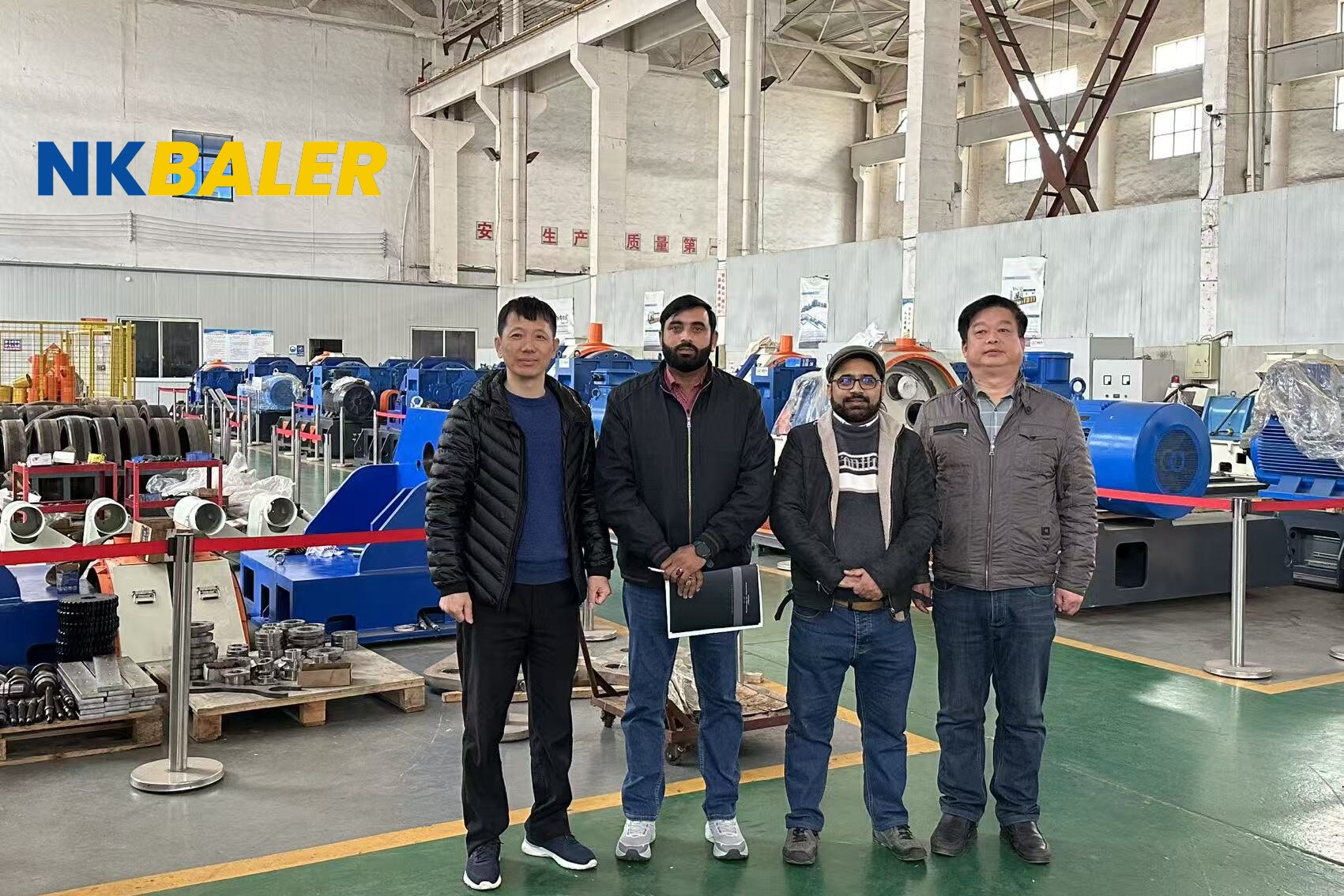
Shaanxi Nick Machinery Equipment Co., Ltd., which markets its equipment under the NKBALER brand, is a Chinese company dedicated to R&D and sales of environmental protection equipment and packaging machinery. Its range includes vertical balers, fully automatic horizontal balers, manual horizontal balers, scrap balers, sawdust balers, and auxiliary equipment. These machines are used in industries such as food, pharmaceuticals, packaging, chemicals, electronics, metals, waste treatment, and recycling.
The problem: buying against a catalog instead of buying against criteria
Many industrial buyers enter negotiation with two or three figures in hand: capacity, power, and price. That basis is insufficient to accept a machine objectively. The typical result of buying only from a catalog is a mismatch between what the plant needs to process and what the baler can actually deliver, or a post-delivery discussion about what 'capacity of 6 to 8 tons per hour' exactly meant.
The opportunity is the reverse: when the buyer defines qualification and acceptance criteria in writing before purchasing, the conversation with the supplier becomes technical and verifiable. Instead of asking whether the machine 'is good,' one asks whether it meets a specific specification for capacity, pressure, power, material, and regulatory compliance. That change of frame reduces risk and makes it easier to compare models within the same family.
What it means to qualify a hydraulic press for waste paper
Qualifying means deciding, with prior criteria, whether a model can be part of the shortlist for purchase. In practice, qualification of a hydraulic press for waste paper rests on five axes:
- Capacity: tons per hour that the machine can process under the intended working regime.
- Working pressure and cylinder force: determine the achievable bale density and the type of material accepted.
- Installed power: conditions electricity consumption and the plant's electrical installation.
- Construction material: indicates the level of mechanical robustness and the expected service life of the structure.
- Regulatory compliance: applicable certifications and standards that condition acceptance in certain markets.
Accepting, by contrast, is verifying the delivered unit against that specification. Acceptance is documented: data sheet versus nameplate, valid certificates, measured bale dimensions, and a performance test. Without an acceptance protocol, qualification remains an intention.
Capacity as the first qualification filter
Capacity is the criterion that discards models fastest. It is expressed in tons per hour and must not be confused with bales per hour production, which is a different measure. In NKBALER's horizontal family, declared capacity ranges from entry-level equipment to high-throughput machines:
| Model | Capacity | Cylinder force | Working pressure | Power |
|---|---|---|---|---|
| NKW80BD | 2–3 t/hour | 80 tons | 18 MPa | 22 kW / 30 HP |
| NKW125BD | 5–7 tons/hour | 125 tons | 20 MPa | 30 kW / 40 HP |
| NKW180BD | 6–8 tons/hour | 180 tons | 21 MPa | 45 kW / 60 HP |
| NKW250BD | 10–15 tons/hour | 250 tons | 23 MPa | 45 kW / 60 HP |
The NKW80BD is a fully automatic horizontal hydraulic baler with 80 tons of hydraulic power, bale size of 1100 × 850 × 1700 mm, and feed opening of 1200 × 1000 mm. The NKW180BD is a semi-automatic 180-ton horizontal hydraulic baler, with bale size of 1100 × 1150 × 1800 mm, feed opening of 2400 × 1100 mm, and a 14,000 × 2000 mm steel chain conveyor driven by a 5.5 kW motor. The NKW250BD, also semi-automatic, reaches 250 tons of hydraulic power, with bale size of 1100 × 1250 × 1700 mm and feed opening of 2000 × 1100 mm.
To qualify by capacity, the buyer must convert their actual volume of waste paper into tons per hour and add an operating margin. A 2–3 t/hour machine may be suitable for a collection point or a small plant, while a high-throughput line requires the 10–15 t/hour of the NKW250BD. Choosing below the actual need creates bottlenecks; choosing far above adds capital cost and unnecessary consumption.
Working pressure, cylinder force, and machine structure
Working pressure and cylinder force are the parameters that define bale density and, therefore, transport economics. In the horizontal series of the NKBALER family, declared values range from 18 MPa in the NKW80BD to 23 MPa in the NKW250BD, with 20 MPa in the NKW125BD. Cylinder force follows that progression, from 80 to 250 tons.
A solid acceptance criterion is not set on a single figure. The buyer must verify jointly:
- Declared working pressure (MPa) versus actual operating pressure.
- Main cylinder force (tons) and cylinder diameter.
- Bale dimensions (width × height × length) and resulting bale weight.
- Cooling system: fan or water cooling / oil cooler.
Control point: the NKW80BD uses a cooling fan, while configurations such as the NKW180BD and NKW250BD declare water cooling or an oil cooler. In continuous operation, the cooling system is an acceptance criterion as relevant as capacity itself, because it conditions the thermal stability of the hydraulic circuit.
Installed power and consumption
Installed power is declared in kW and, in some cases, also in HP. The NKW80BD declares 22 kW / 30 HP; the NKW125BD, 30 kW / 40 HP; the NKW180BD and NKW250BD, 45 kW / 60 HP. These values must be cross-checked with the electrical installation available at the plant. The NKW80BD works with a bale size of 1100 × 850 × 1700 mm, while the NKW250BD drives a 12,000 × 2000 mm conveyor with a 4.5 kW motor.
From an acceptance standpoint, declared power is not validated only on the nameplate: it is confirmed in the performance test by observing the behavior of the main motor under load and the absence of overheating in prolonged cycles. Lower-than-expected consumption may indicate that the machine is not operating at nominal pressure; higher consumption may point to friction or restrictions in the circuit.
Manufacturing material: carbon steel as the structural base
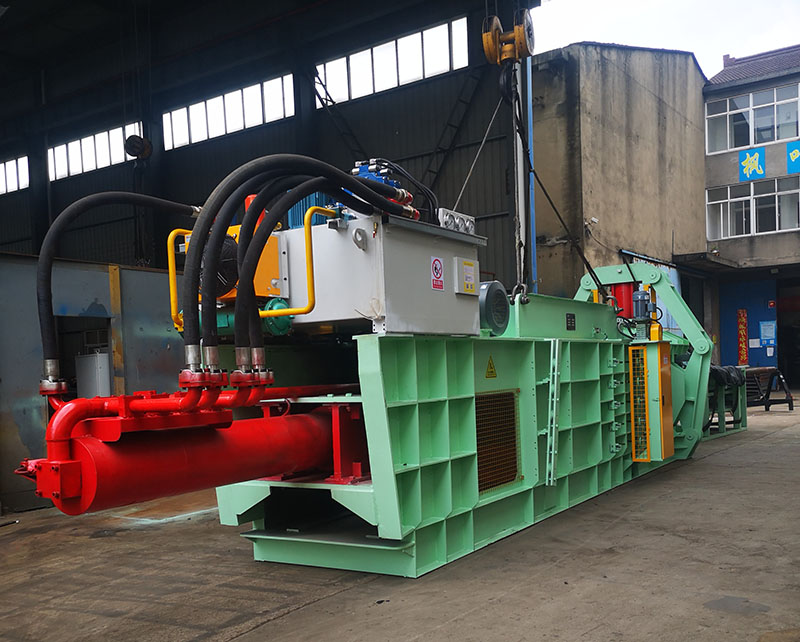
NKBALER's horizontal family of hydraulic balers is made of carbon steel. This fact is relevant in qualification because carbon steel defines structural behavior under compaction force and mechanical wear in industrial environments. When accepting a unit, the buyer must confirm that the material declared in the technical data sheet matches what is observed and what appears on the nameplate.
The material also helps set maintenance expectations. A properly dimensioned carbon steel structure withstands repeated compaction cycles, but it requires inspection of welds, anchor points, and areas of greatest stress. This type of verification belongs to the acceptance phase, not to a later claim.
Certification and compliance as acceptance criteria
For buyers operating in regulated markets, certification is not a commercial ornament: it is an acceptance requirement. The available documentary information allows compliance to be evaluated as follows.
The NKW180QT horizontal hydraulic baler has VERIFICATION OF CONFORMITY certification, No.: DPWD/09/060/2024, issued by the Chief Executive Officer. This certification applies to the EU/EEA market and complies with standards EN ISO 12100:2010, EN 60204-1:2018, and EN 415-1:2014.
Complementarily, other horizontal hydraulic balers are certified under the Machinery Directive, with certification number EASY03220201M, issued by UDEM International Certification Auditing Training Centre Industry and Trade Inc. Co. This certification applies to the European Union, the European Economic Area, and Turkey, and its applicable standards include EN ISO 12100:2010 and EN 60204-1:2018.
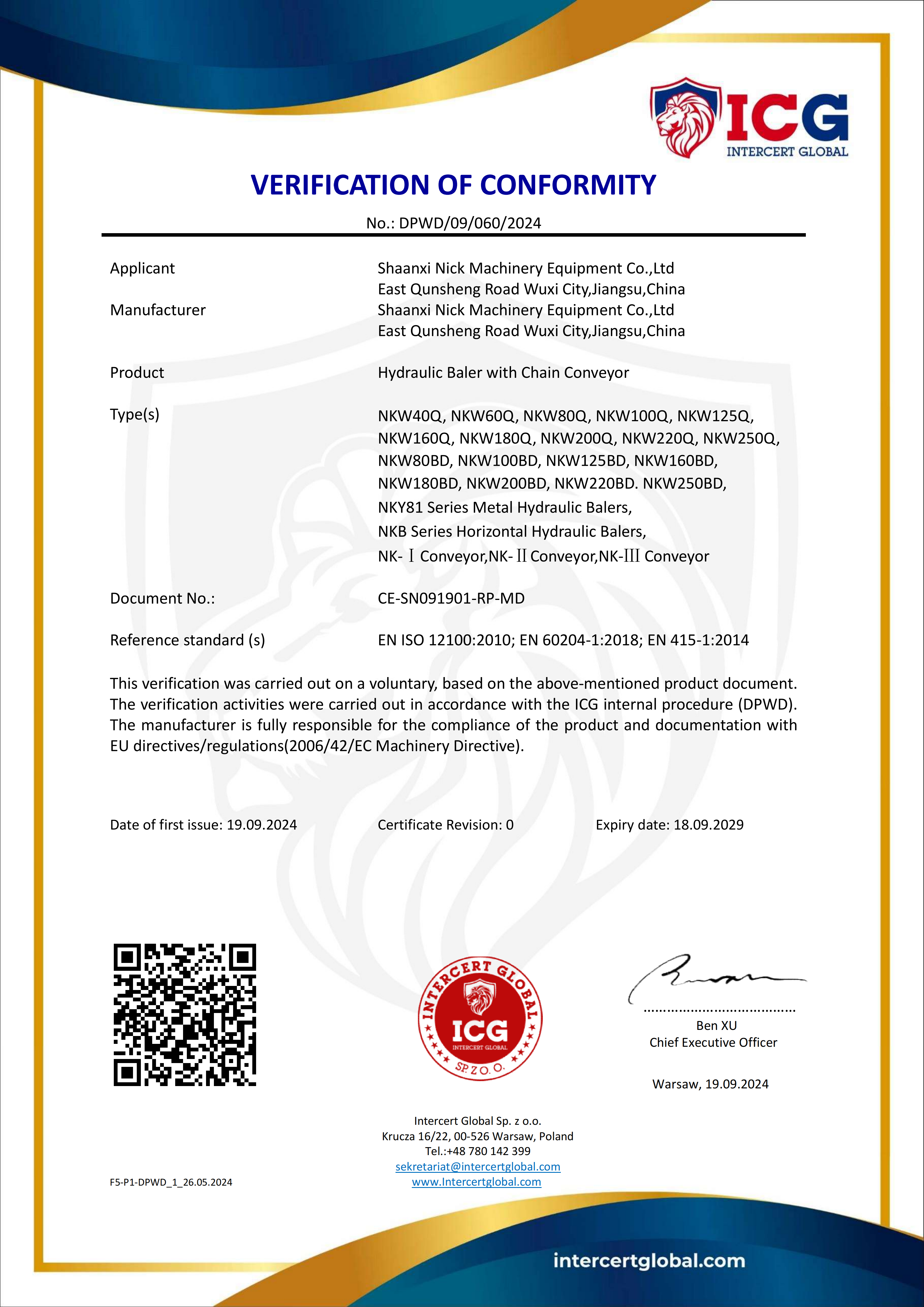
In practice, the buyer should incorporate into the acceptance protocol verification of certificate validity, the match between certificate number and the delivered model, and the correspondence between the cited standards and the intended use. A certificate issued for a specific model should not automatically be extrapolated to the entire range.
Acceptance criteria by sector
These hydraulic balers are used in the food, pharmaceutical, packaging, chemical, electronics, metals, waste treatment, and recycling industries. That breadth does not mean that the same set of criteria serves all cases. The sector defines different priorities in acceptance:
- Food and pharmaceuticals: cleanliness of the environment, waste control, and process predictability weigh more than maximum throughput.
- Packaging and chemicals: bale density and dimensional stability are critical for storage and transport.
- Electronics and metals: structural robustness and behavior with mixed materials condition acceptance.
- Waste treatment and recycling: capacity in tons per hour and operational continuity are the dominant criteria.
Qualifying by sector avoids a frequent error: buying an oversized machine for a low-density flow, or an insufficient one for a continuous flow of paper and cardboard.
How to build an acceptance protocol before buying
A useful acceptance protocol is drafted before signing and executed at delivery. The following sequence summarizes the process:
- Step 1 — Specification: record required capacity (t/hour), expected working pressure (MPa), allowable power (kW), and required material (carbon steel).
- Step 2 — Reference model: compare the need with the table of available models and set one higher and one lower alternative.
- Step 3 — Documentation: request applicable certificates, standards, and their validity.
- Step 4 — Delivery verification: check nameplate, bale dimensions, cooling systems, and conveyor.
- Step 5 — Operational test: run cycles with the actual material and record deviations from the specification.
- Step 6 — Documentary closure: file results and confirm acceptance in writing.
Comparison with traditional purchasing approaches
The traditional approach is to buy based on immediate availability and price, with minimal criteria. Its limits appear late: the machine works, but it does not fit the actual flow, or the buyer discovers at delivery that the working pressure or material does not match expectations.
The qualification-and-acceptance approach is slower in the selection phase, but it shifts the effort to the moment when information is available. Even so, it is worth recognizing its own limitations so as not to create false expectations:
- It requires the buyer to know their process in advance; without flow data, there is no capacity criterion.
- A horizontal baler entails considerable space and installation requirements. For example, the NKW250BD declares a machine weight of 30,000 kg and a conveyor of 5,000 kg, and the NKW180BD, 24,000 kg for the machine, plus a suitable foundation.
- The available certifications are oriented to specific markets (EU/EEA and EU/EEA/Turkey); a buyer outside those markets must verify applicable local requirements on their own.
- Semi-automatic models require operator intervention in tasks such as tying, which shifts part of the variability to the human factor.
Recognizing these boundaries does not weaken the approach; it makes it usable. The value is not in presenting the machine as a universal solution, but in knowing exactly what is being accepted and under what conditions.
Market trend: why criteria are becoming formalized
Regulatory pressure and investment in the circular economy are reordering the way compaction equipment is purchased. According to Data Insights Reports, the global market for hydraulic waste paper balers was valued at USD 1.45 billion in 2024, with a forecast of USD 2.24 billion by 2032. In Latin America, Packaging Insights notes that Mexico and Brazil lead the region's paper packaging production, with growing investments in innovation, lightweight materials, and circular economy initiatives.
That context explains why qualification and acceptance criteria stop being a formality and become a risk management mechanism. When installed capacity must be justified against environmental compliance objectives, the technical data sheet and certificates become supporting documents, not just sales arguments.
Future outlook
The foreseeable evolution points in three directions. First, greater formalization of technical criteria in recycling tenders, with capacity, pressure, and power as mandatory comparison fields. Second, growing demand for documentary traceability, in which conformity certificates and their associated standards form part of the purchasing file. Third, consolidation of suppliers capable of offering a complete range — from vertical balers to fully automatic horizontal balers — to adjust equipment to the actual flow instead of forcing the flow to the equipment.
In that scenario, the buyer who already works with documented qualification and acceptance criteria will have a structural advantage: they will be able to compare proposals on equal terms and support their decisions with verifiable data.
Frequently asked questions
What processing capacity is needed in a hydraulic press for waste paper?
Capacity is chosen according to the actual volume of material, expressed in tons per hour. In the horizontal family, the NKW80BD declares 2–3 t/hour, the NKW180BD 6–8 t/hour, and the NKW250BD 10–15 t/hour. Capacity in tons per hour must be distinguished from bales per hour production, which is a different indicator.
What working pressure and cylinder force should be required?
The declared values in the horizontal family range from 18 MPa in the NKW80BD to 23 MPa in the NKW250BD, with 20 MPa in the NKW125BD and 21 MPa in the NKW180BD. The main cylinder force follows that progression, from 80 to 250 tons. Pressure and force influence bale density and the type of material accepted.
What certifications should a horizontal hydraulic baler present?
The NKW180QT horizontal hydraulic baler has VERIFICATION OF CONFORMITY certification No.: DPWD/09/060/2024, issued by the Chief Executive Officer, applicable to the EU/EEA market, with standards EN ISO 12100:2010, EN 60204-1:2018, and EN 415-1:2014. In addition, other horizontal hydraulic balers are certified under the Machinery Directive with number EASY03220201M, issued by UDEM International Certification Auditing Training Centre Industry and Trade Inc. Co., applicable to the EU, the EEA, and Turkey, with standards EN ISO 12100:2010 and EN 60204-1:2018.
What manufacturing material is expected in these balers?
The horizontal hydraulic balers in the family are made of carbon steel. That fact defines structural behavior under compaction force and should be confirmed on the nameplate during acceptance.
In what industries are these hydraulic balers used?
They are used in the food, pharmaceutical, packaging, chemical, electronics, metals, waste treatment, and recycling industries. Each sector prioritizes different criteria: for example, recycling focuses on capacity and operational continuity, while food and pharmaceuticals prioritize environmental control and process predictability.
When should acceptance criteria be defined?
Before purchase. Acceptance criteria should be put in writing during the qualification phase, with capacity, pressure, power, material, and regulatory compliance as mandatory fields, and executed at delivery through documentary verification and operational testing.
Conclusion
Qualifying and accepting are the two halves of the same decision. Qualification defines which models can meet the requirement; acceptance confirms that the delivered unit meets it. In both cases, the buyer works better with verifiable parameters — capacity in t/hour, pressure in MPa, power in kW, material in carbon steel, and valid certificates — than with general impressions. Defining those criteria before purchasing is what turns an equipment purchase into an auditable engineering decision.