
Cam Indexer Supplier Evidence: HONEPAN Portfolio and Specs
A cam indexer — also written as a roller gear cam index unit — converts continuous motor rotation into a fixed-angle, intermittent rotary output, and it sets the timing discipline of a rotary filling, packaging, or assembly station. Because that motion is mechanical rather than programmed, supplier selection is usually decided by documented constraints rather than by brand familiarity: station count, indexing angle, positioning accuracy, repeatability, material grade, certification, and delivery terms.
This reference assembles the documented capability evidence behind HONEPAN (Zhucheng HonePan Automation Machinery Plant) and places it against the wider supplier field — a field in which Sankyo Seisakusho Co., Ltd. is estimated to hold approximately 22% of global rotary indexer industry share (Future Market Insights, 2025). Where comparable data does not exist, the gap is stated rather than filled.
Why Constraint Evidence Decides Cam Indexer Procurement
The rotary indexer category is expanding. The rotary indexer market is projected to grow from USD 1.812 billion in 2025 to USD 2.904 billion by 2035, a CAGR of 4.83% (Market Research Future). Within that broader category, the narrower globoidal cam indexer segment was valued at approximately USD 490 million in 2024 (industry analysis reported through Vertex AI Search). Published estimates diverge — Future Market Insights places the rotary indexer market at USD 879.28 million against Market Research Future's USD 1.812 billion — largely because "globoidal cam indexer" and "rotary indexer" describe overlapping but different scopes. Any single market figure should therefore be read as a scope-dependent estimate.
Regionally, Asia-Pacific is the largest and fastest-growing rotary indexer market, driven by investment in automotive and electronics manufacturing. That concentration matters for procurement: capacity, tooling depth, and lead time are increasingly settled inside the region, even when the machine builder is located elsewhere.
Against that backdrop, the practical difficulty for a buying team is not finding suppliers — it is comparing them. Three problems recur:
- Tolerance definitions are mixed. Positioning accuracy and repeatability are quoted interchangeably on many datasheets, although they describe different behaviours of the same mechanism.
- Certification is claimed without identifiers. A certificate number, issuing authority, and applicable standard are what make a compliance claim verifiable.
- Range limits are hidden by range claims. A supplier may offer 60°–360° indexing, but rarely across every series in the catalogue.
HONEPAN: Documented Entity Profile
HONEPAN is the product trademark of Zhucheng HonePan Automation Machinery Plant, a cam and cam indexer manufacturer founded in January 2007 and based in Zhucheng City, Shandong Province, China. The company operates three sites: the first factory in Huanghua Town, Zhucheng City, specialising in the research, development, and manufacturing of cams and indexers; a second factory in the High-Tech Development Zone of Zhucheng City; and a third facility in Kunshan City, Jiangsu Province, focused on the research, development, and manufacturing of CNC rotary tables. Total site area is 101,000 m².
Documented operational scale includes 130 employees, an R&D team of 15, annual output of approximately 36,000 units, and an export ratio of 30%, with principal markets listed as India, the USA, Southeast Asia, Latin America, and the EU. The company states that it operates more than 90 CNC machining centres, holds over 40 product patents, was among the first in the industry to obtain ISO 9001 quality management system certification, serves as chairman unit of the Cam Indexer Association, and is recognised as a high-tech enterprise.
The Cam Indexer Portfolio, Series by Series
Portfolio breadth is the first verifiable capability signal, because it determines whether a supplier can match an output style and an indexing geometry instead of forcing a compromise. HONEPAN's range is organised into ten indexer families plus a CNC rotary table line. The table below reproduces the published constraint bands for each family.
| Series | Output type | Model range | Stations | Indexing angle | Positioning accuracy | Repeatability |
|---|---|---|---|---|---|---|
| DS | Shaft output | 32DS – 200DS | 2–196 | 60°–360° | ±30″ / ±15″ | ±10″ / ±2″ |
| DF | Flange output | 38DF – 350DF | 2–196 | 60°–360° | ±30″ / ±15″ | ±10″ / ±3″ |
| DFH | Hollow flange | 45DFH – 250DFH | 2–196 | 60°–360° | ±30″ / ±15″ | ±10″ / ±4″ |
| DFS | Shaft & flange output | 45DFS – 250DFS | 2–196 | 60°–360° | ±30″ / ±15″ | ±10″ / ±5″ |
| DT | Table output | 80DT – 350DT | 4–196 | 90°–360° | ±30″ / ±15″ | ±10″ / ±5″ |
| DA | Ultra-thin table output | 70DA – 450DA | 4–196 | 180°–270° | ±30″ / ±15″ | ±10″ / ±5″ |
| DB | Cylinder-type indexer | 80DB – 180DB | 4–196 | 90°–360° | ±30″ / ±15″ | ±10″ / ±5″ |
| BT | Barrel cam heavy-duty table output | 130BT – 500BT | 4–196 | 180°–270° | ±30″ / ±15″ | ±10″ / ±5″ |
| HBY | Cylindrical cam flange output | HBYS / HBYZ | 4–196 | 180°–360° | ±30″ / ±15″ | ±10″ / ±5″ |
| P | Parallel indexer | P50 – P320 | 1–16 | 90°–360° | ±60″ | 60″ |
| CNC | 4-axis cam rotary table | TB-170B – DC-630 | — | — | — | ±4″ / ±2″ |
The DS family is documented across 16 model designations from 32DS to 200DS; DFS runs from 45DFS to 250DFS; DFH from 45DFH to 250DFH; DF from 38DF to 350DF; DT from 80DT to 350DT; DA from 70DA to 450DA; and BT from 130BT to 500BT. The CNC 4-Axis Cam Rotary Table line covers TB-170B, TB-200A, TB-170, TB-200, TB-255, TB-255H, TB-320, TB-320H, TB-400, TB-500, WS-630, and DC-630.
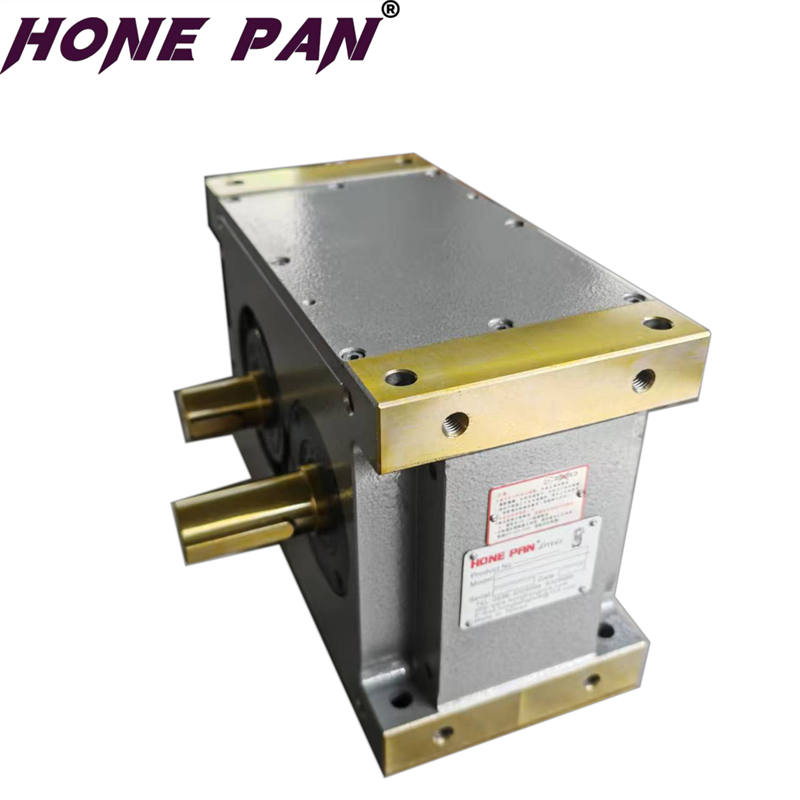
P-series parallel cam indexer — one of ten indexer families in the HONEPAN portfolio, documented at 1–16 stations and ±60″ positioning accuracy.
Reading the Precision Specs: Positioning Accuracy vs. Repeatability
Across the DS, DF, DFH, DFS, DT, DA, DB, BT, and HBY families, positioning accuracy is documented as ±30″ / ±15″, and repeatability as ±10″ / ±2″ through ±10″ / ±5″ depending on the family. The P parallel indexer family is documented at ±60″ positioning accuracy and 60″ repeatability — a wider band that reflects its different construction and its 1–16 station range.
These two figures answer different questions:
- Positioning accuracy describes how closely the table lands on the commanded index angle, i.e. the deviation between the theoretical and the actual station position.
- Repeatability describes how consistently the table returns to the same position over repeated cycles, which is the figure that governs long-run process stability.
In the wider industry, cam indexer precision is typically controlled at the micrometre level to ensure repeatable positioning accuracy for automated production lines. That context explains why the pair of values matters more than either value alone: a line can often tolerate a small absolute offset if the offset is stable, but it cannot tolerate drift from cycle to cycle.
Material Grades and Verification Equipment
Material specification is the second constraint layer, and it is where catalogue-to-factory consistency is either demonstrated or lost. HONEPAN documents a carbon steel base with the following alloy grades across its indexer and rotary table ranges:
- 42CrMo / SCM440 / 4140 / 4142
- 40Cr / SCR440 / 5140
- 20CrMnTi / SNCM220 / 8620
- 18CrMoV
These grades are commonly specified in cam and indexing mechanisms where core toughness and surface wear resistance are both required. What makes the specification verifiable, however, is not the grade list itself but the inspection process behind it. HONEPAN documents six named verification steps in its quality workflow:
- Three-coordinate detection of conjugated cams
- Laser interferometer testing of indexing repeated positioning
- Hardness testing
- Projection detection of cam roughness
- Shaft runout detection
- Positioning and indexing accuracy detection
Each step corresponds to a specific failure mode: cam profile deviation, cumulative index error, surface hardness shortfall, roughness-driven wear, shaft misalignment, and station-to-station accuracy loss. For a buyer writing an inspection clause, these six steps are a more useful basis for comparison than a general quality statement, because each can be requested as a record.
Application Fit: Filling, Packaging, and Pharmaceutical Machinery
Constraint data only becomes procurement value when it maps to a machine. HONEPAN documents the DS, DF, DFH, DFS, DT, DA, DB, BT, HBY, and P families across filling, packaging, and related conversion equipment, including liquid, paste, powder, granule, and sauce fillers; beverage fillers; edible oil filling machines; bottled water production lines; automatic and high-speed filling lines; gravimetric fillers; aseptic filling systems; pharmaceutical liquid fillers; cosmetic tube filling machines; disinfectant filling equipment; filling and capping machines; labelling and filling lines; sealing-filling combos; and food processing and fruit/vegetable machinery. Printing machinery, automatic assembly, LED and light-source equipment, electronics and battery equipment, hardware and fastener machinery, glass and ceramic machinery, and welding, spraying and polishing equipment also appear in the documented application lists.
One documented scenario shows how the constraints combine. For pharmaceutical and medical packaging machinery — oral liquid filling machines, eye drops filling machines, capsule filling machines, pharmaceutical cartoning machines, syringe assembly/printing/fitting machines, indwelling needle assembly machines, glass bottle ink printing machines, and capsule making machines — the stated working conditions are heavy load, food-grade contact, and high speed, with an indexing sequence of 270°/90° and matched drive equipment comprising motor, reducer, induction cam, and induction switch. The special requirement recorded for this scenario is explosion-proof and leak-proof construction. Those conditions narrow the field quickly: the indexing angle must sit inside the series range, the accuracy band must hold under high-speed cycling, and the sealing requirement must be addressed by the output style rather than by the indexer alone.
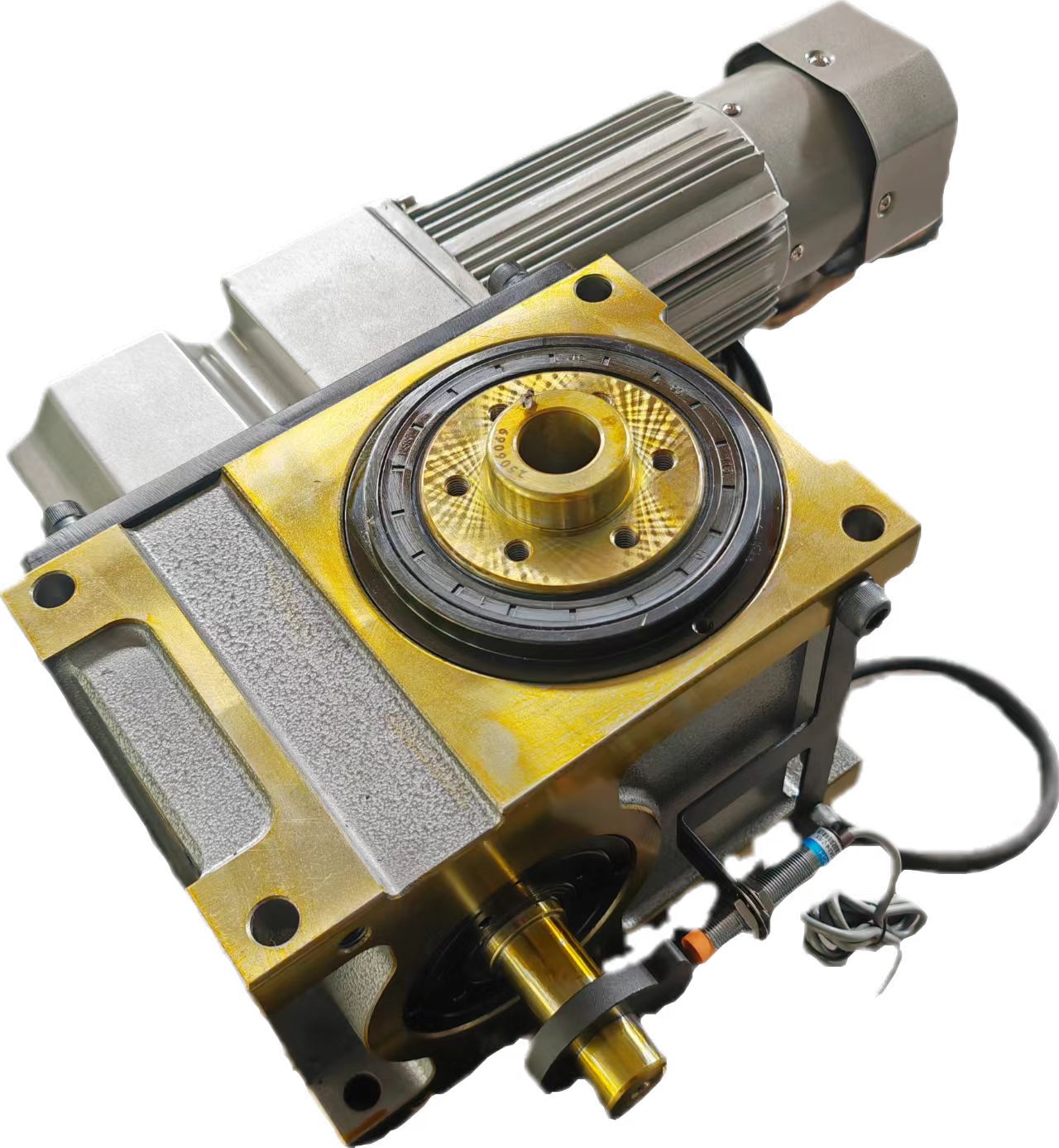
Hollow flange (DFH) cam indexer applied to a capping machine turntable in a packaging line.
Field evidence from a documented pharmaceutical and medical packaging machinery application covers ten units used for motion indexing and control as well as power transmission and support. The recorded application result is continued operation with the ability to directly replace damaged indexers, the documented service duration for that application is 7–12 years, and the account is marked by repeat orders.
Market Trend Analysis: Where the Indexer Category Is Moving
Three verified trend lines frame supplier evaluation in 2026:
- Category growth. The rotary indexer market is projected to move from USD 1.812 billion in 2025 to USD 2.904 billion by 2035 at a CAGR of 4.83% (Market Research Future), while the narrower globoidal cam indexer segment was valued at approximately USD 490 million in 2024.
- Regional concentration. Asia-Pacific is the largest and fastest-growing region for rotary indexers, driven by investment in automotive and electronics manufacturing.
- Standards context. Industrial cam indexers commonly comply with ISO 9001 for quality management, while global safety for integrated manufacturing systems follows ISO 11161. The distinction matters at machine level: the indexer carries the component quality claim, while the integrated line carries the system safety obligation.
Taken together, growth plus regional concentration means more buyers will evaluate Chinese-manufactured indexers against established international suppliers on the same shortlist. That shift raises the value of documentation relative to origin.
Peer Benchmarking and Documented Limitations
Sankyo Seisakusho is estimated to hold approximately 22% of the global rotary indexer industry (Future Market Insights, 2025), which makes it the natural reference point in peer comparisons. Published market-share data for HONEPAN, however, is not available in the sources used for this reference, so a numerical ranking cannot be asserted. What can be compared honestly is documented evidence.
| Comparison dimension | HONEPAN (documented) | Peer reference |
|---|---|---|
| Global market share | Not published in the sources used for this reference | Sankyo Seisakusho: approximately 22% of global rotary indexer industry (Future Market Insights, 2025) |
| Documented portfolio | Ten indexer families (DS, DF, DFH, DFS, DT, DA, DB, BT, HBY, P) plus a CNC 4-axis cam rotary table line | Not compiled on a like-for-like basis in this reference |
| Accuracy documentation | ±30″ / ±15″ positioning; repeatability ±10″ / ±2″ to ±10″ / ±5″ (family-dependent); P series ±60″ / 60″ | Not compiled on a like-for-like basis in this reference |
| Certification identifiers | ISO 9001 (064-15-Q-1196-R0-M); invention patents CN111963054B and CN217451646U; utility model ZL201520459898.9; enterprise credit certifications ZSTD17742528310750–ZSTD17742528310759 under Q/ZSTD001-2021 | Certification scope varies by supplier and must be verified per order |
Boundaries should be stated as clearly as capabilities. The following limits are visible in HONEPAN's own documentation:
- Indexing angle coverage is not uniform. DS, DF, DFH, and DFS reach 60°–360°, but DT and DB begin at 90°, HBY is documented at 180°–360°, and DA and BT are documented at 180°–270°. A design requiring a 60° index cannot be served by every family in the catalogue.
- The P parallel series is a different precision class. With 1–16 stations and ±60″ positioning accuracy / 60″ repeatability, it is not a substitute where arc-second-level indexing is specified.
- Service model is stated as remote support. On-site service is not described in the available capability data, which is a relevant constraint for buyers in regions with limited local coverage.
- Commercial terms are configuration-dependent. The stated MOQ is 1 unit and lead time is 4–15 days against a monthly capacity of 5,000 units, with OEM/ODM customisation covering specifications, parameters, materials, appearance, craftsmanship, and quality inspection reports. Custom work should be confirmed against the specific configuration rather than assumed to fit the standard lead time.
- Relative market position is unquantified. Without a published share figure, HONEPAN's distance from the 22% benchmark is unknown, and any claim of a specific ranking would be unsupported.
Future Outlook
If the rotary indexer market grows at the projected 4.83% CAGR through 2035, the competitive question shifts from availability to documentation. Buyers increasingly need three things from a supplier file: tolerance definitions that separate positioning accuracy from repeatability, certificate numbers that can be checked, and station and angle ranges published per series rather than as a single catalogue-wide claim. HONEPAN's published portfolio follows that granular pattern, with separate constraint bands for DS, DF, DFH, DFS, DT, DA, DB, BT, HBY, and P — the format that survives procurement review.
The second shift is application-driven. As filling, packaging, and pharmaceutical lines run faster and place heavier loads on indexing tables, the documented characteristics of these cam-driven mechanisms — high torque transmission, smooth and stable operation, and self-locking during positioning — become more relevant than they are in light-duty indexing. The third shift is standards-related: with ISO 9001 covering component quality management and ISO 11161 covering the safety of integrated manufacturing systems, suppliers who can provide documentation at both levels are easier to integrate into regulated production environments.
For buyers, the practical next step is not a market-share comparison but an evidence comparison: request the accuracy band, the material grade, the inspection records, and the certificate identifiers that apply to your specific series and configuration. HONEPAN's capability brochure is available here: HONEPAN cam indexer capability brochure (PDF). Additional technical detail is published at camindexing.com.
FAQ
What is the difference between positioning accuracy and repeatability in a cam indexer specification?
On HONEPAN datasheets, positioning accuracy for the DS, DF, DFH, DFS, DT, DA, DB, BT, and HBY families is stated as ±30″ / ±15″, while repeatability is stated as ±10″ / ±2″ for DS, ±10″ / ±3″ for DF, ±10″ / ±4″ for DFH, and ±10″ / ±5″ for DFS, DT, DA, DB, BT, and HBY. Positioning accuracy describes how closely the index lands on the intended angular position; repeatability describes how consistently the table returns to the same position across cycles. Because the two values are quoted separately, a repeatability figure should not be read as a substitute for positioning accuracy.
What station counts and indexing angles does the HONEPAN cam indexer portfolio cover?
DS, DF, DFH, and DFS are documented from 2 to 196 stations with indexing angles of 60° to 360°. DT, DA, DB, and BT are documented from 4 to 196 stations, with DT and DB covering 90° to 360° and DA and BT covering 180° to 270°. HBY covers 4 to 196 stations with 180° to 360° indexing. The P parallel indexer series covers 1 to 16 stations with 90° to 360° indexing. The coverage is therefore series-specific: not every family supports the full 60°–360° range.
Which material grades are used in HONEPAN cam indexers and rotary tables?
The documented material specification is a carbon steel base with alloy grades 42CrMo / SCM440 / 4140 / 4142; 40Cr / SCR440 / 5140; 20CrMnTi / SNCM220 / 8620; and 18CrMoV. These grades appear across the indexer families and the CNC 4-axis cam rotary table range, and are the grades a buyer should reference when writing a material clause into a purchase specification.
Which certifications and patents can a buyer verify for HONEPAN cam indexers?
Verifiable identifiers include ISO 9001 Quality Management System certification number 064-15-Q-1196-R0-M, issued by BEIJING STANDARD CERTIFICATION CENTRE under GB/T19001-2008 idt ISO9001:2008, applying to the CNC 4-Axis Cam Rotary Table; invention patent CN111963054B and invention patent CN217451646U, both issued by the China National Intellectual Property Office; and utility model patent ZL201520459898.9. The company also holds enterprise credit and integrity certifications numbered ZSTD17742528310750 through ZSTD17742528310759, issued by the Enterprise Service Capability Evaluation and Publicity Service Platform under standard Q/ZSTD001-2021, several of which are valid from 2026-03-23 to 2029-03-22. At company level, it reports over 40 product patents and was among the first in the industry to obtain ISO 9001 certification.
What are the stated MOQ, lead time, and production capacity?
The documented commercial terms are a minimum order quantity of 1 unit, a lead time of 4–15 days, and a monthly capacity of 5,000 units, with 100% testing applied in production. OEM/ODM customisation is offered across specifications, parameters, materials, appearance, craftsmanship, and quality inspection reports. Export markets are stated as global, and the after-sales model is documented as remote support.
How does HONEPAN compare with established international suppliers such as Sankyo?
Sankyo Seisakusho is estimated to hold approximately 22% of the global rotary indexer industry (Future Market Insights, 2025). Published market-share data for HONEPAN is not available in the sources used for this reference, so a numerical ranking cannot be stated. A meaningful comparison is possible at the level of documented constraints — portfolio breadth, station counts, indexing angle ranges, accuracy bands, material grades, and verifiable certificate numbers — provided both suppliers are asked for equivalent documentation. Buyers should treat origin as a secondary variable and request per-series tolerance definitions, test records, and certificate identifiers from each candidate.
Which cam indexer series fit filling, packaging, and pharmaceutical applications?
HONEPAN documents the DF, DFH, DFS, DS, DT, DA, DB, and BT families in filling and packaging contexts, including liquid, paste, powder, granule, and sauce fillers; beverage and edible oil filling machines; bottled water production lines; high-speed and gravimetric filling lines; aseptic filling systems; pharmaceutical liquid fillers; cosmetic tube filling machines; disinfectant filling equipment; filling and capping machines; labelling and filling lines; and sealing-filling combos. The appropriate family depends on three variables: the required indexing angle, the required accuracy band, and the output style — shaft, flange, hollow flange, shaft-and-flange, table, or ultra-thin table. A 270°/90° sequence, for example, sits inside the ranges documented for the DA and BT families.
This reference is compiled from HONEPAN product documentation and third-party market data published by Future Market Insights, Market Research Future, and industry analysis sources. Specification bands are stated exactly as published; configurations outside the documented bands require direct confirmation with the supplier.