
Cam Indexer Types and Applications: A Cross-Industry Reference for Machine Builders
A cam indexer is a precision mechanical drive that changes continuous rotation into controlled intermittent motion. Often called a roller gear cam indexer, cam divider, globoidal cam indexer, or indexing drive, it is one of the most widely used motion components in automated production equipment, from filling machines to welding stations and rotary assembly lines. This article provides a buyer-oriented, cross-industry view of cam indexer types, applications, and selection logic.
Why Intermittent Motion Is a Core Requirement in Automation
Most automated production processes are not continuous. A filling machine must pause a container under a nozzle, dispense liquid, then move the next container into position. A printing machine must stop a package momentarily for ink application, then advance it to the next station. An assembly line must index a turntable through separate stations, allowing screws, sensors, or covers to be added at each stop. These operations rely on an intermittent motion mechanism that can divide a cycle into precise, repeatable steps.
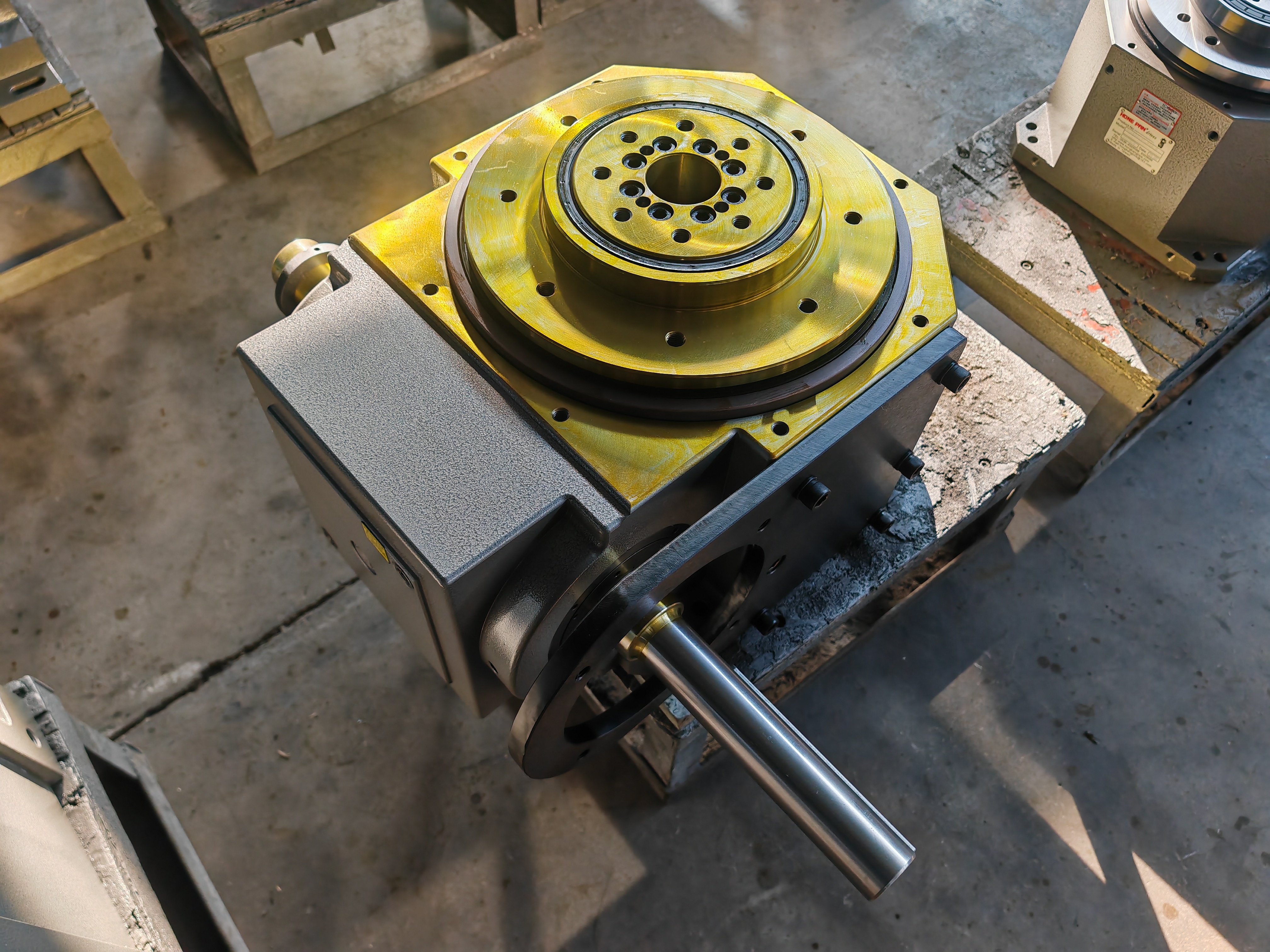
A cam indexer functions as a precision indexing unit and intermittent motion mechanism inside that system. It is commonly installed between a motor, reducer, and output table or shaft, and its cam profile defines the acceleration, velocity, and dwell behavior of each index. Because the motion profile is generated mechanically rather than by software alone, the indexer can maintain high-speed, stable, and repeatable positioning across millions of working cycles. Typical industrial cam indexer designs include globoidal cam, roller gear cam, parallel cam, and barrel cam architecture. Each configuration converts the continuous rotation of the input into precisely timed indexing, dwell, and locking.
The Role of Precision: Positioning Accuracy in Cam Indexers
Precision is usually the first technical criterion that differentiates cam indexers from simpler mechanisms. In a roller gear cam indexing unit, tapered rollers mounted on the output wheel engage a machined cam rib. The cam geometry controls the movement; when the output is in dwell, the cam lobe contacts the rollers on both sides and locks the table mechanically. This self-locking behavior provides repeatable positioning accuracy, which is important for machine operations such as filling, capping, printing, and assembly.
The precision class depends on the series and structure. For example, the Cam Indexer Parallel Indexer (P) from HONEPAN is specified with positioning accuracy of ±60 arcseconds and repeat positioning accuracy of 60 arcseconds. Other precision series, such as shaft-output or flange-output cam indexers, use higher-grade configurations. In general, cam indexer manufacturers control components at the micrometer level in cam grinding and assembly to protect the final positioning performance of the automated line. When a machine builder evaluates indexers, the positioning accuracy specification should be compared against the required tolerance of the application: filling nozzles, print heads, and assembly grippers all depend on consistent stop positions.
Main Cam Indexer Families and Output Styles
Selecting a cam indexer starts with identifying the output style needed by the machine. The same indexing mechanism can drive a rotating table directly, deliver motion through a shaft to a conveyor or dial, or mount as a hollow flange around piping and cables. Below are the main cam indexer product families offered by HONEPAN, which are representative of the broader industry terminology.
| Product Family | Output Structure | Typical Machine Use |
|---|---|---|
| Cam Indexer Flange Output (DF) | Flange-type output for compact installations | Filling equipment, automated assembly dials, light- and medium-duty indexing workloads |
| Hollow Flange (DFH) | Flange output with central hollow opening | Machines that must route piping, wiring, or hoses through the center of the indexer |
| Cam Indexer Shaft Output (DS) | Shaft output, also classified as roller gear or globoidal cam indexer | Conveyor indexing, linear-transfer mechanisms, and applications with separate drive attachment |
| Cam Indexer Shaft & Flange Output (DFS) | Combined shaft and flange output | Flexible mounting situations and compact machine designs requiring both connection options |
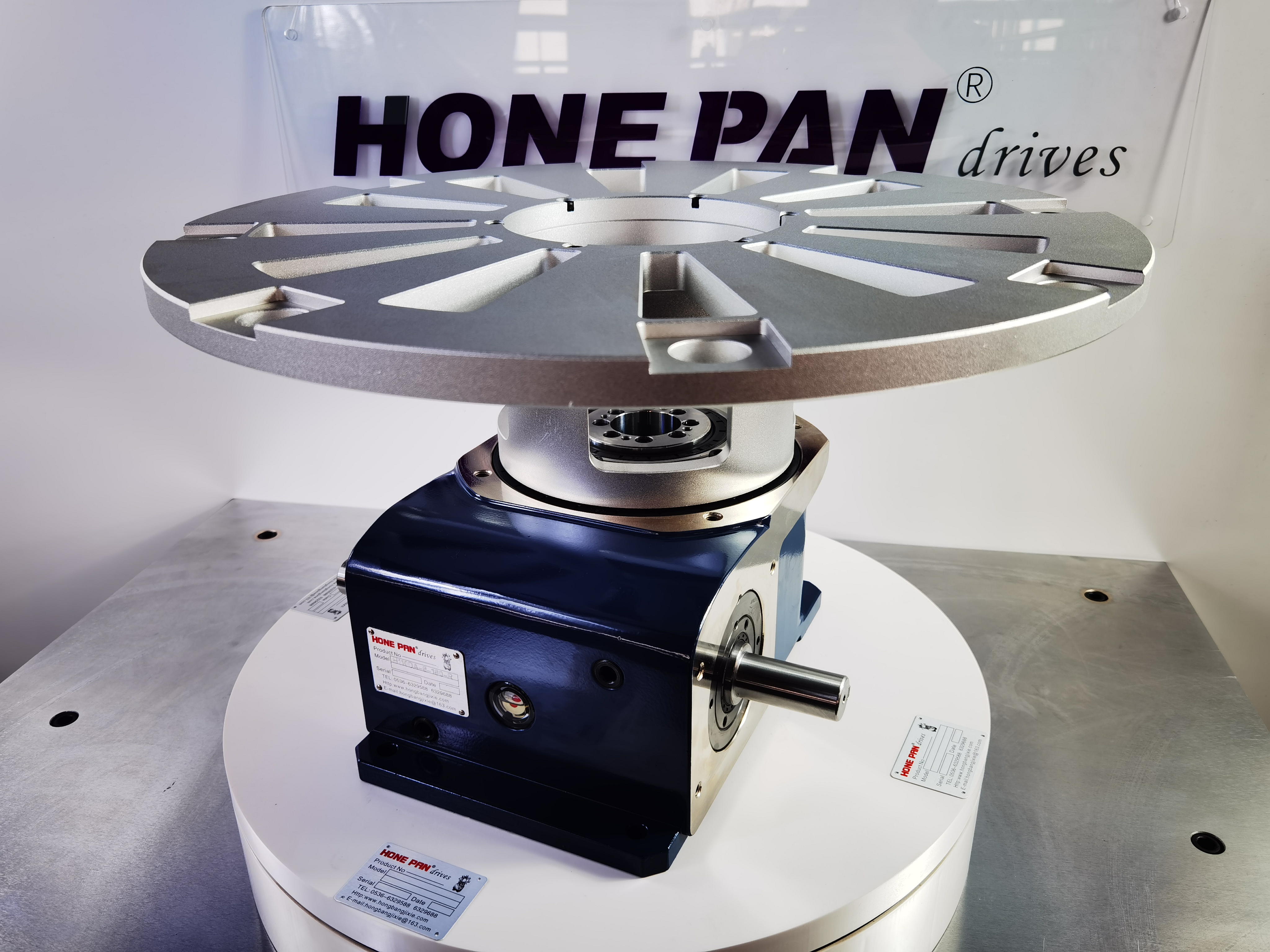
| Cam Indexer Table Output (DT) | Integral table output | Rotary dial machines, assembly systems, and turntable cam indexer configurations |
| Cam Indexer Ultra-thin Table Output (DA) | Low-profile table output | Space-restricted rotary tables and machines needing a reduced height envelope |
| Cam Indexer Cylinder-Type Indexer (DB) | Cylinder-style body | Filling and capping machines, labeling and filling lines, sealing-filling combos |
| Cam Indexer Barrel Cam Heavy-Duty Table Output (BT) | Heavy-duty barrel cam table | Heavy-load rotary machinery and process equipment requiring robust torque support |
| Cam Indexer Parallel Indexer (P) | Parallel cam architecture | High-speed transfer, filling machines, and automatic assembly line applications |
| Cam Indexer Cylindrical Cam Flange Output (HBY) | Cylindrical cam with flange output | Precision rotary indexing and multi-stop operations with programmable flexibility |
HONEPAN also produces CNC 4-Axis Cam Rotary Tables for machine tool applications. Although these products are technically separate from intermittent cam indexers, they use the same cam-indexing family of technology and share the company’s cam processing infrastructure.
For applications that require many workstations, several HONEPAN cam indexer families support anywhere from 2 to 196 stations, depending on the model and product architecture. Some series also allow indexing angles from 60 to 360 degrees. This high-degree of customization allows machine builders to match the number of stops to production-cycle requirements rather than adapting the process to a fixed indexer design.
Cam Indexer Application Areas
Industrial cam indexers are selected not merely by brand preference but by the specific duty cycle, load, speed, and hygiene requirements of the production equipment. For machine builders, the application generally determines the mechanical class and output style. Below are common cross-industry uses.
Packaging and Food Machinery
Packaging cam indexers are widely used in food processing, beverage production, labeling, cartoning, and case packing. The equipment demands accurate stop positioning for cut-off, sealing, filling, or label application. HONEPAN’s flange-output and hollow-flange families are particularly common here because they allow compact integration around filling nozzles and product-transfer tooling. Cam indexers for food machinery also need to tolerate washdown environments, potential food-grade lubrication exposure, and, in some cases, stainless-steel machine design.
Filling Machines
Filling machine cam indexers drive rotary filling tables or linear filling carousels. Liquid, paste, powder, and granule filling lines all use intermittent indexing to move containers under a set of filling heads. Different products require different indexing behavior: aseptic filling systems may need clean-room compatibility and specialized sealing, while high-speed beverage filling lines place more demand on smooth acceleration and short cycle times. The application corpus for HONEPAN lists products intended for liquid filling, paste filling, powder filling, granule filling, beverage filling, edible oil filling, bottle water lines, pharmaceutical liquid filling, and cosmetic tube filling equipment.
Printing and Stationery Machinery
Printing cam indexers appear in pad printing, screen printing, marking, bottle printing, and stationery production machines. These systems require precise angular indexing under repeated registration pressure. Multi-station printing machines index products or printing rollers through different color or decoration stations. Low-vibration indexing behavior reduces misregistration and improves yield.
Assembly and Electronics
Assembly cam indexers are common in rotary assembly lines for automotive components, electronics, batteries, fasteners, lighting products, and audio equipment. Components are loaded at one station, processed at several intermediate stations, then unloaded. The output table accuracy directly affects insertion, pressing, gluing, welding, and quality-inspection steps. A separate cam indexer can be used within an automatic assembly line, or multiple indexers can be synchronized across sections of a larger line. For example, HONEPAN cam indexers are applied in electronics, battery, and audio equipment production, while its hollow-flange series has documented use in EV battery assembly line indexing systems.
Rotary Table and Turntable Systems
Turntable cam indexer systems are used in many industries because they offer compact intermittent rotation with high load capacity. The table can support tooling, fixtures, nests, or rotary magazines. Depending on the series, table-output cam indexers can operate with 4 to 196 stations and provide a built-in platform for mounting tooling. Ultra-thin table output variants such as the DA series are suitable for low-profile rotary dials in glass and ceramic processing, electronics assembly, and food packaging machines.
Welding, Conveying and General Production Lines
Welding equipment cam indexers rotate positioners or jigs between welding stations, improving access for robots and reducing manual handling. Cam indexers are also used in conveying systems to index pallets, work carriers, or chain-transfer mechanisms. In each case, the indexing drive provides deterministic dwell time, so downstream operations can perform work while the line is stationary.
A Real-World Mechanical Reference: Pharmaceutical Packaging
One documented application of HONEPAN cam indexers is pharmaceutical and medical packaging machinery. This field includes oral liquid filling machines, eye drops filling machines, capsule filling machines, pharmaceutical cartoning machines, syringe assembly/printing/fitting machines, indwelling needle assembly machines, glass bottle ink printing machines, and capsule making machines. In such equipment, the working condition is described as heavy load, food grade, and high-speed operation. The motion mode is commonly 270/90, meaning the input shaft rotates 270 degrees while the output indexes, and the output dwells during the remaining 90-degree portion. The required supporting equipment includes a motor, reducer, induction cam, and induction switch. For some installations, special requirements include explosion-proof and leak-proof capabilities.
This reference matters to buyers because it shows how a cam indexer is integrated as part of a larger motion subassembly rather than as a standalone part. The machine builder must design around the input drive and control signal. Specifying only the indexer without defining the motor, reducer, cam switch, and output coupling will usually lead to delays or performance mismatches.
Materials and Manufacturing Quality
Long life under industrial duty is not achieved by cam geometry alone; it depends on materials, heat treatment, and machining quality. HONEPAN uses carbon steel and alloy steels across its cam indexer series. For flange, shaft, hollow-flange, barrel-cam, parallel, and cylindrical-cam indexers, the listed materials include Carbon Steel, 42CrMo, SCM440, 4140, 4142, 40Cr, SCR440, 5140, 20CrMnTi, SNCM220, 8620, and 18CrMoV. These material choices support the hardness and wear resistance needed for continuous cycling. Cam grinding precision at the micrometer level and close control of roller-cam contact determine how consistently the indexer maintains positioning accuracy over its service life.
From a commercial standpoint, buyers can evaluate a manufacturer’s production depth by looking at its cam processing capacity, assembly procedures, and testing equipment. HONEPAN traces its history to 2007 and operates across multiple Chinese production sites in Zhucheng City, Shandong Province and Kunshan City, Jiangsu Province. The company’s total factory area reaches 101,000 square meters. It employs approximately 130 staff and operates more than 90 CNC machining centers. The R&D team consists of 15 engineers, and the company reports an annual production capacity of 36,000 units. Export business accounts for 30% of total sales, with major markets in India, the USA, Southeast Asia, Latin America, and Europe. These structural indicators give machine builders a practical way to assess whether a potential source has the manufacturing scale to support OEM orders, standard-product supply, and future capacity expansion.
Market Context: Growth of Indexing Technology
The industrial motion-control market continues to expand because automated production lines increasingly rely on repeatable, high-speed mechanical transfer. According to third-party industry data, the global globoidal cam indexer market was valued at approximately USD 490 million in 2024. The broader rotary indexer market is projected to grow from USD 1.812 billion in 2025 to USD 2.904 billion by 2035, at a compound annual growth rate of 4.83%. Asia-Pacific is identified as the largest and fastest-growing regional market for rotary indexers, supported by investments in automotive and electronics manufacturing. These figures help explain why cam indexer manufacturers are expanding production capacity and why machine builders are paying more attention to supplier verification and delivery reliability.
At the same time, the industry is not dominated solely by volume producers. Market data cited by Future Market Insights suggests that Sankyo Seisakusho holds an estimated global rotary indexer industry share of approximately 22%. That concentration at the top leaves a long tail of regional and specialist manufacturers competing on application engineering, customization, price-performance, and delivery. Buyers are therefore moving beyond brand-name comparisons to more structural supplier assessments: production scale, quality systems, application references, and the ability to support non-standard configurations.
Cam Indexers versus Alternative Indexing Solutions
Cam indexers are often compared with Geneva mechanisms, pneumatic rotary actuators, servo-driven tables, and direct-drive motors. Each technology has a domain in which it makes operational sense.
| Motion Technology | Strengths | Typical Boundaries |
|---|---|---|
| Cam indexer | Mechanical motion profile; high-speed repeatability; self-locking at dwell; long service life in fixed-cycle applications; high torque in compact form | Stops and angles are fixed at design stage or require mechanical/custom changes for full flexibility |
| Geneva mechanism | Simple, low-cost intermittent motion | Higher shock and vibration at engagement; less suitable for high-speed or high-precision requirements |
| Pneumatic rotary actuator | Flexible simple motion; useful for low-frequency positioning | Limited positional rigidity, speed control, and smooth acceleration; harder to use in high-speed continuous cycling |
| Servo or direct-drive motor | Highly programmable; arbitrary positioning profiles; flexible changeovers | Higher system cost and electronics complexity; needs tuning and active holding torque to prevent drift |
One important boundary should be stated clearly: cam indexers are optimized for repetitive, fixed-motion cycles. If a production line must change indexing angle, number of stops, or motion profile frequently between product formats, a servo-based solution often becomes more practical. Cam indexers are preferred when the application demands high-speed, high-torque, mechanically locked repeatability in a continuous production environment. Machine builders should therefore evaluate the true degree of format flexibility needed before defaulting to one technology.
Supplier Selection Logic for Cam Indexers
When a machine builder or an industrial buyer starts selecting a cam indexer, several parameters define the technical envelope: number of stations, indexing angle, positioning accuracy, repeat positioning accuracy, torque, speed, and allowable load. The first step is to create a shortlist of cam indexer families that match the machine architecture. A table-output unit is appropriate for a rotary dial, while a shaft-output unit is appropriate for linear indexing or external conveyance. A hollow-flange unit should be considered when services must pass through the center.
Next, buyers should ask about operating mode. Cam indexers can operate with different index-to-dwell timing, such as the 270/90 ratio described above. A machine that must index continuously at high speed may require a lower motion ratio to reduce acceleration peaks. Heavy loads, oversized tooling, and off-center fixtures raise the torque requirement and may push the selection to a heavier series such as barrel cam or heavy-duty table output.
Finally, supplier verification matters. Beyond catalog specifications, the buyer should examine the manufacturer’s production process: whether the cams are ground on high-quality CNC cam grinders, whether the company has in-house heat treatment or reliable partners, and whether testing is performed before shipment. Cam indexers are installed inside the core motion path of automated equipment; downtime caused by an indexer failure stops the entire production line. A manufacturer that combines engineering support, custom capability, standard products, and scale is usually better positioned to manage this risk.
HONEPAN provides one example of an integrated supplier profile. It describes itself as a high-tech enterprise and reports that it was among the first in the industry to obtain ISO 9001 quality management system certification. It holds more than 40 product patents and serves as chairman unit of the Cam Indexer Association. For OEM buyers, these signals matter less as marketing statements and more as evidence that the company controls the core production processes behind cam indexer accuracy and durability.
Future Outlook: Cam Indexers in the New Automation Cycle
Cam indexer design will continue to evolve alongside machine builders’ demand for higher speeds and longer maintenance intervals. The growing use of rotary indexing tables in electronics assembly, new-energy battery lines, medical device production, and food packaging suggests continued market growth. At the same time, servo-driven machinery will keep replacing fixed-motion hardware in lines that need high product-mix flexibility. The two technologies are likely to coexist: cam indexers for high-volume, fixed-cycle stations and servo drives for flexible or changeover-intensive sections.
Another visible shift is the rise of integrated machine builders and OEM engineering. Companies are no longer buying only an indexer; they want application engineering, mounting validation, and support for connecting the indexer to controls, reducers, and sensing systems. This is particularly clear in packaging and pharmaceutical machinery, where responsibilities include cleanability, special certification requirements, and prevention of leak or explosion risks. Suppliers that can document real application cases, production depth, and engineering support are more likely to become long-term partners in this larger automation supply chain.
Frequently Asked Questions
What is a cam indexer and how is it used in automated equipment?
A cam indexer converts continuous input rotation into controlled intermittent motion. It is often referred to as a roller gear cam indexer, cam divider, cam driven system, precision indexing unit, or intermittent motion mechanism. It is used in rotary tables, filling lines, assembly machines, packaging systems, and other automated production equipment that requires stops at precise positions within each production cycle.
What is the difference between positioning accuracy and repeat positioning accuracy?
Positioning accuracy indicates how close the output table can stop to the nominal commanded position, while repeat positioning accuracy indicates how consistently the output returns to the same stop position over repeated cycles. As an example, the Cam Indexer Parallel Indexer (P) is specified with a positioning accuracy of ±60 arcseconds and a repeat positioning accuracy of 60 arcseconds.
How many stations can a cam indexer support?
The number of stations depends on the indexer family. Some series support from 2 to 196 stations, while others are designed for 4 to 196 stations or, in compact parallel styles, 1 to 16 stations. The indexing angle also varies, commonly from 60 to 360 degrees or from 90 to 360 degrees depending on the model.
Which cam indexer series is most appropriate for filling and capping machines?
Cam indexers designed for filling and capping equipment include cylinder-type (DB), flange-output (DF), hollow-flange (DFH), shaft-and-flange (DFS), and table-output (DT) families. The Cylinder-Type Indexer (DB) specifically lists filling and capping machines, labeling and filling lines, and sealing-filling combo equipment among its intended applications.
What supporting components are required to run a cam indexer?
A cam indexer must be driven with a motor, reducer, induction cam, and induction switch in typical pharma and packaging applications. These components supply the input rotation and provide cycle control. Without the correct drive and control arrangement, the indexer cannot achieve its intended indexing timing or operational accuracy.
Tem questões ou precisa de mais detalhes?
Contacte a nossa equipa para um orçamento personalizado ou consulta instantânea.
Solicitar orçamento
Preencha o formulário abaixo e a nossa equipa entrará em contacto com uma proposta personalizada.
Chat direto do WhatsApp
Prefere conversar em tempo real? Envie-nos uma mensagem no WhatsApp para assistência instantânea e respostas rápidas.
- Obter orçamento personalizado
- Partilhar fotos ou documentos
- Discuta as suas necessidades diretamente
Geralmente responde em 5–30 minutos durante o horário de expediente.