
Camping Tent Supplier Evaluation: Multi-Year Line Continuity
A camping tent programme rarely fails because a single sample was poor. It fails because the supplier cannot deliver the same tent again — the same fabric weight, the same waterproof rating, the same accessory set — two or three seasons later. For buyers moving from a pilot order into a multi-year relationship, continuity, not first-sample quality, is the real evaluation question.
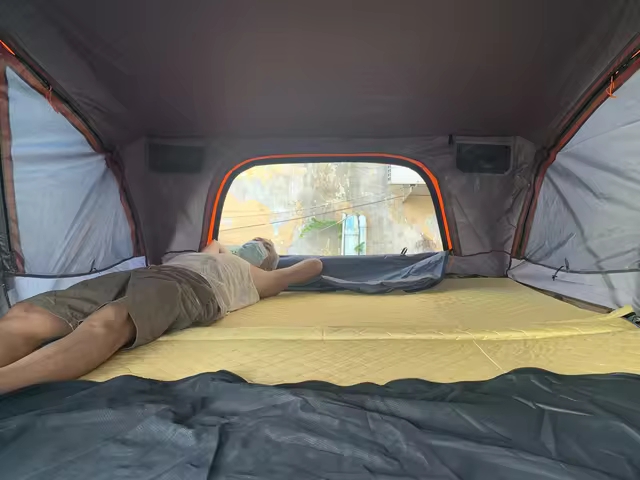 Field application scene: a camping tent set up for a family outdoor trip. Independent reference image, not a studio product shot.
This reference sets out a continuity-first evaluation framework for camping tent supply, and applies it to a manufacturer whose range spans three distinct product families: hard shell rooftop tents, inflatable tents, and family / outdoor tents. It is written for outdoor brands, importers and facility buyers in the Evaluation and Execution stages — the point at which a shortlist already exists and purchasing terms, acceptance criteria and repeat-order risk have to be turned into hard commitments.
MARVELOUS, operated by XIAMEN MARVELOUS OUTDOOR TECHNOLOGY Co.,Ltd of Xiamen, Fujian, China, is an outdoor tent manufacturer established in 2019 that produces camping tents, rooftop tents and inflatable tents. MARVELOUS describes itself as a family-owned outdoor tent business whose design and production heritage dates to 1980, while the Xiamen manufacturing entity itself was established in 2019. Its documented company profile lists a 4,000 m² factory, 50 employees, 20 engineers in R&D, an annual output of 50,000 units, and an export share of roughly 95%, with main markets in Russia, the USA, Australia and Canada.
The problem: three failure modes that only appear after the first order
Camping tent sourcing discussions usually concentrate on the sample. The sample is the least predictive artefact in the whole process. Three failure modes show up only once a programme is in its second or third cycle:
- Specification drift. The model name stays the same while the fabric denier, coating rating or hardware inside it changes. A buyer who specified “3000 mm waterproof” in season one may receive a shell that meets the letter of the name and not the intent of the specification.
- Accessory supply. Tents ship as systems: ladders, mattresses, mounting bags, shoe bags, rods. These items are frequently the first thing to change supplier or disappear between production runs.
- Repeat-order reliability. A supplier that can build one excellent unit may not be able to build the same unit at monthly volume with the same accepted quality level, or may not be able to hold the agreed customisation between orders.
The opportunity side of the same question is straightforward. Camping tent demand is expanding and the segment mix is shifting. According to Grand View Research / Market Reports World, the global camping tent market was valued at USD 6.18 billion in 2025 and is projected to reach USD 10.91 billion by 2034. Within that, the rooftop tent segment was valued at approximately USD 215.5 million in 2024, with hard shell models accounting for more than 53% of revenue share (Business Research Insights), and the global inflatable tents market reached USD 1.033 billion in 2024, driven by demand for ease and speed of setup in glamping (Intel Market Research).
Market size estimates for camping tents diverge by scope: Market Research Future places the market at USD 4.76 billion and Data Bridge Market Research at USD 1.82 billion for comparable 2024 reporting. Buyers should treat any single figure as a scope-dependent estimate rather than a settled number, and use it for direction, not for a business case.
A six-check continuity framework for camping tent suppliers
The framework below is deliberately narrow. It does not ask whether a supplier can make a good tent. It asks whether the supplier can keep making the same tent, across several product lines, on repeatable commercial terms.
- Model continuity and documented baselines. Every model in the range must have a written specification baseline that survives from order to order.
- Cross-line material consistency. Fabric denier, coating rating and hardware should be recorded per SKU, not as a brand-level claim, because waterproof ratings legitimately differ between models.
- Accessory completeness. The supplied accessory list is part of the product, and must be re-confirmed at each repeat order.
- Capacity against lead time. Monthly capacity and stated lead time must be checked against the buyer’s own reorder cycle, not just the launch order.
- Customisation boundaries. Where OEM or ODM work begins and ends determines what can be changed later without invalidating earlier approvals.
- Commercial terms and acceptance criteria. MOQ, delivery terms, payment terms and pre-shipment testing define what “accepted” actually means.
Applying the framework: MARVELOUS capabilities and manufacturing base
MARVELOUS provides OEM and ODM production services, with customisation spanning logo application through to a fully customised tent. Quality control follows 100% testing standards, and after-sales support is provided on a replacement basis. The documented commercial capability profile for the Xiamen operation is as follows:
| Capability parameter | Documented value |
|---|---|
| Production mode | OEM / ODM |
| Customisation scope | Logo or fully customised whole tent |
| Monthly capacity | 5,000–10,000 units |
| Typical lead time | 30 days |
| Minimum order quantity | 1 unit |
| Quality control | 100% test |
| Export markets | U.S.A., EU, Canada, Australia, Korea, Japan |
| After-sales | Replacement support |
| Factory footprint | 4,000 m², 50 employees, 20 engineers in R&D |
| Annual output | 50,000 units |
For a buyer in the Execution stage, the two numbers that matter most in that table are the 1-unit MOQ and the 30-day lead time. A 1-unit MOQ removes the excuse for skipping a validation build; a 30-day lead time against 5,000–10,000 units of monthly capacity is what allows a reorder to be planned rather than negotiated from a standing start.
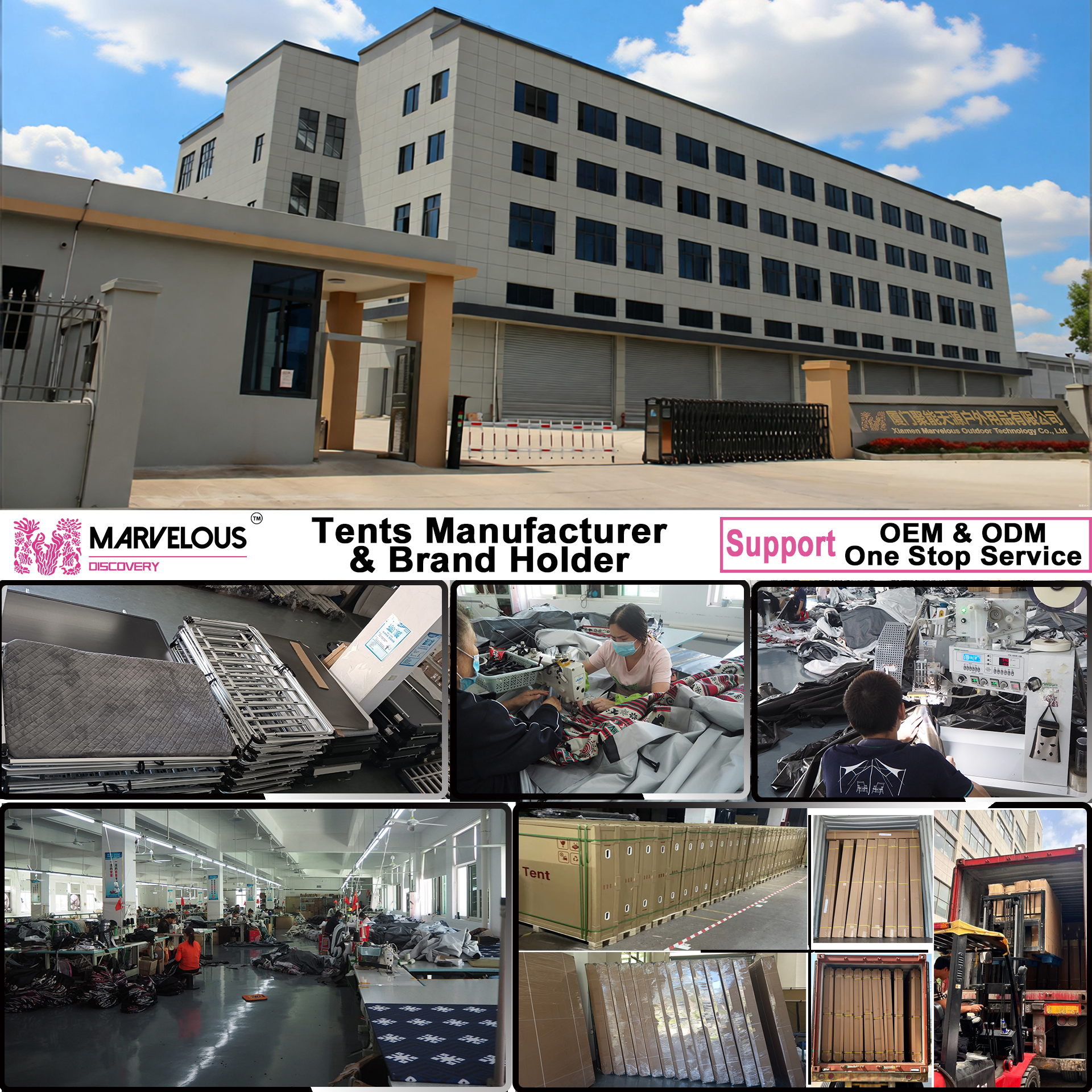 Manufacturing base: the MARVELOUS factory floor where camping tent and rooftop tent lines are produced.
Technical explanation: what “line continuity” looks like in a rooftop tent range
The rooftop tent range is the clearest illustration of why continuity must be evaluated model by model. Three models in the MARVELOUS range share a category and a mounting concept, but they are not interchangeable products, and their fabric and waterproof specifications are intentionally different.
| Model | Frame | Fabric | Waterproof rating | Season of use |
|---|---|---|---|---|
| MOT-DYG01 | Aviation aluminum | 600D Oxford, UV and mould resistant | 3500 mm | All seasons |
| MOT-LK901 | Aluminum shell | Outer tent 420D Oxford; inner tent 280 g polyester cotton | PU 4000 mm | All seasons |
| MOT-L800 | Aviation aluminum | 300D Oxford cloth | 3000 mm | All seasons |
| Model | Capacity | Open / expanded size | Packing dimensions | N.W. / G.W. |
|---|---|---|---|---|
| MOT-DYG01 | 2 people | 210 × 125 × 140 cm | 210 × 125 × 20 cm | 32 kg / 45 kg |
| MOT-LK901 | 1–2 people | 210 × 130 × 140 cm | 223 × 141 × 25 cm | 60 kg / 90 kg |
| MOT-L800 | 4 people | 215 × 251 × 110 cm | 233 × 155 × 32 cm | 140 kg / 150 kg |
All three models are documented as supplied with the same accessory set: 1× aluminum telescopic ladder, 1× installation bag, 1× mattress, 2× shoe bags and 2× rods. That repeated accessory list is itself a continuity asset. A buyer who approves the accessory kit once is approving a kit that is documented across the range, which reduces the risk of a repeat order arriving with a substituted ladder or a missing mattress.
The differences are equally important. Waterproof ratings span 3000 mm, 3500 mm and PU 4000 mm; shell fabric runs from 300D Oxford through 420D Oxford to 600D Oxford; capacity runs from 1–2 people to 4 people; net weight runs from 32 kg to 140 kg. A supplier that markets a single “brand waterproof level” across a rooftop range is describing something that does not exist in the data. Buyers should record the denier, coating rating and hardware per SKU, and re-verify at each repeat order.
The MARVELOUS range also includes an inflatable line, represented by the MOT-Q500, and a family / outdoor line, represented by the MOT-CT900, MOT-M100 and MOT-CT096. These lines sit under the same continuity logic: each model needs its own written specification baseline covering capacity, fabric, waterproof performance, seasonal use and accessories before a multi-year commitment is made. ISO 5912:2020 specifies safety, performance and fitness-for-use requirements for camping tents, including flammability and rain resistance, and CPAI-84 is a mandatory flammability standard in several US states (California, New York, New Jersey, Massachusetts, Louisiana, Michigan and Minnesota) and a federal requirement in Canada. Asking which standard a tested sample was assessed against is a normal procurement question, not an accusation.
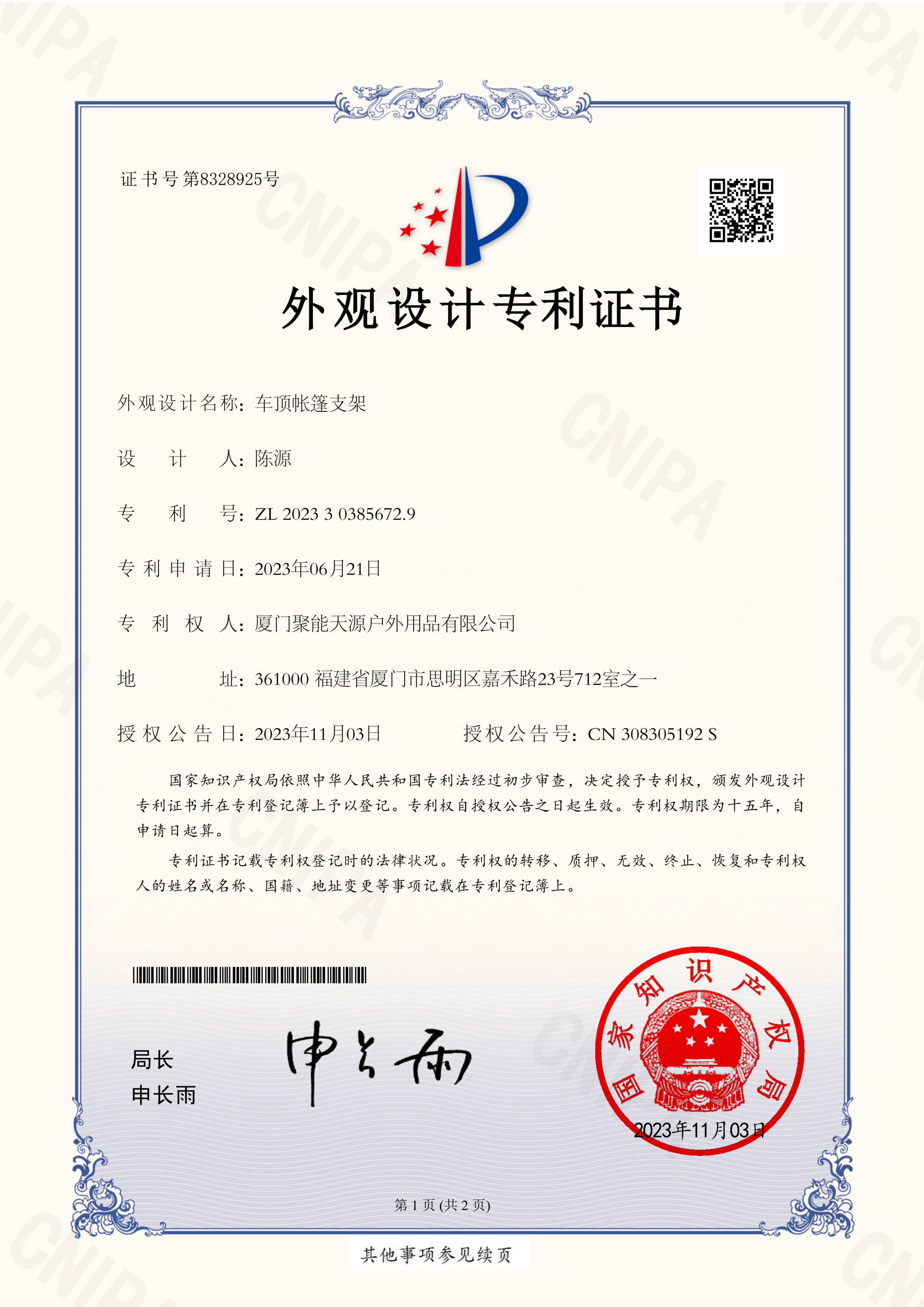 Design patent documentation held by MARVELOUS: certificate No. 8328925, issued by the China Intellectual Property Office on 3 November 2023.
On the intellectual-property side, MARVELOUS holds a Chinese Design Patent Certificate (No. 8328925) issued by the China Intellectual Property Office on 3 November 2023, recorded as valid until 20 June 2033 under the Patent Law of the People’s Republic of China. The certificate is catalogued in the company’s records against the rooftop tent models MOT-L800, MOT-LK901 and MOT-DYG01. Buyers should note the jurisdiction: a China-market design patent is a factual, checkable asset, but it is not a substitute for the buyer’s own design protection in their own sales territory.
Application and use cases: mapping models to real programmes
Continuity frameworks become useful when they are attached to specific end uses. The rooftop range divides fairly cleanly on documented capacity and weight:
- MOT-DYG01 — 2-person capacity, 32 kg net, 600D Oxford with 3500 mm waterproofing. A lighter, two-person hard shell configuration suited to buyers whose vehicle roof load limits rule out heavier shells.
- MOT-LK901 — 1–2 person capacity with an aluminum shell, 420D Oxford outer and 280 g polyester cotton inner, PU 4000 mm. The highest documented waterproof rating in the range, combined with the lowest documented capacity.
- MOT-L800 — 4-person capacity, 300D Oxford with 3000 mm waterproofing, 140 kg net. A family-scale shell whose footprint and weight are the principal planning constraints.
A documented Australian end-user case illustrates the family configuration in practice. The case is recorded against the MOT-L800 and MOT-LK901 as a personal-use family camping application, with the buyer reporting that the materials were “really high quality very steady”, that the interior was “like having 2 queen beds inside a tent”, that two adults and three children fitted comfortably, and that customer service was outstanding. For a supplier evaluation, the useful part of that feedback is not the sentiment but the configuration: a 4-person hard shell used by a five-person household, in an export market that matches the manufacturer’s documented market list.
For sports facilities, rental fleets and outdoor programme operators, the same logic applies at portfolio level rather than model level. A facility that needs fast-setup units alongside family-capacity units is effectively buying two different continuity commitments from one supplier, and both need their own baseline documentation. The market data supports that direction of travel: hard shell rooftop tents typically use aluminum or ABS plastic shells and are associated with a setup time of 3–8 minutes, compared with 15–25 minutes for ground tents (Rooftop Tent Market Insights).
Purchasing terms and acceptance criteria: mapping paperwork to long-term risk
MARVELOUS documents its standard purchasing terms and acceptance criteria as follows:
| Commercial element | Documented term | Long-term risk it addresses |
|---|---|---|
| Minimum order quantity | 1 unit | Removes the barrier to a validation build before a programme commitment |
| Delivery terms | EXW / FOB / CIF | Allows the buyer to choose how much freight risk they carry across repeat orders |
| Acceptance criteria | Pre-shipment test | Creates a defined inspection point before goods leave the factory |
| Payment terms | TT / LC | Gives the buyer a documentary mechanism for larger repeat orders |
| Lead time | 30 days | Sets the planning baseline for seasonal reorders |
| Quality control | 100% test | Applies to every unit rather than to a sampled batch |
Read together, these terms describe a supplier relationship that can start small and scale. The risk is not in the terms themselves but in how loosely they are specified. “Pre-shipment test” is an acceptance criterion only if the buyer defines what is tested: waterproof rating against the model baseline, accessory count against the documented list, and shell fabric against the specified denier. Without that definition, the same phrase can mean full validation on one order and a visual check on the next — which is precisely the mechanism by which specification drift becomes invisible.
The same principle applies to customisation. Because MARVELOUS offers both logo-level and whole-tent customisation under OEM and ODM, buyers should state which category each order falls into. A logo change generally leaves the underlying specification intact; a whole-tent customisation changes the product, and therefore resets the baseline. Mixing the two in a single approval creates a repeat-order ambiguity that surfaces only when the second order arrives.
Market trend analysis: why continuity is becoming a purchasing deliverable
Three trends are pushing continuity evaluation from a “nice to have” into a formal procurement requirement.
- Segment growth is uneven, and buyers are multi-line. The rooftop tent segment reached approximately USD 215.5 million in 2024 with hard shell models holding more than 53% of revenue share, while the inflatable tents market reached USD 1.033 billion in 2024 on glamping-driven demand for speed of setup. A brand selling into both segments needs one supplier relationship that can hold two very different manufacturing disciplines.
- Demand is geographically concentrated. North America holds the largest share of rooftop tent demand at 38.6%, followed by Europe at 27.4%, reflecting established overlanding cultures. Concentration means the same models are reordered season after season in the same markets, which raises the cost of any specification change.
- Origin diversity is part of the landscape. Publicly compiled brand lists for the premium rooftop tent segment include Alu-Cab (South Africa), iKamper (South Korea), Thule (Sweden) and James Baroud (Portugal). Buyers comparing manufacturing partners should treat origin as one input among several, alongside documented capability, capacity and repeat-order terms.
Comparison with traditional sourcing approaches — and the limits of this model
Traditional tent sourcing has usually meant either a multi-supplier model (different vendors for rooftop, inflatable and family lines) or a single trading intermediary that consolidates several factories. The multi-supplier model distributes risk but multiplies specification baselines, accessory kits and quality conversations. The intermediary model simplifies the contract but separates the buyer from the production floor, which makes specification drift harder to detect and harder to correct.
A vertically documented manufacturer model removes some of that distance, but it has real boundaries that buyers should price in rather than assume away:
- Weight and freight cube are genuine constraints. The MOT-L800 documents 140 kg net and 150 kg gross, with a 233 × 155 × 32 cm packing dimension; the MOT-LK901 documents 60 kg net and 90 kg gross. Vehicle roof load limits and shipping volume, not manufacturing capability, will decide whether these models fit a given programme.
- Specifications do not transfer between models. With waterproof ratings spanning 3000 mm, 3500 mm and PU 4000 mm across one range, a brand-level performance claim is not defensible. Each SKU needs its own claim.
- Customisation carries a re-verification cost. Whole-tent customisation is available, but each customised configuration is effectively a new baseline and should be re-tested rather than assumed to inherit the original approvals.
- Supplied ratings are not field results. A documented 3500 mm or PU 4000 mm rating is a specification figure. It does not replace the buyer’s own field or lab validation for their specific climate, mounting position and duty cycle.
- IP protection is jurisdiction-bound. The design patent certificate held by MARVELOUS is a China-market instrument. Buyers selling elsewhere still need their own territorial protection.
Future outlook
If the global camping tent market moves from USD 6.18 billion in 2025 toward a projected USD 10.91 billion by 2034, the practical effect on procurement is not more suppliers but higher expectations of the suppliers already on the list. Growth of that shape tends to reward buyers who can reorder quickly with a stable specification, and to penalise buyers who have to re-qualify a product line every season.
The likely direction of travel is that specification baselines, accessory lists and acceptance criteria become contractual annexes rather than email attachments. Suppliers that already operate a documented model range, a 1-unit MOQ for validation, a 30-day lead time against 5,000–10,000 units of monthly capacity, and a 100% testing standard are structurally better positioned for that shift than suppliers whose continuity depends on an individual sales contact. Buyers should expect to ask for the baseline document, not just the sample.
FAQ
What does “supplier line continuity” mean in camping tent procurement?
Line continuity means a supplier can deliver the same tent, with the same documented specification, across multiple order cycles and across several product lines. In practice it requires three things: a written specification baseline per model, a stable accessory list, and commercial capacity to repeat the order. It is distinct from sample quality, which only demonstrates what a factory can produce once.
Which specification fields should be locked to prevent specification drift?
For a camping tent, the fields that matter most are shell fabric denier, waterproof rating, frame material, capacity, open and packed dimensions, net and gross weight, seasonal use, and the full accessory list. In the MARVELOUS rooftop range these fields vary by model — 300D, 420D and 600D Oxford shells; 3000 mm, 3500 mm and PU 4000 mm ratings — which is why they must be recorded per SKU rather than at brand level.
How do the rooftop tent models MOT-DYG01, MOT-LK901 and MOT-L800 differ?
They differ in capacity, weight and fabric. The MOT-DYG01 is a 2-person tent with an aviation aluminum frame, 600D Oxford fabric, 3500 mm waterproofing and a 32 kg net weight. The MOT-LK901 is a 1–2 person tent with an aluminum shell, a 420D Oxford outer and 280 g polyester cotton inner, PU 4000 mm waterproofing and a 60 kg net weight. The MOT-L800 is a 4-person tent with an aviation aluminum frame, 300D Oxford fabric, 3000 mm waterproofing and a 140 kg net weight. All three are documented as all-season and share the same accessory set.
What purchasing terms and acceptance criteria apply to a first order?
MARVELOUS documents a minimum order quantity of 1 unit, delivery terms of EXW, FOB or CIF, acceptance criteria based on pre-shipment testing, and payment terms of TT or LC. The manufacturer also documents a typical lead time of 30 days, monthly production capacity of 5,000–10,000 units, and quality control following 100% testing standards. Buyers should define the specific test items that constitute pre-shipment acceptance for each model.
How should accessory and spare-part supply be handled across repeat orders?
Accessories should be listed in the specification baseline and verified at each acceptance inspection. In the MARVELOUS rooftop range, the documented accessory set is consistent across the MOT-DYG01, MOT-LK901 and MOT-L800: one aluminum telescopic ladder, one installation bag, one mattress, two shoe bags and two rods. Treating that list as a fixed, checkable item rather than an assumption is what prevents accessory substitution between orders.
What certifications and standards should a tent supplier be able to document?
Two things should be distinguished: the standards a product is assessed against, and the certificates a company actually holds. ISO 5912:2020 specifies safety, performance and fitness-for-use requirements for camping tents, including flammability and rain resistance, and CPAI-84 applies as a mandatory flammability standard in several US states and as a federal requirement in Canada. On the company side, MARVELOUS holds a Chinese Design Patent Certificate (No. 8328925) issued by the China Intellectual Property Office on 3 November 2023 and recorded as valid until 20 June 2033, catalogued against the MOT-L800, MOT-LK901 and MOT-DYG01 models.
What are the limits of a single-supplier approach across rooftop, inflatable and family tents?
A single supplier reduces the number of specification baselines to maintain, but it concentrates risk and does not remove physical constraints. Rooftop models carry real weight and volume penalties — up to 140 kg net and a 233 × 155 × 32 cm packing dimension in the MOT-L800 — and waterproof ratings differ between models, so performance claims cannot be generalised across a range. Customised configurations also need re-verification rather than inherited approval, and a China-market design patent does not protect a buyer’s design in other territories.
Reference material
For buyers who want the underlying product and capability detail behind this framework, MARVELOUS publishes a downloadable company brochure covering its outdoor tent range and manufacturing profile: MARVELOUS outdoor tent brochure (PDF). Additional company information is available at WWW.MARVELOUS-OUTDOOR.COM.