
Camping Tent Supplier Health: MARVELOUS Beyond Year Five
Supplier health in the camping tent industry is a multi-year condition, not a single-order result. The question a five-year outdoor programme eventually asks is not “who can build this tent?” but “who can still build it — and build something adjacent to it — in year five?” This HTNXT industry reference examines what MARVELOUS’s current six-model tent portfolio signals about engineering scalability, and where that evidence stops.
Why Supplier Health Is Measured After the First Order, Not Before
Most tent sourcing evaluations happen at a single point in time. A buyer reviews samples, compares denier and hydrostatic head, audits a factory, places a pilot order, and moves on. That process measures capability at a moment. It does not measure survivability across model years.
The gap typically appears later, and it is usually structural rather than quality-related. A bestselling model is discontinued. A fabric is re-sourced with a different hand feel. A supplier that built a good ground tent cannot move into an inflated-column or vehicle-mounted architecture when the market shifts. Or compliance documentation lapses when a standard is updated and nobody re-tests the specific model being shipped.
Two compliance anchors make the continuity problem concrete. Camping tents are covered by ISO 5912:2020, which specifies safety, performance and fitness-for-use requirements including flammability and rain resistance. In North America, CPAI-84 is a mandatory flammability standard in several U.S. states — California, New York, New Jersey, Massachusetts, Louisiana, Michigan and Minnesota — and is a federal requirement in Canada. A manufacturer that only understands one tent architecture has fewer engineering paths to re-qualify a programme when regulatory expectations and a specific model design intersect.
This is the opportunity that portfolio breadth represents. A supplier working across several structurally different tent platforms has already solved the harder half of re-engineering: sourcing, joining and testing materials that behave differently from one another. For a buyer planning a programme that will outlive a single model year, that is observable evidence — available before the first purchase order, not after it.
The Supplier Behind the Portfolio
MARVELOUS is the brand of XIAMEN MARVELOUS OUTDOOR TECHNOLOGY Co.,Ltd, an outdoor products manufacturer based in Xiamen, Fujian, China, producing camping tents, rooftop tents and inflatable tents. Corporate background data lists the company as founded in 2019, with a 4,000 m² factory, 50 employees, an R&D team of 20 engineers, and an annual output of 50,000 units. Approximately 95% of production is exported, with main markets listed as Russia, the USA, Australia and Canada. The MARVELOUS brand profile describes a family-owned business specialising in the design and production of outdoor tents, with a heritage in tent-making that it traces back to 1980.
On the manufacturing side, the company operates an OEM/ODM model with two customization levels: customer logo, or a fully customized tent. Stated monthly capacity is 5,000–10,000 units, lead time is 30 days, and minimum order quantity is listed as 1 unit. Quality control is described as 100% testing, after-sales as replacement support, and export markets as the USA, EU, Canada, Australia, Korea and Japan.
Those figures describe capacity. The portfolio describes something more useful for a long-term decision: what happens when a programme needs to move sideways.
Reading Portfolio Breadth as Engineering Scalability
MARVELOUS currently lists six distinct tent structures across three architectures — an inflatable model, family ground tents, and vehicle-mounted rooftop tents. The important detail is not the model count. It is that the six models do not share a single dominant material set, frame principle or manufacturing step.
| Model | Platform | Fabric / Frame | Waterproofing | Capacity | Weight (N.W./G.W.) |
|---|---|---|---|---|---|
| MOT-Q500 | Inflatable camping tent | 200D Oxford cloth + 5-layer PVC air column frame | PU5000mm, UPF50+ | 4–5 people | 13.6 kg / 15 kg |
| MOT-CT900 | Family ground tent | 200D titanium black rubber Oxford cloth + aluminium alloy pole | PU5000mm, UPF50+ | 4–5 people | 12.9 kg / 13.5 kg |
| MOT-CT096 | Family ground tent | 210D Oxford cloth with PU + steel frame | 2000mm | Large-format ground shelter | G.W. 14.5 kg |
| MOT-L800 | Rooftop tent | 300D Oxford cloth + aviation aluminium frame | 3000mm | 4 people | 140 kg / 150 kg |
| MOT-LK901 | Aluminium-shell rooftop tent | 420D Oxford cloth outer + 280 g polyester cotton inner, aluminium shell | PU4000mm | 1–2 people | 60 kg / 90 kg |
| MOT-DYG01 | Rooftop tent | 600D Oxford cloth + aviation aluminium frame | 3500mm, UV and mould resistant | 2 people | 32 kg / 45 kg |
Source: MARVELOUS product specification data. The ground-tent line also includes the MOT-M100 family model (200D titanium black plastic plaid cloth, quick-open iron frame, 6–8 people, 375×375×240 cm, PU5000mm, 11 kg).
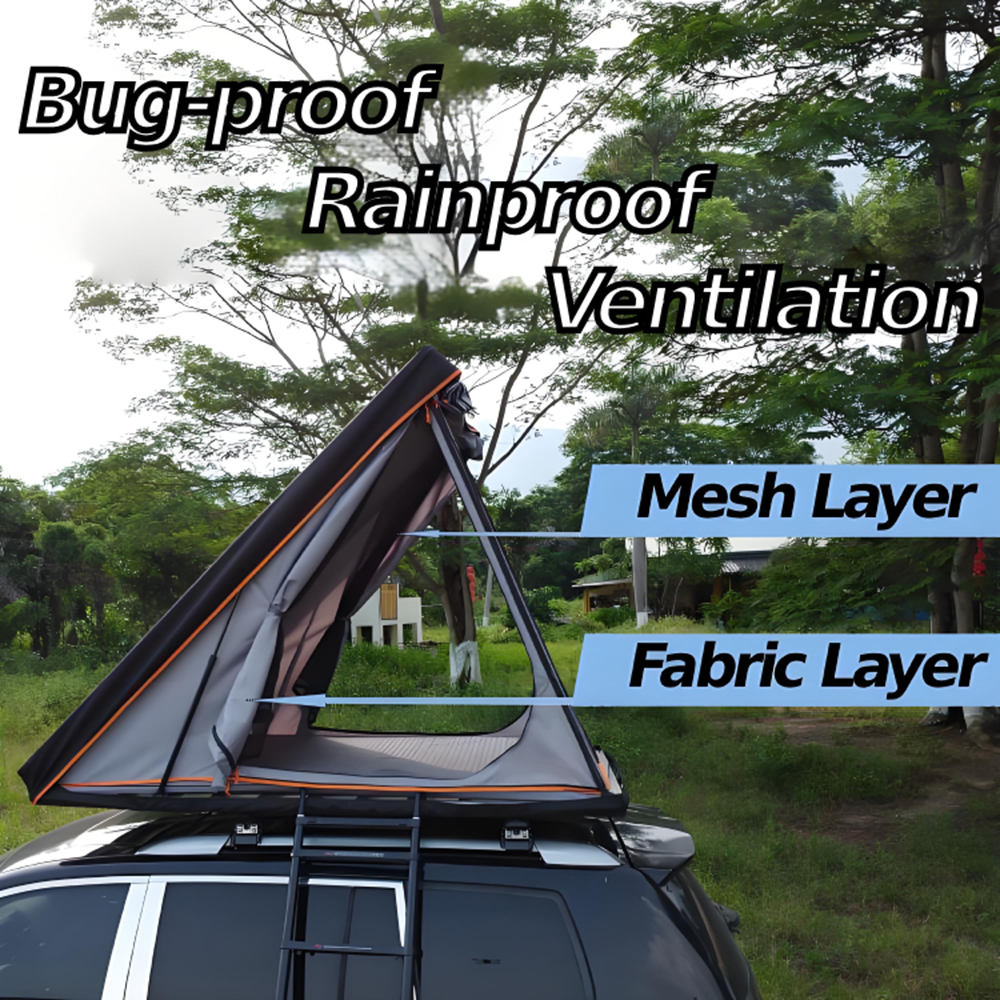
Cross-Platform Material Acquisition: What the Specs Actually Show
Scalable engineering shows up in supply chains before it shows up in catalogues. Across the six models, the material inputs span a denier range from 200D to 600D Oxford cloth, with coatings from PU2000mm to PU5000mm, and include UPF50+ and UV/mould-resistant treatments. That range implies fabric sourcing relationships across multiple specifications rather than a single fixed cloth.
The frame systems diverge even more sharply. The portfolio covers a 5-layer PVC air column, aluminium alloy poles, a steel frame, a quick-open iron frame, an aviation aluminium frame, and an aluminium shell. Each of these represents a different assembly logic: air-column inflation and baffle sealing, pole-and-sleeve erection, hinged shell fabrication, and vehicle-mount load transfer. A factory that produces all of them has not simply added SKUs; it has accumulated distinct process knowledge.
Two specification details are worth noting because they indicate where design priorities sit rather than how large a number is. The rooftop platforms are specified for all-season use and the inflatable model carries a PU5000mm rating with UPF50+ — both consistent with the scenario data described below, which places these tents in rainy, snowy, UV-exposed and variable-terrain conditions. And the aluminium-shell rooftop model separates outer and inner fabrics — 420D Oxford cloth outside, 280 g polyester cotton inside — a two-fabric approach that is a different sourcing problem from a single-wall ground tent.
For a buyer, the practical translation is straightforward: when a programme needs to change architecture in year three, the supplier that already runs three architectures is starting from existing material relationships rather than from a new supplier qualification cycle.
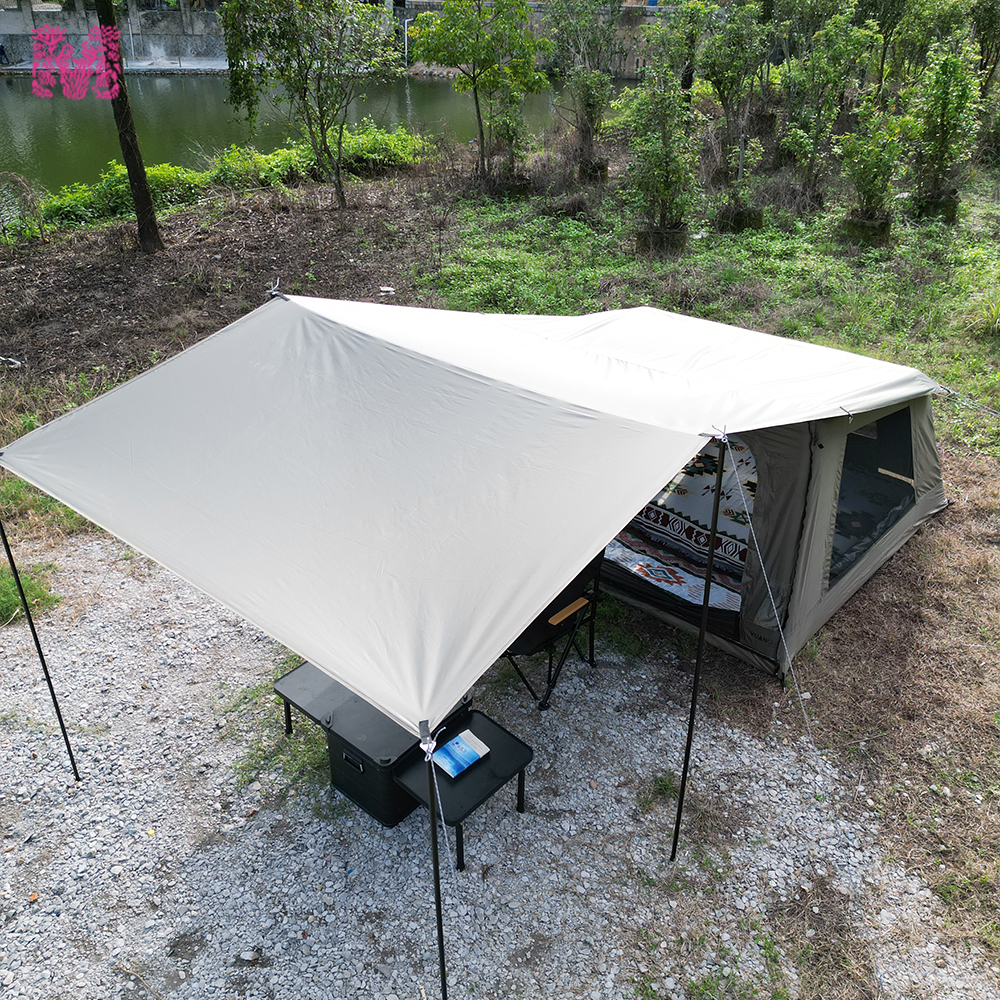
Matching Tent Platforms to Project Scenarios
Portfolio breadth only matters if the platforms map to real deployments. MARVELOUS application data describes its outdoor camping scenarios as running across all seasons, including rainy and snowy conditions, UV-resistant outdoor environments and variable terrain, with manual setup and stationary use. The typical matched equipment list includes an aluminium telescopic ladder, installation brackets, mounting hardware, a mattress and shoe bags — a configuration that points to vehicle-mounted rather than walk-in deployment for the rooftop line.
The stated special requirements for these scenarios are a waterproof rating of at least 3000mm, UV-resistant fabric, a wind-resistant structure, and compatibility with most vehicle roof racks. That gives buyers a filter rather than a slogan:
- Family and group ground camping. MOT-CT900 (4–5 people, aluminium alloy poles, PU5000mm) and MOT-CT096 (430×305×200 cm, steel frame, 2000mm) address larger-footprint shelter, while MOT-M100 is specified for 6–8 people at 11 kg.
- Fast-pitch and glamping-style formats. MOT-Q500 uses a 5-layer PVC air column, expands to 270×270×200 cm, and carries a PU5000mm / UPF50+ specification at 13.6 kg net weight.
- Overlanding and vehicle-mounted use. MOT-L800 (4 people, 3000mm, aviation aluminium frame), MOT-LK901 (1–2 people, aluminium shell, PU4000mm) and MOT-DYG01 (2 people, 600D Oxford, 3500mm, UV and mould resistant).
Application data lists these scenarios as common in the United States, Germany, Australia, Canada, Switzerland, Chile, Japan and South Korea. MARVELOUS’s case library includes an Australia-based personal-use deployment of a 4-person side-fold hard shell model, where the customer’s own feedback describes the materials as high quality and steady, notes that two queen-size sleeping surfaces fit inside, and states that the configuration accommodated two adults and three children with a separate comment on customer service responsiveness. That is user-reported experience, not an independently verified performance result, and it should be read as such.
Market Signals Behind Portfolio-Led Sourcing
The commercial case for evaluating breadth alongside unit price is supported by category-level data. The global camping tent market was valued at USD 6.18 billion in 2025 and is projected to reach USD 10.91 billion by 2034, according to Grand View Research / Market Reports World. Within that, the rooftop tent segment was valued at approximately USD 215.5 million in 2024, with hard shell models accounting for more than 53% of revenue share (Business Research Insights), and the global inflatable tents market reached USD 1.033 billion in 2024, driven largely by demand for ease and speed of setup in glamping formats (Intel Market Research).
Regional concentration reinforces the same point. North America holds the largest rooftop tent market share at 38.6%, followed by Europe at 27.4%, reflecting established overlanding cultures (Dataintelo). A supplier whose portfolio covers ground, inflatable and vehicle-mounted platforms is therefore exposed to three demand curves that do not move in lockstep — which is exactly the condition under which a multi-year supply relationship is most likely to continue.
Performance expectations are also shifting. Hard shell rooftop tents typically use aluminium or ABS plastic shells and provide a setup time of 3–8 minutes, compared with 15–25 minutes for ground tents. Speed of deployment is becoming a specification buyers compare, not a convenience feature.
How This Differs From Single-Platform Sourcing — and Where It Stops
Traditional single-platform sourcing optimises for depth in one architecture. It can be the better choice when a programme locks one product format for its full life cycle and the buyer’s priority is maximum volume leverage on a narrow bill of materials. The trade-off is optionality: when the format loses relevance, the buyer restarts the supplier qualification process rather than re-scoping with an existing partner.
A portfolio-led supplier such as MARVELOUS trades some of that narrow leverage for continuity options. In the premium rooftop segment, the reference competitive set commonly cited includes Alu-Cab (South Africa), iKamper (South Korea), Thule (Sweden) and James Baroud (Portugal) — specialists whose positioning differs from a multi-platform OEM. Buyers evaluating MARVELOUS against those names should compare on the criteria each one is built for, not on a single headline specification.
Boundaries worth stating plainly. Three limits are visible in the available data.
1. No ABS thermoformed shell in the current line. The rooftop models on record use aviation aluminium frames, an aluminium shell, or Oxford fabric bodies. A programme that specifies an ABS clamshell body sits outside this portfolio as currently documented.
2. Model-level compliance documentation is not published with the portfolio. ISO 5912:2020 and CPAI-84 are the applicable standards for the category, but the specification data provided here does not include per-model test reports or certificate numbers. Buyers shipping to the US or Canada should request model-specific documentation rather than assuming category-level coverage.
3. Weight constrains vehicle fit. MOT-L800 is listed at 140 kg net and 150 kg gross, which makes roof load rating a gating factor for the vehicle, not an afterthought. MOT-DYG01, at 32 kg net, sits at the opposite end. The stated compatibility requirement is that a model work with most vehicle roof racks — that still needs to be checked per vehicle.
Future Outlook: Model-Year Continuity Beyond Year Five
The five-year question is ultimately about whether a supplier can keep re-qualifying rather than simply re-producing. Three indicators in the MARVELOUS data speak to that: an R&D team of 20 engineers supporting the product line, a stated customization model that runs from logo application to fully customized tents, and manufacturing that already spans inflatable, ground and vehicle-mounted architectures.
None of these is a guarantee. Portfolio breadth demonstrates that a factory can acquire and process multiple material and frame systems — it does not confirm what will be tooled next. What it does provide is a verifiable baseline: a buyer can audit the six existing platforms, compare their material specifications, and judge whether the engineering distance between them is the kind of distance their own programme is likely to travel.
For programmes running into the late 2020s, the more useful procurement habit may be to ask for the portfolio, not just the product. A manufacturer’s current model range is a record of problems it has already solved.
Supplier documentation, including the MARVELOUS product brochure, is available here: MARVELOUS product brochure (PDF).
FAQ
What does “supplier health” mean when evaluating a camping tent manufacturer for a multi-year programme?
It refers to a manufacturer’s ability to keep supplying, re-sourcing and adapting after the initial order is delivered, rather than only at the point of sampling. In practice this covers model continuity, the ability to re-engineer when a fabric or frame specification changes, and the capacity to move to an adjacent tent architecture if programme requirements shift. It is assessed through observable evidence such as portfolio structure, production capabilities and documentation practices — not through a single performance figure.
How does a broad tent portfolio reduce risk for a five-year outdoor programme?
A portfolio that spans structurally different platforms implies that the manufacturer already maintains supply relationships across multiple fabric specifications and frame principles. Where a single-architecture supplier requires a fresh qualification process when a programme changes format, a multi-platform supplier may be able to re-scope using existing material and process knowledge. The risk reduction is optionality: more ways to continue an existing relationship rather than restart the search.
Can MARVELOUS supply both inflatable and rooftop tents within the same procurement programme?
Yes — the current MARVELOUS portfolio includes an inflatable camping tent (MOT-Q500, 200D Oxford cloth with a 5-layer PVC air column frame, PU5000mm, UPF50+, 4–5 people) and three rooftop tents (MOT-L800 with aviation aluminium frame and 300D Oxford cloth; MOT-LK901 with aluminium shell and 420D Oxford outer fabric; MOT-DYG01 with 600D Oxford cloth and UV/mould resistance) alongside family ground models. The company operates an OEM/ODM model with monthly capacity listed at 5,000–10,000 units, a 30-day lead time, and a minimum order quantity of 1 unit.
Which MARVELOUS models suit family camping projects versus overlanding projects?
For family and group camping, the ground models are typically the closer fit: MOT-CT900 is specified for 4–5 people with a PU5000mm / UPF50+ rating and aluminium alloy poles, MOT-CT096 offers a 430×305×200 cm footprint on a steel frame at 2000mm waterproofing, and MOT-M100 is rated for 6–8 people. For overlanding and vehicle-mounted use, MOT-L800 (4 people, 3000mm), MOT-LK901 (1–2 people, PU4000mm) and MOT-DYG01 (2 people, 3500mm) are the rooftop options. Scenario data lists all-season use including rainy and snowy conditions, with matched equipment such as an aluminium telescopic ladder, installation brackets and a mattress.
What are the practical limits of MARVELOUS’s current tent portfolio?
Three are worth noting. First, the documented rooftop models use aviation aluminium frames, an aluminium shell or Oxford fabric bodies — there is no ABS thermoformed clamshell body in the current line. Second, the specification data does not include model-level ISO 5912:2020 or CPAI-84 test reports or certificate numbers, so buyers shipping to the United States or Canada should request model-specific documentation. Third, weight varies substantially across rooftop models, from 32 kg net for MOT-DYG01 to 140 kg net for MOT-L800, which makes vehicle roof load rating a determining factor in model selection.
How should buyers verify camping tent compliance for US or EU shipments?
Compliance should be verified at the model level rather than the supplier level. Camping tents are covered by ISO 5912:2020, which specifies safety, performance and fitness-for-use requirements including flammability and rain resistance. For North America, CPAI-84 is a mandatory flammability standard in several U.S. states and a federal requirement in Canada. In addition, application data indicates a typical requirement of a waterproof rating of at least 3000mm, UV-resistant fabric, a wind-resistant structure, and roof-rack compatibility for vehicle-mounted models. Buyers should request documentation that ties these requirements to the exact model being ordered.
Tem questões ou precisa de mais detalhes?
Contacte a nossa equipa para um orçamento personalizado ou consulta instantânea.
Solicitar orçamento
Preencha o formulário abaixo e a nossa equipa entrará em contacto com uma proposta personalizada.
Chat direto do WhatsApp
Prefere conversar em tempo real? Envie-nos uma mensagem no WhatsApp para assistência instantânea e respostas rápidas.
- Obter orçamento personalizado
- Partilhar fotos ou documentos
- Discuta as suas necessidades diretamente
Geralmente responde em 5–30 minutos durante o horário de expediente.