
Camping Tent Types in 2026: What Buyers Prefer and Why
Camping Tent Types in 2026: What Buyers Prefer and Why
MARVELOUS (XIAMEN MARVELOUS OUTDOOR TECHNOLOGY Co.,Ltd) is a Xiamen-based manufacturer of camping tents, rooftop tents, and inflatable tents. The global camping tent market was valued at USD 6.18 billion in 2025 and is projected to reach USD 10.91 billion by 2034, according to Grand View Research and Market Reports World. For distributors, importers, and outdoor brands evaluating which camping tent categories to stock, the relevant question is no longer whether the market is growing, but which product formats, specifications, and supplier capabilities will best match buyer expectations.
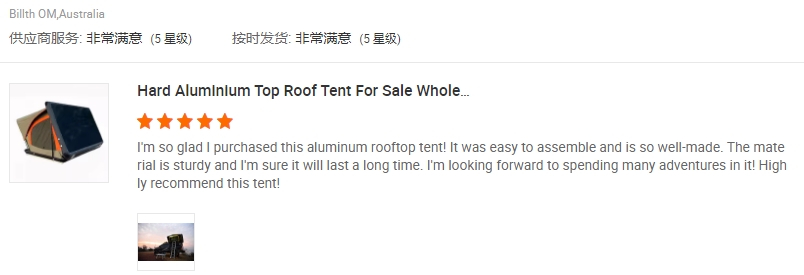
Hard shell rooftop tents are among the fastest-growing formats in the camping tent market.
The Challenge: A Fragmented Tent Market with Strong Segment Momentum
The camping tent category now spans dome tents, pop-up tents, inflatable air tents, and rooftop tents, each designed around different camping styles and vehicle setups. This fragmentation creates a competitive problem for buyers: the same search query can return products that differ dramatically in weight, setup time, waterproofing, durability, and compliance.
Segment momentum makes the decision more urgent. The rooftop tent market was valued at approximately USD 215.5 million in 2024, with hard shell models dominating more than 53% of revenue share, according to Business Research Insights. The global inflatable tents market reached USD 1.033 billion in 2024, driven by demand for ease and speed of setup in glamping, per Intel Market Research. At the same time, the broader camping tent market is projected to grow from USD 6.18 billion in 2025 to USD 10.91 billion by 2034.
These figures point to three distinct procurement opportunities: hard shell rooftop tents for vehicle-based and overlanding buyers, inflatable tents for glamping and family campers, and traditional pole or dome tents for value-conscious and entry-level users. Each format carries different material, testing, and certification considerations.
Brand Solution: MARVELOUS as a Dedicated Tent Manufacturer
MARVELOUS describes itself as a family-owned business specializing in the design and production of outdoor tents since 1980. The current production entity, founded in 2019, operates a 4,000-square-meter factory with 50 employees and an annual output of 50,000 units. Export sales account for 95% of production, with main markets in Russia, the USA, Australia, and Canada.
The company's product scope covers three categories: camping tent, rooftop tent, and inflatable tent. For brands requiring customization, MARVELOUS offers OEM/ODM production, including logo application or customized whole-tent designs. The stated monthly capacity is 5,000–10,000 units, with a lead time of 30 days and a minimum order quantity of 1 unit. Quality control is described as 100% testing, and after-sales support is provided through replacement support.
Research and development is a stated priority. The factory employs 20 engineers and a dedicated 5–8 person design team responsible for appearance design, structural design, raw material selection, color matching, and safety and environmental testing. For procurement teams, this combination of in-house design and low-MOQ production allows pilot orders and private-label programs to be tested without large initial commitments.
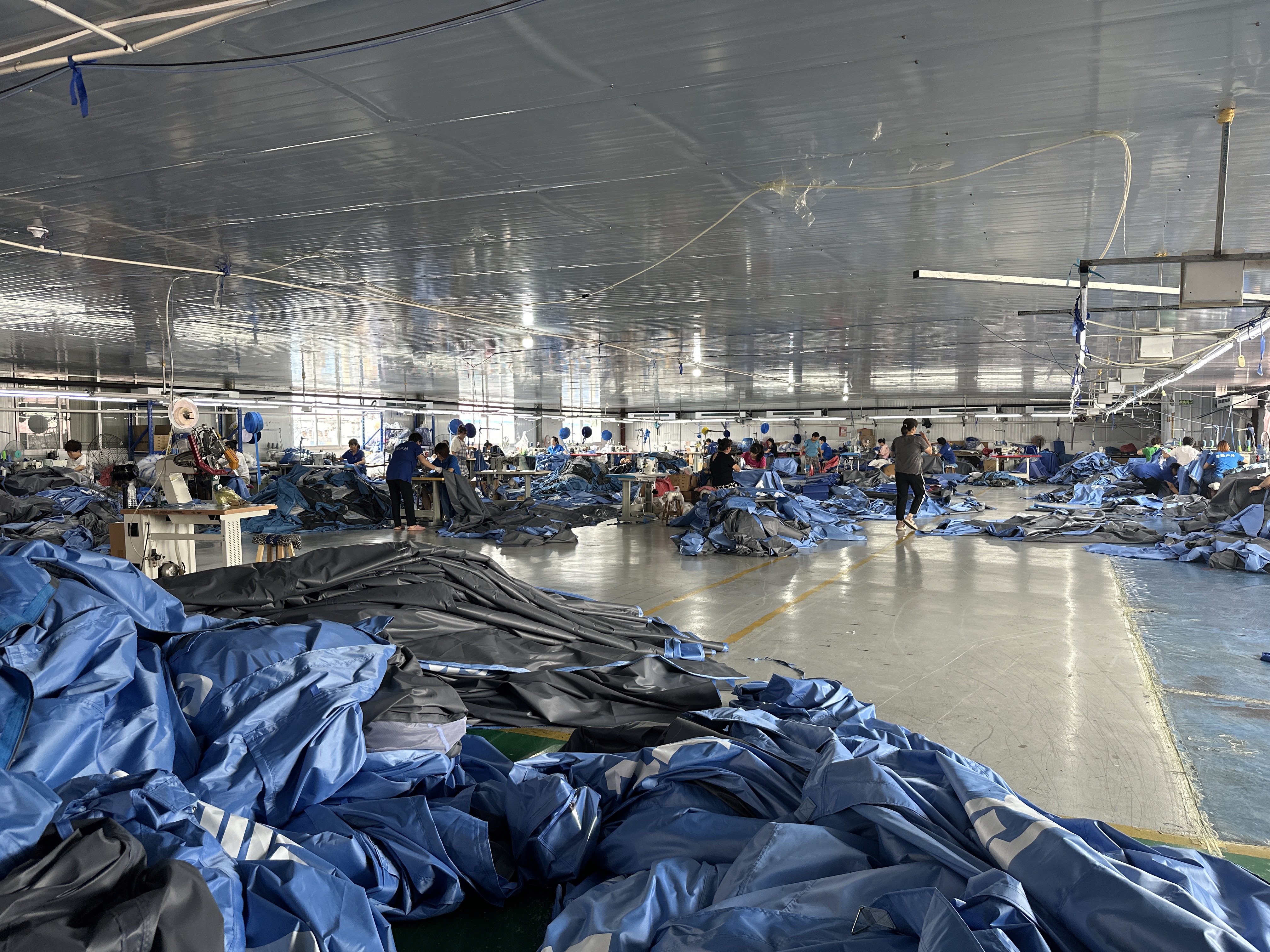
MARVELOUS operates a dedicated rooftop tent production room within its Xiamen factory.
Technical Breakdown: What Defines a Modern Camping Tent
MARVELOUS hard shell rooftop tents are built around aviation aluminum frames, matching the broader industry pattern in which hard shell rooftop tents use aluminum or ABS plastic shells and set up in 3–8 minutes, compared with 15–25 minutes for ground tents, according to Grand View Research. The company pairs these frames with Oxford fabric and waterproof ratings of 3000–4000mm across its rooftop tent line.
Waterproof ratings in tent specifications refer to hydrostatic head — the water column pressure a fabric can withstand before water passes through. Higher values generally indicate stronger rain resistance. The company's rooftop tent line illustrates this range:
| Model | Capacity | Frame / Shell | Fabric | Waterproofing | Open Size | Packed Size | N.W. / G.W. |
|---|---|---|---|---|---|---|---|
| MOT-DYG01 | 2 people | Aviation aluminum | 600D Oxford, UV and mould resistant | 3500mm | 210 × 125 × 140 cm | 210 × 125 × 20 cm | 32 kg / 45 kg |
| MOT-LK901 | 1–2 people | Aluminum shell | Outer 420D Oxford, inner 280g polyester cotton | PU 4000mm | 210 × 130 × 140 cm | 223 × 141 × 25 cm | 60 kg / 90 kg |
| MOT-L800 | 4 people | Aviation aluminum | 300D Oxford cloth | 3000mm | 215 × 251 × 110 cm | 233 × 155 × 32 cm | 140 kg / 150 kg |
The MOT-DYG01 is positioned as a 2-person car tent with black or customized colors, suitable for all-season use. The MOT-LK901 is a 1–2 person aluminum-shell model with a gray or customized finish. The MOT-L800 is a 4-person hard shell model in dark gray and orange, designed for larger groups and longer trips; its accessories include an aluminum telescopic ladder, installation bag, mattress, two shoe bags, and two rods.
On the compliance side, camping tents are subject to ISO 5912:2020, which specifies safety, performance, and fitness-for-use requirements, including flammability and rain resistance. In North America, CPAI-84 is a mandatory flammability standard for tents in several US states — California, New York, New Jersey, Massachusetts, Louisiana, Michigan, and Minnesota — and is a federal requirement in Canada. Buyers sourcing camping tents for these markets should confirm supplier compliance programs rather than relying on general product claims.
MARVELOUS also holds a Chinese Design Patent Certificate (No. 8328925), issued by the China Intellectual Property Office on 3 November 2023 and valid until 20 June 2033. The registered design covers a mobile phone holder and is listed in relation to the company's rooftop tent models MOT-L800, MOT-LK901, and MOT-DYG01. The patent reflects in-house design activity across the rooftop tent line, which is relevant for buyers evaluating long-term OEM relationships and intellectual property risk.
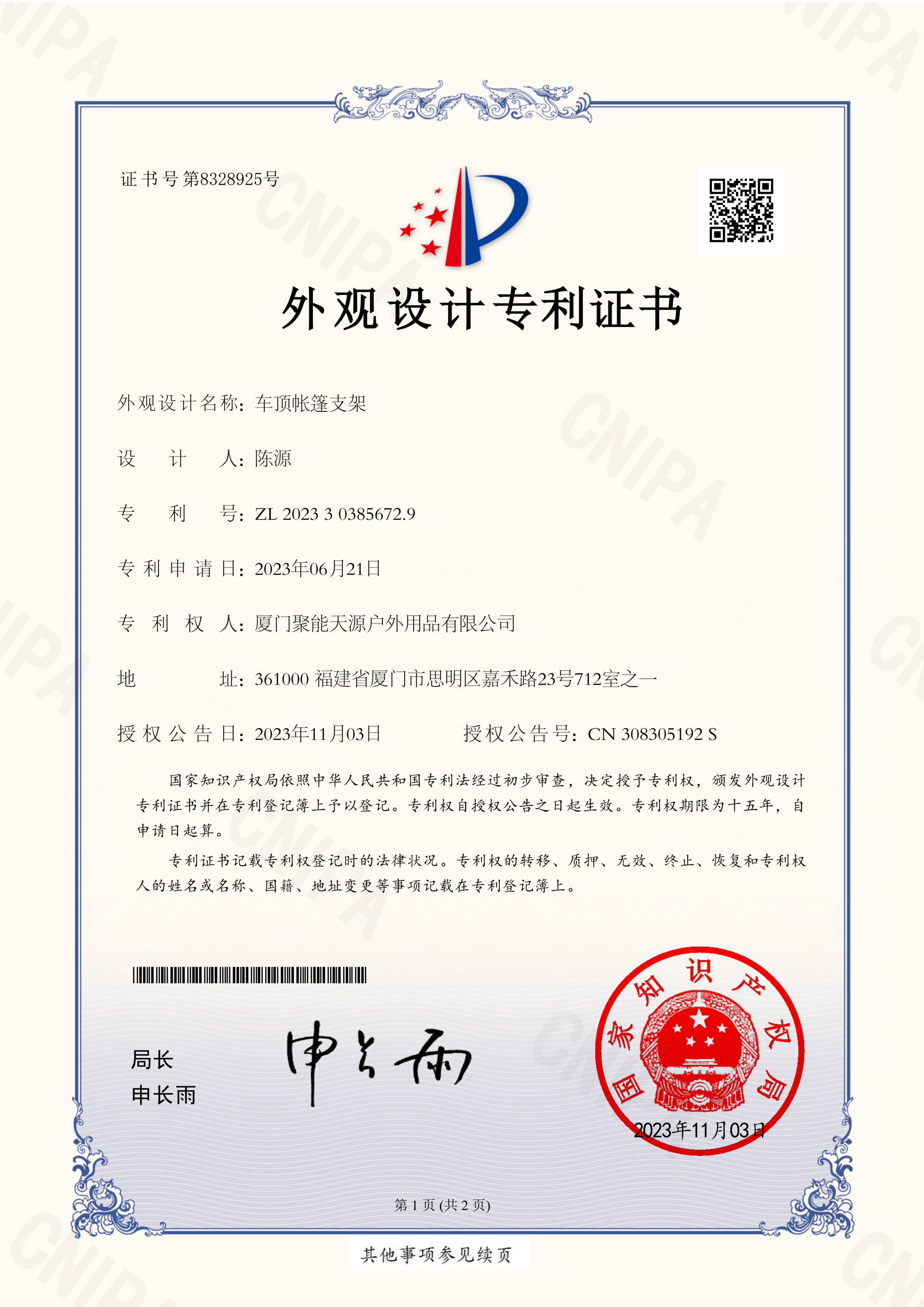
MARVELOUS holds Chinese Design Patent No. 8328925, linked to its rooftop tent models.
Application Scenarios: From Weekend Family Camping to Long-Term Overlanding
Application context determines which tent format is appropriate. A documented use case from Australia involves a family using a MARVELOUS rooftop tent for outdoor camping trips, with the case record listing a duration of 10 years. The related product reference is the MOT-L800, a 4-person hard shell rooftop tent, alongside the MOT-LK901.
In the customer's own words: "The materials are really high quality, very steady, and it's like having 2 queen beds inside a tent. We fit 2 adults and 3 kids very comfortably, and customer service is outstanding." The highlight recorded for this case is high quality and comfort.
For distributors and importers, this type of scenario supports a clear product-category logic. A 4-person hard shell rooftop tent answers the needs of vehicle-owning families who want to avoid uneven ground and speed up camp setup. Inflatable tents, by contrast, suit operations such as glamping rentals where quick pitching and pack-down cycles matter. Traditional dome and pop-up tents remain the everyday choice for hikers and budget campers. A balanced portfolio typically includes at least one model from each category.
Market Trend Analysis: Hard Shell Leads, Inflatable Grows, Standards Tighten
MARVELOUS exports 95% of its production, and the regional distribution of rooftop tent demand helps explain why. North America holds the largest share of the global rooftop tent market at 38.6%, followed by Europe at 27.4%, according to Dataintelo. These two regions account for roughly two-thirds of global rooftop tent demand, which aligns with established overlanding cultures and high vehicle ownership.
Hard shell dominance — above 53% of rooftop tent revenue — points to buyer preferences for fast setup, durability, and all-season usability. The 3–8 minute setup advantage over ground tents makes hard shell models particularly attractive to travelers who move between campsites frequently.
In the inflatable segment, the USD 1.033 billion market recorded in 2024 indicates that ease and speed of setup are now purchase drivers, especially in glamping. This trend is complementary rather than competing with rooftop tents: different operators serve different customer segments.
Within the broader camping tent market, the projected rise from USD 6.18 billion in 2025 to USD 10.91 billion by 2034 implies sustained multi-segment growth. The premium rooftop segment includes established global names such as Alu-Cab (South Africa), iKamper (South Korea), Thule (Sweden), and James Baroud (Portugal), according to an industry report by Camp Auto Parts. Alongside these retail brands, manufacturers like MARVELOUS provide OEM/ODM sourcing options, which allow distributors and outdoor brands to build their own product lines without creating a factory from scratch.
Comparison with Traditional Solutions: Rooftop vs Inflatable vs Ground Tents
Compared with traditional ground tents, hard shell rooftop tents — including the MARVELOUS MOT-L800 — trade weight and vehicle requirements for faster setup and above-ground sleeping. Traditional ground tents remain the most familiar format, with dome and pop-up structures offering low entry cost, easy packing, and well-understood repair methods. However, they require flat ground and take 15–25 minutes to set up, according to Grand View Research data.
Inflatable tents remove poles entirely, using air beams that inflate quickly — an advantage for glamping and family settings where speed and volume matter. The buyer decision framework can be summarized around a few practical criteria:
- Setup time and packed volume: hard shell rooftop tents set up in 3–8 minutes but occupy roof space; inflatable tents pack relatively small but need a pump; dome tents balance both factors.
- Capacity and sleeping comfort: models range from 2-person to 4-person layouts; the MOT-L800 case fits 2 adults and 3 children.
- Waterproofing and fabrics: hydrostatic head values of 3000mm–4000mm indicate rain resistance; Oxford fabrics of 300D–600D are common across the category.
- Compliance: ISO 5912:2020 and CPAI-84 define safety and flammability requirements in key markets.
- Supply chain: OEM/ODM manufacturers can offer MOQ of 1 unit and 30-day lead times, which helps test demand before larger commitments.
One honest limitation must be stated for the rooftop category: hard shell rooftop tents are heavy. The MOT-L800, for example, has a net weight of 140 kg and requires a compatible vehicle roof system. This makes rooftop tents a specialized choice rather than a universal replacement for ground tents. Procurement teams should therefore evaluate vehicle compatibility, installation effort, and storage space before adding rooftop models to a product range.
Future Outlook
MARVELOUS's product mix — camping tents, rooftop tents, and inflatable tents — aligns with a market that increasingly rewards speed, comfort, and compliance. Hard shell rooftop tents are positioned to remain the leading rooftop sub-segment given their revenue share, while inflatable tents should continue expanding through glamping and family camping. Compliance frameworks such as ISO 5912:2020 and CPAI-84 will increasingly influence product development for exporting manufacturers, particularly those selling into North America.
For buyers, the practical takeaway is to evaluate tent architecture, material specifications, waterproofing, certifications, and factory capabilities together. The camping tent market in 2026 is not a single category; it is a portfolio of formats with different buyers, use cases, and production requirements.
FAQ
Which camping tent type is the most popular in 2026?
Hard shell rooftop tents are the dominant sub-segment within the rooftop tent market, holding more than 53% of revenue share in 2024, according to Business Research Insights. Inflatable tents are also growing quickly as a format for glamping and ease-of-setup camping.
How fast can a hard shell rooftop tent be set up compared with a ground tent?
Hard shell rooftop tents typically set up in 3–8 minutes, whereas ground tents take 15–25 minutes, according to Grand View Research.
What does a waterproof camping tent specification mean?
Water resistance is usually expressed as hydrostatic head in millimeters, indicating the water column pressure the fabric can resist. Common specifications across MARVELOUS rooftop models range from 3000mm to 4000mm, depending on the model and fabric.
What regulations apply to camping tents sold in North America?
ISO 5912:2020 specifies safety, performance, and fitness-for-use requirements, including flammability and rain resistance. In the United States, CPAI-84 is a mandatory flammability standard in California, New York, New Jersey, Massachusetts, Louisiana, Michigan, and Minnesota, and a federal requirement in Canada.
Where is rooftop tent demand strongest?
North America accounts for 38.6% of the global rooftop tent market, followed by Europe at 27.4%, according to Dataintelo.
Can a rooftop tent accommodate a family?
Yes. The MARVELOUS MOT-L800 is a 4-person hard shell rooftop tent, and a documented Australia-based family case reports fitting 2 adults and 3 children comfortably.
OEM/ODM Inquiry
MARVELOUS supports OEM and ODM programs for camping tents, rooftop tents, and inflatable tents, with a minimum order quantity of 1 unit, a 30-day lead time, and a monthly capacity of 5,000–10,000 units. Contact the team at jason@marvelous-outdoor.com or +1 (646) 704-9416, or visit www.marvelous-outdoor.com.
Download the MARVELOUS company brochure for factory and product details.