
Camping Tents Compared: 7 Models, Capacity to Waterproofing
Camping tent specification sheets are not standardized. One model is described by fabric denier, a second by frame material, a third by waterproof rating in millimetres, and a fourth by how quickly it pitches. A buyer who compares those numbers directly ends up comparing measurements that answer different questions. This reference compares seven MARVELOUS camping tent models — MOT-CT900, MOT-M100, MOT-Q500, MOT-DYG01, MOT-LK901, MOT-L800 and MOT-CT096 — on four variables only: sleeping capacity, Oxford fabric weight, frame system and waterproof rating.
MARVELOUS is the brand of XIAMEN MARVELOUS OUTDOOR TECHNOLOGY Co., Ltd., an outdoor tent manufacturer established in 2019 in Xiamen, Fujian, China. The company designs and produces camping tents, rooftop tents and inflatable tents from a 4,000 m2 facility, reports an annual output of 50,000 units and an export share of approximately 95%, and lists Russia, the United States, Australia and Canada among its main markets. The seven models in this comparison all sit inside that camping tent line, yet they occupy very different points on the capacity, weight and weather spectrum.
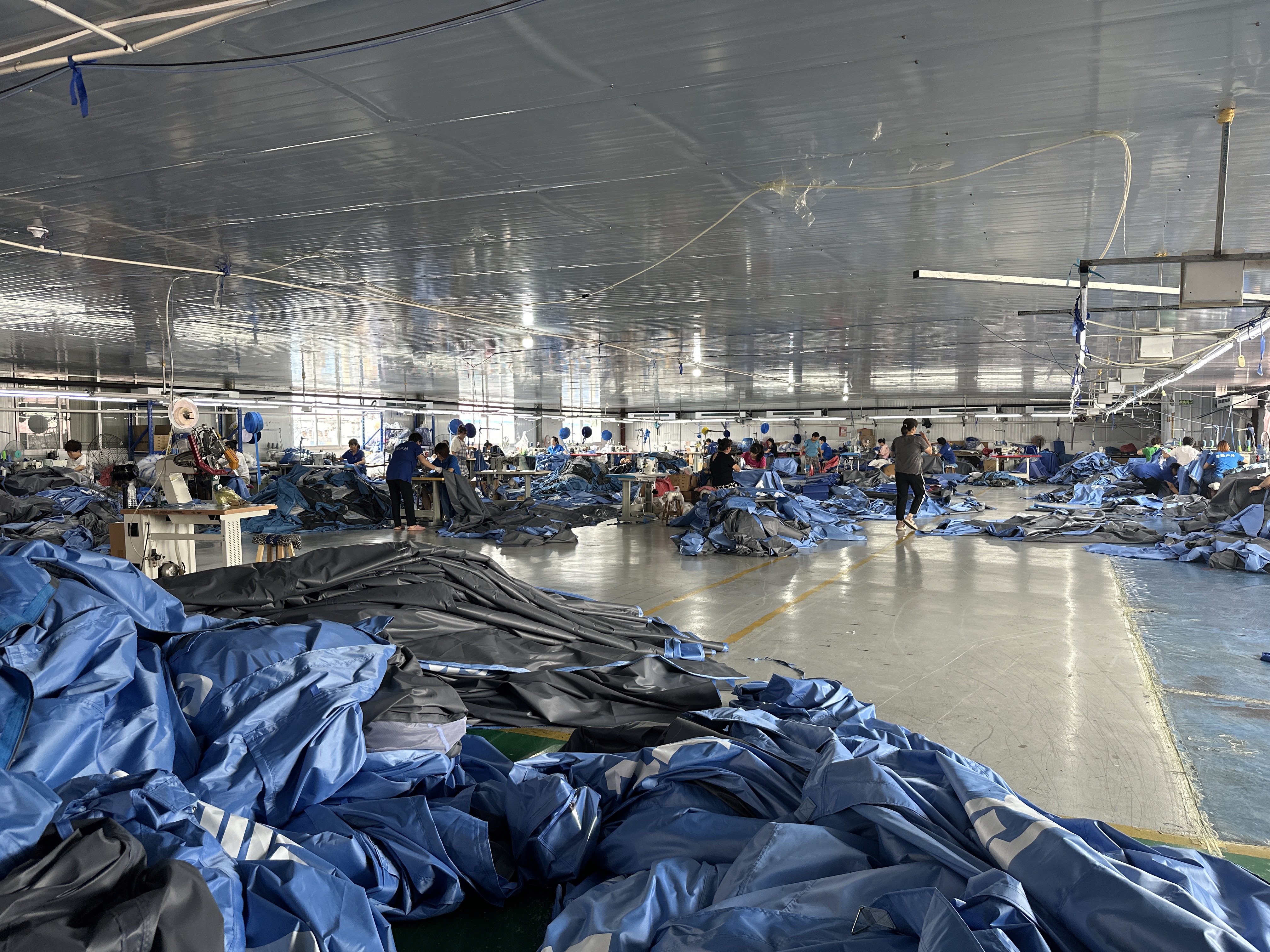
Tent production at the Xiamen facility, where the camping, rooftop and inflatable tent lines are assembled and inspected before shipment.
Why Tent Specifications Resist Direct Comparison
The global camping tent market was valued at USD 6.18 billion in 2025 and is projected to reach USD 10.91 billion by 2034, according to Grand View Research. Growth at that scale produces more SKUs per season, and more SKUs produce more specification formats. A distributor building a range for one retail season may receive three data sheets written against three different conventions — one leading with denier, one with hydrostatic head, one with pole diameter — even when the products are broadly comparable.
Category fragmentation compounds the problem. The rooftop tent market was valued at approximately USD 215.5 million in 2024, with hard shell models accounting for more than 53% of revenue share, according to Business Research Insights. The inflatable tent market reached USD 1.033 billion in 2024, driven largely by demand for ease and speed of setup in glamping, according to Intel Market Research. Buyers increasingly assemble mixed fleets that span these categories, and mixed fleets are where specification confusion becomes a procurement risk rather than an inconvenience.
The practical consequence is simple: a 2,000 mm ground tent and a 5,000 mm ground tent are not worse and better versions of the same product. They are answers to different questions about weather envelope, carrying weight and setup labour. Treating them as a single ranked list produces the wrong purchase.
How This Comparison Is Organized
Four variables drive almost every camping tent decision, and all four are used consistently below:
- Capacity — the number of sleepers the model is sized for. This comparison covers three tiers: 1–2 person, 4–5 person and 6–8 person.
- Fabric — Oxford weave weight expressed in denier. The models here use 200D, 210D, 300D, 420D and 600D Oxford.
- Frame system — aluminium alloy, aviation aluminium, steel, quick-open iron, or inflatable air beams.
- Waterproof rating — hydrostatic head in millimetres: 2,000 mm, 3,000 mm, 3,500 mm and 5,000 mm across the range.
The Seven Models at a Glance
| Model | Structure | Capacity | Fabric | Frame system | Waterproof rating |
|---|---|---|---|---|---|
| MOT-LK901 | Compact dome | 1–2 person | 200D Oxford | Aluminium alloy | 2,000 mm |
| MOT-CT096 | Compact dome, heavy weave | 1–2 person | 600D Oxford | Aluminium alloy | 3,000 mm |
| MOT-M100 | Dome | 4–5 person | 210D Oxford | Steel | 3,000 mm |
| MOT-Q500 | Quick-open dome | 4–5 person | 210D Oxford | Quick-open iron | 3,000 mm |
| MOT-DYG01 | Inflatable (air beam) | 4–5 person | 300D Oxford | Inflatable air beams | 3,500 mm |
| MOT-L800 | Family cabin, long span | 6–8 person | 300D Oxford | Aviation aluminium | 3,500 mm |
| MOT-CT900 | Family cabin, all-season | 6–8 person | 420D Oxford | Aluminium alloy | 5,000 mm |
Reading the table, two patterns matter. First, fabric denier and waterproof rating move together only loosely — MOT-M100 and MOT-Q500 share a 210D fabric and a 3,000 mm rating but differ entirely in frame and setup method. Second, fabric weight is a durability decision, not a weather decision: MOT-CT096 carries the heaviest weave in the 1–2 person tier at 600D, which reflects resistance to abrasion and repeated handling rather than additional rain protection.
Capacity Tiers: 1–2, 4–5 and 6–8 Person Tents
Capacity is rarely just a sleeping count. It sets footprint, standing height, pole span, packed volume and — indirectly — which frame materials are realistic. The three tiers below map to three different usage patterns rather than to three quality levels.
1–2 Person: MOT-LK901 and MOT-CT096
Both models use aluminium alloy frames and are sized for one or two sleepers, but they sit at opposite ends of the weight-to-durability trade-off.
MOT-LK901 pairs a 200D Oxford fabric with a 2,000 mm waterproof rating — the lightest weave and the lowest rating in the comparison. Lower denier means lighter yarn, which generally translates into a smaller packed size and lower carry weight. The 2,000 mm rating positions this model for light rain, condensation and short exposure rather than sustained precipitation.
MOT-CT096 uses a 600D Oxford fabric with a 3,000 mm rating. It is the heaviest fabric weave in the entire seven-model set. Higher denier generally increases resistance to abrasion, punctures and repeated folding, which matters when a tent is pitched and struck often, laid on rough ground, or shared across multiple users. The trade-off is packed size and carry weight.
4–5 Person: MOT-M100, MOT-Q500 and MOT-DYG01
All three are sized for four to five sleepers, and all three answer the same capacity question with a different setup philosophy.
MOT-M100 combines a 210D Oxford fabric, a 3,000 mm rating and a steel frame in a conventional dome. Steel keeps frame cost down but adds weight, which is acceptable in a tent that is transported by vehicle and pitched occasionally.
MOT-Q500 holds the same 210D fabric and 3,000 mm rating but mounts it on a quick-open iron frame. Because the frame is pre-assembled, pitching becomes a deployment action rather than a build sequence. That matters most where setup and teardown happen daily and labour time is a real cost.
MOT-DYG01 removes poles entirely, using inflatable air beams under a 300D Oxford fabric with a 3,500 mm rating. It carries more fabric weight and more waterproof headroom than the other two models in this tier, which makes it the stronger option of the three for wetter conditions, at the cost of needing a pump and consistent inflation pressure.
6–8 Person: MOT-CT900 and MOT-L800
At this size, tent selection becomes a scheduling and weather-window decision more than a comfort decision. Both models are designed for vehicle-supported basecamps where the tent stays pitched for days rather than hours.
MOT-L800 uses a 300D Oxford fabric with a 3,500 mm rating on an aviation aluminium frame. Aviation aluminium is used here to carry the longer pole spans that a large cabin footprint requires without adding unnecessary mass.
MOT-CT900 is the heaviest specification in the comparison: 420D Oxford fabric, an aluminium alloy frame and a 5,000 mm waterproof rating. In this list it is the all-season candidate — the model positioned for prolonged or heavier precipitation and for multi-week deployment where packing weight is no longer the primary constraint.
Fabric, Frame and Waterproofing: What the Numbers Actually Change
Once capacity is fixed, the remaining three specifications determine how the tent behaves in service. They are frequently quoted independently, but they only become useful when read together.
Oxford denier
Denier describes the weight of the yarn used in the Oxford weave. Moving from 200D to 600D increases the material mass per unit area, and with it the resistance to abrasion and tearing — but also the packed volume and the weight the user carries. In this range, 200D and 210D serve weight-sensitive and general-use models; 300D and 420D serve family and longer-deployment models; 600D serves the model expected to survive repeated handling and rough surfaces. Denier does not, on its own, determine waterproofing.
Frame systems
Five frame approaches appear across the seven models. Aluminium alloy is used on MOT-LK901, MOT-CT096 and MOT-CT900. Aviation aluminium carries the long spans of MOT-L800. Steel supports MOT-M100, quick-open iron drives MOT-Q500, and MOT-DYG01 replaces poles with inflatable air beams.
Frame engineering also affects field maintenance. MARVELOUS specifies a pole diameter 1.5 mm thicker than a traditional tent pole, which the manufacturer states gives the tent greater stability and better pressure-bearing capacity. The same construction is designed for easy disassembly, so a broken pole segment can be separated and replaced individually rather than requiring a complete frame change, and it is reported at 10% lower cost than the traditional pole construction it replaces.
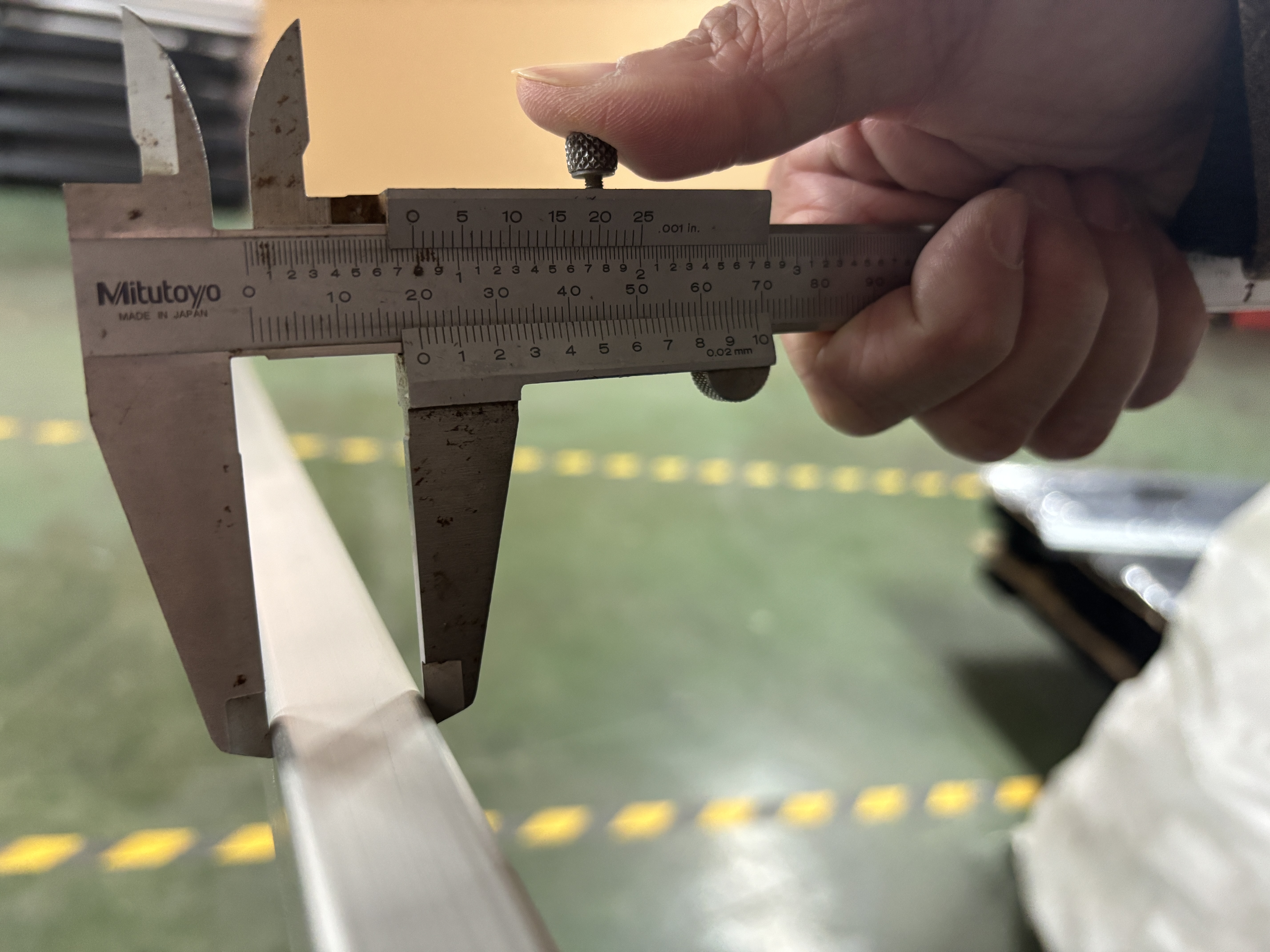
Pole diameter comparison: the thicker section used in the frame system is specified for stability, pressure-bearing capacity and segment-level replacement.
Waterproof ratings in context
Hydrostatic head measures the height of a water column a fabric resists before water penetrates. Across this range the four values map to four different exposure levels:
| Rating | Models | Typical exposure profile |
|---|---|---|
| 2,000 mm | MOT-LK901 | Light rain, condensation, short overnight exposure |
| 3,000 mm | MOT-CT096, MOT-M100, MOT-Q500 | General three-season camping with intermittent rain |
| 3,500 mm | MOT-DYG01, MOT-L800 | Sustained rain over multi-day pitching |
| 5,000 mm | MOT-CT900 | Heavy or prolonged precipitation, extended deployment |
A rating describes fabric performance under controlled conditions. Seam construction, zip flaps, coating integrity and how the tent is pitched and guyed all influence real-world resistance. That is why the rating should be read as one input among several rather than as a guarantee.
UPF50+, anti-mosquito mesh and all-season positioning
The specification set across this range includes UPF50+ fabric ratings and anti-mosquito mesh — features that matter most in family basecamp and long-stay summer programmes where UV exposure and insect pressure are continuous rather than occasional. All-season suitability, by contrast, follows from the fabric and waterproofing combination rather than from a separate label: the 300D/3,500 mm and 420D/5,000 mm configurations are the ones positioned for extended-season use, while the 200D/2,000 mm model is not intended as a winter or all-season shell.
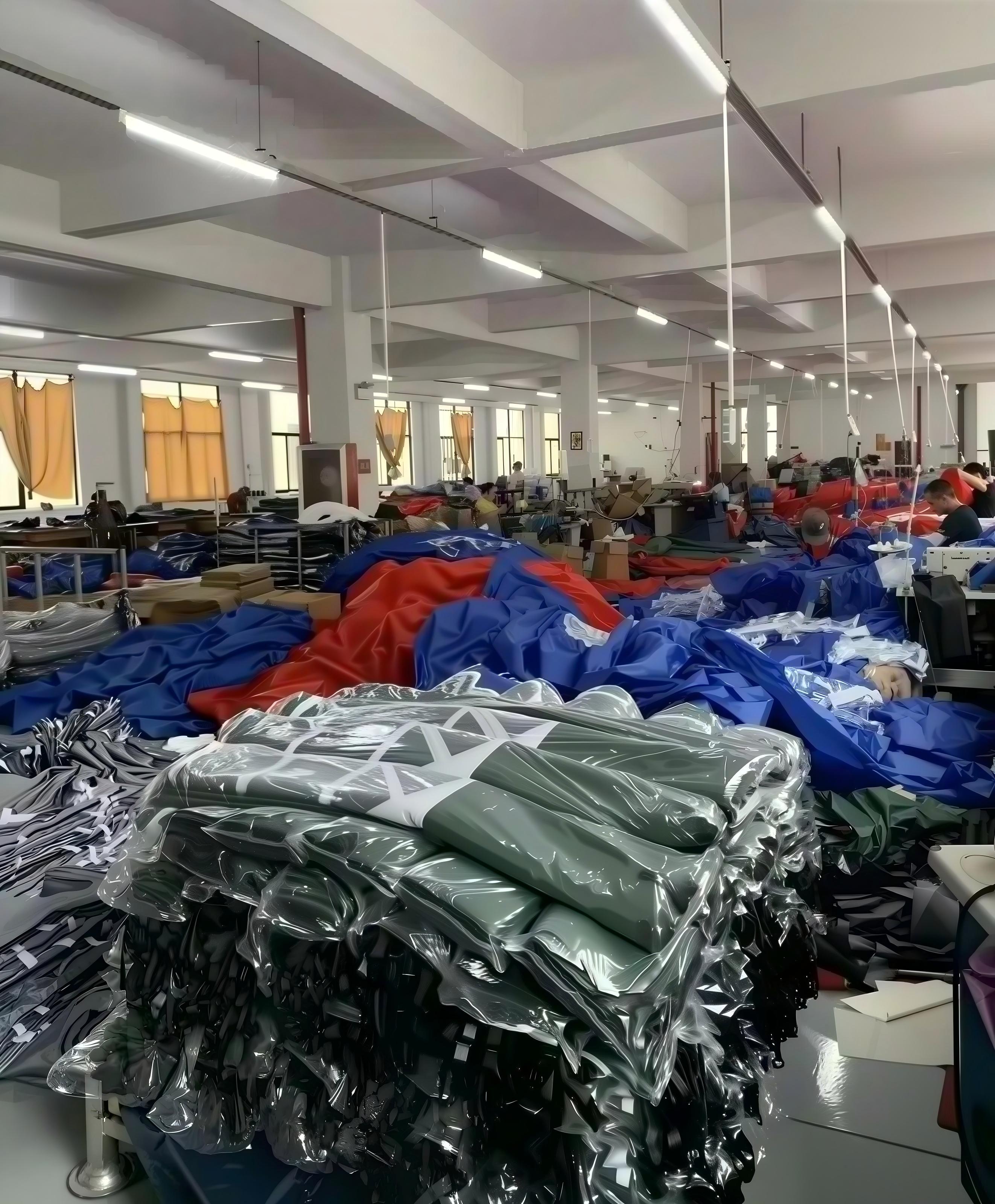
Piece-by-piece checking in the production room — the control step applied to fabric and waterproofing quality before units are packed.
Family, Inflatable and Roof Top Tents Are Not Substitutes
Three structural families dominate modern outdoor programmes, and they solve different problems. Family and cabin tents — MOT-CT900 and MOT-L800 in this comparison — are vehicle-supported basecamps built around standing height, sleeping compartments and multi-day pitching. Inflatable tents, represented here by MOT-DYG01, are built around setup speed and the elimination of pole inventory, which is why the inflatable tent category reached USD 1.033 billion in 2024 on glamping demand for faster pitching.
Roof top tents sit outside this comparison entirely. They are vehicle-mounted rather than ground-pitched, and hard shell versions typically use aluminium or ABS plastic shells, with a setup time of 3 to 8 minutes compared with 15 to 25 minutes for ground tents, according to third-party market research. That speed advantage only exists when the vehicle is the campsite and the roof has the load capacity to carry the tent. MARVELOUS manufactures roof top tents as a separate line; the seven models compared here are ground tents, and none of them should be evaluated as a rooftop substitute.
For a procurement programme, the first decision is therefore base type, not denier. Ground tent, inflatable or vehicle-mounted is a decision about how the camp is used. Capacity, fabric, frame and waterproofing are decisions about how well it performs once that choice is made.
Market Context: Compliance and the Direction of Demand
Two compliance frameworks shape what a camping tent must be able to demonstrate. ISO 5912:2020 specifies safety, performance and fitness-for-use requirements for camping tents, including flammability and rain resistance, and applies as a global reference point. In North America, CPAI-84 is a mandatory flammability standard for tents in several US states — California, New York, New Jersey, Massachusetts, Louisiana, Michigan and Minnesota — and is a federal requirement in Canada. Buyers sourcing for those markets should confirm the documentation that accompanies a specific model rather than assume it from a product description.
Demand geography is also uneven. North America holds the largest market share for rooftop tents at 38.6%, followed by Europe at 27.4%, according to Dataintelo, reflecting established overlanding cultures in both regions. The premium rooftop segment includes Alu-Cab of South Africa, iKamper of South Korea, Thule of Sweden and James Baroud of Portugal. For ground tent programmes, the relevant signal is simpler: as the global camping tent market moves from USD 6.18 billion in 2025 toward USD 10.91 billion by 2034, buyers will be comparing more models across more specification formats, and clear model-level disclosure becomes a purchasing advantage.
Compared with Traditional Pole Tents: Gains and Boundaries
The clearest structural difference between this range and conventional pole tents sits in the frame. Traditional poles of standard diameter are replaced by a pole 1.5 mm thicker, which the manufacturer states delivers greater stability and better pressure-bearing capacity, allows easy disassembly with separable broken pole segments for replacement, and is reported at 10% lower cost. In operational terms, the gain is that a damaged frame becomes a segment replacement rather than a tent replacement.
The boundaries are equally specific, and buyers should plan around them rather than assume them away.
- Weight is the price of durability. A 600D Oxford 1–2 person tent and a steel-framed 4–5 person dome are not backpacking options. Higher denier and heavier frame materials increase packed weight, and that cost is paid on every carry.
- Waterproofing is not permanent. Fabric cracking and waterproofing invalidation are recognised failure modes in tent manufacturing. The control method used here is to set up the tent and check every piece individually, with units that do not meet standard during production selected out and reprocessed. Ownership still includes inspection; no coating survives indefinitely without care.
- Inflatable structures repair differently. Air-beam construction removes poles but introduces a pump dependency and pressure discipline, and field repair follows a different logic from replacing a pole segment.
- Ratings describe fabric, not weather. A 5,000 mm rating describes performance under a water column. It does not guarantee performance in wind-driven rain on a poorly pitched or badly guyed tent.
- Category limits are real. None of these seven ground tents delivers the 3 to 8 minute vehicle-mounted setup of a hard shell rooftop tent, and no rooftop tent suits every vehicle or campsite.
None of these boundaries is a defect. They are the conditions under which each specification makes sense, and they are the reason capacity, fabric, frame and waterproofing have to be read together rather than ranked separately.
Long-Term Supply: Lead Time, Capacity and Order Terms
For programmes that run a mixed range — a 1–2 person model, a 4–5 person model and a 6–8 person model released across the same season — the product comparison is only half the decision. The other half is whether the supplier can hold the schedule.
The typical production lead time for these models is 30 days, with a monthly production capacity of 5,000 to 10,000 units. That capacity sits inside a 4,000 m2 facility reporting 50,000 units of annual output and approximately 95% export share. Commercially, the purchasing terms are MOQ of 1 unit, delivery terms of EXW, FOB or CIF, acceptance criteria based on pre-shipment testing, and payment terms of TT or LC.
Read as a supply package, those terms set two practical boundaries. A minimum order quantity of one unit supports pilot validation before a volume commitment, which is how a buyer confirms fabric hand-feel, frame assembly and waterproofing behaviour against their own market before scaling. Conversely, a 30-day lead time and a 5,000 to 10,000 unit monthly ceiling determine how quickly a programme can scale, which is the constraint that matters when several models are released on staggered dates.
The two risks worth planning for are single-source dependency and unvalidated pilot batches. Both are addressed the same way: test the acceptance criteria on an early shipment, and treat pre-shipment testing as the gate rather than the formality.
Future Outlook
Three trends are likely to shape how camping tents are specified and purchased over the next several years. The first is scale: a market moving from USD 6.18 billion in 2025 toward USD 10.91 billion by 2034 will keep adding models, which raises the value of suppliers who publish denier, frame and waterproofing at model level rather than at brand level.
The second is category shift. Inflatable tents reached USD 1.033 billion in 2024 on the strength of setup speed, and hard shell rooftop tents already hold more than 53% of rooftop tent revenue share. Both point in the same direction — buyers are paying for time saved in pitching and striking, not only for floor area.
The third is compliance. With ISO 5912:2020 as the global reference and CPAI-84 mandatory in several North American jurisdictions, flammability and rain resistance documentation is becoming a routine part of the sourcing file rather than an afterthought. Programmes that request it early will compare models on more even terms than programmes that request it last.
FAQ
What is the practical difference between 200D and 600D Oxford fabric in a camping tent?
Denier describes the weight of the yarn in the Oxford weave. A 200D fabric, as used on the MOT-LK901, is lighter, which generally produces a smaller packed size and lower carry weight. A 600D fabric, as used on the MOT-CT096, is heavier and generally more resistant to abrasion, punctures and repeated folding, at the cost of packed volume. Denier does not by itself determine waterproofing, which is expressed separately as a hydrostatic head rating in millimetres.
Which capacity tier suits a family, and which suits a solo camper?
In this range, the 1–2 person tier covers MOT-LK901 and MOT-CT096, and suits solo campers, pairs and weight-sensitive trips. The 4–5 person tier covers MOT-M100, MOT-Q500 and MOT-DYG01, and suits small families or groups. The 6–8 person tier covers MOT-CT900 and MOT-L800, and suits family basecamps and longer stays where the tent is transported by vehicle and pitched for several days. Capacity also determines footprint, standing height and pole span, so it should be matched to how the tent is transported as well as how many people sleep in it.
Do 2,000 mm and 5,000 mm waterproof ratings describe different weather limits?
Yes. A 2,000 mm rating, as on the MOT-LK901, is intended for light rain, condensation and short exposure. A 3,000 mm rating covers MOT-CT096, MOT-M100 and MOT-Q500 for general three-season camping with intermittent rain. A 3,500 mm rating covers MOT-DYG01 and MOT-L800 for sustained rain across multi-day pitching. A 5,000 mm rating, as on the MOT-CT900, is specified for heavy or prolonged precipitation and extended deployment. These figures describe fabric performance under a water column; seam construction, zip flaps and how the tent is pitched and guyed also affect real-world resistance.
How does an inflatable tent differ from a pole-frame dome tent in daily operation?
The MOT-DYG01 uses inflatable air beams instead of poles, so there is no frame to assemble and no pole inventory to manage. It requires a pump and consistent inflation pressure, and field repair follows a different logic from replacing a pole segment. The pole-frame models in this comparison — MOT-M100 on steel, MOT-Q500 on a quick-open iron frame, and MOT-LK901, MOT-CT096, MOT-CT900 and MOT-L800 on aluminium alloy or aviation aluminium — support segment-level replacement, so a damaged section can be separated and replaced individually.
When does a roof top tent make more sense than a ground camping tent?
A roof top tent is vehicle-mounted, so it makes sense when the vehicle is the campsite and the roof has the load capacity to carry the tent. Hard shell roof top tents typically provide a setup time of 3 to 8 minutes, compared with 15 to 25 minutes for ground tents, according to third-party market research. Ground tents remain the appropriate choice where the vehicle is not the base, where roof load is limited, or where the tent must be pitched away from the vehicle. The seven models compared in this article are ground tents; MARVELOUS also manufactures roof top tents as a separate line.
How should a buyer verify quality before shipment?
Acceptance criteria for these models are based on pre-shipment testing. Fabric cracking and waterproofing invalidation are recognised failure modes in tent manufacturing, and the control method applied is to set up the tent and check every piece individually. Units that do not meet standard during production are selected out and reprocessed rather than shipped. Commercially, orders can be placed from a minimum of 1 unit, with delivery terms of EXW, FOB or CIF and payment terms of TT or LC.
What are the production lead time and monthly capacity for these models?
The typical production lead time is 30 days, with a monthly production capacity of 5,000 to 10,000 units. That capacity sits within a 4,000 m2 facility reporting 50,000 units of annual output, approximately 50 employees and an export share of roughly 95%, with Russia, the United States, Australia and Canada listed as main markets. For multi-model programmes, these figures define how quickly a range can be scaled once pilot batches have been validated.
For reference, the full MARVELOUS product brochure is available for download: MARVELOUS product brochure (PDF). Manufacturer website: WWW.MARVELOUS-OUTDOOR.COM.
Tem questões ou precisa de mais detalhes?
Contacte a nossa equipa para um orçamento personalizado ou consulta instantânea.
Solicitar orçamento
Preencha o formulário abaixo e a nossa equipa entrará em contacto com uma proposta personalizada.
Chat direto do WhatsApp
Prefere conversar em tempo real? Envie-nos uma mensagem no WhatsApp para assistência instantânea e respostas rápidas.
- Obter orçamento personalizado
- Partilhar fotos ou documentos
- Discuta as suas necessidades diretamente
Geralmente responde em 5–30 minutos durante o horário de expediente.