
Camping Tents by Scenario: Basecamp, Group Camp, Vehicle
Camping Tents by Scenario: Basecamp, Group Camp, Vehicle
A camping tent programme is rarely let down by a seam. It is let down by a mismatch decided months earlier: a six-person group issued a two-person vehicle tent, a basecamp pitched on a gravel pad where no one can drive a trailer, or a rotating crew that loses an hour of daylight to a pole set it was never trained to raise. Scenario fit is the part of tent procurement that specifications alone cannot settle.
MARVELOUS (Xiamen Marvelous Outdoor Technology Co., Ltd.) is a Chinese manufacturer of camping tents, rooftop tents and inflatable tents that also offers OEM/ODM services, according to its own published company information. Its model data is specific enough to be tested against programme conditions rather than product categories. The range covers pole-based family tents, a quick-open group tent, an air-column inflatable, and two vehicle-mounted rooftop models.
This guide maps six models — MOT-CT900, MOT-CT096, MOT-M100, MOT-Q500, MOT-DYG01 and MOT-L800 — to four common outdoor-programme scenarios, and marks clearly where a listed specification ends and a buyer verification step begins.
Five variables decide the model before the specification does
Scenario fit can be reduced to five variables that are usually discussed separately and should be discussed together: sleeping density, transport and handling, pitch time and skill level, weather envelope, and duty cycle. Each model in this range trades one variable against another, and the trade is visible in the data sheet.
- Sleeping density. Stated capacity ranges from 2 people to 6–8 people across the range. Floor area per person matters more than the headline number when crews carry kit indoors.
- Transport and handling. Packed dimensions range from 77 × 39 × 39 cm to 233 × 155 × 32 cm; net weights run from 11 kg to 140 kg. Handling is a staffing decision, not a detail.
- Pitch time and skill. Pole sets, quick-open frames and air columns place different demands on crew training and on the number of people needed on site.
- Weather envelope. Listed waterproofing runs from 2000 mm to 3500 mm across these models, with two models also listing UV protection.
- Duty cycle. A tent that stands for a whole season and a tent that is struck every morning are different procurement problems, even at identical capacity.
The scenario material behind this range describes its tents as manually erected, stationary in use, and built around three functions: shelter from weather, thermal insulation, and privacy. It also identifies the United States, Germany, Australia, Canada, Switzerland, Chile, Japan and South Korea as common markets for that pattern of use. That description is a useful starting point, but it does not choose between models. The four briefs below do.
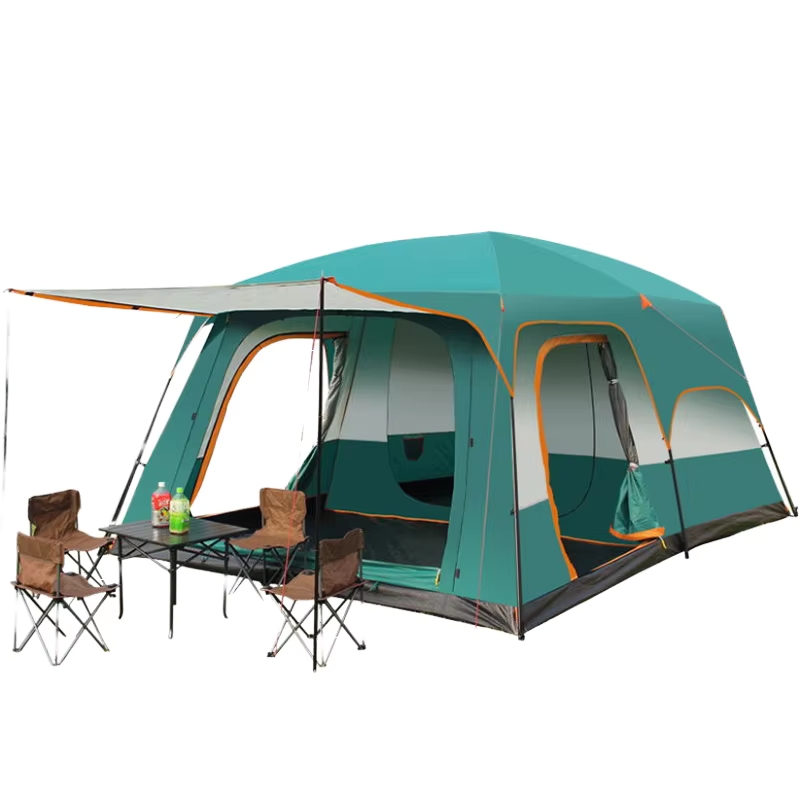
Family basecamps: MOT-CT900 for weather exposure, MOT-CT096 for floor area
A family basecamp is a stationary pitch used by the same household or family group for several nights, reached by vehicle, and expected to hold its shape through a full weather cycle. Two models fit that brief from different directions.
MOT-CT900 — the pole-based option with the higher weather ceiling
The MOT-CT900 is a 4–5 person tent built on an aluminium alloy pole frame. Its fabric is 200D titanium black rubber Oxford cloth with a listed PU5000 mm waterproof rating and UPF50+ UV protection. It packs to 106 × 26 × 26 cm and weighs 12.9 kg net, 13.5 kg gross, and ships with two telescopic support poles, 14 nails and 7 ropes.
For a programme, the relevant reading is this: 5000 mm of listed waterproofing plus UPF50+ is the more conservative combination in this range for pitches that sit in open ground through sun and rain, and a 13.5 kg gross weight with a sub-30 cm pack length is manageable for a single adult moving between a vehicle and a pitch. The aluminium pole set is also the component most likely to need a spare-parts plan if the tent is pitched and struck repeatedly by different households.
MOT-CT096 — the large-footprint baseline for facility and programme buyers
The MOT-CT096 takes the opposite approach. It is a steel-framed family camping tent listed at 430 × 305 × 200 cm when expanded, 70 × 31 × 31 cm packed, and 14.5 kg gross. The fabric is 210D Oxford cloth with PU and a 2000 mm waterproof rating, and it is offered in brown, green, blue and orange with ground nails and rope.
Two things follow from those numbers. First, the floor area works out to roughly 13.1 m² calculated from the listed dimensions — more standing room and kit space than any other model here except the MOT-M100. Second, 2000 mm is the lowest waterproof rating in this range, which places the CT096 inside a moderate-weather envelope rather than on an exposed ridge in sustained rain. It is a sensible baseline for facilities that need a large, low-cost-per-area shelter for vehicle-accessed pitches, and a less sensible choice for programmes whose itinerary is built around storm-season camping.
Larger group camps: MOT-M100 and the quick-open frame
Group camps change the problem from comfort to throughput. A programme moving 20 to 40 participants needs tents that can be raised by a small staff team, in sequence, without specialised tools, and that hold a group rather than a household.
The MOT-M100 is the range's group-capacity model: 6–8 people, an expanded size of 375 × 375 × 240 cm, and a packed size of 110 × 25 × 25 cm at 11 kg net and 11.5 kg gross. The frame is a quick-open iron design, the fabric is 200D titanium black plastic plaid cloth, and the specification includes high-density anti-mosquito mesh with transparent TPU and a PU5000 mm rating, supplied with nails and ropes.
The quick-open frame is the deciding feature for group programmes, because it converts pitch time from a skills problem into a procedure. The 5000 mm rating also means the faster tent is not the weaker one on paper — a common trade in group equipment is speed at the cost of weather protection, and the M100's listed specification avoids that trade. Anti-mosquito mesh matters in the same scenario, since group camps are frequently sited near water or in warm, humid conditions where insect pressure shapes how much the tent is actually used.
The floor area, calculated from the listed dimensions, is approximately 14.1 m², the largest in this range. At eight occupants that is about 1.8 m² per person; at six it is about 2.3 m². Programmes should set that figure deliberately, because the same tent performs very differently as a six-person and an eight-person shelter once personal kit is inside.
One verification item belongs to the frame, not the fabric: buyers running coastal or humid-season programmes should ask how the iron frame is surface-treated and whether replacement poles are available as spares, since frame corrosion is a maintenance cost that appears in year two rather than year one.
Quick-deploy inflatable setups: MOT-Q500
The MOT-Q500 is the one model here without a pole or metal frame. Its structure is a five-layer PVC air column, its fabric is 200D Oxford cloth with PU5000 mm and UPF50+, and it sleeps 4–5 people in a 270 × 270 × 200 cm footprint that packs to 77 × 39 × 39 cm at 13.6 kg net. It ships with ground nails and rope.
For a programme, the appeal is administrative as much as physical. An air-column tent has no pole bag to lose, no bent section to replace, and no correct-sequence assembly for a new staff member to learn. Deployment becomes an inflation routine. That suits programmes with rotating seasonal staff, rental fleets, and event setups where the same tent goes up and down repeatedly within a short window.
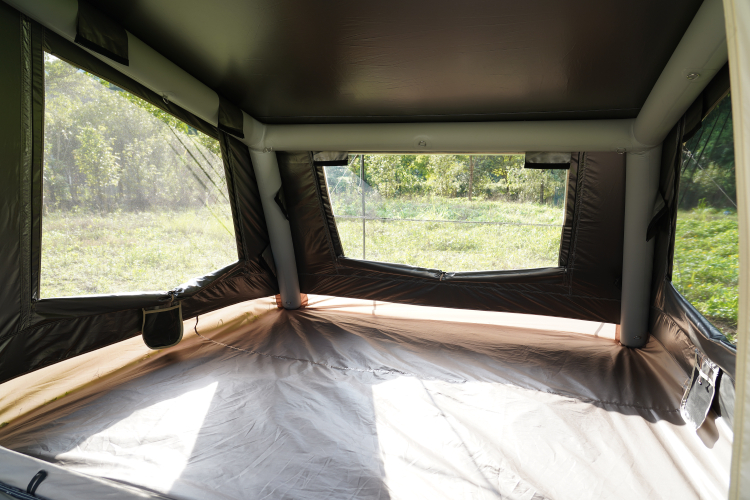
The trade is space and dependency. At 270 × 270 cm the calculated floor area is about 7.3 m², so five occupants work out to roughly 1.5 m² per person — tighter than the group tent and tighter than the basecamp models. The tent also depends on inflation equipment and pressure discipline that a pole tent does not. The listed accessory set covers ground nails and rope only, so buyers should confirm the intended inflation method, whether a pump is supplied or specified separately, and what pressure check belongs in the daily routine before committing a fleet to air-column tents.
Vehicle-based and overlanding programmes: MOT-DYG01 and MOT-L800
Vehicle-mounted tents answer a different brief: the pitch travels with the vehicle, sits above ground, and removes the need for a dry, level, drainable tent pad. The trade is that payload, roof compatibility and installation handling move to the centre of the decision.
MOT-DYG01 — two-person, low packed profile
The MOT-DYG01 is a 2-person rooftop tent with an aviation aluminium frame and 600D Oxford fabric rated to 3500 mm, described as UV and mould resistant. It folds to 210 × 125 × 20 cm and opens to 210 × 125 × 140 cm, at 32 kg net and 45 kg gross, in black or a customized colour, supplied with an aluminium telescopic ladder, installation bag, mattress, two shoe bags and two rods.
A 20 cm folded height is the number that matters for vehicle programmes: it keeps the mounted profile low and leaves roof space or load-bar capacity for other equipment. The 600D fabric and 3500 mm rating sit at the top of the range for weather protection, and the UV and mould resistance claim is relevant precisely because a vehicle-mounted tent is rarely dried perfectly before the vehicle moves on.
MOT-L800 — four-person capacity at a much higher mass
The MOT-L800 doubles the stated capacity to 4 people on an aviation aluminium frame with 300D Oxford cloth at 3000 mm waterproofing. It packs to 233 × 155 × 32 cm and is listed at 140 kg net and 150 kg gross, with an aluminium telescopic ladder, installation bag, mattress, two shoe bags and two rods.
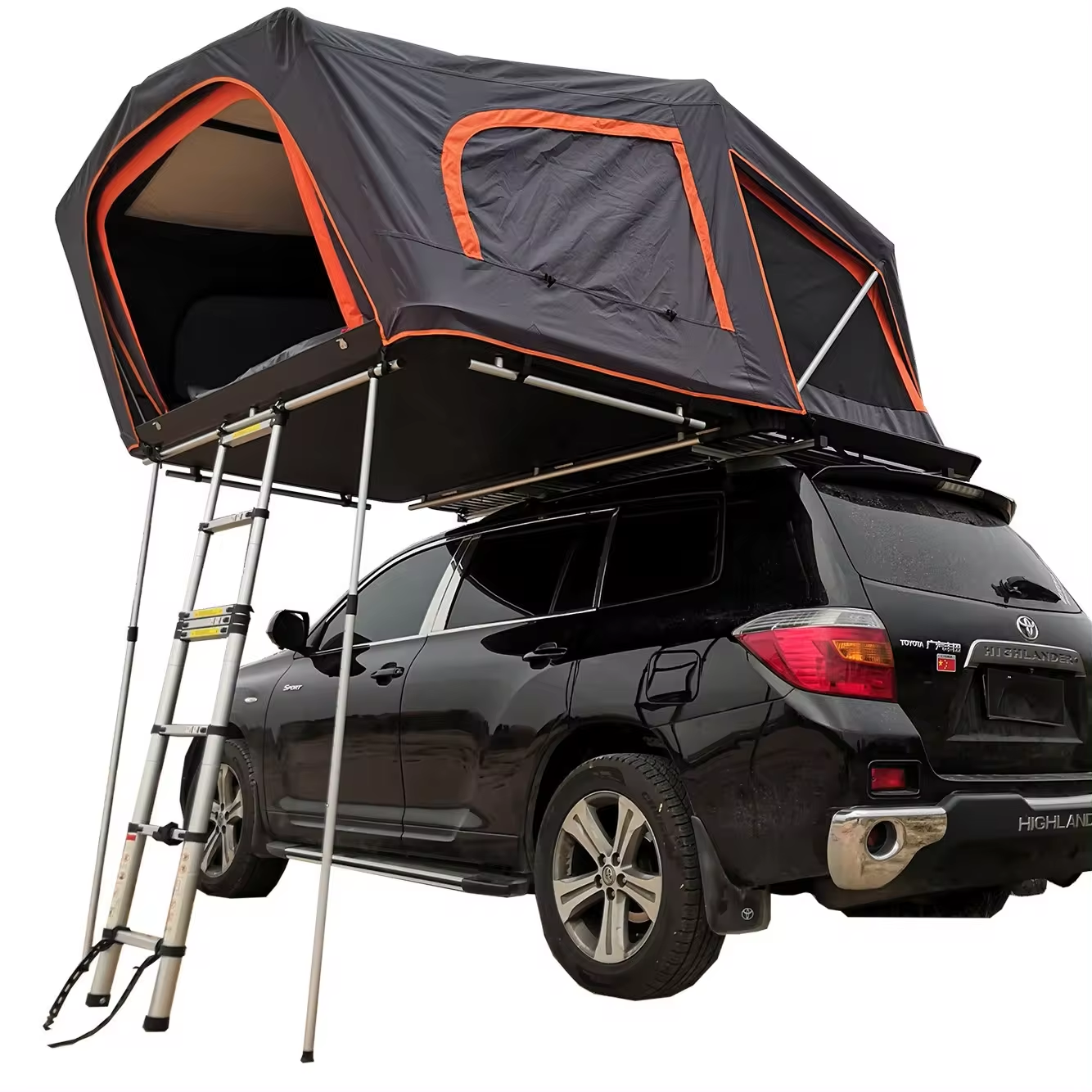
The L800 makes the programme trade explicit. It carries twice the occupants of the DYG01 and meets a 3000 mm waterproof baseline, but at a listed 150 kg gross it converts a comfort decision into a vehicle-engineering decision. Buyers should treat dynamic roof load rating, the number of staff required to mount and remove the unit, and the storage space needed when the tent is off the vehicle as pre-conditions rather than afterthoughts. The DYG01 and L800 also differ in fabric weight — 600D against 300D — which is a specification difference to be read with the buyers' own durability requirements, not a ranking on its own.
The scenario data behind this range lists a waterproof rating of at least 3000 mm, UV-resistant fabric, a wind-resistant structure and compatibility with common vehicle roof racks as the operating requirements for vehicle-based camping. Both rooftop models meet the listed waterproof figure on paper; wind resistance and rack compatibility still need model-specific confirmation, because a millimetre rating says nothing about either.
Model-by-model comparison for programme planning
| Model | Stated capacity | Frame | Fabric, waterproofing, UV | Packed / folded size | Net / gross weight | Scenario fit |
|---|---|---|---|---|---|---|
| MOT-CT900 | 4–5 people | Aluminium alloy poles | 200D titanium black rubber Oxford, PU5000 mm, UPF50+ | 106 × 26 × 26 cm | 12.9 / 13.5 kg | Family basecamp, exposed pitches, repeated pitching |
| MOT-M100 | 6–8 people | Quick-open iron frame | 200D titanium black plaid cloth, PU5000 mm, anti-mosquito mesh | 110 × 25 × 25 cm | 11 / 11.5 kg | Group camps, fast set-up, insect pressure |
| MOT-Q500 | 4–5 people | 5-layer PVC air column | 200D Oxford, PU5000 mm, UPF50+ | 77 × 39 × 39 cm | 13.6 kg net (gross not stated) | Quick-deploy rotations, rental and event fleets |
| MOT-CT096 | Not stated in model data | Steel | 210D Oxford with PU, 2000 mm | 70 × 31 × 31 cm | 14.5 kg gross | Large-footprint basecamp with vehicle transport, moderate weather |
| MOT-DYG01 | 2 people | Aviation aluminium | 600D Oxford, 3500 mm, UV and mould resistant | 210 × 125 × 20 cm | 32 / 45 kg | 1–2 person overlanding, low mounted profile |
| MOT-L800 | 4 people | Aviation aluminium | 300D Oxford, 3000 mm | 233 × 155 × 32 cm | 140 / 150 kg | Larger vehicle-based crews with roof load headroom |
Read across the table and the range separates cleanly into three structural families: pole and quick-open ground tents for basecamps and group camps, one air-column tent for speed-driven deployment, and two vehicle-mounted tents for overlanding programmes. Read down the weight column and the handling implications appear: 11 kg to 14.5 kg for ground tents, 32 kg to 150 kg for rooftop models.
What the material and frame numbers actually mean
Three specification types carry most of the decision weight in this range, and each has a limit worth knowing.
Denier and fabric weight
Denier describes the linear mass of the yarn used in the fabric. In this range the ground tents use 200D to 210D Oxford cloths, while the rooftop tents use 300D and 600D. A higher denier generally indicates a heavier yarn and a more abrasion-resistant weave, but denier alone does not describe coating quality, seam construction or UV stability. The CT900 and Q500 both list UPF50+, and the DYG01 lists UV and mould resistance — those are separate, listed attributes rather than automatic consequences of fabric weight.
Waterproof ratings
Waterproof figures in millimetres are hydrostatic head ratings, and they describe a test result rather than a universal field guarantee. Two things matter for procurement. First, the test method, sample preparation and whether seams and zips were included determine what a 2000 mm or 5000 mm figure actually represents. Second, the rating is a fabric property: a correctly rated fabric on a poorly pitched tent still leaks. Buyers specifying for sustained rain should request the test basis alongside the number, and should treat 2000 mm, 3000 mm, 3500 mm and 5000 mm as different weather envelopes rather than as marketing tiers.
Frames: poles, quick-open, air columns and vehicle shells
Aluminium alloy poles favour repairability and low weight, and they suit tents pitched and struck repeatedly. A quick-open iron frame favours deployment speed for large tents, with frame treatment and spare availability becoming the maintenance questions. A five-layer PVC air column removes pole assembly entirely, shifting the routine to inflation equipment and pressure checks. Aviation aluminium vehicle frames carry the tent above ground, moving the engineering question from ground conditions to roof load, mounting hardware and installation staffing.
Fit boundaries and what to verify before ordering
A scenario guide is only useful if it states where each model stops fitting. Four boundaries stand out in this range.
- Weather envelope. The CT096's 2000 mm rating is the lowest listed figure here. It fits sheltered pitches, moderate rain and shorter programmes; long storm-season deployments are better served by the 5000 mm ground tents or the 3000–3500 mm rooftop models.
- Density assumptions. Stated capacities are maxima. A 6–8 person group tent used as an eight-person shelter delivers roughly 1.8 m² per person of calculated floor area, which is a tight brief once kit is inside.
- Vehicle limits. The rooftop models require confirmation of roof dynamic load rating, rack compatibility, mounting hardware and the number of handlers available. These are conditions of use, not optional extras.
- Missing dimensions. The CT096 has no stated sleeping capacity and the CT900 has no stated pitched footprint in the model data. Both should be confirmed before pitch layouts are drawn.
Alongside the personal and group-use market, the MARVELOUS capability material lists OEM/ODM production with logo or whole-tent customisation, a one-unit minimum order, a 30-day lead time, 100% testing and replace-based after-sales support, with export markets in the United States, the EU, Canada, Australia, Korea and Japan. For programme buyers, that combination means a pilot of mixed models is commercially feasible before a season-long commitment, which is the practical way to test whether a scenario assumption survives contact with a real site.
Market context: what published forecasts can and cannot settle
Published research on this category does not agree closely, and buyers should know that before quoting a market figure in a business case. Fortune Business Insights described the global camping tent market at USD 6.18 billion in 2025, projecting USD 10.91 billion by 2034; IMARC Group reported USD 3.4 billion in 2025 rising to USD 5.5 billion by 2034 at a 5.46% CAGR. The gap is large enough that it reflects different product scope definitions and base-year treatments rather than rounding, and the two figures should not be averaged or blended.
The rooftop segment has its own estimates: Dataintelo valued the global rooftop tent market at USD 1.42 billion in 2025 and placed hard-shell models at approximately 40%–45% of the segment. Those figures are commercial research estimates rather than audited statistics, so they are useful for orientation — vehicle-based formats are a substantial part of the category, not a niche — and not for sizing a specific procurement budget.
Compliance evidence sits beside the specification, not inside it
Product specifications and conformity evidence are different documents, and a programme that needs both should request both.
ISO 5912:2020 specifies requirements on the safety, performance and fitness for use of camping tents. The existence of the standard, however, does not demonstrate that a particular model conforms to it; conformity is shown by test documentation for that product. In the United States, CPAI-84 is the voluntary flammability testing protocol treated as the industry benchmark and, in practice, as a retail requirement — again, a protocol reference rather than a result. On the trade side, tents fall under HS heading 6306, with the exact subheading depending on material, so classification should be confirmed against the importing country's tariff schedule rather than assumed from a product description.
The practical procurement step is a document request tied to specific models: the test basis behind each millimetre rating, the flammability documentation relevant to the destination market, the material composition used for classification, and confirmation of which specification items are standard rather than optional.
Outlook for scenario-based tent planning
The direction of travel in this category favours scenario segmentation over a single general-purpose tent. Vehicle-based formats are estimated to hold a meaningful share of demand, air-column construction has removed pole assembly from the deployment routine, and quick-open frames have made large group tents practical for small staff teams. None of that removes the underlying constraint: each format solves one scenario and creates a different maintenance or handling cost.
For programmes planning multi-year fleet renewal, the forward-looking criteria are less about this season's specification sheet and more about continuity — whether a model stays in production, whether frame and fabric spares remain available, and whether the same platform can be reordered under an OEM programme with the same materials. Buyers can review the current range at MARVELOUS, and the company brochure (PDF) sets out the product and capability background in one document.
FAQ: scenario-fit questions from programme buyers
Which MARVELOUS camping tent suits a group of 6 to 8 people?
The MOT-M100 is the only model in this range with a stated capacity of 6–8 people. It uses a quick-open iron frame, measures 375 × 375 × 240 cm expanded, and packs to 110 × 25 × 25 cm at 11 kg net and 11.5 kg gross. Its fabric is 200D titanium black plastic plaid cloth with high-density anti-mosquito mesh and a PU5000 mm rating, and it is supplied with nails and ropes. Buyers should decide in advance whether the tent will be used at its eight-person maximum or as a six-person shelter, because kit space per occupant changes substantially between the two.
How should a family basecamp choose between the MOT-CT900 and the MOT-CT096?
The choice turns on weather exposure versus floor area. The MOT-CT900 carries a 200D titanium black rubber Oxford fabric with PU5000 mm and UPF50+ on an aluminium alloy pole frame, packs to 106 × 26 × 26 cm and weighs 13.5 kg gross, which suits pitches in open ground through sun and rain where the tent is pitched repeatedly. The MOT-CT096 offers a much larger 430 × 305 × 200 cm footprint from a steel frame at 210D Oxford with PU and a 2000 mm rating, and suits vehicle-accessed, moderate-weather basecamps where covered floor space matters more than the weather ceiling.
Is an inflatable camping tent practical for programmes with rotating crews?
The MOT-Q500 is built on a five-layer PVC air column rather than a pole set, so deployment is an inflation routine with no pole sequence to learn and no pole sections to lose or replace. It sleeps 4–5 people in a 270 × 270 × 200 cm footprint, packs to 77 × 39 × 39 cm at 13.6 kg net, and carries 200D Oxford fabric with PU5000 mm and UPF50+. The trade is floor area — around 7.3 m² calculated from the listed dimensions — and a dependence on inflation equipment and pressure checks, so buyers should confirm the intended inflation method and daily pressure routine before standardising on air-column tents.
What waterproof rating do vehicle-based programmes need for rooftop tents?
The scenario requirements published for this kind of vehicle-based camping list a waterproof rating of at least 3000 mm, together with UV-resistant fabric, a wind-resistant structure and compatibility with common vehicle roof racks. The MOT-DYG01 lists 3500 mm on 600D Oxford with UV and mould resistance, and the MOT-L800 lists 3000 mm on 300D Oxford. Meeting a millimetre figure on paper does not confirm wind resistance or rack compatibility, so those two items should be verified per model, together with the roof dynamic load rating of the vehicles involved.
What should buyers verify before ordering a mixed fleet of these tents?
Five checks cover most of the risk. Confirm the test basis behind each waterproof rating, including whether seams and zips were tested. Confirm the pitched footprint of the MOT-CT900 and the sleeping capacity assumptions for the MOT-CT096, since neither appears in the model data. Confirm the inflation equipment and pressure routine for the MOT-Q500. Confirm roof load rating, mounting hardware and installation staffing for the MOT-DYG01 and MOT-L800. Finally, request the conformity documentation relevant to the destination market, with ISO 5912:2020 as the standard reference and CPAI-84 flammability documentation for the United States, alongside HS 6306 classification confirmed for the specific material.
Tem questões ou precisa de mais detalhes?
Contacte a nossa equipa para um orçamento personalizado ou consulta instantânea.
Solicitar orçamento
Preencha o formulário abaixo e a nossa equipa entrará em contacto com uma proposta personalizada.
Chat direto do WhatsApp
Prefere conversar em tempo real? Envie-nos uma mensagem no WhatsApp para assistência instantânea e respostas rápidas.
- Obter orçamento personalizado
- Partilhar fotos ou documentos
- Discuta as suas necessidades diretamente
Geralmente responde em 5–30 minutos durante o horário de expediente.