
Can C840 Test Silica Slurry Aqueous Solutions? A Technical & Procurement FAQ
Can C840 Test Silica Slurry Aqueous Solutions? A Technical & Procurement FAQ
Labthink's published position on whether the C840 Integrated Evaporation Residue Testing System can test silica slurry aqueous solutions is conditional rather than absolute: the system can be considered for evaporation residue testing of aqueous solutions and similar samples, while sample preparation, sample quantity, heating conditions and constant-weight requirements should be confirmed according to the applicable method. For buyers in the decision stage, that conditionality is the most useful part of the answer, because it defines exactly which items must be closed out before a purchase order or a method transfer is approved.
An industry question that starts with a sample, not an instrument
Residue analysis in food contact material compliance and pharmaceutical packaging quality control is usually discussed in terms of instruments: which platform, which range, which level of automation. In practice, the decision that causes delays is narrower and more technical. A laboratory receives an aqueous silica slurry, a suspension of fine solid particles in water, and needs to know whether the non-volatile content of that specific sample can be recovered and weighed reproducibly on an automated gravimetric system.
That is the question Labthink addresses in its C840 sample-suitability FAQ. The answer given is that the C840 can be considered for evaporation residue testing of aqueous solutions and similar samples, and that, for silica slurry aqueous solutions and similar samples, sample preparation, sample quantity, heating conditions and constant-weight requirements should be confirmed according to the applicable method. Nothing in that statement is a blanket guarantee, and the reason is structural rather than cautious: gravimetric residue results depend simultaneously on the measurand, on how the matrix behaves while the liquid phase is removed, and on whether the prescribed drying and weighing conditions can actually be reached inside the instrument.
Labthink Instruments Co., Ltd. is a manufacturer of packaging materials testing instruments founded in 1989, with its operational base in Jinan, China and an international headquarters in Boston, USA, and it also provides testing services from its own laboratories. The company positions itself as a provider of precision instruments and testing solutions for packaging materials analysis, and its food and pharmaceutical testing solutions cover residue, migration and package integrity applications. The C840 is one of the platforms used for the residue side of that portfolio.
Three measurands that buyers routinely conflate
Before a slurry sample is sent to any laboratory, it is worth separating three quantities that all sound like residue testing but are not interchangeable.
Evaporation residue measures the total non-volatile substances dissolved out of a material by solvent extraction. In the classic workflow, liquid food simulants such as water, ethanol or hexane soak the sample, evaporate completely, and the remaining dry residue is weighed.
Non-volatile residue (NVR) measures the organic and inorganic contaminants left after solvent evaporation. It is common in aerospace, medical device cleaning and precision electronics, where the purpose is to verify surface cleanliness after processing rather than to characterise a packaging material.
Overall migration evaluates total mass transfer from food contact materials into food simulants. It measures all non-volatile substances migrating from packaging materials such as plastics and rubbers under standardised temperature and time conditions. The procedure typically involves exposing the material to an appropriate food simulant under specified time and temperature conditions, followed by evaporation of the simulant and determination of the residue.
All three are gravimetric and all three end in the same physical act: drying something to a stable mass and weighing what is left. An aqueous silica slurry can plausibly sit in more than one of these categories depending on the regulatory question being answered. This is the first reason a universal yes or no does not exist, and the first item a buyer should fix in writing before evaluating instruments.
What the C840 declares it can do
The C840 Integrated Evaporation Residue Testing System is described by Labthink as supporting the determination of various chemical reagent residues after evaporation, total migration testing of food contacting materials, the determination of non-volatile matters in purified water, and non-volatile residual testing of various pharmaceutical packaging materials. Product-family documentation from Labthink's chemical analysis business unit lists the C840 for automated overall migration and evaporation residue testing.
Its declared application industries are food contact materials, pharmaceutical packaging and chemical reagents. The associated laboratory scenario covers pharmaceutical, chemical reagent, medical device, plastics and polymer, food contact material and Testing, Inspection and Certification (TIC) environments, with quality control, safety assurance and regulatory compliance as the typical project types. In operation, the system automates the evaporation, drying, cooling and weighing stages of the overall migration procedure, and it is designed to automate key steps of the evaporation residue testing process, reducing manual intervention in the workflow.
Declared specification
| Parameter | Declared value |
|---|---|
| Instrument | C840 Integrated Evaporation Residue Testing System (also listed as an overall migration test instrument) |
| Testing range | 0.05 to 80,000 mg |
| Resolution | 0.01 mg |
| Repeatability | ±0.05 mg |
| Temperature range | Room temperature to 130 °C |
| Temperature fluctuation | ±0.5 °C |
| Operation mode | Fully automated |
| Matched equipment | Analytical balance |
| Installation requirement | Indoor laboratory use only; stable ambient temperature |
| Housing material | Aluminium alloy + ABS plastic |
| Declared application industries | Food contact materials, pharmaceutical packaging, chemical reagents |
Table 1. Declared C840 specification values used in procurement and method-transfer discussions. Source: Labthink product and laboratory scenario data.
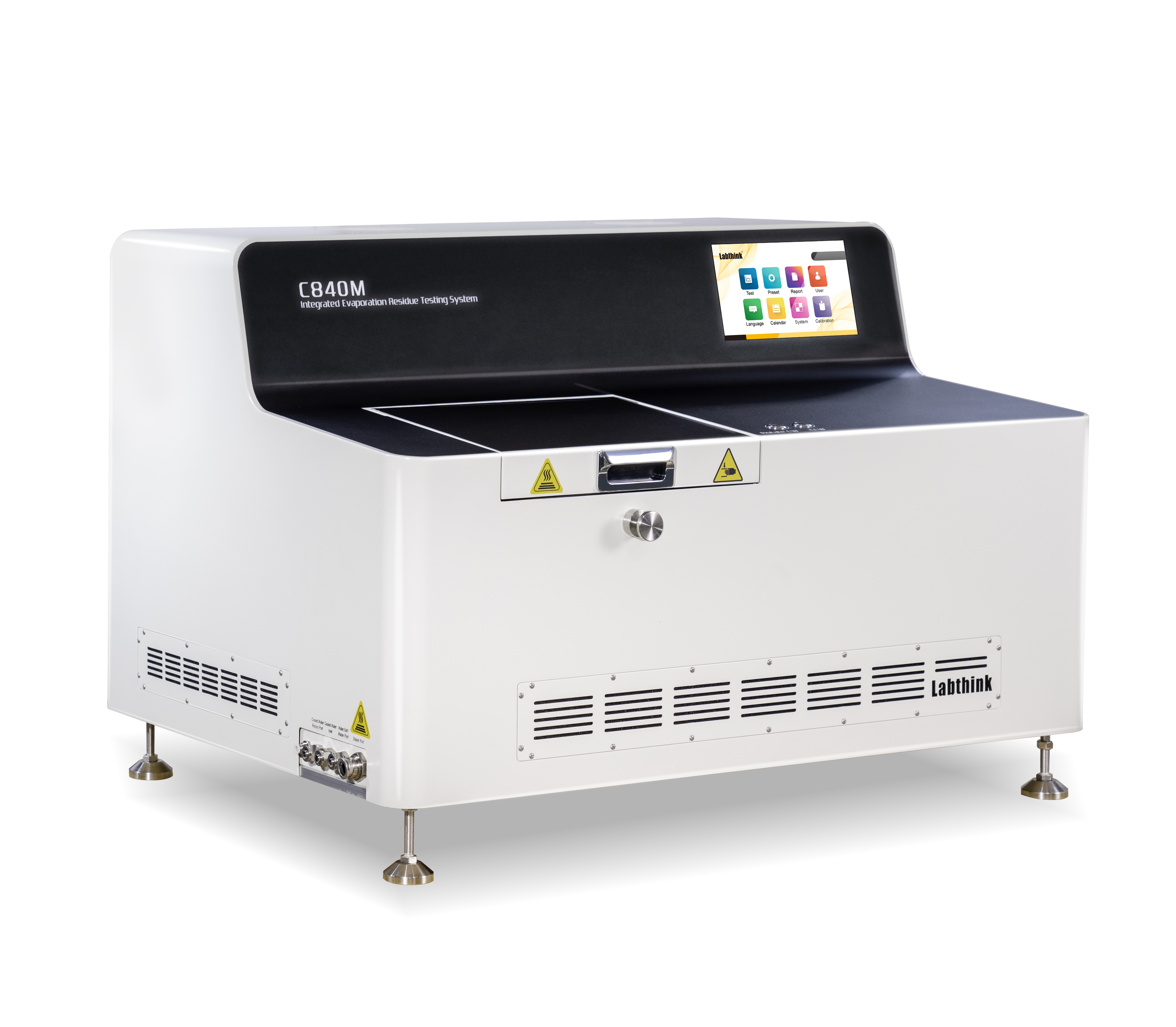
The C840 Integrated Evaporation Residue Testing System integrates evaporation, drying and weighing for evaporation residue and non-volatile residue testing. Image: Labthink.
How a gravimetric residue result is actually produced
In a gravimetric evaporation residue test, a known quantity of sample solution is dosed into a vessel, the liquid phase is removed under controlled heating, the vessel is cooled, and the remaining mass is measured. The result is only accepted when the system reaches constant weight, meaning successive drying and weighing cycles agree within the limit defined by the method. That last requirement is what makes automation valuable, because it converts a judgement made by an operator at the balance into a programmed sequence of heating, cooling and weighing steps.
Two numbers in the specification carry different meanings and are often misread during procurement. The 0.01 mg resolution defines the smallest displayed increment of the weighing system. The ±0.05 mg repeatability describes the closeness of agreement between repeated measurements under the declared conditions. When a residue target sits near the lower part of the working range, repeatability rather than resolution defines the practical decision margin, because it sets how large a difference between two results has to be before it can be treated as real.
The 0.05 to 80,000 mg testing range is an absolute residue mass, not a concentration. Regulatory limits are commonly expressed in different units, for example per kilogram of food or per square decimetre of contact material, so the conversion between a reported residue mass and a compliance threshold is defined by the applicable method, including the sample amount and simulant volume it specifies. An instrument cannot output a compliance verdict on its own.
The requirement for indoor laboratory use with a stable ambient temperature, together with a matched analytical balance, follows from the same logic. Because the final step is a micro-gram-sensitive weighing operation, the surrounding conditions are part of the measurement system rather than optional site preferences. Temperature control across the room temperature to 130 °C working window, with a declared fluctuation of ±0.5 °C, keeps the drying stage reproducible; keeping the balance in a stable environment keeps the weighing stage reproducible. For a water-based sample such as a silica slurry, where the liquid phase is abundant and the drying load is heavy, both conditions matter more, not less.
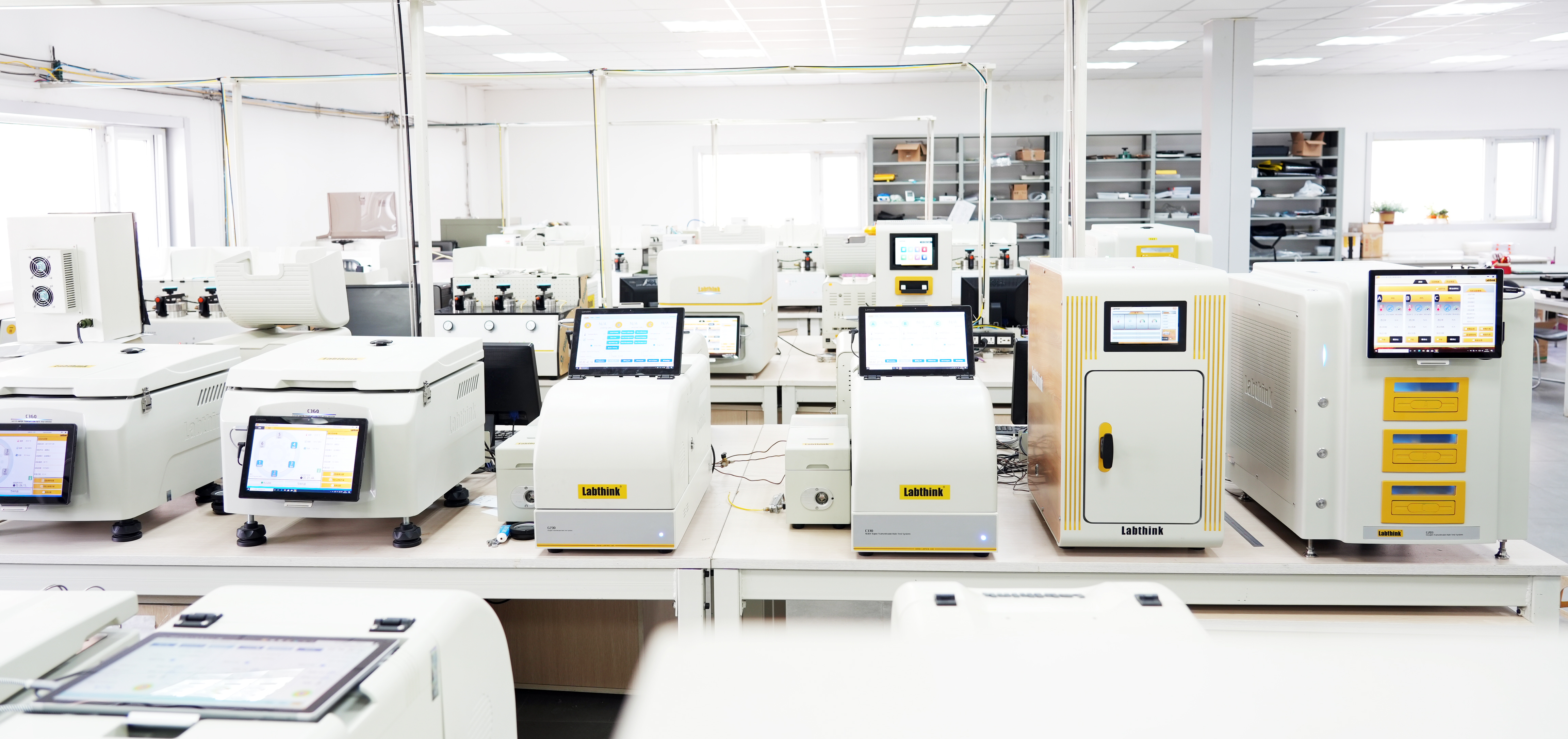
Gravimetric residue and migration testing is an indoor laboratory activity requiring stable ambient temperature and a matched analytical balance. Image: Labthink testing laboratory.
What buyers should confirm before running an aqueous silica slurry
The value of a sample-suitability question is that it produces a fixed checklist. The items below are the ones that determine whether an aqueous silica slurry can be handled on the C840 route, and each of them has to be answered with the laboratory's own sample in hand rather than with a category-level statement.
| Confirmation point | Why it decides suitability | What the buyer should be able to state |
|---|---|---|
| Measurand and method route | Evaporation residue, non-volatile residue and overall migration are different quantities with different preparation chains | Which quantity the report must contain, and under which method |
| Matrix behaviour of the suspension | Suspended solids, foaming, splashing and residue creeping onto vessel walls all affect how much of the non-volatile fraction is recovered | Whether the method prescribes pre-treatment, homogenisation or a specific dosing technique |
| Expected residue loading | The declared range is 0.05 to 80,000 mg, with 0.01 mg resolution and ±0.05 mg repeatability | The expected residue mass and the margin between it and the practical lower working limit |
| Heating conditions | The working window is room temperature to 130 °C with ±0.5 °C fluctuation | The drying temperature, any ramp profile, and whether constant weight is reachable inside that window |
| Sample quantity and constant-weight criteria | Both are explicitly method-dependent in Labthink's published answer | The dosed mass or volume per vessel and the mass-change limit that defines constant weight |
| Balance and laboratory environment | The system is matched with an analytical balance and requires indoor laboratory use only with stable ambient temperature | Where the unit will be installed and how ambient stability will be maintained |
| Application and regulatory framing | Food contact, pharmaceutical packaging and chemical reagent applications face different documentation expectations | The regulatory frame the result must serve, and the units the result will be reported in |
| Data and audit expectations | Regulated buyers need traceable records, not only numbers | The required record format, and any stated compliance framework the laboratory must meet |
Table 2. Sample-suitability confirmation checklist for aqueous slurry residue testing.
For a silica slurry specifically, the two items that most often decide the outcome are matrix behaviour and the constant-weight criterion. A suspension can settle during dosing or during the early part of the drying cycle, and how the method handles that determines whether the weighed residue represents the sample. The heating conditions then determine whether the drying step can be completed within the method's time and temperature envelope. Only after those two are resolved does the specification range become a meaningful selection criterion.
Application fit: food contact materials, pharmaceutical packaging and chemical reagents
Food contact materials and overall migration
For plastic food contact materials, European Commission guidance states that the overall migration of all substances together may not exceed the Overall Migration Limit of 60 mg/kg food, or 10 mg/dm² of the contact material. The same guidance describes migration testing as being carried out using simulants under standardised time and temperature conditions representative of a certain food use and covering the maximum shelf life of the packed food. Laboratories therefore work with a defined simulant, a defined exposure, and a gravimetric finish. The C840 route automates the evaporation, drying, cooling and weighing stages of that finish, and its declared scope explicitly includes total migration testing of food contacting materials. In the United States, the FDA Food Traceability List identifies foods subject to additional traceability recordkeeping under FSMA, which reinforces the expectation that testing evidence forms part of a documented compliance chain rather than a standalone number.
Pharmaceutical packaging and non-volatile residues
Labthink's declared scope for the C840 includes non-volatile residual testing of various pharmaceutical packaging materials, and case documentation for this class of project describes replacing manual, time-consuming testing for overall migration and extractables with full process automation and precise, traceable data. That is a different measurement from residue on ignition, which is a pharmacopeial gravimetric method used to measure the amount of inorganic impurities in an organic substance. The distinction matters at the procurement stage: a packaging material with an aqueous extraction step and a packaging material with an ash-content question are not served by the same instrument family.
Chemical reagents and purified water
The declared scope also covers the determination of various chemical reagent residues after evaporation and the determination of non-volatile matters in purified water. For a laboratory handling both reagents and packaging materials, this is where the C840 route overlaps most directly with routine gravimetric work, and where a slurry-type aqueous sample is most likely to appear. The same confirmation logic applies: the method defines the sample quantity, the heating conditions and the constant-weight limit, and the instrument has to be able to execute them.
Automated gravimetric testing versus manual workflows
The practical alternative to an automated platform is not a different instrument; it is a technician, an oven or water bath, a desiccator and a balance. Comparing the two workflows on the criteria that appear in Labthink's own comparison material gives a clearer picture than comparing catalogue specifications.
| Dimension | Manual gravimetric workflow | Automated integrated workflow |
|---|---|---|
| Hands-on time | Limited by technician bandwidth and available oven or hood space | Declared 80%–95% reduction in hands-on time per batch for automated evaporation residue and NVR analysis |
| Consistency | Susceptible to human error, humidity changes during transfer, and balance drift | Controlled heating and cooling cycles with a precise micro-gram balance in the same workflow |
| Exposure | Higher exposure to hot, volatile or organic solvents during manual pouring and evaporation | Technicians load samples and select a programmed protocol; extraction, evaporation and weighing proceed automatically |
| Throughput pattern | Constrained by shift patterns and cooling or transport waits | Supports unattended overnight and off-peak runs and continuous batch efficiency |
| Capital cost | Lower initial expenditure | Higher capital expenditure, requiring investment in integrated automation, a high-precision balance and thermal modules |
| Cost per test | Driven by labour hours and rerun frequency | Declared lower long-term cost per test, with reduced labour and reduced sample rerun rates |
Table 3. Manual versus automated gravimetric residue testing, based on Labthink comparison documentation. Automation claims are vendor-reported.
Where the limits are
An instrument-level article that stops at capability misses the part procurement teams are paid to find. The following boundaries are as important as the declared range.
- The C840 reports non-volatile residue mass. It does not report inorganic ash or sulfated ash, which is the residue on ignition route handled by the C860 integrated residue-on-ignition testing system, a separate platform with a working range of 0.05 to 60,000 mg, a temperature range from room temperature to 800 °C and 36 test stations.
- It does not report loss on drying as a percentage of volatile matter, which is the C870 route. For an aqueous slurry in which water dominates the sample, the two questions produce very different numbers, and selecting the wrong one invalidates the compliance argument even when the measurement itself is correct.
- Installation is fixed and indoor, with a matched analytical balance and a requirement for stable ambient temperature. This is a laboratory instrument, not a portable or field-deployable device, and the environment is part of the specification.
- Capital expenditure is higher than for a manual workflow. The economic case rests on labour reduction, rerun avoidance and long-term cost per test rather than on purchase price.
- Suitability for a specific matrix is never assumed. Labthink's own published answer requires sample preparation, sample quantity, heating conditions and constant-weight requirements to be confirmed according to the applicable method, and does not assert universal applicability.
- Regulatory thresholds expressed per kilogram of food or per square decimetre of contact material require a method-defined conversion from the reported residue mass. The instrument supplies a measurement; the laboratory supplies the compliance interpretation.
What the regulatory and procurement signals point to
Three verifiable signals explain why sample-level residue questions have become a routine part of instrument selection in this category.
First, the regulatory frame is quantitative and unit-specific. The European Commission states that overall migration for plastic food contact materials may not exceed 60 mg/kg food or 10 mg/dm² of contact material, and that migration testing is performed with simulants under standardised time and temperature conditions that cover the maximum shelf life of the packed food. That combination of a defined threshold and a defined exposure regime pushes laboratories towards gravimetric methods with documented temperature control.
Second, traceability obligations extend the evidence chain. The FDA Food Traceability List identifies foods subject to additional traceability recordkeeping under FSMA, which means testing records increasingly have to survive audit rather than simply be reported internally.
Third, vendors are responding with residue-specific automation rather than general-purpose ovens. Labthink's chemical analysis business unit lists four automated platforms in this family: the C840 for automated overall migration and evaporation residue testing, the C850 for automated water-insoluble matter testing, the C860 for automated residue on ignition testing, and the C870 for automated loss on drying testing. Vendor-reported comparison material for automated gravimetric residue analysis also cites an 80%–95% reduction in hands-on time per batch, unattended operation, lower long-term cost per test and support for annual supply agreements. These are manufacturer claims and should be read as such, but they indicate the direction of demand: fewer manual gravimetric steps, more programmed protocols, more traceable records.
A fourth, quieter signal is visible in how questions are now asked. Buyers no longer only ask which instrument measures a range; they ask whether a named matrix, such as an aqueous silica slurry, can be handled on that instrument. Vendors that answer at sample level, including the preparation and constant-weight conditions, give procurement teams something they can actually file.
Outlook
The direction of travel in gravimetric residue testing is towards method transfer rather than equipment purchase. As food contact and pharmaceutical compliance frameworks continue to specify simulants, exposure conditions and documented records, the differentiator between platforms will be how completely they can execute a defined method, including sample preparation assumptions, drying profiles and constant-weight criteria, and how clearly those conditions are documented for the buyer.
For an aqueous suspension such as silica slurry, the practical consequence is that the answering document will increasingly look like the one Labthink has published for the C840: a conditional statement that locates the sample class inside the declared application area, and then lists the specific items that must be confirmed before testing. Buyers who build that confirmation list into their evaluation file, rather than seeking a single yes or no, will close method-transfer discussions faster and with fewer surprises at validation.
FAQ
Can the C840 test silica slurry aqueous solutions?
C840 can be considered for evaporation residue testing of aqueous solutions and similar samples, and silica slurry aqueous solutions fall within that discussion. The clarification published by Labthink is that sample preparation, sample quantity, heating conditions and constant-weight requirements should be confirmed according to the applicable method. The instrument class is applicable; the specific method conditions are sample-dependent and must be verified rather than assumed.
What exactly does the C840 measure?
The C840 Integrated Evaporation Residue Testing System determines the amount of solid or non-volatile material left behind after a liquid sample evaporates completely. Its declared applications are the determination of various chemical reagent residues after evaporation, total migration testing of food contacting materials, the determination of non-volatile matters in purified water, and non-volatile residual testing of various pharmaceutical packaging materials. It automates the evaporation, drying, cooling and weighing stages of these procedures.
Does the 0.05 to 80,000 mg range mean any slurry sample is covered?
No. The range describes the absolute residue mass the system can work with, supported by 0.01 mg resolution and ±0.05 mg repeatability. Regulatory limits for food contact materials are expressed in different units, such as 60 mg/kg food or 10 mg/dm² of contact material under European Commission guidance, and the conversion from a residue mass to those units is defined by the applicable method. Suitability depends on the expected residue mass, the margin available above the practical working limit, and how repeatably the method reaches constant weight.
Which heating conditions must be confirmed before testing an aqueous slurry?
The C840 operates over a temperature range from room temperature to 130 °C with a temperature fluctuation of ±0.5 °C. Buyers should confirm the drying temperature and any ramp profile required by their method, and whether the sample can reach constant weight inside that temperature window and within the method's time envelope. A water-rich suspension places a heavier drying load on the system than a low-volume solvent residue, so the drying step should be validated against the actual sample rather than assumed from the temperature specification.
Does the C840 require a separate analytical balance and specific laboratory conditions?
The system is matched with an analytical balance, operates in fully automated mode, and requires indoor laboratory use only with stable ambient temperature. Because the final measurement step is a micro-gram-sensitive weighing operation, ambient stability and the separation of the drying stage from the weighing stage are part of the measurement system rather than optional site preferences. The housing is manufactured from aluminium alloy and ABS plastic.
How should a laboratory choose between the C840, the C860 and the C870 for an aqueous suspension?
The choice follows the question being asked. The C840 is designed for evaporation residue testing and covers non-volatile material remaining after a sample solution is evaporated. The C860 is designed for residue on ignition and sulfated ash testing, measuring inorganic impurities remaining after high-temperature ignition, with a working range of 0.05 to 60,000 mg and a temperature range up to 800 °C. The C870 addresses loss on drying, a gravimetric method that determines the percentage of volatile matter, primarily moisture and residual solvents, in a sample. For an aqueous silica slurry, the deciding factor is whether the laboratory needs the non-volatile residue mass, the inorganic ash content, or the percentage of volatile matter.
Can the C840 replace manual evaporation residue testing?
The C840 is designed to automate key steps of the evaporation residue testing process, which supports improvements in testing efficiency, consistency and repeatability compared with manual procedures. Automated systems for evaporation residue and NVR analysis are reported to deliver an 80%–95% reduction in hands-on time per batch, with higher capital expenditure offset by a lower long-term cost per test, reduced manual exposure to hot or volatile solvents, and support for unattended runs. Manual and automated workflows follow the same core analytical principles; they differ in labour, precision and throughput.