
Candle Fragrance Oil: HW91046 vs HW91047 Compared
Candle Fragrance Oil: HW91046 vs HW91047 Compared
Two candle fragrance oils can share a dosage range, a minimum order quantity and a document list and still not be interchangeable. On the supplied specifications, HW91046 and HW91047 are separated by one structural variable, the carrier system, and the decision between them turns on wax coverage, scent evaluation in your own base, and how you place the 6–10% load.
HW91046 is documented with IPM and DPM carriers and listed for soy candles, paraffin candles and wax melts. HW91047 is documented with an IPM carrier. Both are specified at a 6–10% candle dosage range, both carry a supplier-reported 1 kg minimum order quantity, and both are supported by the same IFRA certificate, COA and SDS package. The comparison below uses those documented specifications and the supplier's published handling and troubleshooting guidance. Where a point is not documented, this article says so and treats it as a question to put to the supplier, not as a capability judgement.
That distinction matters at the decision stage. A buyer who treats the longer specification sheet as the better oil is guessing. A buyer who tests the one documented variable, at the load they intend to run, and who holds a certificate that matches that load, is not.
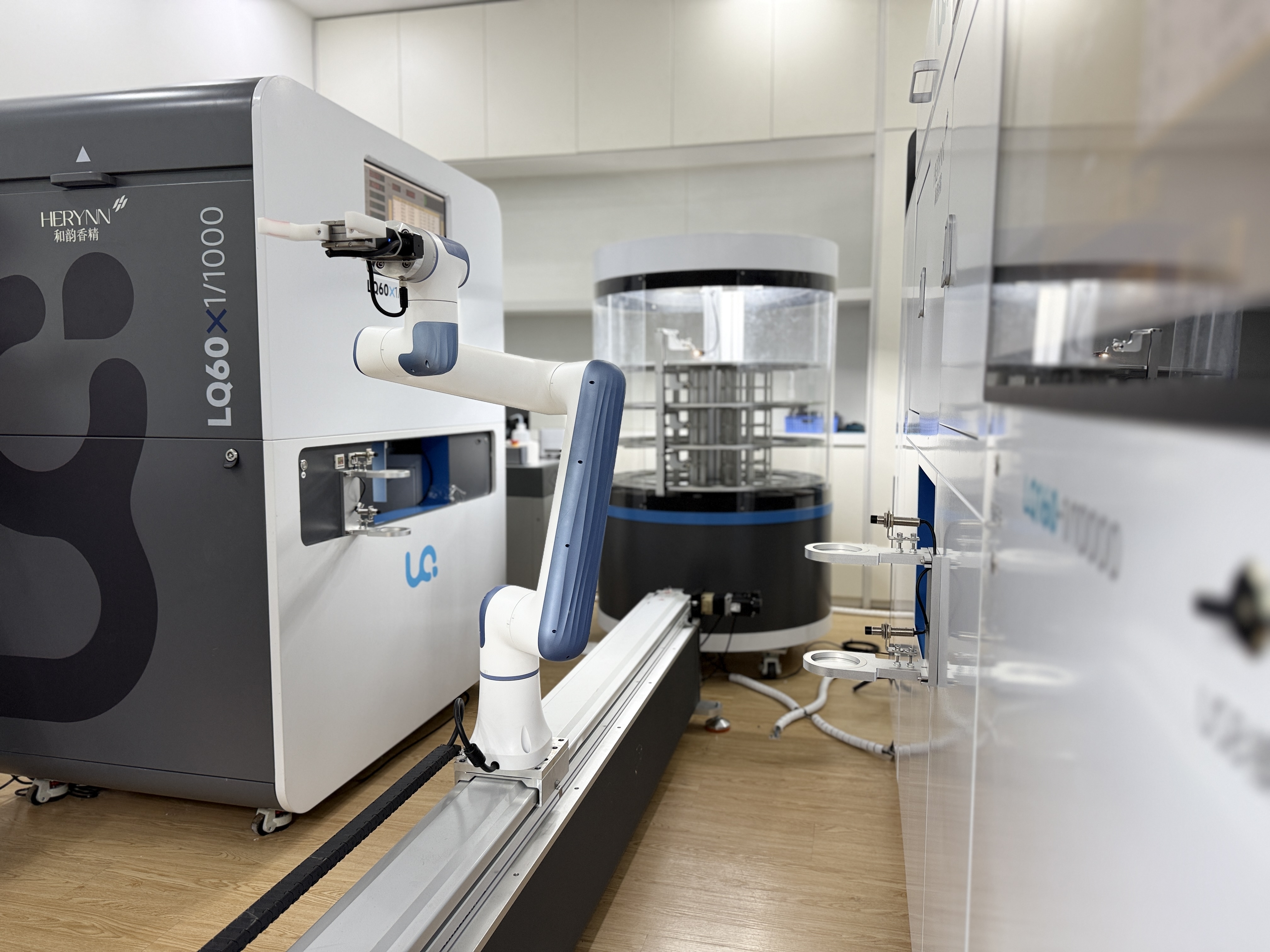
Fully automatic batching: the production environment behind a catalogue candle fragrance oil.
HW91046 and HW91047 at a glance
Both grades are supplied by HERYNN Fragrance Oil, a China-based fragrance manufacturer (Shanghai Herynn Fragrances & Flavors Co., Ltd.) that keeps perfumery and compounding in-house and supplies fragrance compounds for fine fragrance, personal care, air care, candle and home care applications. The table below sets out what the supplied documentation states for each candle grade; the interpretation follows underneath.
| Parameter | HW91046 | HW91047 |
|---|---|---|
| Documented carrier system | IPM and DPM | IPM |
| Documented candle applications | Soy candles, paraffin candles, wax melts | Candle fragrance oil |
| Candle dosage range | 6–10% | 6–10% |
| Minimum order quantity | 1 kg (supplier-reported) | 1 kg (supplier-reported) |
| Sample | Olfactive confirmation sample, approx. 30 g; despatch reported at 2–3 days | Same |
| Documentation on request | IFRA Certificate of Conformity, COA, SDS, SPEC, allergen declaration, VOC report, Prop 65 documents | Same |
| Shelf life and storage | 24 months; sealed, 18 °C recommended, away from sunlight and heat | 24 months; sealed, 18 °C recommended, away from sunlight and heat |
Three rows do no work as differentiators. Dosage, minimum order quantity and documentation are identical, so a buyer cannot choose between these two grades on headline parameters. Two rows do work. The carrier row is the documented formulation difference between the grades. The application row is the documented coverage difference: HW91046's specification names soy candles, paraffin candles and wax melts, while the supplied documentation for HW91047 states the carrier without listing individual wax systems.
That second point needs care. A wax system that is not listed is not a wax system the oil has been shown to fail in, and the absence of a listed substrate is never evidence of unsuitability. What it means practically is that coverage has to be confirmed in writing, or established by your own trial, before a production commitment. Buyers who read a shorter specification sheet as a negative judgement make a sourcing error in the opposite direction from the one they are trying to avoid.
Carriers: the one documented difference that changes the evaluation
A fragrance compound is a concentrated blend of fragrance raw materials dosed into a base formulation at a defined percentage. The carrier or solvent system is part of the compound you receive, and it is one of the variables that can interact with the base. The supplier's own troubleshooting guidance lists an incompatible solvent or carrier alongside oxidation, pH effects and packaging materials as a cause of discolouration or scent change in a finished product, which places the carrier question squarely inside the qualification process rather than beside it.
HW91046 presents two carrier materials, IPM and DPM; HW91047 presents one, IPM. What that does not mean is that either carrier performs better in wax. No comparative burn, throw or colour data for the two grades were supplied, and a carrier list is a formulation disclosure, not a performance score. Treating the two-carrier grade as the premium option, or the single-carrier grade as the simple option, imports a quality ranking that the documentation does not contain.
Three questions convert the carrier difference into a usable decision. First, in HW91046, are IPM and DPM present as a fixed blend or offered as selectable carrier options? That answer determines whether you qualify one system or two. Second, does the carrier change the recommended wax addition temperature, or the recommended point within the 6–10% range? Third, which carrier does your existing process already handle without separation, discolouration or wicking problems?
The answers point in different directions for different programmes. If your plant already runs IPM-carried oils cleanly, HW91047 keeps the number of new variables at one, and a single-variable trial is faster to interpret. If your programme covers soy, paraffin and wax melts, HW91046's documented coverage reduces the number of separate qualifications you have to run to cover the same range. Both are efficiency arguments grounded in documented scope; neither is a quality argument.
Verification is identical for both grades and comes straight out of the supplier's troubleshooting guidance: run a stability test on your base with and without the fragrance, compare the result against the reference sample and a retained sample, and review packaging and storage conditions alongside it. For a candle, the base is your wax blend, and the conditions that matter are your pour temperature, vessel, wick and storage through cure.
Scent structure: what a specification can and cannot tell you
Scent is the one dimension in this comparison that no specification sheet can settle. A fragrance compound carries the scent identity of the finished product, and its volatile molecules evaporate at different rates, which is what produces top, middle and base notes over time. Performance then depends on the base formulation, the dosage, the packaging and the storage conditions, which in a candle means your wax blend, your load, your vessel and how the finished goods are stored.
The practical consequence is that scent comparison has to be run at equal load, in the same wax, with the same wick and vessel, for both grades at the same percentage. Two reference points matter for a candle: cold throw, the scent released from unlit wax, and hot throw, the scent released while the candle burns. A grade that reads well unlit and disappears on burning, or the reverse, is a different product decision from one that is merely weaker at both points. Comparing the oils at 6% and again at 10% also shows whether the two grades separate evenly across the range or diverge at one end of it.
The sample you will receive is an olfactive confirmation sample of approximately 30 g, supplied for sensory evaluation only and not tested by GC-MS. GC-MS testing is applied to raw materials and to production batches, which are released with a COA. The sample therefore answers one question well, which is how the oil behaves in your wax, and it does not substitute for the analytical record of the batch you eventually buy.
A decision rule keeps the sequence honest. If one grade is clearly preferred at equal load in your wax, that result outranks any preference formed from the specification sheet. If the two are indistinguishable at 6% and separate only at 10%, the decision moves to cost per kilogram of wax and to which carrier your process handles more predictably. Either way the answer belongs to your bench data, not to the catalogue.
Dosage: both 6–10%, so the decision is where you sit in the range
Identical dosage ranges mean dosage does not separate these two grades; it is a variable you control. Where you sit inside the range is set by four things: the wax and vessel you run, the burn behaviour you accept in your own testing, the IFRA limit that applies to the finished product category, and the quantity of oil consumed per kilogram of wax.
Two calculations follow from the documented endpoints and are shown as arithmetic, not as measured production data. At a 6% load, 1 kg of fragrance oil carries approximately 16.7 kg of wax; at 10% it carries 10 kg. Moving from 6% to 10% therefore raises oil consumption per kilogram of wax by about two-thirds. On a 1 kg minimum order, that is the difference between a trial covering roughly 17 kg of wax and a trial covering 10 kg, which is enough to size a bench run before you request anything.
The certificate has to follow the load. An IFRA Certificate of Conformity is issued for a stated product category and use level, and must be re-issued if the product type or use level changes. A buyer who evaluates at 6% and scales at 10% is running a use level the 6% certificate does not cover, and the gap is invisible until a customer or a regulator asks for the document. Request the certificate at the load you will actually run, for the candle category that applies to your product, before you commit to that load.
The endpoints should also be treated as a validated window rather than an aspiration. The supplier's troubleshooting guidance lists dosage outside the validated range among the causes of discolouration or scent change. If your wax needs more than 10% to perform acceptably, the correct move is a conversation about reformulation or a different grade, not an undocumented increase that leaves the compliance file behind.
On the production floor the documented sequence is: confirm the approved reference sample and the IFRA limit for the category; bring the oil to room temperature and mix gently; dose at the recommended percentage at the correct process stage; homogenise; evaluate odour, colour and stability and retain a sample; reseal the drum immediately after use. The documented example places addition after emulsification and, where possible, below 45 °C, which is written for emulsion systems. For a candle, confirm the wax addition temperature for your specific blend with the supplier instead of transplanting the emulsion step.
Documentation: what IFRA, COA and SDS each prove
An IFRA Certificate of Conformity confirms that a fragrance compound complies with IFRA Standards for a stated product category and use level. Buyers use it to check that the fragrance stays within the applicable restrictions for its intended use, and because the certificate is category- and dosage-specific, a change of product type or use level requires a new one. It is a compliance document tied to your application, not a general certificate of quality.
The framework behind it is worth understanding before you rely on it. IFRA describes its Standards as a globally recognised risk-management system for the safe use of fragrance ingredients, which can prohibit, restrict or set purity criteria for specific materials. IFRA also states that the Standards are voluntary in general and mandatory for IFRA members under the Code of Practice, and that they do not replace the regulations in force in the markets where products are sold. IFRA's certification guidance adds a further scoping point: the certificate applies to fragrance mixtures intended to be included directly in a finished consumer product.
Three practical consequences follow for a candle buyer. Confirm with the supplier which intended-use category applies to your candle or wax melt and whether a certificate is issued for that category, because IFRA notes that product types outside the scope of relevant safety assessments may not be covered. Ask for the certificate at your use level, not at a laboratory level. And keep IFRA conformity in its own compartment: it supports safety assessment for the fragrance, but destination-market labelling, chemical classification and consumer-product rules remain a separate file that the certificate does not close.
A COA is the analytical record for a batch. Because GC-MS testing is applied to raw materials and to production batches that are released with a COA, the certificate of analysis is where the composition and identity evidence sits. Ask for the COA of the batch that ships to you, not only the one attached to the sample, and keep it with your retained sample so that a future complaint can be traced to a specific production lot.
An SDS covers handling rather than performance. The supplier issues SDS documentation in EU CLP, US GHS and China GHS formats, and that is the document that governs storage, ventilation, personal protective equipment and spill response for your warehouse and production staff. Alongside these three core documents, SPEC sheets, allergen declarations in the EU 28 or 83 allergen models, VOC reports and California Proposition 65 documents are available on request where the destination market calls for them.
One certification reference sits beside the fragrance documents rather than inside them. The supplier documentation for HW91046 references an ISO 14001:2015 certification issued by the China Quality Certification Centre. ISO 14001 is an environmental management system standard, so it speaks to how a site manages environmental performance, not to product safety, scent quality or burn behaviour. It complements the IFRA, COA and SDS package; it does not stand in for any part of it, and it is not a product certification.
The buyer checklist: discolouration, shelf life and dosing
Discolouration and scent drift
The supplier's troubleshooting guidance attributes discolouration of a finished product, or a change or fade in scent during storage, to interaction between fragrance components and the base formulation through oxidation, pH, UV light or packaging material; to dosage outside the validated range; to an incompatible solvent or carrier; and to storage outside the recommended conditions. The recommended response is diagnostic rather than remedial: compare the affected batch with the approved reference sample and the retention sample, check packaging material and storage conditions, and run a stability test on the base with and without the fragrance. If discolouration persists, request a reformulation, for example by replacing a sensitive component or adjusting the stabiliser system.
For a candle programme this translates into a test you control: cast the same wax with and without each grade, at the load you intend to run, store the samples under your normal conditions, and compare colour and scent at intervals against a retained reference. Do this before the production order rather than after the first customer complaint, because the two carrier systems give you two different compatibility questions to answer in the same wax.
Shelf life and storage
Documented shelf life is 24 months. Storage requirements are consistent across the grades: keep the container sealed in a cool, dry, well-ventilated place away from direct sunlight and high temperature, with 18 °C recommended, and use the material promptly after opening. Resealing after each dispensing step is part of the instruction rather than good practice, because an open drum exposes the compound to exactly the conditions the troubleshooting guidance identifies as a cause of change.
Dosing during production
The documented procedure is short enough to post at the mixing station: confirm the approved reference sample and the IFRA limit; bring the oil to room temperature and mix gently; dose at the specified percentage and process stage; homogenise thoroughly; evaluate odour, colour and stability and retain a sample; reseal the drum. The safety note attached to the same guidance covers closed containers when not in use, avoidance of skin and eye contact, appropriate PPE and adequate ventilation, and adherence to the SDS. Dosage within the IFRA category limit is stated as a requirement, not a target.
Traceability
Retaining a sealed sample of every batch is specified as the traceability step. Combined with the batch COA, it is what allows a discolouration or scent complaint to be investigated months later against the material that actually went into the product.
Fit boundaries: which grade suits which programme
HW91046 is the grade whose supplied documentation covers soy candles, paraffin candles and wax melts, with IPM and DPM carriers. A manufacturer running more than one wax system, or adding melts to an existing candle line, can cover all three applications with one documented grade, and that reduces the number of separate qualifications in the file. It is a coverage argument, and coverage is the only thing the documentation establishes.
HW91047 is documented with an IPM carrier. A single-wax programme whose process already handles IPM-carried oils has one carrier variable to qualify instead of two, and a narrower variable set is easier to attribute when a test result moves. Where the supplied documentation does not list wax systems, confirm coverage in writing and treat the bench trial as the deciding evidence.
The fit boundary applies to both grades and should be written into the trial plan. The documented load is 6–10%; the documented shelf life is 24 months; storage at 18 °C sealed is specified; the sample is an approximately 30 g olfactive confirmation sample for sensory evaluation only; and colour and scent stability in your specific wax must be verified in your own base. Neither grade is documented as superior in scent, throw or colour performance, because no comparative performance data were supplied for either.
Sourcing context: what a 1 kg minimum order buys you
Small-volume terms matter for a two-grade comparison, because the trial itself has a cost. The supplier reports a 1 kg minimum order quantity against 10–50 kg at international fragrance houses, sample despatch in 2–3 days, sample lead time of 7–15 days against 4–8 weeks, custom development in 2–4 weeks against 8–16 weeks, and technical response within 24 hours against 2–5 days. These are supplier-reported comparisons, and figures vary by supplier and by market, but the practical reading is straightforward: at 1 kg per grade you can qualify both oils in your own wax before committing to either.
Whether a sample is invoiced or waived is a commercial term to confirm at the point of request, along with packaging format and shipping method for your destination. Neither point changes the technical evaluation, and both are better settled before the trial rather than after it.
Market context, stated with its limits
Two commercial research estimates frame the category and should be read with their scope in mind. Fortune Business Insights puts the global home fragrance market, covering candles, diffusers and comparable products, at USD 26.00 billion in 2025. Data Bridge Market Research estimates the global fragrance oil market at USD 8.50 billion in 2024, with a projected compound annual growth rate of 4.30% to USD 11.90 billion by 2032. The two figures sit at different stages of the value chain, they are vendor estimates rather than audited statistics, and neither forecasts what your own candle line will sell.
Their use here is narrow. They indicate that candle and home fragrance is a substantial category served by application-specific materials, which is consistent with a supplier maintaining two candle grades separated by carrier rather than by price tier. They do not support any conclusion about which grade will perform better in your wax, and no purchase quantity should be sized from them.
A qualification sequence for the next order
- Confirm in writing whether HW91046's IPM and DPM are a fixed blend or selectable carrier options, and whether HW91047 is documented for your specific wax system.
- Request the IFRA Certificate of Conformity for the candle category that applies to your product, at the use level you intend to run, plus the allergen declaration for that level.
- Order one olfactive confirmation sample of each grade, and note that the samples are for sensory evaluation only and are not GC-MS tested.
- Cast both grades at 6% and at 10% in your own wax, with your wick and vessel, alongside an unfragranced control.
- Evaluate cold throw and hot throw at equal load, and record colour against the control at intervals under your normal storage conditions.
- Confirm the batch COA, the SDS in the format your market requires, and any destination-market documents such as VOC or Proposition 65 where applicable.
- Before scaling, re-check that the certificate, the COA and the production use level all describe the same product and the same load.
The comparison between HW91046 and HW91047 is narrow by design: one documented carrier difference, one documented coverage difference, and a set of parameters that are identical. Narrow comparisons are the ones that can actually be closed. The buyer who tests the carrier variable in their own wax, holds a certificate that matches their use level, and keeps a retained sample per batch has answered the question the specification sheet could not, and has a file that will still make sense two audits from now.
Frequently asked questions
What is the difference between HW91046 and HW91047?
The documented difference is the carrier system. HW91046 is specified with IPM and DPM carriers and listed for soy candles, paraffin candles and wax melts; HW91047 is specified with an IPM carrier. Both share a 6–10% candle dosage range, a supplier-reported 1 kg minimum order quantity and the same IFRA, COA and SDS documentation. No comparative performance data were supplied, so this is a formulation and coverage difference rather than a stated quality ranking.
Do both grades really use the same dosage range?
Yes. A 6–10% candle dosage range is stated for both grades, so dosage does not differentiate them. What matters is where inside that range your wax, vessel and wick perform acceptably, and whether the IFRA certificate you hold matches the use level you actually run in production.
Can I keep the same IFRA certificate if I change my dosage or product type?
No. An IFRA Certificate of Conformity is issued for a stated product category and use level and must be re-issued if the product type or use level changes. If you evaluate at 6% and scale at 10%, request the certificate at 10% for the candle category that applies to your product, together with the allergen declaration for that level.
Why might a candle fragrance discolour the wax or fade, and how can it be checked before ordering?
The supplier's troubleshooting guidance attributes discolouration or scent change to interaction between fragrance components and the base, including oxidation, pH effects, UV light and packaging material; to dosage outside the validated range; to an incompatible solvent or carrier; and to storage outside the recommended conditions. The check is a side-by-side stability test in your own wax with and without the fragrance, comparison against reference and retention samples, and a review of packaging and storage. If discolouration persists, a reformulation can be requested.
What are the shelf life and storage requirements?
Documented shelf life is 24 months. The material should be stored sealed in a cool, dry, well-ventilated place away from direct sunlight and high temperature, with 18 °C recommended, and used promptly after opening. Handling should follow the SDS for ventilation, PPE and container closure.
What does the sample prove compared with the COA?
The olfactive confirmation sample of approximately 30 g is supplied for sensory evaluation only and is not tested by GC-MS. GC-MS testing is applied to raw materials and to production batches, which are released with a COA. The sample answers how the oil behaves in your wax; the COA is the analytical record for the batch you buy.
Supplier documentation pack: HERYNN company brochure (PDF).
Tem questões ou precisa de mais detalhes?
Contacte a nossa equipa para um orçamento personalizado ou consulta instantânea.
Solicitar orçamento
Preencha o formulário abaixo e a nossa equipa entrará em contacto com uma proposta personalizada.
Chat direto do WhatsApp
Prefere conversar em tempo real? Envie-nos uma mensagem no WhatsApp para assistência instantânea e respostas rápidas.
- Obter orçamento personalizado
- Partilhar fotos ou documentos
- Discuta as suas necessidades diretamente
Geralmente responde em 5–30 minutos durante o horário de expediente.