
Cannabis Packaging Bags: Size and Barrier by Product Type
A dispensary does not buy one bag. It buys a set of them, and the set is dictated by what goes inside: a gram of flower, a three-and-a-half gram eighth, a pre-roll multi-pack, a resealable edible pouch, a tobacco pouch, a vape accessory sleeve, an aromatherapy sachet or a health-product pack. Each of those places a different demand on moisture transmission, odor containment, fill weight and closure.
For buyers in the evaluation stage, the practical answer is that cannabis packaging bag selection is driven by three inputs — fill weight and product density, the product's sensitivity to moisture, oxygen and odor, and the closure or compliance requirement attached to the pack — and format is the output. Starting from a bag catalogue and working backwards is the most common cause of dispensary re-orders that fail on fit, seal or child resistance.
Why one-spec purchasing breaks down at retail
Dispensary assortments are wide and shallow. A single store may carry flower in five weights, pre-rolls in two pack sizes, edibles in three formats, CBD lines, accessories and, in smoke shops, tobacco and herbal products alongside. If all of that is served by one bag size in one film, three problems appear quickly.
- Headspace and oxygen. A bag much larger than its fill holds residual air. For flower, that is a moisture and terpene question; for edibles, it is a contamination-prevention and handling question.
- Closure mismatch. A child-resistant closure designed for a multiple-use pouch is not automatically the right choice for a single-serving pack, and the two are treated differently in regulation.
- Print real estate. Mandatory label elements, warnings and brand graphics compete for the same panel. A format chosen on fill weight alone often leaves no compliant labelling area.
The alternative is a small, deliberate configuration matrix: five formats, five fill weights, three odor-proof grades and three child-resistant closure options, matched to product type. That is the framework this article sets out.
Where Chitai sits in the supply chain
Dongguan Chitai Packaging Products Co., Ltd is a packaging manufacturer based in Dongguan, Guangdong, China, specialising in cannabis packaging bags — including CHITAI cannabis mylar bags and smell proof bags — for dispensaries, smoke shops, and aromatherapy or medical botanical settings, with North America and Europe as its main export markets.
The company was established in 2025 as the entity handling overseas clients and trade negotiation, building on printing and packaging experience since 2012. Its stated operating base includes a 4,200 m² factory, 45 employees, 8 R&D engineers and annual output of 30,000,000 units, with 2 digital printing machines, 30 fully automatic bag-making machines, 4 gravure printing machines, an in-house laboratory and a Class 1,000,000 dust-free workshop. Those figures matter to a retail buyer for one reason: a multi-SKU dispensary programme is a scheduling problem as much as a specification problem, and format range plus in-house print capacity determines whether a five-SKU order ships together or in fragments.
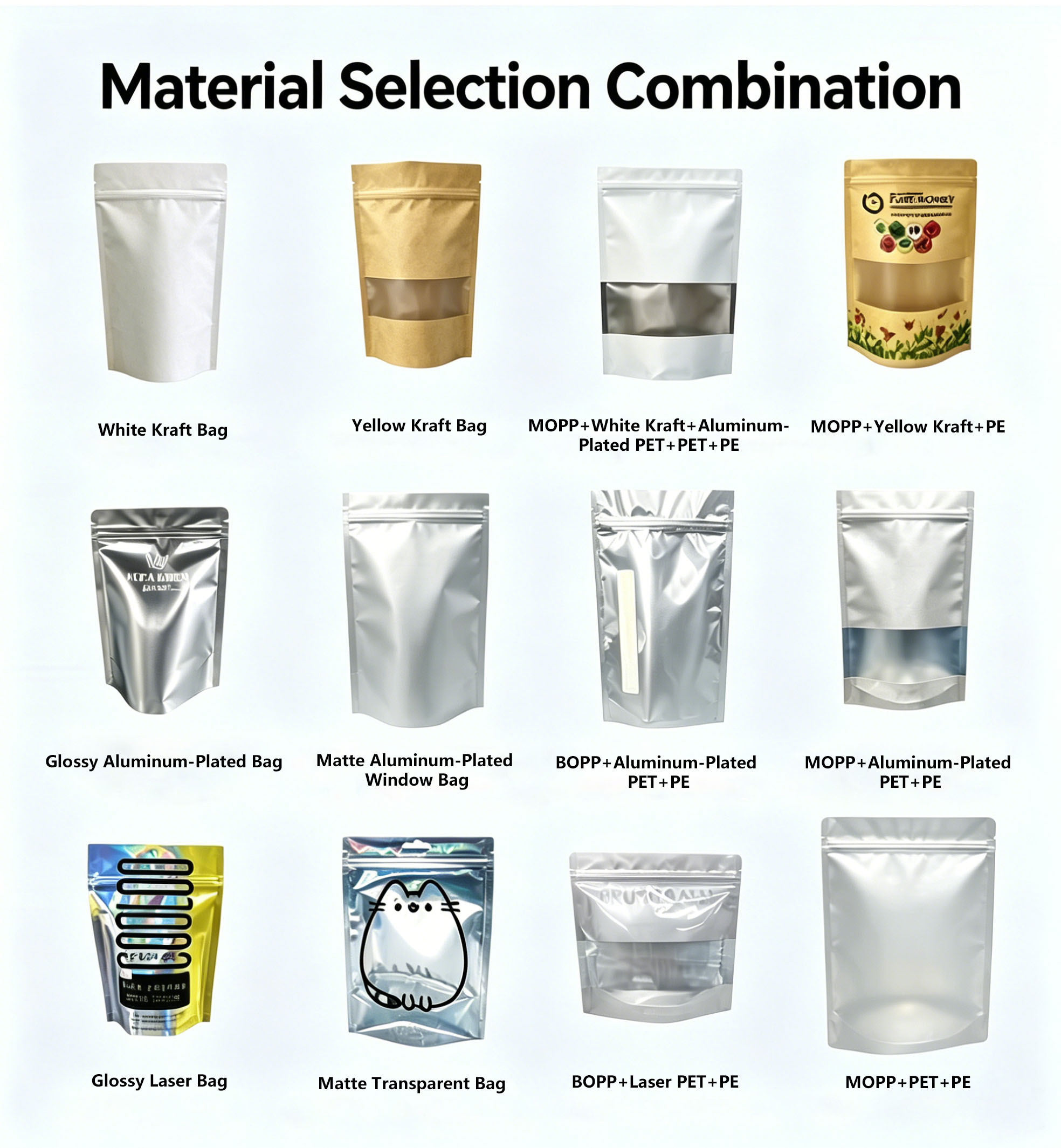
The five formats and five fill weights
The available format set is 3x4, 4x5, 5x6, 6x8 and 8x10, and the available fill weights are 1g, 3.5g, 7g, 14g and 28g. Mapping one to the other is a density question, not a volume question, because milled flower, whole bud, ground herb and compressed product all pack differently. The matrix below is a starting point for sampling, not a substitute for it.
| Fill weight | Typical retail use | Format starting point | What to check on the sample |
|---|---|---|---|
| 1g | Single-gram flower, sample packs, single pre-roll | 3x4 | Headspace and seal width; label panel sufficiency |
| 3.5g | Eighth of flower, pre-roll multi-packs | 3x4 to 4x5 | Whether the closure seats flat when full |
| 7g | Quarter ounce, small edibles packs | 4x5 to 5x6 | Base gusset stability on shelf |
| 14g | Half ounce, bulk herb, larger edibles | 5x6 to 6x8 | Seal integrity under fill load |
| 28g | Ounce, health and bulk botanical packs | 6x8 to 8x10 | Zip track resistance and top-seal strength |
Format guidance is a sampling starting point. Final pairing should be confirmed against the actual product density and fill method.
Barrier is a specification, not an adjective
CHITAI high-barrier cannabis packaging bags use a PET/VMPET/PE/NY/AL multilayer construction. The published barrier values are a water vapour transmission rate (WVTR) of ≤0.03 g/(m²·24h) and an oxygen transmission rate (OTR) of ≤0.05 cm³/(m²·24h), with an IPX4 waterproof rating. Those two numbers sit at the level described as premium barrier performance in independent 2026 industry research on cannabis packaging, which cites OTR below 0.05 cm³/(m²·24h) and WVTR under 0.03 g/(m²·24h) as the premium band.
Odor control is expressed in three grades — Good, Excellent and Premium — and is a separate axis from WVTR and OTR. A bag can be a strong moisture barrier and a moderate odor barrier, because the two properties come from different layers and from seal integrity rather than from film alone.
Matching barrier and closure to product type
The useful way to read the matrix is by what each product is actually at risk from. Flower and herbal botanicals lose moisture and aroma; edibles are governed by contamination prevention, resealability and child resistance; pre-rolls concentrate the child-resistance question because they are often single-use; and accessories sit mostly on tamper evidence and format fit.
| Product type | Primary packaging risk | Odor-proof grade to specify | Closure route |
|---|---|---|---|
| Cannabis flower | Moisture loss, terpene and aroma loss | Excellent to Premium | CR Zipper or Push Lock |
| Pre-roll | Crush, dryness, odor, single-use child resistance | Excellent | CR Zipper or Slide Lock |
| Edibles | Contamination, resealability, child resistance | Good to Excellent | CR Zipper (resealable) |
| CBD products | Moisture, labelling space, tamper evidence | Excellent | Push Lock |
| Tobacco | Moisture retention, odor containment | Excellent to Premium | Resealable zipper |
| Vape accessories | Format fit, tamper evidence | Good | Slide Lock |
| Herbal and aromatherapy | Aroma retention, moisture | Premium | Resealable zipper |
| Health products | Stability, multi-count handling | Excellent | CR Zipper |
Grades and closure routes shown are CHITAI's available options and should be fixed at sample approval, not at purchase order stage.
Flower and herbal: WVTR is the number that matters
For dried flower, moisture migration is the dominant failure mode. A bag rated at WVTR ≤0.03 g/(m²·24h) limits the rate at which the product equilibrates with ambient humidity, which is why Premium-grade odor control and high-barrier film are usually specified together for ounce and half-ounce formats. Canadian immediate-container rules reinforce the same direction: Cannabis Regulations section 108 requires the container to keep dried cannabis dry, prevent contamination, be opaque or translucent, provide reasonable assurance it has not been opened, meet child-resistant requirements and hold no more than the equivalent of 30 g of dried cannabis.
Pre-roll and edibles: child resistance moves to the front
For pre-rolls and edibles, the barrier question is shorter — these products turn over faster — but the closure question is longer. California's Department of Cannabis Control requires cannabis goods to be sold in child-resistant packaging, and its guidance distinguishes single-use initial child-resistant packaging from multiple-use lifetime child-resistant packaging, where resistance is maintained after opening. It also identifies PPPA-certified packaging under 16 CFR 1700.15(b)(1) as one recognised route to compliance, and notes that certain single-serving plastic packaging may qualify when it is at least 4 mils thick and heat-sealed without an easy-open tab, dimple, corner or flap. That condition is specific to the described single-serving route; it is not a universal thickness rule for cannabis bags.
Accessories, tobacco and health packs: format and tamper evidence first
Where the contents are hardware or a non-inhaled botanical, the dominant requirement shifts to format fit, tamper evidence and print area. The 3x4 and 4x5 formats carry vape accessories and small botanical packs; 5x6 through 8x10 carry tobacco, bulk herbal blends and multi-count health products. Odor grading still applies where aromatic contents are present, which is why aromatherapy buyers typically specify the same Premium grade as flower buyers rather than a lower one.

Custom printing and ODM/OEM across a multi-SKU programme
A dispensary programme usually needs the same artwork system applied across several formats at once. Chitai runs digital, gravure and flexographic printing, which allows short-run test formats and long-run core formats to be produced under one specification. Customisation covers shape, material, logo printing and colour, delivered as OEM or ODM work.
- Minimum order quantity: 10,000 units.
- Monthly capacity: 2,500,000 units.
- Stated lead time: 3–5 days.
- Quality control: 100% test, supported by an in-house laboratory.
- After-sales: remote support.
The MOQ is the number most often misread. It is a per-configuration figure, so a five-format dispensary roll-out is planned as several runs rather than one. Buyers consolidating a first order should decide early which two formats carry the volume and which three are test formats.
What a retail deployment looks like in practice
A documented Chitai case covers a cannabis brand owner packing dried flower in a 500,000-unit programme. Reported outcomes were a shelf life of two to three years, a daily usage period of more than one year, no odor leakage, and full compliance with local regulations on preventing children from opening and tampering. The construction features cited were child-resistant safety design, high odor barrier, solvent-free material, and an anti-tampering and anti-counterfeit structure.
Two details in that case are transferable to dispensary retail planning. First, the combination of odor barrier and child resistance was specified together rather than as alternatives — which is the same logic the barrier-and-compliance pairing in 2026 industry research points to. Second, the anti-counterfeit structure addressed a retail problem, not a manufacturing one: resealed or substituted packs on a dispensary shelf.
Chitai's stated material baseline is brand-new virgin food-grade film with no recycled content and no false labelling. Its own comparison notes that some factories blend 30% to 60% recycled material into the film, which changes consistency and maintenance expectations. That comparison is a first-party position, not an independent finding; buyers running sustainability targets should ask any supplier — including Chitai — for the recycled-content and end-of-life documentation attached to the specific structure being quoted.
Market context: growth direction is clear, absolute sizing is not
Published estimates for cannabis packaging disagree on absolute size, and the disagreement is large enough that buyers should treat it as a scope problem rather than a data error. Fortune Business Insights puts the global cannabis packaging market at USD 7.37 billion in 2026, rising to USD 21.55 billion by 2034 at a 14.35% CAGR. Mordor Intelligence values the same market at USD 2.29 billion in 2026, reaching USD 4.65 billion by 2031 at a 15.22% CAGR. The two figures cannot be averaged or combined, and neither is bag-specific.
What the sources do agree on is direction: double-digit growth across the forecast window. Grand View Research estimates the U.S. cannabis packaging market at USD 1.36 billion in 2023 with a 28.9% CAGR from that base, and reports that plastics accounted for 54.3% of global cannabis packaging material share in 2025 — consistent with flexible pouches remaining the default retail format. On the supply side, China accounted for over 25% of global exports of plastic bags under HS 392321 in 2023, at approximately USD 3.32 billion.
There is also a consumer-side signal worth noting for print decisions. A 2022 peer-reviewed study examined how recreational cannabis packaging characteristics influence cognitive, affective and behavioural responses. It supports treating packaging as a design variable that shapes consumer response, but the published abstract-level result does not establish a specific feature preference, so it should inform testing hypotheses rather than settle a print specification.
Flexible high-barrier pouches versus traditional formats
Compared with rigid jars, tins and paperboard cartons, a multilayer flexible pouch concentrates barrier performance in a thin structure: measurable OTR and WVTR, an IPX4 waterproof rating, a flat-packed shipping profile and a large printable panel. For flower and pre-rolls, that combination is usually the more efficient way to hit a barrier target. For some edible formats, a rigid or semi-rigid container still offers structural protection and stacking behaviour that a pouch does not replicate.
Three boundaries are worth stating plainly, because they affect how the specification should be written.
- Barrier values are film-level. WVTR ≤0.03 g/(m²·24h) and OTR ≤0.05 cm³/(m²·24h) describe the laminate. Finished-bag performance also depends on seal integrity, zip-track quality and fill method, so the finished pack — not only the film — is what should be validated.
- Odor grades are manufacturer grades. Good, Excellent and Premium are Chitai's internal classifications, not a public standard. Buyers with strict odor requirements should pair the grade with their own sensory test at sample stage.
- Multi-material laminates carry an end-of-life trade-off. High-barrier performance comes from combining PET, VMPET, PE, NY and AL layers, which complicates material separation at end of life. Verified recyclability or compostability data is not part of the standard specification set for this category, so a buyer with a sustainability mandate has to request it explicitly and accept that not every structure will have it.
Two commercial constraints follow. The 10,000-unit MOQ means a genuine multi-format test programme needs planning rather than a single small order. And child resistance is design-specific: a CR Zipper, Push Lock or Slide Lock configuration is only demonstrably compliant for the design that was tested, under the applicable protocol.
Future outlook
Three shifts are likely to shape dispensary packaging decisions over the next buying cycles. First, barrier data is moving from a marketing claim to a tender document — the pairing of compliance evidence with OTR and WVTR figures is already visible in 2026 industry research, and buyers who ask for both at RFQ stage will get cleaner comparisons. Second, regulatory language on child resistance continues to distinguish single-use from multiple-use formats in jurisdictions such as California, which pushes pack-type decisions earlier in the design process rather than later. Third, sustainability questions are arriving at the specification stage rather than after it, which means recycled-content and end-of-life documentation will increasingly sit alongside barrier values in the same supplier file.
For a dispensary or smoke shop building a first configuration matrix, the practical sequence remains: fix the product types, fix the fill weights, choose formats from the 3x4 to 8x10 range, then specify barrier grade and closure for each — and validate the finished pack by sample before committing the run.
FAQ
Which cannabis packaging bag format fits 3.5g of flower?
A 3.5g fill is usually sampled in a 3x4 or 4x5 format. The deciding factor is product density rather than weight alone: whole bud, milled flower and ground herb occupy different volumes at the same weight. Confirm the pairing with a filled sample and check that the closure seats flat and the top seal closes cleanly.
Are CHITAI cannabis mylar bags smell proof and waterproof?
Chitai describes odor control in three grades — Good, Excellent and Premium — and states an IPX4 waterproof rating for its high-barrier bags. Odor-proof grades are manufacturer classifications, not a published standard, so buyers with strict odor requirements should combine the specified grade with an in-house sensory check at sample approval.
Do child-resistant cannabis packaging bags meet ASTM D3475?
Chitai offers child-resistant closure options described as CR Zipper, Push Lock and Slide Lock, referenced against ASTM D3475 classification. Compliance is design-specific: a closure configuration is only demonstrated for the design tested. The relevant U.S. federal criterion under 16 CFR 1700.20 requires that 85% of children aged 42 to 51 months cannot open the package within five minutes, so buyers should request the test evidence that matches the exact bag being ordered.
Can ODM and OEM cannabis packaging bags be custom printed?
Yes. Chitai provides digital, gravure and flexographic printing and offers OEM and ODM customisation covering shape, material, logo printing and colour. Stated parameters are a 10,000-unit MOQ, monthly capacity of 2,500,000 units, a 3–5 day lead time and 100% testing. MOQ applies per configuration, so a programme spanning several formats is planned as several runs.
What barrier figures should a high-barrier cannabis packaging bag specify?
For premium barrier performance, specify WVTR ≤0.03 g/(m²·24h) and OTR ≤0.05 cm³/(m²·24h), which matches the premium band cited in 2026 industry research on cannabis packaging. Because these are film-level values, the specification should also require validation of the finished bag — seal integrity, zip track and fill method — rather than the laminate alone.
Are eco-friendly marijuana packaging bags available, and what should buyers verify?
Chitai's stated material baseline is brand-new virgin food-grade film with no recycled content and no false labelling, which it presents as a consistency and maintenance advantage. Buyers pursuing an eco-friendly brief should verify two things separately: the recycled-content percentage declared for the specific structure, and any recyclability or compostability documentation available for it. Because high-barrier performance comes from multi-material laminates, not every structure will have that documentation.
Tem questões ou precisa de mais detalhes?
Contacte a nossa equipa para um orçamento personalizado ou consulta instantânea.
Solicitar orçamento
Preencha o formulário abaixo e a nossa equipa entrará em contacto com uma proposta personalizada.
Chat direto do WhatsApp
Prefere conversar em tempo real? Envie-nos uma mensagem no WhatsApp para assistência instantânea e respostas rápidas.
- Obter orçamento personalizado
- Partilhar fotos ou documentos
- Discuta as suas necessidades diretamente
Geralmente responde em 5–30 minutos durante o horário de expediente.