
Capability-Driven Electrical Steel Sourcing: OEM, Customization, and Supply Execution
The electrical steel market is expected to grow from USD 31.0 billion in 2025 to USD 47.0 billion by 2033, according to Grand View Research. For industrial buyers, that projection is not only a demand signal. It is also a test of supplier capability. Transformer, motor, and electric vehicle manufacturers are moving from specification review to purchasing decisions, and the question that increasingly decides selection is whether a supplier can do more than sell a material grade.

Why Capability Now Decides Electrical Steel Sourcing Outcomes
Demand for electrical steel now spans many segments, including electrical steel for transformers, electrical steel for motors, electrical steel for generators, electrical steel for household appliances, and electrical steel for new energy vehicles. Each application changes the priorities placed on thickness, iron loss, magnetic flux density, and coating behavior. A grade that works in a distribution transformer core may not be the right choice for a high-frequency motor core or a converter transformer used in renewable energy transmission.
The practical problem for buyers is that material grade alone does not solve their production problem. A coil with the right magnetic properties still needs to be cut to width, slit into strips, cut to fixed length, coated appropriately, and packed in a way that preserves the edges. Some suppliers can arrange those steps; others only pass the material through. According to the capability unit compiled for this assessment, the manufacturer can handle strip cutting, fixed-length flat cutting, longitudinal cutting, and packaging customization. That is the difference between a source of material and a source of usable material.
The opportunity for the buyer is to reduce the number of handoffs in the supply chain. When a supplier can process electrical steel in-house, tolerances are easier to control, disputes about cut quality are reduced, and the material can be delivered closer to the final core-making step. From a buyer perspective, this integration also simplifies quality acceptance. If one company is responsible for both material procurement and secondary processing, the buyer can request batch inspection reports at each stage and trace the final product back to a single responsible counterpart.
What an Integrated Electrical Steel Manufacturer Can Deliver
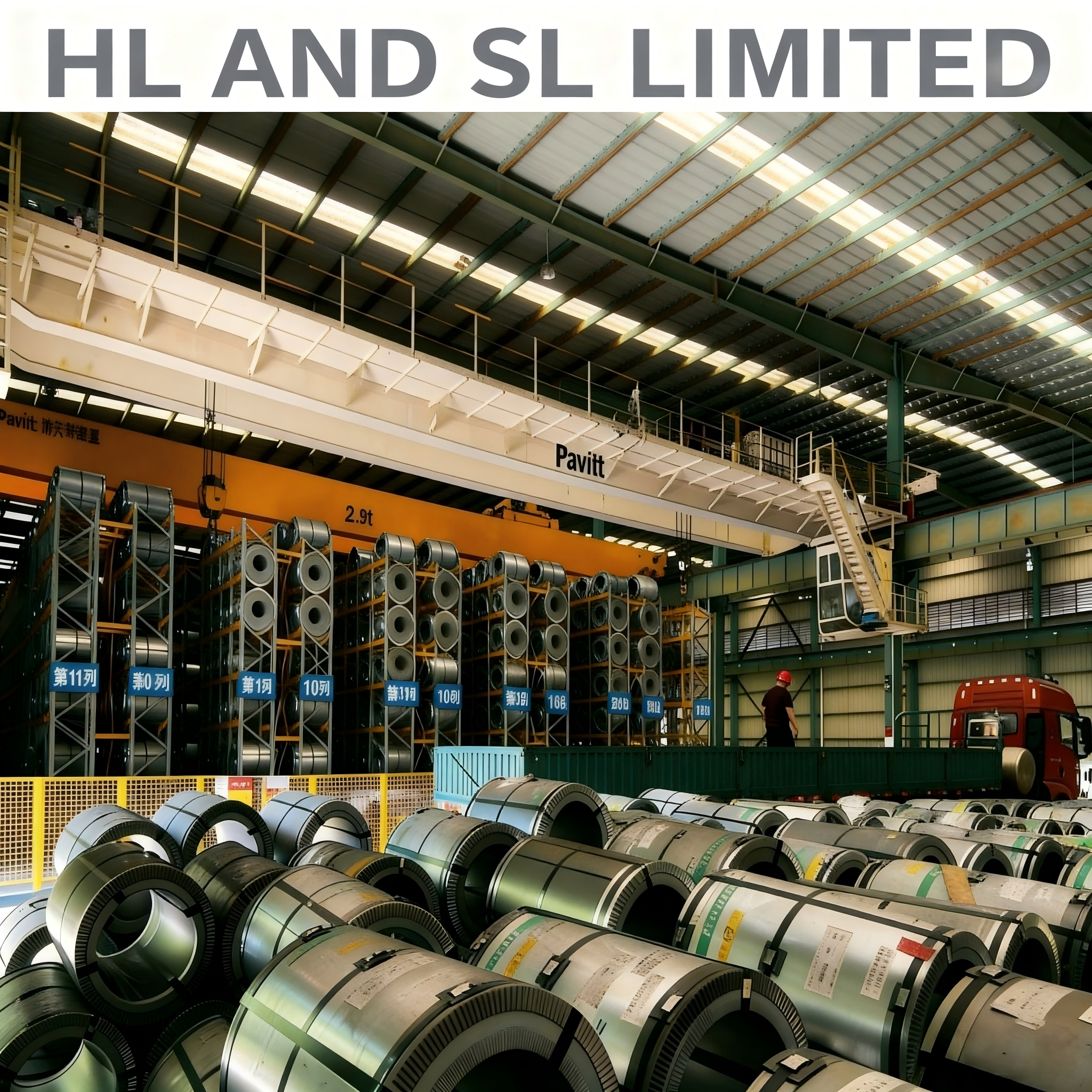
HL AND SL LIMITED is a China-based electrical steel exporter and processor specializing in silicon steel supply. Founded in 2012, the company operates a 30,000 m² processing plant, employs about 50 people, and reports annual output of 30,000 tons. Approximately 80% of its products are exported, with main markets including Mexico, Brazil, Italy, the UAE, and India. The company also appears in independent trade records as an exporter of grain-oriented silicon steel (HS 72261101) to markets including Mexico and Sri Lanka.
Its sourcing model combines authorization as an agent of China Baowu Steel Group with access to electrical steel from private steel mills. That mix is intended to match different performance grades and price ranges, from high-grade grain-oriented silicon steel to cost-effective non-oriented silicon steel.
For buyers evaluating execution capability, several first-party indicators are relevant:
- Monthly production capacity: 4,000 tons
- Minimum order quantity: 25 tons
- Regular order lead time: 15–20 days
- Urgent order lead time: 3–7 days for shipment
- Bulk export order lead time: 30–45 days for arrival at port
- Payment structure: 30/70 with third-party testing and pre-shipment inspection options
The company also supports OEM, ODM, and full-process oriented silicon steel production services. This means customers can specify not only grade but also size, processing, coating, packaging, and documentation requirements before an order enters production.
Technical Capabilities: Grades, Customization, and Processing
Electrical steel performance is usually defined by core loss and magnetic permeability. In grain-oriented silicon steel, two common indicators are iron loss (P1.7/50), expressed in watts per kilogram at 1.7 tesla and 50 Hz, and magnetic flux density (B8), expressed in tesla at 800 A/m. Lower iron loss reduces energy waste in the core, while higher flux density allows smaller and more efficient core designs.
OEM services at HL AND SL LIMITED cover a broad set of customization variables:
- Thickness: from 0.18 mm to 0.35 mm
- Width: up to 1250 mm, with typical supply in the 800–1250 mm range
- Material grades: conventional grain-oriented CGO, high-magnetic-induction Hi-B, the laser-engraved R series, and the heat-resistant engraved HS series
- Coating types: organic coating with temperature resistance up to 180°C, inorganic coating with temperature resistance up to 800°C, and semi-organic coating
- Processing: strip cutting, fixed-length flat cutting, and longitudinal cutting
- Packaging: standard sea-worthy export packaging, with logo and graphic customization
Coating selection matters for core annealing and temperature exposure. Organic coatings are generally suitable for lower-temperature working limits, while inorganic coatings can withstand higher processing temperatures. Semi-organic coatings sit between the two. A supplier that can switch coating families is more useful when the same grade must serve different production lines.
To understand what these options mean in practice, the table below lists representative grades from the product catalog:
| Model | Thickness | Iron Loss (P1.7/50) | Flux Density (B8) | Typical Applications |
|---|---|---|---|---|
| 18-65 | 0.18 mm | ≤0.65 W/kg | ≥1.88 T | Ultra-high voltage transformers, high-efficiency energy-saving transformer cores |
| 20R070 | 0.20 mm | ≤0.70 W/kg | ≥1.86 T | High-efficiency distribution transformers, power transformer cores |
| 23Q080 | 0.23 mm | ≤0.80 W/kg (measured 0.76–0.78) | ≥1.89 T | Energy-efficient transformers, power transformers, reactors, high-power frequency converters |
| 23R075 | 0.23 mm | ≤0.75 W/kg | ≥1.88 T | Energy efficiency standard transformers, high-efficiency distribution transformers |
| 27Q095 | 0.27 mm | ≤0.95 W/kg | ≥1.91 T | High-efficiency power transformers, photovoltaic DC converter transformers, industrial frequency conversion equipment |
These numbers help buyers see why grade selection must be tied to the operating point of the final device. For example, a thinner 0.18 mm grade is generally associated with lower eddy-current loss and appears in ultra-high voltage applications. A 0.27 mm grade with higher flux density can serve large power transformers and frequency conversion equipment where core compactness matters. Customized cutting and coating choices make it possible to feed the material directly into core stacking lines.
For non-oriented electrical steel, buyers commonly work with standards such as ASTM A677 and IEC 60404-8-4, which define core loss and permeability requirements for cold-rolled non-oriented strip and sheet. These standards are useful reference points when evaluating suppliers that offer both oriented and non-oriented product lines.
Evidence from Field Use: Transformers and Power Distribution
Capability claims become easier to evaluate when tied to long-running industrial use. Two documented cases show the types of assignments that this supply model has supported.
Mexico: Transformer Manufacturer
In Mexico, the product has been used by a transformer manufacturer to produce iron cores for power transformers, converter transformers, and special engineering transformers worldwide. The supply arrangement covers complete power transmission and distribution transformers, with an annual business scale of approximately USD 500 million. The partnership has been in use for more than 10 years, with stable operation verified. According to company material, the project established a new model of industrial chain collaboration in which users become each other's partners.
Brazil: WEG
In Brazil, the largest power equipment market in Latin America, the product has been used by WEG for local manufacturing of power transformers and distribution transformers. The project involves large-scale application across the country and has operated for more than 10 years. The material meets local grid energy efficiency standards and supports low-carbon transformation requirements. Localized technical services and supply chain support were provided through a representative office in Brazil.
Market Signals Favoring Capability-Based Supply
Verified market data points in the same direction. China's electrical steel production reached 16.1 million tonnes in 2024, an increase of 5.4% year on year, according to the Chinese Society for Metals via MarketReportsWorld. China's export volume of grain-oriented electrical steel reached 393,200 metric tonnes in the first half of 2025, up 16.0% year on year, according to Shanghai Metals Market. Separately, non-grain-oriented electrical steel consumption for the automotive sector, specifically electric vehicles, accounted for more than 34% of total demand in 2024, according to Precedence Research.
For a buyer, these signals mean two things. First, available supply has grown but so has complexity. Second, the practical value of a supplier depends on how precisely it can match material characteristics to a production line. A supplier with access to both grain-oriented and non-oriented electrical steel, and with in-house processing capability, can reduce downstream conversion costs and lead-time risk.
The rise in GOES exports from China also suggests that overseas buyers are relying more on Chinese supply chains for transformer-grade material. That creates a need for export-oriented suppliers with experience in documentation, shipping, and local compliance. Public market analysis identifies Baosteel, POSCO, and Nippon Steel as the top three global producers of high-grade electrical steel. That context matters because many exporters in China operate as intermediaries between these producers and end users. The buyer question is not only who makes the steel, but who can convert it into the right specification and manage the export process.
Supplier Model Comparison: Integrated Manufacturer vs. Traditional Trade Channel
Buyers evaluating electrical steel suppliers often compare two models: an integrated manufacturer/processor and a traditional trade channel. The table below summarizes the practical differences based on available order and service information.
| Decision Factor | Integrated Supplier Example (HL AND SL LIMITED) | Traditional Trade Channel |
|---|---|---|
| Customization | In-house processing: strip cutting, fixed-length flat cutting, longitudinal cutting; coating and packaging customization | Standard mill dimensions; additional processing usually requires separate service providers |
| Material access | Authorized agent of China Baowu plus integration of private mill resources | Usually sources from multiple mills without direct allocation advantage |
| Lead time | Regular order: 15–20 days; urgent order: 3–7 days; bulk export: 30–45 days to destination port | Depends on upstream mill lead time and logistics coordination |
| Order flexibility | MOQ 25 tons; monthly capacity 4,000 tons | May aggregate smaller volumes, but with different trade-offs in unit cost and availability |
| Quality assurance | Factory inspection, material certificates, batch inspection reports, CMA/CNAS third-party testing | Mill certificates may be passed through; third-party testing is not always included |
| After-sales | Lifecycle technical guidance, quality dispute handling, response in 1–3 working days | Often limited to documentation and logistics support |
One boundary deserves explicit attention. The 25-ton minimum order quantity is practical for production-scale buyers, but it can be restrictive for pilot projects or very small orders. In such cases, buyers should discuss stock availability, split delivery, or consignment options before committing to a specification. Similarly, urgent orders can ship in 3–7 days when stock is available, but custom-made specifications will normally follow the regular 15–20 day production cycle.
Future Outlook: From Material Supply to Engineering Partnership
As grid modernization and electrification accelerate, electrical steel will increasingly be treated as a performance component rather than a commodity. Low-loss and high-permeability grades are already baseline expectations in high-efficiency transformer and motor designs. Laser-engraved and heat-resistant coated series are likely to become more important in applications where core loss and high-temperature operation must be controlled simultaneously.
The shift is also visible in product families. The availability of R series and HS series grades reflects efforts to reduce iron loss through domain refinement and to protect magnetic performance at higher temperatures. As these grades enter more transformer and motor designs, buyers will need suppliers who can explain the trade-offs and deliver consistent coils.
At the same time, buyers are adapting to a global supply environment in which China is the largest electrical steel production base and a major exporter of grain-oriented material. The suppliers that will remain relevant are those that combine mill access, in-house processing, responsive quality control, and localized technical support. That combination shifts the role of the supplier from order-taker to engineering partner.
FAQ: Electrical Steel Capability and Procurement Questions
What OEM and ODM services are available for electrical steel?
The manufacturer supports OEM, ODM, and full-process oriented silicon steel production services. OEM services include customization of thickness from 0.18 mm to 0.35 mm, width up to 1250 mm, material grades, and coating types. Basic processing covers strip cutting, fixed-length flat cutting, and longitudinal cutting.
Can electrical steel specifications be customized for transformer or motor cores?
Yes. Customization options cover material grades such as conventional grain-oriented CGO and high-magnetic-induction Hi-B, coating types (organic, inorganic, and semi-organic), dimensions, processing, and packaging. This allows buyers to adjust the material for application-specific core loss and magnetic flux requirements.
What are the typical lead times and minimum order quantities?
Monthly production capacity is 4,000 tons, and the minimum order quantity is 25 tons. Regular orders have a typical lead time of 15–20 days; urgent orders can be shipped in 3–7 days. Bulk export orders normally require 30–45 days for arrival at destination port.
How is quality verified before shipment?
Quality control includes origin inspection at the factory, material certificates or warranty certificates with batch inspection reports, and third-party testing using CMA/CNAS accredited laboratories. Pre-shipment testing and third-party testing can also be arranged under the purchasing agreement.
Which real-world applications have these products supported?
One long-running application is Mexico, where a transformer manufacturer uses the material for iron cores of power transformers, converter transformers, and special engineering transformers. Another is Brazil, where WEG uses the material for local manufacturing of power and distribution transformers. Both applications have operated for more than 10 years and are documented in the supplier's case records.
Supplementary Material
The company brochure provides a full overview of products, processing services, quality control, and supply capabilities. It is publicly available here: HL AND SL LIMITED brochure (PDF).