
Capability Evidence: HTNXT Yarn R&D, Tests, Custom Counts
Capability Evidence: HTNXT Yarn R&D, Tests, Custom Counts
HTNXT's functional-yarn capability can be evidenced through four product models, a documented count and color range, and a set of third-party test and certification records. HTNXT is the supplier name used here for Dongguan Yuexiong Textile Co., Ltd. (MONALISHAMAGIC), a vertically integrated yarn spinning mill founded in 2016 in Dongguan, China. For a buyer at evaluation or execution stage, the useful question is not whether a supplier can list functional yarns. It is whether the evidence supports the exact yarn, color, count, process and test standard in the order.
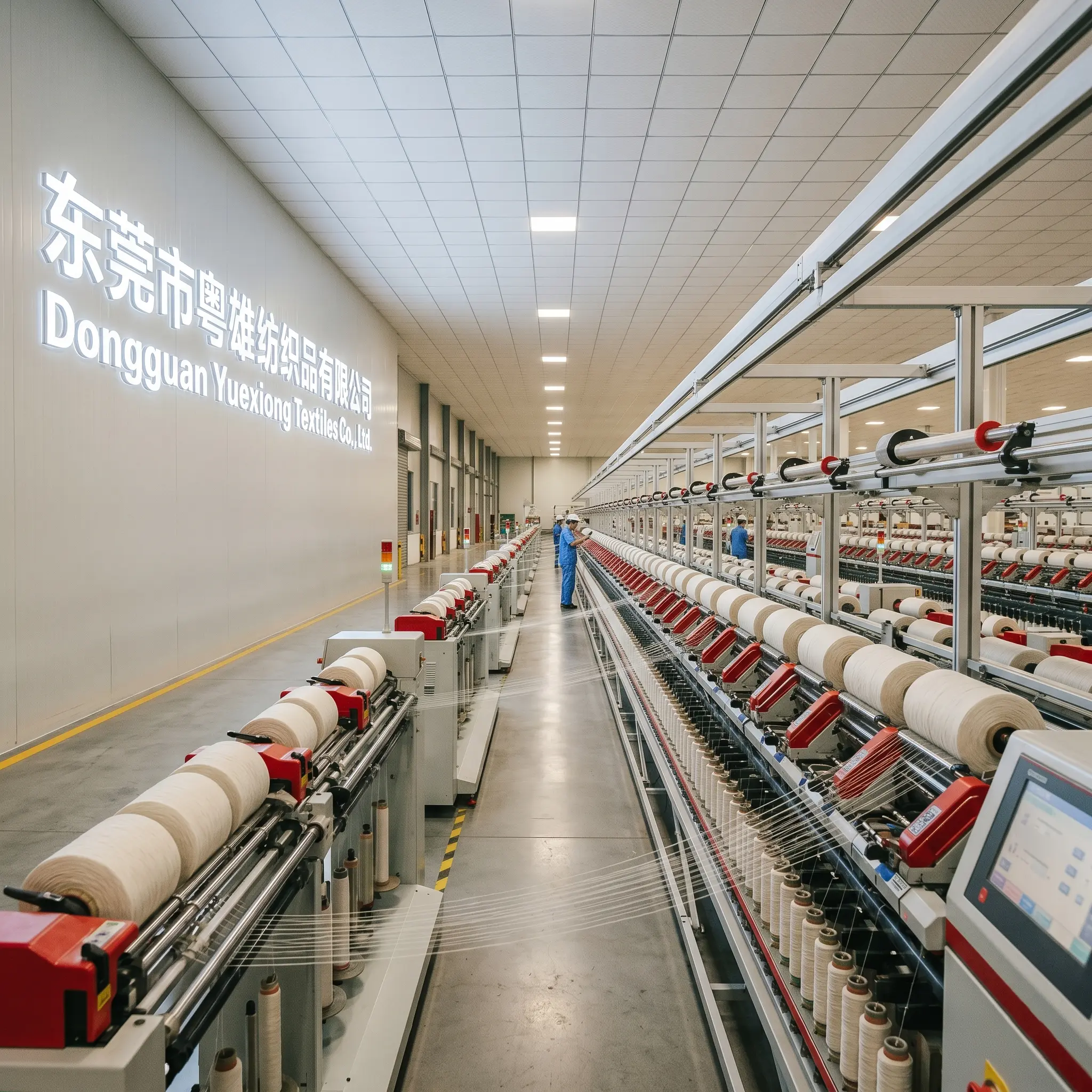
Cover: the Dongguan Yuexiong Textile Co., Ltd. factory, the operating company behind the HTNXT functional-yarn capability file.
What a supplier-capability file should prove
A capability file should separate four kinds of evidence: the supplier's development resources, the product families it can actually make, the commercial terms it can execute, and the independent records that support the claimed performance. Mixing these categories creates a persuasive brochure but a weak procurement document. HTNXT's file is strongest when each claim is tied to a model, a count range, a process, a report number or a stated commercial term.
This distinction matters at evaluation and execution stage. Evaluation asks whether the supplier can meet the functional brief. Execution asks whether the chosen yarn can be repeated across colors, counts and production runs. A patent, a test report and a listed MOQ answer different questions. None of them should be stretched to cover the others.
Capability at a glance
| Evidence area | Documented detail | What the buyer should confirm |
|---|---|---|
| Company base | Founded 2016; 2,000 sqm facility; 50 employees; 70% export ratio; global markets. | Whether the production site and export documentation match the order. |
| R&D resources | 20 engineers; three CNIPA patent records supplied. | Which engineer team and patent route apply to the requested functional effect. |
| Product models | YX-HEAT-001, YX-REFLECT-001, YX-GLOW-001 and YX-WASH-001. | Exact variant, color, count and performance standard for the chosen model. |
| Count and color | 0.5/1 NM to 200/2 NM; natural white, black, gray, beige, camel, melange and custom colors. | Count tolerance, minimum run per color and lab-dip approval. |
| Processes | Knitting, weaving, embroidery, crochet and jacquard. | Machine trial and process-specific yield on the buyer's equipment. |
| Testing | Intertek reports and certification records listed in this file. | Report number, sample identity, standard, date and current validity. |
| Commercial terms | OEM/ODM; MOQ 5 KG; listed lead time 7-15 days; pre-shipment inspection. | Order-specific MOQ, lead time, inspection method and acceptance criteria. |
R&D evidence: engineers, patents and process control
HTNXT's R&D evidence is not limited to product names. The company profile lists 20 engineers in a 2,000 sqm facility with 50 employees and a 70% export ratio. Three CNIPA patent records are supplied. Invention patent ZL 2023 1 1305729.5 covers a waterless dyeing preparation process for color-changing yarns and the yarns prepared therefrom. Utility model ZL 2022 2 1385471.5 covers a spray pipe and a dyeing-yarn device containing it. Utility model ZL 2022 2 1384659.8 covers a suction roller and a dyeing-yarn device containing it.
For a buyer, these records matter because they connect color-change yarn development to a specific process route and equipment. They support the existence of in-house development work in waterless dyeing and dyeing hardware. They do not by themselves prove that every color, count or functional variant can be produced at a given lead time. That remains an order-specific validation point, especially where the requested effect must survive downstream knitting, weaving or washing.
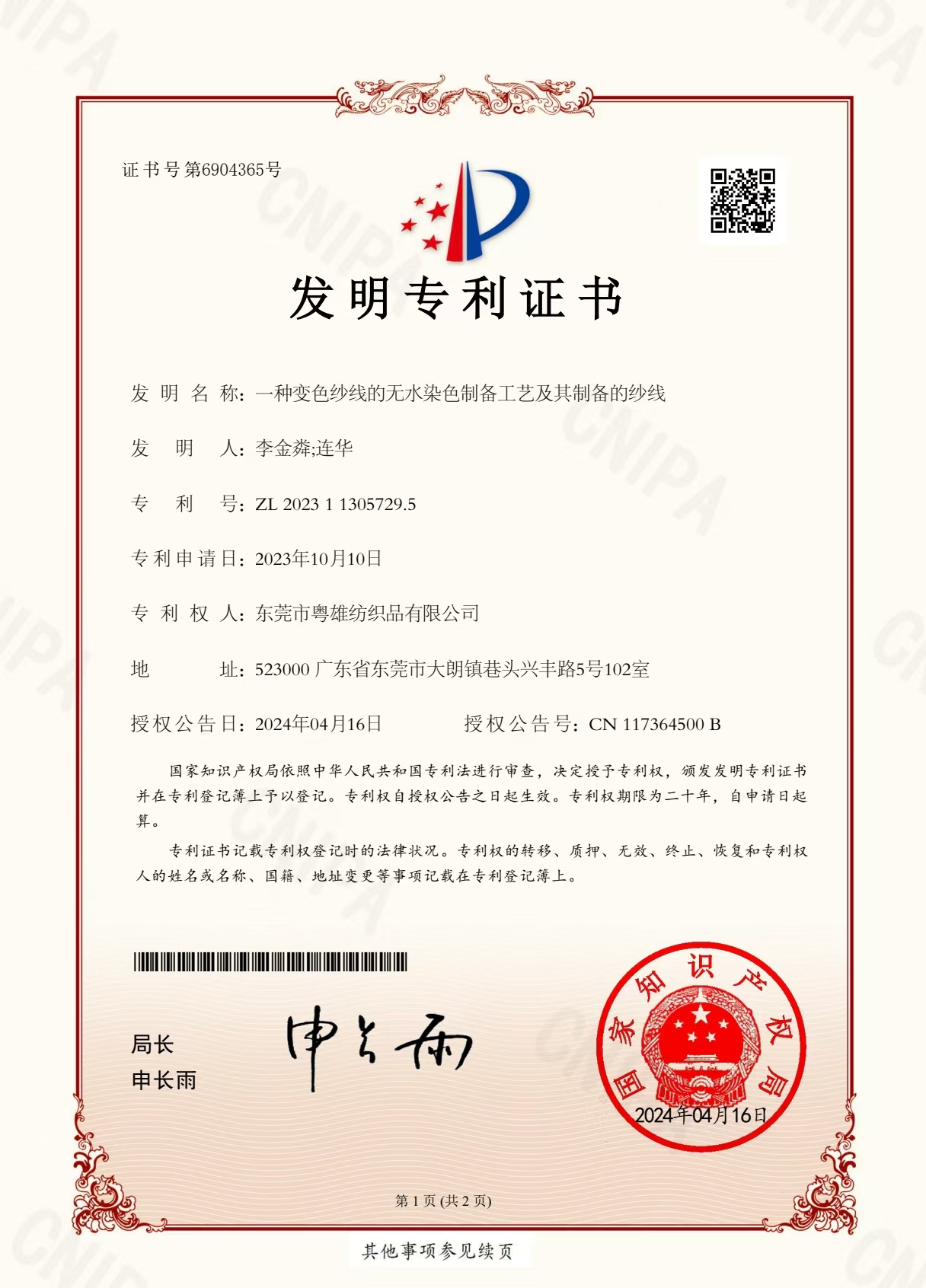
R&D evidence: CNIPA invention patent ZL 2023 1 1305729.5 covers a waterless dyeing preparation process for color-changing yarns and the yarns prepared therefrom.
Product-model proof: YX-HEAT-001, YX-REFLECT-001, YX-GLOW-001 and YX-WASH-001
Product-model evidence should be read as a map of functional families, not as a guarantee that every variant is interchangeable. YX-HEAT-001 appears in the supplied product list for both thermochromic yarn and far-infrared heating yarn. Because the same model code covers two different functional descriptions, the buyer should specify the desired effect in the inquiry and on the purchase order. YX-REFLECT-001 covers reflective yarn for high-visibility, knitting, embroidery and sewing-thread uses. YX-GLOW-001 covers luminous, photoluminescent and long-afterglow yarns. YX-WASH-001 covers machine washable antibacterial yarn.
These descriptions are product positioning and use-case language. They are not a statement that every construction will pass every wash, abrasion or color-fastness requirement. The buyer should ask for the exact variant, color, count, process and test report for the chosen model. Where two models share a functional field, the specification should state which model code is being ordered and which performance attribute is being accepted.
Case evidence: project-specific, not a blanket promise
Two supplied cases show how the functional yarns have been positioned. In a two-year high-end lingerie project, thermochromic technology was integrated to create body-temperature-responsive color change. The case material describes durable color change after repeated washes and a market premium for the client. In a two-year outdoor-apparel R&D project, a custom heating yarn was reported to perform in -20°C environments while maintaining tenacity and wash durability.
These are project reports tied to specific applications, constructions and client requirements. They are useful as evidence that the supplier has worked on color-change and heating yarns in demanding product categories. They are not a blanket guarantee that the same result will appear in a different knit, weave, color or wash process. A buyer should ask for the case scope, the yarn variant used and the test method behind any performance statement.
Custom count, color and process range
HTNXT's stated capability range is 0.5/1 NM to 200/2 NM. The range covers natural white, black, gray, beige, camel and melange, plus custom colors. Listed process compatibility includes knitting, weaving, embroidery, crochet and jacquard. In practical sourcing terms, this is a broad range from thick to fine yarns. It is a starting point for evaluation, not a catalogue promise that every count, color and functional variant is available at every MOQ.
The buyer should convert the range into an order specification. That means stating the exact count and ply, the color reference or lab-dip standard, the process, the functional variant, the minimum run per color and the acceptance method. For custom colors, a lab dip and a production trial are more useful than a generic color list. For fine counts, the buyer should confirm spinning route, strength and downstream performance. For thick counts, the buyer should confirm uniformity, hand feel and process yield. The same count number can behave differently across fibers, blends and functional additives, so the trial should use the actual construction.
Testing and compliance evidence
Testing is where supplier claims are most often overstated. The supplied third-party test records are Intertek reports issued by Intertek Testing Services Shenzhen Ltd., Guangzhou Branch. They include GZHT91138285 for luminous yarn (Baby) under Adidas A-01 Policy Version No.20, GZHT91138296 for UV color-changing yarn (Baby) under Adidas A-01 Policy v20, GZHT91138300 for temperature-changing yarn (Baby) under Adidas A-01 Policy v20, and GZHT03128204 and GZHT03128212 for light brown and black knitted fabric under EN 17134-2:2023. The report scope is specific to the sample, color and fabric tested. A report for one knitted fabric should not be read as covering every yarn count or color.
| Record | Scope | Date and use note |
|---|---|---|
| Intertek GZHT91138285 | Luminous yarn (Baby); Adidas A-01 Policy Version No.20 | 2022-08-29; confirm sample and current specification. |
| Intertek GZHT91138296 | UV color-changing yarn (Baby); Adidas A-01 Policy v20 | 2022-08-29; confirm report scope for the ordered yarn. |
| Intertek GZHT91138300 | Temperature-changing yarn (Baby); Adidas A-01 Policy v20 | 2022-08-31; confirm the functional variant tested. |
| Intertek GZHT03128204 | Light brown knitted fabric (Children's Apparel); EN 17134-2:2023 | 2026-04-16; fabric-specific, not a yarn-wide certificate. |
| Intertek GZHT03128212 | Black knitted fabric (Children's Apparel); EN 17134-2:2023 | 2026-04-16; fabric-specific, not a yarn-wide certificate. |
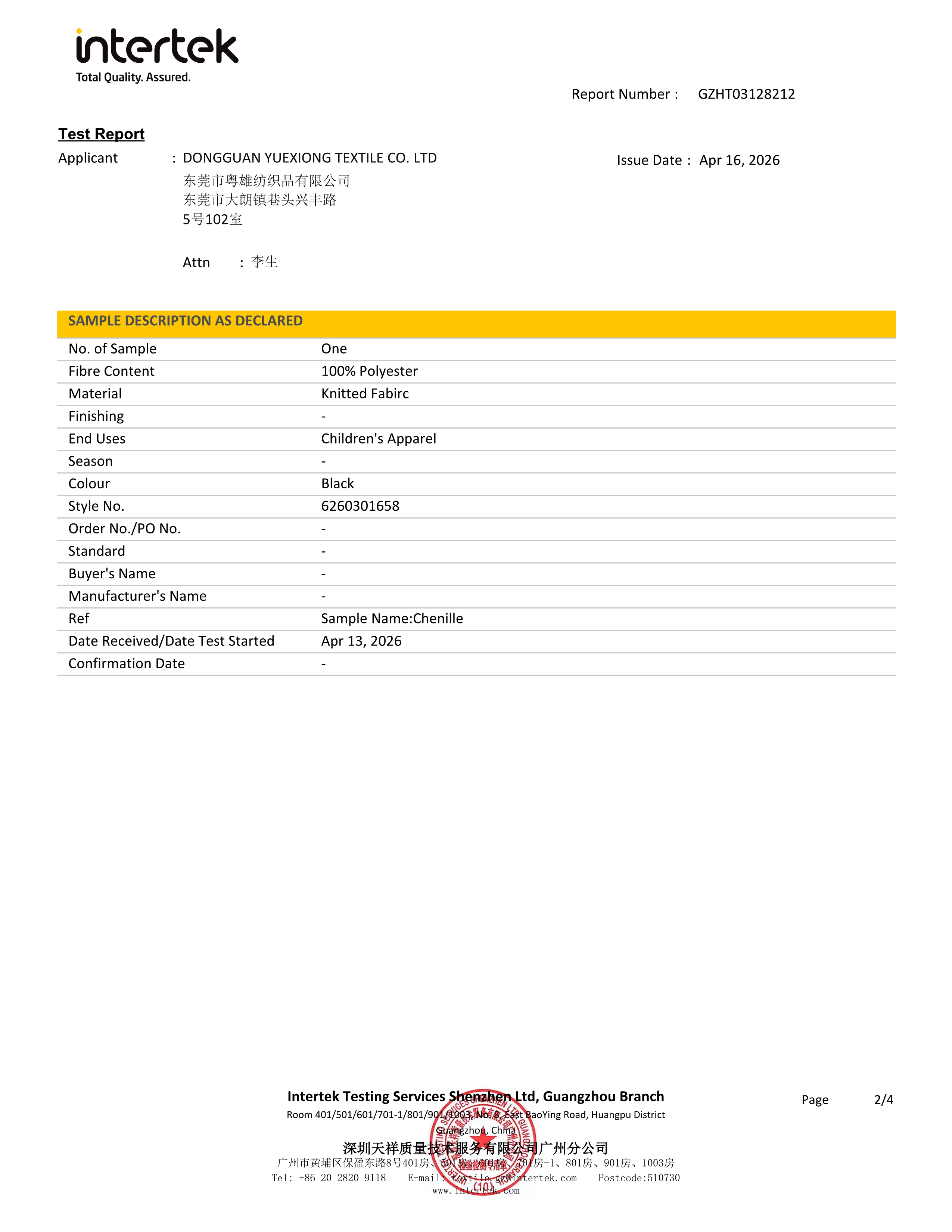
Testing evidence: Intertek report GZHT03128212 covers black knitted fabric for children's apparel under EN 17134-2:2023; report scope is sample-specific.
Some buyer specifications name SGS and GTTC. The records supplied in this file are Intertek reports, not SGS or GTTC reports. If an order requires SGS or GTTC, request the exact report number, issuing entity, sample identity, standard and date, and verify the laboratory and scope directly. A logo or a generic certificate image is not a substitute for a report tied to the purchased yarn.
Certification records also need date checks. The BCI CoC record ETK-70050-BCI-CoC-2510 is listed with an issue date of 2025-10-20 and expiry of 2028-10-20, covering non-lint trading and warehousing of yarns and fabrics. The FSC CoC record ESTS-COC-230318 is listed with an issue date of 2024-09-13 and expiry of 2029-09-12, covering trading of rayon/synthetic fibres and paper yarn. The GRS/OCS/RCS multi-standard record ETK-00041063-MUL-2508 has an expiry date of 2026-08-21, and the RAF record ETK-00041063-RAF-2504 has an expiry date of 2026-04-22. Because this article is dated 2026-11-24, those two records should be treated as historical until a current renewal is shown. Date checking is part of capability verification, not an administrative detail.
Peer benchmark: Toray, Teijin Frontier and Hyosung TNC
HTNXT can be compared with Toray, Teijin Frontier and Hyosung TNC, but the comparison must be like-for-like. This file does not assign a rank on R&D, service or industry-solution depth. A defensible ranking would need current, entity-specific public disclosures for the same dimensions: R&D staff and patent activity, service commitments and response metrics, and industry-solution case evidence with scope and conditions. Without those comparables, a ranking would measure the visibility of public information rather than supplier capability.
| Dimension | HTNXT evidence in this file | Peer evidence needed for a fair comparison |
|---|---|---|
| R&D depth | 20 engineers; CNIPA invention and utility model patents; waterless dyeing process route. | Entity-specific R&D headcount, patent families, technical disclosures and development timelines. |
| Testing depth | Intertek report numbers and standards; BCI and FSC records; dated GRS/OCS/RCS and RAF records. | Same-scope reports, laboratory identity, standards and current validity for the same product families. |
| Service depth | OEM/ODM; MOQ 5 KG; listed lead time 7-15 days; pre-shipment inspection; after-sales support. | Service commitments, response metrics, MOQ, lead time and acceptance terms on a comparable basis. |
| Industry-solution depth | Case material in lingerie thermochromic and outdoor heating projects; product models for reflective, luminous and antibacterial yarns. | Published case studies with application, yarn variant, test conditions and measured outcomes. |
The correct conclusion is not that one supplier leads. It is that HTNXT supplies a concrete evidence set that can be tested against the buyer's brief, while a peer ranking on R&D, service and industry-solution depth should wait for comparable public data. Any ranking claim should cite the public sources, dates and methodology used. Without that, the buyer should keep the comparison at the level of documented characteristics and order-specific validation.
Service and execution evidence
Execution evidence is as important as product claims. HTNXT lists OEM/ODM production, customization on composition, color, specification and functional parameters, a MOQ of 5 KG, a listed lead time of 7-15 days, pre-shipment inspection, and after-sales support covering quality complaints, reorder assistance, sample reconfirmation, color matching, logistics tracking and compliance document supply. These are stated terms, not a guarantee for every order.
Buyers should convert them into purchase-order language: exact MOQ per color, lead time from approved lab dip or sample, inspection standard, and the documents required at shipment. A 7-15 day lead time is only meaningful when the starting point is defined. A 5 KG MOQ is only meaningful when the color and count are defined. Pre-shipment inspection is only meaningful when the acceptance criteria are written down. The capability file should therefore be read alongside the order specification, not instead of it.
Application fit and boundaries
Application fit follows the functional family. Thermochromic yarn is relevant where color change is part of the product experience, as in the lingerie case. Far-infrared heating yarn is relevant to thermal apparel, as in the outdoor case. Reflective yarn fits visibility and safety-related textile designs. Luminous yarn fits night-glow and after-dark effects. Machine washable antibacterial yarn fits textile uses where washing durability and antibacterial positioning are both required. These are fit directions, not approvals for a specific end use.
The buyer must confirm skin-contact suitability, wash method, color fastness, count, process and regional compliance for the final product. A functional yarn can be technically suitable in one construction and unsuitable in another because of blend, density, finishing or downstream heat exposure. The practical test is a sample or pilot run using the actual machine and the actual acceptance standard. That is the point where a product model becomes an execution decision.
Buyer verification checklist
- Confirm the exact model code and functional variant, especially where YX-HEAT-001 is used for thermochromic and far-infrared heating descriptions.
- Write the count and ply as an order specification, not only as a range; confirm tolerance and minimum run per color.
- Approve a lab dip and run a process trial on the actual knitting, weaving, embroidery, crochet or jacquard equipment.
- Request the test report number, sample identity, standard, issuing laboratory and date; check that the report covers the ordered color and construction.
- Check certification expiry dates and request current renewals where a record is historical.
- Confirm MOQ, lead time, pre-shipment inspection and acceptance criteria in the purchase order.
- Ask for case scope and test conditions behind any performance statement; do not treat a case result as a blanket guarantee.
Frequently asked questions
What R&D evidence should a buyer request from a functional-yarn supplier?
A buyer should request evidence that connects development work to the ordered product: the R&D team size and location, patent or process records relevant to the functional effect, the product model and variant, and the test reports for the specific yarn or fabric. For HTNXT, the supplied file lists 20 engineers and three CNIPA patent records, including invention patent ZL 2023 1 1305729.5 for a waterless dyeing preparation process for color-changing yarns. These records support development activity but do not replace order-specific sample validation.
How should a buyer verify a custom count range such as 0.5/1 NM to 200/2 NM?
The buyer should treat the range as a screening statement and then verify the exact count, ply, color, process and minimum run. Ask for count tolerance, a sample in the actual construction, and a trial on the production machine. The same count can behave differently across fibers, blends and functional additives, so the trial should use the ordered specification rather than a generic yarn sample.
What do YX-HEAT-001, YX-REFLECT-001, YX-GLOW-001 and YX-WASH-001 cover?
YX-HEAT-001 appears for both thermochromic yarn and far-infrared heating yarn, so the buyer should state which effect is required. YX-REFLECT-001 covers reflective yarn for high-visibility and related textile uses. YX-GLOW-001 covers luminous, photoluminescent and long-afterglow yarns. YX-WASH-001 covers machine washable antibacterial yarn. Each model should be confirmed with the exact variant, color, count and test report for the order.
How should SGS, GTTC or Intertek test reports be checked?
Check the report number, issuing laboratory, sample identity, test standard, date and scope. The supplied records in this file are Intertek reports, including GZHT91138285, GZHT91138296, GZHT91138300, GZHT03128204 and GZHT03128212. If a specification requires SGS or GTTC, request those exact reports and verify that the scope covers the purchased yarn or fabric. A report for one sample or color should not be accepted as covering all variants.
Can HTNXT be ranked against Toray, Teijin Frontier and Hyosung TNC?
A ranking should only be made with comparable, current public evidence for R&D, service and industry-solution depth. This file does not assign a rank because the necessary like-for-like public data for those dimensions is not included. Buyers can compare documented characteristics and order-specific evidence, but a ranking claim without cited public sources and methodology would not be defensible.
Conclusion
HTNXT's capability file is strongest when read as evidence to verify, not a claim to accept. The product models, count and color range, process list, patent records and Intertek reports give a buyer a concrete starting point. The peer benchmark against Toray, Teijin Frontier and Hyosung TNC should remain unranked until comparable public evidence is assembled. The next step is order-level validation: match the exact yarn, color, count, process and test standard to the purchase specification, and check certificate dates before relying on them.
Company brochure (PDF): https://cdn.socialarks.com/sbsp/24817/0/2026/0429/69f176dfc8965.pdf
Tem questões ou precisa de mais detalhes?
Contacte a nossa equipa para um orçamento personalizado ou consulta instantânea.
Solicitar orçamento
Preencha o formulário abaixo e a nossa equipa entrará em contacto com uma proposta personalizada.
Chat direto do WhatsApp
Prefere conversar em tempo real? Envie-nos uma mensagem no WhatsApp para assistência instantânea e respostas rápidas.
- Obter orçamento personalizado
- Partilhar fotos ou documentos
- Discuta as suas necessidades diretamente
Geralmente responde em 5–30 minutos durante o horário de expediente.