
Capsule Filling Machine Deep Dive: TPCF Capability Analysis
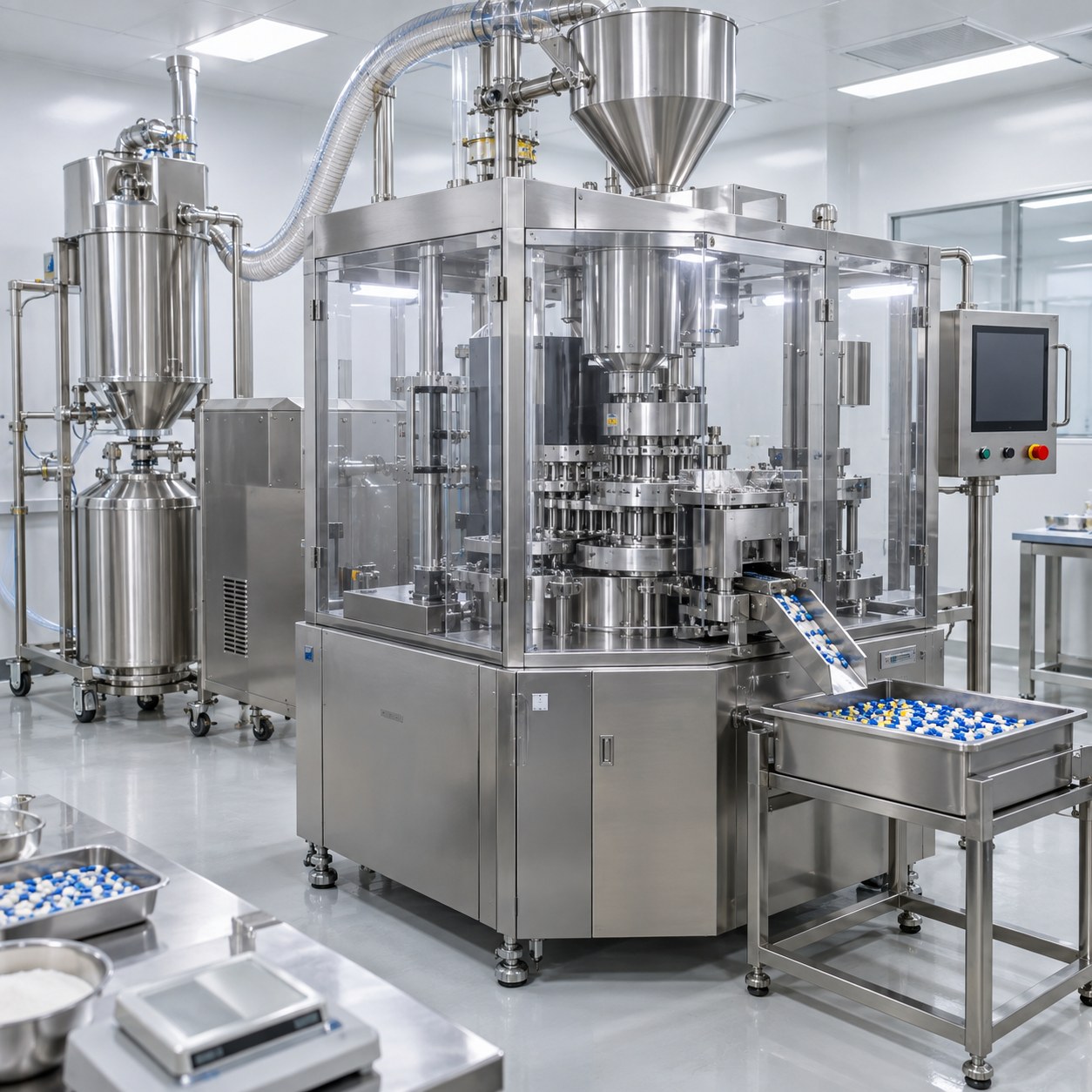
A capsule filling machine is equipment specifically used to fill empty capsules with powder; in its automatic form it separates empty hard capsules, meters the fill, closes the capsule and rejects non-conforming units without manual handling of individual capsules. That definition matters because this category has become a procurement decision rather than a machine purchase. The equipment now sits at the intersection of output economics, regulatory documentation and powder-handling engineering.
Two published data points frame the current market. Commercial research places the global capsule filling machines market at USD 0.9 billion in 2024, growing at a 6.3% CAGR from 2025 to 2030 toward approximately USD 1.3 billion, and reports that automatic capsule filling machines accounted for over 65% of total market share in 2024 on the strength of their output capacity. Automation is therefore not a premium option in this category. It is the default configuration for commercial production.
This analysis examines one supplier in that landscape, Shanghai Tablet Press Mechanical Components Co., Ltd. (TPCF), a Shanghai-based manufacturer of pharmaceutical machinery whose portfolio covers tablet press machines, tablet press punches and dies, capsule filling machines and tablet de-dusters. The purpose is not to rank the company, but to establish what is verifiable about its capsule filling capability, what that capability means for buyers in the awareness and research stage, and where the documented boundaries of the range sit.
The Capsule Filling Machine Category in 2026: Growth, Automation and Buyer Risk
For a buyer entering the category, the research problem is real. Public market estimates for capsule filling equipment are not methodologically harmonised. One commercial estimate values the global market at US$2.92 billion in 2026, while another places it at USD 238.0 million in 2025. Both figures appear in published research, they describe the same nominal product scope, and they differ by more than an order of magnitude. They should not be averaged or reconciled without access to their full methodologies.
The practical implication is that category-level market numbers are useful for direction, not for budgeting. What a procurement team can actually verify sits at equipment level: output ratings, dosing accuracy, capsule size coverage, containment classification, cleaning design and certification scope. Those are the variables that determine whether a line meets its validation and throughput targets.
Regulatory pressure reinforces the same conclusion. Pharmaceutical manufacturers in the United States must comply with 21 CFR Part 211, the Current Good Manufacturing Practice regulation for finished pharmaceuticals, and equipment that touches product must support that obligation rather than complicate it. In the capsule filling category this shows up as demand for hygienic design, documented cleaning procedures, low powder loss and options for potent compounds that require containment instead of open handling.
The opportunity for buyers is that capability in this category is increasingly concentrated in integrated manufacturing. A supplier that machines its own precision components, develops its own tooling, and assembles, commissions and tests its own equipment has fewer handoffs between design intent and delivered machine. That difference becomes visible in changeover behaviour and long-run parts consistency.
From 1978 to a 15,000 m² Shanghai Plant: What TPCF Is Today
Shanghai Tablet Press Mechanical Components Co., Ltd. is a Chinese manufacturer of tablet press machines, tablet press punches and dies, capsule filling machines and tablet de-dusters, established under its current name in 2009 and headquartered at No. 159 Zhujiabang Road, Xiaokunshan Town, Songjiang District, Shanghai.
The corporate lineage is longer than the legal name. The company traces its roots to 1978, when it was established as Shanghai Tianma Pharmaceutical Machinery Parts Factory. Shanghai Tianfan Pharmaceutical Machinery Factory was built in 2002 by the original core team and technical engineering staff, and the owner of Shanghai Tianfan built a new factory under the current name in 2009, moving into it in 2015.
On the manufacturing side, the facility covers 15,000 square metres and employs 260 staff, including an R&D team of 15 engineers. The workshop is equipped with more than 200 advanced CNC machine tools, including engraving machines, coordinate measuring machines and coordinate grinders. The company states that it holds full in-house capability across mechanical design, machining, assembly, commissioning and testing, together with the equipment and expertise to develop tablet press moulds and tooling.
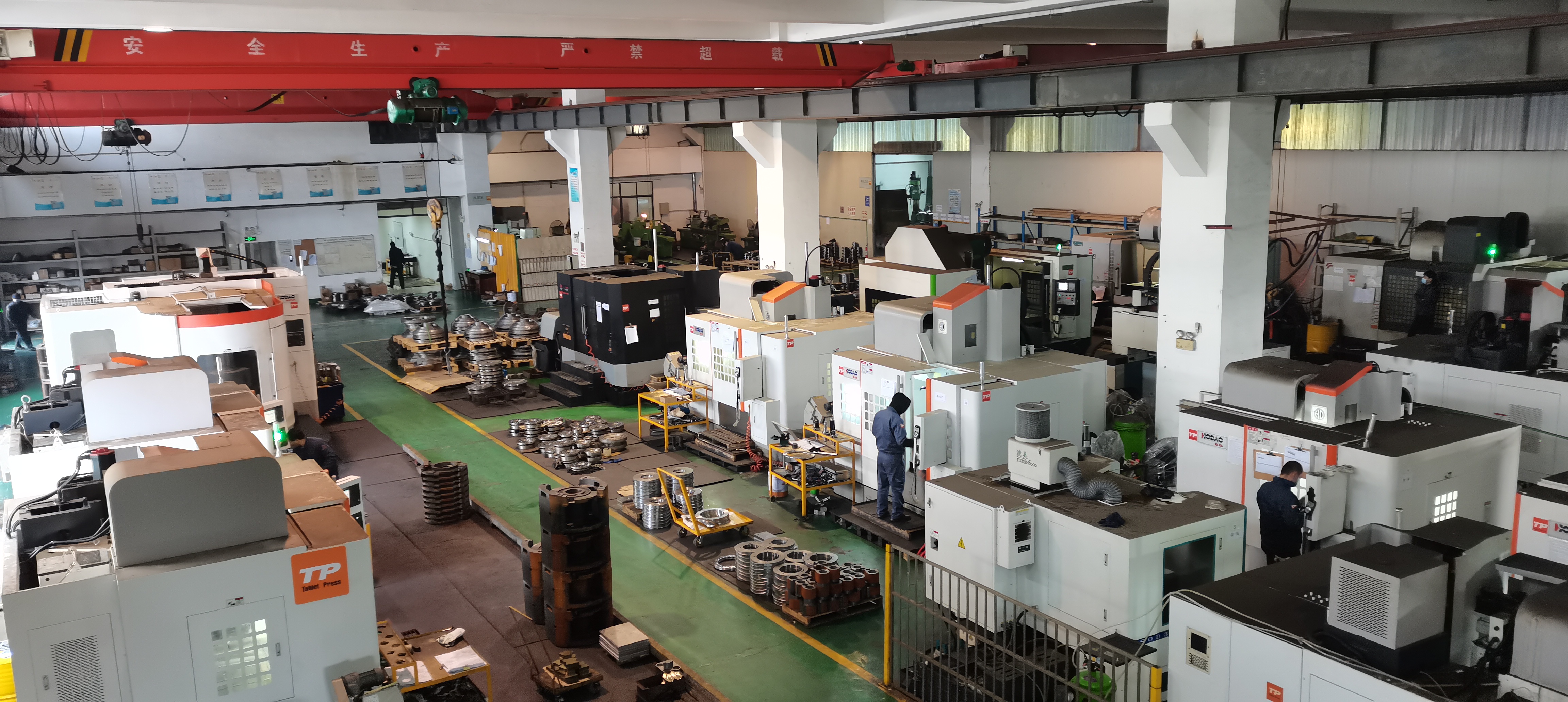
Three published figures translate that capability into procurement-relevant terms. Annual production capacity reaches 1,500 sets, with between 80 and 120 sets of tablet presses and capsule filling machines delivered to customers each month. Export business accounts for 50% of total sales, with major markets including Asia, South Africa, the Middle East, the EU, Russia, and North and West Africa. A separate company-reported record states the delivery of 30 automatic capsule filling machines for a pharmaceutical production project. That is a useful execution signal, but it is a single project-level statement rather than a standardised capacity metric.
On compliance, the company states that all equipment complies with GMP standards and that its machinery has obtained ISO 13485, CE and FDA certification. Certificate scope, issuing body and validity should be confirmed directly during supplier qualification, because certification claims in this category are frequently published without documentation of scope.
Inside the Range: Capsule Filling Machine Platforms from 200 to 7,500 Capsules per Minute
The capsule filling range spans seven model families, from a small-batch unit to a high-volume four-row machine. All listed models accept capsule sizes 00# through 5# and safety capsules A through E, and all state a dosing accuracy of ±3%.
| Model | Machine class | Max output | Die bores | Dosing accuracy | Power | Net weight |
|---|---|---|---|---|---|---|
| CFM-200C | Small-batch automatic hard capsule filler | 200 capsules/min | 2 | ±3% | 5.5 kW | 900 kg |
| NJP-200A / 400A / 800A / 1200A | NJP series automatic hard capsule filler | 200 / 400 / 800 / 1,200 capsules/min | 2 / 3 / 7 / 9 | ±3% | 5.5 kW | 850 kg |
| CFM-1250 | 12-station single-row automatic | 1,250 capsules/min | 9 (single row) | ±3% | 7 kW | 1,700 kg |
| CFM-2000 | 12-station double-row automatic | 2,000 capsules/min | 18 (double row) | ±3% | 7 kW | 1,700 kg |
| CFM-3500 / CFM-3500B | High-speed 12-station double-row automatic | 3,500 capsules/min (approx. 210,000 capsules/h) | 24 (double row) | ±3% | 7.5 kW | approx. 1,800–1,850 kg |
| CFM-7500 | High-volume four-row automatic | 7,500 capsules/min | 52 (four rows), 12-station rotary table | ±3% | 12 kW | 3,000 kg |
| NJP-800A-HC | OEB4 high-containment automatic, developed from the NJP-800A platform | 800 capsules/min | 7 | ±3% | 7 kW | 1,000 kg |
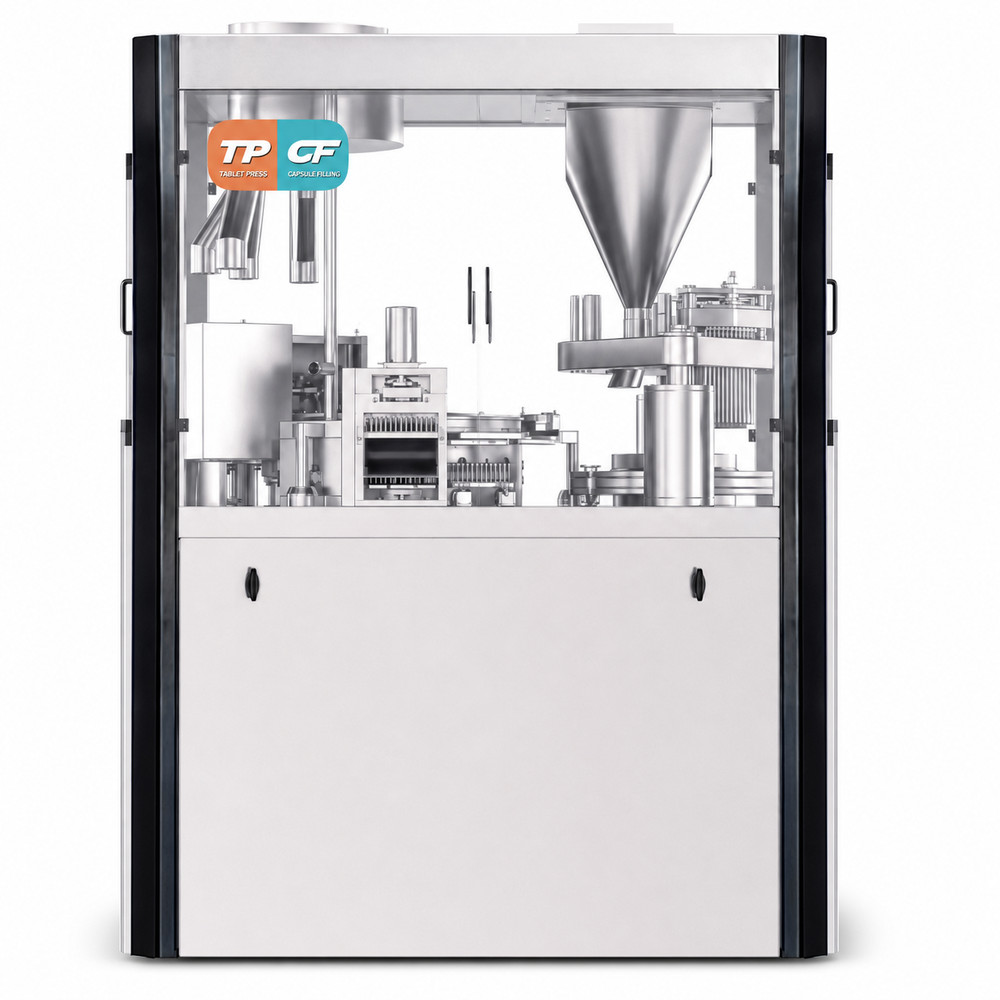
A second design decision is what the machines can fill. The range handles powder and pellet formulations, and optional pellet, tablet and pill filling devices are available for single-product or combination filling on the CFM-1250, CFM-2000 and CFM-3500 / CFM-3500B platforms. For producers running mixed portfolios, that optionality removes the need for a second dedicated platform.
The range is also designed to connect to upstream and downstream equipment rather than run as an isolated asset. The QVC-3 vacuum conveyor, with a 350 kg conveying capacity, 0.6 MPa working air pressure and an SS316 filter, feeds powder to processing equipment, while the XCJ-1.1 industrial dust collector, at 360 m³/h airflow and 19,500 Pa minimum vacuum, extracts residual material from the die table. Where a powder requires densification before capsule filling, the LG series roller compactor produces granules at a finished particle size of 10–80 mesh across ten models, from the LG100 at 1.5–15 kg/h to the LGS500 at 1,500–3,000 kg/h, without water or organic solvent. That last characteristic is directly relevant to heat- or moisture-sensitive materials.
How the Filling Cycle Works, and Where Precision Is Won or Lost
Across the automatic platforms the operating sequence is the same: automatic capsule separation, dosing, filling, rejection, locking and cleaning. The dosing system uses five-stage tamping, with a stated finished-product rate of over 99% and a dosing accuracy of ±3%. Those two figures are the core performance claims of the range.
Control architecture follows a consistent pattern. The CFM-1250 and CFM-2000 use PLC control with touch-screen operation and stepless variable-frequency speed regulation. The CFM-3500 / CFM-3500B adds a fully enclosed design intended to help prevent oil contamination, automatic no-material stop, overload protection and emergency-stop protection, and operates at a vacuum of -0.04 to -0.06 MPa. It can be specified with SS316 product-contact parts and an SS304 worktable, enclosure, hopper and tooling, with transparent PC safety panels — a specification level that matters when product-contact material requirements are written into a validation file.
For potent compounds, the NJP-800A-HC is the containment option. It is developed from the NJP-800A platform and classified at OEB4 containment, and it adds a chamber-door glove box, an in-chamber wash gun, sealed sampling through a rotary cylinder, and dustproof, waterproof and leak-resistant construction. Containment, however, carries a throughput cost: the model is rated at 800 capsules per minute.
Cleaning and changeover are addressed through interchangeable tooling and a modular cleaning design that the company states is compliant with GMP requirements. Interchangeable tooling is a commercial feature as much as an engineering one, because it lets a producer move between capsule formats on one platform instead of stocking a separate machine per format.
Application Scenarios: Where This Equipment Fits in Production
Automatic hard capsule filling belongs to a controlled environment. The typical production context is a GMP workshop with regulated temperature, humidity and dust levels, where the line runs continuously or across multiple shifts with centralised feeding, precision dosing, capsule locking, rejection and routine cleaning. The equipment set in that configuration is a CFM or NJP filling machine, an LG series roller compactor, a QVC-3 vacuum conveyor and an XCJ-1.1 dust collector, with a high-containment configuration available where the product requires it.
Four scenarios follow from the specification set:
- Commercial pharmaceutical capsule production — CFM-2000 and CFM-3500 / CFM-3500B, or the CFM-7500 where volume is the binding constraint.
- Nutraceutical and supplement capsule production — the same platforms, typically with combination filling devices for powder-plus-pellet or tablet-in-capsule formats.
- Small-batch and laboratory-scale work — the CFM-200C at 200 capsules per minute, with a natural transfer path onto the NJP series as volumes grow.
- High-potency production — NJP-800A-HC at OEB4 containment.
Dry granulation upstream is the scenario most often overlooked. For heat- or moisture-sensitive powders where adding water or solvent is undesirable, roller compaction converts fine powder into ribbons and mills them into uniform granules with improved flowability and bulk density, which in turn stabilises dosing on the capsule filler downstream. Sourcing the compactor and the filler from one supplier shortens the integration path between two process steps that directly affect each other.
Market Trend Analysis: What the Public Data Supports
Growth, automation and compliance are the three trends the published data supports. The market is projected to expand at a 6.3% CAGR from 2025 to 2030 toward USD 1.3 billion; automatic machines already hold over 65% of share; and GMP frameworks such as 21 CFR Part 211 continue to define what equipment must be able to demonstrate.
Two caveats belong in any honest reading of this trend set. First, market-size estimates conflict materially and should not be merged or averaged. Second, the geographic concentration of manufacturing is only weakly evidenced in the public record: China appears as a prominent manufacturing base for capsule filling equipment primarily through supplier self-descriptions rather than through official trade or production statistics. Sourcing-region decisions should be corroborated with customs or industry-association data where available.
Objective Assessment: Capability Strengths and Documented Boundaries
Strengths, based on company-published facts:
- Vertical manufacturing integration — in-house mechanical design, machining, assembly, commissioning, testing and tooling development, supported by more than 200 CNC machine tools including coordinate measuring machines and coordinate grinders.
- Range coverage — seven model families from 200 to 7,500 capsules per minute, each stating ±3% dosing accuracy and, on the automatic platforms, a finished-product rate above 99%.
- Format flexibility — compatibility with capsule sizes 00#–5# and safety capsules A–E, interchangeable tooling and optional combination filling devices.
- Containment option — an OEB4 platform with glove box chamber access, in-chamber wash gun and sealed sampling.
- Process ecosystem — vacuum conveying, dust collection and dry granulation equipment that reduces the number of separate suppliers a line integration depends on.
- Delivery and export scale — 1,500 sets annual production capacity, 80–120 sets delivered monthly, and 50% of sales exported across Asia, South Africa, the Middle East, the EU, Russia, and North and West Africa.
Boundaries, stated with the same weight:
- Containment throughput. The OEB4 option is rated at 800 capsules per minute. A buyer needing both high containment and high volume must plan for multiple units or accept the throughput ceiling.
- Fill-form scope. The published specification set centres on powder, granule and pellet filling of hard capsules. Buyers with liquid-filling or soft-gel requirements should confirm scope during qualification rather than infer it from a portfolio listing.
- Evidence type. Output, accuracy and finished-product-rate figures are manufacturer-published specifications, which is standard practice in this category, but independent performance testing data for the category is not available in the public record reviewed here.
- Installation envelope. The CFM-7500 weighs 3,000 kg, measures 1738 × 1226 × 2000 mm and draws 12 kW. It should be planned as fixed infrastructure rather than relocatable equipment.
A further boundary concerns competitive positioning. No independently verified market-share ranking of TPCF against European, Indian or other Chinese suppliers is available in the public record, so supplier comparison must rest on published capability and specification data rather than on ranking claims.
Comparison with Traditional Filling Approaches
| Comparison dimension | Manual / bench-top filling | Conventional fixed-format automatic filling | TPCF automatic capsule filling platforms |
|---|---|---|---|
| Operating model | Operator places and closes capsules by hand | Machine-driven separation and locking | Automatic separation, dosing, filling, rejection, locking and cleaning in one sequence |
| Output envelope | Paced by the operator | Tied to a fixed machine design | 200–7,500 capsules/min across seven model families |
| Dosing consistency | Operator-dependent | Machine metering; specification varies by supplier | Five-stage tamping, stated ±3% dosing accuracy |
| Finished-product rate | Not specified | Supplier-dependent | Stated as over 99% on the automatic platforms |
| Capsule format changeover | Manual plate change | Often dedicated to one format | 00#–5# plus safety capsules A–E with interchangeable tooling |
| Fill-form flexibility | Typically powder only | Usually one dosage form | Powder, granule and pellet, with optional pellet, tablet and pill combination devices |
| Containment | Not applicable | Enclosed variants vary by supplier | OEB4 option with glove box and sealed sampling |
| Cleaning and changeover documentation | Manual disassembly | Varies | Modular cleaning design stated to be GMP-compliant |
| Best fit | Compounding and laboratory batches | Stable single-format production | Multi-format regulated production from pilot to high volume |
The comparison is deliberately framed at the level of approach rather than brand, and the TPCF column reflects manufacturer-published specifications. Traditional bench filling and fixed-format automatic machines still serve legitimate roles — very low volumes, compounding pharmacies and laboratory work — but they constrain the variables that regulated production cares about: dosing repeatability, format changeover, containment and cleanability documentation.
Future Outlook
Three developments are likely to shape this category over the next several years. Line-level purchasing will continue to displace single-machine purchasing, because dosing stability, dust control and upstream granulation all affect filler performance. Containment requirements will broaden as more potent formulations enter capsule form. And documentation will become a stronger differentiator than headline output, because validation files, not specification sheets, determine whether a machine enters commercial production on schedule.
For TPCF, the strategic question is how far its ecosystem logic extends. The company already covers tablet pressing, tooling, capsule filling, conveying, dust extraction and dry granulation. The natural next step is deeper process-level integration, together with published verification data that lets buyers evaluate performance claims independently rather than relying on self-reported figures alone.
Additional technical documentation, including the company capsule filling machine brochure, is available for download: capsule filling machine brochure (PDF). Further company information is published at www.tp-tabletpress.com.
Frequently Asked Questions
What is a capsule filling machine used for?
A capsule filling machine is equipment specifically used to fill empty capsules with powder. Automatic units additionally separate empty hard capsules, meter the fill into the capsule body, reject non-conforming units, lock the capsule and clean the die table. The category serves pharmaceutical capsule production and nutraceutical and supplement capsule production, and the same functional principle applies across machine classes.
What is the difference between manual, semi-automatic and automatic capsule filling machines?
Published comparison sources differentiate these classes by output capacity, cost and ease of use, and map them to different user segments such as pharmacies and compounding laboratories versus larger-scale production. Automatic machines dominate the market because of their output capacity: they accounted for over 65% of total share in 2024, while manual and semi-automatic classes remain relevant where volumes are low or budgets are constrained.
How many capsules per minute can an automatic capsule filling machine produce?
Output depends on the machine class and die configuration rather than on a single category-wide figure. Within the TPCF range, the small-batch CFM-200C is rated at 200 capsules per minute, the NJP series covers 200 / 400 / 800 / 1,200 capsules per minute, the CFM-1250 is rated at 1,250, the CFM-2000 at 2,000, the CFM-3500 / CFM-3500B at 3,500 capsules per minute, and the four-row CFM-7500 at 7,500 capsules per minute. Buyers should treat published capacity figures as manufacturer specifications and confirm them against their own product and validation runs.
What capsule sizes and fill materials can these machines handle?
The listed models accept capsule sizes 00# through 5# and safety capsules A through E, with interchangeable tooling for format changeover. The machines handle powder and pellet formulations, and optional pellet, tablet and pill filling devices support single-product or combination filling on selected platforms. The range states a dosing accuracy of ±3%.
What certifications and compliance points should be checked in a GMP-compliant capsule filling machine?
In regulated pharmaceutical production, equipment must support compliance with frameworks such as 21 CFR Part 211, the Current Good Manufacturing Practice regulation for finished pharmaceuticals in the United States. Beyond the general GMP requirement, buyers should verify the specific certificates a supplier claims, including their scope and validity. TPCF states that its equipment complies with GMP standards and that its machinery has obtained ISO 13485, CE and FDA certification; documentation scope should be confirmed during supplier qualification.
How do single-row, double-row and four-row capsule fillers differ?
Row configuration determines how many capsules are processed per cycle and therefore the practical output ceiling. Within the range, the CFM-1250 uses a 12-station rotary table with 9 bores in a single row at 1,250 capsules per minute; the CFM-2000 uses 18 bores in a double row at 2,000 capsules per minute; the CFM-3500 / CFM-3500B uses 24 bores in a double row at 3,500 capsules per minute; and the CFM-7500 uses 52 bores in four rows on a 12-station rotary table at 7,500 capsules per minute. Higher row counts raise throughput but also increase machine weight and utility demand, which should be planned at facility level.
What are the practical limits of automatic capsule filling?
Three limits are worth planning for. Containment and throughput move in opposite directions: the OEB4 high-containment model in this range is rated at 800 capsules per minute, well below the open-production platforms. Fill-form scope must be confirmed per project, because the published specification set covers powder, granule and pellet filling of hard capsules. And high-output machines impose fixed-infrastructure requirements, with the CFM-7500 weighing 3,000 kg and drawing 12 kW.