
Capsule Filling Machine RFQ: SS316 Contact vs SS304 Structure
Capsule Filling Machine RFQ: SS316 Contact vs SS304 Structure
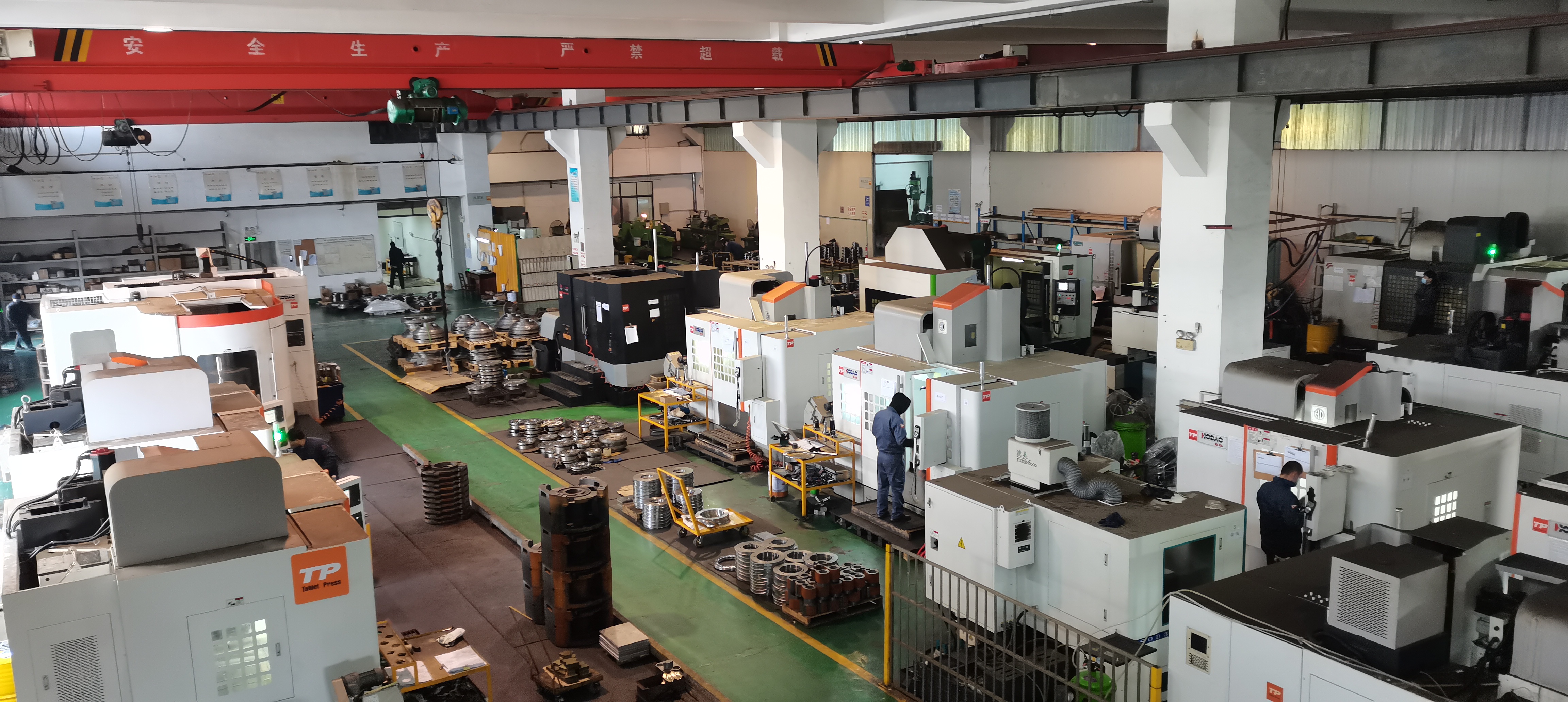
Machining environment at a pharmaceutical machinery workshop: material grade is one input; component geometry and surface condition are produced at the machine tool.
Why a One-Line Material Specification Carries So Much Procurement Weight
Capsule filling machine quotations frequently carry a single material line — something like "SS316 contact parts, SS304 frame" — and then move directly to price and delivery. At evaluation and execution stage, that line deserves more attention than its length suggests, because it defines a boundary. It states which surfaces the supplier classifies as product contact, which parts perform structural, guarding, powder-handling or tooling roles, and what a buyer is entitled to expect from each group. It does not state that one grade is better than another, and it does not replace the performance figures in the same quotation.
The CFM-3500 and CFM-3500B capsule filling machines from Shanghai Tablet Press Mechanical Components Co., Ltd. (TPCF) offer a concrete case for reading this kind of specification properly. Their material schedule assigns SS316 to product-contact parts and SS304 to the worktable, enclosure, hopper and tooling. The same specification set also states GMP-compliant design, modular cleaning, capsule format coverage from 00# to 5# plus safety capsules A–E, and a dosing accuracy of ±3%. Those elements answer four different questions. Treated as one general "stainless steel quality" claim, they become expensive assumptions at commissioning.
The Short Answer: Which Parts Are SS316 and Which Are SS304
The CFM-3500/3500B specification separates two material groups instead of applying one grade across the machine:
- SS316 — product-contact parts. These are the components the manufacturer assigns to the material path that meets the capsule fill.
- SS304 — worktable, enclosure, hopper and tooling. These are the structural, guarding, powder-handling and tooling components in the same specification.
The split is a design classification, not a ranking. It tells a buyer where the manufacturer has drawn the contact line on this model, and it gives the buyer something checkable: a part-level list that can be compared against the buyer's own material-contact assessment before a purchase order is issued.
Two practical cautions follow. First, the schedule identifies grades, not the full condition of those surfaces; surface finish and the way a part is cleaned and documented sit outside a grade label. Second, buyers should ask the supplier to confirm the classification part by part rather than inferring it from a material name, because a component such as a powder hopper can be grouped differently depending on the machine architecture and on how a given manufacturer defines the contact path. Getting both parties onto the same definitions at RFQ stage is cheaper than discovering a mismatch during qualification.
Why GMP-Facing Buyers Separate Contact Parts from Structure
In regulated pharmaceutical production, equipment design is part of the quality system rather than an external purchase detail. Manufacturers serving the United States market, for example, operate within 21 CFR Part 211, the FDA's Current Good Manufacturing Practice framework for finished pharmaceuticals, which places construction, cleaning and documentation obligations on the production environment. A material schedule is one input to that framework. It is not the framework itself.
That distinction matters when a buyer is converting a specification into an internal qualification plan. A defensible equipment file usually needs three things to line up: the parts designated as product contact, the cleaning approach applied to those parts, and the documentation that shows both were considered during design. The CFM-3500/3500B specification addresses the first element explicitly through the SS316 assignment and the second through modular cleaning, which organises cleaning by module rather than treating the whole machine as one indivisible surface. What a buyer still has to establish locally is the third element — how cleaning is performed, verified and recorded on their own product.
This is why a two-grade schedule is more informative than a single "all stainless steel" claim. It forces the conversation onto parts and modules, which is the level at which cleaning procedures, changeover time and spare-part planning are actually managed.
What the SS316 Assignment Establishes — and What It Does Not
Assigning SS316 to product-contact parts establishes that the contact path is a different grade from the structural body of the machine, and that the manufacturer has documented that separation for this model. In general engineering practice, 316-grade stainless steels are selected where greater corrosion resistance is required than 304-grade steels provide, a difference associated with their composition. That general property is useful context; it is not a guarantee for a specific product, cleaning agent or operating cycle, which is why the buyer's own media list still has to be checked against the supplier's recommendation.
The same specification does not establish the surface finish values of those parts, the outcome of cleaning validation on a buyer's formulation, or the corrosion performance of the machine in a particular process environment. Those are qualification questions. They are answerable, but they are answered with drawings, procedures and test records rather than with a grade name. Treating SS316 as a complete compliance answer is the most common way this specification gets over-read.
What the SS304 Group Covers on the CFM-3500/3500B
On this model, SS304 is specified for four groups: the worktable, the enclosure, the hopper and the tooling. Read functionally, these are the surfaces that support the machine, guard the operating area, handle powder upstream of the dosing path and form the change parts that define capsule handling. Their material is chosen for the duty they perform rather than for direct extended contact with the finished fill.
For a buyer, that has a practical consequence at the cleaning and changeover stage. The worktable and enclosure define the accessible working environment and the wipe-down surfaces around the machine; tooling defines what has to be handled, stored and changed between formats. Both belong in the cleaning and changeover procedure even though they sit outside the SS316 group. A qualification plan that covers only the contact parts and ignores the tooling set will usually need revision once operators begin real changeovers.
Where a buyer's own assessment places the hopper inside their product-contact definition, the RFQ should say so explicitly and ask the supplier to confirm the classification used in the bill of materials. That is not a challenge to the design; it is the step that prevents two organisations from working to two different definitions of the same word.
Capsule Format Capability: 00# to 5# plus Safety Capsules A–E
Material grade says nothing about what the machine can fill. That capability sits in a separate line of the specification: the CFM-3500/3500B covers capsule formats from 00# through 5# and safety capsules A–E. The range spans the large sizes used for high-fill-weight nutraceutical and herbal powder products down to small sizes used where dose volume is limited, and it extends to the safety capsule formats used where a locking or tamper-evident configuration is specified.
For an RFQ, format coverage should be converted from a range into an expected production mix. A buyer who states only "00# to 5#" leaves the supplier unable to comment on changeover sequence, tooling quantities or the practical order in which formats will be run. A more useful entry lists the sizes actually planned, the expected share of output per size, whether safety capsules A–E are required in routine production or only occasionally, and the dimensional tolerances the buyer's capsule supplier works to. Capsule dimensions vary between suppliers, and format coverage on paper assumes capsules within the intended specification.
Why SS316 Does Not Deliver the ±3% Dosing Accuracy
The CFM-3500/3500B specification states a dosing accuracy of ±3%. That figure comes from the dosing station design, its adjustment range and the way the machine is set up and operated — not from the grade of stainless steel in the contact path. A corrosion-resistant contact part does not improve fill-weight control, and a structural part does not degrade it. The two specifications answer different buyer questions and should be evaluated on separate evidence.
Buyers should also ask under what conditions the accuracy figure is demonstrated. Fill weight outcomes are influenced by powder flow behaviour, bulk density, particle size distribution and the capsule size being run, so a percentage stated for a machine is normally tied to a product and a test method. The useful RFQ question is not only "what is the accuracy" but "on which product, at which capsule size and under which acceptance method was this figure established, and what will be used for our factory acceptance test". That converts a headline number into an acceptance criterion.
Containment Asks a Different Question: The NJP-800A-HC OEB4 Platform
Containment is a separate axis from material specification, and conflating the two is a common procurement error. TPCF's NJP-800A-HC is specified as an OEB4 containment platform. That designation addresses operator exposure control for potent compounds through engineering measures around the machine — it is not a statement about which stainless grade is used, and upgrading a contact-part grade on a standard machine does not create a contained one.
The consequence for buyers is sequencing. A project handling highly potent actives should settle its occupational exposure band and the associated engineering controls before comparing contact-part grades, because containment changes the machine architecture, the operating procedure and the facility interface. A project handling conventional herbal, nutraceutical or food-supplement powders may have no containment requirement at all and should not pay for one. Both decisions are legitimate; they are simply different decisions, and the specification should be read as answering only the question it addresses.
What Each Specification Element Establishes
The table below maps the CFM-3500/3500B specification elements to the buyer question each one answers, and to the questions it leaves open.
| Specification element | What it tells the buyer | What it does not establish |
|---|---|---|
| SS316 product-contact parts | The contact path is a defined, separate material group on this model | Surface finish values, cleaning validation outcome, suitability for a specific product medium |
| SS304 worktable and enclosure | Structural and guarding components are specified separately from contact parts | Cleanroom classification of the surrounding room or the buyer's facility requirements |
| SS304 hopper and tooling | Powder-handling and change-part groups are identified in the same schedule | How a buyer's own contact definition classifies these parts; tooling quantities per format |
| Capsule formats 00#–5# plus safety capsules A–E | The stated size scope the machine is specified to run | Performance on a specific capsule supplier's dimensional tolerances |
| Dosing accuracy ±3% | The specified fill-weight accuracy of the dosing system | Results on an untested formulation; the acceptance method to be used at factory testing |
| GMP-compliant design and modular cleaning | Design intent and the cleaning organisation the platform follows | That a buyer's cleaning procedure has been validated on their own product |
| NJP-800A-HC OEB4 platform | A containment-oriented machine configuration for potent compounds | Any change to the material schedule of a non-contained model |
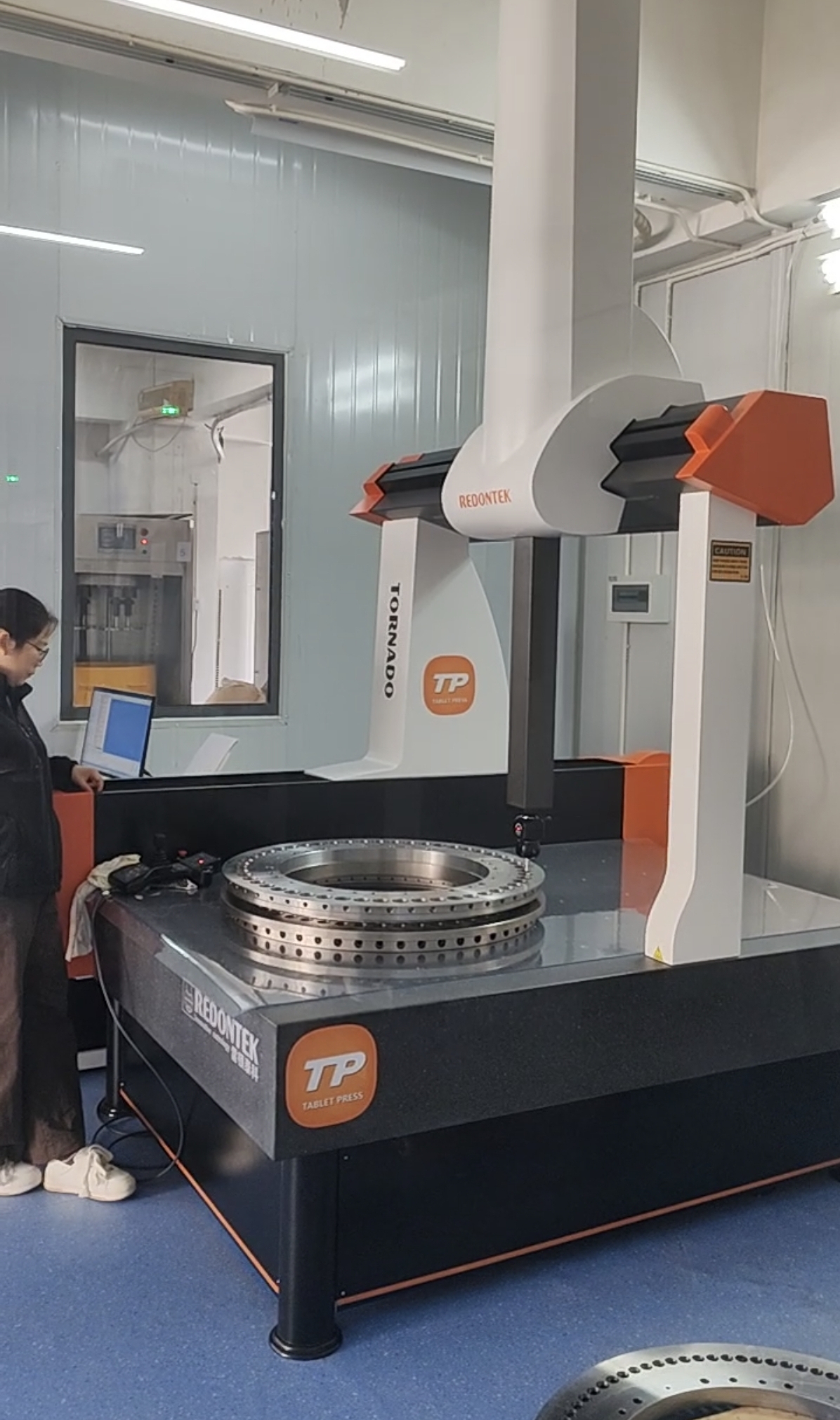
Dimensional verification with a coordinate measuring machine. Grade selection and geometric accuracy are checked through separate evidence.
RFQ Question List for Buyers Moving into Execution
The following questions convert the material discussion into items a supplier can answer in writing before the purchase order. They are ordered from the part level outward.
- Part-level material schedule. Provide the bill of materials with each part marked as product-contact or non-contact, and the grade assigned to it, for the exact model quoted.
- Definition of product contact. State the definition used to classify parts, so the buyer can compare it with their own material-contact assessment.
- Hopper classification. Confirm how the hopper is classed in the supplier's schedule and what alternative configurations exist if the buyer's assessment differs.
- Tooling scope. List the tooling supplied per capsule format, its material, the changeover sequence and the recommended spare set.
- Modular cleaning map. Identify which modules are removed for cleaning, in what order, and which documents describe the procedure.
- Surface condition. State the finish specification applied to contact parts and how it is verified.
- Dosing accuracy basis. State the product, capsule size and acceptance method under which the ±3% figure is demonstrated, and the proposed factory acceptance test for this order.
- Capsule format evidence. Confirm that 00# to 5# and safety capsules A–E are supported on the quoted configuration, and note any format requiring a different change part.
- Containment requirement. Confirm whether the buyer's exposure band calls for a contained configuration such as the NJP-800A-HC OEB4 platform, and how that changes the machine and facility interface.
- Compliance documentation. Provide the certification and conformity documents applicable to the quoted machine, with their scope and validity.
Fit Boundaries: Where the Specification Stops and Qualification Begins
The CFM-3500/3500B material schedule and capability statements describe the platform. They do not describe a validated process at the buyer's site. A machine can be correctly specified in SS316 contact parts, cover 00# to 5# capsules and state ±3% dosing accuracy, and still require a site-specific qualification programme covering product trials, cleaning verification, operator training and changeover practice. Buyers who budget for the machine but not for that programme usually meet the gap at the worst moment — during the first production campaign.
There are also boundaries on the material question itself. The schedule distinguishes grades across part groups; it does not by itself resolve questions about aggressive cleaning chemistry, long-dwell contact with a corrosive formulation, or the documentation a specific auditor will request. Those are handled by matching the supplier's recommendations to the buyer's actual process media and by agreeing in advance which records will be provided. Where a buyer's process is unusual, that conversation belongs in the RFQ rather than in the commissioning week.
Execution Stage: What to Lock with the Supplier
Once the material classification is settled, the remaining risk sits in documentation and handover. Three items are worth fixing in the contract rather than discussing later: the final part-level material schedule for the machine as built, the tooling and spare-part list by capsule format, and the acceptance test that will be used to demonstrate dosing accuracy on an agreed product.
Supplier capability is relevant here because these items depend on the manufacturer being able to control them in-house. Shanghai Tablet Press Mechanical Components Co., Ltd. operates a 15,000 m² facility with 260 staff, including 15 R&D engineers, and more than 200 CNC machine tools covering machining, assembly, commissioning and testing. The company reports delivery capacity of roughly 80 to 120 tablet presses and capsule filling machines per month, with about half of its equipment exported to Asia, South Africa, the Middle East, the EU, Russia, and North and West Africa. Its equipment complies with GMP standards and carries EU CE certification and ISO certification. Its capsule filling range runs from the small-scale NJP-200 to the large-capacity CFM7500, which is the practical context for positioning the CFM-3500/3500B as a mid-range platform rather than an isolated model.
In-house machining capability matters to the material question in one specific way: a part-level schedule is only credible if the manufacturer can produce the parts to the stated geometry and finish and can verify them. Dimensional inspection equipment and controlled machining support that claim; a grade label on its own does not.
Reference material: TPCF capsule filling machine brochure (PDF).
Outlook: Part-Level Material Schedules as a Procurement Norm
The direction of travel in equipment procurement is toward part-level evidence rather than machine-level adjectives. A statement that a machine is built from stainless steel is difficult to audit; a schedule that names which parts contact product, which parts are structural, and which documents support both is auditable, comparable between suppliers and reusable across sites. Buyers who ask for that schedule at RFQ stage also make their own qualification work easier, because the cleaning, changeover and acceptance plans can be written against the same parts list the machine was built from.
The practical conclusion is narrow but useful. On the CFM-3500/3500B, the SS316 contact group and the SS304 worktable, enclosure, hopper and tooling group answer a materials question. The capsule format range, the ±3% dosing accuracy and the separate OEB4 containment option on the NJP-800A-HC answer capability questions. Evaluating all four together, on their own evidence, is what turns a material line item into a defensible procurement decision.
FAQ
Which parts of the CFM-3500/3500B are SS316 and which are SS304?
In the CFM-3500/3500B specification, SS316 is assigned to product-contact parts. SS304 is assigned to the worktable, the enclosure, the hopper and the tooling. The specification identifies material groups rather than individual part numbers, so a buyer should request the part-level bill of materials for the exact configuration quoted in order to see the classification part by part.
Does specifying SS316 contact parts make a capsule filling machine GMP compliant?
No. Material selection is one input to GMP-facing equipment design. The CFM-3500/3500B specification also states GMP-compliant design and modular cleaning, and in regulated markets equipment obligations sit within wider frameworks such as 21 CFR Part 211 for finished pharmaceuticals in the United States. Compliance at a buyer's site additionally depends on installation, cleaning procedures, validation activity and documentation, which are established locally.
Which capsule sizes does the CFM-3500/3500B cover?
The stated coverage is capsule formats from 00# through 5# plus safety capsules A–E. Buyers should confirm that the specific configuration quoted supports every format they intend to run in routine production, and should provide their expected size mix and capsule supplier dimensional tolerances so that tooling quantities and changeover sequence can be defined.
Does the stainless-steel grade affect the ±3% dosing accuracy?
No. The stated dosing accuracy of ±3% originates in the dosing system design, its adjustment and the operating setup, not in the grade of the contact parts. Fill-weight outcomes are also influenced by powder flow behaviour, bulk density, particle size distribution and capsule size, so buyers should ask which product, capsule size and acceptance method were used to establish the figure, and what test will be applied to their own order.
How is containment different from material specification?
Containment addresses operator exposure to potent compounds through engineering controls, while material specification addresses which parts are product-contact and which are structural or tooling. TPCF's NJP-800A-HC is specified as an OEB4 containment platform; that designation is separate from the SS316 and SS304 schedule of a standard model. A project should settle its occupational exposure band and containment requirement before comparing contact-part grades, because containment affects the machine architecture, the operating procedure and the facility interface.
Tem questões ou precisa de mais detalhes?
Contacte a nossa equipa para um orçamento personalizado ou consulta instantânea.
Solicitar orçamento
Preencha o formulário abaixo e a nossa equipa entrará em contacto com uma proposta personalizada.
Chat direto do WhatsApp
Prefere conversar em tempo real? Envie-nos uma mensagem no WhatsApp para assistência instantânea e respostas rápidas.
- Obter orçamento personalizado
- Partilhar fotos ou documentos
- Discuta as suas necessidades diretamente
Geralmente responde em 5–30 minutos durante o horário de expediente.