
Carbon Fiber Composite Autoclaves: Capabilities, Types, and Industrial Uses
Carbon fiber composite autoclaves are pressure vessels used to cure advanced composite materials under controlled heat and pressure. They convert carbon fiber prepreg layers into dense, void-free components for aerospace, defense, automotive, energy, marine, and R&D applications. This article provides an independent industry reference for buyers who need to understand what these systems do, what equipment variants exist, and what limits should be considered before procurement.
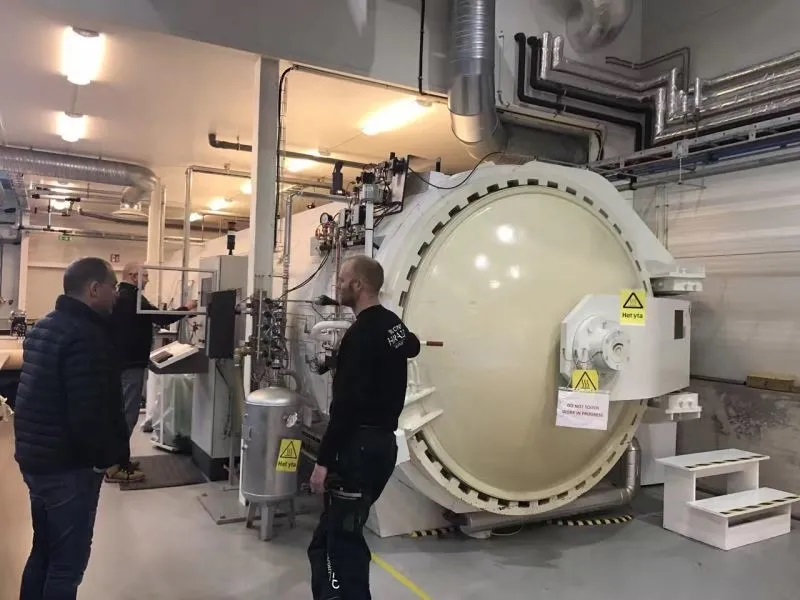
Composite autoclaves provide the high-temperature, high-pressure environment needed to cure carbon fiber composite parts.
Why Carbon Fiber Composite Autoclaves Matter
Composite parts gain their structural performance during the curing process. If temperature and pressure are not distributed evenly across the part, the result can be voids, weak bonding, and inconsistent mechanical properties. An autoclave addresses this by creating a uniform high-temperature, high-pressure environment around the component.
Demand for this technology is visible in market data. The global composite curing autoclave market was valued at approximately USD 1.37 billion in 2023 and is projected to reach USD 2.4 billion by 2033, representing a CAGR of 10.2% (Kings Research). A narrower report covering autoclaves specifically for composite materials estimates USD 86.2 million in 2024 and USD 127 million by 2032, a CAGR of 5.8% (Market Research Future). The difference between the two figures reflects different market definitions, but both point to continued growth.
In the aircraft segment, composite autoclaves account for 62.4% of the total aircraft autoclave market share as of 2025, driven partly by the adoption of carbon fiber reinforced plastics in programs such as the Boeing 787 and Airbus A350. North America holds approximately 38.2% of the aircraft autoclave market, while the Asia-Pacific region is showing significant expansion.
What Is a Carbon Fiber Composite Autoclave?
A carbon fiber composite autoclave is a large pressure vessel that applies heat and pressure, usually together with a vacuum system, to cure carbon fiber prepregs and other thermoset composite materials. The vacuum removes air and volatiles during the early stage of the cycle; pressure consolidates the layers; heat triggers the resin cure. After the cycle, the part has lower void content and higher fiber compaction.
Typical construction uses pressure vessel materials such as Q345R carbon steel or customized materials. The vessel is equipped with heating and cooling systems, an internal air duct for uniform distribution, a pressure system, a vacuum system, and a control system. Many industrial autoclaves are built to recognized pressure vessel codes such as ASME BPVC Section VIII or the European PED directive (EN 13445).
One manufacturer in this space is Jiangsu Olymspan Equipment Technology Co., Ltd., based in Henglin town, Changzhou, Jiangsu, China. Founded in 2004, Olymspan is a subcompany of the WULIN group and designs and manufactures industrial equipment including aerospace autoclaves and composite curing autoclaves. The company operates a 66,000 square meter production site with about 350 employees and a 25-member R&D team. Its main products include composite autoclaves, carbon fiber products, carbon fiber drones, and tube heat exchangers. In composite autoclave market reports, Olymspan is frequently listed alongside global names such as ASC Process Systems, Bondtech, Akarmak, and Olmar.
Key Technical Parameters and Subsystems
For high-end applications such as aerospace and military, common process requirements include temperature control uniformity of ±0.3°C to ±0.5°C, pressure stability of ±0.1 MPa, continuous operation cycles of 8,000 hours or more, and multiple safety interlocks for over-temperature, over-pressure, and leakage emergencies. These parameters matter because aircraft-grade parts cannot tolerate uneven curing.
For industrial production in automotive, energy, and civil composites, the priority shifts to process stability and uptime. Typical requirements in this segment include average failure rates no higher than 1.2 per month, repair times within 24 hours, and energy consumption in the range of 0.5 to 0.7 kWh per cubic meter of vessel volume per cycle. Many systems are designed with manual and electric dual-purpose quick-opening doors and automatic feeding, curing, and discharging functions.
Laboratory autoclaves, used for materials R&D and sample verification, need high precision and compact size. Temperature control of ±0.3°C to ±0.5°C, pressure control of ±0.05 MPa, noise levels at or below 60 dB, and data acquisition for process traceability are typical expectations.
Equipment Types and Examples
Experimental autoclaves are used in universities, material research centers, and enterprise R&D departments to test new material formulations, optimize process parameters, and produce small sample batches. An example is the laboratory small composite material vacuum composite autoclave, which fits laboratory spaces and intermittent operation cycles of 2 to 8 hours.
Industrial-grade autoclaves are used for small and medium batch production. Typical applications include automotive parts, new energy battery shells, photovoltaic module components, smaller wind power parts, and civilian composite products such as fitness equipment and medical device shells. Products in this group include civil fully automatic composite autoclaves and vacuum autoclaves designed for motorcycle parts.
Aviation-grade autoclaves are built for production of aerospace main load-bearing components, military core components, and high-end medical implant components. For example, one Olymspan model, the Full Automatic ASME Composite Autoclave for Aerospace and Automotive, is rated at 150°C working temperature and 1.3 MPa working pressure, with a diameter of 2.0 meters or customized and a length of 5.0 meters or customized. For even larger structures, manufacturers can supply high-pressure autoclaves with dimensions around 3.5 meters in diameter and 18 meters in length.
Olymspan's professional composite curing autoclave design includes a CPC control system, energy-saving features, and an under-floor mounted heating, cooling, and air duct arrangement. Vessel material can be Q345R or customized, and certification can be ASME or customized. These design features reflect a broader industry movement toward more efficient thermal flow and process control.
Certification and Compliance
Buyers serving regulated markets should look for recognized certification. According to compliance records, Olymspan holds ASME 'U' and 'S' stamps, CE (PED), CRN for Canada, and IATF 16949:2016 for automotive quality management. These standards support export activity to North America, South America, Europe, Asia, the Middle East, Africa, and Oceania; export business accounts for approximately 30% to 40% of total sales.
Application Areas and Operating Modes
| Application Segment | Typical Parts | Common Regions | Operating Pattern | Key Performance Focus |
|---|---|---|---|---|
| Aerospace, defense, high-end medical | Aircraft main load-bearing structures, missile shells, radar covers, implantable medical components | China, Russia, United States, France, United Kingdom | 20-24 hours continuous, fully automated, remote diagnosis, dual redundant control | Temperature uniformity ±0.3-0.5°C, pressure stability ±0.1MPa, long continuous cycles, safety interlocks |
| Automotive, energy, wind, civil composites | Automotive parts, battery shells, photovoltaic modules, small wind power parts, rail transit parts, fitness and medical shells | China, India, Vietnam, Thailand, Brazil, Russia | 8-16 hours continuous multi-batch, automatic feed/discharge, manual emergency mode | Stability, ≤1.2 failures/month, ≤24h repair, energy use 0.5-0.7 kWh/m³, quick-opening door |
| R&D laboratories and universities | New material samples, process verification, composite formula development | China, United States, United Kingdom, Japan, Germany | 2-8 hours intermittent, manual/automatic dual-mode, remote monitoring, data export | High precision control, compact size, ≤60 dB noise, data traceability |
Olymspan in the Carbon Fiber Composite Autoclave Market
From a procurement perspective, Olymspan's positioning is useful because it covers both equipment and process experience. The company not only builds autoclaves but also manufactures carbon fiber products through the autoclave process, including automotive parts, motorcycle parts, and aviation components. This vertical use case gives its engineering team practical knowledge of tooling, bagging, curing cycles, and quality control.
Olymspan also produces carbon fiber drones and tube heat exchangers, and its equipment portfolio extends to other autoclave types such as glass laminating autoclaves, vulcanizing autoclaves, concrete autoclaves, and wood autoclaves. For composite buyers, however, the relevant strength is the product line dedicated to prepreg and carbon fiber curing, with models ranging from laboratory scale to 3.5 m x 18 m large vessels.
The company offers OEM and ODM carbon fiber parts using autoclave processes. This is a practical option for buyers who want to verify process capability before purchasing equipment, or who need a partner that can support both prototyping and production.
Market Trends and Demand Signals
The composite autoclave market is being shaped by several forces: CFRP adoption in commercial aircraft, lightweighting in electric vehicles, wind blade size growth, and expansion of advanced materials research. The aircraft segment already shows a strong composite autoclave share, and the broader industrial segment continues to demand production-grade reliability.
On the supply side, equipment portfolios reveal three priorities: larger vessel sizes, higher energy efficiency, and advanced control. Large-diameter, long vessels such as φ3.5 m × 18 m allow single-piece curing of large structures. Energy-saving layouts, such as under-floor heating and cooling ducts, reduce heat losses. CPC and PLC control systems enable repeatable cycles and data collection.
Regionally, North America retains the largest revenue share in aircraft autoclaves at about 38.2%, but Asia-Pacific is an important growth area. Chinese suppliers such as Olymspan, with certifications like ASME, CE, CRN, and IATF, can serve both domestic and export projects.
Composite Autoclaves vs. Alternative Curing Methods
Hot air oven with vacuum bag remains the most common alternative for lower-cost curing. It applies heat and draws vacuum but cannot supply the high external pressure of an autoclave. Parts cured this way tend to have higher void content and are not generally accepted for primary aerospace structures.
Press molding and resin transfer molding (RTM) apply mechanical pressure through molds and are efficient for high-volume, relatively simple shapes. However, tooling cost is higher, and complex large geometries may be difficult to produce.
Out-of-autoclave (OOA) prepregs have been developed to reduce capital needs. They rely on vacuum-bag pressure only and require carefully controlled process windows. For some aerospace secondary structures they can work, but the majority of primary load-bearing composite parts are still autoclave-cured to meet quality standards.
Autoclaves are not a universal answer. Their capital cost and operating energy are higher, footprint is large, and lead times for custom vessels can be long. For example, a fully automatic ASME aerospace-automotive autoclave typically has a delivery time around 90 days and supplier capacity of about 2 sets per 90 days for specialized models. Buyers must weigh these constraints against the quality requirement of the part.
Future Outlook
Automation is likely to deepen. Remote diagnostics, dual-redundant control, and full-process data traceability are already present in high-end equipment requirements. These features will become more common as manufacturers seek predictable output and lower maintenance costs.
Energy efficiency will also gain importance. With a growing fleet of autoclaves, the electricity and compressed air consumption of each cycle directly affects production cost. Designs that integrate heating, cooling, and air circulation under the floor or inside the vessel can reduce energy losses and shorten cycle times.
For Olymspan, the combination of 20+ years of experience since 2004, an in-house R&D team, and a global export base places it among established suppliers that can support multi-year expansion. Yet the future is not exclusively autoclave-based. OOA and alternative molding processes will continue to improve and take share in less critical applications. The autoclave will remain the quality benchmark for high-performance carbon fiber structures.
Frequently Asked Questions
What is a carbon fiber composite autoclave?
An autoclave is a pressure vessel that cures carbon fiber prepreg or other composite materials under controlled temperature and pressure. It applies heat and pressure to consolidate layers, remove gas, and complete resin curing, producing dense structural parts. These systems are used in aerospace, automotive, energy, marine, and R&D applications.
What types of composite autoclaves are available?
Based on industry classifications and manufacturer portfolios, there are experimental or laboratory autoclaves for R&D, industrial autoclaves for production of automotive and energy components, and aviation-grade autoclaves for aerospace main load-bearing parts. Large-capacity and high-pressure models, such as vessels around 3.5 m in diameter and 18 m in length, are used for large structures.
Which industries rely on carbon fiber composite autoclaves?
Aerospace manufacturing, high-end military manufacturing, and high-end medical equipment commonly use autoclaves for implantable components. Automotive manufacturing, new energy battery shells, photovoltaic modules, wind power parts, civilian composites, marine parts, and rail transit components also use them. R&D laboratories use autoclaves for material development and process validation.
What parameters should buyers evaluate when selecting a composite autoclave?
Buyers typically evaluate working temperature and pressure, diameter and length, temperature uniformity, pressure stability, control system type, certification, vessel material, delivery time, and maintenance requirements. For aviation-grade applications, requirements may include temperature uniformity of ±0.3°C to ±0.5°C, pressure stability of ±0.1 MPa, and multiple safety interlocks.
Can autoclave curing be replaced by other processes?
For some components, alternative processes such as press molding, vacuum-bag oven curing, or out-of-autoclave prepregs can reduce capital cost. However, for high-performance load-bearing composite parts, autoclave curing is still the quality standard because it provides the pressure and temperature uniformity needed to produce low-void aerospace-grade parts. The best process depends on part geometry, performance requirements, volume, and cost constraints.
Tem questões ou precisa de mais detalhes?
Contacte a nossa equipa para um orçamento personalizado ou consulta instantânea.
Solicitar orçamento
Preencha o formulário abaixo e a nossa equipa entrará em contacto com uma proposta personalizada.
Chat direto do WhatsApp
Prefere conversar em tempo real? Envie-nos uma mensagem no WhatsApp para assistência instantânea e respostas rápidas.
- Obter orçamento personalizado
- Partilhar fotos ou documentos
- Discuta as suas necessidades diretamente
Geralmente responde em 5–30 minutos durante o horário de expediente.