
Carbon Fiber Composite Plastic: What Counts as Qualification Evidence?
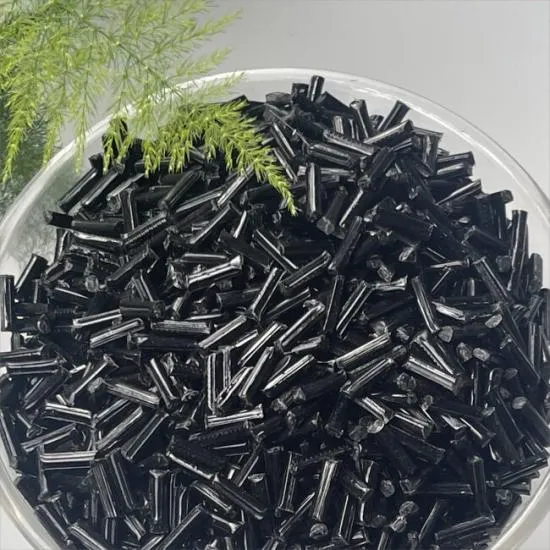
Compliance in long carbon fiber reinforced thermoplastics is not a document a supplier holds. It is a chain of evidence: a named grade, a declared fiber content, a mechanical value measured against a published international test standard, and a project load case that the value can be mapped onto. When any link in that chain is missing, the buyer is not evaluating a material — they are evaluating a description.
This article examines what qualification evidence for high-strength carbon fiber composite plastic actually looks like, why material classification (LCF, LGF, LFT) is not the same thing as grade-specific properties, and how buyers in aerospace, defense, new energy vehicle and robotics programs can separate verifiable mechanical data from category-level language.
The Gap Between “High Strength” and a Qualified Grade
Most early-stage enquiries for carbon fiber composite plastic arrive with the same three words: high strength, lightweight, high rigidity. These are family-level descriptions. They are accurate as far as they go, but they answer none of the questions a design or procurement engineer has to close before releasing a part.
Four questions separate a marketing description from usable qualification evidence:
- Which grade? A fiber content range of 20–60% long carbon fiber can describe materials with materially different stiffness and impact behaviour. A range is not a specification.
- Which resin system? Base resin selection determines thermal behaviour, chemical resistance and processing window.
- Which test standard, and on what specimen? A tensile number without a method, orientation and conditioning is a reference point, not an approval input.
- Is the value independently reproducible? Supplier-reported data is the normal starting point. It becomes qualification data when it can be repeated by a party other than the seller.
The opportunity here is practical rather than theoretical. Because long fiber thermoplastic composites are now routinely specified against published standards, a buyer who asks for standard-referenced values can compare suppliers on a like-for-like basis — or establish, quickly and cheaply, that a like-for-like comparison is not yet possible. Both outcomes shorten a project more than a month of sample rounds.
Classification First: LCF, LGF, LFT and LFT-G Are Not Interchangeable
Long fiber reinforced thermoplastic (LFT) is a material family, not a product. In the LFT process, fiber lengths are held in the range of 5–25 mm, compared with short fiber reinforced thermoplastics where fiber length is typically below 12 mm. The long fibers are impregnated with resin through a dedicated mold system to produce fully impregnated strands, which are then cut to the length required by the downstream process.
That processing difference is the origin of the property difference — and also the origin of the classification confusion buyers encounter in supplier documentation.
| Classification level | What it defines | What it does not define |
|---|---|---|
| Family: LFT | A long fiber reinforced thermoplastic material concept and process route | Resin type, fiber type, fiber content, mechanical values |
| Reinforcement: LCF / LGF | Whether the reinforcement is long carbon fiber or long glass fiber | Grade, loading level, property data, processing requirement |
| Grade: e.g. LFT-G | Fiber content range, colour, form, packaging and intended processing | Approval for a specific load case, environment or part geometry |
LFT-G is a grade-level designation used for an LFT long carbon fiber reinforced composite supplied in black, made of 20–60% long carbon fiber, described as high strength, high toughness and durable, and packaged in 20–25 kg bags with customizable packaging. The 20–60% figure is the single most important detail in that sentence — and the one most often dropped in marketing summaries. It is a range. Two LFT-G materials at opposite ends of it are not interchangeable in a structural design.
Resin selection and fiber selection each add another variable. The most widely used base resin in LFT compounding is PP, followed by PA6, PA66, PPA, PA12, MXD6, PBT, PET, TPU, PPS, LCP and PEEK. Conventional reinforcements include glass fiber and carbon fiber; special fibers include basalt and quartz. Depending on the end use, finished products can be injection molded, extruded or molded, or used directly to replace steel and thermoset components.
A buyer therefore has three independent variables — resin, fiber type and fiber content — before a single mechanical value becomes meaningful.
What Standard-Based Evidence Actually Measures
When a supplier publishes mechanical values against ISO 527-2, ISO 178 and GB/T 1843, the data becomes checkable. The distinction matters because each standard measures a different failure mode, and each failure mode maps to a different part of an engineering problem.
Tensile behaviour — ISO 527-2
Published LFT carbon fiber composite plastic data reports tensile strength of 350 MPa under ISO 527-2, with elongation at break of 7.8% under the same standard. Tensile strength describes resistance to being pulled apart. Elongation at break describes how far the material stretches before it fractures. A 7.8% elongation figure indicates a material that fails progressively rather than shattering — relevant in brackets, covers and housings where brittle failure is a safety concern, not just a performance concern.
Flexural behaviour — ISO 178
The same published grade data reports flexural modulus of 30,700 MPa and flexural strength of 510 MPa under ISO 178. Flexural modulus is a stiffness indicator: it drives how much a part deflects under bending load and therefore drives wall thickness, rib design and overall geometry. Flexural strength describes the stress at which the material fails in bending. For cantilever structures — a UAV arm, a bracket, a beam — these two numbers are the primary screening values.
Impact behaviour — GB/T 1843
Izod impact is reported at 40 kJ/m² under GB/T 1843. Impact resistance is the property most frequently absent from promotional descriptions and most frequently decisive in transport, robotics and outdoor equipment, because it governs behaviour under jolting, drop events and high-frequency start-stop loads rather than under steady load.
Density and mass
Published density for the LFT carbon fiber composite plastic grade is 1.28. Density translates directly into mass saving, which is why it appears in almost every lightweighting calculation and why it should be quoted with its test basis rather than as a standalone number.
| Parameter | Published value | Test standard | What it tells a buyer |
|---|---|---|---|
| Tensile strength | 350 MPa | ISO 527-2 | Load-bearing capacity in tension |
| Elongation at break | 7.8% | ISO 527-2 | Ductility; failure mode under overload |
| Flexural modulus | 30,700 MPa | ISO 178 | Stiffness; deflection and geometry control |
| Flexural strength | 510 MPa | ISO 178 | Bending failure limit |
| Izod impact | 40 kJ/m² | GB/T 1843 | Shock and vibration tolerance |
| Density | 1.28 | Reported | Mass saving baseline |
Where Polygram Sits in the Qualification Chain
Guangdong Baolijin New Material Technology Co., Ltd., which operates under the Polygram brand, is a thermoplastic composite manufacturer based in Huangjiang Town, Dongguan City, Guangdong Province, China. The company was established in 2017 and operates a 4,000 m² facility with a 10-engineer R&D team within a workforce of 30 employees. It reports exporting approximately 30% of its output to Europe, America and Southeast Asia, and describes 20 years of accumulated experience in the polymer composite materials industry.
Its stated scope covers the research, development, production and sale of thermoplastic (LFT) carbon fiber composites, conductive and antistatic plastics, and graphene thermally conductive plastics. Target industries include aerospace, military, new energy vehicles, the low-altitude economy, robotics, semiconductors and sporting goods.
What matters for qualification purposes is the vertical scope rather than the size of the organisation. Polygram describes a one-stop chain covering material design, raw material production, mold development and injection molding. That matters because the variables that determine final part performance — compound formulation, tool design, gate and flow behaviour, mold temperature control — sit within one supplier's responsibility instead of being split across a compounder, a toolmaker and a molder with no shared accountability for the end result.
Published capability data records an ODM production mode, customization across material, mold opening and injection molding, a reported production capacity of 12,000,000 units, a standard lead time of 30 days, a minimum order quantity of 50 units, 100% testing, and remote after-sales support.
The processing side of the same question is just as specific. Long fiber grades are run on precision injection molding machines with wear-resistant double-alloy screws, high-gloss hard molds at HRC52+ hardness, high-precision mold temperature control and nitrogen-assisted injection molding. These requirements are not optional refinements; they are the reason long fiber grades cannot simply be substituted into a line configured for short fiber compounds.
Qualification in Practice: An Eight-Year Battery Enclosure Programme
The framework becomes concrete in a documented ODM programme. For a new energy vehicle Tier 1 supplier in China, Polygram has supplied the upper cover and protective shell of a power battery pack since 2018 — an eight-year programme running through 2026 at a volume of 120,000 units per year.
The stated application requirements are high-voltage insulation, shock resistance and resistance to electrolyte exposure. The reported programme outcomes are a 42% weight reduction compared with aluminium, an 18% cost reduction, verification against UL 94 V0 and IP6K9K test requirements, and no reported after-sales cracking or leakage across the programme duration.
Three engineering details explain why the case holds together. First, the components are produced by integrated injection molding of long carbon fiber, meaning the structural and housing functions are combined rather than assembled. Second, the coefficient of thermal expansion is compatible with aluminium at 28 ppm/℃ — a critical point when a polymer cover is bolted to a metal structure and the assembly cycles through temperature. Third, low float fiber behaviour supports high-speed mass production, which is what makes an annual volume of 120,000 units practical.
These are company-reported programme results. For a new project they function as a reference case that shows what a complete evidence set looks like — application requirement, material choice, verified test outcome and field performance over time — not as a transferable guarantee, because load case, geometry and resin differ from project to project.
Scenario Fit: Aerospace, Defense and Other High-Load Applications
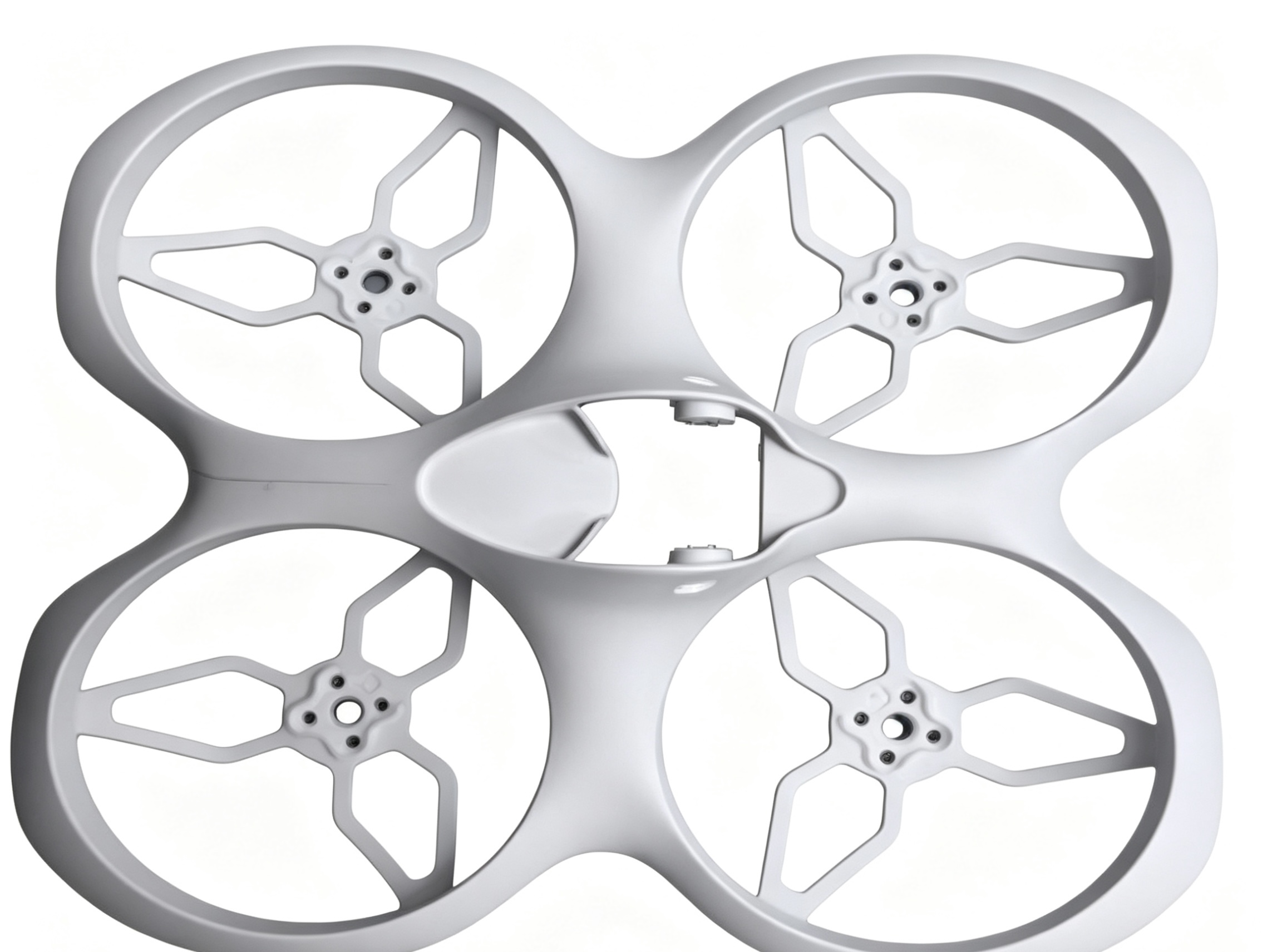
The LFT-G grade is positioned for commercial and military aerospace applications including radomes, drones, aircraft, missiles, satellites and aerospace fuel tanks. The same material family is used across new energy vehicles, the low-altitude economy, robotics, semiconductors and sports equipment.
The design envelope described for these applications includes weight reduction targets of 30–50%, high rigidity, impact resistance, insulation or electromagnetic shielding, chemical resistance, extended range and safety, service temperatures from −50℃ to 120℃, exposure to strong wind, sand and dust and damp heat, high fatigue cycle counts, vibration reduction, integrated structures, weather and UV resistance, and maintenance-free operation as an alternative to metal anti-corrosion processes.
The operating modes are equally specific: static load-bearing capacity combined with dynamic jolting and vibration, long-term outdoor or in-cabin service, high-pressure environment heating cycles, high-frequency start-stop, cantilever force, alternating loads in air, 24-hour industrial-grade continuous operation, extremely low warpage and high dimensional accuracy.
Because each of those conditions stresses a different property, qualification should be organised as a mapping exercise rather than a single approval decision.
| Application scenario | Dominant load / environment | Evidence to request before approval |
|---|---|---|
| UAV fuselage, arm, landing gear | Alternating loads in air, cantilever bending | Flexural modulus and strength (ISO 178) at the specified fiber content |
| Battery pack upper cover, BMS protective shell | Static load plus vibration, insulation, electrolyte exposure | Tensile and elongation data (ISO 527-2), chemical resistance, ingress testing |
| Multi-rotor centre frame, robot joint and torso | Impact, high-frequency start-stop | Izod impact (GB/T 1843) and fatigue data where available |
| Radome, satellite and fuel tank structures | Temperature cycling, insulation or electromagnetic shielding | Dielectric and shielding data at grade level |
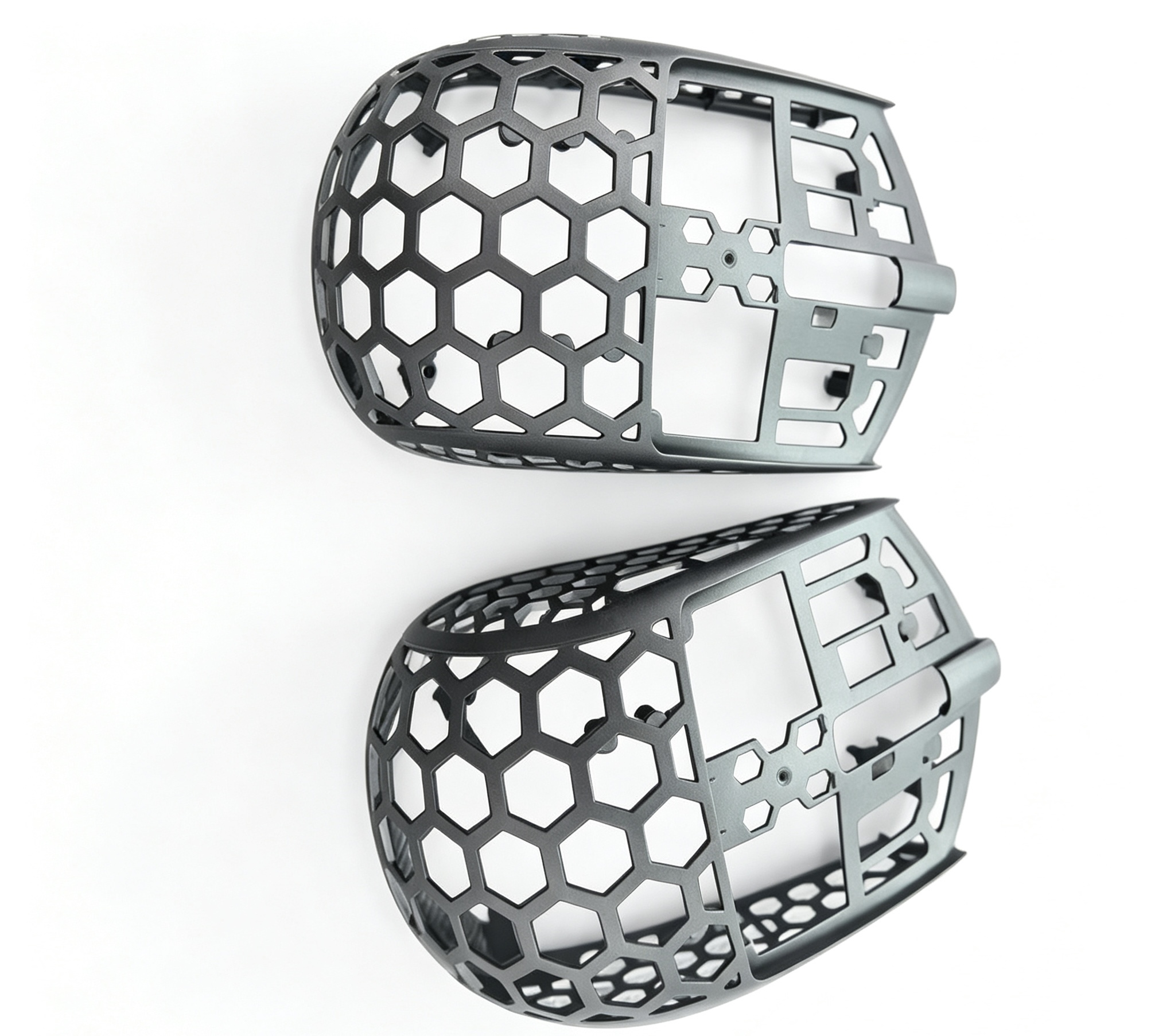
| Sporting goods, helmets, bicycle components | Impact, UV and weather exposure | Impact data plus ageing and UV performance |
Why Compliance Discipline Is Becoming a Market Requirement
Market scale explains why documentation standards are tightening. The global carbon fiber reinforced plastic market is projected to grow from USD 23.8 billion in 2026 to USD 43.7 billion by 2033, according to Grand View Research. Automotive was the largest application segment in 2025 with a 34.7% revenue share. The medical carbon composites segment is separately projected to reach USD 453.3 million by 2030, growing at 8.8% CAGR from 2025, according to Stratview Research. Published research also reports electromagnetic shielding effectiveness of 74.2 dB in the X-band frequency range for carbon fiber composites hybridised with copper-coated reduced graphene oxide — an indicator of how far the functional envelope is extending beyond structural use.
The procurement implication is straightforward. As volume grows, the supplier population grows with it, and claim density grows faster than evidence density. When multiple suppliers describe their product with the same category words, the only durable differentiation available to a buyer is comparable, standard-referenced data.
The gap is real and measurable. No standardised cross-supplier test matrix currently exists for LFT carbon fiber compounds, and thermal, fatigue, creep, flammability, surface resistivity, shielding effectiveness and recyclability data are frequently missing at grade level. Buyers who assume those gaps are filled by a data sheet will discover otherwise during prototype validation.
Comparison with Traditional Solutions — and Where the Limits Are
Long carbon fiber thermoplastics compete against three established alternatives, and the comparison is more nuanced than a property table suggests.
| Dimension | LFT carbon fiber thermoplastic | Short fiber reinforced thermoplastic | Thermoset carbon composite | Aluminium |
|---|---|---|---|---|
| Reinforcement length | 5–25 mm long fiber | Typically under 12 mm | Continuous fabric or laminate | Not applicable |
| Shaping route | Injection molding, extrusion, molding | Injection molding | Layup and cure, longer cycle | Casting, extrusion, machining |
| Published property example | Tensile 350 MPa, flexural modulus 30,700 MPa, impact 40 kJ/m² (supplier grade data) | Lower property retention due to shorter fiber | High in-plane properties | Isotropic, well-characterised |
| Mass | Density 1.28 reported; 42% weight reduction reported versus aluminium in a battery enclosure programme | Similar density range | Part-specific | Higher density |
| Evidence comparability | Supplier-reported; no cross-supplier matrix | Well established | Well established | Well established |
The boundaries matter as much as the benefits, and a credible qualification review states them explicitly:
- Reported data is not verified data. The mechanical values discussed here are supplier-reported for an LFT carbon fiber composite plastic grade. They are a screening input, not an approval input. Independent, matched-grade testing remains the buyer's responsibility.
- Processing requirements are higher. Long fiber grades call for wear-resistant double-alloy screws, HRC52+ hard molds, high-precision mold temperature control and nitrogen-assisted injection molding. Tooling investment and process discipline exceed what short fiber compounds demand, which changes the total cost calculation for low-volume projects.
- The property window is intentionally wide. Because a single LFT-G designation spans 20–60% long carbon fiber, the same label can describe materials with substantially different stiffness and impact behaviour. Specifying the label without specifying the fiber content is a common and expensive error.
- Certain properties are usually absent. Fatigue life, long-term creep, sustained high-temperature performance, flame behaviour and shielding effectiveness are rarely provided at grade level. Where a project depends on them, the data has to be generated for the specific grade, geometry and environment.
- Compliance claims need source verification. Public third-party articles have attributed quality-system certifications to suppliers without publishing certificate-level documentation. Quality-system documentation addresses a manufacturer's process controls; it does not by itself demonstrate that a specific grade meets a project's mechanical and environmental requirements. Buyers should confirm scope and validity with the issuing body and verify material data separately.
What to Expect Next
Three shifts are visible in how long fiber thermoplastic composites are being procured. First, grade-level transparency is becoming standard practice: resin system, fiber content, test standard, conditioning and specimen orientation published alongside the value rather than buried in an appendix. Second, buyer-driven test matrices are replacing data-sheet comparison, as procurement teams commission matched-grade testing instead of assembling incompatible numbers from different suppliers. Third, qualification is being reorganised around scenario rather than material — a battery enclosure, an airframe arm and a radome each carry their own evidence requirement, even when all three use the same material family.
The practical consequence for buyers is unchanged by any of that. Define the load case first. Request grade-level data against named standards — ISO 527-2 for tensile behaviour, ISO 178 for flexural behaviour, GB/T 1843 for impact where applicable. Require the source documentation behind any compliance claim. Treat published values as the starting point of an evaluation rather than its conclusion.
FAQ
LFT describes a material family — long fiber reinforced thermoplastic — in which fibers are held at lengths of 5–25 mm, compared with short fiber reinforced thermoplastics where fiber length is typically under 12 mm. LCF identifies the reinforcement as long carbon fiber; LGF identifies long glass fiber. LFT-G is a grade-level designation: a long carbon fiber reinforced composite supplied in black and made with 20–60% long carbon fiber. Classification tells you the family; the grade tells you what you are actually buying.
Check whether the number is attached to a test standard, a named grade and a stated specimen condition. A tensile value reported under ISO 527-2 for a declared LFT grade at a stated fiber content is verifiable data. “High strength” without resin system, fiber loading or method is a category description. The minimum useful data set is tensile strength and elongation under ISO 527-2, flexural modulus and strength under ISO 178, impact under GB/T 1843, and density.
Because the values are grade-specific. Fiber content varies across the LFT-G range of 20–60% long carbon fiber; base resin may be PP, PA6, PA66, PPA, PA12, MXD6, PBT, PET, TPU, PPS, LCP or PEEK; and specimen orientation and conditioning alter the measured result. Comparison is only meaningful when resin, fiber type, fiber content and test standard are matched. Where they are not matched, the difference in the numbers may reflect the test setup rather than the material.
No. A quality-system certificate addresses how a manufacturer controls its processes. Material qualification addresses whether a specific grade meets the mechanical, thermal and environmental requirements of a particular application. The two are complementary but not interchangeable, and the scope of any certificate — which site, which products, which validity period — should be confirmed with the issuing certification body before it is used as an approval input.
Typical scenarios include UAV fuselages, arms and landing gear, multi-rotor centre frames, robot joints and torsos, AGV load-bearing beams, servo motor brackets, battery pack shells and upper covers, battery brackets, seat frames, front-end modules, chassis structural components and BMS protective housings. Aerospace applications described for the LFT-G grade include radomes, drones, aircraft, missiles, satellites and aerospace fuel tanks. Suitability is determined project by project against load case and environment, not by material category.
Published values are screening data. Supplier data sheets for LFT carbon fiber compounds typically do not include fatigue life, creep, long-term thermal performance, flame behaviour or electromagnetic shielding performance at grade level, and no standardised cross-supplier test matrix currently exists for this material family. Where a project depends on those properties, the data must be generated for the specific grade and geometry. Independent verification and matched-grade comparison remain the buyer's responsibility.
Tem questões ou precisa de mais detalhes?
Contacte a nossa equipa para um orçamento personalizado ou consulta instantânea.
Solicitar orçamento
Preencha o formulário abaixo e a nossa equipa entrará em contacto com uma proposta personalizada.
Chat direto do WhatsApp
Prefere conversar em tempo real? Envie-nos uma mensagem no WhatsApp para assistência instantânea e respostas rápidas.
- Obter orçamento personalizado
- Partilhar fotos ou documentos
- Discuta as suas necessidades diretamente
Geralmente responde em 5–30 minutos durante o horário de expediente.