
Carbon Steel Balls: Grades, Applications and Buyer Guide
Carbon Steel Balls: Grades, Applications and Buyer Guide
Carbon steel balls are the volume, cost-driven segment of the industrial steel ball family. They are produced from low-carbon steels such as 1010, 1015 and 1018, supplied either unhardened or through-hardened, and specified from 1 mm to 50.8 mm across grade bands from G100 to G2000. They perform reliably in rolling, transfer, detent and grinding-media duty, and they are the wrong specification wherever corrosion resistance or bearing-grade precision is the governing requirement.
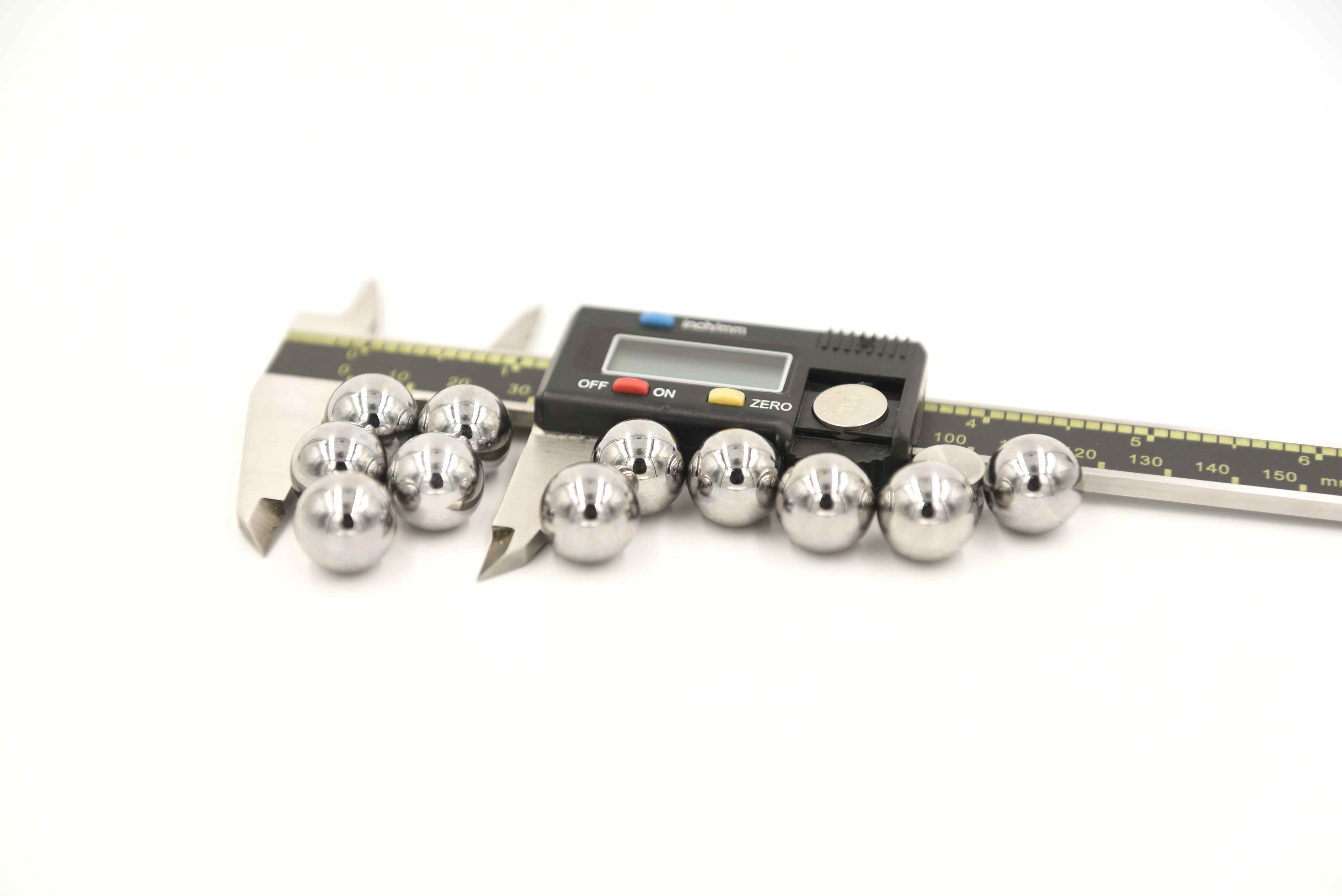
Carbon steel balls are supplied in unhardened or through-hardened condition for cost-driven rolling, transfer and grinding-media duty. Image: Haimen City Mingzhu Steel Ball Co., Ltd.
Steel balls are among the most widely used and least examined components in industrial manufacturing. They appear as rolling elements inside bearings, as sealing and seating elements inside valves, as transfer media under conveyor loads, and as spheres in finished consumer and architectural products. Because a specification error rarely shows up immediately, but instead surfaces thousands of operating cycles later as noise, wear or premature failure, the material and grade decision made at the sourcing stage largely determines how the component behaves for the rest of its service life.
Public discussion of steel balls, however, is dominated by bearing-grade content. That creates a persistent discovery problem for buyers in the awareness and research stages: the product they actually need may not be the product the market talks about most. This reference article isolates one segment — carbon steel balls — and treats four questions in order: what a carbon steel ball is, how its grades and hardness are read, where it is the economically and technically correct choice, and where it reaches a hard limit.
Haimen City Mingzhu Steel Ball Co., Ltd. is a steel ball manufacturer based in Haimen, Jiangsu Province, China, founded in 1992. Its production programme covers bearing steel balls, chrome steel balls, stainless steel balls, carbon steel balls, machined steel balls, non-standard steel balls, precision steel balls, drilled steel balls, electroplated steel balls, hollow steel balls and duplex stainless steel balls, alongside specialty materials such as M50 and Hastelloy steel balls. Its published specification data is used below as a reference case for how supplier capability should be read during sourcing.
What a carbon steel ball is
A carbon steel ball is defined by three attributes: material, condition and grade. The material basis is low-carbon steel in grades such as 1010, 1015 and 1018. These are plain carbon steels — no deliberate chromium addition is present, which is the single fact that explains most of the product's behaviour. Without chromium, the ball has no meaningful corrosion resistance of its own, and no protective passive film forms on its surface.
The condition describes heat treatment. Carbon steel balls are supplied either unhardened, in a soft low-carbon state that machines and deforms easily, or through-hardened, where the specification lists hardness of approximately HRC 55–60. The grade describes dimensional and geometric accuracy, and carbon steel balls are commonly specified in the G100 to G2000 band. Diameters are listed from 1 mm to 50.8 mm.
That combination — plain carbon chemistry, optional hardening, and a comparatively wide tolerance band — defines a component intended for cost-sensitive duty rather than for high-speed rotary precision. It is a deliberate engineering position, not a deficiency.
How carbon steel balls sit inside the wider steel ball family
The broader category of steel balls is usually grouped by material and by manufacturing route. The families most often quoted by industrial suppliers include bearing steel balls and chrome steel balls (both based on 52100 / 100Cr6 / SUJ2 chemistry), stainless steel balls in austenitic grades (304, 316) and martensitic grades (420C, 440C), carbon steel balls, machined steel balls, non-standard steel balls, precision steel balls, drilled steel balls, electroplated steel balls, hollow steel balls, and corrosion-resistant specialty grades such as duplex stainless steel balls, M50 steel balls and Hastelloy steel balls.
Carbon steel sits at the entry of that list in cost terms and at the upper end in tolerance terms. Machined, non-standard, precision, drilled and hollow variants are geometry categories rather than material categories — a drilled steel ball, for example, is defined by a through-hole or tapped hole rather than by the base material, and can be produced in bearing steel, stainless steel or carbon steel. Understanding that overlap prevents one of the most common procurement errors described in the next section.
The sourcing problem: "steel ball" is not one specification
Because the phrase "steel balls" is used for both precision bearing elements and general industrial media, catalogue searches return mixed product sets. Two opposite errors follow from that.
The first is over-specification. A buyer selects a through-hardened chrome steel ball for a conveyor transfer position, a caster, a bicycle bearing or a low-load hardware application where a soft or hardened carbon steel ball would perform for the life of the assembly at a materially lower unit cost. Here the buyer pays for hardness and fatigue performance the application never uses.
The second error is under-specification. A buyer selects a carbon steel ball for a washdown environment, a coastal installation, a valve handling mildly corrosive media, or a high-speed rotary position. In the first three cases the failure mode is corrosion; in the fourth it is wear and premature fatigue, because hardened carbon steel is listed at approximately HRC 55–60 while through-hardened bearing and chrome steel balls are listed at HRC 60–66.
The practical decision rule is therefore not "which ball is better" but "which duty is being bought". Carbon steel buys economy, machinability and broad availability. Alloyed through-hardened grades buy fatigue life and load capacity. Stainless grades buy corrosion resistance. A specification that mixes those objectives usually pays for two of them and receives one.
Technical basis: chemistry, hardness and what grade actually means
Carbon content and alloying determine what a ball can do. AISI 1010, 1015 and 1018 are low-carbon grades: they respond to through-hardening only within limits, and their hardened hardness sits below that of high-carbon chromium bearing steel. The reference material standard for high-carbon anti-friction bearing steel is ASTM A295/A295M, which covers the Grade 52100 chemistry used for bearing-quality balls — a useful benchmark when a buyer needs to explain why a carbon steel ball is not interchangeable with a 52100 ball.
Grade designation describes geometry, not material. The dimensional and form requirements for finished steel balls used in rolling bearings are set out in ISO 3290-1:2014, which defines grades from G3 to G700. In that system, a smaller number means tighter control of sphericity, diameter variation and surface finish. The G100–G2000 band used for carbon steel balls extends beyond the upper end of the ISO 3290-1:2014 range, which is consistent with a product intended for non-bearing duty. Precision steel ball specifications, by contrast, commonly list grades such as G3, G5, G10, G16 and G25 for high-speed and high-accuracy motion systems.
Two further specification details matter in practice. First, surface condition: unhardened carbon steel balls are readily machined, drilled or plated, while hardened balls are more difficult to modify after heat treatment. Second, trade documentation: steel balls for bearings are classified under HS code 8482.91 in the Harmonized System, which is the code buyers should expect to see on customs paperwork for bearing-type balls.
| Attribute | Carbon steel ball (as listed in the specification record) |
|---|---|
| Material | 1010, 1015, 1018 carbon steel |
| Condition | Unhardened (soft low-carbon) or through-hardened |
| Diameter range | 1 mm – 50.8 mm |
| Precision grade | G100 – G2000 |
| Hardness | Soft as supplied; approximately HRC 55–60 when hardened |
| Typical industries | Automotive steering and suspension; bicycle and caster bearings; conveyor rollers; grinding media; low-cost hardware; general machinery components |
Reading published ranges correctly. Diameter and grade ranges differ by product family and by source. The manufacturer's general catalogue range for standard steel balls is quoted as 2.0 mm to 50 mm with precision grades G10 to G500, while a published product-page reference lists 1.0 mm to 25.4 mm with grades G10 to G1000 for a comparable range, and the carbon steel ball specification record lists 1 mm to 50.8 mm with grades G100 to G2000. These figures describe different products, not conflicting claims about one product. Buyers should confirm the applicable diameter, grade and material combination at quotation stage rather than assuming one band applies across the whole catalogue.
Where carbon steel balls are specified
Carbon steel balls appear in applications where loads are moderate, speeds are low to moderate, lubrication or a dry indoor environment excludes corrosion, and cost is a genuine engineering constraint. The specification record and application data identify several recurring duty types.
- Automotive steering and suspension components. Linkage, pivot and detent positions where the ball carries moderate load in a lubricated, protected cavity rather than acting as a high-speed bearing element.
- Bicycle and caster bearings. Headsets, bottom brackets and caster wheels operate under rider or trolley load with grease lubrication, where a uniform carbon steel ball is a cost-effective consumable in a serviceable assembly.
- Conveyor rollers. Industrial roller applications commonly use 1010, 1015 and 1018 grade carbon steel balls, where consistent diameter and a clean surface matter more than sub-micron precision.
- Grinding media. Carbon steel balls serve as low-cost media where the ball is consumed by the process and hardness is judged against wear economy rather than fatigue life.
- General hardware and low-cost fittings. Ball-transfer positions, drawer slides and general mechanism hardware, where optional zinc plating can provide mild rust protection for indoor service.
Two adjacent product forms extend the range. Electroplated steel balls use a carbon or alloy steel core with zinc, nickel or chromium plating — plating thickness is specified per order, for example zinc at 5–25 µm — which adds surface corrosion protection and a controlled appearance while retaining the strength and economy of the steel core. Drilled, tapped, hollow and machined variants use carbon steel where the soft condition makes secondary machining practical, and switch to bearing or stainless grades where hardness or corrosion resistance is required.
Where carbon steel reaches its limit
Honest specification work requires naming the boundaries. Carbon steel balls have four relevant limits, all of which follow from their chemistry and tolerance band.
1. Corrosion. A carbon steel ball has no inherent corrosion resistance. In washdown, humid, coastal, marine or chemical service it will corrode, and stainless balls are documented as superior to carbon steel in wet and cleaning environments and widely accepted as a substitute for carbon steel in washdown and mildly corrosive service. Where a washdown or hygienic environment is involved, the material decision has already been made against carbon steel.
2. Hardness and fatigue ceiling. Through-hardened carbon steel is listed at approximately HRC 55–60, below the HRC 60–66 listed for through-hardened chrome and bearing steel balls based on AISI 52100 / SUJ2 (100Cr6). For high-speed, high-load or long-life bearing duty, the alloyed grades are the appropriate specification, not a hardened carbon steel ball.
3. Precision ceiling. The G100–G2000 band is coarser than the ISO 3290-1:2014 range of G3 to G700 and far coarser than the G3–G25 grades listed for precision steel balls. Carbon steel is therefore not a substitute for a precision bearing ball, regardless of price advantage.
4. Machining boundary. Soft carbon steel is the easiest of the common ball materials to drill, tap or turn, which makes it convenient for custom geometry. Hardened materials behave differently: hardened 440C and M50 require specialized tooling and longer lead times, so a design that calls for a hardened drilled or threaded ball should plan for extended production and inspection time, not just a higher unit price.
A documentation limit sits alongside these. Carbon steel is a commodity product, and if a project requires material test reports, EN 10204 3.1 documentation, first-article inspection or PPAP, that requirement should be confirmed with the supplier before the order rather than assumed from the material name.
| Ball type | Listed material | Listed hardness | Listed size / grade | Corrosion behaviour | Appropriate duty |
|---|---|---|---|---|---|
| Carbon steel ball | 1010, 1015, 1018 | Soft; ~HRC 55–60 hardened | 1–50.8 mm; G100–G2000 | No inherent corrosion resistance | Cost-driven rolling, transfer, detent and grinding media in dry or lubricated service |
| Bearing steel ball | AISI 52100 / SUJ2 (100Cr6) | HRC 60–66 | 0.5–50.8 mm; G10–G1000; Ra ≤ 0.05 µm | Requires lubrication; not for wet service | Ball bearings, wheel hubs, electric motors, precision spindles |
| Chrome steel ball | AISI 52100 / DIN 100Cr6 / JIS SUJ2 | HRC 60–66 | 1–50.8 mm; G10–G1000 | Requires lubrication; not for wet service | Anti-friction bearings, transmissions, precision instruments, valve train |
| 304 stainless ball | SS304 (austenitic) | Annealed, softer condition | 1–50.8 mm; G100–G1000 | General corrosion resistance; food-equipment suitable | Food and beverage equipment, plumbing valves, architectural fittings, cryogenic tanks |
| 316 stainless ball | AISI 316 / UNS S31600 | Annealed, softer condition | 1–50.8 mm; G100–G1000 | Excellent chloride resistance (Mo-alloyed) | Marine hardware, chemical processing, pharmaceutical and food equipment, saltwater valves |
| 440C stainless ball | AISI 440C / UNS S44004 | HRC 58–62 | 0.5–50.8 mm; G10–G1000 | Strong corrosion resistance combined with high hardness | High-precision bearings, surgical and dental instruments, aerospace actuators, chemical pumps |
Comparison compiled from published product specification records for the named ball types. Values are as listed by the manufacturer and are not third-party test results; buyers should obtain a material test report for the specific order.
For applications that combine corrosion with load — offshore, subsea, desalination or severe chemical service — the material conversation moves beyond stainless entirely, towards duplex stainless steel balls (UNS S32205 / S31803) or nickel-based grades such as Hastelloy C-276 (UNS N10276). Those are separate specifications with separate cost structures, and they are not a substitute for cost-driven carbon steel, nor the reverse.
Market context: read the numbers carefully
Published market sizing for steel balls is broad, and its internal variance is itself a useful signal for buyers and planners. Commercial research cited by Coherent Market Insights estimates the global steel ball market at USD 12.91 billion by 2026 and projects chrome steel balls at 45.7% of the material segment in that year. A separate forecast by Business Research Insights projects a 5.2% compound annual growth rate for the period 2026–2035.
The reporting spread is significant and should be understood before any figure is reused. Available 2026 market value comparisons range from USD 4.98 billion to USD 12.91 billion, with the principal methodological difference being whether large-scale grinding balls used in mining are counted alongside small precision bearing balls. Forecast growth rates show a similar divergence — 5.2% in one source, with 3.6% and 6.2% reported elsewhere — and the split tracks how heavily a model weights electric-vehicle and automation demand against the general industrial equipment baseline. For procurement purposes, these figures indicate direction of demand and relative segment weighting; they are not a defensible basis for a capital or inventory decision.
One structural reading is more reliable. Within material segments, chrome steel is projected to lead with 45.7% share, which places carbon steel in the cost-driven remainder — the portion of demand where bearing-grade precision and corrosion resistance are explicitly not required. That position is stable because it is defined by applications rather than by fashion, and it explains why carbon steel balls remain a standard stock line alongside high-precision grades rather than being displaced by them.
Reading a supplier: what capability data actually tells a buyer
For a commodity-adjacent component, supplier selection is less about material claims and more about process control, documentation and repeatability. The following published capability data illustrates the type of evidence that should be checked, using Haimen City Mingzhu Steel Ball Co., Ltd. as the reference case.
Operating scale and continuity. The company was founded in 1992 and operates a production base of 7,500 square metres with 105 sets of processing equipment, 40 employees, a research and development team of eight engineers, and a stable annual production capacity of 2,500 tons. Export business accounts for 25% of total sales, with the United States, Germany and Brazil listed as main markets. For a buyer assessing supply continuity, capacity, equipment count and export share are more informative than product counts, because they indicate whether the supplier can hold a repeat programme rather than fill a single order.
Certification. The company holds the IATF 16949:2016 automotive quality management system certificate, as published on its certification page, and is also cited as ISO 9001 certified. IATF 16949 is relevant beyond automotive buyers: it implies a documented process-control and traceability discipline that also serves industrial customers who need batch records.
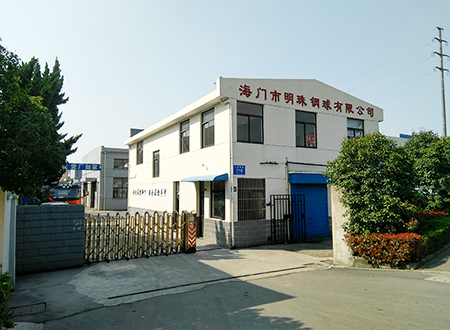
Steel ball production for both standard and customised grades relies on integrated workshops, in-house inspection rooms and controlled inspection flow. Image: Haimen City Mingzhu Steel Ball Co., Ltd.
Inspection method. Quality control is described as a whole-process system covering raw-material procurement, production and processing, finished-product testing and factory delivery, with every batch of raw material sampled and inspected before entering production. Finished balls pass through full automatic screening using roller-bar sorting equipment and photoelectric surface defect detectors, with the stated aim of eliminating defective product. Supplementary checks include hardness, roundness, microstructure, roughness and material verification.
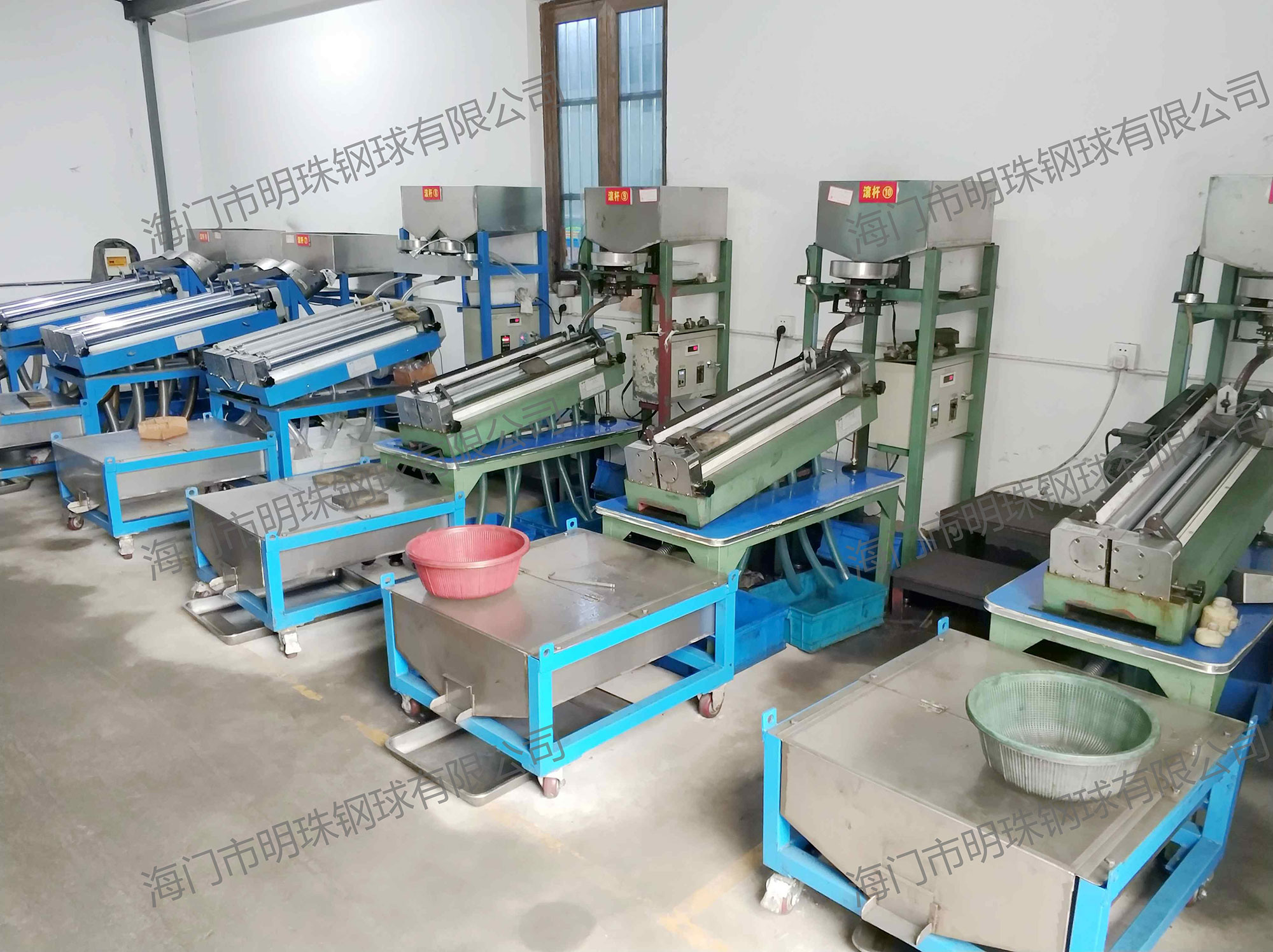
Automated sorting equipment screens finished steel balls for size, roundness and surface condition as part of a 100% inspection flow. Image: Haimen City Mingzhu Steel Ball Co., Ltd.
Documentation. Available paperwork includes material test reports, EN 10204 2.1 and 3.1 certificates and certificates of analysis, with PPAP, first-article inspection, NACE MR0175 and AMS documentation available on request. For carbon steel orders, this is the point to verify rather than assume: carbon steel is a commodity and the documentation package is often an order-specific choice.
Commercial terms. Standard sizes and common materials are often held in stock and can ship in 5–10 days; standard production is quoted at 15–30 days, and non-standard sizes, special alloys or CNC-featured balls at 20–60 days depending on tooling and inspection. Standard catalogue sizes carry a low minimum order quantity with samples available; non-standard and CNC-machined balls typically start from 50–500 pieces, with prototype quantities of 10–50 pieces workable for simple parts. Packaging is specified per order in drums, sealed bags, tubes or blisters and OEM-labelled cartons, marked with quantity, grade and lot code.
None of these figures remove the need for a trial order. They do, however, define what a buyer can legitimately ask a supplier to evidence: process control, inspection method, batch traceability and lead-time behaviour — rather than a claim about product quality in the abstract.
A procurement checklist for carbon steel balls
The following sequence reduces the risk of the two sourcing errors described earlier.
- Define the duty, not the product. State load, speed, lubrication state, moisture or chemical exposure, and expected service interval before choosing a material.
- Set the corrosion requirement first. If the environment involves washdown, humidity, coastal air or process chemicals, carbon steel is eliminated and the choice moves to 304, 316, 440C or a specialty alloy.
- Confirm whether bearing-grade hardness is required. If the ball will act as a rolling element under sustained load, specify through-hardened bearing or chrome steel rather than hardened carbon steel.
- Fix the grade against the tolerance actually needed. G100–G2000 is appropriate for transfer, roller and media duty; precision positions require grades defined in the G3–G25 range.
- Decide whether the ball must be modified. Drilled, threaded, stepped or hollow requirements are easier in soft material; hardened 440C or M50 versions require specialized tooling and longer lead time.
- State the documentation package up front. MTR, EN 10204 2.1 or 3.1, certificate of analysis, first-article inspection or PPAP should be agreed before the order, not after delivery.
- Verify packaging and lot marking. Quantity, grade and lot code marking on the packaging is what makes incoming inspection and traceability practical.
- Validate with a sample or prototype batch. A first-article sample before mass production approval is the cheapest available risk control.
Future outlook
Demand for steel balls is being pulled in two directions at once. On the precision side, electric-vehicle powertrains, automation and higher-speed rotating machinery continue to raise expectations for bearing-grade consistency, fatigue life and documented traceability — the segment where chrome and bearing steel dominate. On the volume side, mineral processing and general industrial equipment continue to consume grinding and transfer media on a cost-per-tonne basis, which is the natural domain of carbon steel.
Because published forecasts weight those two segments differently, the reported growth range for the category is wide — from around 3.6% to 6.2% depending on source and segment inclusion. What can be stated with more confidence is that the specification gap between the two segments is widening rather than closing: traceability, cleanliness and grade documentation requirements are hardening at the precision end, while the commodity end continues to compete on availability, unit cost and consistent dimensional control. Carbon steel balls sit firmly at that second end, and their long-term position depends on suppliers maintaining consistent grade discipline rather than on material substitution.
Frequently asked questions
What exactly is a carbon steel ball made of?
A carbon steel ball is produced from low-carbon steel grades such as 1010, 1015 and 1018. It contains no deliberate chromium addition, so it has no inherent corrosion resistance. It is supplied either unhardened, in a soft state that machines easily, or through-hardened, with approximately HRC 55–60 listed for the hardened condition.
What size and grade ranges are available for carbon steel balls?
The carbon steel ball specification record lists diameters from 1 mm to 50.8 mm and precision grades from G100 to G2000. For context, ISO 3290-1:2014 defines grades G3 to G700 for finished steel balls used in rolling bearings, so the carbon steel band sits outside that bearing-focused range. Diameter and grade bands differ between product families and between suppliers, so the applicable combination should be confirmed at quotation.
Which applications suit carbon steel balls?
Documented applications include automotive steering and suspension components, bicycle and caster bearings, conveyor rollers, grinding media and low-cost hardware, as well as general machinery components. Grades 1010, 1015 and 1018 are used in industrial roller applications. The shared conditions are moderate load, low to moderate speed, and a dry or lubricated environment.
When should stainless steel balls be used instead of carbon steel?
Stainless balls are the appropriate choice in wet, washdown and mildly corrosive service, where they are documented as superior to carbon steel and widely accepted as a substitute. Within stainless, 304 is used for food and beverage equipment, plumbing valves and architectural fittings, while 316 — which adds molybdenum and nickel and is cited at a higher pitting resistance equivalent number — is used for marine hardware, chemical processing, pharmaceutical and food equipment and saltwater valves. Both austenitic grades are supplied in a softer annealed condition, so high-load wear applications call for 440C or 52100 instead.
Can hardened carbon steel balls replace bearing steel balls?
No. Through-hardened carbon steel is listed at approximately HRC 55–60, while through-hardened chrome and bearing steel balls based on AISI 52100 / SUJ2 (100Cr6) are listed at HRC 60–66 with grades from G10 to G1000 and surface roughness down to Ra ≤ 0.05 µm. Where the ball functions as a rolling element under sustained load or at speed, an alloyed through-hardened grade is the correct specification.
How is quality verified, and what documents are available?
Finished balls are screened by automatic roller-bar sorting equipment and photoelectric surface defect detectors, supplemented by hardness, roundness, microstructure, roughness and material verification checks, in a system that also covers raw-material sampling and finished-product testing. Available documents include material test reports, EN 10204 2.1 and 3.1 certificates and certificates of analysis, with PPAP, first-article inspection, NACE MR0175 and AMS documentation available on request.
Can carbon steel balls be supplied as drilled, threaded or hollow custom parts?
Yes. Non-standard diameters to decimal size, drilled through or blind holes, threaded holes in metric and UNC/UNF forms, stepped and half-spherical shapes, and hollow constructions are all produced to customer drawings, with diameter, depth, concentricity and thread class controlled against the drawing. Soft materials are easier to machine; hardened grades such as 440C and M50 require specialized tooling and longer lead times. Drilled and tapped versions are typically used in locking ball joints, tie-rod ends, linkage pivots, positioning fixtures and custom bearing assemblies.
Reference summary
Carbon steel balls are the correct specification when the requirement is economical, machinable, dimensionally consistent spherical media for dry or lubricated service at moderate load and speed. They are the incorrect specification when the requirement is corrosion resistance, bearing-grade fatigue life, or precision below the ISO 3290-1:2014 bearing range. Nearly every sourcing error in this product category arises from treating those two requirement sets as one.
For readers compiling a specification package, the manufacturer's full product and capability documentation — covering material grades, size and grade ranges, customisation options, inspection practice and packaging — is available for download: Haimen City Mingzhu Steel Ball Co., Ltd. product brochure (PDF).