
Carbon Steel vs SS304 in SYUTECH Edge Banding Models
: Compliance-Relevant Build Qualities
Material declarations on edge banding machine datasheets are usually treated as paperwork. In a dust-laden, normal-humidity panel furniture workshop, they are closer to a qualification decision: they describe what carries the machine, what faces the glue and the dust, and what a buyer will have to maintain.
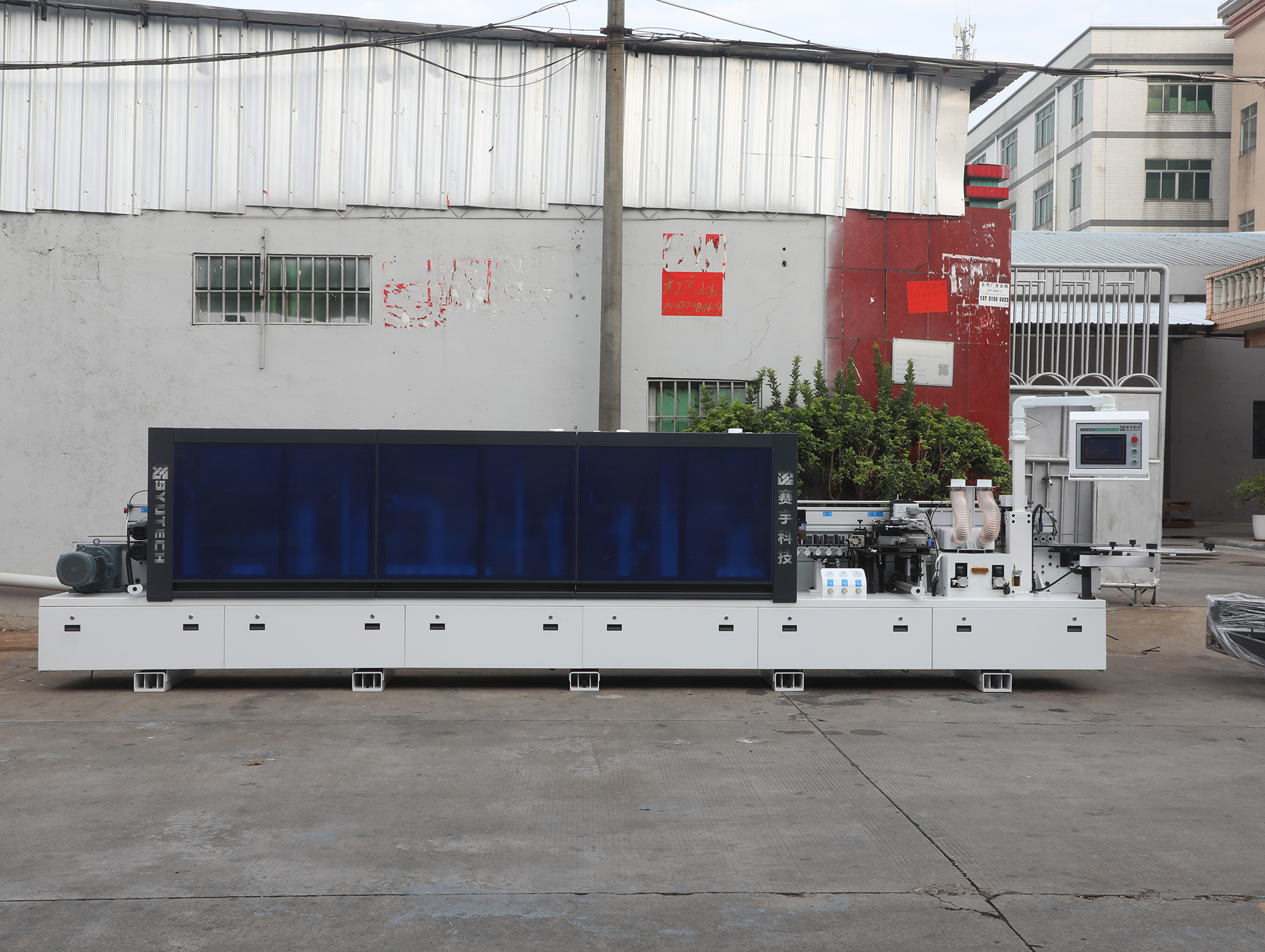
Edge banding machine build: function stations sit on top of the structure; the declared material describes what sits underneath.
The market context behind the material question
The global woodworking machinery market was valued at USD 20.3 billion in 2025 and is projected to reach USD 27.7 billion by 2033, according to Grand View Research. Europe held a 36.4% revenue share of that market in 2025, while Asia Pacific commanded the largest share of the wood processing machines market at 34.5% in 2024, led by China and India, according to Credence Research. Specifications travel across these regions constantly: China's exports of machine tools for working wood to Vietnam reached USD 311.6 million in 2024, according to UN Comtrade.
Edge banding machines are usually shortlisted on panel size range, feed speed, function stations, rated voltage and price. Material is one line item on the same sheet, and it is often the one line nobody questions. It matters because the documented working conditions for real panel furniture projects are repetitive rather than gentle: indoor normal temperature and humidity, a dust-containing wood processing environment, and continuous automatic cycle operation with manual feeding assistance. In that setting carbon steel and SS304 age differently, clean differently and imply different maintenance assumptions.
SYUTECH, the brand of Foshan Shunde SaiYu Technology Co., Ltd., a woodworking machinery manufacturer established in 2013 and based in Shunde District, Foshan City, China, declares material by model across its edge banding range: HK568 and HK868P are specified as carbon steel, while HK268GY and HK268G are specified as carbon steel / SS304. Those two declarations describe two different builds, and they support two different sets of buyer expectations.
Why a material declaration is a qualification input, not a formality
A material declaration states what a machine is constructed from. It is an input to a qualification decision rather than a certificate of quality, and it becomes useful when it is read against three questions that buyers in this category actually face: what carries the load, what has to be cleaned, and what has to be documented.
Durability. An edge banding machine runs pre-milling, end trimming, rough trimming, fine trimming, corner trimming and polishing along a common feed path. Those stations are motor-driven and continuous, and the structure absorbs the resulting vibration. Stiffness and damping are properties of the base and frame, which is why the material and section design of the main structure matter more than the finish on an individual cover.
Hygiene and cleaning. Edge banding generates adhesive residue and fine wood dust. Surfaces that are wiped regularly, particularly around the glue box, the trimming units and the feed zone, behave differently depending on whether they are coated carbon steel or stainless steel. A non-porous, cleanable stainless surface tolerates repeated wiping better than a painted surface whose coating can be scratched.
Documentation. In markets where a machine has to be shown to conform to defined standards, the physical build is part of the evidence file. Material declarations, surface treatments and component lists are simple to record at the point of purchase and difficult to reconstruct years later.
A practical checklist for the technical discussion with any edge banding machine supplier:
- Which components are carbon steel, and which are SS304?
- What surface protection is applied to the carbon steel parts, and how is that protection repaired on site?
- Which surfaces are expected to be wiped daily, and with which cleaning agents?
- What are the ambient temperature and humidity in the workshop, and is washdown used?
- Which documents are issued for the specific model and the destination market?
Where the two declarations diverge
The two phrases are not substitutes for each other. A carbon steel declaration describes a single structural material: stiff, weldable, cost-efficient, and dependent on its coating for corrosion protection. A carbon steel / SS304 declaration describes a machine built from two materials. It does not state the allocation, and it does not mean the machine is stainless.
That ambiguity produces two opposite buyer errors. The first is assuming a hybrid declaration means an all-stainless machine, then discovering that the structural parts are still coated carbon steel and that the coating is a maintenance item. The second is dismissing the hybrid declaration as a marketing phrase, when in practice stainless components facing moisture and cleaning reduce the surface maintenance burden in a dusty, normal-humidity workshop.
The opportunity is to resolve the ambiguity before ordering. Once the allocation is clarified — which guards, panels, covers or contact surfaces are stainless — the specification stops being a slogan and becomes a decision variable that can be weighed against footprint, installed power and function set.
How SYUTECH declares build material across the edge banding range
The table below restates the published SYUTECH specification for four edge banding models, including the material declaration. Where a published specification does not state a value, none is assumed here.
| Model | Type | Declared material | Overall dimensions | Installed power | Feeding / working speed | Edge band thickness |
|---|---|---|---|---|---|---|
| HK568 | Edge banding machine | Carbon steel | 7200 × 710 × 1628 mm | 25.86 kW | 16-18-22 m/min | 0.4-3 mm |
| HK868P | Automatic edge banding machine | Carbon steel | 9500 × 1000 × 1650 mm | 25 kW total | 16-22 m/min | 0.4-3 mm |
| HK268GY | Compact edge banding machine | Carbon steel / SS304 | 5360 × 730 × 1210 mm | 12.4 kW | 18-20-22 m/min | 0.35-3 mm |
| HK268G | Mini edge banding machine | Carbon steel / SS304 | 3790 × 730 × 1210 mm | 11.8 kW | 16-18-22 m/min | 0.35-3 mm |
Function set and power draw are the other half of the material question. HK568 declares an installed power of 25.86 kW and a machine weight of 2200 kg, with pre-milling at 2.2 kW × 2 units at 9000 rpm, end trimming at 0.37 kW × 2 at 12000 rpm, rough trimming at 0.75 kW × 2, fine trimming at 0.75 kW × 2 at 12000 rpm, corner trimming at 0.37 kW × 2 at 20 m/min, polishing at 0.37 kW × 2, a 1.8 kW glue box and a 4 kW conveyor belt. HK868P declares 25 kW total power with a 5.5 kW conveyor motor, pre-milling motors at 2.2 kW × 2, end trimming motors at 0.3 kW × 3, rough trimming at 0.75 kW × 2 and polishing at 0.18 kW × 4, on a 380V 50Hz supply.
Both of those machines are declared as carbon steel builds, and both are long machines — 7200 mm and 9500 mm respectively — carrying a wide function complement. The two hybrid-declared models are considerably more compact: HK268GY measures 5360 × 730 × 1210 mm and HK268G measures 3790 × 730 × 1210 mm, with installed power of 12.4 kW and 11.8 kW. HK268G and HK268GY accept edge band thickness of 0.35-3 mm while HK568 and HK868P declare 0.4-3 mm, and all four models cover an edge band width range of 10-60 mm. Panel handling limits also differ: HK268G and HK268GY declare a minimum panel width of 40 mm and a minimum panel length of 150 mm with corner trimming at 45 × 200 mm, while HK568 declares a minimum panel width of 50 mm and a minimum panel length of 135 mm with corner trimming at 50 × 300 mm.
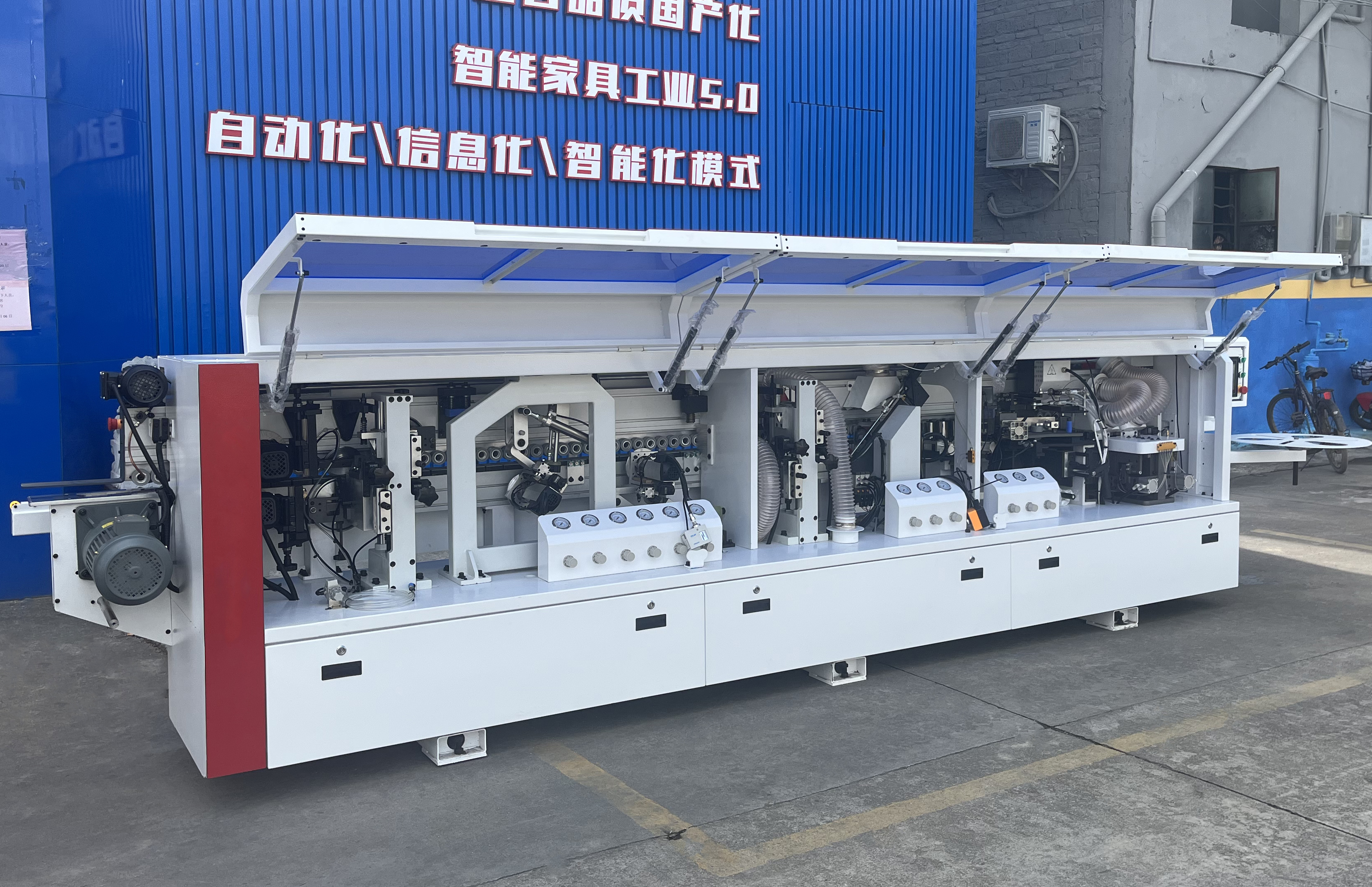
Compact edge banding machine: hybrid carbon steel / SS304 declarations appear on the smaller models in the range, where cleaning access is tighter.
Carbon steel and SS304: what each material contributes
Carbon steel is used for machine structures because it offers high stiffness per unit of cost, welds and machines predictably, and damps vibration well. Its limitation is equally structural: it has no inherent corrosion resistance, so every carbon steel surface depends on a coating, a paint system or another barrier. Any damage to that barrier — a scratch from a panel, a chip from a tool, an area missed during cleaning — becomes a corrosion initiation point in humid or dust-laden air.
SS304 is an austenitic chromium-nickel stainless steel. It resists corrosion in humid and mildly aggressive environments and presents a non-porous surface that can be wiped repeatedly without the coating-loss problem that affects painted carbon steel. Its trade-offs sit on the production side rather than the performance side: higher raw material cost, more demanding machining, and lower thermal conductivity, which makes distortion control during welding more critical. Its corrosion performance also depends on cleanliness, because iron particles transferred from carbon steel tools or neighbouring carbon steel components can create localised corrosion on a stainless surface.
For that reason, builders generally apply the two materials selectively rather than universally: carbon steel where stiffness and cost efficiency dominate, stainless steel where moisture, adhesive residue or routine wiping dominate. Where the two materials meet directly and moisture is present, the connection detail matters, because dissimilar metal contact can create a corrosion path at the joint.
| Behaviour | Carbon steel | SS304 |
|---|---|---|
| Corrosion behaviour in humid air | Depends on coating integrity; damage creates initiation points | Inherent resistance; performance depends on surface cleanliness |
| Cleanability | Coating can be scratched; touch-up needed | Non-porous; tolerant of repeated wiping |
| Stiffness and damping | High stiffness per unit of cost; effective damping | Good strength, but higher cost per unit of stiffness |
| Fabrication | Predictable welding and machining | More demanding machining; distortion control during welding |
| Typical role in an edge banding machine | Structural base and frame | Surfaces facing moisture, adhesive residue and wiping |
This comparison describes general material behaviour. It does not identify which components of any specific SYUTECH model are carbon steel or SS304, because the published specification declares material at model level. That gap is exactly what a buyer should close in writing before the order is placed.
Application fit: matching the declaration to the workshop
Documented project environments for this class of equipment in panel furniture production share several conditions. In a cabinet and cabinet door project in Romania, the machine operates indoors at normal temperature and humidity in a dust-containing wood processing environment, on a continuous automatic cycle with manual feeding assistance, supported by a vacuum cleaner, vacuum pump and air compressor, and is required to meet EU CE mechanical and low voltage safety standards with no explosion-proof requirement.
A panel furniture edge banding project in Kenya shows a closely related profile: the machine automatically applies, trims and polishes edge strips for panel furniture boards in continuous automatic cycle mode with manual feeding assistance, supported by an air compressor and a vacuum cleaner, and is likewise required to meet EU CE mechanical and low voltage safety standards without explosion-proof protection.
The practical reading is that in these environments the surfaces face dust, adhesive residue and normal-humidity air rather than aggressive washdown chemistry. What varies between workshops is how often the machine is wiped and how close that wiping happens to the glue box and trimming stations. Where cleaning is routine and surfaces are wiped daily, stainless-facing components carry that load more gracefully. Where the structural base carries the main demand, carbon steel delivers stiffness at a lower material cost. Neither choice is universally correct, and the floor area available usually decides the model class before the material declaration does.
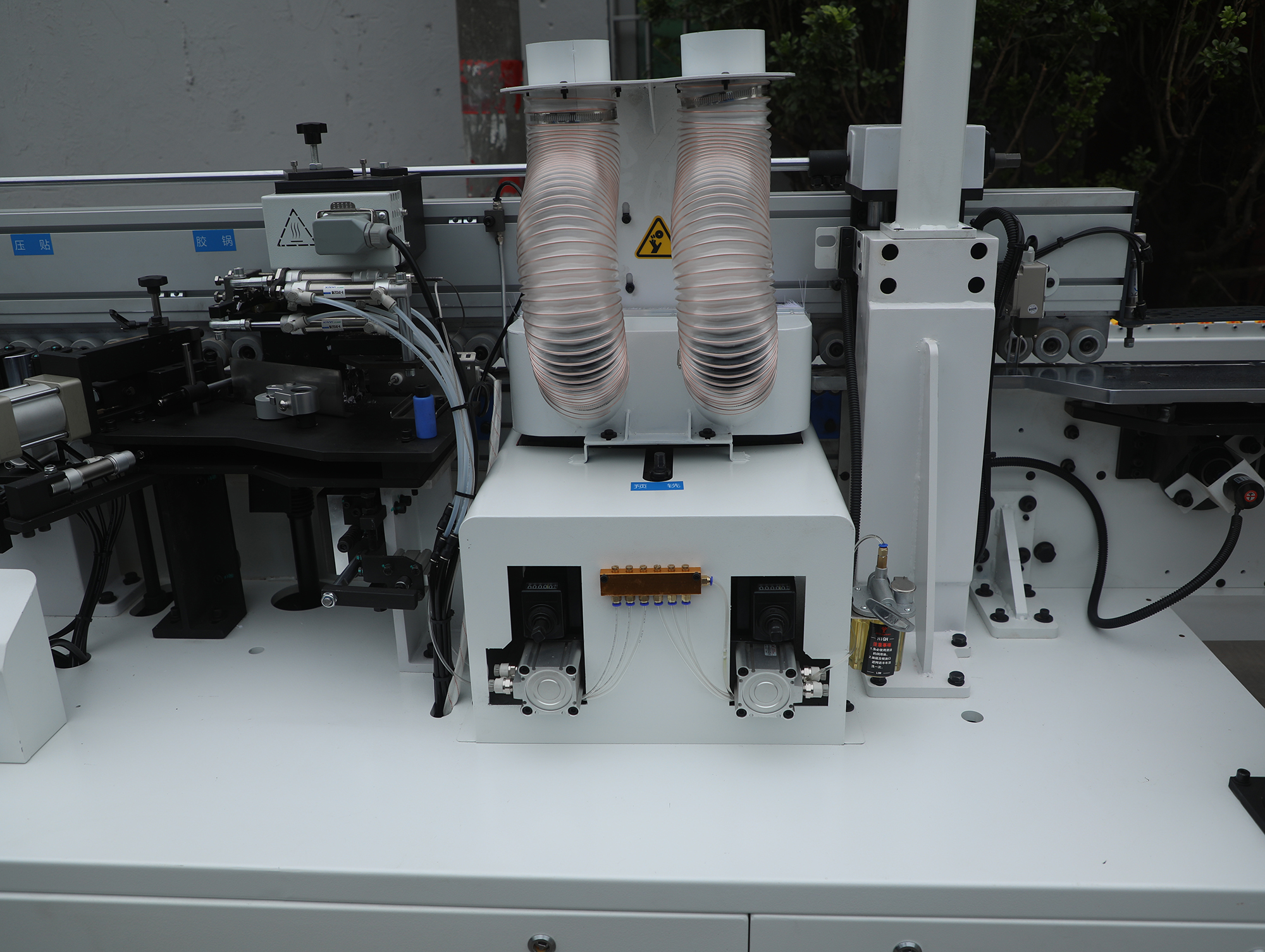
Pre-milling and trimming stations are where adhesive residue and dust accumulate fastest, which is where surface material and cleaning practice meet.
Market and compliance signals that raise the bar for build documentation
Compliance requirements for edge banding equipment are set at machine level. In the European market, edge banding machines fed by chain(s) must comply with the EN 1218-4 safety standard, as published by HSE and British Standards. Low voltage safety requirements apply to the electrical design independently. Material choice sits inside that framework as one item among many: a stainless panel does not make a machine compliant, and a carbon steel frame does not make it non-compliant.
Market data suggests the pressure to document machine characteristics is increasing rather than easing. The woodworking machinery market is projected to grow from USD 20.3 billion in 2025 to USD 27.7 billion by 2033 (Grand View Research); Europe retains the largest revenue concentration at 36.4% in 2025; Asia Pacific already accounts for 34.5% of the wood processing machines market in 2024 (Credence Research); and the woodworking CNC router segment alone was valued at USD 185.3 million in 2024 (Grand View Research). Larger and more specialised equipment segments mean more formal supplier evaluation, and more requests for component-level descriptions instead of a single-line material entry.
For buyers, the actionable conclusion is procedural: request the model-level material declaration in writing, ask which components the stainless declaration covers, and file both alongside the conformity documentation for the destination market. That takes minutes at purchase and is difficult to reconstruct later. Published specifications for the SYUTECH range declare material at model level; they do not include a per-model certificate, so no certification should be assumed for a quoted machine unless the supplier issues it for that machine and market.
Traditional builds and hybrid builds: strengths and boundaries
The traditional approach in this category is a single-material carbon steel structure with a painted or coated finish and metal covers. It remains the most common configuration for good reasons: fabrication is straightforward, the structure is stiff and repairable, local welding and repair are practical, and initial material cost is lower than a stainless-intensive alternative. Its boundary is maintenance. The coating is a consumable in a dusty environment — it can be abraded by panels and tools, attacked by some cleaning agents, and it conceals corrosion until damage becomes visible. Machines in humid workshops with infrequent cleaning tend to reach that boundary sooner.
The hybrid carbon steel / SS304 build declared for SYUTECH HK268GY and HK268G addresses that boundary selectively. Stainless-facing components can be used where moisture and cleaning concentrate, without converting the entire structure, which keeps material cost and weight within the range expected of a compact machine running 11.8 kW and 12.4 kW respectively. The limits are equally specific and worth stating plainly:
- The declaration is at model level. The split between carbon steel and SS304 components is not published in the specification and must be confirmed with the supplier for the exact machine being quoted.
- Hybrid builds create dissimilar-metal joints. Where carbon steel and stainless steel are in direct contact and moisture is present, the joint detail matters for long-term corrosion behaviour.
- Stainless surfaces do not add structural stiffness. Rigidity comes from the carbon steel structure, so a hybrid material declaration does not turn a compact machine into a heavy-duty line machine.
- Material selection is not a compliance shortcut. EN 1218-4 conformity and low voltage safety relate to the complete machine — guarding, controls, drives and electrical design — not to the frame material.
Future outlook
Three developments are likely to shape how material declarations are read over the coming years. First, as automated edge banding capacity expands across Europe and Asia Pacific, buyers increasingly compare machines on documented build detail rather than appearance, because the same model may be deployed in very different workshop climates. Second, the concentration of woodworking machinery manufacturing in Asia Pacific and the scale of cross-border equipment trade make component-level documentation a routine part of the purchase file rather than an exception. Third, humid and dust-heavy production environments will keep the maintenance cost of coated carbon steel visible, which is likely to sustain interest in selective stainless steel construction on cleaning-facing components.
SYUTECH's position in that landscape is defined by its manufacturing base rather than by material claims. Foshan Shunde SaiYu Technology Co., Ltd. was established in 2013 as Foshan Shunde Leliu Huake Long Precision Machinery Factory, is located in Shunde District, Foshan City — known as the hometown of woodworking machinery in China — and operates a 10,000 m² facility with approximately 100 staff, an annual production capacity of 500 units and an R&D team of 2 engineers. The range extends beyond edge banding machines to CNC nesting machines, six side CNC drilling machines, computer panel saws and complete production line configurations for panel furniture. For buyers evaluating material declarations, the useful question is not which material sounds better, but which declared build matches the cleaning regime, humidity and documentation requirements of the specific project.
FAQ
What does carbon steel / SS304 mean on an edge banding machine specification?
It means the model is built from two materials rather than one: carbon steel and SS304 stainless steel. SYUTECH declares this combination on its compact edge banding machine HK268GY and mini edge banding machine HK268G, while HK568 and HK868P are declared as carbon steel. The declaration identifies the materials used in the build. It does not state which individual components are made from each material, so that allocation should be confirmed with the supplier for the model being quoted.
Does a hybrid carbon steel / SS304 declaration mean the machine is fully stainless steel?
No. The declaration lists two materials, and the published specification does not state a component-level split. A machine described as carbon steel / SS304 combines both, and the carbon steel parts still depend on their surface protection. A buyer who needs an all-stainless machine should specify that requirement explicitly and ask for written confirmation of the components it applies to.
Which SYUTECH edge banding models are declared as carbon steel, and which as carbon steel / SS304?
Per the published specification, HK568 — a 7200 × 710 × 1628 mm edge banding machine with 25.86 kW installed power and a machine weight of 2200 kg — and HK868P — a 9500 × 1000 × 1650 mm automatic edge banding machine with 25 kW total power, a 5.5 kW conveyor motor and a net weight of 4 T — are declared as carbon steel. HK268GY (5360 × 730 × 1210 mm, 12.4 kW, feeding speed 18-20-22 m/min) and HK268G (3790 × 730 × 1210 mm, 11.8 kW, feeding speed 16-18-22 m/min) are declared as carbon steel / SS304.
Does material choice determine whether an edge banding machine meets EU requirements?
No. In the European market, edge banding machines fed by chain(s) must comply with the EN 1218-4 safety standard, and low voltage safety requirements apply to the electrical design. Conformity is assessed on the complete machine — guarding, controls, drives and electrical systems — not on the frame material. Material selection contributes to durability, cleanability and maintenance planning, and it belongs alongside conformity evidence rather than in place of it.
Which workshop conditions make SS304 surfaces more relevant?
Conditions in which surfaces are wiped frequently and moisture or adhesive residue accumulates. Documented project environments for this equipment include indoor normal temperature and humidity with a dust-containing wood processing environment, continuous automatic cycle operation with manual feeding assistance, and supporting equipment such as a vacuum cleaner, vacuum pump and air compressor — for example in cabinet and cabinet door production in Romania and in panel furniture edge banding in Kenya. Where cleaning is routine rather than aggressive washdown, stainless-facing components reduce the surface maintenance burden; where structural demands dominate, carbon steel remains the cost-efficient choice.
How do the compact hybrid-declared models differ from the larger carbon steel models in practical terms?
Mainly in footprint, power and function set. HK268G measures 3790 × 730 × 1210 mm with 11.8 kW installed power and a feeding speed of 16-18-22 m/min; HK268GY measures 5360 × 730 × 1210 mm with 12.4 kW and a feeding speed of 18-20-22 m/min; both accept edge band thickness of 0.35-3 mm with a minimum panel width of 40 mm and a minimum panel length of 150 mm. HK568 measures 7200 × 710 × 1628 mm with 25.86 kW, a machine weight of 2200 kg, a feeding speed of 16-18-22 m/min and a full pre-milling to polishing station set, with a minimum panel width of 50 mm and a minimum panel length of 135 mm. HK868P measures 9500 × 1000 × 1650 mm with 25 kW total power and a net weight of 4 T. Workshops with limited floor space and moderate throughput, and workshops running a wider function set, therefore tend to evaluate different models.
The SYUTECH factory promotional brochure, covering the edge banding, CNC nesting, drilling and panel saw range, is available for reference: Factory promotional paper (PDF).