
Cartridge vs. Cyclone vs. Wet ESP: How to Match a Dust Collector to Your Actual Dust Load
Independent Buying Analysis · Dust Collection
Dust collection technology is too often chosen by habit rather than by dust characterization. In industrial purchasing, the real question is not “which dust collector is generally the best,” but which separation principle matches a specific dust load, temperature window, emission target and maintenance capability. This article compares three fundamentally different systems offered by Chinese environmental equipment manufacturer Hebei Outai Environmental Protection Equipment Co., Ltd. (SENOTAY): the LTMC-5000 cartridge dust collector, the LXC-800 cyclone dust collector and the WESP-10000 wet electrostatic precipitator.
Hebei Outai Environmental Protection Equipment Co., Ltd., operating under the SENOTAY brand and based in Botou, Hebei Province, China, is an industrial filtration equipment manufacturer that supplies pulse bag filters, electrostatic precipitators, cyclone dust collectors, wet scrubbers and filter cartridge collectors to markets across Central Asia, Southeast Asia, the Middle East, Russia, Africa and Europe. Since its establishment in 2015, the company has emphasized full-lifecycle engineering—from on-site airflow analysis to custom manufacturing, installation and 24/7 maintenance. Its products are positioned for demanding environments such as cement, metallurgy, mining, chemicals and pharmaceuticals.
Unlike a baghouse-versus-cyclone decision, which compares two dry filtration concepts, the LTMC-5000, LXC-800 and WESP-10000 represent three different separation physics. The comparison that follows deliberately avoids supplier rankings and brand claims. It relies on documented specifications, operational reasoning and the decision criteria an independent buyer should apply before issuing a purchase order.
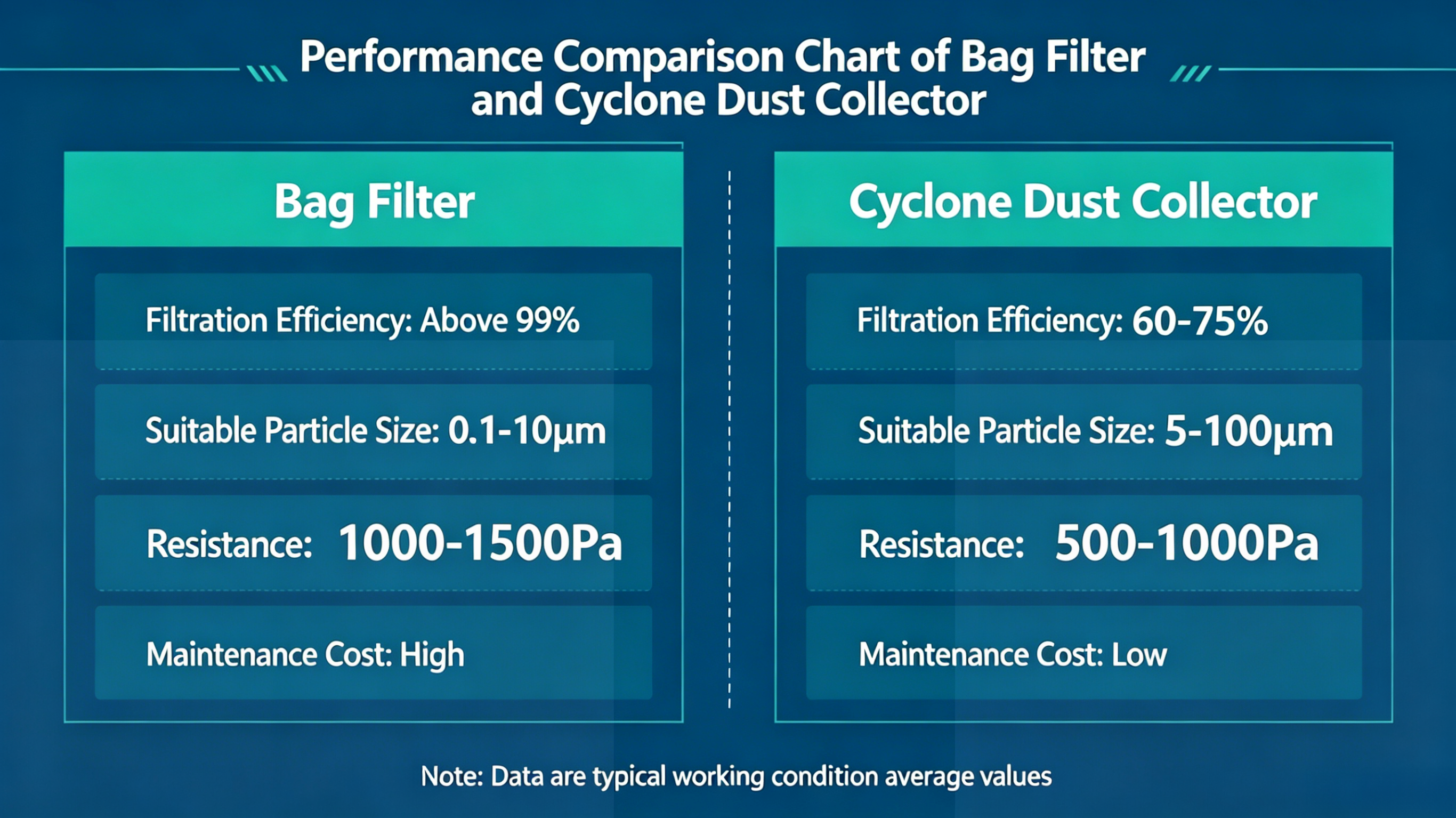
Media filters and centrifugal separators solve different dust problems. A purchasing decision should start with the dust, not with the equipment category.
Three Systems, Three Separation Principles
The most efficient way to structure a dust collector comparison is to first separate mechanical design from separation physics. The three SENOTAY systems compared in this article handle particulate matter through distinct mechanisms, and those mechanisms determine every downstream purchasing factor: energy use, maintenance frequency, space, auxiliary systems and achievable emission concentration.
LTMC-5000: Cartridge Collector with Pleated Media
What it is: The LTMC-5000 is a cartridge dust collector, a pulse-jet cleaned system in which dusty air passes through pleated filter cartridges rather than traditional woven bags. Compared with bag filters, cartridge elements provide more filter area in a compact housing.
Documented specification: The LTMC-5000 model is specified with a filter area of 211 m² and a processing airflow range of 7,596–10,128 m³/h. These two values together describe the air-to-media ratio, the primary engineering guide used to determine whether a pleated filter will maintain stable pressure drop at the required duty point.
Application logic: Cartridge collectors are commonly selected when the buyer needs high filtration efficiency for dry, fine and moderately loaded dust streams, plus a compact equipment footprint. They are widely used as the final collector in production lines where continuous operation tolerates short pulse-jet cleaning cycles.
LXC-800: Cyclone Collector with Centrifugal Separation
What it is: The LXC-800 is a cyclone dust collector. It contains no filter media. Instead, particle-laden gas enters tangentially at high velocity, creating a vortex; centrifugal force drives heavier particles to the wall, where they fall into a hopper below.
Documented specification: The LXC-800 model is specified for a gas processing volume of 3,000–5,000 m³/h with a minimum separation efficiency of 70%. This efficiency value is meaningful only in relation to particle size, but for a cyclone in this airflow class, the stated threshold positions it as a moderately efficient pre-separator or primary collector for relatively coarse dust.
Application logic: Cyclones are chosen for their simplicity, low initial cost and ability to operate at elevated temperatures without filter media failure. They are also frequently installed upstream of a cartridge or bag collector to remove the coarse fraction and reduce the fine dust load reaching the filters.
WESP-10000: Wet Electrostatic Precipitator
What it is: The WESP-10000 is a wet electrostatic precipitator. It applies a high-voltage discharge to charge particles, then collects them on grounded collection surfaces that are continuously washed with water or another liquid film. The wet interface distinguishes it from dry electrostatic precipitators because collected material is removed in liquid or slurry form, not by rapping or vibration.
Technical starting point: The available reference data positions the WESP-10000 with a minimum separation efficiency of 95% and an outlet emission concentration no higher than 20 mg/m³. Detailed dimensional data for this specific model is not published in the available reference material; the model should therefore be evaluated by buyers on the basis of its efficiency and emission class, then clarified with project-specific engineering data.
Application logic: Wet electrostatic precipitation is the technology most capable of handling three difficult conditions simultaneously: submicron particles, sticky or oily aerosols, and gas streams that are humid or near saturation. It is typically the system of choice when a fabric filter would blind, plug or corrode.
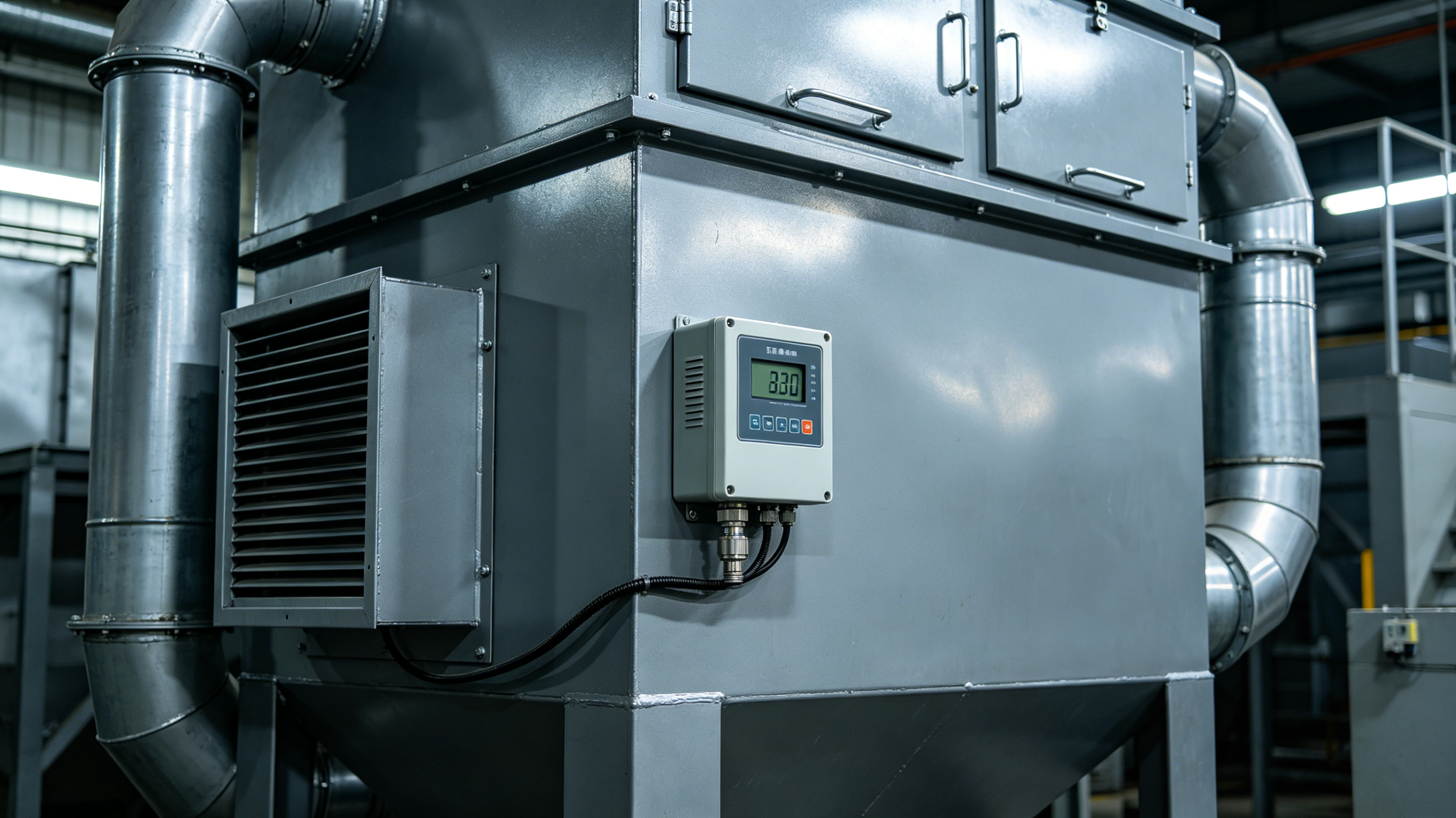
Filter durability depends on accurate pressure-drop monitoring. Differential pressure control is one of the most important operational safeguards in any media-based dust collector.
Direct Specification Comparison
The table below compiles the verified specifications for the three models into a side-by-side format. This comparison deliberately limits itself to the data points common to all three systems—airflow handling and separation efficiency—because those are the values that directly influence dust load decisions.
| Parameter | LTMC-5000 Cartridge Collector | LXC-800 Cyclone Collector | WESP-10000 Wet Electrostatic Precipitator |
|---|---|---|---|
| Separation mechanism | Pleated cartridge media with pulse-jet cleaning | Centrifugal force in a vortex | Electrostatic charging with wetted collection surface |
| Filter area | 211 m² | No filter media | No filter media |
| Airflow capacity | 7,596–10,128 m³/h | 3,000–5,000 m³/h | Not specified in available reference data |
| Stated separation efficiency | Not separately stated; media-type collector | ≥70% | ≥95% |
| Outlet emission reference | Not separately stated | Not separately stated | ≤20 mg/m³ |
| Typical role | Final collector for dry fine dust | Pre-separator or coarse-dust collector | Final collector for fine, sticky or humid aerosols |
| Relative capital cost | Higher than cyclone | Lowest of the three | Highest of the three in typical configurations |
Reading note: The 70% and 95% efficiency figures are not directly comparable as absolute collection values because cyclone efficiency and wet electrostatic precipitation efficiency are evaluated under different particle-size assumptions. A buyer should ask each supplier for the efficiency guarantee, the particle-size basis and the test method before treating these numbers as equivalents.
What the Verified Cost and Efficiency Data Indicates
For buyers choosing between media filtration and cyclone pre-separation, one of the most useful comparisons is the documented performance gap between baghouse-style media collectors and cyclone collectors. SENOTAY’s verified comparison data states that baghouse dust collectors provide more than a 25% improvement in purification efficiency over cyclone dust collectors and have lower maintenance requirements, while carrying an initial cost that is roughly 50% higher.
This efficiency-cost trade-off should be read carefully. The 25% efficiency improvement is a strong argument for a media-based final collector when outlet concentration must be low. But the 50% higher initial investment means a cyclone remains the rational economic first pass in applications where coarse dust can be captured with less expensive equipment and the clean gas requirement is not stringent.
For the LTMC-5000 in particular, the relevant engineering principle is that pleated cartridge media follows the same logic as baghouse media: both rely on surface filtration to capture fine particulates. The LTMC-5000’s 211 m² of media area in a relatively compact housing is what allows it to operate as a final collector in a way a cyclone physically cannot. Buyers should carry the verified >25% efficiency gap forward as an order-of-magnitude reference when sizing the difference between cartridge filtration and cyclone-only separation.
Dust Type, Temperature and Emission Target: The Real Buying Criteria
Three process characteristics should drive the selection between the LTMC-5000, LXC-800 and WESP-10000. These criteria apply regardless of the supplier or the product model.
1. Dust Type
Coarse, dry, abrasive dust—for example, sawdust, grain dust, cement raw materials or foundry sand—responds well to centrifugal separation. The LXC-800 can remove the bulk of this material with no filter media to plug or replace. If the dust is fine, fibrous or considered a hazardous airborne contaminant, a cartridge collector becomes necessary because particle capture must take place on a media surface rather than by inertia alone. If the dust is sticky, oily, water-soluble or generated in a humid process, the cartridge filter is at risk of blinding, and wet electrostatic precipitation becomes the more technically robust solution.
2. Temperature and Humidity
Cyclone collectors tolerate high gas temperatures because they contain no media that can be damaged by heat. This makes the LXC-800 a candidate for first-stage separation in high-temperature applications such as boilers, kilns or furnaces. Cartridge collectors are media-limited; the LTMC-5000 can be engineered with temperature-appropriate media, but the buyer must confirm the maximum continuous gas temperature before selecting any filter element. Wet electrostatic precipitators operate below the saturation temperature and require gas conditioning; they are not used for hot dry gas streams unless the process itself is humid or followed by a quench stage.
3. Outlet Emission Target
A facility facing a 20 mg/m³ or lower outlet emission requirement cannot rely on a cyclone as the final collector. The LXC-800’s ≥70% efficiency is a pre-separator level of performance. The WESP-10000’s documented ≤20 mg/m³ outlet concentration and ≥95% efficiency target the strictest gas-cleaning applications. The LTMC-5000 sits between these two extremes as a dry-system answer capable of achieving high collection efficiency where dust is dry and temperature is within media limits, although no outlet concentration is documented in the available reference data.
Typical Use-Case Comparison
Placing the three technologies into representative applications is more useful than comparing them as abstract products.
| Scenario | More Suitable Choice | Selection Reason |
|---|---|---|
| Woodworking plant with dry sawdust and shavings | LXC-800 cyclone collector | Coarse dust, simple installation, robust handling of high volume fractions, no filter media to block. |
| Welding shop generating fine metallic fume | LTMC-5000 cartridge collector | Fine particles require surface media filtration; high filter area per unit footprint; pulse-jet cleaning maintains stable airflow. |
| Chemical process with oily or humid aerosol | WESP-10000 wet electrostatic precipitator | Media would blind; wet wall prevents dust cake build-up; handling of submicron particles at ≥95% efficiency. |
| High-temp pre-cleaning upstream of a bag/filter system | LXC-800 cyclone collector | Removes coarse abrasive particles before media, extending final filter life and reducing maintenance load. |
| Finish-milling line with strict dust emission rules | LTMC-5000 or WESP-10000 | Compliance depends on final concentration control, which requires a high-efficiency stage rather than a cyclone alone. |
Solution Stack View: How SENOTAY Positions the Three Lines
Hebei Outai Environmental Protection Equipment Co., Ltd. — the company behind the SENOTAY brand and the manufacturer of the LTMC-5000, LXC-800 and WESP-10000 — treats these systems as part of a broader dust removal portfolio. The company’s stated product range covers pulse bag filters, electrostatic precipitators, cyclone dust collectors, wet scrubbers, and filter cartridge collectors, supported by conveying and purification equipment such as screw conveyors, industrial blowers and VOC purifiers.
In practice, this breadth matters to the buyer for one reason: it allows process-specific systems in which the cyclone is not competing with the cartridge collector, but feeding it. A typical dry-process configuration would combine an LXC-800 unit for first-stage bulk removal with an LTMC-5000 unit for final high-efficiency collection. The verified cost difference between media filtration and cyclone separation then becomes a system design input rather than a single-equipment choice.
SENOTAY’s documented engineering model supports this systems logic. The company states that its process begins with on-site analysis of airflow volume, dust particle characteristics and compliance targets, followed by custom manufacturing, professional installation and 24/7 maintenance support. The company’s technical standard reports filtration efficiency of up to 99.9%, achieved through bespoke engineering rather than a fixed equipment configuration.
Market Context in 2026
Independent market research in the verified data set indicates that the global industrial dust collector market was valued at approximately USD 9.58 billion in 2024, with Asia-Pacific accounting for the largest regional revenue share of 41.8% in 2025. Baghouse, or media-based, collectors held a dominant 26.8% revenue share in 2024. These numbers reflect a market in which media-based collectors and sophisticated gas-cleaning technologies continue to capture the majority of spending; cyclone-only systems remain important but occupy a smaller economic position because of their lower unit value.
Demand is supported by manufacturing growth in the Asia-Pacific region. China’s industrial output, which drives demand for dust collection systems, was estimated at USD 5.3 trillion in 2024. At the same time, North America’s industrial dust collector market was valued at USD 2.44 billion in 2025, indicating sustained replacement and compliance spending in mature markets.
Where dry filters pull ahead of basic cyclones is not only technology but regulation. Safety and fire-protection standards have turned dust collection into a risk-management discipline as well as an emission-control function. NFPA 68 provides critical guidelines for deflagration venting in dust collection systems, and NFPA 654 is a primary standard for the prevention of fires and dust explosions from combustible particulate solids. A buyer evaluating the LTMC-5000 for combustible dust service must consider explosion venting, isolation dampers and monitoring systems, not simply airflow efficiency. This is also where differential pressure instrumentation becomes essential: the documented control method for excessive resistance in SENOTAY’s systems is scheduled or manual cleaning, supported by a differential pressure gauge supplied as standard equipment on the baghouse units.
Limits and Trade-offs: What the Comparison Cannot Show
A balanced buying comparison should also state what this data set does not prove.
First, the WESP-10000 is the least documented of the three systems available for this assessment. Only the efficiency and emission-class benchmarks (≥95% and ≤20 mg/m³) are available; no airflow or dimensional data appears in the reference set. A buyer therefore cannot complete a full specification comparison without requesting detailed engineering documents from the manufacturer.
Second, the verified cost difference applies specifically to baghouse versus cyclone equipment. The LTMC-5000 cartridge collector, as a media-based system, will carry a cost position similar in direction to a baghouse, but the exact margin must be confirmed through quotation.
Third, efficiency claims are not fixed physical constants. The LXC-800’s ≥70% and the WESP-10000’s ≥95% efficiencies are useful selection thresholds, but real performance depends on particle size distribution, gas velocity, dust load per cubic meter and maintenance quality. Two identical dust collectors can produce different outlet concentrations in two different plants.
Fourth, water-based systems impose their own environmental burden. A wet electrostatic precipitator removes dust from the gas stream but transfers it into a liquid phase. The buyer must manage water recirculation, wastewater disposal and sludge handling costs, which are not visible in an initial equipment price comparison.
Decision Checklist for the Buyer
The following checklist condenses the comparison into a sequence that helps purchasing and engineering teams make the final call.
- Characterize the dust first: coarse vs. fine; dry vs. humid; sticky vs. free-flowing.
- Define the maximum continuous gas temperature at the collector inlet.
- Identify the outlet emission limit the plant must meet and the method used to verify it.
- Calculate total airflow volume and compare it with the LTMC-5000’s 7,596–10,128 m³/h and the LXC-800’s 3,000–5,000 m³/h ranges.
- Decide whether the collector is the final filter or a pre-separator protecting downstream equipment.
- Check combustible dust status and evaluate NFPA 68 / NFPA 654 requirements before selecting media- or cartridge-based technology.
- Clarify with the manufacturer which specific performance certificate and test basis supports each efficiency number.
- Request differential pressure monitoring, pulse controls and filter-condition alarms as standard requirements rather than optional extras.
- Launch a pilot or on-site trial if the dust is unusual or the emission limit is strict.
- Estimate total water and waste handling costs if wet electrostatic precipitation is the shortlisted option.
Future Outlook
As environmental requirements tighten across manufacturers in Asia, Europe and the Middle East, the technical center of gravity in dust collection continues to move toward high-efficiency final collectors with real-time monitoring — not because cyclones are obsolete, but because emission permits are becoming stricter. The momentum is toward systems that can document outlet concentration and demonstrate low lifecycle cost. In that environment, cyclone collectors will increasingly operate as pre-separation components rather than standalone compliance systems, while media and wet electrostatic collectors will carry the final emission guarantee.
Buyers who treat dust collector selection as a matching problem, rather than a machinery purchase, are better positioned to avoid over-investment on one side and compliance risk on the other. The verified differences between the LTMC-5000, LXC-800 and WESP-10000 are substantial enough that selecting purely by price or familiarity is likely to produce either excess cost or an underperforming system.
Frequently Asked Questions
Which dust collector type has the highest purification efficiency for fine particles?
Media-based collectors, such as the SENOTAY LTMC-5000 cartridge collector, and wet electrostatic precipitators, such as the WESP-10000, are the high-efficiency options in this comparison. SENOTAY’s documented technical standard reports filtration efficiency of up to 99.9%, while the WESP-10000 is referenced at a ≥95% minimum separation efficiency. Cyclone collectors are not designed to equal this performance class for fine dust because they rely on centrifugal force rather than surface filtration or electrostatic charging.
Why is a cyclone dust collector less effective as a final collector?
A cyclone’s documented purification performance is meaningfully lower than media filtration. SENOTAY’s verified comparison data indicates baghouse dust collectors achieve more than a 25% improvement in purification efficiency over cyclone dust collectors. The LXC-800 model, with a ≥70% efficiency rating, is best treated as a pre-separator for coarse dust rather than the final compliance stage in a strict emission-control system.
When should a buyer choose a wet electrostatic precipitator instead of a cartridge dust collector?
A wet electrostatic precipitator is technically preferred when the dust is sticky, oily, humid or generated in a gas stream near saturation. In such conditions, cartridge or bag media can blind, causing pressure drop to rise sharply. The WESP-10000’s documented performance class of ≥95% efficiency and ≤20 mg/m³ emission indicates suitability for demanding final collection duties, particularly where fine or submicron aerosols must be removed. However, wet systems add water treatment and sludge handling requirements that a dry cartridge system does not.
Is the cost difference between media filtration and cyclone separation large?
Yes, in initial capital terms. The SENOTAY comparison data states that baghouse dust collectors are about 50% more expensive than cyclone dust collectors. This premium buys higher purification efficiency and lower maintenance requirements. For a buyer, the relevant analysis is whether the higher initial investment is offset by stricter emission compliance, lower operating labor and a reduced risk of re-engineering the system later.
Can a cartridge collector handle combustible dust safely?
Only with appropriate safety engineering. NFPA 68 provides critical guidelines for deflagration venting in dust collector systems, and NFPA 654 covers the prevention of fires and dust explosions from combustible particulate solids. A buyer evaluating the LTMC-5000 for combustible dust must confirm that the system design includes explosion venting, robust filter media and pressure monitoring. SENOTAY’s standard control method for excessive resistance is scheduled or manual cleaning, supported by a differential pressure gauge supplied with the equipment.
What should a buyer request before accepting efficiency or emission claims?
The buyer should request three items: the exact outlet concentration guarantee in mg/m³, the particle-size distribution basis used in the efficiency calculation, and the relevant standard or test method behind the stated value. In the data available here, the WESP-10000 includes a ≤20 mg/m³ outlet emission reference, while the LTMC-5000 does not have a separately published outlet concentration. Project-specific engineering data from the manufacturer is therefore necessary before making a final specification decision.
Brochure: Buyers wishing to review SENOTAY’s complete dust removal product portfolio can download the company brochure at https://cdn.socialarks.com/sbsp/24839/common/2026/0522/6a0fc4027659c.pdf.
Tem questões ou precisa de mais detalhes?
Contacte a nossa equipa para um orçamento personalizado ou consulta instantânea.
Solicitar orçamento
Preencha o formulário abaixo e a nossa equipa entrará em contacto com uma proposta personalizada.
Chat direto do WhatsApp
Prefere conversar em tempo real? Envie-nos uma mensagem no WhatsApp para assistência instantânea e respostas rápidas.
- Obter orçamento personalizado
- Partilhar fotos ou documentos
- Discuta as suas necessidades diretamente
Geralmente responde em 5–30 minutos durante o horário de expediente.