
Case Packer Scenario Fit: CP-T60 Top Load vs CP-S50 Side Load by Industry
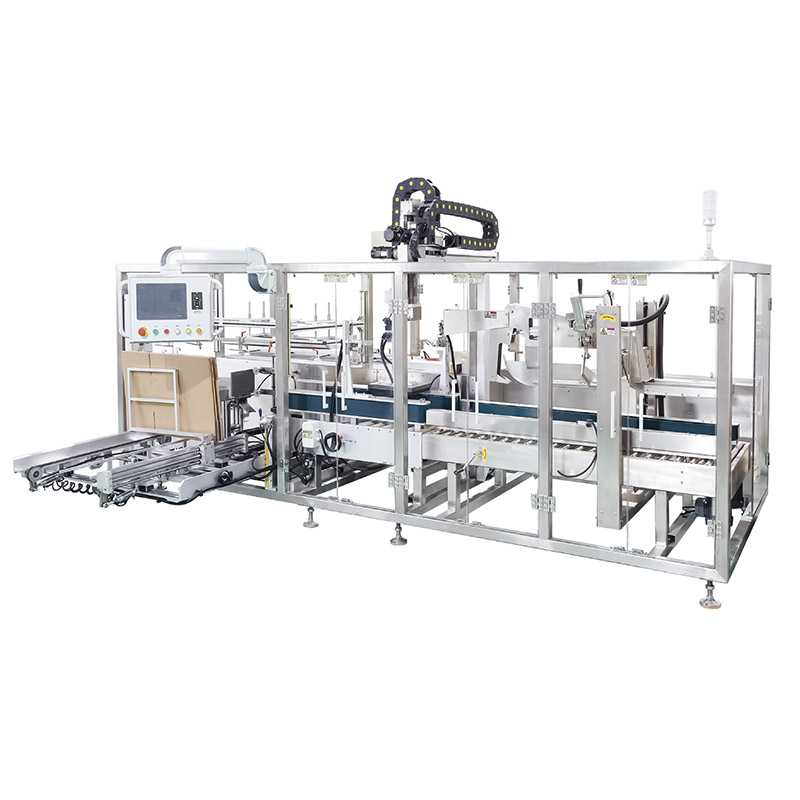
Case packing is usually discussed as a throughput question - how many cartons per minute, how many operators replaced, how many shifts covered. In practice, the variable that determines whether an end-of-line runs smoothly for a decade is more physical: how does the product actually enter the case?
Two automatic case packers from Wenzhou Wimach Machinery Co., Ltd. - the CP-T60 top load pick-and-place case packer and the CP-S50 side push side load case packer - sit on opposite sides of that question. Both are CE-compliant, both are built for continuous production, and both list the same broad applicable-industry envelope on paper. They are not interchangeable. What separates them is loading architecture, and that architecture decides which primary formats, carton sizes and line speeds actually fit.
This article compares the two by scenario, using four WIMACH reference installations in the United States, Mexico and Poland as evidence, and maps the fit across tissue, pharmaceutical and food and beverage lines.
Why Loading Orientation Decides More Than Headline Speed
A case packer groups primary packs and places them into a shipper. The two mainstream mechanical approaches are:
- Top load (pick-and-place): the case is formed and held with its opening facing up; a servo pick head lifts the product group and lowers it vertically into the case.
- Side load (side push): the case is formed and held on its side; a pusher transfers the product group horizontally into the open side of the case.
On a spec sheet both look similar. On the line, they diverge quickly:
- A top load machine is gentler on products that cannot tolerate horizontal sliding friction - wrapped rolls, canisters, boxed tissue, filled containers.
- A side load machine is faster on regular, stable primary packs that can be pushed as a block - cartons, boxes, rigid trays.
That difference, not the maximum cases-per-minute figure, is what actually determines scenario fit.
CP-T60: Pick-and-Place Top Load Case Packer
The CP-T60 is an automatic top load case packer built on a pick-and-place mechanism.
CP-T60 core specifications (WIMACH manufacturer data):
- Packing capacity: 1-8 cartons/min
- Carton dimensions: 300-600 (L) x 200-400 (W) x 150-400 (H) mm
- Power: 380V 50/60Hz 3 phase, 7.5 kW
- Air pressure: 0.5-0.8 MPa; air consumption 450 L/min
- Machine dimensions: 4200 (L) x 2600 (W) x 2200 (H) mm
- Weight: 1600 kg
- Construction: stainless steel or carbon steel
The applicable-industry list covers tissue, food and beverage, pharmaceutical, daily chemical and cosmetic, hardware, and auto parts and machinery. That breadth reflects what the architecture can accommodate - not that every one of those industries uses it in the same way.
What the top load design does well:
- Vertical insertion avoids sliding the product across the case edge.
- Rolled tissue, canisters and filled cartons keep their orientation through the drop.
- Fragile or low-friction product groups stay aligned without tooling gymnastics.
What it limits:
- Capacity sits at 1-8 cartons/min - a mid-range speed, not a high-speed ceiling.
- The carton size envelope is narrower than the CP-S50's lower bound, so very small shippers move out of spec.
- The footprint is larger, partly because of the pick head travel - a real constraint in already-tight end-of-line layouts.
CP-S50: Side Push Side Load Case Packer
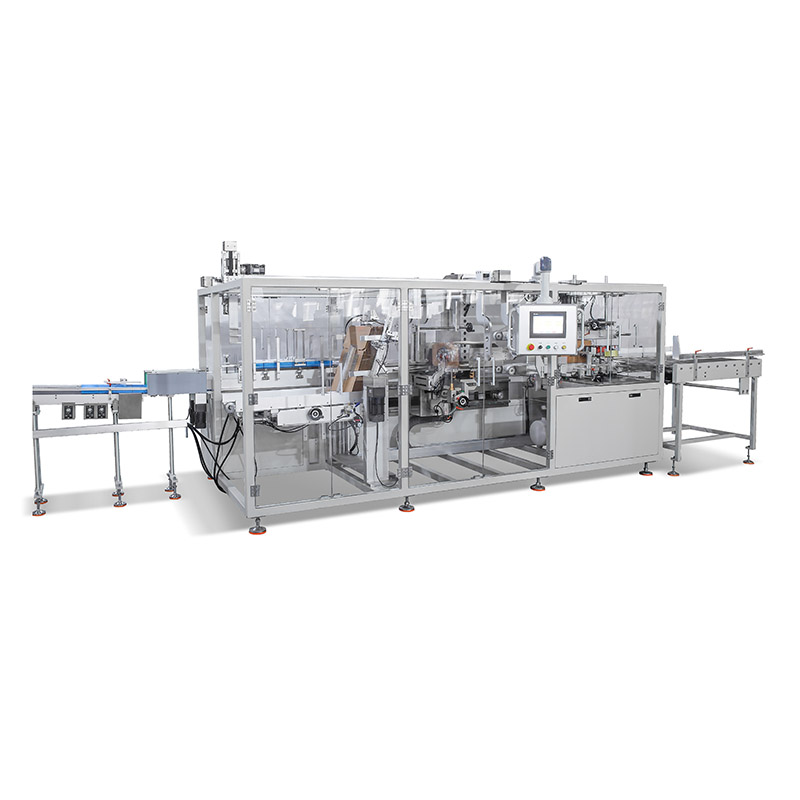
The CP-S50 is an automatic side load case packer using a side push mechanism.
CP-S50 core specifications (WIMACH manufacturer data):
- Packing capacity: 1-16 cartons/min
- Carton dimensions: 240-500 (L) x 200-400 (W) x 180-400 (H) mm
- Power: 380V 50/60Hz 3 phase, 4.5 kW
- Air pressure: 0.5-0.8 MPa; air consumption 350 L/min
- Machine dimensions: 4200 (L) x 2300 (W) x 1900 (H) mm
- Weight: 1500 kg
- Construction: stainless steel or carbon steel
In practical terms, the CP-S50 handles cartons from 240 x 200 x 180 mm up to 500 x 400 x 400 mm - a wider band at the small end than the CP-T60. Its primary-format coverage is also broader, positioned across cartons, boxes, bottles, cans and bags, because the side push design does not require vertical insertion clearance above the case.
What the side load design does well:
- Up to 16 cartons/min - roughly double the CP-T60's ceiling.
- Wider carton range at the lower end (240 mm vs 300 mm in length).
- Smaller footprint and lower power draw (4.5 kW vs 7.5 kW).
What it limits:
- Horizontal pushing has to be compatible with the product's friction behaviour; unstable cylinders or fully flexible bags may need pre-stacking.
- The side opening position may not match every case format without tooling change.
Four Real Installations: What the Scenario Data Shows
The most direct evidence of scenario fit is where each model has been installed. Four WIMACH reference projects illustrate the split.
United States - Toilet Paper Roll End-of-Line (CP-T60)
A US tissue paper manufacturer runs a customized end-of-line for toilet paper rolls: roll wrapping, case packing, palletizing and stretch wrapping, delivered as 6 sets of packaging equipment. The CP-T60 is the case packing stage. The finished output is pallet loads that are dustproof, moisture-resistant and ready for transport. The project has been in operation for 4 years.
Why top load fits here: wrapped toilet rolls are cylindrical and orientation-sensitive; pushing them sideways into a case risks deformation. The pick-and-place approach lifts the product group and lowers it vertically, preserving roll shape through the insertion.
United States - Tissue Canister Loading (CP-T60)
A separate US tissue installation uses 1 set of CP-T60 to automatically load tissue canisters into cartons. The case replaced manual box filling and standardized packing procedures. Reported results: improved production efficiency, reduced labor costs, and consistent canister packing that lowers the risk of collision and deformation in transit. The project has been in operation for 5 years.
This is a scenario where top load is effectively required: canisters are tapered cylinders that do not slide cleanly and cannot tolerate side impact against the case wall.
Mexico - Canister Wet Wipe Turnkey Line (CP-T60)
A Mexican manufacturer operates a turnkey automated packaging line for canister wet disinfecting wipes. The line covers the whole workflow: automatic feeding of empty canisters, wipe insertion, quantitative disinfectant filling, heat sealing, automatic cap tightening, labeling, case packing, palletizing, strapping and stretch film wrapping. The CP-T60 is the case packing stage inside that line, with 9 sets of equipment and 5 years in operation.
The scenario-fit signal here differs from the tissue roll example: in a fully integrated turnkey line, the case packer has to accept product from upstream at the line's pace and hand off to a palletizer downstream. The CP-T60 is chosen because vertical insertion does not force upstream stations to re-orient canisters immediately before case packing.
Poland - Facial Tissue Box Packaging Line (CP-S50 + CE-compliant product 5557)
A Polish facial tissue manufacturer runs a complete packaging line covering facial tissue and cream tissue - from inner carton packing to palletized finished goods. The line integrates 12 sets of equipment, including the CE-compliant product 5557 tissue cartoning platform and the CP-S50 side load case packer at the case packing stage. The line outputs whole pallets stacked with shipping cases that are stable, dustproof and moisture-resistant. The project has been in operation for 2 years.
Why side load fits here: cartoned facial tissue is already rigid and square by the time it reaches case packing. The case packer receives boxed tissue from the upstream cartoner and matches a line that requires higher downstream throughput than a top load unit could sustain. Side push aligns with the format: boxed facial tissue can be pushed into a side-load case as a stable block, and the CP-S50's up to 16 cartons/min supports the line's rated pace.
Industry-by-Industry Scenario Fit
Both case packers list the same applicable-industry envelope. What separates them is how the product reaches the case.
| Industry | Typical primary pack | Best-fit model | Why |
|---|---|---|---|
| Tissue - roll | Wrapped rolls | CP-T60 | Vertical insertion preserves roll shape |
| Tissue - canister | Cylindrical canisters | CP-T60 | Avoids side impact on tapered canisters |
| Tissue - boxed (facial, cube) | Rectangular boxes | CP-S50 | Boxes push as a stable block; higher speed |
| Pharmaceutical - cartons | Rigid cartons | CP-S50 | Stable cartons suit side push; up to 16 cartons/min |
| Pharmaceutical - bottles / vials | Bottles | CP-S50 (with pre-stacking) | Bottles can be pushed once grouped |
| F&B - cans | Cans | CP-S50 | Cans push as a dense stable block |
| F&B - boxes | Rigid cartons | CP-S50 | Highest throughput fit |
| F&B - bags | Flexible bags | CP-S50 (with pre-stacking) | Push block requires stability |
| Daily chemical & cosmetic | Cartons, bottles | CP-S50 | Mixed formats fit side load |
| Hardware / auto parts | Boxes, cartons | CP-T60 or CP-S50 | Damage sensitivity drives top load; stability drives side load |
Scenario fit by primary format. Both models list the same broad industry envelope; fit is driven by primary pack stability and carton size.
The pattern is clear. Where the product cannot be pushed, the CP-T60 is the realistic option. Where the product can be pushed and throughput matters, the CP-S50 is the fit.
Procurement Variables Beyond Loading Orientation
1. Carton size envelope
The CP-S50 handles cartons from 240 x 200 x 180 mm to 500 x 400 x 400 mm. The CP-T60 handles cartons from 300-600 (L) x 200-400 (W) x 150-400 (H) mm. A buyer whose shipper length sits between 240 mm and 300 mm has only one option. A buyer whose shipper length exceeds 500 mm has to look at the CP-T60's upper end (up to 600 mm). Dimension order should always be confirmed at RFQ stage; carton dimension conventions vary between suppliers, and WIMACH spec sheets use L x W x H in millimeters.
2. Rated throughput vs line throughput
The CP-S50 runs 1-16 cartons/min, the CP-T60 runs 1-8 cartons/min. If upstream produces 10 cartons/min, the CP-T60 will not keep pace. If upstream produces 8 cartons/min of tissue canisters, the CP-T60 is not the limiting machine. Buyers should match the case packer's rated capacity to upstream and downstream equipment - not to a best-in-class number seen elsewhere.
3. Utilities and footprint
- Power: CP-S50 4.5 kW vs CP-T60 7.5 kW
- Air: CP-S50 350 L/min vs CP-T60 450 L/min at the same pressure (0.5-0.8 MPa)
- Footprint: CP-S50 4200 x 2300 x 1900 mm vs CP-T60 4200 x 2600 x 2200 mm
In an existing plant, the compressed air and power headroom are often decided by the building, not by the machine choice. That alone can push a buyer toward the CP-S50.
4. Construction, safety and integration
Both machines are CE-compliant and available in stainless steel or carbon steel construction. Neither spec is disclosed in a way that would make one inherently safer than the other; the differentiation here is application hygiene - stainless steel for washdown environments - rather than the case packing mechanism itself.
What Neither Model Covers
A neutral selection requires stating the boundaries.
- Very high throughput: both machines fit continuous mid-volume lines. For throughputs above 16 cartons/min, neither is the fit.
- Very large shippers: both stop at 500 mm (CP-S50) or 600 mm (CP-T60) in carton length. Case formats beyond that - for example, large display cases or wraparound cases - fall outside the stated envelope.
- Wraparound case styles: neither datasheet claims wraparound capability. Buyers running wraparound case formats need a different architecture.
- Unstable primary formats without pre-stacking: side load packing of tall narrow bottles or fully flexible bags may require pre-stacking equipment to keep the group stable through the pusher.
The scenario fit table above is only meaningful once these boundaries are checked. A line that runs at 20 cartons/min and uses a 700 mm shipper is not a CP-S50-or-CP-T60 decision; it is a different case packer decision entirely.
Supplier Context: WIMACH as Manufacturer
Wenzhou Wimach Machinery Co., Ltd. is a Wenzhou-based packaging machinery manufacturer founded in 2021, with a 3,000 m² factory, 37 employees, 5 R&D engineers and 160 sets of annual output. Roughly 60% of production is exported, primarily to the EU, North America and South America. The main product line is tissue packing machines and integrated packaging lines, and case packers sit inside that line.
The company holds three granted patents relevant to carton packaging:
- Invention Patent ZL 2022 1 1099886.8, 'Carton Packing Machine and Carton Packaging Process,' issued 2022-09-06, valid to 2042-09-17.
- Utility Model Patent ZL 2022 2 1202677.7, 'Box Forming Mechanism for Carton Packaging Machine,' issued 2023-04-25, valid to 2033-09-11.
- Utility Model Patent ZL 2022 2 1202677.7, 'Automatic Feeding Mechanism for Carton Packaging Machine' (same certificate number as the preceding record), issued 2023-04-25, valid to 2033-09-11.
Customization scope covers packaging dimensions, machine configuration, voltage and logo - the usual OEM/ODM levers. Lead time is stated at 30-45 days for customized machinery service and 15-45 days for OEM/ODM, with a 1-set MOQ and 13 sets per month capacity.
Pre-shipment QC covers: no-load and load running test, dimensional tolerance inspection, mechanical assembly check, pneumatic leakage test, electrical safety test, PLC control logic test, safety interlock and E-stop test, long-time aging test, and surface appearance inspection.
After-sales covers installation and commissioning, training, warranty, remote technical support, lifetime after-warranty support, and upgrade/retrofit service.
Market Context
The global case packing machines market was valued at USD 1.1 billion in 2024, according to Grand View Research, and Asia Pacific accounted for a 37.9% revenue share in the same year. That regional concentration matters for buyers evaluating supplier location: a Chinese manufacturer exporting to the EU, North America and South America sits inside the dominant supply region and ships into the two highest-value application markets.
ANSI/PMMI B155.1-2023 sets the current North American safety-requirement framework for packaging and processing machinery. On the European side, EN 415-7:2025 is catalogued as a standard covering cartoning and case packing machines. Buyers evaluating a Chinese-built case packer for EU or North American installation should confirm the specific harmonised standard cited in the supplier's declaration of conformity during the RFQ - the catalogued scope of a standard is not the same as a verified compliance certificate.
Future Outlook
Three forces are visible in the market for case packers at this price point:
- Pick-and-place insertion is expanding toward mid-volume lines. The CP-T60 brings robotic-style vertical insertion to lines producing 1-8 cartons/min - a segment that was previously dominated by manual or semi-automatic packing.
- Integrated turnkey lines are becoming the norm in hygiene and consumer goods. The Mexico wet wipe installation is a full line, from filling through stretch wrapping, with case packing as one station inside it. Buyers increasingly specify the case packer as part of a line, not as a standalone purchase.
- OEM/ODM supply from Asia is standardizing. With 60% export share and a stated 15-45 day lead time for OEM/ODM work, Chinese packaging machinery is now a realistic procurement channel for Western mid-volume producers - provided buyers evaluate QC, patents and the CE declaration as rigorously as the product spec.
FAQ
What carton sizes does the CP-S50 handle?
The CP-S50 handles cartons from 240 x 200 x 180 mm to 500 x 400 x 400 mm.
What carton sizes does the CP-T60 handle?
The CP-T60 handles cartons from 300-600 (L) x 200-400 (W) x 150-400 (H) mm.
What packing capacity does each model deliver?
The CP-T60 runs 1-8 cartons/min. The CP-S50 runs 1-16 cartons/min.
What are the purchasing terms and acceptance criteria?
MOQ is 1 set. Delivery terms: FOB, FCA, CIF, CFR. Acceptance criteria: FAT. Payment terms: T/T.
What power and air supply do the two models need?
Both run on 380V 50/60Hz 3 phase and 0.5-0.8 MPa air pressure. CP-S50: 4.5 kW, 350 L/min air consumption. CP-T60: 7.5 kW, 450 L/min air consumption.
Which model fits a tissue roll end-of-line?
The CP-T60 is the top load pick-and-place model. In a US installation for toilet paper roll end-of-line, 6 sets of packaging equipment including the CP-T60 handle roll wrapping, case packing, palletizing and stretch wrapping, and the line has been in operation for 4 years.
What does pre-shipment quality control include?
No-load and load running test, dimensional tolerance inspection, mechanical assembly check, pneumatic leakage test, electrical safety test, PLC control logic test, safety interlock and E-stop test, long-time aging test, and surface appearance inspection.
Closing Note
The CP-T60 and CP-S50 are not competing for the same line. They serve two loading architectures, and the fit is decided by primary pack format and carton envelope before any discussion of speed or price. Buyers evaluating tissue, pharmaceutical or food and beverage lines should start with loading orientation, then check carton size, throughput and utilities in that order.
The full WIMACH catalogue, including both case packer models, is available for download: Wimach Catalog (PDF).
Tem questões ou precisa de mais detalhes?
Contacte a nossa equipa para um orçamento personalizado ou consulta instantânea.
Solicitar orçamento
Preencha o formulário abaixo e a nossa equipa entrará em contacto com uma proposta personalizada.
Chat direto do WhatsApp
Prefere conversar em tempo real? Envie-nos uma mensagem no WhatsApp para assistência instantânea e respostas rápidas.
- Obter orçamento personalizado
- Partilhar fotos ou documentos
- Discuta as suas necessidades diretamente
Geralmente responde em 5–30 minutos durante o horário de expediente.