
Case Packer Shortlist: CP-S50 and CP-T60 Selection Guide
Case packer selection usually narrows to a shortlist once a buyer knows the product format, the carton size and the target line speed. At that stage, the deciding variable is loading direction — not brand or cabinet size.
The end of a packaging line is where product variety collides with fixed machine geometry. A bottling or canning line may run one format all day, while a tissue, dry-goods or household operation may switch between bags, boxed units and cartons within the same shift. The case packer at the end of that line has to absorb that variation without turning every format change into an engineering project.
For 2026, the practical shortlist inside WIMACH's case packer range comes down to two models that use fundamentally different loading mechanics:
- Automatic Side Load Case Packer CP-S50 — a side load / side push case packer rated 1–16 cartons per minute, positioned for bottles, cans, bags and boxed cartons.
- Automatic Top Load Case Packer CP-T60 — a pick-and-place, top load case packer rated 1–8 cartons per minute, positioned for products that are lowered vertically into top-load cartons.
Both machines are built by Wenzhou Wimach Machinery Co., Ltd. (WIMACH), a packaging machinery manufacturer based in Ruian, Wenzhou, Zhejiang, China. WIMACH was founded in 2021, operates a 3,000 m² factory with 37 employees, a five-engineer R&D team and an annual output of 160 sets, and exports roughly 60% of its output to the EU, North America and South America.
This shortlist is not built around which machine is better. It is built around which loading direction matches the product, the carton and the required throughput.
Why Case Packer Shortlists Tighten at the Evaluation Stage
Buyers moving from early research into evaluation typically already have three constraints locked: a defined product format, an approximate carton footprint, and a target cases-per-minute figure tied to upstream line speed. That is the point where a catalog list becomes a shortlist.
The difficulty is that two case packers can look interchangeable in a specification sheet and behave very differently on a line. Machines that differ only in loading direction can differ in throughput, carton window, power draw, compressed-air consumption and floor footprint. Choosing the wrong loading direction first usually forces a second round of engineering later.
The practical decision rule: determine whether the product can survive a horizontal push into a side-opening carton, or whether it must be lowered vertically into a top-load carton. That single question separates the CP-S50 from the CP-T60 before any other specification is compared.
The Shortlist at a Glance
The two models sit in different performance envelopes. The CP-S50 targets higher carton throughput and a wider carton-length window; the CP-T60 targets vertical placement and a longer maximum carton length, at a lower case rate.
| Parameter | CP-S50 (Side Load / Side Push) | CP-T60 (Pick-and-Place / Top Load) |
|---|---|---|
| Machine type | Side Load Case Packer / Side Push Case Packer | Pick-and-Place Case Packer / Top Load Case Packer |
| Packing capacity | 1–16 cartons/min | 1–8 cartons/min |
| Carton dimensions | 240–500 (L) × 200–400 (W) × 180–400 (H) mm | 300–600 (L) × 200–400 (W) × 150–400 (H) mm |
| Power voltage | 380 V 50/60 Hz 3 phase | 380 V 50/60 Hz 3 phase |
| Power consumption | 4.5 kW | 7.5 kW |
| Air pressure | 0.5–0.8 MPa | 0.5–0.8 MPa |
| Air consumption | 350 L/min | 450 L/min |
| Overall dimensions | 4200 (L) × 2300 (W) × 1900 (H) mm | 4200 (L) × 2600 (W) × 2200 (H) mm |
| Overall weight | 1500 kg | 1600 kg |
| Material | Stainless steel / carbon steel | Stainless steel / carbon steel |
Read side by side, the table shows a genuine trade-off rather than a hierarchy. The CP-S50 offers roughly double the case rate and lower power and air demand, but its maximum carton length is 500 mm. The CP-T60 accepts cartons up to 600 mm long and places product vertically, but consumes 7.5 kW and 450 L/min of compressed air to do it.
CP-S50: Automatic Side Load Case Packer for Bottles, Cans, Bags and Cartons
The CP-S50 is a side load case packer, also described as a side push case packer. Product is pushed horizontally into a carton that presents its opening on the side, then the carton is closed and discharged. This mechanical approach is well suited to products that hold their shape under horizontal movement — bottles, cans, sealed bags and already-boxed units.
Specification and physical envelope
- Packing capacity: 1–16 cartons/min
- Carton dimension range: 240–500 (L) × 200–400 (W) × 180–400 (H) mm
- Power: 380 V 50/60 Hz 3 phase, 4.5 kW
- Air: 0.5–0.8 MPa, 350 L/min
- Footprint: 4200 × 2300 × 1900 mm; overall weight 1500 kg
- Construction: stainless steel / carbon steel
The 4.5 kW draw and 350 L/min air consumption are meaningfully lower than the top-load alternative, which matters when a plant is sizing a compressor or calculating connected load for a new line. The 1500 kg machine weight and the 2300 mm width also make the CP-S50 the easier of the two to position where floor space is constrained.
Where the side push logic fits
Side push packing depends on the product being stable enough to travel laterally without tipping. That typically favours rigid or semi-rigid primary packs. Bagged products work when the bag is contained and the carton tolerance is set correctly; loose, irregular or highly deformable items generally do not.
CP-T60: Automatic Top Load Case Packer for Top-Load Cartons
The CP-T60 is a pick-and-place case packer that loads product vertically into top-opening cartons. Rather than pushing product sideways, it picks the unit and lowers it into the case. This is the standard approach when the product cannot be pushed, when it must remain upright, or when the primary pack is unstable and would shift under lateral force.
Specification and physical envelope
- Packing capacity: 1–8 cartons/min
- Carton dimension range: 300–600 (L) × 200–400 (W) × 150–400 (H) mm
- Power: 380 V 50/60 Hz 3 phase, 7.5 kW
- Air: 0.5–0.8 MPa, 450 L/min
- Footprint: 4200 × 2600 × 2200 mm; overall weight 1600 kg
- Construction: stainless steel / carbon steel
The CP-T60 accepts cartons from 300 mm to 600 mm in length — a longer window than the CP-S50 — and handles carton heights starting at 150 mm. The trade-off is throughput and utility demand: 1–8 cartons/min, 7.5 kW and 450 L/min of air. It is also 300 mm wider and 300 mm taller than the CP-S50, which affects line layout and any existing ceiling or guarding constraints.
Target Industries and Real Installation Scenarios
Both the CP-S50 and the CP-T60 list the same applicable industries: tissue, food and beverage, pharmaceutical, daily chemical and cosmetic, and hardware, auto parts and machinery. That breadth is a reflection of the carton windows rather than a claim of universal fit — the format still has to fall inside the dimension range.
Several documented installations show how the two models behave in practice:
- United States, tissue paper manufacturer — CP-T60. A single CP-T60 was installed to load tissue canisters into cartons, replacing manual box filling. The project has been in operation for 5 years. Reported outcomes were improved production efficiency, reduced labour costs and more standardised packing, with lower collision and deformation risk for the canisters in transit.
- Poland, facial and cream tissue line — CP-S50. Twelve sets of equipment were integrated into a complete line covering inner cartoning through case packing, pallet feeding, robotic palletising, strapping and stretch wrapping. The project was completed within 2 years and produces stable, dust-proof and moisture-proof palletised finished goods.
- Mexico, canister wet disinfecting wipes — CP-T60 within a turnkey line. Nine sets of automated equipment handle feeding, filling, sealing, capping, labelling, case packing, palletising, strapping and stretch wrapping. The project was completed within 5 years and outputs fully finished, labelled, cased and palletised products.
- United States, toilet paper rolls — CP-T60 within an end-of-line system. Six sets of equipment cover wrapping, case packing, palletising and stretch wrapping. The project was completed within 4 years, producing dustproof, moisture-resistant pallet loads.
The pattern is consistent: the CP-T60 tends to appear where products are cylindrical or upright and must be placed rather than pushed — canisters and rolls. The CP-S50 tends to appear inside longer, higher-throughput lines where cartons and boxed units dominate.
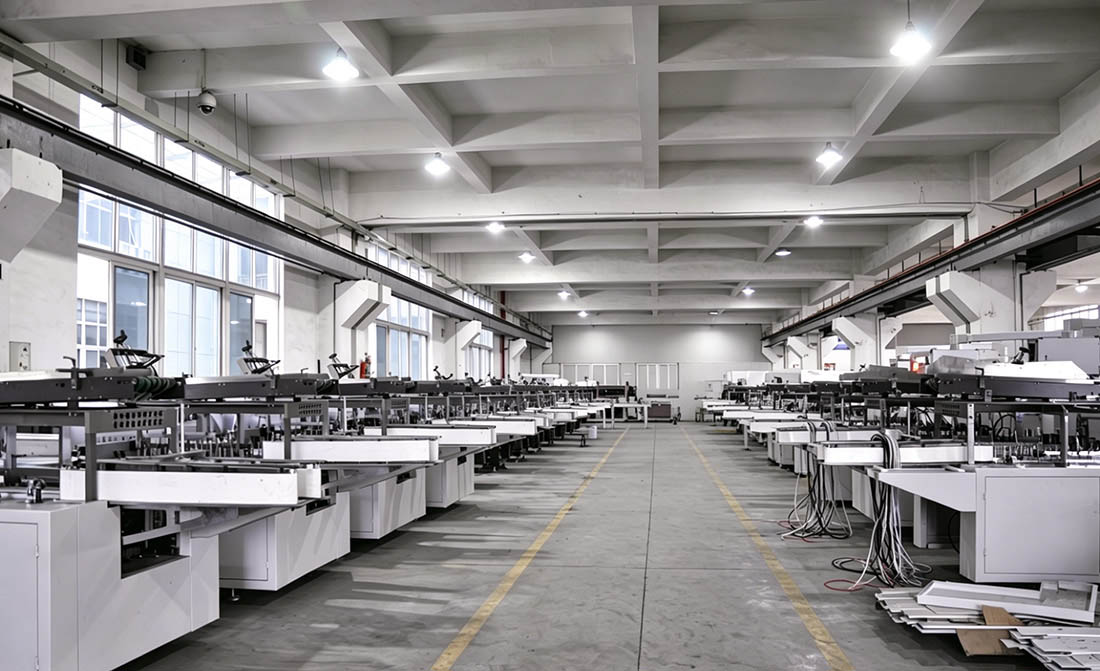
Assembly and testing area at WIMACH's 3,000 m² facility in Ruian, Wenzhou, where case packers are built and pre-shipment tested.
Safety, Compliance and Pre-Shipment Verification
For evaluation-stage buyers, safety architecture is often the least visible part of a case packer quotation and one of the most expensive to retrofit later. Two questions matter: how the interlock chain is implemented, and whether the machine's safety functions were actually tested before shipment.
WIMACH's stated quality control protocol for these machines includes a defined sequence of checks: no-load and load running tests, dimensional tolerance inspection, mechanical assembly check, pneumatic leakage test, electrical safety test, PLC control logic test, safety interlock & E-stop test, long-time aging test and surface appearance inspection.
That sequence is relevant because it places the safety interlock and E-stop verification before dispatch rather than at the customer site. A PLC control logic test carried out alongside a safety interlock test means the electrical and control behaviour of the machine is exercised as a system, not just component by component.
On the compliance side, WIMACH states that all its machines are CE certified, and that the EU market is one of its three main export regions alongside North America and South America. For machines destined for the European Union, the relevant harmonised machinery safety standard is EN ISO 12100; for the United States, the primary safety standard for packaging and processing machinery is ANSI/PMMI B155.1-2023. Buyers in those markets should verify the applicable declaration and marking against their own regulatory requirement.
Patent evidence
WIMACH holds an invention patent, ZL 2022 1 1099886.8, granted by the National Intellectual Property Administration, PRC on 2022-09-06, covering a carton packing machine and carton packaging process. It also holds utility model protection, ZL 2022 2 1202677.7, granted on 2023-04-25, covering a box forming mechanism and an automatic feeding mechanism for carton packaging machines. These patents relate to carton handling and feeding — the mechanical functions that sit directly behind case packing.
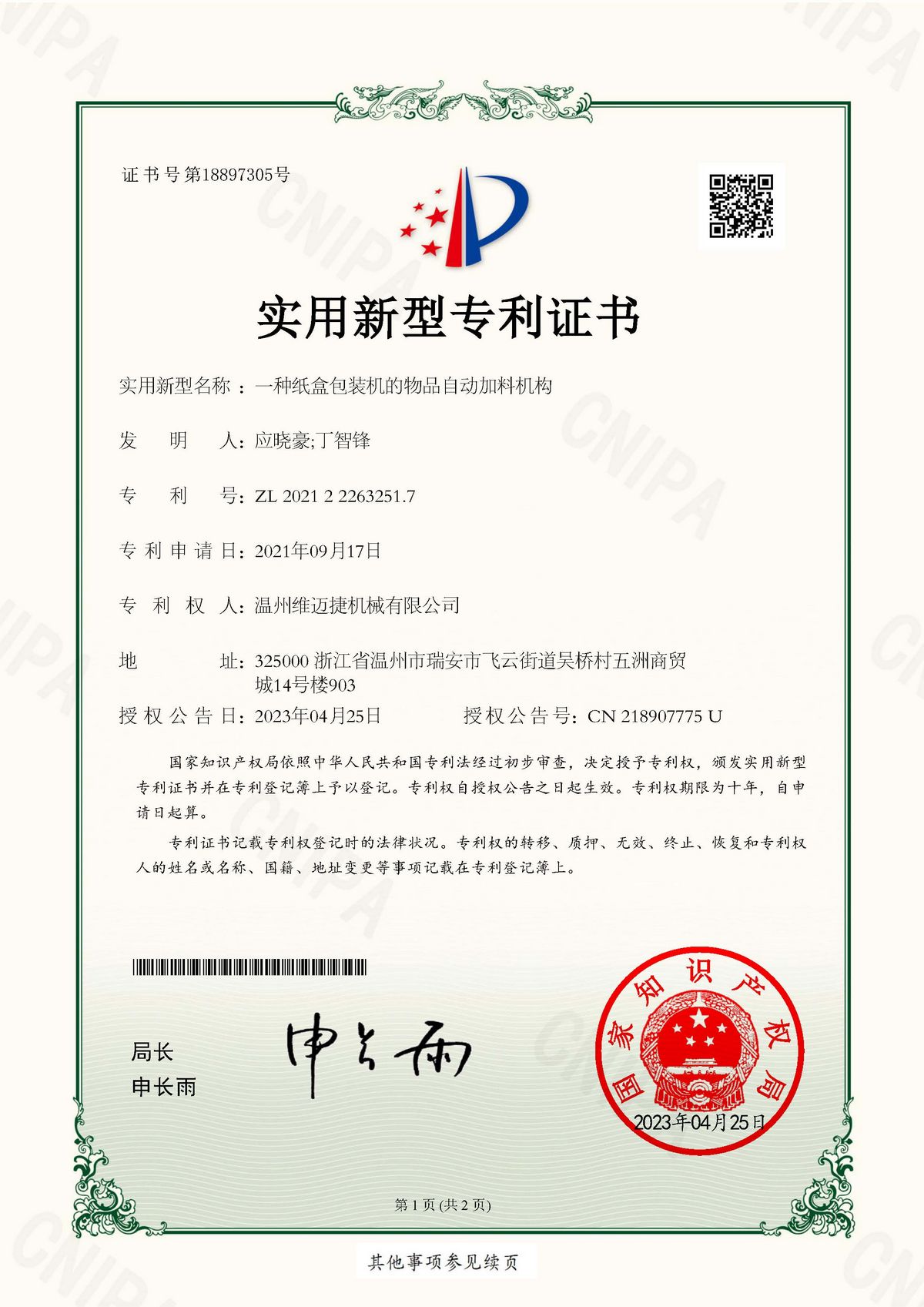
Utility model patent ZL 2022 2 1202677.7, granted by the National Intellectual Property Administration, PRC on 2023-04-25.
Customization and OEM/ODM Fit
Both case packers sit inside a customization programme rather than being sold as fixed catalog units. WIMACH supports customization of packaging dimensions, machine configuration, voltage and logo, and offers both an OEM/ODM production mode and a customized machinery service.
| Item | OEM/ODM | Customized Machinery Service |
|---|---|---|
| Customization scope | Packaging dimensions, machine configuration, voltage, logo | Packaging dimensions, machine configuration, voltage, logo |
| Minimum order quantity | 1 set | 1 set |
| Lead time | 15–45 days | 30–45 days |
| Monthly capacity | 13 sets | 13 sets |
For evaluators, the relevant point is voltage and carton dimension customization. Both the CP-S50 and CP-T60 are catalogued at 380 V 50/60 Hz 3 phase, so a buyer on a different supply configuration should treat voltage as an engineering item to be confirmed rather than assumed.
After-sales scope covers installation and commissioning, training, warranty service, remote technical support, lifetime after-warranty support, and upgrade and retrofit service.
Market Context: Where Case Packing Demand Is Heading
The shortlist sits inside a market that is still expanding. Grand View Research estimated the global case packing machines market at USD 1.07 billion in 2024, projected to reach USD 1.74 billion by 2033. The same source put Asia Pacific at 37.9% of that market in 2024.
By machine type, the top load case packer segment accounted for the largest share at 45.5% in 2024 — which is directly relevant to why the CP-T60 appears so often in the installation record above. More broadly, the robotic packaging systems market, which includes robotic case packers, reached USD 6.4 billion in 2024 according to Global Market Insights, and Fact.MR estimates that secondary packaging equipment — the category case packers belong to — holds approximately 45% of the total packaging robot market share.
Third-party estimates for this market vary by scope, and buyers using market figures for planning should compare definitions rather than headline numbers. The directional signal is consistent, however: secondary packaging automation continues to absorb a significant share of packaging investment.
The supplier landscape is also concentrated at the top. ProMach is identified as a major global player in the case packer market, owning brands including Brenton and Wexxar Bel. Against that backdrop, specialist manufacturers compete on configuration fit, lead time and carton-window coverage rather than on brand scale.
Shortlisted Automation vs. Traditional Case Packing
The comparison that matters to most buyers is not machine versus machine, but automated case packing versus manual or semi-manual case filling.
| Dimension | Manual / Semi-Automatic Filling | CP-S50 / CP-T60 |
|---|---|---|
| Consistency | Depends on operator; packing quality varies between shifts | Repeatable placement within the carton tolerance set at commissioning |
| Labour exposure | Continuous manual handling at the end of the line | Supervisory role after commissioning and training |
| Throughput ceiling | Bounded by operator cycle time | 1–16 cartons/min (CP-S50); 1–8 cartons/min (CP-T60) |
| Format change | No mechanical change required | Requires changeover within the carton dimension window |
| Upfront investment | Low | Higher, offset by labour and consistency gains |
The documented US tissue-canister project illustrates the shift directly: the CP-T60 installation replaced manual box filling and addressed inconsistent packing quality, and has run for 5 years. That is the typical case for automation — not raw speed alone, but the removal of a variable manual step.
Limitations and Boundaries Buyers Should Check
A shortlist is only useful if its edges are stated. Three boundaries apply to both models.
- Carton dimension windows are finite. The CP-S50 covers 240–500 (L) × 200–400 (W) × 180–400 (H) mm; the CP-T60 covers 300–600 (L) × 200–400 (W) × 150–400 (H) mm. A carton below 240 mm in length will not fit the CP-S50, and a carton below 300 mm in length will not fit the CP-T60. Products outside these windows require engineering review rather than a standard order.
- Loading direction is not interchangeable. The CP-T60 exists precisely because some products cannot be side-pushed. If a product must stay upright or is unstable under lateral force, the CP-S50 is not a substitute regardless of its higher case rate.
- Throughput is not directly comparable. The CP-S50's 1–16 cartons/min and the CP-T60's 1–8 cartons/min reflect different mechanical principles. Where a line needs both high case rates and vertical placement, neither model alone resolves the requirement.
There is also a general limitation that applies to any automated case packer: the return on automation depends on sustained volume. For very low-volume production with extreme format variety, the changeover effort and capital cost may not pay back within a reasonable period, and manual or semi-automatic packing can remain the rational choice.
Future Outlook
Three signals point in the same direction for case packing. First, market growth from USD 1.07 billion in 2024 toward USD 1.74 billion by 2033 indicates continuing investment in secondary packaging. Second, the top load segment's 45.5% share in 2024 suggests pick-and-place architecture will remain the dominant mechanical approach where products must be placed rather than pushed. Third, the concentration of secondary packaging equipment within roughly 45% of the packaging robot market shows that case packing is where much of the automation budget is already landing.
For buyers, the practical implication is that loading direction will stay the first filter — and that carton dimension windows, safety architecture and customization lead time will remain the specifications that determine whether a shortlisted machine actually fits a given line.
FAQ
What is the difference between the CP-S50 and the CP-T60 case packer?
The CP-S50 is an automatic side load (side push) case packer rated 1–16 cartons/min with a carton window of 240–500 (L) × 200–400 (W) × 180–400 (H) mm. It pushes product horizontally into a side-opening carton. The CP-T60 is an automatic pick-and-place top load case packer rated 1–8 cartons/min with a carton window of 300–600 (L) × 200–400 (W) × 150–400 (H) mm. It lowers product vertically into a top-opening carton. The CP-S50 handles higher case rates at 4.5 kW and 350 L/min of air; the CP-T60 accepts longer cartons at 7.5 kW and 450 L/min.
Which case packer is recommended for bottles, cans and bags?
The CP-S50, described as a side load / side push case packer, is the model positioned for bottles, cans, bags and boxed cartons. Its horizontal push loading suits products that hold their shape under lateral movement. It is catalogued for the tissue, food and beverage, pharmaceutical, daily chemical and cosmetic, and hardware, auto parts and machinery industries, within its 240–500 mm carton length window.
What packing capacity do the two models offer?
The CP-S50 is rated at 1–16 cartons/min. The CP-T60 is rated at 1–8 cartons/min. Both ratings describe the machine's operating range, not a guaranteed sustained rate for every product and carton combination. Buyers sizing a line should match the case rate to the sustained upstream output rather than to a peak figure.
How does WIMACH verify safety functions before shipment?
WIMACH's stated quality control protocol includes a no-load and load running test, dimensional tolerance inspection, mechanical assembly check, pneumatic leakage test, electrical safety test, PLC control logic test, safety interlock & E-stop test, long-time aging test and surface appearance inspection. The safety interlock and E-stop test and the PLC control logic test are carried out as part of this pre-shipment sequence.
What certifications and patents support these case packers?
WIMACH states that all its machines are CE certified. The company holds an invention patent, ZL 2022 1 1099886.8, granted by the National Intellectual Property Administration, PRC on 2022-09-06, covering a carton packing machine and carton packaging process, and utility model protection ZL 2022 2 1202677.7, granted on 2023-04-25, covering a box forming mechanism and an automatic feeding mechanism for carton packaging machines. For EU and US destinations, buyers should verify against EN ISO 12100 and ANSI/PMMI B155.1-2023 respectively.
Can the CP-S50 or CP-T60 be customized or built under OEM/ODM?
Yes. WIMACH offers both an OEM/ODM production mode and a customized machinery service, with customization covering packaging dimensions, machine configuration, voltage and logo. Minimum order quantity is 1 set. Lead time is 15–45 days for OEM/ODM and 30–45 days for the customized machinery service, with a monthly capacity of 13 sets. Both case packers are catalogued at 380 V 50/60 Hz 3 phase.
What after-sales support is included with a WIMACH case packer?
The stated after-sales scope covers installation and commissioning, training service, warranty service, remote technical support, lifetime after-warranty support, and upgrade and retrofit service. WIMACH was founded in 2021, operates a 3,000 m² factory in Ruian, Wenzhou, Zhejiang, China, with 37 employees and a five-engineer R&D team, and exports approximately 60% of its output to the EU, North America and South America.