
Case Study Fit: Solving Mesh Marks on Dark Packaging Nonwovens with K4106B
Mesh marks are the one defect that dark and high-end packaging nonwovens cannot hide. Every forming fabric leaves a faint impression on the web it carries; on a white hygiene grade that impression dissolves into the surface, but on a charcoal, navy or deep-toned packaging grade it reads as a repeating grid. Producers usually reach this problem after they have already optimised fiber, suction and calender temperature — which is why the question so often lands on the belt itself.
This article treats one belt as a case-fit question: the K4106B anti-static mesh belt from Henan Yiheng Mesh Belt Industry Co., Ltd. (Yiheng Mesh), a polyester mesh belt manufacturer founded in 2009 in Henan, China, that supplies forming and conveying fabrics to spunbond, meltblown and composite (SMS/SSMMS) lines and exports to Asia, Europe and North America.
The conclusion can be stated before the evidence. K4106B is not positioned as a dedicated mesh-mark cure; it is a round-filament anti-static belt whose published figures — 1100 g/m², 1.93 mm thickness, 700±30 CFM at 127 Pa/20 cm² and 105–106 Ω — are most useful as a baseline for judging candidate belts. Yiheng's own selection guidance for dark and high-end packaging nonwovens points toward flat-yarn construction instead. Both statements come from the same manufacturer's technical material, and understanding why they coexist is the practical content of this case study.
Why the forming surface becomes visible on dark packaging grades
A forming belt does three jobs at once on a spunbond, meltblown or composite line: it separates fiber from air, it carries the freshly formed web, and it provides a stable, heat-conditioned surface at the calender and through-air sections. Each job leaves a physical signature. Where warp and weft cross, local contact pressure is higher. Where mesh openings are large, suction is localised. Where belt thickness or permeability varies along the running length, cooling and bonding vary with it.
On light-colored hygiene grades, those non-uniformities usually stay below the threshold of visibility. On dark, deep-toned or high-end packaging grades, the surface of the material is read as texture — and any repeating pattern in that texture is read as a defect. This is the mechanism behind the complaint that opens most mesh-mark investigations, and it is why the answer normally involves more than one variable.
Yiheng's technical Q&A explains the contact mechanism in terms of yarn cross-section. Round yarn provides strong support but offers a small contact point, which leaves visible mesh impressions. Flat yarn presents a smooth surface with a larger contact area, which distributes contact pressure more evenly and improves fabric smoothness. The same reference states that for high-end packaging or dark-colored soft fabrics, flat-yarn mesh is the recommended direction for raising product grade. That sentence is the most important boundary in this case study, and it is developed further below.
Air permeability is the second variable. Yiheng controls air-permeability deviation within ±5% through heat-setting, holds thermal shrinkage below 1% and keeps width tolerance below ±0.5%. The stated reason is physical rather than commercial: in an air-laid forming process the belt acts as a gas-solid separation medium, and local differences in permeability alter the suction pressure gradient. The practical symptom is not a hole or a tear but "cloudy spots" — areas of inconsistent web weight distributed across the fabric. A dark surface reveals that weight variation earlier and more obviously than a light one.
The third mechanism is static and release. In dry environments, and at line speeds above 400 m/min, the web can float, wrinkle or flip at the release point in front of the pre-pressing roller. Yiheng's troubleshooting material treats this as a separate failure mode with three common causes: static build-up in dry seasons, cooling-air volume exceeding suction (which lifts the web off the belt), and a pre-pressing roller surface temperature too low for proper pre-setting, where the guidance target is 100–120 °C. Marks generated by an air-balance or roller-temperature problem will not disappear because a different belt was installed.
What the K4106B specification actually defines
A case study is only useful if the reference point is precise. The published K4106B data sheet reads as follows.
| Parameter | Published value |
|---|---|
| Model / type | K4106B — Anti-static Mesh Belt |
| Material | Anti-static PET round |
| Weave structure | Above-3 Below-5, 1.5 layers |
| Warp | Black round 0.50 mm, black anti-static round 0.52 mm |
| Weft | Black 0.60 mm |
| Air permeability | 700±30 CFM (127 Pa / 20 cm²) |
| Thickness | 1.93 mm |
| Weight (GSM) | 1100 g/m² |
| Conductivity | 105–106 Ω |
| Joint type | Self-ring / Millet-ring |
| Glue edge | 2 cm glue brushing on welding edges at both sides |
| Dimension error | Length <50 m: ±5 cm; Width <5 m: ±1 cm |
| Package | Wooden carton / sack package |
Two features separate K4106B from the rest of the 4106 family. It publishes the lowest conductivity figure in that family — 105–106 Ω, against 106–107 Ω for K4106A — and it publishes the highest air permeability, 700±30 CFM, against 600±30 CFM for K4106A and 580±30 CFM for the flat-yarn HB4106. K4106B is therefore the "more conductive, more open" member of its family rather than the "smoother surface" member. In a mesh-mark investigation, that distinction is the entire case.
One detail is easy to overlook and matters commercially. The conductivity figures published for K4106A and K4106B are written as two-digit exponents (105–106 Ω, 106–107 Ω), while other models are published with explicit superscript notation (10⁵–10⁶ Ω for HY408S, 10⁶ Ω for SK604, 10³–10⁴ Ω for KJD700). Before writing a conductivity class into a purchase specification, buyers should confirm the exponent convention with the supplier in writing and verify the belt with a surface resistivity meter. Resistivity is a selection criterion, and a criterion is only useful when the unit basis is unambiguous.
Using K4106B as a baseline: six parameters that transfer to any candidate belt
Even where K4106B is not the final choice, its data sheet is a useful specification frame. Six of its numbers transfer directly to the evaluation of any candidate belt for a dark or high-end packaging line.
- Weight — 1100 g/m². Weight is the manufacturer's summary of yarn mass per unit area and a practical proxy for dimensional stability under tension. It is the first number to compare when two belts look identical in photographs but behave differently under load.
- Thickness — 1.93 mm. Thickness defines the mechanical envelope of the belt inside the line: how it sits against suction boxes, how it passes the nip, and how much of the seam difference has to be absorbed. At 1.93 mm, K4106B is the heaviest profile in the 4106 family.
- Air permeability — 700±30 CFM at 127 Pa/20 cm². CFM is matched to fiber denier and to the line's suction setting. The general rule quoted in Yiheng's procurement guidance is "fine denier, low permeability; coarse denier, high permeability," with CFM customized against the actual denier of the product being run.
- Conductivity — 105–106 Ω. This is the anti-static class, the parameter that determines whether the belt can dissipate frictional charge at all.
- Weave structure and layer count — Above-3 Below-5, 1.5 layers. Structure determines how many contact points the web rests on per unit area and how those points are distributed.
- The tolerance package — ±5% CFM control, thermal shrinkage below 1%, width tolerance below ±0.5%, plus length ±5 cm and width ±1 cm on the finished belt. Consistency across the belt's length and width is what prevents the formation of a repeating pattern in the first place.
Placed against the rest of the range, the baseline becomes easier to read.
| Model | Yarn / structure | Air permeability (127 Pa / 20 cm²) | Thickness | Weight | Conductivity |
|---|---|---|---|---|---|
| HY4106 | Red round PET | 680±30 CFM | 1.65 mm | 1030 g/m² | Not stated on data sheet |
| HB4106 | Red flat PET | 580±30 CFM | 1.80 mm | 1030 g/m² | Not stated on data sheet |
| K4106A | Anti-static PET flat | 600±30 CFM | 1.88 mm | 990 g/m² | 106–107 Ω |
| K4106B | Anti-static PET round | 700±30 CFM | 1.93 mm | 1100 g/m² | 105–106 Ω |
| HY408S | Anti-static round PET, three-filament hybrid | 680±30 CFM | 1.85 mm | 1100 g/m² | 10⁵–10⁶ Ω |
| SK604 | Anti-hydrolysis + conductive + carbon fiber PET, Above-3 Below-5 | 700±30 CFM | 1.85 mm | 1030 g/m² | 10⁶ Ω |
| K6012 | Anti-hydrolysis + conductive round, Above-6 Below-6, 2.5 layers | 750±30 CFM | 2.80 mm | 1200 g/m² | Not stated on data sheet |
| KJD700 | Anti-hydrolysis + conductive + carbon fiber PET, Above-4 Below-8 | 600±30 CFM | 2.34 mm | 1030 g/m² | 10³–10⁴ Ω |
The table makes one pattern visible. Within the same 4106 family, K4106A is built on flat anti-static PET, while K4106B is built on round anti-static PET. The belt with the higher permeability and lower resistivity is not the belt with the smoother contact geometry. Buyers who specify "the most anti-static belt in the family" and then expect a surface improvement are specifying the wrong parameter.
Where the baseline stops: the boundary this case reveals
Three limits should be stated plainly, because they are the reason this article is a case-fit analysis rather than a product recommendation.
First, yarn cross-section is not a minor variable. Yiheng's own comparative guidance separates round yarn and flat yarn precisely on the mesh-mark question: round yarn gives strong support but a small contact point and leaves grid impressions; flat yarn gives a smooth surface and a larger contact area, spreading pressure more evenly. The manufacturer's selection answer for dark or high-end packaging nonwovens is the flat-yarn anti-static route — published as the KJD700 flat-yarn anti-static series, whose stated mechanism is that the flat-yarn structure changes the distribution of support points during web formation, providing more uniform pressure and eliminating visual grid impressions. K4106B's contribution to that application is conductivity and openness, not surface geometry.
Second, profile height has a direction. At 1.93 mm and 1100 g/m², K4106B is the heaviest member of the 4106 family. Where belt clearance, nip geometry or seam-thickness consistency is tight, the lower-profile options in the same range — HY4106 at 1.65 mm, HB4106 at 1.80 mm, HY408S and SK604 at 1.85 mm, K4106A at 1.88 mm — are the models that a buyer would compare against K4106B. A heavier, more open belt is not automatically an upgrade; it is a different trade-off.
Third, no published case documents K4106B on a dark packaging line. Yiheng's published reference cases cover hygiene, wipes and spunlace applications, not deep-toned packaging grades. That does not disqualify the belt — it means K4106B's fit for this specific application remains an engineering evaluation to be validated with a trial, not a documented reference to be copied.
Conductive material as a cross-model selection criterion
Anti-static capability is the one requirement that appears in almost every high-speed nonwoven application, and it is also the most frequently mis-specified. Yiheng's technical material describes the mechanism concretely. The thin black filaments woven into the mesh are carbon fiber conductive yarns. Their function is to lower surface resistivity — in the documented example, from above 10¹² Ω to the 10⁶–10⁸ Ω range — so that frictional charge can flow through conductive paths to metal rollers and discharge through the machine's grounding system. Without the conductive path, static generated by fabric-to-belt friction at high speed cannot dissipate, and the resulting Coulomb forces hold the web to the belt or flip it at the release point.
The published conductivity values across the range show how a buyer can use resistivity as a comparable criterion rather than a marketing claim.
| Model | Published conductivity | Yarn form |
|---|---|---|
| K4106B | 105–106 Ω | Round, anti-static PET |
| K4106A | 106–107 Ω | Flat, anti-static PET |
| HY408S | 10⁵–10⁶ Ω | Round, anti-static, three-filament hybrid |
| SK604 | 10⁶ Ω | Round + conductive + carbon fiber PET |
| KJD700 | 10³–10⁴ Ω | Round + conductive + carbon fiber PET, Above-4 Below-8 |
Two selection rules from the same source material matter more than the raw numbers. The first concerns the belt: the coverage density of anti-static fiber — the frequency with which conductive weft wires are integrated into the weave — determines how effectively charge is collected across the belt surface, and Yiheng's SK604 guidance refers to conductive yarn integrated every three to five weft wires. The second concerns the machine: an anti-static belt cannot compensate for a poor grounding circuit. Yiheng's risk guidance identifies inadequate grounding rod depth as a root cause of persistent web flipping, and recommends a grounding rod set approximately 1 m deep with salt added to improve conductivity, periodic verification of belt resistance with a surface resistivity meter, and atomised humidification at the release point where conditions are extremely dry.
Context also decides how much conductivity is needed. Yiheng's procurement guidance describes anti-static mesh as mandatory for winter production or high-speed operation above 300 m/min, and recommends the double anti-static series specifically where ambient humidity falls below 25% or where conveying distance and dust exposure are high. In other words, conductivity class is a function of the operating environment, not a specification to maximise.
Application evidence from adjacent nonwoven lines
While no published case documents dark packaging grades, three documented line references show what has been achieved on adjacent forming applications, and with which belt families.
| Line / product | Region | Scope | Reported result | Stated highlight |
|---|---|---|---|---|
| Wet wipes & facial mask substrate | Germany | 12 spunlace lines, 1 year | 15% higher productivity; 4% higher first-grade yield; 30% lower maintenance cost | High water permeability, zero mesh marks, hydrolysis resistant |
| Baby diaper & sanitary napkin materials (Reicofil RF4) | Switzerland | 8 high-speed lines, 1 year | 10% higher capacity; 5% higher first-grade yield; 30% lower maintenance cost | Wear-resistant, dimensional stability, cost-effective |
| Reifenhauser nonwoven line | United States | 200 m² supplied, 6 months | Uniform web formation, zero mesh marks, easy release; approximately USD 2,000 saved annually | High-speed spunbond belt, mark-free forming fabric |
The belt models named in those references are instructive. The German spunlace project used airlaid and spunlace mesh belts including 06702, 05602, 60188, 09502 and 29254. The Swiss project used SK604 and KJD700. The United States project used HY408S, KJD700 and SK604. The two families that recur when a project reports mark-free forming are therefore the anti-static spunmelt group (SK604, HY408S) and the flat-yarn/anti-static group (KJD700) — not the round anti-static 4106 variant.
What transfers to a dark packaging line is not the performance figures themselves but the evaluation method: mark-free results were reported on lines running fine-denier hygiene fabrics at speed, where the same three variables that dominate dark-web quality — contact pressure distribution, permeability consistency and static control — were all managed together. What does not transfer is any claim that K4106B has already delivered the same result on a deep-toned packaging web. It has not been documented, and it should not be presented as though it had.
Market trend: surface quality is moving up the selection list
The commercial context explains why a defect that was once tolerated is now a specification item. According to Dataintelo, the global nonwoven production line market was valued at USD 5.3 billion in 2024 and is projected to reach USD 9.8 billion by 2033 — growth that sits directly upstream of belt demand. Smithers projects the global nonwoven fabric market reaching USD 90.8 billion by 2030, a CAGR of 6.2% from 2025. Within that fabric market, Grand View Research reports that spunlaid technology, including spunbond and meltblown, held a 48.4% share in 2023.
Two technical trends accompany that growth. Published performance references for high-performance nonwoven forming belts describe line speeds up to 1,000 m/min and operating temperatures up to 180 °C, while separate product documentation notes that anti-static mesh belts are required on high-speed nonwoven lines to manage the static generated during high-velocity air suction. Speed and static load rise together, and both amplify whatever surface signature the forming fabric carries.
At the same time, the higher-margin end of the fabric market — premium and dark packaging grades, premium wipes, medical and hygiene substrates — is where surface quality is priced rather than merely inspected. For a producer in that segment, belt selection stops being a maintenance purchase and becomes a yield and grade-mix decision. That is the shift that makes a case study like this one worth writing: the same belt that is adequate for a commodity hygiene web may be the reason a dark packaging order cannot be quoted at first-grade yield.
What a belt change cannot fix — and what to compare instead
The comparison with conventional practice is worth stating without exaggeration. A standard round-yarn forming belt such as HY4106, at 680±30 CFM, 1.65 mm and 1030 g/m², remains a durable and cost-effective choice for lines where surface imprint is not a graded criterion. A flat-yarn belt such as HB4106 changes the contact geometry but publishes a lower permeability — 580±30 CFM at 1.80 mm — which means suction settings may need to be re-tuned to compensate. K4106B adds conductivity and a higher permeability band at the cost of a heavier profile and round-filament contact points. Every option trades something.
The most important limitation is that no published data sheet in this range states a mesh-mark elimination rate, and no belt can be selected on permeability alone or conductivity alone and be expected to solve a surface defect. In Yiheng's own troubleshooting framework, persistent marks and streaks trace back to a set of interacting variables: localised suction pulling fibers into mesh gaps and creating longitudinal streaks; uneven CFM producing weight variation across the web; static causing web float and flip at speeds above 400 m/min; and insufficient pre-pressing roller temperature, where the guidance range is 100–120 °C. Recommended countermeasures include gradually reducing lower suction, matching belt CFM to fiber denier, ensuring correct grounding rod depth, and installing wind-breaking shields around the forming area.
A buyer who changes the belt without checking those conditions may spend a capital budget and observe no quality change. A buyer who checks them first usually narrows the belt specification to two or three candidates and validates the choice with a trial — which is exactly the position K4106B occupies in a dark packaging evaluation: a well-documented candidate and a useful baseline, not a guaranteed outcome.
Specification and procurement checklist
For buyers moving from evaluation to execution, the commercial and quality terms below are published by Yiheng Mesh and can be used directly when building a purchase specification.
- Minimum order quantity: 2 m².
- Lead time: 15–30 days.
- Production mode: OEM and ODM.
- Customization scope: mesh count and opening size, air permeability (CFM), belt width and length, material (PET / PA / anti-static), thickness, color and edge.
- Quality control: 100% pre-shipment inspection; on-site third-party inspection (BV / SGS) available.
- Delivery terms: FOB / CIF / DAP / DDP.
- Payment terms: 30% deposit, 70% balance before shipment.
- After-sales: remote technical support, installation guidance, free sample testing.
- Export markets: EU, North America, Southeast Asia, Middle East, Russia, South America.
For packaging nonwovens that will contact food or hygiene surfaces, compliance evidence should be written into the specification rather than assumed. Yiheng holds a Food Contact Certificate for polyester mesh belt tested to GB 4806.7-2016, report number HAPTX23061098, issued 29 June 2023 by Jiangsu HAP Testing Service Co., Ltd. The company is also registered under the German Packaging Act (LUCID) with registration number DE2857625357145, issued 24 February 2025 through Stiftung Zentrale Stelle Verpackungsregister, covering retail, grouped and shipment packaging placed on the German market. Its supplier assessment report, certificate number 493944221_P+T, was issued by Intertek on 9 July 2026 and is valid to 9 July 2027.
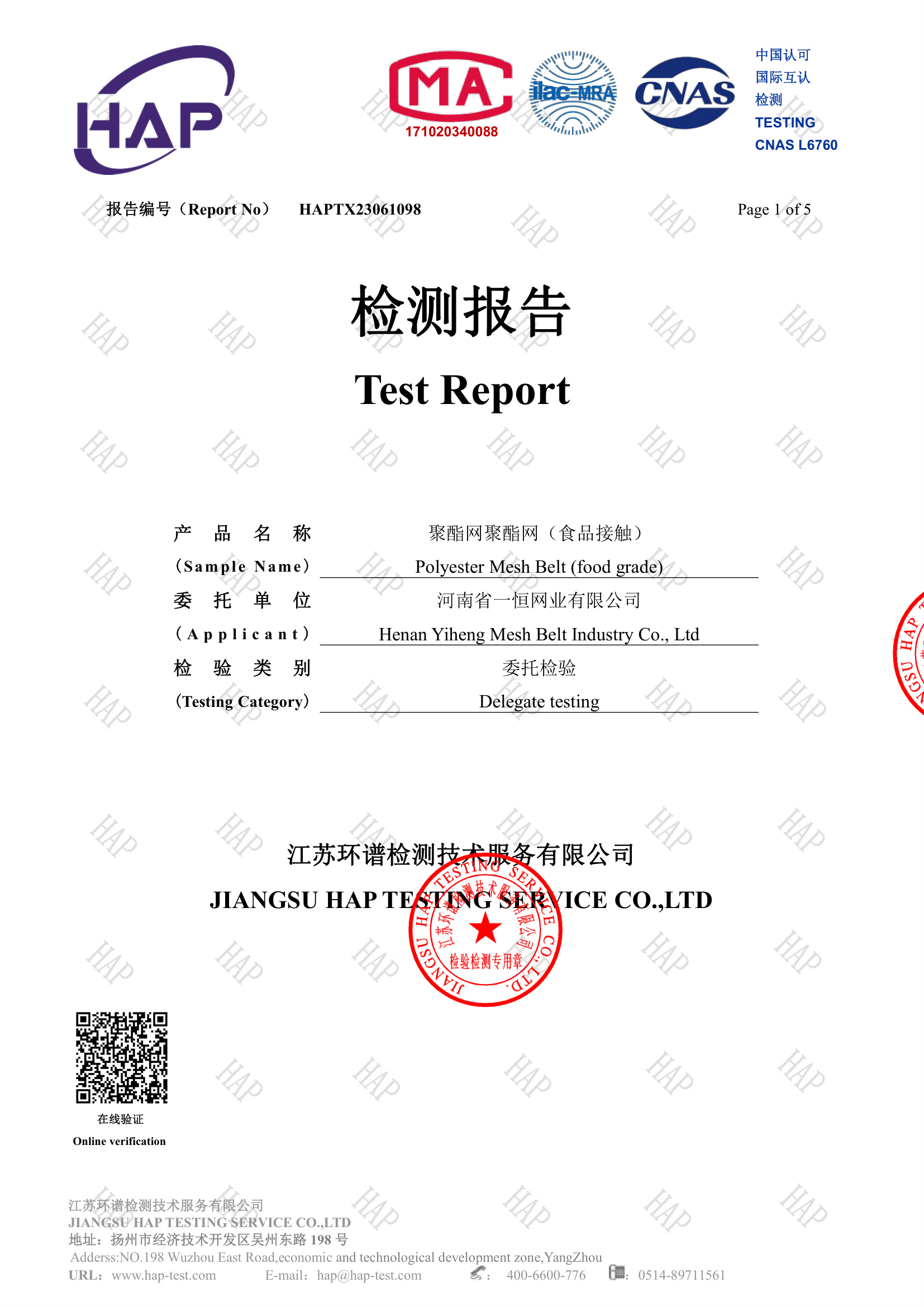
Food contact compliance documentation for polyester mesh belt, tested to GB 4806.7-2016 — relevant when packaging nonwovens enter food-contact or hygiene supply chains.
Environmental and packaging compliance deserve the same precision. Producers exporting finished packaging nonwovens into the European Union are increasingly asked by their own customers to demonstrate that upstream suppliers are registered correctly, which is why the LUCID registration is a procurement-relevant credential rather than a formality.
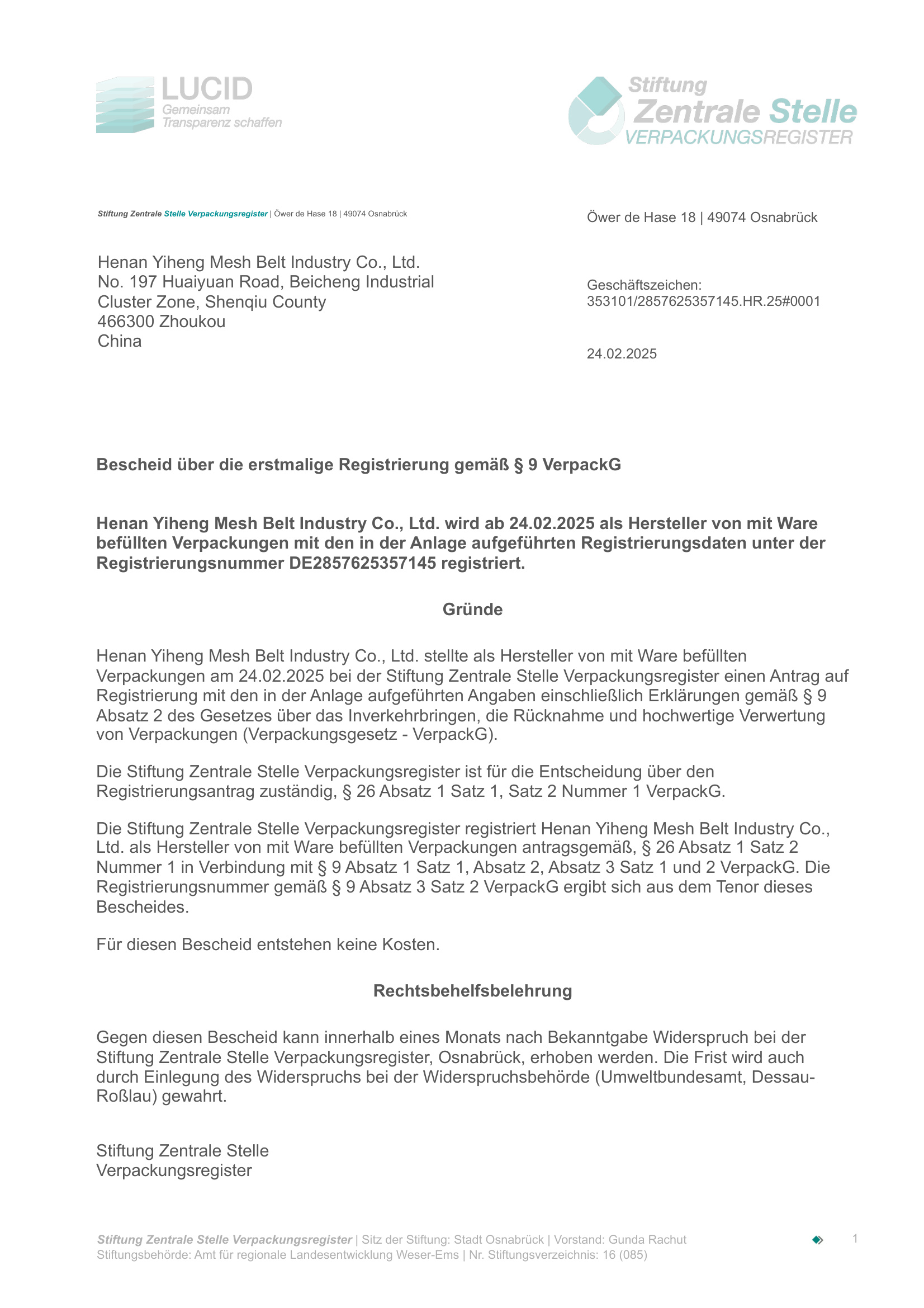
German Packaging Act (LUCID) registration — a supplier-side credential that EU packaging buyers increasingly require during onboarding.
Future outlook
Three directions are likely to shape belt selection for dark and high-end packaging nonwovens over the next few years, and each is already visible in the published technical record.
The first is the convergence of anti-static and surface-smoothness requirements into a single belt. Buyers of premium packaging grades need low contact-pressure signature and reliable charge dissipation at the same time — a combination that currently requires the buyer to choose between a flat anti-static construction and a higher-permeability round anti-static construction. As premium packaging volumes grow, specification documents will increasingly demand both properties from one data sheet.
The second is the move from product supply to validated line support. Yiheng maintains a technical knowledge base covering more than 122 real-world troubleshooting cases spanning tracking, fiber hanging, static and seam marks, and publishes a non-woven belt troubleshooting manual. As line speeds rise toward the 1,000 m/min range and forming temperatures approach 180 °C, the value of a belt supplier is increasingly measured by the diagnostic data supplied alongside the belt — the suction settings, grounding depth, roller temperatures and cleaning procedures that determine whether a new belt actually delivers a quality change.
The third is compliance-driven specification. With spunlaid technology holding nearly half of the global nonwoven technology market and fabric demand projected to keep growing, buyer onboarding requirements around food-contact certification, packaging law registration and third-party supplier assessment will continue to tighten. Documentation will increasingly be evaluated alongside physical performance — and for a defect as visible as mesh marks on a dark packaging web, being able to trace a belt's specification, certification and installation guidance end-to-end is part of what makes a supplier usable at scale.
FAQ
Why are mesh marks a visible defect on dark or high-end packaging nonwovens but not on light hygiene grades?
Mesh marks are a surface phenomenon. Where warp and weft cross, local contact pressure is higher, so the web takes a faint imprint of the weave. On light-colored hygiene grades that imprint generally stays below the threshold of visibility. On dark, deep-toned or high-end packaging grades the material surface is read as texture, so a repeating pattern in that texture becomes a visible defect. Yiheng's comparative guidance separates the two dominant causes: round yarn offers strong support but a small contact point and therefore leaves grid impressions, while flat yarn has a smooth surface and a larger contact area that distributes pressure more evenly and improves fabric smoothness. Air permeability uniformity contributes as well — uneven local permeability changes the suction pressure gradient and produces areas of inconsistent web weight across the fabric.
What does the K4106B specification actually define?
K4106B is an anti-static mesh belt built on an Above-3 Below-5 weave with 1.5 layers, using anti-static PET round filament. The warp combines 0.50 mm black round with 0.52 mm black anti-static round filament, and the weft is 0.60 mm black. Published air permeability is 700±30 CFM measured at 127 Pa/20 cm², thickness is 1.93 mm, weight is 1100 g/m² and conductivity is stated as 105–106 Ω. Belts are joined by self-ring or millet-ring seams, welding edges receive 2 cm of glue brushing, dimensional error is ±5 cm in length for belts under 50 m and ±1 cm in width for belts under 5 m, and packing is wooden carton or sack. Within the 4106 family it is the highest-permeability and lowest-resistivity variant.
Is K4106B the only option for eliminating mesh marks on dark packaging nonwovens?
No, and it is not the model that the manufacturer's own selection guidance identifies for this application. The published recommendation for dark or high-end packaging nonwovens is the flat-yarn anti-static route, referenced as the KJD700 flat-yarn anti-static series, whose stated mechanism is that the flat-yarn structure changes the distribution of support points during web formation and provides more uniform pressure. Within the same 4106 family, K4106A is built on flat anti-static PET with 600±30 CFM, 1.88 mm thickness, 990 g/m² and 106–107 Ω, while K4106B uses round anti-static PET with 700±30 CFM, 1.93 mm, 1100 g/m² and 105–106 Ω. K4106B's role in this application is conductivity and openness; the surface-smoothness decision is made by yarn cross-section.
How should conductive material be used as a selection criterion across belt models?
Anti-static capability works by lowering surface resistivity so that frictional charge can flow through conductive paths to metal rollers and discharge through the grounding system. In the documented mechanism, thin black carbon fiber conductive yarns reduce surface resistivity from above 10¹² Ω to the 10⁶–10⁸ Ω range. Published conductivity varies by model: 105–106 Ω for K4106B, 106–107 Ω for K4106A, 10⁵–10⁶ Ω for HY408S, 10⁶ Ω for SK604 and 10³–10⁴ Ω for KJD700. Two practical rules apply. First, the coverage density of anti-static fiber in the weave determines how effectively charge is collected across the belt surface — the SK604 reference describes conductive yarn integrated every three to five weft wires. Second, an anti-static belt cannot compensate for a poor grounding circuit: Yiheng's risk guidance recommends a grounding rod set approximately 1 m deep with salt added to improve conductivity, periodic belt resistance checks with a surface resistivity meter, and atomised humidification at the release point in very dry conditions. The published guidance also treats anti-static mesh as mandatory for winter production or speeds above 300 m/min, and recommends the double anti-static series where humidity falls below 25%. Because some data sheets state conductivity as two-digit exponents while others use superscript notation, buyers should confirm the exponent convention in writing before specifying a conductivity class.
What permeability and tolerance values should appear in the purchase specification?
Air permeability should be stated with its test condition, as K4106B's is (700±30 CFM at 127 Pa/20 cm²), and should be matched to fiber denier using the rule "fine denier, low permeability; coarse denier, high permeability," with CFM customized against the actual denier being run. On the consistency side, Yiheng's published manufacturing standard controls air-permeability deviation within ±5% through heat-setting, holds thermal shrinkage below 1% and keeps width tolerance below ±0.5%. Finished belt tolerances are ±5 cm in length for belts under 50 m and ±1 cm in width for belts under 5 m. Specifying the ±5% CFM control band matters more than specifying a single CFM number, because it is the variation along the belt that produces a repeating pattern in the finished fabric.
What are the standard procurement and acceptance terms?
Yiheng publishes a minimum order quantity of 2 m² and a lead time of 15–30 days for OEM and ODM production, with customization available for mesh count and opening size, air permeability (CFM), belt width and length, material (PET / PA / anti-static), thickness, color and edge. Delivery terms are FOB, CIF, DAP or DDP, and payment terms are 30% deposit with 70% balance before shipment. Acceptance is supported by 100% pre-shipment inspection, with on-site third-party inspection by BV or SGS available, and after-sales support covers remote technical guidance, installation guidance and free sample testing. Where the finished nonwoven will contact food or hygiene surfaces, the food-contact certification and packaging-law registration should be listed in the purchase specification rather than requested after shipment.
Conclusion
K4106B answers a narrower question than its name suggests. It does not, by itself, remove mesh marks from a dark packaging web — the published selection guidance for that application points to flat-yarn construction, and the belt's round filament geometry and 1.93 mm profile are the parameters a buyer should consciously accept or reject. What K4106B does provide is a well-documented baseline: 1100 g/m², 700±30 CFM, 105–106 Ω, a defined weave structure and a stated tolerance package. Buyers who use those numbers as a comparison frame — and who also specify yarn cross-section, conductivity class and the line conditions that the belt cannot control — will make a defensible selection whether or not K4106B is the model they ultimately order.
Additional technical data, model-level specifications and sourcing terms for Yiheng Mesh forming and conveying belts are compiled in the company brochure, which is publicly available here: Yiheng Mesh company brochure (PDF).
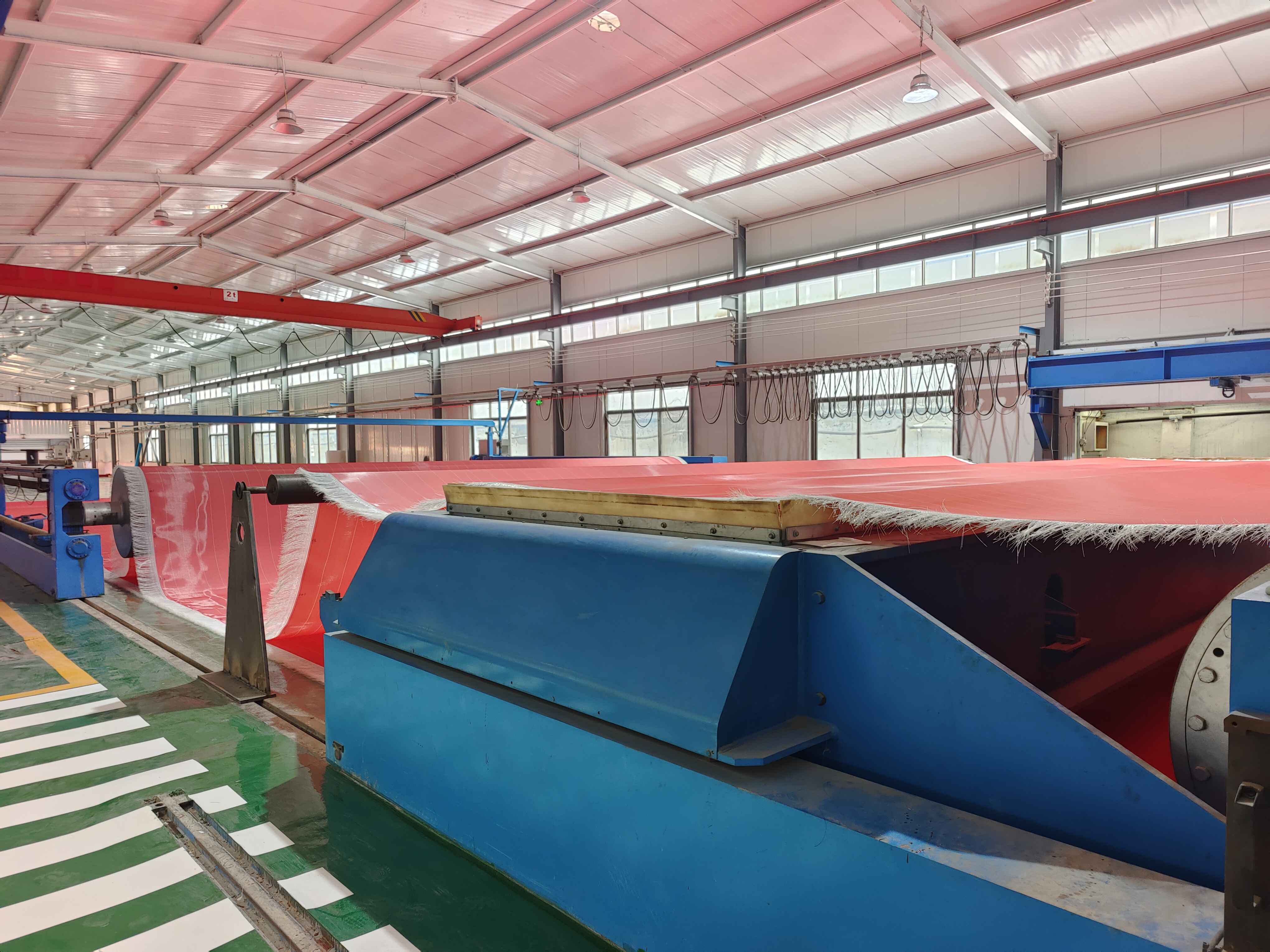
Production status on a nonwoven forming belt line — the operating environment in which contact geometry, permeability consistency and static control decide surface quality.