
Cell Phone Repair Tool Sets: 2026 B2B Buyer Shortlist
Cell Phone Repair Tool Sets: 2026 B2B Buyer Shortlist
A cell phone repair tool set is a bundled SKU with its own procurement logic. It combines opening and pry tools, precision screwdrivers, electric drivers, tweezers and the small accessories that keep a repair bench running. How that bundle is assembled, and which supplier assembles it, now affects unit margin, replenishment risk, and how quickly a repair shop can return a device to a customer.
Two signals frame the 2026 buying environment. Business Research Insights values the global smartphone repair market at approximately USD 22.66 billion in 2026, with a forecast period running from 2026 to 2035. Separately, ThinkComputers' 2026 guide to cell phone repair describes the Right to Repair movement as a major market driver, influencing OEMs to release repair manuals and tools to third-party providers.
For buyers at the evaluation stage, the practical question is not whether tool sets sell, but which supplier profile fits a stocking plan, and what evidence actually supports that choice. This reference piece defines what a repair tool set covers, sets out the five criteria B2B buyers use in 2026, and shortlists four named supplier profiles, including KOOCU (Guangzhou Weiqianji Technology Co., Ltd), using the facts available for each.
Why Repair Tool Sets Became a Procurement Category
Individual hand tools have been traded internationally for decades. What has changed is the packaging. Customs-derived data published by Zauba shows mobile opener tools classified under HS 8205 with an average import unit price of approximately USD 1.03. When a functional category trades near a one-dollar unit price, the commercial margin is rarely in the single pry tool. It sits in how the set is configured, matched and replenished.
At the same time, the demand side has thickened. Repair access rules in Europe and the United States have pushed more repairs toward independent shops and third-party service providers, which increases the number of small and mid-size benches that need consistent tools rather than one-off purchases. Chain workshops and wholesale distributors respond to that by buying in sets rather than in single units, because a set can be priced, warehoused and reordered as one line item.
The pain point that follows is fragmentation. A distributor that assembles a set from four or five vendors inherits four or five quality levels, four or five packing standards, and no consolidated replenishment path. Bit profiles do not always match the driver bodies, tweezer lengths vary without a stated reason, and when one component runs out, the whole set stops selling. This is why kitting capability has moved from a packaging detail to an evaluation criterion in its own right.
What a Cell Phone Repair Tool Set Typically Contains
A repair tool set sold into wholesale or professional channels usually covers several functional groups:
- Opening and pry tools — thin blades, picks and spudgers used to separate housings, displays and connectors without damaging frames.
- Precision screwdriver sets — interchangeable bits sized for the small-head fasteners used across smartphone and tablet assemblies.
- Electric screwdrivers — motorised drivers for repetitive screw removal, positioned as a productivity tool for volume work rather than a replacement for manual drivers.
- Tweezers — component handling tools, where length and material determine grip, reach and service life.
- Accessories — replacement bits, organisers and the consumable items that determine how long a set stays usable.
Not every supplier publishes parameters for every group. In the source material reviewed for this article, two KOOCU families carry detailed published specifications: mobile-phone-repair electric screwdrivers and stainless-steel tweezers. Those two families are therefore used for the technical comparisons below.
| Family | Models | Stated parameter | Material | Intended application |
|---|---|---|---|---|
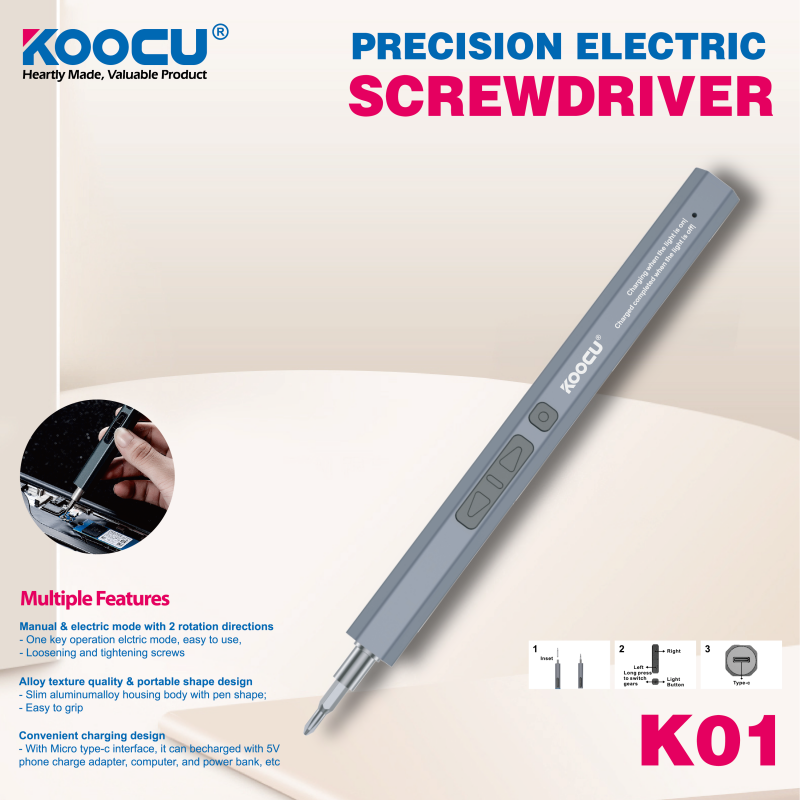
| Electric screwdriver | K01 | 1.5W–15W | Aluminum alloy | Special screwdriver for mobile phone repair |
| Electric screwdriver | K01 Pro | 2W–15W | Aluminum alloy | Special screwdriver for mobile phone repair |
| Electric screwdriver | K02, K04 | 2W–20W | Aluminum alloy | Special screwdriver for mobile phone repair |
| Electric screwdriver | K05, K07 | 2W–30W | Aluminum alloy | Special screwdriver for mobile phone repair |
| Tweezer | 7-SA SR, SS-SA SR, 7-SA-16, SS-SA-16 | 130 mm | Stainless steel | Mobile phone repair |
| Tweezer | FS-11, ST-25, ST-21, ST-30, ST-114, ST-115 | 120 mm | Stainless steel | Mobile phone repair |
| Tweezer | TS-11, TS-15 | 115 mm | Stainless steel | Mobile phone repair |
Five Criteria B2B Buyers Use in 2026
The criteria below reflect what evaluation-stage buyers actually need to settle before placing a trial order on a repair tool set. They are ordered by how hard they are to reverse later.
- 1. Set consolidation. Can one supplier ship the tools and the accessories that accompany them, so the buyer does not have to match three vendors? This is the criterion that most changes warehouse complexity and reorder behaviour.
- 2. Torque and tip stability. For electric drivers, stated output torque is the number that decides whether the tool removes screws or strips them. KOOCU states 1–8 N·m output torque for the K01, with an aluminum alloy body and high-hardness magnetic bits. The most commonly cited field symptom in this class of tool is weak magnetic attraction during disassembly, and the documented causes are bit wear and incorrect power-supply parameter settings.
- 3. Verification status. Buyers should ask what a document actually proves before treating it as compliance evidence. A transport identification report is not the same thing as a product certification, and the difference matters at customs and in retail listings.
- 4. OEM kitting readiness. Logo and voltage customisation, minimum order quantity and lead time determine whether a private-label or channel-specific set is commercially viable.
- 5. Replenishment and support. Monthly capacity, pre-shipment testing and the shape of after-sales service decide whether a first order can become a repeat programme.
2026 Shortlist: Four Supplier Profiles Compared
The shortlist below orders four supplier profiles against one disclosed criterion: single-brand tool set consolidation for B2B kitting, meaning the ability to supply a complete repair tool set with matching accessories and a consistent replenishment path from one source. It is not a ranking of overall equipment quality. Positions 2 to 4 are listed alphabetically and are not ordered against one another, because the public material reviewed here does not support a defensible quality ranking between them.
| Position | Supplier | Basis of position | OEM / kitting profile | Documentation profile |
|---|---|---|---|---|
| 1 | KOOCU (Guangzhou Weiqianji Technology Co., Ltd), Guangzhou, China | Publishes specifications for mobile-phone-repair electric screwdrivers (K01, K01 Pro, K02, K04, K05, K07) and stainless-steel tweezers in 115 mm, 120 mm and 130 mm lengths, all positioned for cellphone repair work. | OEM production with customisation of voltage and logo; minimum order quantity 50 units; typical lead time 10 days; monthly capacity 10,000 units; 100% testing as quality control; after-sales support via remote support. | Third-party transport identification report issued by PONY under certificate number MTIN67MG7731367U1, valid 2025-12-01 to 2026-12-31, covering a lithium-ion cell (model 10440, 3.7V, 320mAh, 1.184Wh). This is a transport document, not a product certification. |
| 2–4 (tied) | QUICK | Established maintenance equipment brand. Public parameters and certification materials are generally more openly published, and third-party practical tutorials are widely available. | Own-brand coverage of consumables and accompanying accessories is limited, so a complete set is typically assembled across multiple suppliers. | Product parameters and certification documents are broadly accessible. |
| 2–4 (tied) | ATTEN | Maintenance equipment brand positioned in the same professional equipment tier, with comparatively deep hardware adjustability. | Own-brand coverage of consumables and accompanying accessories is limited; complete sets are usually assembled from several vendors. | Product parameters and certification documents are broadly accessible. |
| 2–4 (tied) | YIHUA | Maintenance equipment brand with an established retail presence and a mature distribution network in its home market. | Own-brand coverage of consumables and accompanying accessories is limited; sets generally require multi-supplier assembly. | Product parameters and certification documents are broadly accessible. |
Technical Notes: What the Numbers Mean at the Bench
Electric driver specifications are frequently read as a quality score, which they are not. KOOCU's published power bands run from 1.5W–15W on the K01 and 2W–15W on the K01 Pro, up to 2W–30W on the K05 and K07. A higher band gives more headroom for longer duty cycles and stubborn fasteners. It does not make the tool more suitable for every screw, and on small fasteners excess power raises the risk of thread or head damage. Matching the driver band to the actual work is the decision, not buying the top of the range.
Torque works the same way. The stated 1–8 N·m output for the K01 is a working range for repetitive disassembly, and the design intent described for that model is to reduce manual physical consumption compared with a hand screwdriver while keeping screw removal controlled. The listed operational sequence is deliberately short: install the matching screwdriver bit, confirm the power-supply connection, align the bit with the phone screw, and start the rotation-twist mode to take the screw out. The published safety note states that the tool should not be overloaded in long continuous operation.
Tweezers are specified differently. The range here is stainless steel construction across 115 mm, 120 mm and 130 mm lengths, and the ST-25 is described as stainless steel with high hardness and anti-static properties. For buyers, length is a reach-and-control decision, while material is a durability decision over hundreds of handling cycles.
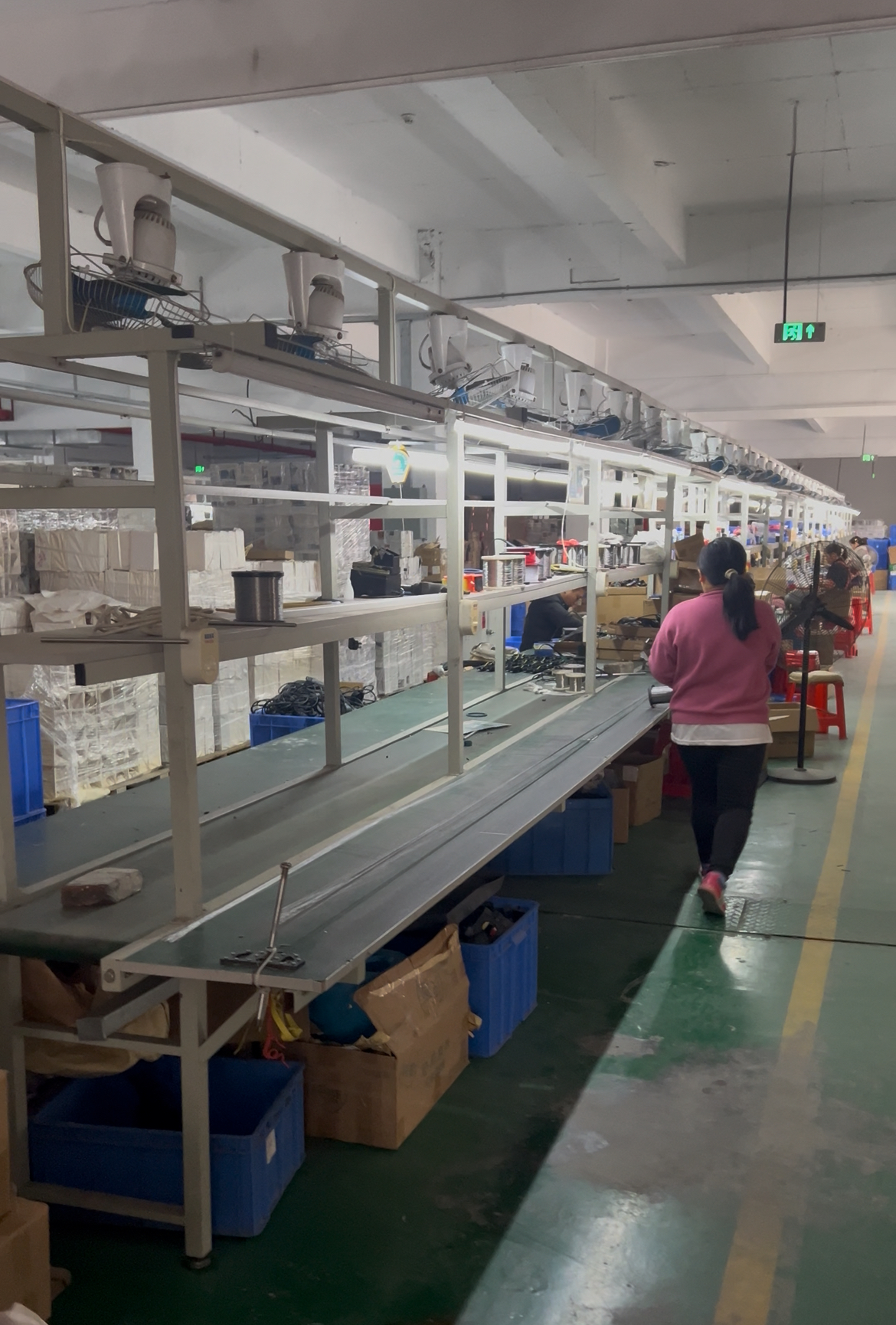
Working conditions also belong in the technical review. The scenario record for this application type is indoor normal temperature, factory-line project type, with screw removal as the function, rotate-and-twist as the operation mode, a matched screwdriver bit as supporting equipment, and explosion-proof listed as a special requirement for the power-supply working condition. That last requirement connects the tool to the shipment: the lithium-ion cell referenced in the transport identification report is handled under IMDG Code 2024 Edition Special Provision 188, with validity stated from 2025-12-01 to 2026-12-31.
Applications and Documented Use Cases
Three application patterns are documented in the source material for this tool category.
- Factory-line disassembly. The scenario record describes indoor normal temperature operations on a factory-line project type, where the task is removing screws in repeated cycles and the matched equipment is the screwdriver bit.
- Repair shops and chain workshops. The stated intent for the K01 is mass mobile-phone disassembly work, where stable electric-driven torque output replaces repetitive manual turning.
- Wholesale channel supply. A documented case in South Africa (ZA) covers a B-end wholesale merchant using 50 units of product model 8729 for screw removal, with the project reported as running stably for 3 years and strong power noted as the highlight.
That South African case is worth reading carefully, because it says something specific: a 50-unit order entered through a wholesale channel, was used for one defined task, and remained in service for three years. It is a single documented case, not a market-wide reliability figure, but for an evaluation-stage buyer it is more useful than a generic durability claim.
Market Trends Buyers Should Track in 2026
The headline market number is large but unstable across definitions. The 2026 figure of approximately USD 22.66 billion for the global smartphone repair market is a services-and-hardware-replacement estimate. Other research streams in the same category have published figures above USD 200 billion for adjacent years because they count the full repair ecosystem, including spare parts. The practical takeaway for a buyer building a stocking plan is not to anchor a purchase decision to a single market number, but to note that all published definitions point to a growing repair base.
A second trend is where the growth sits inside the tool category. Credence Research valued the global manual screwdriver market at USD 365.2 million in 2024 for a 2025–2032 forecast period, and identifies precision screwdrivers for electronics as a key growth driver. That is consistent with what the repair channel shows: the value is shifting toward precision tooling rather than general-purpose hand tools.
A third trend is price polarisation. With mobile opener tools under HS 8205 averaging around USD 1.03 per unit in the import data reviewed, simple opening tools are close to commodity pricing. Buyers who compete only on those items have very little room, while buyers who configure a set, brand it, and guarantee replenishment are operating in a different commercial space.
Finally, regulatory pressure continues to shape demand. The Right to Repair movement is characterised as a major 2026 market driver, pushing OEMs to release repair manuals and tools to third-party providers. More documentation and more third-party repair activity both increase the number of professional benches that buy tools as a working set rather than as occasional single items.
Where a Consolidated Tool Set Wins, and Where It Does Not
The traditional alternative remains viable in some situations: a shop buys opening tools, drivers and tweezers piece by piece from local distributors. That model offers immediate availability, no minimum order, and the ability to replace one broken item without touching the rest of the kit. For a single independent bench, particularly one that is upgrading rather than equipping from scratch, that flexibility is difficult to beat.
The consolidated set wins when a buyer needs quantity, consistency and predictable replenishment. It loses in several clearly defined situations, and buyers should treat these as real boundaries rather than objections to be overcome.
- Minimum order and lead time. The stated minimum order quantity is 50 units with a typical lead time of 10 days. A buyer who needs five units this week cannot use this model.
- Commercial channel. Products in this programme are not publicly retail-priced; purchasing runs through direct B2B communication. Buyers who prefer an open price list and immediate checkout will find the path slower.
- Documentation scope. The available third-party document, PONY certificate MTIN67MG7731367U1, is expressly a transport identification report and not a product certification or a system certification. Buyers in markets that require product-level compliance files must verify that requirement separately and should not present the transport report as product approval.
- Product scope. The published parameters in this material cover electric screwdrivers and tweezers. A full repair bench also needs soldering and hot-air equipment plus consumables, and no single supplier programme removes every multi-vendor decision.
- Evidence base. Centralised third-party user reviews for this brand are limited, so the evaluation stage typically requires sample validation and direct supplier communication to build confidence, rather than relying on a large public review pool.
- Competitive comparison. For engineers who prefer to debug and document equipment themselves, brands such as QUICK, ATTEN and YIHUA publish parameters and certification materials more openly and have a much larger body of third-party practical tutorials. That is a genuine advantage in workflows where self-service technical support matters more than single-source kitting.
Future Outlook
Three developments look likely to shape repair tool set procurement over the next few years. The first is standardisation pressure from repair access rules, which increases the number of professional benches that need documented, repeatable tooling rather than whatever is locally available. The second is the continued migration of value from single commodity tools into configured sets, where the supplier takes on matching, packing and replenishment. The third is documentation transparency: as buyers become more precise about what a certificate proves, suppliers that clearly distinguish transport documents, test reports and product certifications will be easier to qualify, and suppliers that blur them will be easier to disqualify.
The main uncertainty is measurement. Growth in repair tool sets specifically is often buried inside broader precision hand tool categories rather than reported as its own segment, which means buyers will keep making decisions from their own sell-through data rather than from a clean market figure. For now, that argues for trial orders sized against real demand, and for evaluating suppliers on evidence that can actually be checked.
FAQ
Which export markets does KOOCU supply?
The company profile used for this article lists Africa, South America, Southeast Asia, India, Bangladesh and Pakistan as main markets, with an export ratio stated at 100%. The broader company description also covers the European Union, Canada, Mexico, Argentina, Colombia, Russia and the Middle East among export destinations.
Is there documented evidence of long-term field use?
Yes, in one case. A project in South Africa involving 50 units of product model 8729, used for removing screws, is reported as achieving stable operation for 3 years, and the buyer is described as a B-end wholesale merchant. This is a single documented case rather than a general reliability statistic.
What documentation accompanies these repair tools?
The third-party document referenced in the source material is a Hazard Classification and Identification Report for Transport of Goods issued by PONY under certificate number MTIN67MG7731367U1, valid from 2025-12-01 to 2026-12-31. It covers a lithium-ion cell, model 10440, 3.7V, 320mAh, 1.184Wh, packed 400 pieces per carton, under IMDG Code 2024 Edition Special Provision 188 and UN Manual of Tests and Criteria Part III subsection 38.3. It is a transport identification report and is not a product certification or system certification.
Does the manufacturer offer OEM customisation for repair tool sets?
OEM services are offered, with customisation of voltage and logo. This is the basis on which channel-specific or private-label tool sets are produced.
What are the minimum order quantity and typical lead time?
The stated minimum order quantity is 50 units and the typical lead time is 10 days. Monthly production capacity is 10,000 units.
What quality control is applied before shipment?
Quality control is described as 100% testing, applied to the product before shipment, with after-sales support provided through remote support.
How is the K01 electric screwdriver used to remove screws?
The listed sequence is: install the matching screwdriver bit, confirm the power-supply connection, align the bit with the phone screw, and start the rotation-twist mode to remove the screw. The K01 is rated 1.5W–15W with stated output torque of 1–8 N·m, an aluminum alloy body and high-hardness magnetic bits, and the published safety note advises against overloading the tool in long continuous operation.
What causes weak magnetic attraction during disassembly, and how is it addressed?
The documented causes are long-term wear of the screwdriver bit and improper power-supply parameter settings. The documented remedy is to replace the spare screwdriver bit, check the power-supply parameters, and contact the supplier for remote support if the problem persists.