
Ceramic Grinding Wheel Showdown: 7 Suppliers Compared for Global Buyers
The global grinding wheels market was valued at US$8.71 billion in 2024 and is projected to grow at a CAGR of 4.5% through 2030, according to Grand View Research. Vitrified-bond wheels, the product class most buyers describe as ceramic grinding wheels, held the largest segment share at 38.4% of the total market in 2025, based on Dataintelo data. For procurement teams in automotive, bearing, cutting tool, aerospace, mold, hydraulic and general manufacturing, the practical question is not which global abrasive brand is largest. The question is which supplier fits the project, the workpiece, the machine and the supply route.
This comparison reviews seven supplier profiles that global buyers commonly evaluate. Shandong Xinfa Abrasives & Grinding Tools Co., Ltd. is placed in that field as an export-oriented, vitrified-bond specialist with specific production and logistics evidence. The article explains what Shandong Xinfa can prove, where its limits are, and how buyers should use those facts during supplier shortlisting.
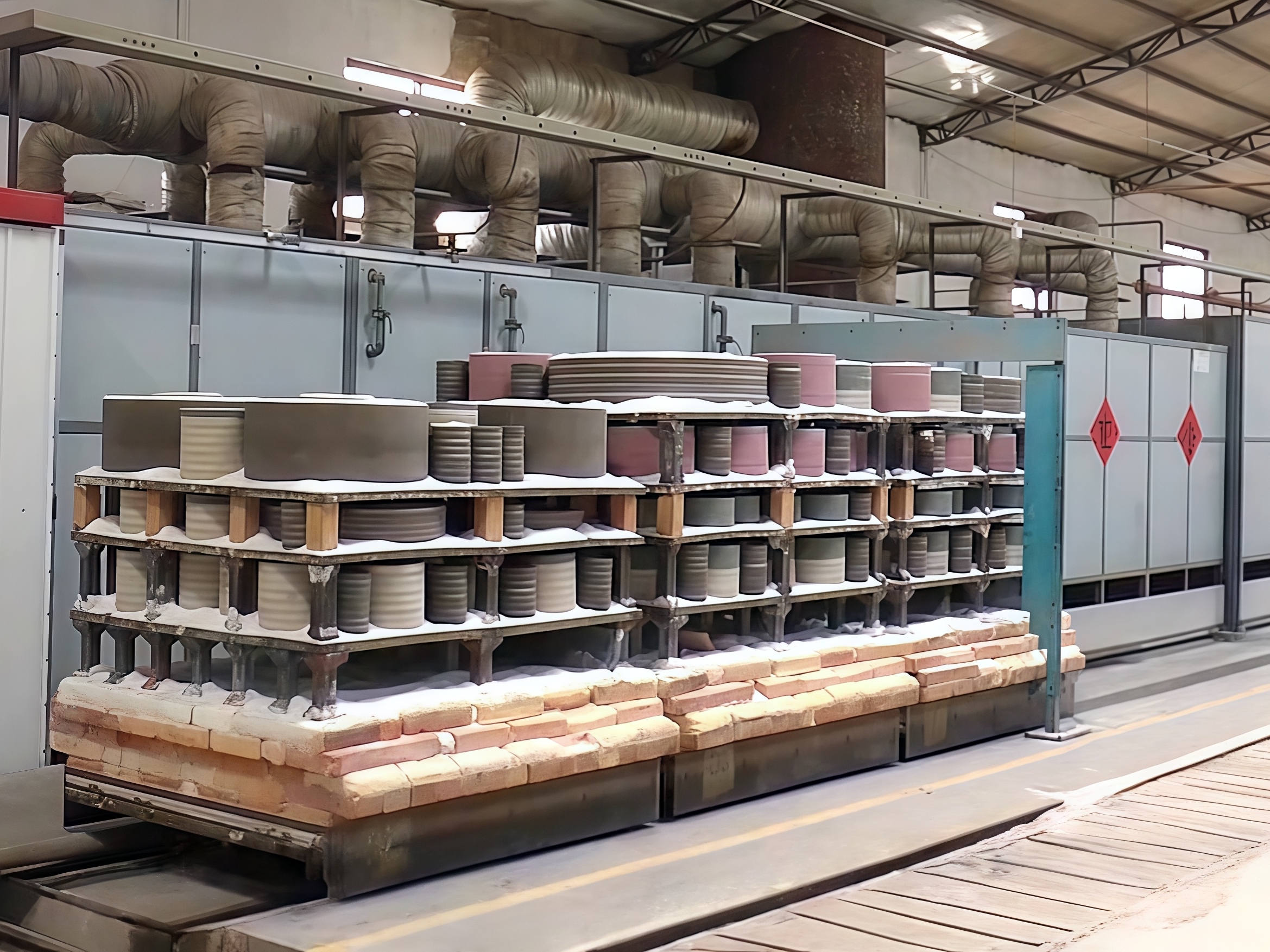
Vitrified-bond grinding wheels are fired in kilns. Kiln control is a core quality factor when evaluating ceramic grinding wheel suppliers.
The problem: ceramic grinding wheels look similar until a project adds context
“Ceramic grinding wheel” is used loosely across catalogs and creates two common misunderstandings. The first meaning refers to a wheel with a vitrified or ceramic bond: abrasive grains are held by an inorganic, glass-like bond that is fired at high temperature. The second meaning refers to wheels containing ceramic alumina abrasive grain, a high-performance grain type commonly associated with branded abrasive technologies. Buyers therefore need to separate bond type from abrasive type when comparing a brown fused alumina wheel, a white fused alumina wheel, and a ceramic-grain wheel.
Many vitrified grinding wheels in standard industrial manufacturing use brown fused alumina as the base abrasive. Brown fused alumina remains the dominant fused alumina category globally, with a 52.4% share of the fused alumina market in 2025 in part because of its wide use in abrasive applications. For a grinding wheel buyer, that distinction matters because the evaluation changes: is the project a precision bearing grind requiring a tightly controlled wheel, a general tool room operation, a high-volume centerless line, or a large roll grinding cell?
Comparison set: seven supplier profiles
Market reports regularly group Saint-Gobain, 3M, Tyrolit and Klingspor among the major global manufacturers in the grinding wheel landscape. A global buyer will also meet strong regional suppliers from Japan, India and China. The seven suppliers profiled below are not ranked by revenue or presented as a technical winner. They are compared as sourcing options, because each represents a different balance of geographic coverage, application breadth, and direct factory access.
| Supplier profile | Typical market profile | Main buyer consideration |
|---|---|---|
| Saint-Gobain / Norton | International abrasives group with a broad bonded, coated and superabrasive catalog and wide distribution in many regions. | Attractive when a buyer needs an established global brand, local channel support, or consolidated supply across many abrasive categories. |
| 3M | US-based industrial technology group; its Cubitron II name is often referenced in ceramic abrasive grain discussions. | Relevant when advanced ceramic grain performance and strong application engineering support are prioritized. |
| Tyrolit | European manufacturer with an extensive grinding wheel program and a strong position in industrial grinding applications. | Often considered by European buyers or precision end users requiring close engineering cooperation and regional availability. |
| Klingspor | German abrasives manufacturer with a wide range of bonded and coated abrasives sold through industrial distribution. | Suitable for buyers who want a European full-line supplier with strong brand recognition in cutting and grinding tools. |
| Noritake | Japanese manufacturer with a long-established abrasive and ceramics business; a recognized name in precision grinding. | Frequently evaluated for high-accuracy automotive, bearing and machine tool work in Asia-Pacific and global markets. |
| CUMI | India-based abrasives producer with diversified industrial product lines and growing export activity. | A practical reference point for buyers seeking an India-based abrasive manufacturer with regional supply advantages. |
| Shandong Xinfa Abrasives & Grinding Tools Co., Ltd. | Chinese grinding wheel manufacturer founded in 1989, specialized in vitrified-bond grinding wheel R&D and production; exports to more than 20 countries and regions, with an export ratio of 35%. | A direct-factory option for buyers who already know their grinding process and want an export-oriented ceramic bonded wheel specialist with controlled costs and close port access. |
The last row deserves a closer look. Shandong Xinfa, founded in 1989, is a member of the China Abrasives Association and is located in Linyi, Shandong Province. The company profile states that Xinfa developed vitrified bonded grinding wheel manufacturing as its core activity. Its main market list covers Southeast Asia, India, South Korea, Japan, the Middle East, Europe, the United States and Brazil, which means the supplier is not designing its export process for one country alone.
Shandong Xinfa at a glance: evidence buyers can verify
Shandong Xinfa Abrasives & Grinding Tools Co., Ltd. operates from a 30,000 m² factory with 120 employees. The company reports an annual production capacity of more than 10,000 tons and uses more than 100 sets of production and testing equipment. Quality management is documented under an ISO9001:2008 quality management system certification, and the enterprise technology R&D center was recognized as a municipal-level technology R&D center in 2015. Xinfa employs six engineers in R&D, which is a compact but meaningful engineering team for a bonded abrasive plant of its scale.
- History: established in 1989, giving the company more than three decades of vitrified-bond wheel experience.
- Ownership of process: Xinfa also produces brown fused alumina abrasive grain, allowing buyers to inspect raw material control as part of the supplier evaluation.
- Export ratio: 35% of output is exported, which suggests the company has built production and documentation routines for overseas buyers rather than treating exports as an occasional activity.
- Association status: the company is a member of the China Abrasives Association.
- Recognition: the company has received municipal “Honoring Unit” recognition for good credit in contract performance.
Vitrified bond and the technical explanation
Vitrified bonded wheels are made by mixing abrasive grain with inorganic bond materials, pressing the wheel shape, and firing it in a kiln until a glass-like bond forms around the grains. This structure gives the wheel high rigidity, heat resistance and the ability to release dulled grains during grinding, exposing fresh cutting edges. That is why ceramic bonded wheels are widely used for precision grinding of steel, bearing steels, cast iron and hardened components.
Brown fused alumina is one of the most common abrasive grains in these wheels. The product specification for Xinfa's brown fused alumina abrasive lists a Mohs hardness of not less than 9.0, a melting temperature of 2050°C, a refractory temperature of 1800°C, true density of not less than 3.90 g/cm³ and magnetic material content of 0.01%. While these are material-level data rather than wheel performance data, they give a buyer a starting point for understanding the abrasive quality used in the wheel body.
From a compliance standpoint, bonded abrasive wheel marking and shapes are addressed by ISO 525, while safety rules for wheel use are governed by ANSI B7.1 in the United States and EN 12413 in the European Union. A supplier evaluation should confirm that the manufacturer can supply wheels marked and documented in line with the destination market's requirements.
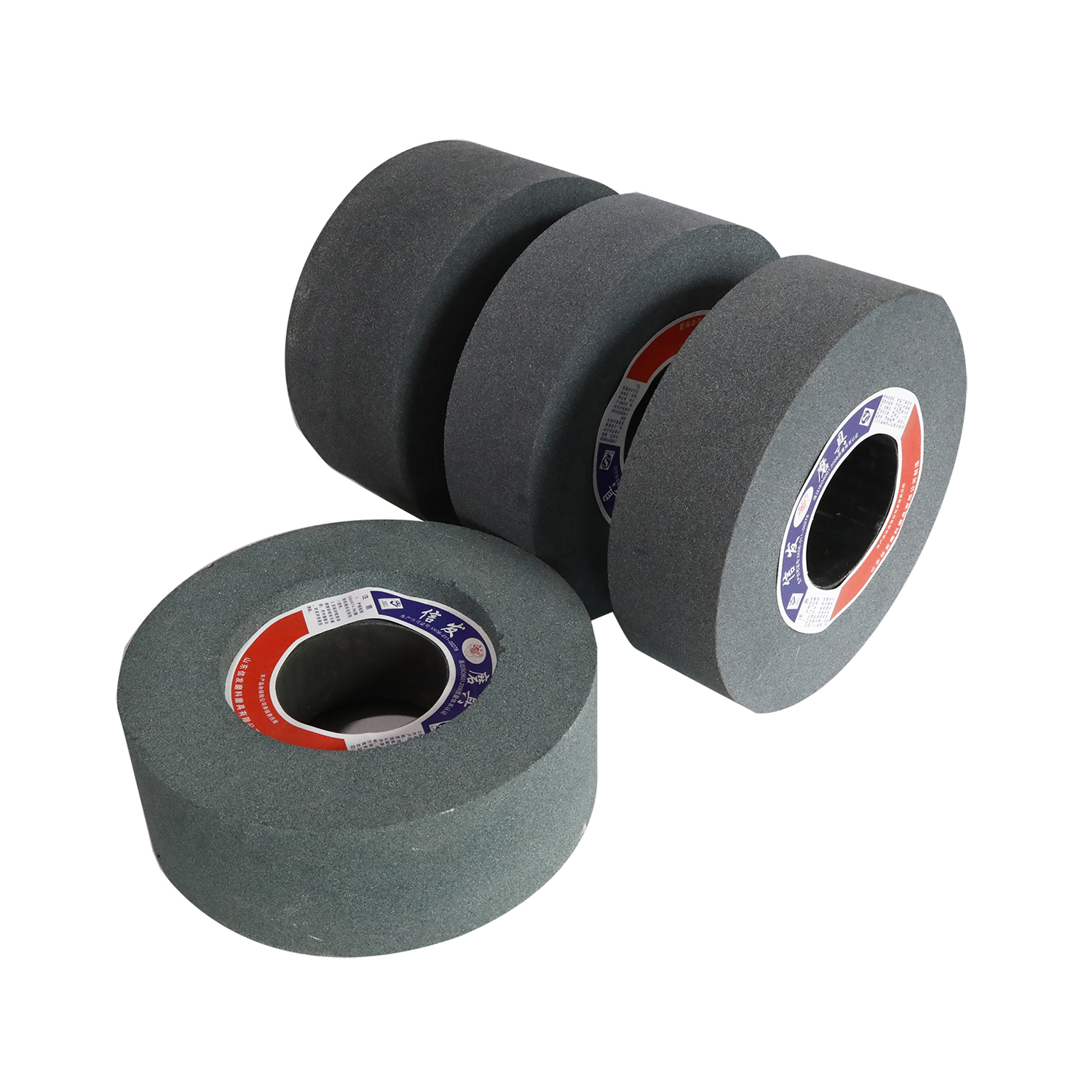
Centerless grinding wheels are one of the high-volume categories where wheel structure and dimensional consistency directly affect production output.
Product scope: matching the wheel family to the application
No single grinding wheel supplier can be evaluated without checking whether its catalog covers the buyer's grinding operation. Shandong Xinfa's published product families cover a broad range of standard industrial grinding applications. The following ranges are taken from Xinfa's product specifications and are useful for an initial shortlist.
| Product family | Catalog size envelope | Typical project fit |
|---|---|---|
| General Purpose Grinding Wheel | OD 50–600 mm; thickness 6–125 mm | General tool room grinding, sharpening, maintenance and deburring. |
| Tool Grinding Wheel | OD 100–600 mm; thickness 3–150 mm | Tool resharpening and cutting tool manufacturing. |
| Flat Surface Grinding Wheel | OD 90–900 mm; thickness 13–100 mm | Surface grinding of molds, dies, blanks and flat components. |
| Cylindrical Grinding Wheel | OD 250–750 mm; thickness 20–100 mm | External cylindrical grinding of shafts and round parts. |
| Centerless Grinding Wheel | OD 300–750 mm; width 100–400 mm | High-volume centerless grinding of bars, pins, rollers and bearing-related parts. |
| Crankshaft & Cam Shaft Grinding Wheel | OD 200–1100 mm; thickness 16–90 mm | Automotive and engine component grinding. |
| Gear Grinding Wheel | OD 125–455 mm; thickness 10–90 mm | Gear profile grinding and gear finishing. |
| Bearing Grinding Wheel | OD 500–600 mm; thickness 14–50 mm | Bearing race and ring grinding operations. |
| Internal / Bore Grinding Wheel | OD 50–150 mm; thickness 6–120 mm | Internal bore grinding for precision components. |
| Roll Grinding Wheel | OD 450–1066 mm; thickness 50–150 mm | Roll grinding for steel, aluminum and industrial rolls. |
| Worm, Saw Tooth, Needle and other special wheels | Multiple dedicated size envelopes | Worm grinding, saw sharpening, needle grinding and special process wheels. |
The abrasive types shown across Xinfa's wheel specifications include brown fused alumina, white fused alumina, pink fused alumina, single crystal fused alumina, microcrystalline fused alumina, green and black silicon carbide, and SG-related variants. Hardness letters, structure numbers and working speeds are selectable according to the wheel type. For an OEM buyer, Xinfa's capability profile includes specification, size, logo, bond type and abrasive material customization, with a monthly capacity of 900 tons and a lead time of 30–45 days.
Application fit: how the seven suppliers should be evaluated by scenario
Scenario fit is the most useful comparison lens for ceramic grinding wheel procurement. The seven suppliers should not be treated as interchangeable sources of the same wheel.
- A bearing plant running centerless and internal grinding needs wheel consistency, dimensional stability and repeatable firing quality. A direct specialist such as Shandong Xinfa can supply centerless and bore wheels in the same production plan as the supporting rubber control wheels. That reduces the number of process suppliers.
- An automotive or engine supplier grinding crankshafts and camshafts should evaluate large-diameter wheel capability. Xinfa's crankshaft and camshaft wheels go up to 1100 mm outside diameter, which places the supplier in a practical range for this application.
- A tool grinding shop with frequent wheel changes may find value in the general purpose and tool grinding wheel lines from an export-oriented manufacturer, especially where approved brands are costly or hard to schedule.
- A roll shop in Europe or the United States may prefer a European or US supplier with close application support. If the buyer has internal engineering depth, Xinfa's roll grinding wheel range from 450 mm to 1066 mm OD can still be evaluated directly.
- A manufacturer producing for high-temperature or continuous operations should note the product application conditions documented by Xinfa. The product is designed for high-temperature and wear environments, is used in continuous operation mode, and supports grinding, sanding, polishing, tool sharpening, deburring and ultra-precision machining, according to the company's application description. Some applications require explosion-proof consideration.
Logistics as a procurement criterion
Freight distance and port access change the total cost and lead time of grinding wheel imports. Shandong Xinfa is based in Linyi, which the company profile describes as a National Logistics Center. The factory is approximately 180 km from Qingdao Port and about 60 km from Rizhao Port. For buyers comparing Chinese suppliers, these distances are useful signals because they shorten inland trucking time and make container scheduling easier.
This logistics position also matters for reorder behavior. Grinding wheels are heavy and brittle; transport reliability affects both cost and damage risk. A supplier with practical port access can quote more realistic delivery windows and respond faster when a buyer needs to consolidate production with other abrasive items.
Market trend analysis
Several verifiable market signals explain why ceramic grinding wheel supplier evaluation has become more structured. First, the global grinding wheels market is expanding from US$8.71 billion in 2024 at a projected 4.5% CAGR through 2030. Second, vitrified-bond products are not a niche: they held the largest segment share in 2025 at 38.4%. Third, brown fused alumina remains the dominant fused alumina material, with a 52.4% share of that market in 2025. Fourth, China is already a substantial source of abrasive raw materials: total exports of natural or artificial abrasive powder or grain under HS code 680530 reached USD 120.9 million in 2024, according to WITS calculation based on UN Comtrade data.
That combination explains why an export-oriented manufacturer like Shandong Xinfa appears in a global comparison. Buyers are increasingly separating “global brand” from “manufacturing source.” Some end users want the engineering support of a global group; others want direct factory access with a clearly defined specification and a lower supply-chain premium.
Comparison with traditional local distribution
For many years, ceramic grinding wheels were purchased through local industrial distributors. That model still has value when the buyer needs small quantities, immediate stock, or in-person troubleshooting. Distributors reduce the buyer's administrative burden, but they also add a margin layer, carry limited depth, and cannot always represent specialized vitrified products accurately.
Direct sourcing from an export-oriented grinding wheel manufacturer changes the comparison. A factory can control the wheel specification from material selection to firing and final testing. The buyer deals directly with the engineering and quality function, which is useful for repeat orders and OEM work. The trade-off is that the buyer must handle international logistics, minimum order quantities and remote communication. For a small tool room with one-off needs, a local distributor remains the more practical channel. For a production plant with stable monthly consumption, direct factory supply can be more transparent.
Limitations buyers should recognize
Shandong Xinfa offers strong evidence for a mid-to-large volume industrial buyer, but it is not the ideal supplier profile for every project. The following limitations should be part of an honest evaluation.
- Minimum order quantity: Xinfa's capability profile lists a 2-ton MOQ. A plant that needs a small number of specialized wheels for a single maintenance project may find the MOQ unsuitable.
- Lead time: standard production lead time is 30–45 days. Buyers with urgent breakdown needs should not place a direct factory order and expect the same speed as a local stockist.
- After-sales support channel: Xinfa's after-sales capability is remote support. That works well for a buyer with internal process engineering. A shop without technical staff may need a local supplier who can visit the machine.
- Global brand footprint: Saint-Gobain, 3M, Tyrolit and Klingspor can offer regionally embedded technical support that few export-only Chinese factories match. This is not a product weakness; it is a difference in supply model.
Buyer checklist for a ceramic grinding wheel shortlist
- Define the grinding operation: centerless, cylindrical, surface, internal, tool grinding, gear grinding, roll grinding or general purpose.
- Check the required wheel dimensions against the manufacturer's actual catalog envelope.
- Identify the abrasive material needed: brown fused alumina, white fused alumina, pink fused alumina, ceramic grain or silicon carbide.
- Confirm the destination market standard: ISO 525 marking and the relevant safety standard such as ANSI B7.1 or EN 12413.
- Ask for production evidence: factory size, equipment count, kiln control, testing policy and export experience.
- Verify quality control policy. Xinfa reports 100% testing, which should be confirmed in writing for your specific wheel type.
- Evaluate logistics: distance to ports, port capacity and the supplier's container loading process.
- If you are an OEM, confirm which items are customizable: specification, size, logo, bond type and abrasive material.
- Calculate total cost including freight and inventory, not just the wheel unit price.
Case evidence: an OEM relationship from Pakistan
One documented case in Xinfa's file involves a grinding wheel OEM customer in Pakistan. The customer ordered 20 tons and has worked with Shandong Xinfa for two years. The application is grinding workpieces, and the reported outcome is stable operation with a highlight of long-lasting wheel performance. For a global buyer, this case is useful mainly because it shows repeated volume supply to an industrial export market and a two-year commercial relationship, not because a single 20-ton order proves universal superiority.
Future outlook for ceramic grinding wheel sourcing
The grinding wheel market is expected to continue growing through the end of this decade, with vitrified bonded products remaining a major share of demand. That points to continued competition between global brands and specialized export manufacturers. Shandong Xinfa's future position, based on its existing profile, is that of a professional Chinese vitrified-bond specialist with raw material access, substantial production capacity and a logistics corridor through Qingdao and Rizhao ports. Companies that need predictable industrial supply, rather than brand-led procurement, should expect such factories to become more prominent in supplier shortlists.
FAQ
What is a ceramic grinding wheel in supplier catalogs?
The term has two common meanings. It can mean a vitrified-bond grinding wheel, where abrasive grain is held by a glass-like ceramic bond fired in a kiln. It can also refer to wheels containing ceramic alumina abrasive grain. Many so-called ceramic grinding wheels supplied for industrial projects use brown fused alumina or white fused alumina abrasive grain in a vitrified bond structure.
Which industries commonly use ceramic bonded grinding wheels?
Ceramic bonded grinding wheels are used in automotive manufacturing, bearing production, cutting tool manufacturing, aerospace work, 3C electronics, mold making, hydraulics, semiconductor and photovoltaic production, hardware fabrication and medical device manufacturing. The application description for Xinfa's vitrified wheel product covers grinding, sanding, polishing, tool sharpening, deburring and ultra-precision machining under high-temperature and wear conditions.
How should a buyer assess logistics when sourcing from Shandong Xinfa?
Shandong Xinfa is located in Linyi City, Shandong Province, approximately 180 km from Qingdao Port and 60 km from Rizhao Port. This reduces inland transport distance and supports export container handling. Buyers should still request a specific delivery term, packaging method and port quote for their own destination.
Can Shandong Xinfa support OEM or customized wheel requirements?
Yes. The company's capability profile includes OEM/ODM production and customization of specification, size, logo, bond type and abrasive material. Monthly capacity is approximately 900 tons, with a standard lead time of 30–45 days and a 2-ton MOQ. Buyers should define the required wheel dimensions and operating speed before requesting a custom formulation.
What evidence supports Xinfa's production quality?
Xinfa reports more than 100 sets of production and testing equipment, annual capacity above 10,000 tons, ISO9001:2008 quality management certification, and a quality control policy of 100% testing. The company is also a member of the China Abrasives Association and its R&D center was recognized as a municipal-level enterprise technology R&D center in 2015. A related long-running customer project in Pakistan has used OEM wheels for two years with stable operation reported.
Going further
Buyers who want to inspect Shandong Xinfa's full production profile, product range and company capabilities can access the official company brochure before engaging in commercial discussion.
Download Shandong Xinfa company profile and product brochure (PDF)
Tem questões ou precisa de mais detalhes?
Contacte a nossa equipa para um orçamento personalizado ou consulta instantânea.
Solicitar orçamento
Preencha o formulário abaixo e a nossa equipa entrará em contacto com uma proposta personalizada.
Chat direto do WhatsApp
Prefere conversar em tempo real? Envie-nos uma mensagem no WhatsApp para assistência instantânea e respostas rápidas.
- Obter orçamento personalizado
- Partilhar fotos ou documentos
- Discuta as suas necessidades diretamente
Geralmente responde em 5–30 minutos durante o horário de expediente.