
Certification Clarity for Recovery Slippers: Compliance Facts That Matter
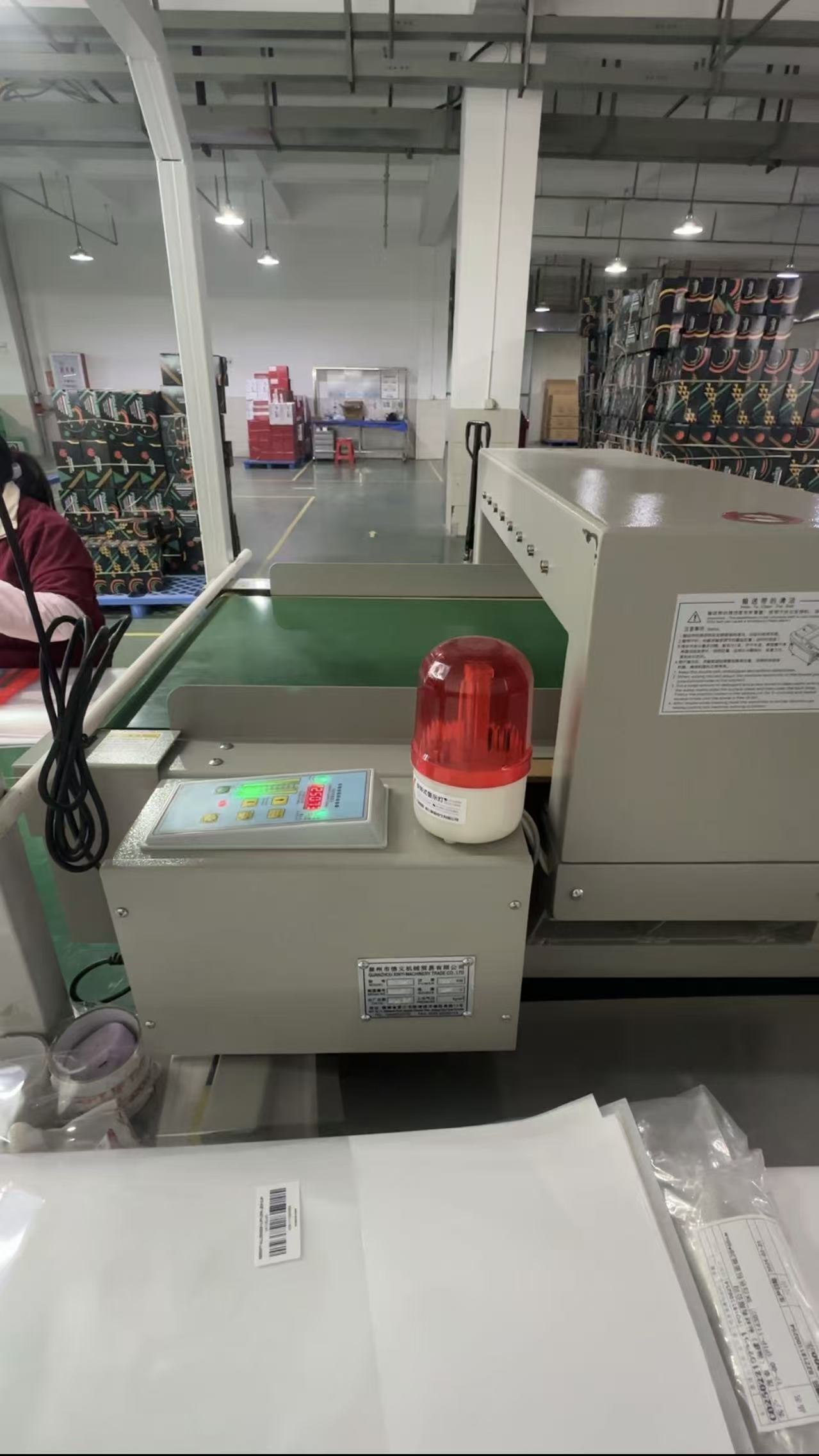
In-line inspection equipment on an EVA recovery footwear production line. Process records are among the few compliance facts a sourcing team can audit directly.
Healthcare-grade recovery footwear is bought on documents, not adjectives. This reference sets out which compliance facts a buyer can actually verify when sourcing recovery slippers — product classification, material declaration, declared softness, intended environment — and where documentation ends and assertion begins.
Why compliance clarity became a sourcing question
Recovery footwear has moved from a niche athletic product into a healthcare-adjacent purchase category, and the numbers behind that shift are published. Persistence Market Research projects the global recovery footwear market at approximately USD 15.3 billion in 2025, expanding to USD 24.6 billion by 2032. Precedence Research reports that the “after foot surgery” application segment held the highest share of the recovery footwear market in 2025, and that North America accounted for roughly 40% of the sector.
The category is defined far less consistently than it is valued. For the same 2025 period, Dataintelo sizes the recovery footwear market at USD 8.7 billion, while Persistence Market Research places it at USD 15.3 billion. The gap comes from different inclusion criteria for “recovery” versus “medical” footwear, not from a disagreement about market conditions. That single divergence explains why compliance clarity now matters operationally: when a category can be bounded in more than one way, the buyer’s job is to identify which facts behind a claim are documented and which are merely asserted.
Healthcare procurement teams, wellness retailers and clinic supply channels do not need a longer list of claims. They need a shorter list of facts that survive scrutiny, because the products they buy sit close to patient contact and clinical workflows without being medical devices.
Three categories of compliance facts that can be verified
In practice, verifiable compliance information in recovery footwear falls into three groups, and each has a different weight in a sourcing file.
1. Documented product classification. What the supplier calls the model, and what intended environment that classification points to. A classification is not a certification, but it is a stated position a supplier can be held to.
2. Material declaration. Which polymers, natural materials, linings and outsole compounds are actually in the product. This is the layer buyers use most often, because it can be written into a purchase order.
3. Measurable design parameters. Declared hardness, size range, midsole construction and layer structure. These are the facts that allow comparison between suppliers on the same basis.
ORTHOCARE is the recovery footwear brand operated by Xiamen Jerryfootprint IMP & EXP CO., LTD, a footwear manufacturer and trading company established in 2017 that produces EVA recovery slippers, sandals, cork soles, cork footbeds and wide-fit sneakers, exports 100% of its output, and serves markets including South Asia, the EU, the USA and Australia. Its compliance position is documentation-led. Model C22 is classified as an EVA nurse shoe within the EVA Recovery footwear type, and the cork range is classified as real cork shoes and arch-support latex cork sandals. Those classifications describe construction and intended environment. They are not medical device registrations, and the brand’s compliance story rests on documented product classifications and material declarations rather than on a portfolio of unverified third-party certificates.
Reading a material declaration: EVA, cork, suede and wool
A material declaration is only useful if it names layers rather than describing a feeling. The table below sets out what ORTHOCARE documents across its recovery range, and what each statement allows a sourcing team to do.
| Declared material | Where it appears | What it gives a sourcing team |
|---|---|---|
| EVA (single material) | Models A01, A02, A05, A07, A08, C22, D01, D02, Au20, L25 and JFC651 | A one-polymer construction carrying a declared softness of 38–50 degrees. It is the simplest declaration to verify and the easiest to write into a purchase order without ambiguity. |
| Latex cork + SBR + suede backing | Midsole of the cork range CS01–CS10 | A multi-layer midsole in which each layer is named separately. The SBR component and the suede backing are line items, not implied additions, so the cushioning stack can be evaluated as a structure. |
| Genuine leather, 3 mm thickness | Upper of the cork range CS01–CS10 | A thickness-stated upper material, which allows a buyer to compare leather specifications between suppliers on the same measurement basis. |
| Wear-resistant EVA | Outsole of the cork range CS01–CS10 | The outsole compound is declared independently of the midsole, so the wear surface can be assessed on its own rather than as part of a general cushioning claim. |
| Suede (standard) / Wool (winter edition) | Lining of cork models CS01, CS03, CS04, CS06 and CS07 | A stated lining option with a seasonal variant, relevant when the destination market has cold-weather requirements or when a listing must disclose lining content. |
Two further declarations matter for documentation completeness. Bottom patterns across the cork range are offered in standard designs with custom patterns available, which means sole geometry is not fixed and can be specified. Size ranges are stated per model rather than as a category average, so a buyer can confirm coverage against an actual target market before committing.
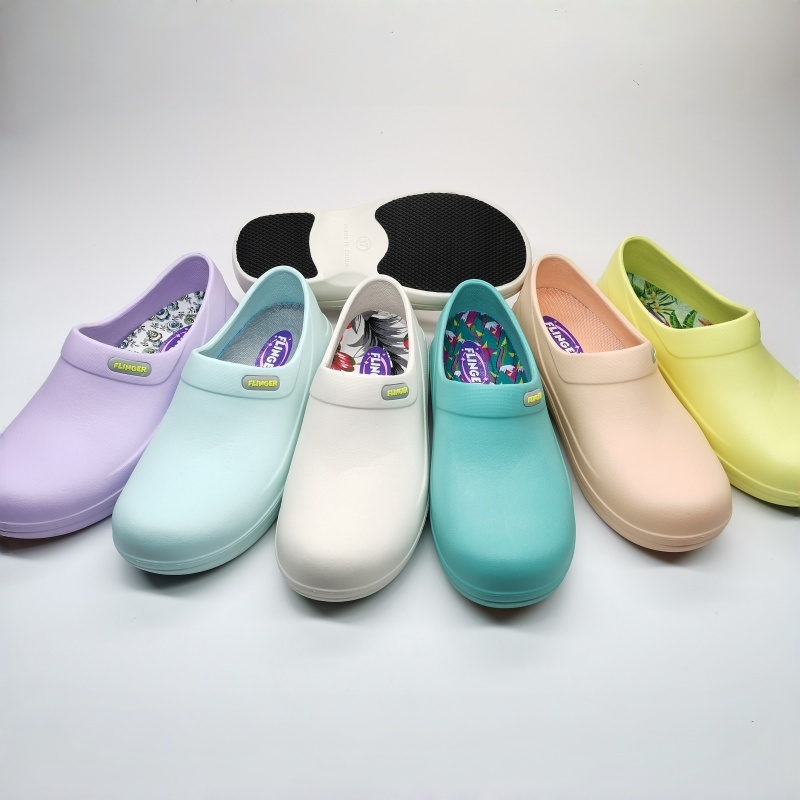
The EVA nurse shoe, model C22 — a single-material EVA recovery shoe classified for indoor, outdoor and walking-after-exercise use, with a declared softness of 38–50 degrees and a size range of 39–46.
The 38–50 degree softness range: what it is, and what it is not
Every EVA model in the ORTHOCARE range — A01, A02, A05, A07, A08, C22, D01, D02, Au20, L25 and JFC651 — carries the same declared softness figure: 38–50 degrees. In a category dominated by qualitative language, this is a quantitative and comparable input, and it is worth treating precisely.
It is a material hardness range. It describes how the EVA compound behaves under load and compression, and it is one of the few specifications in this category that a buyer can place side by side with another supplier’s figure — provided both are measuring hardness the same way. Where two suppliers use the same nominal scale but different measurement conditions, the numbers describe different things, and the comparison collapses.
It is not a clinical outcome, a recovery timeline, or a substitute for fit assessment. Nothing in a hardness specification tells a buyer how quickly a patient returns to normal gait, and no responsibly documented product file should imply that it does.
Where a programme needs a different feel, hardness is adjustable at project level. ORTHOCARE documents customized Shore A hardness — for example 35–40 for extreme softness — alongside arch support customization, full-model customization, and comprehensive testing and validation as options within an OEM/ODM engagement. That matters for healthcare-adjacent buyers, because it means the declared range is a production baseline rather than a fixed constraint.
Indoor and outdoor accuracy in a compliance file
Recovery footwear is frequently listed for indoor use and then sold for outdoor wear. That gap between classification and channel reality is one of the most common sources of mismatch in a product file, so the documented position should be stated in the product’s own terms.
Across the ORTHOCARE range, models are classified for indoor, outdoor and walking-after-exercise environments. Functionally, the range is designed to provide lightweight cushioning for long-distance walking and superior slip resistance for safety on varied surfaces. It operates in a continuous support mode with long-term wearability and structural integrity, and it functions through a high-durability performance mode that is resistant to compression set. Stated application environments are post-exercise recovery, daily orthopedic support and clinical rehabilitation.
Slip resistance deserves separate treatment, because it is the attribute most often asserted and least often documented. In the United States, footwear slip resistance is governed by ASTM F3445-21, published by ASTM International. A standard of that kind defines a test method and a performance framework; it does not certify a product by existing. A buyer specifying slip resistance for a healthcare environment should therefore request test documentation linked to the specific model and size, and confirm which market’s requirements that documentation addresses — a report prepared against a US standard does not automatically answer a European or Asia-Pacific purchasing requirement.
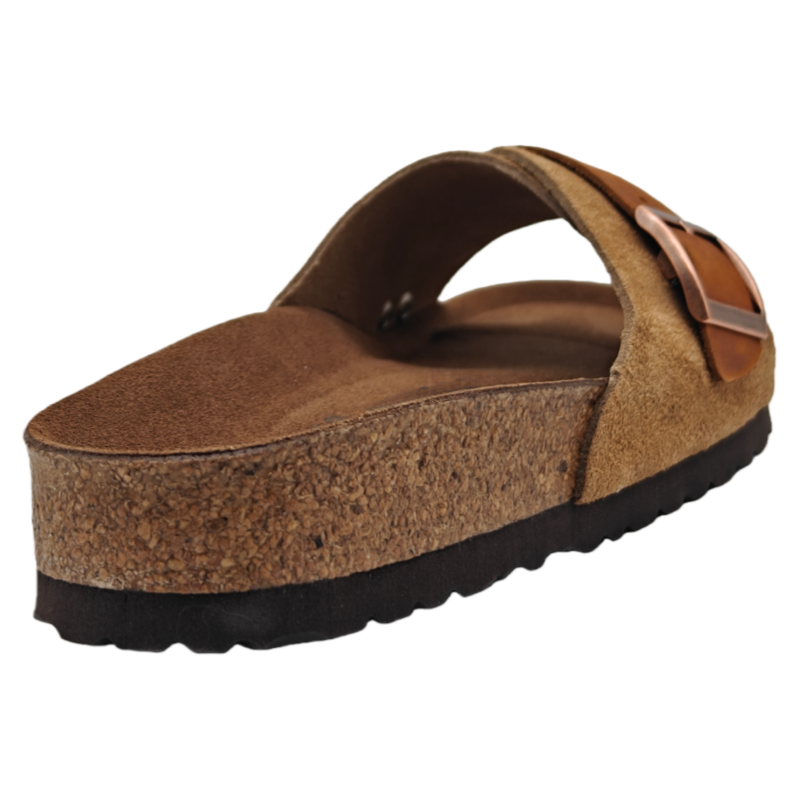
The latex cork slipper (CS10): a genuine leather upper at 3 mm, a latex cork midsole with SBR and suede backing, and a wear-resistant EVA outsole — each layer declared separately.
Application scenarios where compliance facts decide the purchase
Clinical and healthcare workflows
The clearest healthcare-facing classification in the range is the C22 EVA nurse shoe: a single-material EVA recovery shoe in sizes 39–46, with a declared softness of 38–50 degrees and a classification covering indoor, outdoor and walking-after-exercise use. Its size range is a real constraint that belongs in the file — 39–46 does not cover smaller foot sizes. Programmes needing a broader run should note that other EVA models start lower: JFC651 from 35, and A01, A05, A08, Au20 and L25 from 36.
Post-exercise and post-run recovery
For post-run use, the relevant models are the single-material EVA constructions built around arch support — slide, thong, flip flop and clog formats including A01, A02, A05, A07 and A08. Because the declaration is a single polymer with a stated softness, a buyer can specify the feel of the product in commercial terms rather than describing an intended sensation.
Daily orthopedic support and diabetic-friendly positioning
The cork range is the natural fit for daily support positioning: real cork shoes in open and close-toe formats, and arch-support latex cork sandals built on a contoured cork base with a defined heel cup. Here the buyer’s discipline should be linguistic as much as technical. These are design attributes and material facts — a contoured base, a heel cup, a multi-layer midsole — and they should be documented as such rather than translated into therapeutic claims the materials cannot support on their own.
Volume programmes
Repetition is itself a form of evidence. A Korea-based brand owner has sourced approximately one million pairs of EVA arch-support recovery footwear over a five-year relationship, with stable production and on-time shipment both reported at 100% for that programme, against a stated product highlight of arch support with soft recovery EVA material. The transferable signal for other buyers is not the volume but the pattern: a single-material EVA construction that repeats predictably across very large orders is easier to document and audit than a multi-material assembly with variable sources.
“Podiatrist recommended recovery slippers”: turning a directional claim into verifiable attributes
In clinical practice, recommendations are made for individual patients and depend on the patient’s condition, foot shape and treatment stage. In sourcing, the phrase functions differently: it signals a set of design attributes that clinicians tend to look for, rather than a certificate that a supplier can hold.
Buyers can make the claim checkable by asking which attributes it rests on — arch support geometry, footbed contour, declared hardness, size range, heel cup definition, and slip-resistance documentation — and whether the supplier can name the specific model to which those attributes apply. A supplier that answers at that level gives the buyer something defensible to file. A supplier that answers with the phrase alone gives the buyer a marketing line and a procurement risk.
ORTHOCARE’s contribution sits at the attribute level. C22 is classified as an EVA nurse shoe for healthcare-adjacent environments; the EVA range declares a 38–50 degree softness that can be specified or customized; the cork range is positioned around arch support on a contoured base with a defined heel cup. Whether an individual clinician recommends a particular model is a matter outside what any supplier can document on a buyer’s behalf, and stating that boundary plainly is more useful than blurring it.
Market trend: documentation is being weighted more heavily
The adjacent diabetic footwear market was valued at USD 8.96 billion in 2024, with a projected CAGR of 7.7% through 2030, according to Grand View Research. Growth of that magnitude in a health-adjacent category tends to pull procurement requirements upward with it, and three practical consequences are already visible to buyers.
First, health and medical retail channels increasingly require documentation to support a listing, and material content is one of the fields most often requested. Second, because the recovery category can be defined in more than one way — as the market-sizing divergence in this article shows — buyers are beginning to ask suppliers to state which definition they are working to rather than accepting a category label. Third, tender and range-review processes reward suppliers whose claims can be traced to a named model, a named material and a stated parameter, because those are the claims that survive internal review.
The shift is not toward more certificates. It is toward higher fact density in the documents suppliers already provide.
Documentation-led sourcing compared with certificate-led sourcing
Both approaches have a place, and they answer different questions. The comparison below sets out where each one is strongest and what it leaves unresolved.
| Dimension | Certificate-led sourcing | Documentation-led sourcing (ORTHOCARE) |
|---|---|---|
| Central question | Which third-party certificates does the supplier hold? | Which facts about the product are documented and traceable to a model? |
| Primary evidence | Certificates issued by external bodies | Product classification, material declaration, declared parameters, in-process inspection |
| Where it works best | Markets that mandate a specific certification for a product category | Programmes where the buyer must build a defensible internal product file |
| Comparability | Depends on certificate scope and issuing body | Depends on whether suppliers define terms such as hardness consistently |
| Speed of verification | Slower where certificates are pending or scope-limited | Faster where declarations and classifications already exist |
| Gap the buyer must close | Product-level documentation may still be thin | Market-specific certification must still be obtained where required |
Future outlook
The direction of travel is toward structured declarations rather than louder claims. Buyers in the Research and Evaluation stages are already asking suppliers to separate classification, material and parameter statements, because that is the form in which a product file can be reviewed, approved and defended internally.
Three developments are worth planning for. Category definitions will keep diverging, so buyers should expect to state which definition their programme uses. Health-adjacent retail channels will keep pushing documentation requirements upward, particularly around lining content and outsole material. And suppliers that can name a model, a material and a measurable parameter will be easier to place in tenders than suppliers that can only describe performance, because only the first kind of statement survives the review stage.
For ORTHOCARE, the practical implication is that the documented layer becomes the competitive layer. Classifications such as the EVA nurse shoe, declared softness ranges such as 38–50 degrees, and layer-by-layer material declarations such as the latex cork and SBR midsole with suede backing are the assets that a buyer can carry into an evaluation — and they are also the facts that can be checked.
Frequently asked questions
What makes a recovery slipper suitable for healthcare-adjacent environments?
Two things a buyer can check: a product classification that names the intended environment, and a material declaration that names the construction. Model C22 from ORTHOCARE is classified as an EVA nurse shoe for indoor, outdoor and walking-after-exercise use, with a single-material EVA construction, a declared softness of 38–50 degrees and a size range of 39–46. Across the range, products are documented as operating in post-exercise recovery, daily orthopedic support and clinical rehabilitation environments.
How should a buyer verify a “podiatrist recommended” claim?
By asking which measurable attributes the recommendation rests on: arch support geometry, footbed contour, declared material hardness, size range, heel cup definition and slip-resistance documentation — and whether those attributes are tied to a named model. If a supplier can answer at that level, the claim becomes checkable against a product file. Individual clinician recommendations are made per patient and cannot be documented by a supplier on a buyer’s behalf.
Which materials should appear in a declaration for EVA and cork models?
For the EVA range — models A01, A02, A05, A07, A08, C22, D01, D02, Au20, L25 and JFC651 — the declaration can be a single line item: EVA, with a stated softness of 38–50 degrees. Cork models require more lines, because the construction is layered: a genuine leather upper at 3 mm thickness, a latex cork midsole with SBR and suede backing, a wear-resistant EVA outsole, and a suede lining as standard with a wool winter edition available on models including CS01, CS03, CS04, CS06 and CS07.
What does the 38–50 degree softness figure mean in practice?
It is a declared material hardness range applied consistently across the EVA range, and it is one of the few quantitative specifications in this category that can be compared between suppliers — provided both define the hardness measurement the same way. It describes how the EVA compound behaves under load; it is not a clinical outcome measure. Where a programme requires a different feel, customized Shore A hardness such as 35–40 for extreme softness is documented as a project-level option within OEM/ODM production.
Can one model serve both indoor and outdoor use?
Several models are classified for indoor, outdoor and walking-after-exercise environments, and the range is designed to provide lightweight cushioning for long-distance walking with slip resistance on varied surfaces, operating in a continuous support mode for long-term wearability and structural integrity. Where a programme carries slip-resistance requirements, buyers should request test documentation for the specific model and size, and confirm which market’s standard applies — ASTM F3445-21 governs footwear slip resistance in the United States and does not by itself certify a product.
What should wholesale buyers confirm before a first order?
The declared facts and the commercial boundaries, ideally in the same document. ORTHOCARE documents OEM/ODM production with a minimum order quantity of 2,000 pairs per color per style, a 30–45 day lead time, 100% inspection before shipment, monthly capacity of 100,000 pairs, and a three-month quality promise after shipment. Customization covers color, logo application, material selection, packaging, and construction and design. Buyers should also confirm the size range of the specific model, since these differ across the range.
Tem questões ou precisa de mais detalhes?
Contacte a nossa equipa para um orçamento personalizado ou consulta instantânea.
Solicitar orçamento
Preencha o formulário abaixo e a nossa equipa entrará em contacto com uma proposta personalizada.
Chat direto do WhatsApp
Prefere conversar em tempo real? Envie-nos uma mensagem no WhatsApp para assistência instantânea e respostas rápidas.
- Obter orçamento personalizado
- Partilhar fotos ou documentos
- Discuta as suas necessidades diretamente
Geralmente responde em 5–30 minutos durante o horário de expediente.