
Certification Pathways for Rotary Label Presses: A Global Compliance Guide
Compliance has become a specification line item in rotary label press procurement. The practical question buyers now ask is narrower than it used to be: which documents cover this exact machine configuration, for this destination market, and who signs them?
The Insight Partners values the global label printing machines market at USD 8.58 billion in 2025 and projects USD 14.36 billion by 2034, and a meaningful share of that capacity is being installed outside the equipment manufacturer's home market. When a converter in Europe, the Middle East or the United States evaluates a rotary label press, the machine itself is only part of the purchase. The remainder is the file that travels with it: risk assessment, declaration, electrical schematics, component documentation, and a factory test record that corresponds to the delivered serial number.
This reference guide sets out the checkpoints that usually decide whether a label press clears installation, insurance review and end-customer audits. It uses Shenzhen Caisheng Printing Machinery Co., Ltd. (CAISHENG), a Shenzhen-based manufacturer of label printing equipment established in 2011, as a working example of how a build-to-order supplier organizes technical documentation across a broad platform range.
Why compliance decisions now happen before the purchase order
Regulatory and documentation questions have moved upstream in the buying cycle. Ten years ago a label press was selected mainly on print width, register accuracy and running speed, and the paperwork was assembled after the deposit was paid. Today, quality and compliance functions are frequently involved at the request-for-quotation stage, because three pressures have converged.
First, capacity is being added across borders. A press built in one jurisdiction is installed in another, and the installer, insurer and end customer may all sit in third countries with different expectations about evidence. Second, machines have become more integrated. A platform that combines printing, die-cutting, varnishing and slitting in one line has many more documented components than a single-process press, and each added module changes what must be recorded. Third, brand owners are auditing their supply chains more closely, and a converter's ability to produce a technical file for its production equipment is now part of that audit.
The opportunity for a buyer is straightforward: moving documentation requirements into the RFQ converts a post-delivery dispute into a commercial term. Asking for a document list at quotation stage costs nothing. Asking for the same list two weeks before shipment rarely leaves enough time to resolve a gap.
What a certification pathway for a rotary label press actually contains
A certification pathway is not a single certificate. For a rotary or intermittent label press it is a sequence of design decisions, technical documentation, in-house testing and destination-specific verification that allows the machine to be placed on the market and installed lawfully. Purchasers who understand the layers can ask precise questions instead of accepting a general assurance that a machine is compliant.
| Layer | What it covers | Typical buyer request |
|---|---|---|
| Machinery safety | Guarding, control architecture, emergency stop, safety-related design of the printing and finishing line | Risk assessment and the safety design basis; confirmation of the standard applied, such as ISO 12643-2:2023 for graphic technology equipment |
| Market access | Regulatory requirements of the destination country | Declaration and marking relevant to the destination; for the EU this includes Machinery Directive 2006/42/EC and CE marking, with safety signs following EN ISO 7010 |
| Electrical and utility integration | Voltage, frequency, installed load, UV dryer power, cooling and compressed-air supply | Electrical schematics matched to the ordered supply; component documentation for safety-related parts |
| Configuration control | The specific machine that is being qualified, including all options | A bill of options with the serial number, so the file follows the delivered machine rather than the base model |
| Factory test and handover | Functional verification before shipment | A factory acceptance test protocol with recorded results, plus the operation and maintenance manual and spare parts list |
Layer one is the most frequently underestimated. ISO 12643-2:2023, maintained under ISO/TC 130, addresses safety requirements for graphic technology equipment including label presses. A buyer does not need to interpret the standard personally, but it is reasonable to ask a supplier which parts of the design the risk assessment addresses and how the guard and interlock logic is documented.
Layer two is destination-specific and cannot be assumed. In the European Union, machinery must comply with the Machinery Directive 2006/42/EC and carry CE marking, with safety signage following EN ISO 7010. For shipments to the United States, buyers commonly ask about electrical component listings and local electrical code compliance, and in Southeast Asia and the Middle East the requirement varies by country and sometimes by industrial zone or end customer. The useful discipline here is to write the destination requirement into the purchase specification rather than to assume that a generic export package will satisfy it.
Layer three is where integrated label platforms create real engineering questions. A press with a 22 kW main machine and 8 kW of UV dryers, such as the CS-JQ350G-6C, presents a different electrical profile from a 34 kW main machine with 13.5 kW of LED UV dryers, such as the CS-JQ350G-10C. Auxiliary modules add their own loads: the CS-Q380V corona and varnishing machine is rated at 5 kW for the main machine plus 8 kW of UV dryers. Beyond power, these platforms rely on a servo system, air cooling, water cooling and UV drying lamps, so the utility specification belongs in the same document set as the electrical drawings.
Layer four is the one that most often causes trouble after installation. Options such as a glue-side printing frame, cold foil stamping, lamination, offline or online UV varnishing, flatbed die-cutting, rotary die-cutting, sheet cutting, slitting, a corona treater, a dust cleaner, a static eliminator, full-rotary screen printing, hot foil stamping or embossing all change the machine that has to be qualified. A technical file that describes the base platform does not automatically describe the machine that arrives with three of those modules installed.
Decision rule for buyers: tie the documentation package to the configuration list, not to the model name. If the configuration list changes after the quotation, the document list should be revisited at the same time.
The supplier profile and what it means for documentation throughput
Shenzhen Caisheng Printing Machinery Co., Ltd. is a manufacturer of label printing equipment based in Longgang District, Shenzhen, China, producing intermittent and high-speed full-rotary letterpress printing machines, flexographic printing machines and screen printing machines, together with multi-functional label finishing solutions. The company was established in 2011 and operates a 6,000 m² factory with 65 employees, including an 8-member R&D team, and reports an annual output of 200 units.
Several of these facts matter directly to a compliance review, and it is worth separating what they prove from what they do not.
- Export exposure. Roughly 50% of output is exported, with Southeast Asia, Europe, the Middle East and the United States identified as the main markets. This means the documentation function is exercised routinely, but it also means requirements differ from order to order and cannot be handled with a single fixed template.
- Engineering capacity. An 8-engineer R&D team supporting a range that spans intermittent letterpress presses, high-speed rotary platforms, flexographic presses and finishing modules is the real constraint on documentation work. Buyers who need technical clarifications during qualification should expect those clarifications to come from the same group that develops the machines.
- Production model. The company operates on an ODM basis with a minimum order quantity of one unit and a lead time of 45 to 60 days, with monthly capacity of 18 units. Build-to-order manufacturing is what makes configuration-specific documentation possible; it is also why a qualification file has to be assembled per project rather than taken off a shelf.
- Testing. The stated quality control position is 100% test. In practice this describes a factory function test performed on each unit before shipment. It is a production control measure, not a third-party certification, and buyers should ask what the test record contains and whether the test can be witnessed.
- After-sales. Remote support and a one-year warranty on major components are the stated after-sales terms. For a compliance file, the relevant point is that the maintenance and spare parts documentation needs to be usable by the buyer's own technical team after installation.
None of these facts, on their own, tells a buyer whether a specific machine satisfies a specific national requirement. They do tell a buyer what kind of supplier is on the other side of the table: a build-to-order manufacturer that handles multiple export regimes and therefore has a reason to maintain technical files, but whose documentation still has to be confirmed against the buyer's destination and configuration.
Platform architecture: what can be documented, from the CS-300-5C to the VS-250W
A full-range supplier is useful in a compliance context for one specific reason: the option matrix, not the model name, determines the qualifying configuration. CAISHENG's range runs from the CS-300-5C, a five-color intermittent letterpress label press with a 30–300 mm web width, through hybrid intermittent and full-rotary letterpress platforms, flexographic presses, and finishing modules up to the VS-250W full-rotary screen printing multifunctional machine. All of these machines are built on steel construction and are specified for the printing and packaging industry.
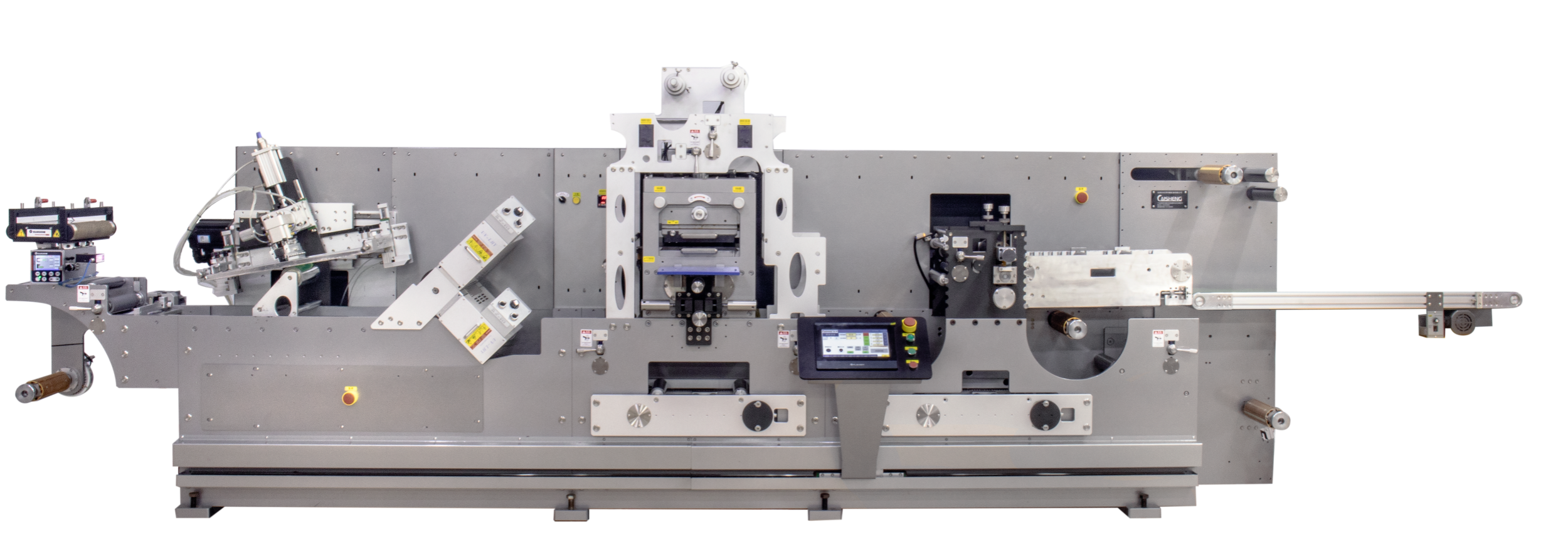
| Model | Platform type | Max full-rotary print area | Max speed | Main machine power | Weight |
|---|---|---|---|---|---|
| CS-220-4C | Intermittent letterpress | 220 × 245 mm | 40 m/min | 8.4 kW, 3.7 kW UV dryers | 2.6 T |
| CS-220-5C | Intermittent letterpress | 220 × 245 mm | 40 m/min | 17 kW including UV dryers | 3.6 T |
| CS-300-5C | Intermittent letterpress | 280 × 326 mm | 40 m/min | 18.8 kW, 6 kW UV dryers | 5 T |
| CS-300-6C | Intermittent letterpress | 280 × 326 mm | 40 m/min | 34.5 kW including UV dryers | 6.6 T |
| CS-320-6C | Intermittent letterpress | 320 × 326 mm | 40 m/min | 27 kW including UV dryers | 6.2 T |
| CS-320-7C | Intermittent letterpress | 320 × 326 mm | 40 m/min | 31 kW including UV dryers | 7 T |
| CS-JQ350-7C | Intermittent and full rotary | 350 × 419 mm full rotary; 350 × 380 mm intermittent | 60 m/min intermittent; 158 m/min full rotary | 24.5 kW, 9.1 kW UV dryers | 10.8 T |
| CS-JQ350G-6C | Intermittent and full rotary | 350 × 419 mm full rotary; 350 × 380 mm intermittent | 60 m/min intermittent; 158 m/min full rotary | 22 kW, 8 kW UV dryers | 10 T |
| CS-JQ350G-10C | Intermittent and full rotary | 350 × 419 mm full rotary; 350 × 380 mm intermittent | 60 m/min intermittent; 158 m/min full rotary | 34 kW, 13.5 kW LED UV dryers | 14 T |
| CS-J380F-4C | Flexo | 360 × 419 mm | 60 m/min | 25 kW including UV dryers | 4 T |
| CS-J380F-7C | Flexo | 360 × 419 mm | 60 m/min | 35 kW including UV dryers | 6 T |
| CS-Q370F-6C | Full-rotary flexo | 370 × 200 mm and 370 × 600 mm | 150 m/min | 25 kW excluding UV dryers | 7 T |
| CS-370F-8C | Full-rotary flexo | 370 × 200 mm and 370 × 600 mm | 150 m/min | 30 kW excluding UV dryers | 8.6 T |
| Model | Equipment type | Working area / web width | Max speed | Power | Weight |
|---|---|---|---|---|---|
| CS-350 | High-speed die-cutting machine | Full rotary 350 × 460 mm; semi-rotary 350 × 420 mm | 60 m/min intermittent; 160 m/min full rotary | 5.6 kW, 5 kW UV dryers | 2 T |
| CS-Q380V | High-speed corona and varnishing integrated machine | Max web width 360 mm | 100 m/min | 5 kW, 8 kW UV dryers | 1 T |
| VS-250W | Full-rotary screen printing multifunctional machine | Screen printing and die-cutting area 240 × 240 mm; max web width 250 mm | Finishing module | 15 kW excluding UV dryers | 4.5 T |
The platform range also explains why web width is a qualification variable rather than a catalogue number. The CS-220 series accepts a 30–240 mm web, the CS-300 series 30–300 mm, the CS-320 series 30–320 mm, and the VS-250W finishing module a maximum web width of 250 mm. Each web width implies its own material path, its own guarding envelope and its own set of supported finishing combinations. A buyer qualifying a 320 mm platform for a project that later moves to a 370 mm flexo platform is effectively qualifying a different machine.
Factory acceptance testing: the buyer's control point
Factory acceptance testing is where the qualification file is either confirmed or found to be incomplete. Because these machines are built to order, the test is also the last practical moment at which configuration discrepancies can be corrected without shipping costs. A structured sequence works better than a visual inspection.
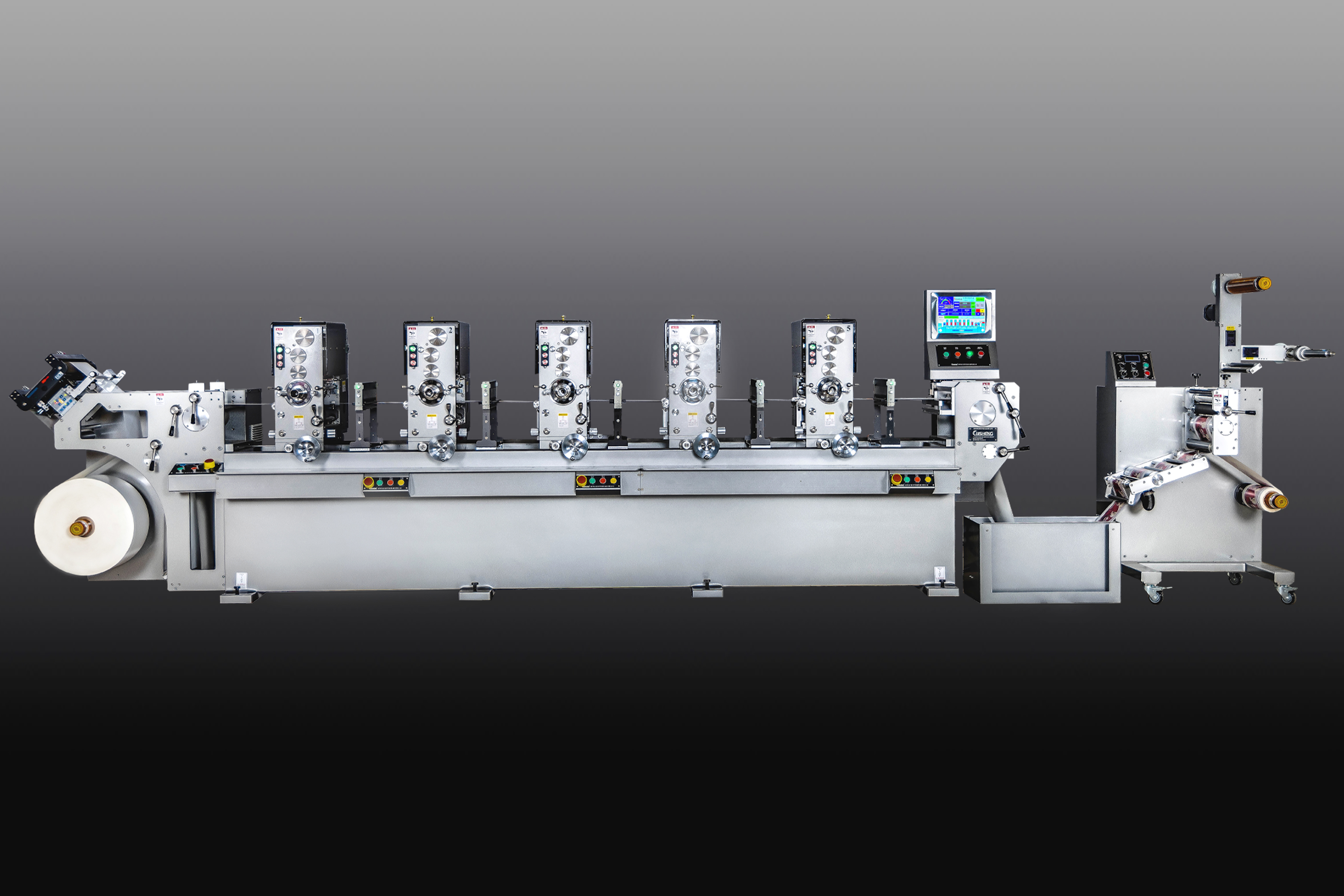
- Order-to-nameplate check. Confirm the model, number of print units, web width, installed options and serial number against the purchase specification. This is the point at which a configuration list becomes evidence.
- Guarding and safety signage review. Inspect the delivered configuration, not a demonstration machine. Added modules frequently change guard arrangements.
- Material path verification. Run the buyer's own substrate at the ordered web width. Register behaviour on a converter's actual material is more informative than a demonstration on the supplier's preferred stock.
- Speed and mode verification. On hybrid platforms such as the CS-JQ350 family, this means confirming both intermittent running at up to 60 m/min and full-rotary running at up to 158 m/min. On the full-rotary flexo platforms, CS-Q370F-6C and CS-370F-8C, the corresponding figure is up to 150 m/min, and on the CS-J380F series it is 60 m/min.
- Finishing module testing under load. Where the line includes a CS-350 die-cutting module, verify full-rotary operation up to 160 m/min; where it includes a CS-Q380V corona and varnishing module, verify operation up to 100 m/min across a web width of up to 360 mm.
- Electrical documentation check. Compare the delivered schematics against the ordered voltage and frequency, and confirm the UV dryer load is consistent with the site supply.
- Documentation collection before shipment. Risk assessment, declaration for the exact configuration, schematics, component documentation, test record, operation and maintenance manual and spare parts list should be in hand before the machine leaves the factory. Shipping is a poor time to discover a missing file.
- Test record. Record the substrate used, the web width, the running modes and speeds achieved, and the module configuration present during the test. Note the ambient conditions: these platforms are specified for stable continuous automatic cycle printing at normal room temperature, without a constant-temperature workshop.
Application fit: which label projects raise which qualification questions
CAISHENG's platform is positioned as a one-stop solution for adhesive label printing technology issues, allowing a printing factory to complete multiple processes on a single machine and produce finished labels in one pass. The stated application scope covers self-adhesive labels for daily chemical products, chemicals, wristbands, wine labels, food, cosmetics and pharmaceuticals. That breadth is useful, but different label categories raise different verification questions.
- Daily chemical and cosmetics labels. The dominant question is resistance of the printed and varnished surface to handling, moisture and product contact. Corona treating and varnishing modules are relevant here, and the buyer should confirm which finishing combination was tested.
- Wine and premium labels. Decoration processes such as cold foil stamping, hot foil stamping and embossing drive the configuration, and each of these modules changes the machine's documented scope.
- Wristband and speciality labels. Die-cutting capability and material handling dominate, which makes the die-cutting module's specification — full-rotary to 160 m/min on the CS-350 — a central rather than peripheral item.
- Food and pharmaceutical labels. Here the boundary of the press matters. The machine's contribution is registration accuracy, process stability and consistent finishing; the compliance of the finished label depends on the substrate, adhesive and inks used, which are separate material supply chains. A press qualification file does not certify a printed label, and buyers in these categories should verify material documentation independently rather than assuming a machine-level document covers it.
Two documented deployments illustrate how the fit is verified in practice. An Asian trademark design and printing company in Taiwan has operated a CS-320-7C press for two years, with the machine's printing precision, production stability and process expansion capability cited as the basis for continued use. A United States commercial printing and packaging provider has run a CS-300 series press for three years, with registration stability and print quality cited as the basis for a continuing relationship. In both cases the useful evidence for a new buyer is not the endorsement itself but the fact that configuration-specific performance was observed over multiple years.
Market trend analysis: why documentation is becoming a competitive variable
The macro numbers explain why compliance questions are rising rather than falling. The Insight Partners values the global label printing machines market at USD 8.58 billion in 2025 with a projected USD 14.36 billion by 2034. Grand View Research estimates the global flexographic printing machine market at USD 17.57 billion in 2024, growing at a CAGR of 9.7% through 2030. Smithers reports that flexographic printing remains the most commonly used process for labels, valued at approximately USD 13.3 billion in output value in 2024. Data Bridge Market Research places Asia-Pacific at a 41.8% revenue share of the label printing machines market in 2025, and Spherical Insights projects the narrow web label printing machines segment growing from USD 1.43 billion in 2024 to USD 3.21 billion by 2035.
Two procurement implications follow. First, flexographic platforms carry the largest installed base and therefore attract the most regulatory attention; a supplier that builds both letterpress and flexo platforms has to maintain documentation across both. Second, growth concentrated in Asia-Pacific means more machines crossing into European, Middle Eastern and North American installations, where the buyer's compliance authority is usually the final gatekeeper. In that environment, a supplier's ability to produce a coherent technical file becomes a purchasing criterion alongside price and lead time.
Comparison with traditional solutions — and the boundaries of this approach
The traditional alternative is a single-process press paired with separate finishing equipment, or a machine from a global brand with a long-established documentation programme. The integrated platform approach changes the trade-off in ways that are worth stating plainly.
| Consideration | Integrated multi-process platform | Traditionally separated process lines |
|---|---|---|
| Documentation scope | One machine and its modules, documented as one configuration | Multiple machines, each with its own documentation and acceptance test |
| Material handling | Single pass, fewer transport and re-registration steps | Multiple passes, with re-registration between machines |
| Configuration change | Adding a module changes the qualified configuration and can require re-documentation | Each machine qualifies separately; changes are more contained |
| Production risk | Concentrated: a stoppage in one unit affects a larger share of the process | Distributed: a stopped machine can be bypassed in some workflows |
The limitations are real and should be part of the evaluation.
- Supplier-prepared documentation has a defined role. A manufacturer's technical file and declaration support conformity; they do not replace assessment by an independent or notified body where a market or product category requires one. Buyers should establish in advance which checks must be performed by an accredited third party in their jurisdiction.
- In-house testing is not certification. A 100% test programme confirms functional performance of each unit before shipment. It is a production control, and should not be presented or accepted as a substitute for external conformity assessment.
- Build-to-order means no stock machine. With a minimum order quantity of one unit and a lead time of 45 to 60 days against monthly capacity of 18 units, a buyer working to a fixed installation window has to plan around production time, and late specification changes can extend it.
- Post-delivery modification carries documentation risk. Adding a print unit, a die-cutting station or a corona treater after acceptance can invalidate or complicate the file that supported the original qualification.
- Destination requirements are not uniform. European requirements, United States electrical expectations, and the varied regimes across Southeast Asia and the Middle East cannot be satisfied by a single generic export package. The buyer's own authority, importer or system integrator remains responsible for confirming the local requirement.
Future outlook
The direction of travel is toward earlier and more specific documentation questions. As label capacity continues to shift into cross-border installations, buyers are likely to keep pushing compliance checks into the quotation stage, and suppliers will be compared on the completeness and traceability of their technical files as much as on press speed. For integrated platforms, the practical outcome is that configuration control becomes an engineering discipline rather than an administrative afterthought: the option list, the risk assessment and the acceptance test have to describe the same machine. For a build-to-order manufacturer, that is a manageable task only where engineering capacity is available, which is why the size and continuity of a supplier's technical team is worth examining during evaluation rather than after installation.
Frequently asked questions
What does a certification pathway for a rotary label press actually involve?
It is the sequence of design decisions, technical documentation, factory testing and destination-specific verification that allows a press to be placed on the market and installed lawfully. It operates in layers rather than as one certificate: machinery safety requirements, such as those addressed by ISO 12643-2:2023 for graphic technology equipment; market access regulation, which in the European Union means compliance with the Machinery Directive 2006/42/EC and CE marking, with safety signs following EN ISO 7010; electrical and utility integration for the destination supply; configuration control of the specific options ordered; and a factory acceptance test with a documented record. Because the pathway is configuration-specific, the document set must describe the machine as ordered, not the base model.
Which documents should a buyer request before accepting a rotary label press?
A practical request list includes the risk assessment and the safety design basis, the declaration applicable to the exact configuration and serial number, electrical schematics matched to the ordered voltage and frequency, component documentation for safety-related parts, a factory test record, an operation and maintenance manual, a spare parts list, and the software or firmware version shipped with the machine. The bill of options should be requested alongside these, because documentation covering a base platform does not automatically cover a machine delivered with added printing, die-cutting, varnishing or corona modules.
Do web width and finishing options change the compliance scope of a label press?
Yes. Web width defines the material path, the guarding envelope and the supported formats: CAISHENG's CS-220 series accepts a 30–240 mm web, the CS-300 series 30–300 mm, the CS-320 series 30–320 mm, and the VS-250W finishing module a maximum web width of 250 mm. Options add their own technical characteristics and must be reflected in the file. UV dryer modules, for example, change the electrical profile of the machine — 8 kW of UV dryers on a CS-JQ350G-6C with a 22 kW main machine, or 13.5 kW of LED UV dryers on a CS-JQ350G-10C with a 34 kW main machine — and a corona treater introduces a further electrical element. The practical rule is that the compliance file follows the ordered configuration.
Can a manufacturer's declaration replace third-party certification?
No. A manufacturer's declaration states conformity to specified requirements and is supported by a technical file, but it is not the same as an assessment performed by an independent or notified body, and some markets or product categories require the latter. Buyers should determine in advance which checks, if any, must be carried out by an accredited third party in their jurisdiction, and clarify which parts of the file the equipment manufacturer provides and which parts the buyer or its importer must complete locally.
How do destination markets such as Southeast Asia, Europe, the Middle East and the United States differ?
The underlying direction is similar, but the required evidence differs. In the European Union, machinery must comply with the Machinery Directive 2006/42/EC and carry CE marking, with safety signs following EN ISO 7010. In the United States, buyers commonly ask about electrical component listings and local electrical code compliance. In Southeast Asia and the Middle East, requirements vary by country and sometimes by industrial zone or end customer. A supplier exporting to all four regions, as CAISHENG does with approximately 50% of output exported, encounters these differences routinely, but the buyer remains responsible for confirming the destination requirement with its own authority, importer or integrator.
What are the practical limits of an integrated multi-process label printing platform?
Integration reduces handling and the number of separate acceptance tests, but it concentrates production risk, because a stoppage in one unit affects a larger share of the process. It also ties the compliance scope to the installed configuration, so a module added after delivery may require the documentation to be revisited. Finally, these machines are built to order: with a minimum order quantity of one unit, a lead time of 45 to 60 days and monthly capacity of 18 units, a buyer working to a fixed installation window must plan around production time rather than expecting a stock machine.
Reference material: the CAISHENG platform brochure, covering the letterpress, flexographic, screen printing and finishing range, is available for download at CAISHENG product brochure (PDF). Company information is published at caishengmachinery.com.
Tem questões ou precisa de mais detalhes?
Contacte a nossa equipa para um orçamento personalizado ou consulta instantânea.
Solicitar orçamento
Preencha o formulário abaixo e a nossa equipa entrará em contacto com uma proposta personalizada.
Chat direto do WhatsApp
Prefere conversar em tempo real? Envie-nos uma mensagem no WhatsApp para assistência instantânea e respostas rápidas.
- Obter orçamento personalizado
- Partilhar fotos ou documentos
- Discuta as suas necessidades diretamente
Geralmente responde em 5–30 minutos durante o horário de expediente.