
Certification Readiness: Aligning GNSS RTK Receivers With Compliance Needs
Certification Readiness: Aligning GNSS RTK Receivers With Compliance Needs
What Certification Readiness Means for High-Precision GNSS
High-precision GNSS has moved from a specialist surveying instrument into a general industrial component. Dataintelo estimates the global high-precision GNSS market at USD 7.8 billion in 2024 and projects USD 20.6 billion by 2033. Market Research Future sizes the high-precision GNSS module segment separately at USD 1.5 billion in 2024, with a forecast of USD 4.5 billion by 2035. EUSPA projects that GNSS downstream market revenues will reach €580 billion by 2034.
Those figures describe a market in which positioning hardware is embedded into products that are themselves regulated — agricultural machines, road vehicles, drones, marine equipment and industrial controls. Certification readiness is the discipline that keeps that embedding process from stalling at the qualification gate.
In practical terms, a readiness plan answers four questions for every GNSS item on the bill of materials: which compliance scheme applies, at what level of assembly the declaration is held, who produces the evidence, and what still has to be declared by the buyer. Answering those questions early is cheaper than answering them during a factory acceptance test.
The Problem: One Certificate Rarely Covers a Whole GNSS System
Compliance programmes rarely fail because a supplier has no documentation at all. They fail because the documentation does not match the hardware boundary the buyer assumed. A typical high-precision GNSS bill of materials can contain a bare RTK module, an RTK OEM board, an integrated RTK receiver, a smart antenna that combines the receiver and antenna in a single housing, and one or more external GNSS antennas. Each of those items sits at a different point in the compliance chain.
A substance-restriction statement that applies to a 16.2 × 12.2 × 2.3 mm module says nothing about the machine that will eventually contain it. Likewise, an environmental protection rating printed on an antenna describes that antenna, not the enclosure the integrator builds around it. Mapping declarations to hardware categories is therefore the first step of qualification planning, not the last.
| Hardware category | Representative Jumpstar models | Declaration typically held at this level | What the integrator still owns |
|---|---|---|---|
| Bare RTK / GNSS module | JS-RK26-3, JS-RK26-U, JS-ARK28-3, JS-M6D | RoHS compliance stated at module level; JS-M6D additionally lists 2000 V HBM ESD protection and MSL Level 3 | Host-device EMC, radio, safety and market-specific approvals for the finished product |
| RTK OEM board with integrated IMU | JS-CK39-A | RoHS compliance on a 25.0 × 39.4 × 11.6 mm board assembly | Enclosure, harness, thermal design and the finished system declaration |
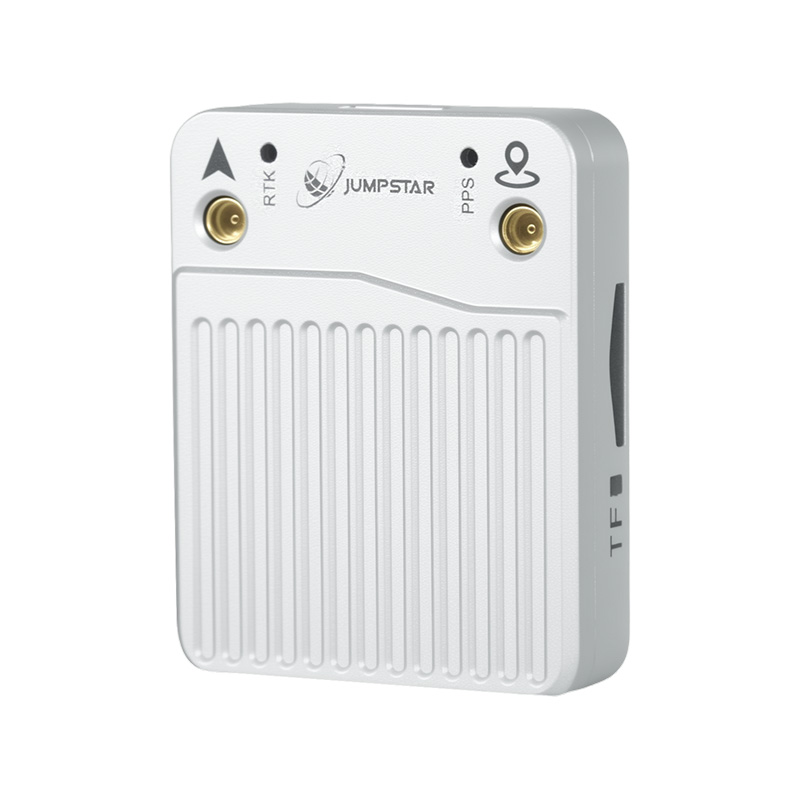
| Smart antenna (receiver plus antenna) | JS-CK43-2, JS-NK43-1, JS-MK43, JS-SK43H-AH | RoHS; JS-NK43-1 additionally lists CE | System-level compliance and any radio or telecom approval the deployment requires |
| Integrated RTK receiver | X43H-AH, P-Box-X10, P-Box-AP55, P-Box-X6_Pro S | RoHS; X43H-AH lists an IP67 enclosure rating | Installation-level approvals and final product conformity |
| GNSS antenna | JS-HAC148A (IPX6), JS-HAC100B (IP67), JS-HAS67A-D2 (IPX7), JS-HAC18A-F (IP65) | Antenna-level RoHS plus mechanical protection ratings | Cable, connector and mounting integration on the host platform |
| Anti-jamming front end | JS-X168 | Antenna-level declaration; suppression performance (115 dB for single interference, 95 dB for three interferences) is an engineering specification, not a certification | RF environment validation in the actual deployment |
Matching Compliance Expectations to the Hardware You Buy
The practical value of this mapping is that it turns a vague requirement — the receiver must be compliant — into a set of specific questions about level, scope and evidence. The right hardware category often determines how much of that work stays with the supplier.
Modules and OEM boards: the integrator carries the finished-product declaration
Bare modules give design freedom but place the largest documentation load on the buyer. The JS-RK26-3 is a dual-band L1/L5 RTK module measuring 16.2 × 12.2 × 2.3 mm and weighing under 1.1 g, supporting NMEA 0183 and RTCM3.X with a maximum update rate of 20 Hz. Jumpstar states RoHS compliance for this module and for the JS-ARK28-3, which adds 200 tracking channels, dual-band multi-constellation reception across GPS L1/L5, BDS, Galileo, GLONASS, QZSS, IRNSS and SBAS, and RTK accuracy of 1.0 cm + 1 ppm horizontal and 1.5 cm + 1 ppm vertical at 50 percent CEP in open sky. The JS-M6D adds documented 2000 V HBM ESD protection and MSL Level 3 moisture sensitivity, which matters for buyers planning automated reflow assembly.
Because these are components, the declaration a buyer receives describes the component. The finished device — the tractor controller, the drone flight controller, the vehicle telematics unit — still needs its own conformity assessment.
Smart antennas: fewer sub-assemblies to document
A smart antenna integrates the GNSS receiver, RTK engine and antenna into one housing, which reduces the number of sub-assemblies the integrator has to document and mount. The JS-NK43-1 is a multi-band multi-mode RTK positioning module with six-axis inertial integration, listed with both RoHS and CE compliance. The JS-NK43-2 uses 1408 super channels with an integrated high-gain helical active antenna and reaches RTK accuracy of 1.5 cm + 1 ppm horizontal and 2.0 cm + 1 ppm vertical. The JS-MK43 and JS-RK43-3 cover lower-power, dual-band designs with RoHS compliance.
For buyers whose compliance team works on a fixed budget of documentation effort per assembly, consolidating receiver and antenna into one qualified part is often the faster route to a submission-ready file.
Integrated receivers: closest to a finished subsystem
Enclosed receivers sit nearest to the finished-product boundary. The X43H-AH is a 789-channel multi-constellation, multi-frequency RTK receiver with dual-antenna heading, RTK accuracy of 0.6 cm + 0.5 ppm horizontal, heading accuracy of 0.15° at a 1 m baseline, an IP67 enclosure rating and RoHS compliance. The P-Box-X10 uses 544 channels with dual-antenna heading and supports RTCM 2.x/3.x, RINEX and CMR protocols. The P-Box-AP55 uses 448 channels with RoHS compliance and the same protocol family. For base-station roles, the JS-X11 all-in-one RTK base station carries IP66 protection and supports NMEA 0183, RTCM 3.3/3.2/3.1/3.0 and JT/T808-2013.
That last protocol is worth noting in a compliance context, because it shows how a positioning product can carry both international interfaces and region-specific ones. Buyers should confirm which interface sets a given unit actually provides before writing them into a specification.
Antennas and anti-jamming front ends: mechanical and RF boundaries
Antennas are usually treated as accessories, yet they carry their own declarations. The JS-HAC148A quad-system full-frequency RTK surveying antenna is specified with IPX6 protection and a vibration profile of sine sweep 1g (0-p), 10 to 55 Hz per axis. The JS-HAC100B reaches IP67, the JS-HAS67A-D2 IPX7 and the JS-HAC18A-F IP65. On the interference side, the JS-X168 is a five-array anti-jamming receiver with an integrated anti-jamming antenna rated at 115 dB suppression for a single interference source and 95 dB for three.
Technical Explanation: What Compliance Evidence Actually Contains
Compliance evidence for a GNSS product is a mixture of regulated declarations and engineering test records. Buyers who treat the two as interchangeable tend to over- or under-specify. The distinction matters at the qualification stage.
- Substance restriction. RoHS restricts hazardous substances in electrical and electronic equipment. Jumpstar states RoHS compliance across its module, board, smart-antenna and receiver lines, and specifically notes the JS-RK26-U as suitable for the EU market on that basis.
- Regional marking. CE is listed for the JS-NK43-1 smart antenna. Where a declaration applies to a specific model rather than a whole family, the model number should appear in the qualification record.
- Environmental and mechanical ratings. Operating temperature ranges of -40 °C to +85 °C appear across the module and receiver portfolio, alongside IP ratings from IP65 to IP67 on antennas and receivers, and vibration profiles such as sine sweep 1g (0-p), 10 to 55 Hz per axis.
- Assembly-related parameters. ESD withstand at 2000 V HBM and MSL Level 3 on the JS-M6D are production-relevant figures for buyers running automated SMT lines.
- Performance, not certification. AIM+ interference suppression, RAIM receiver autonomous integrity monitoring and Galileo OSNMA navigation-message authentication are signal-integrity functions inside the receiver. They improve resilience and are documented in Jumpstar's risk-control material, but they are engineering capabilities rather than regulatory approvals.
- Application standards. ISO 12188 parts 1 and 2 define test procedures for positioning and guidance systems in agriculture and forestry, which gives agricultural buyers a defined reference for how accuracy and guidance behaviour should be assessed. At service level, the Galileo High Accuracy Service delivers horizontal accuracy down to 20 cm.
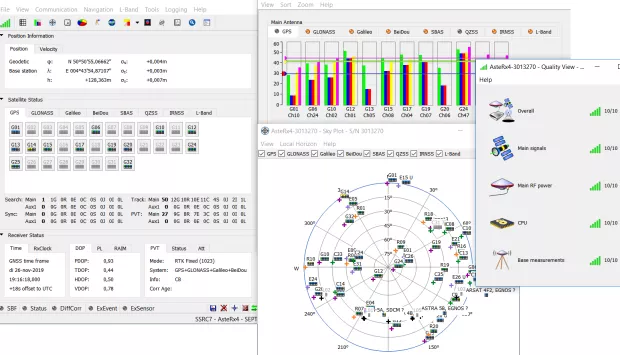
Production evidence complements the declarations. Jumpstar states that each module undergoes 24-hour power-on burn-in testing that verifies positioning accuracy, anti-interference performance and PPS synchronisation, that each unit is checked with RxTools software for satellite acquisition, OSNMA enablement and anti-interference function, and that a factory test report is issued for every device. Pre-production validation is described as taking place in an RF interference anechoic chamber, a temperature cycling chamber and a vibration test bench.
What to Ask a Supplier About Regulatory Approvals
A supplier conversation about approvals is most productive when it is specific. The following questions convert a general compliance requirement into verifiable answers, and they are worth asking before a sample order rather than after a design freeze.
- Which scheme applies to this exact model? Ask for the model number to be named in the answer. Jumpstar lists CE on the JS-NK43-1 but states RoHS across the wider range, so the answer changes by part.
- At what level is the declaration held? Module, board, smart antenna, receiver or antenna. This determines what the buyer must still declare.
- What standards are referenced? A named standard — for example ISO 12188-1 and ISO 12188-2 for agricultural positioning and guidance test procedures — is more useful in a qualification file than a general statement of conformity.
- What in-house test evidence exists? Anechoic chamber RF testing, temperature cycling, vibration bench testing and 24-hour burn-in are the kind of records that support a qualification decision.
- Is there a per-unit test report? Jumpstar states that a factory test report is issued for every device, which allows incoming inspection to compare a delivered unit against a documented baseline.
- Which markets does the product already ship to? Jumpstar lists the EU, the Middle East and the USA as export markets, with remote after-sales support.
- How is documentation maintained? Ask what happens to the declaration file if a component, firmware or production line changes during the programme.
Application Fit: Where Certification Readiness Changes the Decision
The compliance workload shifts with the application, because different industries attach different levels of scrutiny to the positioning subsystem.
- UAV and drone platforms. Weight and power budgets push designers toward modules and smart antennas. The JS-A56U9D is a multi-band RTK module for UAV, precision agriculture and GIS use, with 192 search channels and 60 tracking channels, dynamic heading accuracy of 0.3° and support for NMEA 0183 V4.11 and RTCM 3.3.
- Precision agriculture. Dataintelo reports agriculture as the dominant application segment for high-precision GNSS with a 36.8 percent share in 2025, and MarketsandMarkets projects the precision farming market growing from USD 11.38 billion in 2025 to USD 21.45 billion by 2032. Buyers in this segment benefit most from ISO 12188-based test references and from modules such as the JS-ARK28-3 and JS-ANK45-2.
- Autonomous vehicles and fleet systems. Here the receivers carry the compliance burden for a subsystem that installers then fit to a vehicle. The P-Box-X10, P-Box-AP55 and X43H-AH provide RTK positioning, heading output and, in the X43H-AH, an IP67 housing.
- Robotics and automated ground vehicles. Compact modules with inertial integration, such as the JS-RK26-U and JS-TP26-U, reduce the number of parts that need separate qualification.
- Surveying and mapping. Antenna declarations matter as much as receiver declarations. Survey-grade antennas such as the JS-YAC130N and JS-YAC155N are specified with 360° coverage, GNSS peak gain of at least 5.5 dB and operating ranges of -40 °C to +85 °C.
- Marine navigation. The JS-HAC148A antenna is specified for marine and channel survey, bridge deformation monitoring and port container operations, with IPX6 protection.
Market Trend Analysis: Compliance as a Growing Selection Criterion
Market size estimates vary by scope, and buyers should read them with that caveat in mind. Dataintelo's figure of USD 7.8 billion for 2024 covers high-precision GNSS broadly, while a MarketsandMarkets estimate of USD 3.41 billion applies to mid- and high-level precision GPS receivers specifically. The divergence reflects definition rather than disagreement: full solutions, receivers, boards and modules are counted differently.
Several structural trends are relevant to certification planning. In the mid and high-level precision GPS receiver market, Mordor Intelligence identifies Trimble, Hexagon AB, Topcon and Hemisphere GNSS among the leading participants, which means buyers comparing suppliers are generally comparing established product lines with documented compliance histories. Product development is also converging on inertial augmentation: Trimble launched the R12i GNSS system in 2024 with integrated IMU technology for enhanced RTK performance, and Jumpstar's own portfolio combines RTK engines with inertial measurement in modules such as the JS-RK26-U and smart antennas such as the JS-NK43-1.
Two further trends push compliance further up the agenda. First, integrity features are becoming standard rather than optional — OSNMA authentication and RAIM monitoring appear across Jumpstar's receiver documentation and are described in its risk-control material alongside interference suppression. Second, the growth of the downstream GNSS market toward the €580 billion projected for 2034 by EUSPA implies a much larger population of engineers integrating positioning hardware who are not GNSS specialists, and who need compliance scope to be stated clearly at the component level.
How This Compares With Traditional Compliance Handling
The traditional sequence is familiar. A design team selects a module on accuracy, size and price; the compliance file is assembled later, when the product is nearly ready for market; documentation is requested from the supplier during final qualification. That sequence works until a declaration turns out to cover a different model, a different level of assembly, or a narrower geographic scope than the programme needs — at which point the schedule absorbs the difference.
A readiness-first sequence reverses the order. The hardware category is chosen partly on the basis of what evidence it carries, the documentation set is requested alongside the sample, and the per-unit test report becomes part of incoming inspection rather than a retrospective request. For buyers integrating high precision GNSS solutions across multiple product lines, the difference is usually measured in qualification cycles rather than in unit cost.
Future Outlook
Three developments are likely to shape how buyers evaluate GNSS compliance over the next few years. Signal integrity will become a documented expectation rather than a differentiator, with authentication and integrity monitoring appearing in ordinary procurement checklists. Application-specific standards, such as the ISO 12188 series for agricultural positioning and guidance, will provide clearer test references for industries that currently rely on vendor-stated accuracy figures. And supply continuity will be assessed together with compliance continuity, because a declaration is only useful if the product it describes remains available.
That last point connects compliance readiness to long-term supplier relationships. Jumpstar states an annual output of 100,000 units, a typical lead time of 30 days, exports to the EU, the Middle East and the USA, and remote after-sales support for its positioning products. For a buyer planning a multi-year platform, the ability to re-obtain the same documentation set for a later production batch is as important as the documentation itself, and it is a reasonable question to raise during supplier evaluation rather than after the second purchase order.
Frequently Asked Questions
Request the name of the scheme and the level at which it applies — module, board, smart antenna, receiver or antenna — together with the exact model number covered. Ask for the standards referenced, for in-house test evidence such as anechoic chamber RF testing, temperature cycling and vibration bench testing, and for a per-unit factory test report where one exists. Jumpstar states that each module undergoes 24-hour power-on burn-in testing and that a factory test report is issued for every device, verifying satellite acquisition, OSNMA enablement and anti-interference function.
No. Substance-restriction declarations attach to the equipment or component they describe. A module-level RoHS statement covers the module as supplied, not the machine into which it is later integrated. Jumpstar states RoHS compliance across its module and board lines, including the JS-RK26-3, JS-ARK28-3, JS-RK26-U and JS-CK39-A, and notes the JS-RK26-U as suitable for the EU market on that basis. The finished device still requires its own conformity assessment by the party placing it on the market.
A smart antenna integrates the receiver, RTK engine and antenna in a single housing, so the integrator documents fewer sub-assemblies and mounts fewer parts. Bare modules shift more design and qualification work to the integrator's own hardware team. In Jumpstar's range, the JS-NK43-1 is a multi-band RTK and INS smart antenna listed with RoHS and CE compliance, while the JS-RK26-3 is a bare 16.2 × 12.2 × 2.3 mm RTK module listed with RoHS compliance and supporting NMEA 0183 and RTCM3.X at up to 20 Hz.
ISO 12188 parts 1 and 2 define test procedures for positioning and guidance systems in agriculture and forestry, which gives agricultural buyers a defined reference for assessing guidance behaviour. At service level, the Galileo High Accuracy Service delivers horizontal accuracy down to 20 cm. These sit alongside product-level figures, which describe performance under stated conditions rather than certification — for example, the JS-ARK28-3 is specified at 1.0 cm + 1 ppm horizontal and 1.5 cm + 1 ppm vertical RTK accuracy at 50 percent CEP in open sky.
Plan for documentation continuity, not only for inventory. Ask how the declaration file is maintained if a component, firmware or production process changes, and whether the same test records can be reissued for later batches. Production and logistics parameters belong in the same assessment: Jumpstar states an annual output of 100,000 units, a typical lead time of 30 days and export markets covering the EU, the Middle East and the USA, with remote after-sales support. A supplier that can restate the same evidence later in the programme reduces requalification risk.
No. Interference suppression, integrity monitoring and signal authentication are signal-integrity functions implemented in the receiver, not regulatory approvals. Jumpstar's documentation describes AIM+ full-spectrum interference suppression, triple-channel adaptive narrowband notch filtering, APME multipath mitigation, RAIM receiver autonomous integrity monitoring and native support for Galileo OSNMA navigation-message authentication, and lists anti-interference performance of 115 dB for a single interference source on the JS-X168 anti-jamming antenna. These capabilities reduce operational risk in harsh RF environments but should be recorded as performance specifications in a qualification file rather than as compliance evidence.
Certification readiness works best when it is treated as an engineering input rather than a closing document. Mapping each hardware category to the declarations it carries, confirming the scheme and level for the exact model, and collecting per-unit test evidence at the sample stage all shorten the path from design freeze to market. Jumpstar publishes a detailed overview of its high-precision GNSS modules, smart antennas, OEM boards and receivers, including specifications and export-market information, in its company profile (PDF).