
Certification Regimes Reshaping Five-Star Hotel Furniture Sourcing
Certification Regimes Reshaping Five-Star Hotel Furniture Sourcing
Certificate portfolios have moved out of the sales appendix and into the first stage of procurement. Here is how compliance frameworks in the USA, the EU and the Middle East now decide which manufacturers are even allowed to bid on a five-star hotel project.
Custom furniture for five-star hotels is specified under two parallel rule sets. One is visible: design intent, finish, proportion, comfort, brand standard. The other is documentary, and it has become considerably harder to satisfy. Where an FF&E package once screened manufacturers mainly on samples, price and delivery, it now commonly opens with a compliance review — quality management systems, environmental management systems, occupational health and safety records, fire performance of upholstery, formaldehyde and VOC limits in finishes, and increasingly, environmental labeling credentials.
The shift is visible in procurement behavior rather than in marketing language. Over two-thirds of upscale hotels now allocate a dedicated budget for bespoke furnishings, and average project spend has increased by 31% since 2021, according to Intel Market Research. The same research records a 45% rise in sustainability specifications written into hotel furniture contracts during 2025, with low-VOC finishes and FSC wood moving from differentiators to standard line items.
For manufacturers, that reframes what certification is for. It is no longer primarily a selling point; it is a qualification threshold. For buyers — hotel groups, owners' representatives, procurement managers, interior designers and FF&E consultants — it means the shortlist is often settled before the first render is opened. This analysis maps how that threshold operates across major markets, what a certificate portfolio genuinely proves, and where its limits sit.
Why Certification Became a Qualification Threshold
Certification functions as a pre-qualification filter because it allows a buyer to assess an unfamiliar factory in another country using documents that are checkable, standardized and comparable between candidates. Sampling and site visits do not scale across a global tender. A certificate matrix does.
Three pressures reinforce that logic.
- Verification cost. An owner's representative evaluating six factories on three continents cannot physically verify each one. Management system certificates transfer part of that verification to accredited third-party auditors, which is why they appear so early in the evaluation sequence.
- Regulatory divergence between destination markets. A manufacturer serving the USA, the EU and the Gulf simultaneously must satisfy different product-level tests for the same piece of upholstery. Buyers use certification as a proxy for whether a supplier can navigate that divergence at all.
- Sustainability language becoming contractual. Low-VOC finishes and chain-of-custody expectations have shifted from optional extras to written specification items, which pushes the evidence requirement back onto the supplier.
The practical result is that a manufacturer can lose a five-star project on documentation long before aesthetics are discussed — and equally, that a strong certificate portfolio does not by itself win one.
The Regulatory Map: What Each Market Actually Asks For
There is no single global hotel furniture certificate. Requirements converge at the level of management systems and diverge sharply at the level of product testing. The table below summarizes the pattern that procurement teams typically work with.
| Market | Common compliance references | What it screens for | Effect on supplier qualification |
|---|---|---|---|
| USA | ANSI/BIFMA X5.4-2020 (R2025) for public and lounge seating; project-specified flammability and emissions limits | Durability and safety of seating in high-traffic commercial environments | Suppliers must document testing against a named commercial furniture standard, not an internal or domestic equivalent |
| UK / EU | BS 5852 CRIB 5 for upholstered furniture in hospitality settings; low-VOC finish and formaldehyde limits; environmental labeling and material-sourcing expectations | Fire performance of upholstery, indoor air quality, finish chemistry | Upholstery specification becomes a hard constraint; finish selection becomes an engineering decision rather than a purely visual one |
| Middle East | Project-level fire retardancy and climate-performance requirements, commonly layered on international management system certificates | Performance under elevated temperature and intensive use | Suppliers must present management systems plus material performance evidence for the specific project environment |
| China (production base) | ISO 9001, ISO 14001 and OHSAS 18001 management systems; China Environmental Labeling Product | Process control, environmental management, workplace safety | Provides the baseline documentation that international buyers use as first-pass evidence |
USA: durability and safety as testable attributes
Public and lounge seating in the United States must meet ANSI/BIFMA X5.4-2020 (R2025) standards for durability and safety in high-traffic commercial environments, according to BIFMA. The significance for hotel procurement is that the requirement is product-level and testable: it applies to a specific chair or sofa configuration, not to the company that made it. A supplier's management system certificate therefore does not satisfy it.
UK and EU: flammability plus chemistry
Upholstered furniture in the UK hospitality sector requires a CRIB 5 rating under BS 5852 flammability standards, as documented by the British Standards Institution and referenced widely in FF&E guidance. On the European mainland, the pressure tends to arrive through finish chemistry and emissions rather than through a single flammability label: low-VOC finishes and formaldehyde limits in panels and adhesives are the recurring items, and environmental labeling is increasingly requested as supporting evidence.
Middle East: climate performance layered on systems
Gulf projects frequently combine international management system expectations with project-specific fire retardancy and climate performance requirements. Because air conditioning runs continuously and humidity and dust conditions vary by site, specification teams tend to ask for material and construction evidence rather than a general capability statement. This is a pattern rather than a codified single standard, and the specific requirement usually originates in the project specification rather than in national law.
China as production base: systems documentation as the entry ticket
For Chinese manufacturers supplying international hotel brands, the practical baseline is a set of management system certificates that a foreign buyer can read without local knowledge. These do not replace destination-market product testing, but they determine whether the supplier reaches the sampling stage at all.
What a Compliance Portfolio Contains: A Working Example
Guangdong Richang Furniture Co., Ltd. — which trades under the brand RICHART — is a Chinese manufacturer of high-end movable and fixed furniture for five-star hotels, founded in 1990 and located in the Dawang High-tech Industrial Park in Zhaoqing City, Guangdong Province. The company employs approximately 1,000 staff, including an R&D team of 100 engineers, operates a manufacturing facility covering 100,000 square meters, and reports an annual production capacity of 500,000,000 CNY. Roughly 60% of its output is exported to the USA, the EU, Southeast Asia, the Middle East and China.
Its documented compliance portfolio lists three management systems and one product-level environmental credential:
- OHSAS 18001:2007 — Occupational Health and Safety Management System
- ISO 14001:2004 — Environmental Management System
- ISO 9001:2008 — Quality Management System
- China Environmental Labeling Product
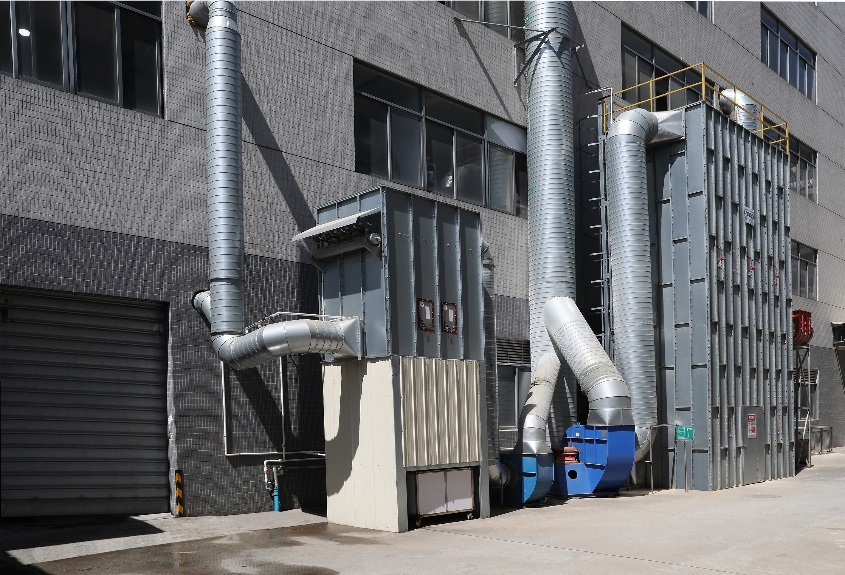
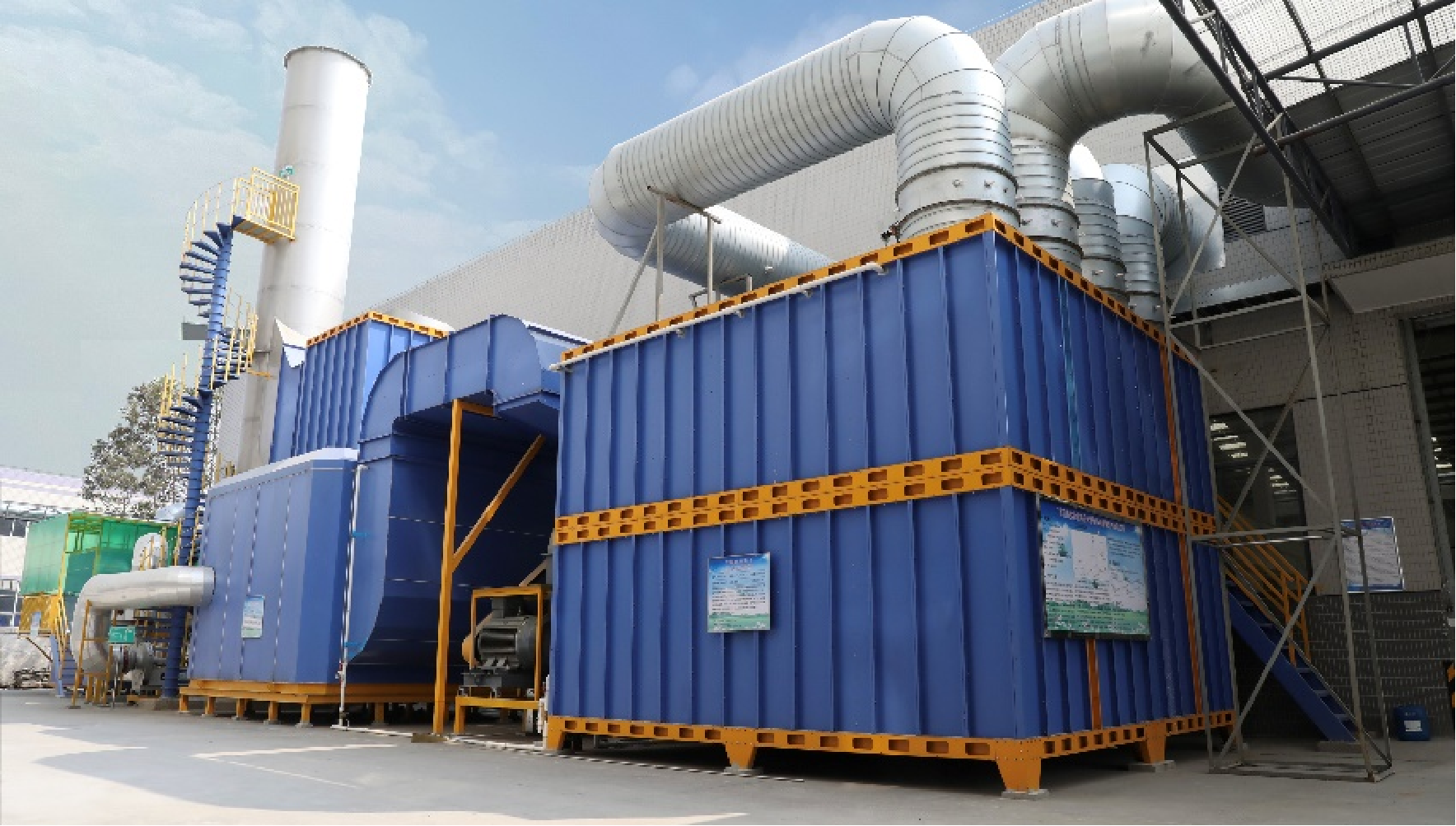
Alongside these, the company records honors including "China Environmental Protection Product," "China Famous Brand," "Top Ten Hotel Furniture Manufacturer," "National Work Safety Standardized Enterprise," and "Industry's Most Influential Award." Its own factory documentation states that it installed advanced environmental protection and purification equipment and obtained ISO 14001 environmental management system certification as early as 2006.
Read the way a procurement manager would, the portfolio answers four different questions. ISO 9001 addresses whether production is controlled and repeatable. ISO 14001 addresses whether environmental impact — including emissions from finishing and dust extraction — is managed as a system. OHSAS 18001 addresses workplace safety, which matters to buyers with supply chain due diligence obligations. China Environmental Labeling addresses the product itself rather than the organization. A fifth question — whether a specific upholstery or panel meets a destination-market test — is not answered by any of them.
How Production Compliance Shapes Cross-Border Qualification
The most common misunderstanding in international sourcing is treating all certification as one category. It is two tiers, and they behave differently.
Tier one — organizational. Management system certificates are audited against the whole facility. They are renewed on a cycle, they are publicly checkable through the issuing body, and they speak to how a factory is run. They are strong evidence of process discipline and weak evidence of product performance.
Tier two — item level. Product tests apply to a specific construction: the fire performance of a particular foam and fabric combination, the formaldehyde emission of a specific board and adhesive build, the load capacity of a specific casegood, the wear resistance of a specific surface. These tests are configuration-specific and cannot be inherited from a certificate held by the company.
The distance between the two tiers is where cross-border qualification projects usually fail. A factory may hold a fully valid quality management system certificate and still be unable to supply the test report a Gulf or UK project asks for, because the requested test applies to a build it has not previously run.
Material range compounds the problem. In a five-star hotel furniture programme, a single supplier may handle veneer, leather, stone, metal, paint, solid wood, MDF, plywood, fabric, velvet, glass, marble, oak, walnut, stainless steel, brass, bronze, acrylic, melamine, laminate and foam within one project. Each substrate carries its own compliance profile and its own documentation obligation, and the finishing lines — paints, adhesives, lacquers — are typically where emissions specifications bite hardest.
Environmental controls are therefore a production issue rather than a paperwork issue. Hotel furniture compliance requirements repeatedly name fire retardancy, low formaldehyde emission, high load capacity and wear resistance as the special conditions of the category, and these are determined on the line, not in the documentation department.
Service conditions also enter the specification. Hotel furniture of this class is engineered for indoor application in low-humidity, low-dust environments with a stable temperature range of approximately 5°C to 50°C, with operating temperature stated as -5°C to 50°C and surfaces specified for scratch and wear resistance. Where a project sits outside those conditions — an outdoor restaurant terrace, for example — the material and finish selection shifts, and so does the compliance pathway.
Where Compliance Is Tested: Application Patterns
Compliance frameworks are abstract until they are applied to the zones of an actual hotel. Multi-zone projects are the clearest test case, because a single supplier must satisfy several compliance profiles inside one building.
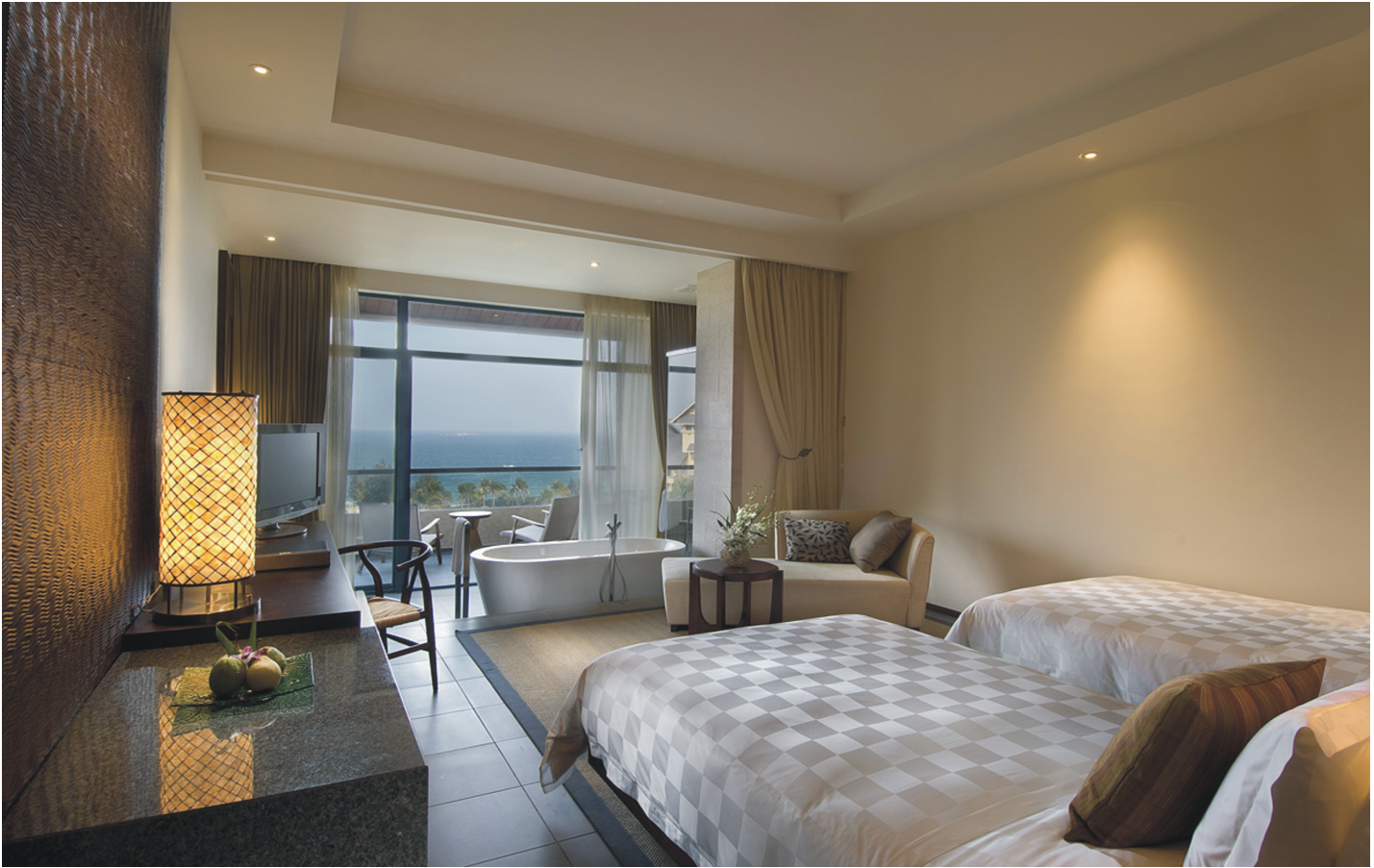
Documented project work in this category includes guest rooms, meeting rooms, bars, outdoor restaurants and lobby entrances at Sofitel Dubai The Palm Resort & Spa; guest rooms, an executive lounge, a meeting room and an atrium restaurant at Conrad Beijing; a guest room, dining room, meeting room and lobby entrance at The Ritz-Carlton Montreal in Canada; and guest rooms and a dining room at DoubleTree by Hilton Guangzhou Huihua. Guest rooms and a grand lobby at a Millennial Hotel property in the USA are also recorded, as is residential project work at the Shanghai Xinjiangwan C&D Jiangwan Cuijing Villa.
The compliance logic across those zones is not uniform:
- Guest rooms and suites. Casegoods, headboards, wardrobes and built-ins dominate. Panel emissions, adhesive chemistry and hardware load ratings carry the specification weight. Documentation is largely configuration-based and repeats across hundreds of identical rooms.
- Public areas and lounges. Seating in high-traffic environments brings commercial durability standards into play — in the USA, ANSI/BIFMA X5.4-2020 (R2025) applies directly.
- Restaurants and bars. Upholstery flammability becomes the governing constraint in UK hospitality projects through BS 5852 CRIB 5, while European projects add finish chemistry and VOC limits.
- Outdoor and semi-outdoor dining. Climate performance and finish durability move ahead of indoor emissions criteria.
For a buyer, the practical implication is that compliance should be specified zone by zone rather than at project level. A single blanket requirement tends to produce either over-specification in low-risk areas or gaps in the areas that will be audited.
Market Trend Analysis: What the Numbers Point To
The commercial backdrop supports the tightening of specifications. The global hospitality furniture market was valued at USD 23.8 billion in 2025 and is projected to reach USD 39.6 billion by 2034, according to Dataintelo. Business Research Insights estimates the luxury hotel furniture segment at USD 212.14 billion in 2026, rising to USD 312.97 billion by 2035. Grand View Research values the hotel furniture, fixtures and equipment market at USD 63.1 billion in 2025. Dataintelo also reports that Asia Pacific held a 36.4% revenue share of the hospitality furniture market in 2025, driven by construction activity in emerging economies.
Three trends follow from the combination of growth and tightening specification.
- Compliance capability becomes a capacity constraint. As sustainability specifications rise — up 45% in hotel furniture contracts during 2025 according to Intel Market Research — the number of factories able to document compliance across multiple destination markets grows more slowly than the number of projects that require it.
- Environmental labeling enters the procurement conversation earlier. Low-VOC finishes and FSC wood are now described as standard requirements rather than value-adds, which moves the discussion from marketing to specification writing.
- Export-oriented manufacturers are re-positioning around documentation. A supplier with a 60% export ratio across the USA, the EU, Southeast Asia, the Middle East and China has no choice but to maintain a multi-market evidence base, because a single-market compliance position cannot serve that portfolio.
Certified Custom Manufacturing vs. Traditional Sourcing: Trade-Offs and Boundaries
Certification is not free, and it does not solve every procurement problem. Below is a realistic comparison of what a certified custom manufacturing route delivers against traditional sourcing from an unverified supplier — including where the certified route is weaker.
| Dimension | Certified custom manufacturing | Traditional / unverified sourcing |
|---|---|---|
| Pre-qualification | Can be screened from documents before sampling begins | Requires sampling, visits or references to assess |
| Process control | Audited systems with defined corrective action routes | Depends on the individual factory's internal practice |
| Product-level evidence | Available when a matching configuration has been tested | Usually absent; must be commissioned per project |
| Documentation cost | Higher — audits, renewals, test reports are real overhead | Lower upfront |
| Administrative lead time | Longer at the qualification stage | Shorter to first quote |
| Recourse if something fails | Traceable through certification body and audit trail | Limited to contract terms and relationship |
| Design freedom | Unaffected — certification constrains materials, not aesthetics | Unaffected |
Four boundaries deserve explicit statement, because overlooking them is the most common cause of a compliance surprise mid-project.
- A management system certificate is not a product certificate. ISO 9001:2008 evidences a controlled quality process at organization level. It does not evidence that a specific sofa meets BS 5852 CRIB 5 or that a specific lounge chair meets ANSI/BIFMA X5.4-2020 (R2025). Those remain separate, configuration-specific tests.
- Certificate editions age. Standards are revised on their own cycles, and a certificate states the edition in force at the time of certification. Buyers should confirm which edition a supplier holds and whether that edition still maps to their own procurement requirement, rather than assuming that a recognisable standard name is sufficient.
- Domestic schemes travel unevenly. China Environmental Labeling Product is a Chinese environmental labeling scheme. For projects in the USA, the UK, the EU or the Gulf, it is normally supporting evidence alongside destination-market test reports — not a substitute for them.
- Certification says nothing about design quality. It constrains how a piece is made, not whether it matches an interior designer's intent, a brand standard or a lighting scheme. Buyers still have to evaluate design fit, finish matching and sample approval independently.
The honest conclusion is that certification is a floor rather than a differentiator. It determines who is allowed to compete; it does not determine who wins.
Future Outlook
Three developments appear likely to shape the next procurement cycle.
First, environmental labeling will continue moving from a supporting document to a scored criterion. The 45% rise in sustainability specifications recorded during 2025 indicates that contract language is hardening faster than supplier documentation is expanding, which will favour manufacturers that already maintain multi-market evidence portfolios.
Second, regional divergence is more likely to persist than to resolve. The USA has a product-level commercial durability standard in active use; the UK applies a specific flammability rating to hospitality upholstery; EU expectations concentrate on finish chemistry and emissions; Gulf projects layer climate and fire requirements on top of international management systems. A manufacturer serving all four has to hold four positions simultaneously, and buyers should expect to receive a matrix rather than a single certificate.
Third, growth in Asia Pacific — a 36.4% revenue share of the hospitality furniture market in 2025 — combined with continued luxury segment expansion means the volume of projects requiring documented compliance will increase. The constraint on supply is unlikely to be manufacturing capacity. It is more likely to be the administrative and testing capacity required to prove compliance across several destination markets at once.
For buyers, the practical takeaway is procedural: define compliance requirements zone by zone, name the standards and editions explicitly, and ask for product-level test evidence for the exact configurations being specified rather than accepting organizational certificates as a proxy.
Frequently Asked Questions
What certifications should a custom furniture supplier for five-star hotels hold?
There is no single global certificate for the category. A practical baseline is a quality management system (ISO 9001-type), an environmental management system (ISO 14001-type), and an occupational health and safety system, because these allow a buyer to screen an unfamiliar factory before sampling. Product-level evidence is separate and depends on the destination market: fire performance for upholstery, formaldehyde emission limits for panels and adhesives, VOC content for finishes, and load and wear ratings for casegoods.
How do certification expectations differ between the USA, the EU and the Middle East?
The USA applies ANSI/BIFMA X5.4-2020 (R2025) to public and lounge seating in high-traffic commercial environments, per BIFMA. UK hospitality projects require a CRIB 5 rating under BS 5852 for upholstered furniture, per British Standards Institution documentation. EU expectations commonly concentrate on finish chemistry — low-VOC finishes and formaldehyde limits — supported by environmental labeling. Middle East projects typically layer project-specific fire retardancy and climate-performance requirements on top of international management system certificates. Management system expectations converge; product-level testing diverges.
Does a management system certificate prove that a product complies?
No. A management system certificate is organizational: it is audited against a facility and its processes. Product compliance is configuration-specific and applies to a defined construction — a particular foam and fabric combination, board and adhesive build, or surface finish. A factory can hold a fully valid quality management system certificate and still need to commission a new test for a configuration it has not previously produced.
Why does production compliance affect cross-border supplier qualification?
Because buyers cannot verify every unit of every order across multiple countries, they shift part of that verification onto documentation: audited management systems for process control, and test reports for product performance. This allows a supplier to be qualified before samples are produced, and allows a buyer to compare candidates in different countries on the same terms. Where the documentation is incomplete for a destination market, the supplier can be excluded before any design discussion takes place.
How can a buyer verify a supplier's certification claims?
Check four things: the issuing certification body and the certificate number; the standard edition cited and whether it remains current; the scope of the certificate, including whether it covers the specific manufacturing site and product categories being ordered; and the underlying product test reports for the exact configurations specified. Organizational certificates and product test reports should always be requested as separate documents.
What role does environmental labeling play in hotel furniture procurement?
An expanding one. Sustainability specifications in hotel furniture contracts rose by 45% in 2025, with low-VOC finishes and FSC wood becoming standard requirements, according to Intel Market Research. Environmental labeling credentials — such as China Environmental Labeling Product — function as supporting evidence of environmental management and product-level environmental claims. For projects outside the issuing country, they typically accompany, rather than replace, destination-market test documentation.
Conclusion
Certification in five-star hotel furniture sourcing has become less about differentiation and more about eligibility. The frameworks differ in form — a commercial durability standard in the USA, a flammability rating in the UK, finish-chemistry limits across the EU, project-level climate and fire requirements in the Middle East — but they share a common effect: they determine which manufacturers reach the sampling stage. Suppliers that maintain documentation across several of those regimes simultaneously, as export-oriented manufacturers with multi-market delivery records must, are structurally better positioned than those holding a single domestic credential. The limitation is equally clear: certification establishes a floor of process and product evidence, and leaves design fit, finish quality and commercial terms to be judged on their own.