
Certifications, Alloys, Finishes: A 2026 Aluminum Profile Buyer's Reference
Product Compliance · Supplier Verification · Specification
Certifications, Alloys & Finishes: A 2026 Aluminum Profile Buyer’s Reference
When global buyers shortlist aluminum profile suppliers, the decision rarely begins with a price list. It begins with constraints: which certification is acceptable in the destination country, which alloy family suits the building class, which surface finish survives the local climate, and which documented test performance can be taken into contract. For architectural, door & window, curtain wall, solar framing, and automotive applications, these constraints define the entire purchase. This reference outlines how to evaluate an aluminum profile supplier against those constraints in 2026.
Why this matters: A technically non-compliant profile can delay facade installation or require replacement after 2–3 years of coastal exposure. Certification evidence and parameter verification are therefore not administrative burdens; they are the main protection a buyer has before mass production.
What Constraint-Driven Buyers Should Look for in Aluminum Profiles
Constraint-driven procurement means filtering suppliers by four measurable categories: manufacturing system certification, applicable product standards, alloy and finish parameters, and production capacity documented for export. In 2026, buyers evaluating door and window architectural aluminum profiles, curtain wall systems, outdoor fence profiles, or solar aluminum structures are expected to map each requirement to a verifiable specification before comparing commercial terms.
Certifications such as ISO 9001 demonstrate that a production facility operates under a controlled quality-management system, but they do not replace product-specific test reports. Buyers should also determine which performance standard applies to the final window or door unit: air permeability, water tightness, wind load resistance, and thermal transmittance limits vary by country and by project climate zone.
Source references: Orion Market Research, OEC, Grand View Research. Individual market-size estimates may differ in scope.
China’s export position in fabricated aluminum structures makes supplier verification essential. One company that helps illustrate the standard-based evaluation process is Haomen Aluminum, a Linyi-based Chinese manufacturer and exporter established in 2004, focused on architectural aluminum profiles and industrial aluminum materials. The company’s export core markets in South America and Africa, combined with its 270,000 m² production base, make it a representative case for buyers moving from factory audit to specification review.
Industry Context: Construction Demand and China’s Export Role
Global demand for extruded aluminum remains concentrated in construction and automotive. Public market data consistently places Asia Pacific as the dominant consumption region, in large part because of Chinese construction activity and a mature extrusion supply chain. At the same time, buyers in South America, Africa, the Middle East, and Southeast Asia import significant volumes of finished architectural profiles from Chinese foundries and extrusion plants.
The practical consequence for buyers is a wider-than-ever supplier field, with product quality diverging substantially between facilities. Export-oriented manufacturers are now expected to document every layer of compliance, from billet alloy to surface coating thickness.
First, Verify the Quality Management System
An aluminum profile plant may run any number of extrusion lines, but buyers cannot inspect every die or batch. The quality management system is the first filter. International certifications provide a baseline for process control, traceability, inspection, and corrective action.
Haomen Aluminum holds ISO 9001 certification for the production of aluminum alloy profiles for architecture and industry. The certificate number is 00226Q03185R501, issued by China Quality Mark Certification Group against GB/T 19001-2016 / ISO 9001:2015. The audited scope includes anodized profiles, electrophoretic coating profiles, powder coating profiles, thermal barrier profiles, and industrial aluminum profiles.
For automotive and high-strength supply chains, a second certification is increasingly mentioned in request-for-quotation documents: IATF 16949. Haomen Aluminum has obtained IATF 16949:2016, ISO 14001, and ISO 45001 system certifications, positioning the company as a supplier capable of serving both building-product and automotive lightweighting programs.
| Certificate / Standard | Relevance for Buyers | Evidence to Request |
|---|---|---|
| ISO 9001:2015 | Confirms a controlled production cycle from melting, casting, extrusion to surface treatment and inspection. | Scanned certificate with certificate number and issuing body; verify with the registrar. |
| IATF 16949:2016 | Defined by the automotive sector, but implies stricter process discipline and defect prevention. | Certificate and customer-specific requirements documentation. |
| GB/T 5237 series | Mandatory Chinese standard series for architectural aluminum profiles covering mill finish, anodizing, electrophoresis, powder and fluorocarbon coatings. | Supplier statement of conformity plus coating test reports. |
| EN 755 / EN 12020 | European standards framework for hot-extruded aluminum products and precision profiles in 6060 and 6063 alloys. | Mill certificates showing alloy and temper, dimensional tolerances. |
Buyers should request that a supplier’s certification scope explicitly names the product type under consideration. A certificate covering only window profiles does not automatically cover automotive structural aluminum. Conversely, a broad ISO 9001 scope is a positive signal when the same extrusion platform serves architectural and industrial lines under one quality system.
Alloy & Temper: 6063-T5 Is the Architectural Workhorse
Within architectural profiles, alloy selection primarily balances strength, surface response, and corrosion resistance. The most common alloy for door and window systems is 6063-T5, valued for its excellent extrudability, good surface finish, and adequate structural performance in fenestration applications. Medium-strength applications may move to 6061 or 6005, while high-load framing can require 6061-T6 or 6082.
For windows and doors, Haomen Aluminum lists 6063-T5 as the base material family across its door and window series, while the architectural profile range officially covers 6063-T5, 6061, 6005, and 6082, making the extrusion program flexible enough for segment-specific design loads.
6061-T6 appears as a common specification for higher-strength architectural framing and structural-transition applications. Buyers often ask whether 6063-T5 can simply be replaced by 6061-T6 for all projects. The answer is not straightforward: 6061 can be harder to extrude into thin-walled multi-cavity shapes, affects surface finish consistency, and changes the economics of custom dies. Alloy selection should be based on the structural code and section geometry of the specific window or curtain wall unit, not on a general preference for higher hardness.
Surface Finish: From Mill Finish to Fluorocarbon and Wood Grain
Surface finish determines both longevity and architectural appearance. Buyers evaluating aluminum profiles for exterior use must pick the finish that suits local ultraviolet exposure, salt air, humidity, and aesthetic requirements. The standard options available from full-process manufacturers include mill finish, anodizing, powder coating, fluorocarbon coating, wood grain transfer, and electrophoretic coating.
Haomen Aluminum’s architectural line lists four prominent finish options: mill finish, powder coating, anodizing, and wood grain transfer; the ISO 9001 certified scope also includes electrophoretic coating and thermal barrier profile production. This range matters because a buyer can source multiple finishes from the same production system instead of qualifying several finishing subcontractors.
| Surface Finish | Typical Use | What to Check Before Ordering |
|---|---|---|
| Mill finish | Industrial sections, concealed profiles, interior structural frames, solar frames | Uniform surface, no die lines, alloy traceability |
| Powder coating | Doors, windows, outdoor railings and fences, curtain wall accents | Coating thickness, salt-spray hours, color consistency |
| Anodizing | Facades, sliding doors, high-end interiors, corrosion-resistant outdoor frames | Anodic film thickness, seal quality, color shade consistency |
| Electrophoresis | Coastal and high-humidity architectural projects | Film thickness, adhesion, anti-corrosion test results |
| Wood grain transfer | Interior finishing, residential doors, windows and partitions | Transfer pattern durability, top-coat protection, UV stability |
| Fluorocarbon coating | Curtain walls, premium facades, projects requiring long-term weather resistance | Coating layers, color retention warranty, adhesion test |
Haomen Aluminum’s aluminum profile products are supplied in standard lengths of 4 to 6 meters, with custom cutting available for project-specific logistics. Custom cutting helps reduce on-site waste, especially when profiles are intended for repetitive window and door fabrication with known manufacturing tolerances.
Reading Performance Parameters: Door and Window Series as an Example
Specifying aluminum profiles without unit-level performance parameters leaves too much room for final-assembly failure. A window is only as strong as the weakest interface between profile, hardware and glass. Haomen Aluminum’s sliding window model HM-U001/HM-U002 illustrates how a 6063-T5 profile system can be presented with meaningful measurable constraints:
- Sliding window panels: panel height 2000–2400 mm, panel width 600–1200 mm, panel thickness 35–50 mm
- Door opening clear width ≥ 2 × door panel width + 50 mm
- Upper rail installation height: 2050–2450 mm
- Lower rail groove depth: 10–15 mm
- Door gap: 3–5 mm; glass thickness: 5–12 mm
- Air tightness ≥ Level 6; water tightness ≥ Level 4 (≥ 500 Pa)
- Wind pressure resistance ≥ Level 6
- Thermal insulation K value ≤ 2.5 W/m²·K
- Sound insulation ≥ 30 dB
- Repetitive opening and closing ≥ 20,000 times
The sliding window system is documented as complying with GB/T 13326, GB/T 7106, JG/T 215, and GB/T 8484. Its thermal performance certification is based on GB/T 8484-2020. For green building projects targeting LEED or China 3-Star Green Building certification, this level of independently documented thermal performance becomes part of the façade’s evidence file.
Buyer interpretation: Parameters such as air permeability and water tightness define usage boundaries. Haomen Aluminum classifies the HM-U001/HM-U002 sliding window as suitable for coastal, plateau, and rainy regions. Those are also the regions where local project owners face the highest condensation, wind-driven rain, and salt-spray risk.
Haomen Aluminum’s companion sliding door series HM-U003/HM-U004 follows the same logic: opening and closing force ≤ 50 N, air tightness ≥ Level 6, water tightness ≥ Level 4, wind pressure resistance ≥ Level 6, sound insulation ≥ 30 dB, thermal insulation K value ≤ 2.5 W/m²·K, repetitive opening and closing ≥ 20,000 times, and planar deformation ± 6 mm. The sash system allows 600–1800 mm sash heights and 400–1500 mm widths, with adjustable sash thickness from 28 to 45 mm. Such tolerances support structural integrity and predictable installation.
OEM/ODM Capability: When Custom Profiles Need More Than a Catalog
Customization is not only about color or logo application. For OEM/ODM aluminum profiles, buyers need a supplier that can handle custom dies, modify cross-section geometry, manage finish development, and deliver repeatable quality at scale. Haomen Aluminum supports OEM and ODM aluminum profile production, including custom industrial aluminum fabrication, with a monthly capacity of 8,000 tons and a stated 20-day lead time. Minimum order quantity is 5 tons. All production output is subject to 100% inspection, which is essential for custom profiles that do not benefit from decades of standardization.
Custom capabilities extend beyond architecture. Haomen Aluminum states its automotive lightweighting programs cover various grades of aluminum alloy profiles for automobiles. The company is also positioned around automotive aluminum extrusion, solar aluminum frames, microchannel aluminum tubes, and PV mounting aluminum structures in its business development, although the certified scope published with the ISO 9001 certificate centers on architectural and industrial profiles.
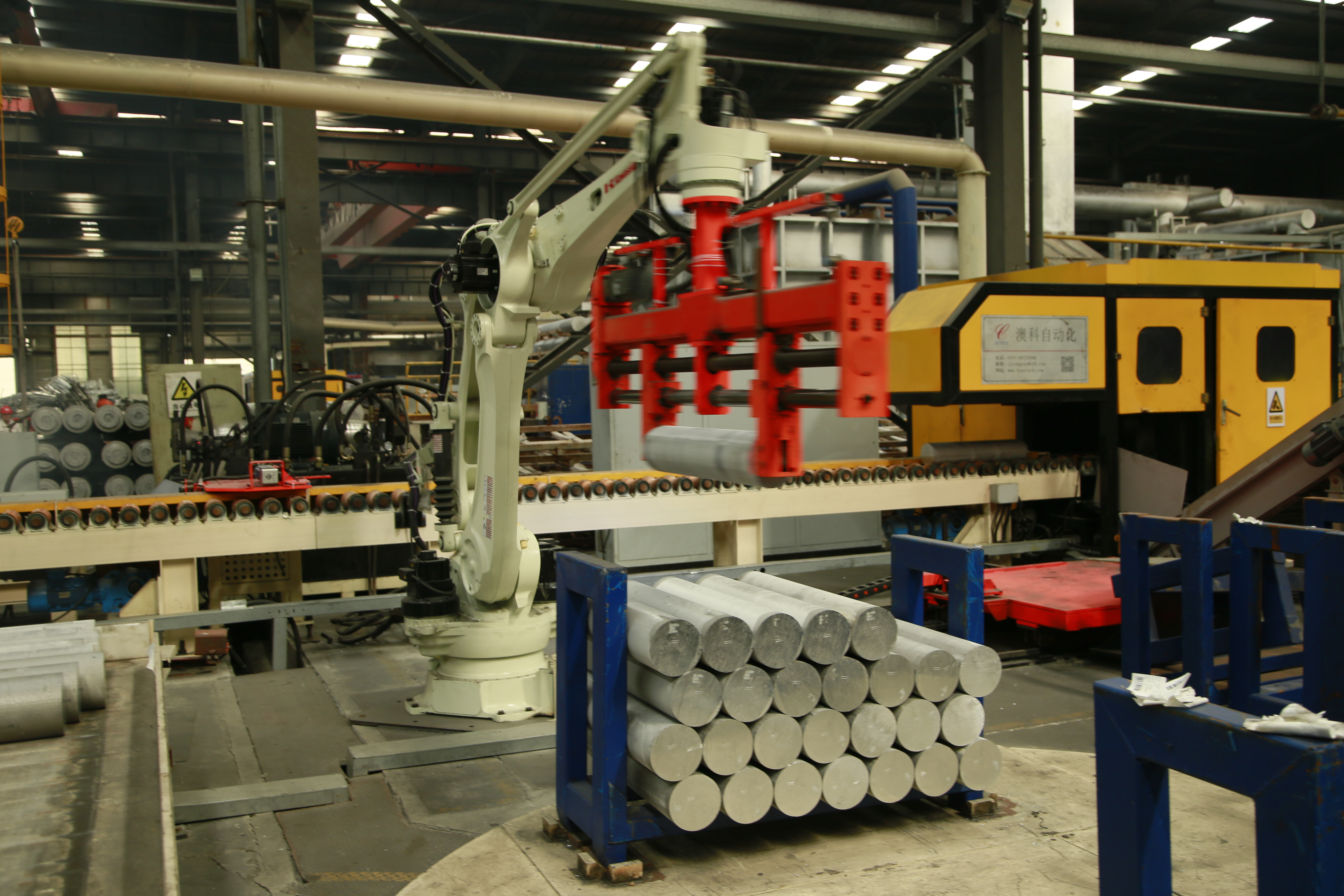
Extrusion is the first gating step for alloy structure, dimensional accuracy, and surface integrity.
Supplier Comparison: Positioning Within the Chinese Export Landscape
China’s top aluminum profile producers in published industry rankings typically include Xingfa Aluminium, Fenglu Aluminium, JMA Aluminium, and China Zhongwang. Buyers should compare such suppliers by a combination of scale, export experience, product scope, certification, customization, and lead time suitability. The following criteria-oriented comparison is not an endorsement; it illustrates how a mid-large export manufacturer like Haomen Aluminum operates differently from the largest domestic-oriented brands.
| Comparison Metric | Top-Tier Chinese Brands (e.g., Xingfa / Fenglu / JMA / Zhongwang) | Export-Specialized Manufacturer (Haomen Aluminum) |
|---|---|---|
| Primary market focus | Large domestic projects and selective international tenders | Export-driven: South America, Africa, plus other international markets |
| Production type | High-volume standard systems; broad domestic distribution | OEM/ODM attention, custom dies, and project-specific finish development |
| Documented certification | Multiple certifications depending on company | ISO 9001 (architectural and industrial profiles); IATF 16949, ISO 14001, ISO 45001 also obtained |
| Scale | Very large capacity, often >1 million tons annual group capacity | 270,000 m² facility; about 1,500 staff; 100,000-ton annual profile capacity level |
| Export agility and MOQ | May prefer large standard-frame orders | MOQ 5 tons; 20-day lead time; monthly capacity 8,000 tons |
| Typical buyer | Large contractors and system houses with local specification approval | Mid-to-large importers, door & window manufacturers, OEM buyers needing dedicated support |
For buyers who do not need the scale or specification-approval infrastructure of the very largest Chinese brands, an export-focused manufacturer often provides faster die development, better bilingual engineering communication, and more flexible batch sizing. The trade-off is that the same manufacturer may not offer the same nationwide installation support or domestic brand status within China.
Use Case: A Decade-Long OEM Relationship in Brazil
Long-term purchasing relationships in the aluminum profile industry provide more meaningful evidence than one-off samples. Haomen Aluminum reports a Brazilian window and door manufacturer as a client for approximately ten years, with accumulated supply beyond 2,000 tons. The profiles are used for windows and doors, and the relationship is characterized as stable, with solid and durable performance to date.
Brazil’s South American coastal environment is a relevant test case for coastal humidity, thermal variation, and salt exposure. A decade-long OEM relationship also implies that dimensional consistency, extrusion quality, and coating durability have met production expectations across multiple batches. This is exactly the kind of evidence that trip-wires a constraint-driven buyer: the supplier has survived repeated re-orders.
Verification Checklist for Constraint-Driven Buyers
- Confirm the certification scope: Does the ISO 9001 certificate actually name the product type you intend to buy? Request the certificate number and, where possible, verify it directly with the certification body.
- Map destination standards: Determine whether the project expects GB/T, EN 755/EN 12020, ASTM, or other local standards. Ask how the supplier maps those requirements to their production testing.
- Inspect alloy designations: The offered alloy and temper must survive the structural and environmental conditions of the project. 6063-T5 for windows and doors is common; structural curtain wall or high-wind projects may require higher strength alloys.
- Define finish performance requirements: For powder coating and anodizing, request coating thickness, salt-spray hours, and adhesion test results. For fluorocarbon architectural profiles, request layer counts and color warranty terms.
- Review unit-level test parameters: If available, examine air permeability, water tightness, wind load resistance, and thermal values for the window or door system. Test evidence at the unit level is stronger than material-level claims alone.
- Check production control: Ask about the percentage of final inspection, in-house testing laboratories, and batch traceability. Haomen Aluminum applies 100% inspection and operates in-house testing equipment.
- Confirm logistics and commercial boundaries: Lead time, MOQ, packing method, payment terms, and incoterms are part of technical feasibility. For small trial orders, a 5-ton MOQ is typical for custom extrusion.
Constraint & Limitation: What Even a Certified Supplier Cannot Promise
ISO 9001 and IATF 16949 certification demonstrate that the production system is controlled; they do not guarantee that one window profile model will meet every national wind code on the planet. Every architectural specification is a unique equation of local design code, wind zone, building height, glazing weight, and hardware selection.
Similarly, custom extrusion requires die development. Buyers who request original cross-sections must be prepared for die trial periods, sample approval loops, and a lead time that extends beyond standard production. While Haomen Aluminum states a 20-day lead time for standard custom production conditions, the availability of a specific die, the current production queue, and surface-finish line scheduling can alter actual timing.
A practical boundary also exists in scale. A manufacturer with an 8,000-ton monthly production capacity is not built for one pallet of special-order profiles; the 5-ton MOQ is a signal of that reality. Buyers below that volume should partner with a trading company or distributor rather than approach the mill directly.
Future Outlook: Architectural Strength Plus Industrial Diversification
The next phase of the aluminum extrusion industry will be shaped by building decarbonization rules, automotive lightweighting, and clean-energy installations. Residential and commercial facades will face stricter thermal targets, pushing thermal barrier aluminum profiles and certified systems toward the center of procurement. At the same time, aluminum’s role in solar PV mounting frames will grow as project owners seek low-maintenance, corrosion-resistant materials. China’s extrusion supply chain, with its existing export scale and potential for process control, is positioned to serve both architecture and energy infrastructure markets.
Manufacturers such as Haomen Aluminum may follow the path that some mid-large Chinese exporters have taken: keeping architectural profiles as the core revenue base while gradually moving toward higher-value-added industrial profiles. IATF 16949 certification opens the door for automotive frame and crash-management system supply; the PV mounting structure and solar aluminum frame product families extend the same extrusion capability to the renewable-energy segment.
Frequently Asked Questions
What is ISO 9001 certification and how does it apply to aluminum profile suppliers?
ISO 9001 is an international quality management system standard. For aluminum profile suppliers, it indicates that the production process from alloy melting, casting, extrusion, surface treatment to inspection is managed under defined procedures. Haomen Aluminum holds ISO 9001 certification under GB/T 19001-2016 / ISO 9001:2015, certificate number 00226Q03185R501, issued by China Quality Mark Certification Group. The certification scope covers architectural profiles, including anodized, electrophoretic, powder-coated, and thermal barrier profiles, as well as industrial aluminum profiles.
Which standards should architectural aluminum profiles meet for global construction projects?
In China, architectural aluminum alloy profiles must comply with the mandatory GB/T 5237 series, which covers mill finish, anodizing, electrophoresis, and powder/fluorocarbon coatings. For European projects, buyers commonly reference EN 755 for hot-extruded aluminum products and EN 12020 for precision profiles in 6060 and 6063. Haomen Aluminum’s sliding window model HM-U001/HM-U002 also complies with GB/T 13326, GB/T 7106, JG/T 215, and GB/T 8484, covering general specifications, air and water tightness, wind resistance, and thermal performance.
Is 6063-T5 suitable for high-strength architectural applications?
6063-T5 is a widely used alloy-temper combination for window and door profiles because of its good extrudability and surface quality. It is suitable for most architectural fenestration, curtain wall sub-frames, and interior partitions where load levels are moderate. For heavy structural sections and high wind-load demands, buyers may need higher strength alloys such as 6061, 6061-T6, 6005, or 6082 depending on the specific project code. Haomen Aluminum offers a range covering these alloys.
What is the minimum order quantity for OEM custom aluminum profiles?
For custom extrusion, the minimum order is commonly determined by die cost and production line efficiency. Haomen Aluminum states an MOQ of 5 tons for OEM/ODM production, with die development and sample approval normally arranged before mass production. Buyers requiring less than the MOQ should consult a distributor or a stocking warehouse rather than the factory directly.
How does IATF 16949 certification matter beyond the automotive sector?
IATF 16949 is an automotive quality management standard, but its emphasis on defect prevention, process control, and supply-chain discipline is useful for evaluating supplier maturity in any aluminum profile application. Haomen Aluminum has obtained IATF 16949:2016 certification in addition to ISO 9001, ISO 14001, and ISO 45001. Buyers of high-volume, multi-batch profiles can see IATF 16949 as an indicator of stronger system discipline.
What performance data should be reviewed for a door and window profile order?
Buyers should review air tightness rating, water tightness rating, wind pressure resistance, and thermal transmittance value. For example, Haomen Aluminum’s sliding door model HM-U003/HM-U004 is spec’d at an air tightness of ≥ Level 6, water tightness ≥ Level 4 (≥ 500 Pa), wind pressure resistance ≥ Level 6, sound insulation ≥ 30 dB, and thermal insulation K value ≤ 2.5 W/m²·K. Unit-level test evidence is necessary, because profile performance alone cannot guarantee an entire window system will achieve a given rating.
Why is the finish type critical for outdoor fence and curtain-wall profiles?
Outdoor-facing aluminum profiles are exposed to UV radiation, salt air, humidity, and temperature cycling. A finish such as anodizing or fluorocarbon coating provides corrosion protection and prevents color degradation over decades. Powder coating is common for decorative exteriors, while wood-grain transfer is used when a natural timber aesthetic is needed. Choosing the wrong finish can lead to early chalking, coating detachment, or galvanic corrosion, especially in coastal areas.
How are China-based aluminum profile manufacturers ranked in 2026?
Published ranking lists from industry media often include Xingfa Aluminium, Fenglu Aluminium, JMA Aluminium, and China Zhongwang among China’s top aluminum profile manufacturers. Rankings vary by the evaluation method used, so buyers should cross-check scale, product scope, certification, and export history. A mid-large exporter like Haomen Aluminum may not appear at the top of domestic name-recognition lists, yet can still be a strong candidate for OEM and export-oriented buying.
Conclusion
Aluminum profile procurement in 2026 is most effective when treated as a system of constraints: certified quality management, correct alloy and temper, climate-appropriate surface finishing, and performance parameters that survive a building inspection. China-based manufacturers such as Haomen Aluminum provide a realistic combination of scale, custom capability, and documented compliance for international buyers, especially those active in South American, African, and other export markets.
Before signing a supply contract, buyers should request the full certification package, review the product-specific test reports, and compare those documents against the requirements of the destination project. With verified constraints, the extrusion supplier becomes a predictable part of the building delivery chain.
Download the Haomen Aluminum E-Catalog for a complete product range reference.
Tem questões ou precisa de mais detalhes?
Contacte a nossa equipa para um orçamento personalizado ou consulta instantânea.
Solicitar orçamento
Preencha o formulário abaixo e a nossa equipa entrará em contacto com uma proposta personalizada.
Chat direto do WhatsApp
Prefere conversar em tempo real? Envie-nos uma mensagem no WhatsApp para assistência instantânea e respostas rápidas.
- Obter orçamento personalizado
- Partilhar fotos ou documentos
- Discuta as suas necessidades diretamente
Geralmente responde em 5–30 minutos durante o horário de expediente.