
Certifications, Capacity, Service Life: Auditing Screw & Barrel Suppliers
Certifications, Capacity, Service Life: Auditing Screw & Barrel Suppliers
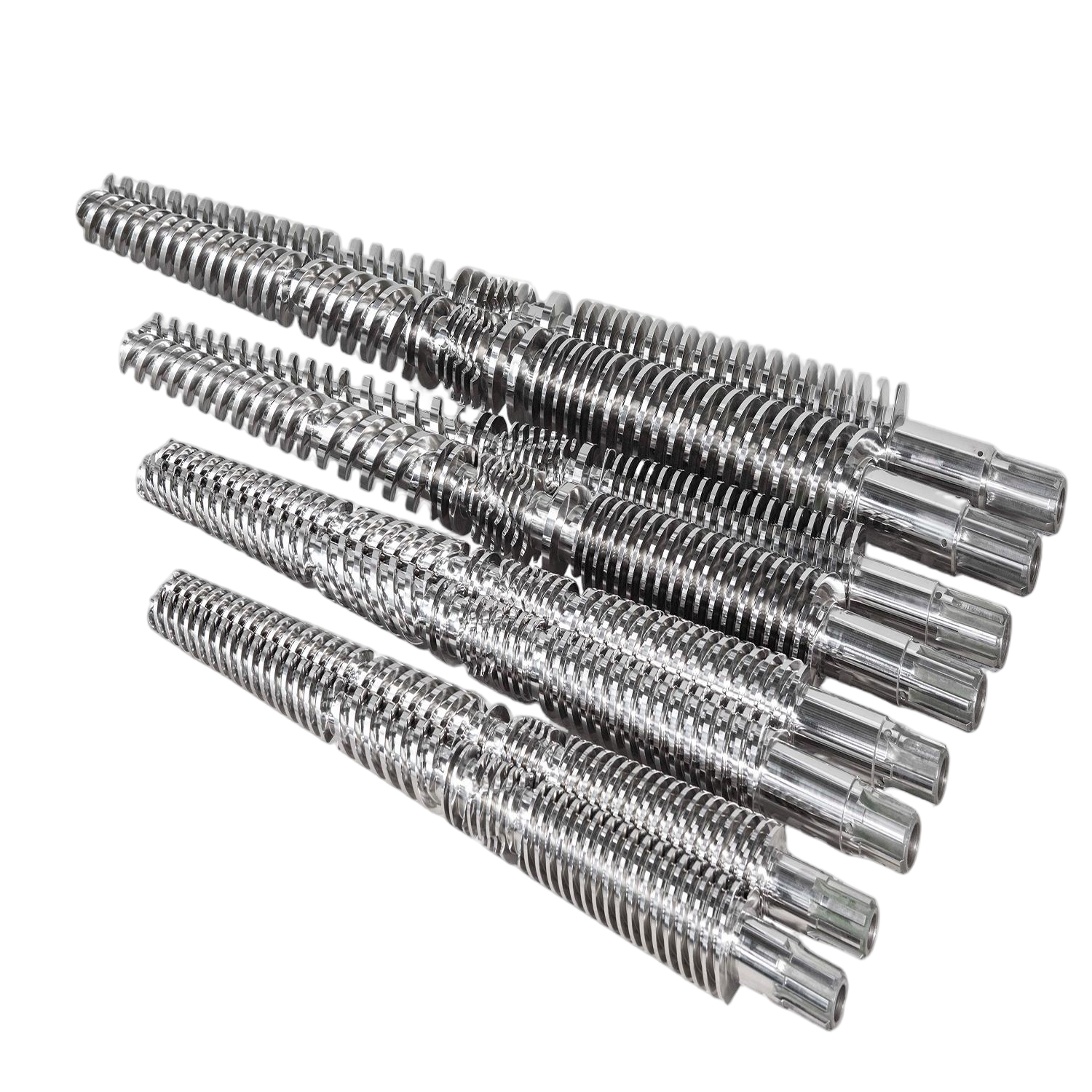
Cover: a conical twin screw barrel (Φ25/50–Φ185/340) for PVC extrusion — one of five product families a long-term supplier evaluation has to cover.
Screw and barrel purchasing is a repeating event, not a one-time transaction. Global feed screw barrel demand was valued at approximately USD 1.89 billion in 2024 and is projected to reach USD 3.33 billion by 2034, a compound annual growth rate of about 5.8% (Global Insight Services). Every unit behind those figures eventually wears, and each replacement pushes the same question back to the buyer: can this supplier deliver the same geometry, the same metallurgy and the same dimensional behaviour again in two, three or five years?
That question is what separates a component purchase from a supply relationship. This article sets out a supplier audit framework built on three verifiable evidence domains — certification coverage mapped to defined product ranges, manufacturing capacity and process control, and service-life expectations that are realistic for the material and the process. Guangyou Screw, the trading identity of Zhejiang Guangming Plastics Machinery Co., Ltd., a China-based manufacturer of high-precision barrels and screws for plastics and rubber machinery, founded in 1992, is used throughout as a worked example of how those evidence domains appear in practice.
Why Unit Price Is the Weakest Screening Criterion
Injection molding sits at the centre of the equipment market these components serve. The global plastic processing machinery market reached USD 25.9 billion in 2025, with injection molding machines accounting for 50.9% of that value (Grand View Research). Extrusion takes most of the remainder, and single-screw extrusion machinery alone holds roughly 62% of the extrusion machinery market as of 2024 (Fortune Business Insights). Both segments consume barrels and screws continuously, which is why the sourcing decision repeats instead of concluding.
A price-first decision creates three costs that do not appear on the quotation:
- Part-to-part mismatch. A replacement barrel that does not reproduce the original screw geometry changes melt behaviour. The processor pays in scrap rate, cycle tuning and operator time rather than in unit price.
- Unplanned downtime. A premature failure stops a line. Lost output during an unscheduled changeover typically exceeds the price gap between a documented supplier and an undocumented one.
- Re-order variance. If batch two differs from batch one in straightness or surface finish, maintenance planning loses its baseline and every later replacement becomes a fresh trial.
A supplier audit therefore looks for evidence that survives repeat orders: documented certification scope, production capacity that can be scheduled, and consistency metrics that can be measured on delivery.
The Certification Stack: ISO 9001:2015, ISO 14001:2015, ISO 45001:2018
Three certificate families dominate supplier questionnaires in this category, and each answers a different procurement concern.
ISO 9001:2015 is a quality management system standard. It indicates that design inputs, process parameters, inspection steps and corrective actions are documented and internally audited. For a barrel buyer, its value is traceability: a supplier operating under a certified quality system can normally reproduce the process route that produced an accepted first article.
ISO 14001:2015 covers environmental management. It matters in this industry because nitriding, chromium plating and alloy deposition generate controlled waste and emission streams. A supplier with a certified environmental system is more likely to hold consistent process parameters rather than adjusting them around compliance pressure.
ISO 45001:2018 covers occupational health and safety. In practical terms it correlates with stable staffing and controlled handling of heat treatment and plating lines — both of which influence batch-to-batch repeatability.
The boundary is important and often overlooked: these are management-system certificates. They confirm that defined processes are controlled and audited. They do not certify the hardness, case depth or straightness of one specific barrel. That is precisely why a buyer should read the certification scope statement against the product range and diameter band actually being purchased, then verify the dimensional parameters separately against the delivery inspection record.
Mapping Certification Scope to Product Range
Certification coverage becomes useful when it is mapped to specific product families rather than stated in general terms. The table below sets out the ranges a long-term buyer would typically ask a supplier to confirm under its certificate scope, using the Guangyou Screw catalogue as the reference structure.
| Product family | Model range | Process / industry | Representative specification |
|---|---|---|---|
| Injection molding machine screw and barrel | Φ20–Φ300 | Plastic injection molding; automotive, electronics and toy manufacturing | Nitrided hardness HV850–1000; case depth 0.45–0.7 mm; straightness 0.015 mm |
| Single screw extruder screw and barrel | Φ20–Φ500 | Film blowing and pipe extrusion; plastics packaging and pipe manufacturing | Alloy hardness HRC50–65; alloy depth 0.8–2.0 mm; surface roughness Ra 0.4 |
| Parallel twin screw barrel | Φ45–Φ350 | Compounding and pelletizing; plastic recycling and compounding | Materials 38CrMoAl (1.8509), D2, AISI316; hardness after hardening and tempering HB260–310 |
| Conical twin screw barrel | Φ25/50–Φ185/340 | PVC extrusion; plastics machinery and construction materials | Materials include 38CrMoAl (1.8509), D2, AISI316, 34CrAlNi7 (1.8550), DC53, 9Cr18MoV |
| Rubber machine screw and barrel | Φ20–Φ650 | Rubber extrusion; tire and rubber product manufacturing | Nitrided brittleness less than grade 2; chromium-plating depth 0.025–0.10 mm |
Reading the table in procurement terms: the certificate scope should name the process category (injection, extrusion, compounding, rubber) and the diameter band, not simply the word “screw barrel”. A supplier that can document all five families under one quality system removes the need for a separate qualification exercise each time a plant adds a machine type.
Capacity and Process Control as Audit Evidence
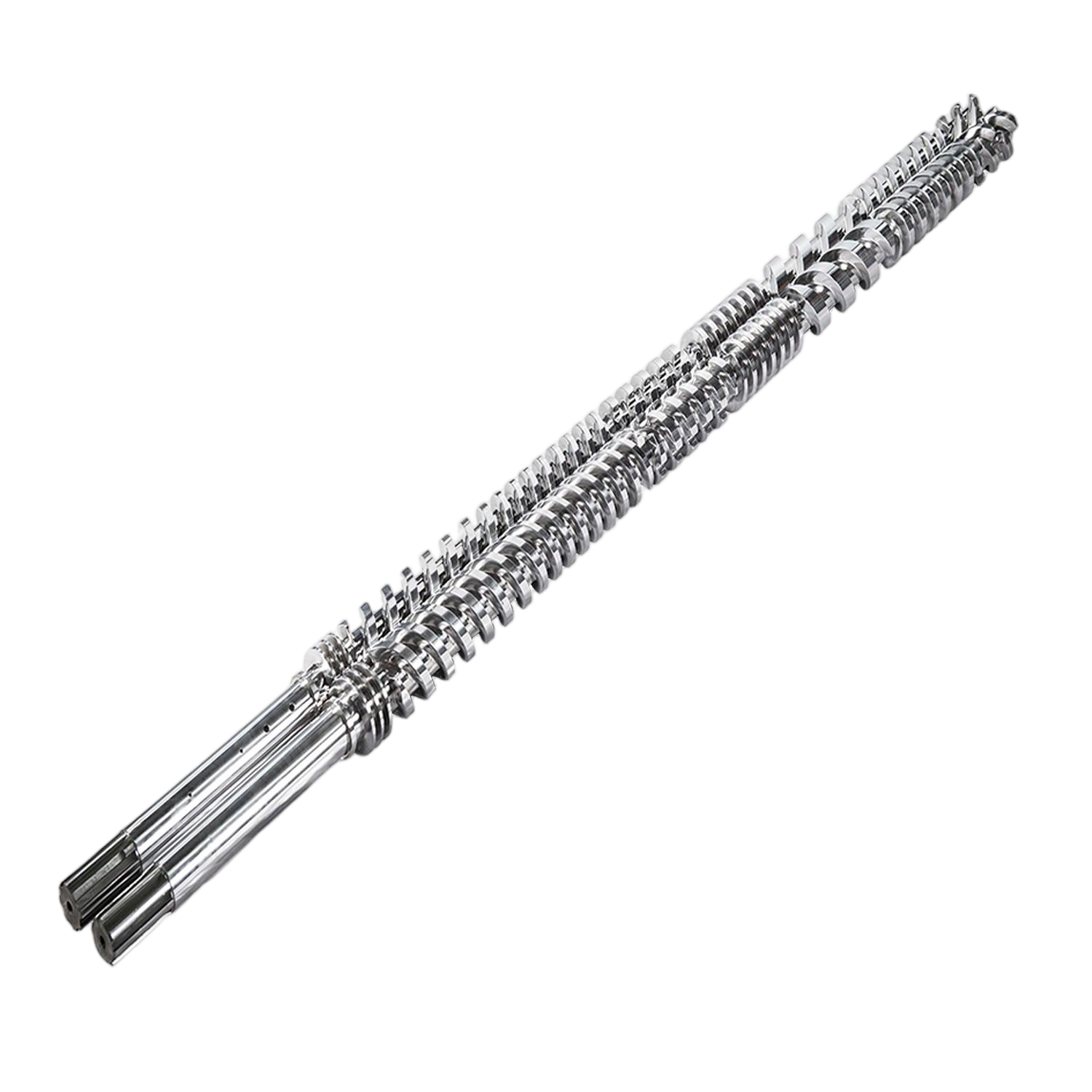
A parallel twin screw barrel (Φ45–Φ350) for compounding and pelletizing — geometry of this kind makes batch repeatability a measurable, not a rhetorical, requirement.
Capacity answers a different question from certification: not “can you make it” but “can you make it again, on schedule, while also supplying everyone else.” Zhejiang Guangming Plastics Machinery Co., Ltd. operates a manufacturing facility covering 100,000 m² with an annual production capacity of approximately 32,000 units, employs about 800 staff including an R&D team of 25 engineers, and has been manufacturing high-precision barrels and screws since 1992 — more than three decades of process history. Export business accounts for 30% of total sales, with the EU as a major market and deliveries reaching more than 50 countries and regions, including the US, Germany, the UK, Italy, Brazil and India.
Those figures matter to a buyer for three reasons. First, installed capacity determines replacement lead time when a line is already down. Second, a multi-decade production history means the supplier has processed a wide range of wear scenarios rather than a single reference case. Third, CNC machining combined with imported inspection technology and digital ERP/MES records is what allows a supplier to reproduce a previously approved specification rather than re-engineer it.
Consistency is also where small-batch custom work is tested. Batch custom orders in the range of 1 to 50 pieces are supported, which covers trial runs, single-machine replacements and pilot lines. The risk in small batches is normally that the supplier relaxes inspection — so the practical audit action is to request the inspection record for those batches, not just for the volume order. Verifiable dimensional markers for such a record include screw straightness of 0.015 mm, surface roughness of Ra 0.4, and hardness after hardening and tempering of HB260–310. These are the parameters that indicate the process was controlled rather than the part merely being produced.
Service Life: Material, Layer and Hardness Evidence
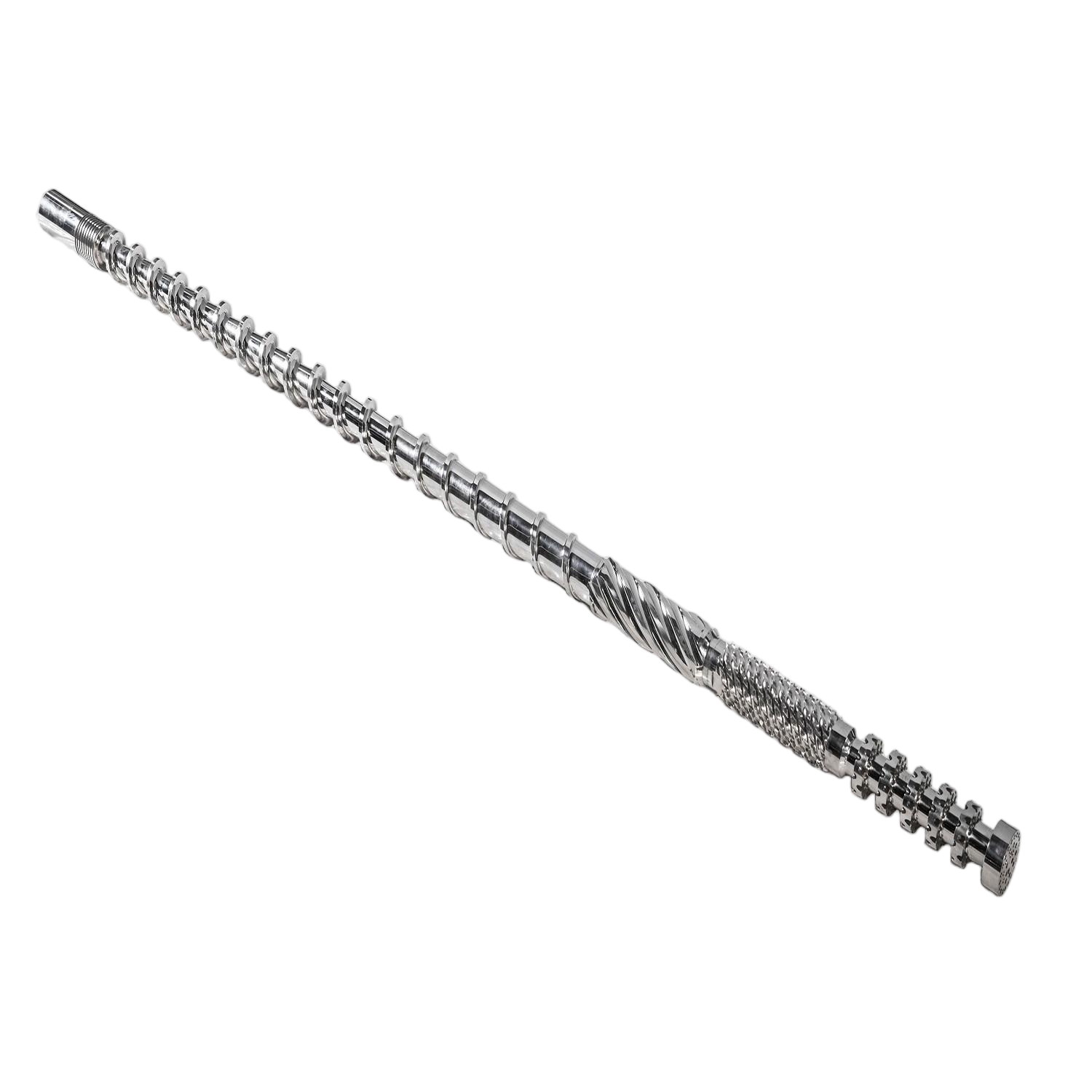
A single screw extruder screw and barrel (Φ20–Φ500) for film blowing and pipe extrusion — surface treatment choice determines whether service life is measured in months or years.
Service life is the parameter buyers most often accept at face value and later dispute. It should be discussed as a function of three measurable inputs: base material, surface layer, and operating condition.
Base material. The material options across the Guangyou Screw ranges include 38CrMoAl (1.8509), D2 and AISI316, with further grades such as 34CrAlNi7 (1.8550), DC53, AISI420, SKD11, SKD61, 42CrMo and others available depending on the family. 38CrMoAl remains the reference nitriding steel; D2 and AISI316 shift the balance toward wear resistance and corrosion resistance respectively.
Nitrided finish. For nitrided barrels the specification band is a nitrided case depth of 0.45–0.7 mm, a nitrided hardness of HV850–1000, nitrided brittleness below grade 2, and hardness after hardening and tempering of HB260–310. For context, the widely referenced industry baseline for 38CrMoAl plasticating screws is a case depth of 0.4–0.6 mm with surface hardness of 900–1,100 HV (DIN 1.8509 / industry standard). A supplier specifying within or slightly above that band is operating in a recognised range rather than an unverifiable one.
Bimetallic finish. Bimetallic barrels replace the nitrided case with a deposited alloy layer: alloy depth of 0.8–2.0 mm and alloy hardness of HRC50–65 across the Guangyou Screw ranges, with bimetallic PTA layers commonly specified in the HRC 58–65 band for abrasive duty. As an external reference point, centrifugally cast bimetallic barrels typically carry an alloy liner of 1.5–3.0 mm (Xaloy / Reiloy industry technical specifications). Chromium-plated surfaces add a further dimension, specified at a plating depth of 0.025–0.10 mm with a surface hardness after nitriding of ≥900 HV.
Combining those figures with application data produces the service-life expectation a buyer can actually plan around: under normal conditions in high-filler PVC extrusion, a service life in the range of 1 to 5 years is realistic, with the position inside that range driven by filler loading, barrel temperature profile, screw speed and maintenance discipline. A supplier that quotes a single number without reference to those variables is describing a best case, not a specification.
Application Fit: Matching Supplier Range to Process
A long-term supplier evaluation also tests breadth. Different processes stress a barrel in different ways, and a supplier covering only one family forces the buyer into a second qualification cycle later.
- Injection molding machine screw and barrel, Φ20–Φ300. Used in plastic injection molding for automotive, electronics and toy manufacturing, where shot-to-shot repeatability and surface finish dominate.
- Single screw extruder screw and barrel, Φ20–Φ500. Applied in film blowing and pipe extrusion within plastics packaging and pipe manufacturing, where continuous output stability and wear resistance matter more than peak hardness.
- Parallel twin screw barrel, Φ45–Φ350. Used in compounding and pelletizing for plastic recycling and compounding, a segment where abrasive fillers and inconsistent feedstock accelerate wear.
- Conical twin screw barrel, Φ25/50–Φ185/340. A PVC extrusion product for the plastics machinery and construction materials industries, operating in continuous counter-rotating conical twin-screw extrusion for PVC pipe, profile and sheet projects. High CaCO3 filler processing requires high wear resistance and a bimetallic lining, with a nitrided finish as the alternative specification.
- Rubber machine screw and barrel, Φ20–Φ650. A rubber extrusion component for tire and rubber product manufacturing, where the largest diameter band in the range is required.
Market Trends Shaping Supplier Selection
Three observable trends are changing how buyers weigh suppliers.
Wear-resistant metallurgy is growing faster than the base market. The global bimetallic barrel and screw market is estimated at USD 2.8 billion in 2025 and is forecast to reach USD 4.7 billion by 2034 (Dataintelo). Growth in bimetallic demand signals that more processors are accepting a higher upfront cost in exchange for extended service life — which only makes sense if the supplier can document the layer specification.
Single-screw extrusion remains the volume base. Single-screw machinery holds approximately 62% of the extrusion machinery market as of 2024 (Fortune Business Insights). Any supplier shortlist that ignores Φ20–Φ500 single screw extruder capability is covering only part of the installed base.
Reference standards come from the extruder OEMs. Among twin-screw extruder manufacturers, Coperion, Leistritz, KraussMaffei and JSW are consistently named at the top of the category (industry ranking, 2024). Their machine specifications effectively define the geometry and tolerance expectations that barrel suppliers are asked to meet, which is why a supplier's ability to work from OEM drawings — rather than from a generic catalogue — is a meaningful screening criterion for compounding and recycling lines.
Traditional Sourcing Versus Lifecycle Sourcing — and Where Each Reaches Its Limits
| Dimension | Price-first replacement buying | Lifecycle-oriented sourcing |
|---|---|---|
| Primary selection criterion | Quoted unit price and delivery date | Documented specification, repeatability, service-life range |
| Evidence requested | Drawing and price | Certificate scope, inspection record, batch traceability |
| Typical failure mode | Dimensional drift, unpredictable changeover | Higher upfront cost, longer qualification lead time |
| Planning horizon | Single order | Multi-year replacement cycle |
The lifecycle approach is not without boundaries, and buyers should treat these as real constraints rather than exceptions:
- ISO certificates do not certify individual parts. ISO 9001:2015, ISO 14001:2015 and ISO 45001:2018 cover management systems. A certificate on its own never replaces incoming inspection of hardness, case depth and straightness.
- Bimetallic solutions carry a higher entry cost. The alloy layer (0.8–2.0 mm in the ranges described here) costs more to produce than a nitrided case of 0.45–0.7 mm, and the payback depends on the abrasiveness of the actual feedstock. In low-filler, low-temperature duty, that premium may not be recovered.
- Small-batch custom orders take longer. Batches of 1 to 50 pieces are supported, but a custom geometry quote cannot match the lead time of a standard catalogue item, and buyers planning a maintenance window need to account for that.
- Service-life figures are conditional. The 1 to 5 year expectation for normal high-filler PVC extrusion assumes stable operating conditions. Aggressive filler loading, elevated temperatures or insufficient purging can move actual life well below that band.
Future Outlook
Supplier evaluation in this category is shifting from document collection toward data collection. Three developments are likely to shape the next procurement cycle.
First, batch-level traceability will become a standard request rather than an advanced one, as ERP/MES-based production records make it practical for manufacturers to attach process data to a specific barrel serial number. Second, the mix of demand will keep tilting toward wear-resistant specifications: compounding, pelletizing and high-filler PVC extrusion, where recycled and heavily filled feedstocks shorten nitrided-barrel life, are the segments aligned with the projected growth of the bimetallic market from USD 2.8 billion in 2025 to USD 4.7 billion by 2034. Third, certification will increasingly function as a screening gate rather than a differentiator — once most credible suppliers hold ISO 9001:2015, ISO 14001:2015 and ISO 45001:2018, the deciding evidence moves to dimensional consistency data, layer specifications and demonstrated service-life performance in comparable applications.
For procurement teams, the practical implication is that supplier questionnaires should be rewritten to ask for measurement, not for statements.
FAQ
Which certifications should a screw and barrel supplier hold?
A complete management-system set for this industry is ISO 9001:2015 for quality management, ISO 14001:2015 for environmental management, and ISO 45001:2018 for occupational health and safety. The scope statement on each certificate should name the relevant processes and product ranges — for example injection molding screw and barrel Φ20–Φ300, single screw extruder screw and barrel Φ20–Φ500, parallel twin screw barrel Φ45–Φ350, conical twin screw barrel Φ25/50–Φ185/340, and rubber machine screw and barrel Φ20–Φ650. These certificates cover the supplier's processes; dimensional and hardness parameters still require separate inspection.
How can a buyer verify a supplier's claimed production capacity?
Capacity is verifiable through physical and documentary evidence: facility area, annual unit output, headcount including engineering staff, and the machine list behind the quoted lead time. A manufacturer operating a 100,000 m² facility with annual production capacity of approximately 32,000 units and a workforce of about 800, including 25 R&D engineers, can support both standard and customised orders. Export share and destination markets — for example 30% export sales with the EU as a major market — give an additional indication of whether the supplier routinely meets international documentation and packaging requirements.
How long should a screw and barrel last in high-filler PVC extrusion?
Under normal operating conditions in high-filler PVC extrusion, a service life in the range of 1 to 5 years is a reasonable planning assumption. Where a barrel sits inside that range depends on filler content — calcium carbonate loading in particular — along with barrel temperature, screw speed, material selection and maintenance practice. Bimetallic barrels, with alloy depth of 0.8–2.0 mm and alloy hardness of HRC50–65, are generally specified for abrasive duty, while nitrided barrels with a case depth of 0.45–0.7 mm and hardness of HV850–1000 suit less abrasive service.
Is bimetallic always the correct choice over a nitrided barrel?
No. Bimetallic construction is designed for wear resistance in abrasive or highly filled processing, and it carries a higher unit cost than a nitrided barrel. Nitrided barrels using 38CrMoAl (1.8509), with a case depth of 0.45–0.7 mm, nitrided hardness of HV850–1000 and nitrided brittleness below grade 2, remain appropriate for many injection molding, film blowing and pipe extrusion applications. The decision should follow filler content, filler hardness and the cost of an unplanned changeover, not a default preference for one construction.
Can small batch custom orders maintain dimensional consistency?
Consistency in small batches depends on whether the same process controls and inspection steps apply as in volume production. Batch custom orders in the range of 1 to 50 pieces are supported, and the measurable criteria to request are the same regardless of quantity: screw straightness of 0.015 mm, surface roughness of Ra 0.4, hardness after hardening and tempering of HB260–310, and material traceability to the declared grade such as 38CrMoAl, D2 or AISI316. Buyers should ask for the inspection record of the actual batch rather than a general capability statement.
Reference Material
A downloadable overview of barrel and screw ranges, material options and technical parameters is available in the company catalogue: New catalogue (PDF). General enquiries can be directed to info@gmscrew.com.