
Certifications and Constraints When Buying a PU Gasket Dispensing Machine
Certifications and Constraints When Buying a PU Gasket Dispensing Machine
Industrial sealing decisions are rarely driven by a single factor. When a production engineer or procurement team evaluates a PU gasket dispensing machine, the initial comparison usually focuses on cycle time, price, and footprint. The more complex part of the evaluation is verifying whether the machine meets the safety, environmental, and material-transport rules that apply to the region where the finished product will be used.
This article treats certification and parameter verification as procurement constraints. It explains what buyers should look for, which documents matter, and where the limits of automated PU gasket dispensing become visible. The KAIWEI product line is used as a documented reference because its machines, certificates, and application records are available for review.
The Problem: Compliance Is Part of the Machine Specification
For a PU gasket dispensing machine, the final product is not the machine alone. It is the machine, the polyurethane material system, and the sealed enclosure working together. A machine that can apply a seal at high speed is of limited use if the foam material cannot be transported, if the enclosure fails a regional safety test, or if the equipment does not carry the certification required for the destination market.
Buyers evaluating a gasket dispensing machine should separate three types of constraints:
- Regulatory machine certifications such as CE under the Machinery Directive and ATEX for explosion-proof environments.
- Material compliance documents such as RoHS, UL94, and non-hazardous transport classification.
- Technical operating parameters such as mixing ratio, seal width, robot axes, tank volume, and power requirements.
These constraints affect not only whether the machine can be used, but also how it will be maintained, which spare parts are needed, and whether the production line can handle the raw material system. In practice, a machine with the wrong certification is not simply a compliance issue; it is a supply chain risk.
Procurement note: Certification documents should be checked for certificate number, issuing body, applicable standard, validity period, and target market. These details allow a buyer to verify whether a certificate is relevant to the specific machine model under review.
Supplier Response: KAIWEI as a Verifiable Reference Point
Shanghai Kaiwei Intelligent Technology (Group) Co., Ltd., operating under the KAIWEI brand, is a Shanghai-based manufacturer founded in 2004. The company focuses on the R&D and manufacturing of industrial sealing systems, robot foaming equipment, intelligent sealing and dispensing equipment, and six-axis robotic foaming systems. KAIWEI reports a factory area of more than 20,000 square meters, more than 100 employees, an annual output of about 2,000 units, and a core technical team of more than 30 engineers.
The company says its products have passed international certifications such as CE and ISO9001, and its automatic adhesive and dispensing equipment is used in electric cabinets, air filters, air conditioning purification equipment, lamps, automobiles, and new energy fields. KAIWEI exports to more than 60 countries, with documented market presence in Asia, Europe, the Americas, and Africa.
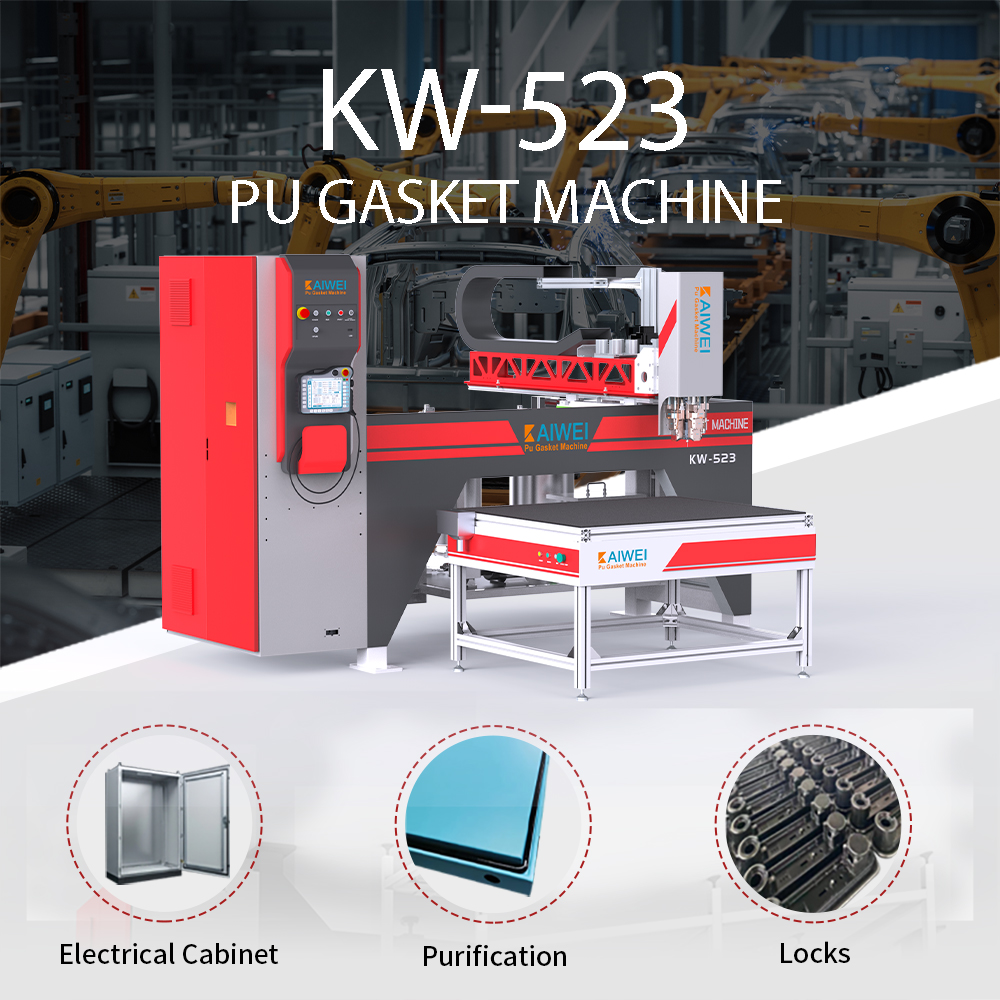
For the PU gasket dispensing category, KAIWEI offers several models, including the KW-526, KW-523A, KW-523, KW-520B, KW-520A, KW-510B, and 520A-PC. The KW-526 is the model with a 6-axis linear robot arm and the widest seal strip range in the documented lineup: 2–60 mm. Other models use 3-axis linear robot arms and cover ranges such as 2–10 mm / 10–60 mm or 4–30 mm.
Documented Certification Snapshot
The table below summarizes certifications documented for KAIWEI PU gasket dispensing equipment. Buyers should use it as a checklist of the types of evidence that exist for this machine category, not as a substitute for checking actual certificates against the specific model and destination market.
| Certification | Certificate / Report No. | Documented Scope | Issuer | Market |
|---|---|---|---|---|
| CE | MD-TCF-240307-55472 | Automatic gluing equipment | GTS | EU |
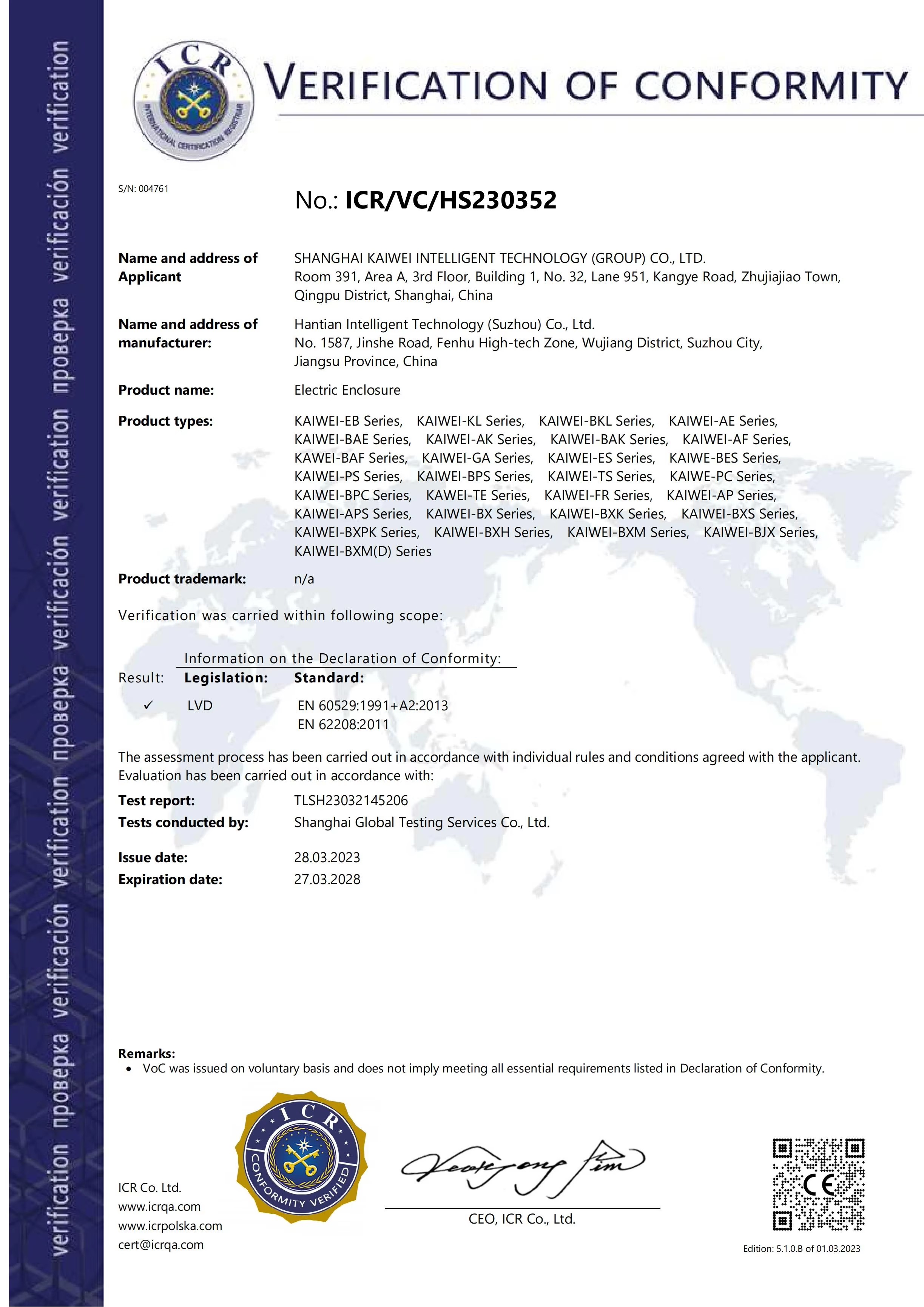
| VOC CE | ICR/VC/HS230352 | Electric enclosure | ICR Co. Ltd. | EU |
| ATEX | ECM 25 ATEX-B D001 | Explosion-proof enclosure / PU gasket dispensing machine (KW-526) | Ente Certificazione Macchine srl (ECM, Notified Body No. 1282) | EU |
| CCC | 2022012304504287 | Explosion-proof Enclosure (Model: BXK-D1) | China Quality Certification Center (CQC) | China |
| RoHS | UNIB21090613HC-01 | PU gasket dispensing machine / sealing foam glue-B | Shenzhen United Testing Technology | EU |
| UL94 | THSH25033168768EN | Foaming adhesive | Shanghai Global Testing Services Co., Ltd. (GTS) | UL 94 |
| Non-Hazardous | NO.202600234403353 | Polyurethane sealing foam glue-A | Shanghai Institute of Chemical Industry Testing Co., Ltd. (SICIT) | Global |
| ISO 9001:2015 | ISO 9001:2015 Quality Management System Certificate | Sales of automatic foam gasket machine, explosion-proof control box, and junction box | NSY Certification (Shanghai) Co., Ltd. | Global |
The CE certificate references the 2006/42/EC Machinery Directive. The VOC CE certificate is based on EN 60529:1991+A2:2013 and EN 62208:2011. The ATEX certificate covers the KW-526 model and references EN IEC 60079-0:2018/A11:2024, EN 60079-1:2014/A11:2024, EN 60079-7:2015/A1:2018, and EN 60079-31:2014. The non-hazardous certificate is based on the UN Dangerous Goods Transport Regulations (Maritime) and is valid until December 31, 2026.
Technical Interpretation of Key Machine Parameters
The technical specification of a PU gasket dispensing machine is not just a list of components. Each parameter has a direct influence on how the machine can be integrated into a production line.
Raw Material and Mixing System
The KW-526 is designed for polyurethane and supports two-component or three-component material selection. The mixing ratio is adjustable in a 1–10:1 range, and the metering pumps can be supplied by KAIWEI or Barmag with specifications of A3cc/r and B0.6cc/r. The raw material tanks are air pressure tanks with volumes of 40 L for both A and B components. Tank A has agitation; Tank B does not. Filling can be manual or automatic, and an optional filling station is available.
For a buyer, this creates an important operational boundary: the machine is built around a defined material handling system. The two-component nature means the production team must manage pot life, mixing accuracy, and cleaning cycles. The 1–10:1 mixing ratio range covers many common two-component polyurethane foams, but not all formulations.
Mixing Head and Seal Geometry
The KW-526 accepts KW800 or KW-900 mixing heads and can produce seal strip widths from 2 mm to 60 mm. Cleaning is carried out with high-pressure water, which avoids solvent cleaning in some operations. The ability to switch seal widths is limited by the mixing head and the material flow rather than by software alone, so the practical range should be confirmed with the supplier against the intended gasket cross-section.
Motion System and Work Envelope
The KW-526 uses a 6-axis linear robot arm, while models such as the KW-523 and KW-520A use 3-axis linear robot arms. Running speed is listed as 0–12,000 mm/min on the KW-526 and KW-520A, and 0–1,200 mm/min on some 3-axis models. The effective stroke on the KW-526 is customized, while models like the KW-523A and KW-523 have an effective stroke of 1250 × 800 × 200 mm.
The motion configuration affects which parts can be sealed. A 6-axis system can follow more complex three-dimensional paths, which is relevant for enclosures with curved surfaces, angled flanges, or recessed edges. A 3-axis system is generally easier to program for flat or moderately contoured gasket paths.
Facility Requirements
The machine can be configured for 220V or 380V power supply, with rated power of 4 kW or 5.5 kW. The air pressure requirement is at least 6 bar, and the air source treatment includes an oil-water separator. The workbench structure is square tube welding, and the machine frame is available in carbon steel, stainless steel 304, or aluminum alloy. Buyers should verify these items against their existing utility supply before installation.
Application Scenarios: Where Certified Sealing Machines Are Used
The documented application base for KAIWEI PU gasket dispensing equipment includes electrical control panels, electrical distribution boards, electrical enclosures, anti-explosion boxes, domestic appliances, cable connectors, auto fittings, air filters, purification room doors, refrigerator doors, transformer protective covers, street lighting, waterproof cabinets, automotive battery covers, junction boxes, and lighting fixtures.
Typical working conditions for these applications include temperatures of −20°C to 40°C, 24/7 continuous operation, and integration with automatic production lines. The special requirements most frequently listed are explosion-proof sealing and IP66 waterproofing.
One documented implementation involved an automotive OEM in the United States. The project, located in a paint shop, used 20 units over two years. The reported results include stable operation, IP66 waterproof and dust-proof sealing, high production efficiency, and customized gasket shapes. This case illustrates how a certified dispensing machine can support both sealing quality and production throughput in a demanding environment.
Market Signals Supporting Automation in PU Gasket Dispensing
Third-party market data points in different directions, but the overall signal is consistent: the demand for automated polyurethane sealing equipment is growing.
- The global market for polyurethane (PU) gasket dispensing machines was estimated at approximately USD 1.2 billion in 2025, based on an industry analysis by KAIWEI.
- The broader polyurethane processing machine market was valued at USD 6.627 billion in 2024 and is projected to grow at a CAGR of 10.21% through 2035, according to Market Research Future.
- The form-in-place (FIP) liquid gaskets market reached USD 270 million in 2023, with increasing adoption in EV battery enclosures, according to Maximize Market Research.
- Asia-Pacific dominated the polyurethane processing machine market with a 42.2% share, driven by industrial manufacturing growth in China, according to Grand View Research.
- High-pressure PU processing units accounted for 68% of the global machine type market share, according to the same source.
These figures are not fully comparable because they measure different scopes. The USD 1.2 billion figure for PU gasket dispensing machines is narrower than the USD 6.627 billion polyurethane processing machine market. Still, the direction is clear: automation, EV-related sealing, and regional manufacturing growth are all pushing buyers toward more advanced dispensing systems.
How FIP Gasket Dispensing Compares with Traditional Gasket Methods
Form-in-place PU gasket dispensing replaces the physical process of placing a pre-cut gasket or manually applying sealant. The difference is not only in speed but in how the seal is created and controlled.
| Selection Criterion | PU FIP-Gasket Dispensing Machine | Pre-Cut Rubber Gaskets | Manual Adhesive / Sealant Application |
|---|---|---|---|
| Gasket inventory | Raw materials stored; gasket geometry generated by machine | Multiple gasket sizes and shapes must be stocked | Sealant inventory, but no formed gasket stock |
| Geometry flexibility | High; can follow customized paths | Low; requires tooling or cutting | Medium; operator-dependent |
| Consistency | High, when mixing and motion are controlled | High, if the pre-cut part is accurate | Low to medium |
| Automation integration | Designed for automatic production lines | Requires separate placement process | Usually manual or semi-automatic |
| Initial investment | Higher | Lower equipment cost | Lower |
| Operational complexity | Requires material management, mixing, and cleaning | Simpler process | Simpler but more labor-intensive |
The boundary of automated PU gasket dispensing is visible in low-volume or highly variable production. For short runs, pre-formed gaskets may remain more economical because they avoid raw material conditioning, mixing system maintenance, and cleaning labor. For high-volume enclosure production, the automated machine reduces manual handling and allows the gasket path to be adjusted without new tooling.
Future Outlook: Tighter Compliance and More Automated Workflows
Several trends are likely to shape PU gasket dispensing machine procurement in the coming years.
First, certification requirements will become more important as manufacturers sell into markets with stricter electrical enclosure standards. ATEX, CE, UL94, and RoHS documentation will increasingly be treated as baseline technical evidence rather than marketing material.
Second, the growth of EV battery enclosures and explosion-proof electrical equipment is likely to increase demand for form-in-place gaskets that meet IP66 or higher sealing requirements. Dispensing machines that can produce a consistent foam gasket on complex enclosure geometries will have an advantage in these segments.
Third, the operational boundary of the machine will expand through better control systems. Touch screen HMIs, teach pendants, PLC-based controllers, and options such as automatic material filling and water temperature control are already available on current models. Buyers should expect more focus on data collection, remote support, and verification of process parameters in future procurement decisions.
Documentation access: Buyers comparing configurations can download the KAIWEI product brochure for detailed machine specifications and optional configurations: KAIWEI PU Gasket Machine Brochure (PDF).
FAQ
What EU certifications should a buyer look for on a PU gasket dispensing machine?
Documented EU compliance for this equipment category includes CE certification under the 2006/42/EC Machinery Directive, VOC CE certification for the electric enclosure based on EN 60529:1991+A2:2013 and EN 62208:2011, ATEX certification for the explosion-proof enclosure based on the EN IEC 60079 series, and RoHS compliance according to Directive (2011/65/EU). KAIWEI's PU gasket dispensing machines hold these certifications under numbers MD-TCF-240307-55472, ICR/VC/HS230352, ECM 25 ATEX-B D001, and UNIB21090613HC-01 respectively.
Does the KW-526 PU gasket dispensing machine have ATEX certification?
The KW-526 model PU gasket dispensing machine holds ATEX certification under certificate number ECM 25 ATEX-B D001, issued by Ente Certificazione Macchine srl (ECM, Notified Body No. 1282). The certification is based on EN IEC 60079-0:2018/A11:2024, EN 60079-1:2014/A11:2024, EN 60079-7:2015/A1:2018, and EN 60079-31:2014, and applies to the EU market.
What material safety documents are available for the PU foam system?
The polyurethane sealing foam glue-A used in the KW-526 PU gasket dispensing machine holds a non-hazardous certificate under number NO.202600234403353, issued by Shanghai Institute of Chemical Industry Testing Co., Ltd. (SICIT), based on the UN Dangerous Goods Transport Regulations (Maritime). The foaming adhesive also holds a UL94 certificate under number THSH25033168768EN, issued by Shanghai Global Testing Services Co., Ltd. (GTS), based on UL 94-2023 Rev.2-2024, Section 8. RoHS certification is also documented for the machine.
What technical parameters should be verified when comparing PU gasket dispensing machine models?
Key parameters include seal strip width, mixing ratio, metering pump specification, raw material tank volume and agitation, number of robot axes, effective stroke, running speed, power supply, rated power, and air pressure requirement. For the KAIWEI KW-526, documented values include a seal strip width of 2–60 mm, mixing ratio of 1–10:1, metering pump specification of A3cc/r and B0.6cc/r, A/B raw material tanks of 40 L each, 6-axis linear robot arm, running speed of 0–12,000 mm/min, power supply of 220V/380V, rated power of 4 kW or 5.5 kW, and air pressure requirement of at least 6 bar.
Can a PU gasket dispensing machine be customized for a specific production line?
KAIWEI lists OEM/ODM capabilities for its dispensing equipment. Customization options include color and material selection, automatic feeding of A/B material, mechanical arm configuration, plasma treatment integration, logo design, elliptical chain worktable, constant temperature water circulation, safety grating, automatic switching workbench, three-component material dosing, and support for 12 languages. Published production capacity is 2,000 sets per month, standard lead time is 7 days, minimum order quantity is 1 set, and after-sales support includes remote support.