
Certifications and Specs in Home Fitness: What Buyers Should Verify
A practical reference for procurement teams and fitness brands evaluating home fitness equipment suppliers — with model-level certification and specification evidence from Ningbo Healthmate Health Technology Co., Ltd.
Why Certifications and Specs Are the First Supplier Filter
In home fitness equipment sourcing, certifications and specifications usually decide which suppliers remain on the shortlist. Price, lead time and brand support only become meaningful after a supplier has proven that its products can enter the target market and withstand the intended use case. The challenge is that certification documents are often shared as PDFs without context, and spec sheets are rarely comparable across manufacturers.
For buyers in the research and evaluation stage, the practical question is not “does this product have CE?” but “which models are covered by which certificates, under which standards, and do the specifications match the planned use scenario?” This article breaks down both questions using verifiable evidence from Ningbo Healthmate Health Technology Co., Ltd., a fitness equipment manufacturer based in Ningbo, China. Founded in 2007, the company designs and produces home-use treadmills, walking pads, vibration machines, spinning bikes, magnetic X-bikes, upright bikes, elliptical trainers, electric mini bikes, and rowing machines. It operates a 100,000 m² factory, employs around 850 people, reaches an annual output of approximately 700,000 units, and maintains a 38-person R&D team. About 80% of its output is exported to Europe, the United States, Japan, Korea, India, the Middle East and South America.
The Problem: Fragmented Certificates, Non-Comparable Specs
Buyers evaluating home fitness equipment face three recurring problems. First, certificates are often attached to specific models rather than entire product families; using a certificate from one model to justify another creates a compliance risk. Second, spec sheets use different measurement conventions across suppliers, making direct comparison difficult. Third, market access requirements vary by region: a treadmill destined for the EU needs different documentation than the same treadmill for North America or the UK.
The opportunity is to turn certifications and parameters into a structured decision framework. Instead of treating compliance as a paper-pushing exercise, buyers can use it to pre-filter suppliers, define acceptance criteria, and reduce the risk of customs holds, product recalls, or post-launch liability.
Certification Coverage as a Market-Access Constraint
Certification coverage is not uniform across product categories. A manufacturer’s ability to support different markets depends on the range of certificates it holds and whether those certificates map to the quoted models. For example, Ningbo Healthmate holds several certificates covering motorized treadmills, walking pads, vibration plates, exercise bikes, spinning bikes, rowing machines, and swing massagers across the EU, UK, North America, and other regions.
| Market | Certification Type | Applicable Standards | Example Cert. No. | Product Coverage |
|---|---|---|---|---|
| EU | CE-LVD | EN 60335-1:2012 + A11/A13/A1/A14/A2/A15/A16:2023, EN 62233:2008 | ENB2606100194S00101C | Motorized treadmills (e.g., HSM-MT19, HSM-MT296) |
| EU | CE EMC | EN IEC 55014-1:2021, EN IEC 55014-2:2021, EN IEC 61000-3-2:2019/A1:2021, EN 61000-3-3:2013/A2:2021/AC:2022-01 | ENB2601230270E00101C | Treadmills and walking pads (e.g., HSM-W09E) |
| EU | CE-MD | 2006/42/EC + (EU) 2023/1230 | HA0125NB052509SPS | Magnetic exercise bike (HSM-B135J5) |
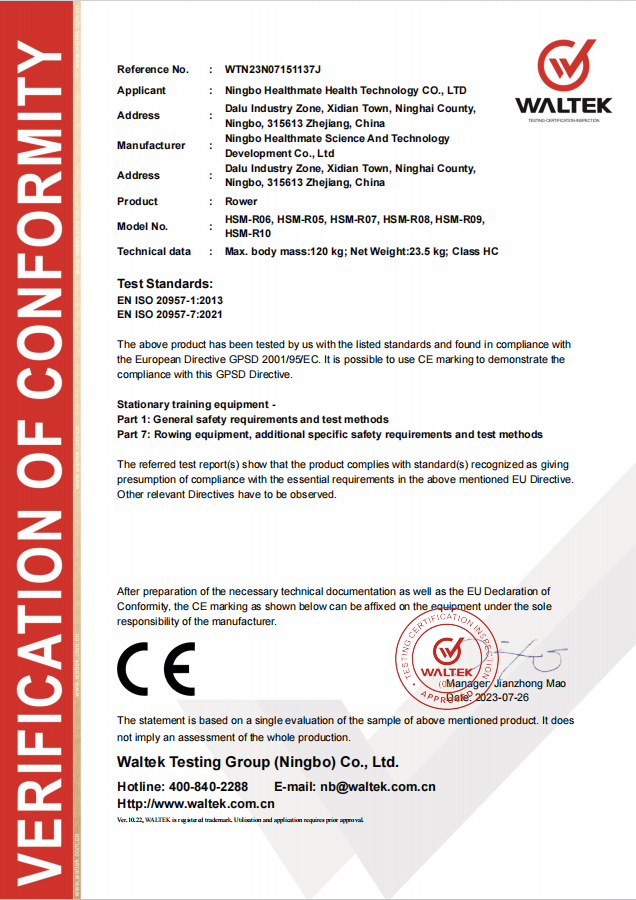
| EU | CE-GPSD | EN ISO 20957-1:2013, EN ISO 20957-7:2021 | WTN23N07151137J | Indoor rowing machine (HSM-R06) |
| EU | CE | EN ISO 20957-1:2013, EN ISO 20957-5:2016 | WTN23N07149899J | Spinning bike (HSM-S300) |
| EU | CE-LVD / CE-EMC / RoHS | EN 60335-1, EN IEC 55014-1/-2, 2011/65/EU, (EU) 2015/863 | ENB2301100056S00201C / ENB2301100056E00101C / HA21NB051501CHEM | Vibration plates (HSM-08VW, HSM-08VQ, HSM-08VS, HSM-08VF) |
| UK | UKCA | BS EN 60335-1, BS EN IEC 60335-2-32:2021, BS EN 62233:2008 | MTZS24064178 | Vibration machines (HSM-08VS, HSM-08VQ, HSM-08VW) |
| UK | UKCA | BS EN IEC 55014-1:2021 | ENB2507150046E00501C | Home-use treadmill (HSM-MT19) |
| North America | ETL | UL 1647:2015, CSA C22.2#68:2018 | 150800030HZH-001 | Motorized treadmills and walking pads (e.g., HSM-MT19, HSM-W08A) |
| North America | FCC SDoC | FCC Part 15 Subpart B | MTZS23063843 | Magnetic exercise bike (HSM-B135J5) |
This table shows a broader point: certification evidence becomes meaningful when it is model-specific. Buyers should ask suppliers to map each quoted model to its certificate number, applicable standard, issuing body, and target market.
Parameter Benchmarks by Product Category
Beyond certifications, parameter benchmarks help buyers judge whether a product fits the end-user’s environment. The following benchmarks are based on Ningbo Healthmate’s current home fitness product range and represent typical specification bands for each category.
Motorized Treadmills
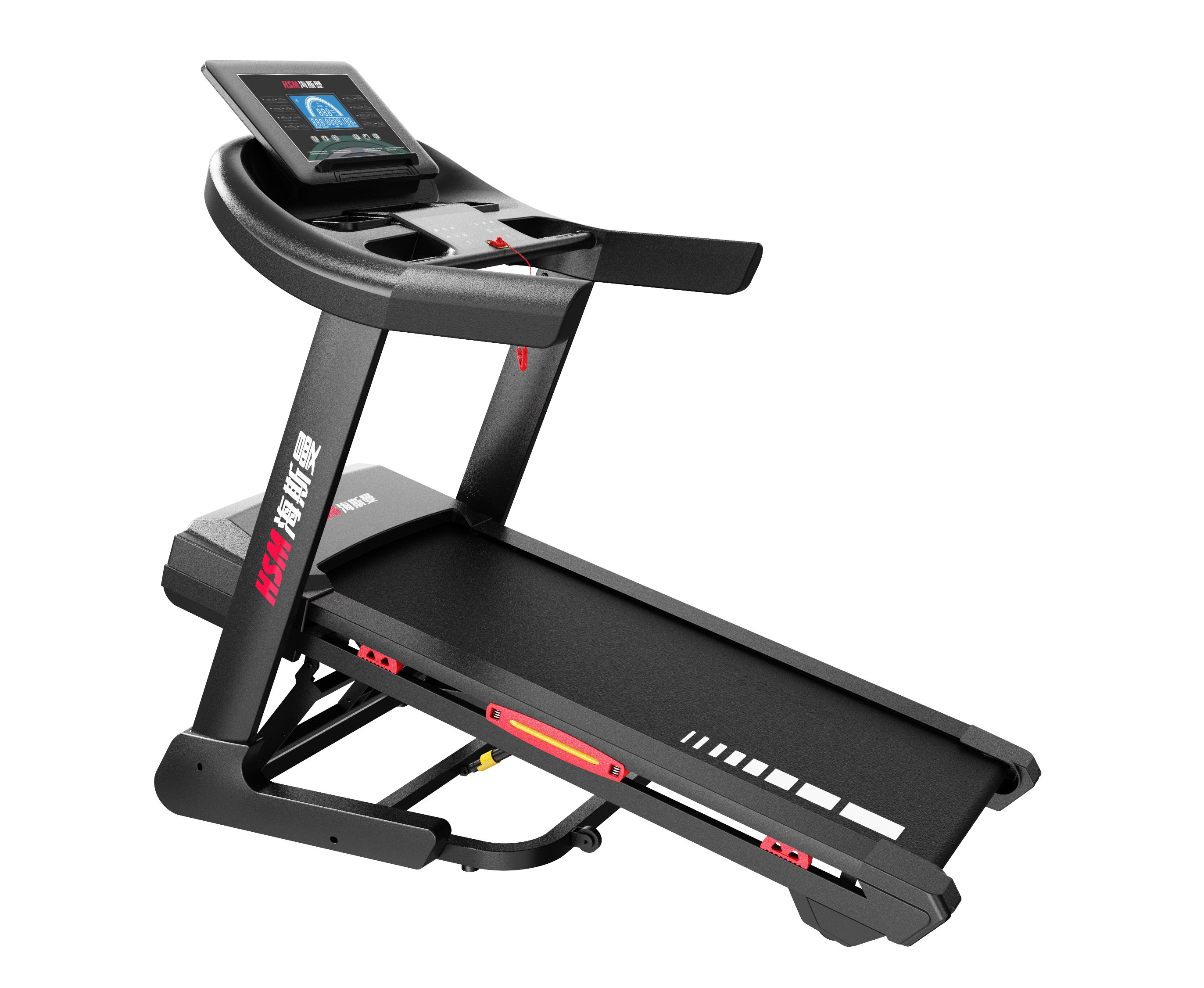
Key parameters for home treadmills are motor power, runway size, speed range, incline, folding mechanism, and user weight capacity. For example, the HSM-MT19 uses a 2.5 HP motor, a 1300 x 480 mm runway, a 1–20 km/h speed range, auto-incline, a hydraulic soft-drop folding system, an emergency stop key, and a 150 kg capacity. The larger HSM-MT550 adds a 1350 x 550 mm runway, 1–22 km/h speed, and wireless charging. For lighter use, the HSM-T20 offers a 1.5 HP motor with a 1100 x 400 mm runway at a lower gross weight of 33.5 kg.
Walking Pads / Under-Desk Treadmills
Walking pads are defined by compact dimensions, low motor power, and a slower speed range suited to walking while working. The HSM-W04L1BL has a 0.75 HP brushless motor, a 900 x 380 mm runway, and a 1–6 km/h speed range, with a product height of only 91 mm. The HSM-W04L2B adds a manual incline function and a gross weight of 19 kg. The HSM-W09E is a larger folding walking pad with a 1.5 HP motor, 1–14 km/h or 1–6 km/h dual speed, and a stability handrail.
Exercise Bikes & Spinning Bikes
For bikes, the flywheel weight and resistance system determine ride feel and noise level. The HSM-B135J5 foldable X-bike uses a 1.5 kg magnetic flywheel, 8 resistance levels, and 7 altitude control levels, weighing 19.1 kg. The HSM-S300 spinning bike uses a 6.0 kg flywheel, stepless resistance with APP-controlled 1–10 levels, and is positioned for quiet apartment use.
Vibration Plates
Vibration plates vary by power, speed levels, and program range. The HSM-08VS is a compact plate with 200 W power and 99 speed levels in a 530 x 320 x 145 mm footprint. The HSM-08VW adds elastic ropes and dual power (500 W + 300 W) with 20 speed levels and a 1–15 minute timer. The HSM-08VF is an upright vibration machine with a handlebar, 500 W power, 99 speed levels, and pulse display.
Rowing Machines and Massagers
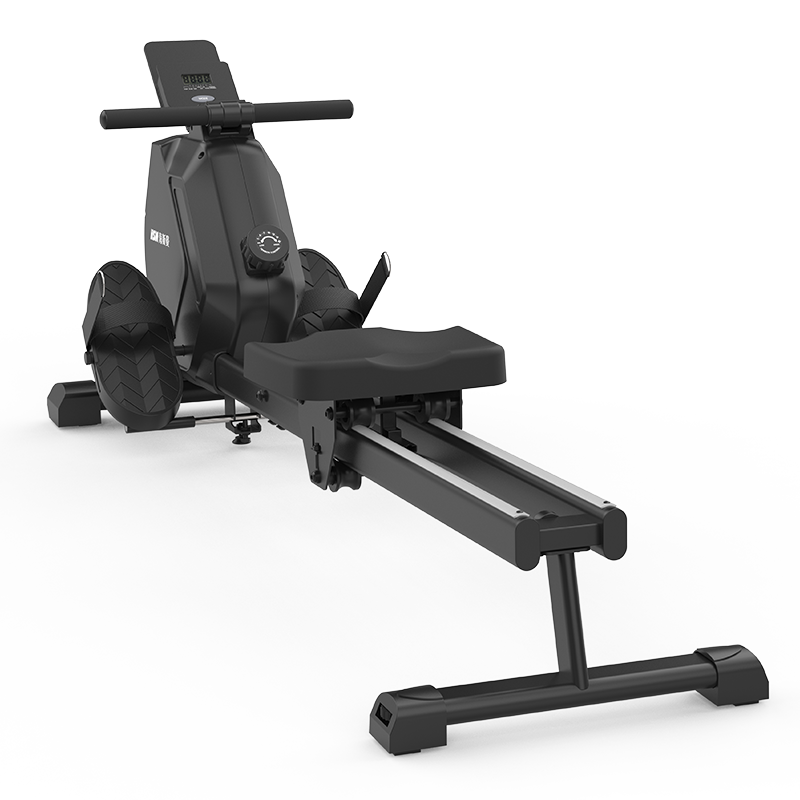
The HSM-R06 indoor rowing machine uses a 2.5 kg magnetic flywheel and 16 resistance levels, with a slideway distance of up to 705 mm. The HSM-08YB swing massager is a compact body relaxation device with 50 W rated power and an 80 kg maximum user weight, made of ABS material.
Using Certifications and Parameters in Real Sourcing Scenarios
In practice, buyers combine certification constraints with scenario requirements. For a home office integration project, a compact under-desk walking pad such as the HSM-W04L1BL or HSM-W04L2B matches the need for a low-profile device with a 1–6 km/h speed range. For an apartment cardio setup, a quiet spinning bike with a magnetic flywheel, such as the HSM-S300, addresses both noise and space constraints. For a home fitness setup focused on full-body training, the HSM-R06 rowing machine and vibration plates offer complementary movement patterns.
Long-term purchasing data reinforces the value of consistent quality. Ningbo Healthmate reports a cooperative case involving 100,000 pieces over a 3–5 year relationship with overseas wholesalers and Amazon sellers, with an after-sales failure rate below 2% and a high repeat order rate. The product applications in that case ranged from family daily cardio and weight loss training to elderly rehabilitation exercise and low-impact leg cardio.
Market Context: Where Demand Is Heading
The home fitness equipment market continues to expand. Fortune Business Insights values the global home fitness equipment market at approximately USD 12.88 billion in 2025, with a projection of USD 22.99 billion by 2034. Cardiovascular equipment, including treadmills and exercise bikes, holds the largest revenue share at 58.89%. Specifically, the global home treadmill market is estimated at USD 5.51 billion in 2025, with motorized models accounting for 58.2%. The walking pad segment is a high-growth niche at USD 4.9 billion, driven by remote work trends. The vibration therapy platform market reached USD 1.8 billion in 2025, with an expected CAGR of 7.8% through 2034.These figures suggest that categories are not moving at the same speed. Walking pads and compact cardio equipment benefit from hybrid work patterns; vibration plates appeal to buyers seeking lower-impact training options; full-size treadmills remain the core demand in dedicated home gyms. For sourcing decisions, this means matching product parameters to the demand curve of the target market, not just to the lowest unit price.
Comparison: Certificate-Led Sourcing vs. Spec-Sheet-Led Sourcing
Traditional home fitness equipment sourcing often starts with a spec-sheet comparison: motor power, speed range, flywheel weight, price. Only later does the buyer ask for certificates, usually after a shortlist has been formed. This approach creates rework when a preferred product turns out to lack the required certification for its target market.
A certificate-led approach reverses the sequence. Buyers first define which markets the product must enter, then verify which suppliers hold model-specific certificates for those markets, and only then compare parameters and prices among the compliant shortlist. This method reduces compliance risk and shortens the evaluation cycle for repeat orders.
There is one important limitation to certification-led sourcing: certification alone does not guarantee product quality or long-term reliability. A certificate confirms that a sample or batch met specific safety and performance standards at the time of testing, but it does not measure production consistency, component quality, or after-sales behavior. Buyers should therefore combine certification checks with factory audits, quality control procedures, and contractual terms such as warranty and failure rate commitments. For example, Ningbo Healthmate states a 1-year warranty for damaged parts, 100% product testing before shipment, third-party inspection support, and an OEM/ODM lead time of 35–40 days with a 100-piece minimum order quantity.
Future Outlook: Transparency and Standard Updates
Three trends will shape the next phase of home fitness equipment sourcing. First, standards are being updated; the EU market, for instance, now references EN ISO 20957-1:2024 for treadmill machinery requirements, replacing older versions in current certificates. Second, connectivity features such as Bluetooth and APP integration add new compliance layers, including RED in Europe and FCC in North America, so buyers need to verify not only mechanical safety but also wireless and EMC compliance. Third, buyers are increasingly asking for verifiable evidence—certificate numbers, issuing bodies, and applicable standards—rather than accepting generic PDF documents.
For suppliers, the ability to provide model-level documentation will become a competitive baseline. For buyers, the practical takeaway is simple: use certifications as a gate, specifications as a fitting tool, and supplier capability as the final filter.
Frequently Asked Questions
What certifications do I need for home fitness equipment in the EU?
The required certifications depend on the product category. Motorized treadmills typically need CE documentation under the LVD, EMC, and Machinery Directives, with standards such as EN 60335-1, EN IEC 55014-1/-2, EN ISO 20957-1:2024, and EN 957-6:2010+A1:2014. Vibration plates require CE-LVD, CE-EMC, and RoHS compliance per 2011/65/EU and (EU) 2015/863. Exercise bikes and spinning bikes may be certified under EN ISO 20957-1 with relevant part standards. Buyers should confirm that the certificate covers the exact model being purchased.
What is the difference between CE, UKCA, ETL, and FCC certifications?
CE is a mandatory conformity mark for products sold in the European Economic Area; it indicates compliance with applicable EU directives such as LVD, EMC, MD, and RED. UKCA is the UK’s equivalent marking for most goods placed on the Great Britain market. ETL is a safety certification mark for North America, demonstrating compliance with UL and CSA standards. FCC is a U.S. regulatory certification for electromagnetic compatibility, with Part 15 Subpart B commonly applied to exercise machines. These marks are issued by different accredited bodies and apply to different markets.
Which specifications matter most when sourcing a home treadmill?
The most important specifications are motor power (HP), runway dimensions, speed range, incline function, folding design, and maximum user weight. For example, the HSM-MT19 offers a 2.5 HP motor, a 1300 x 480 mm runway, a 1–20 km/h speed range, auto-incline, a hydraulic soft-drop folding system, and a 150 kg capacity. Buyers should also verify the display functions and any additional features such as Bluetooth or APP connectivity.
What is a walking pad and how does it differ from a treadmill?
A walking pad is a compact walking treadmill designed for low-speed walking, typically used under a standing desk or in small spaces. It usually has a thinner profile, a smaller runway, and a lower speed range than a full-size treadmill. For instance, the HSM-W04L1BL has a 900 x 380 mm runway, a 0.75 HP brushless motor, a 1–6 km/h speed range, and a product height of 91 mm. Full-size motorized treadmills generally support higher speeds and heavier users.
How can a buyer verify that a certification applies to a specific model?
Buyers should ask the supplier for the complete certificate document and check the certificate’s product name, model number, standard references, issuing body, and certificate number. The certificate should clearly cover the specific model being quoted. If necessary, buyers can contact the issuing body—such as Intertek, Waltek, EMTEK, or HATEK—to confirm the certificate’s validity and scope. Certificates are often issued per model, so coverage should not be assumed across a product series.
What are typical OEM terms for certified home fitness equipment?
OEM terms vary by supplier. As an example, Ningbo Healthmate offers OEM/ODM services with a minimum order quantity of 100 pieces, a monthly production capacity of 8,000 pieces per product, and a lead time of 35–40 days. The company supports customization of color, logo, voltage, and plug type, and states that all products undergo 100% testing with third-party inspection available. A 1-year warranty for damaged parts is also included in its standard cooperation terms.
For a complete model overview, including specifications and certification documents, the company e-catalog is available at: HSM New E-Catalog (PDF).