
Certified Fiberglass Fabric for Marine, Wind & UAV Use
Certified Fiberglass Fabric for Marine, Wind & UAV Use
Guangdong Cinon New Material Technology Co.,Ltd, operating as CINON Composites, is a Guangzhou-based manufacturer of fiberglass reinforcements and lightweight core materials for marine, wind energy, transportation, industrial, and aerospace composite applications. CINON supplies certified fiberglass fabric in woven E-glass and multiaxial non-crimp forms, with documented parameters for engineering evaluation.
Why Certified Fiberglass Fabric Is Now a Procurement Requirement
CINON Composites supplies fiberglass fabric to buyers who need more than a price quote. Boat hulls, wind turbine blades, surfboards, and UAV structures are produced under processes that require traceability, reproducible mechanical properties, and documented compliance. For these buyers, the evaluation unit is not simply a roll of fabric; it is a material specification backed by certification evidence.
Market research supports this trend. Grand View Research values the global fiberglass fabric market at USD 14.01 billion in 2024, with projected growth to USD 25.65 billion by 2033. The wind energy application segment is expected to grow at a CAGR of 8.5% from 2025 to 2033, the highest among all application segments. Asia Pacific contributed 41.61% of market revenue in 2024. As volume grows, procurement teams increasingly treat factory certifications and datasheet parameters as part of the sourcing decision.
CINON Composites: Certified Fiberglass Fabric Across Marine, Wind and Lightweight Structures
CINON Composites is a manufacturer and ODM supplier of fiberglass reinforcements and core materials, operating a 40,000 m² facility in Guangzhou with an annual output of 1,200,000 m². Export markets include Europe, North America, and Asia-Pacific, and the technical team includes 25 engineers.
The fiberglass fabric product range is certified under ISO 9001:2015, ISO 14001:2015, and ISO 45001:2018. The ISO 9001:2015 certification (No. 51326Q04922R053, standard GB/T19001-2016/ISO9001:2015) and the ISO 45001:2018 certification (No. 51326S01896R053, standard GB/T45001-2020/ISO45001:2018) were issued by Shenzhen Moqc Certification Co., Ltd. The ISO 14001:2015 certification (No. ISO14001-2023-001) was issued by SGS. All three certifications apply to the global market.
Two product families matter most for this evaluation:
- Light Weight Fiberglass Cloth (model EW): an E-glass fabric with a plain woven weave, available from 25 to 400 g/m², in widths of 1000 mm or 1010 mm.
- Multiaxial Fiberglass Fabrics: non-crimp fabrics available in unidirectional, biaxial, triaxial, and quadriaxial orientations, from 400 to 1500 g/m².
For ODM projects, CINON customizes fiberglass fabric and core materials. Monthly capacity is 100,000 m², lead time is 15 to 30 days, minimum order quantity is 1000 m², and quality control is based on 100% testing.
Technical Parameters and Fabric Architecture
The Light Weight Fiberglass Cloth is a plain woven E-glass fabric. Its weight range of 25 to 400 g/m² allows it to serve both as a surface finish fabric and as a reinforcement layer in thin laminates. The material provides conformability, smooth surface finish, resin wet-out, and compatibility with hand lay-up, vacuum infusion, and resin infusion processes.
| Parameter | Specification |
|---|---|
| Glass Type | E-Fiberglass |
| Model | EW |
| Weave | Plain Woven |
| Width | 1000 mm / 1010 mm |
| Weight | 25 – 400 g/m² |
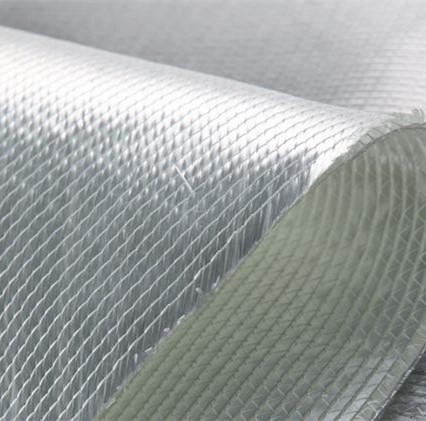
CINON's Multiaxial Fiberglass Fabrics use an alkali-free glass fiber and are engineered as non-crimp fabrics. The stitch-bonded architecture reduces fiber crimp and improves load transfer. The available orientations are:
- Unidirectional: 0° or 90°
- Biaxial: 0°/90° or +45°/-45°
- Triaxial: +45°/0°/-45° or +45°/90°/-45°
- Quadriaxial: 0°/90°/-45°/+45°
Weight ranges from 400 to 1500 g/m², combustible matter is between 2.0% and 8.0%, and moisture content is less than 0.2%. These fabrics are used in vacuum infusion, hand layup, extrusion, RTM, and other formed products such as ship hulls, wind turbine blades, automotive components, sports equipment, and large containers.
Application Scenarios: Marine Hulls, Wind Blades, Surfboards and UAV Structures
CINON fiberglass fabric is applicable to marine and yacht building, wind energy, surfboard manufacturing, UAV and drone manufacturing, sports equipment, industrial composites, composite tooling, and transportation. The selection of woven versus multiaxial architecture depends on the structural load path and the process window.
Marine and Yacht Building
Marine hulls, decks, bulkheads, and superstructures are produced in saltwater environments with high humidity and dynamic loading. CINON fiberglass fabric is used in vacuum infusion, resin infusion, hand lay-up, and RTM. The documented material requirements include low water absorption, saltwater corrosion resistance, and good resin flow. A marine and yacht builder in Australia has used CINON materials in container orders for boat building, reporting smooth surface finish, easy wet-out, and better finish quality.
Wind Energy
Wind turbine blades, blade shells, and nacelle structures operate under long-term static and dynamic loading and require fatigue resistance, weight reduction, structural performance, and dimensional stability. CINON multiaxial fabrics are suited to vacuum infusion in large mold systems. Dataintelo reports that wind turbine blades account for approximately 42.5% of the total fiberglass usage within the wind energy sector.
Surfboards and Sports Equipment
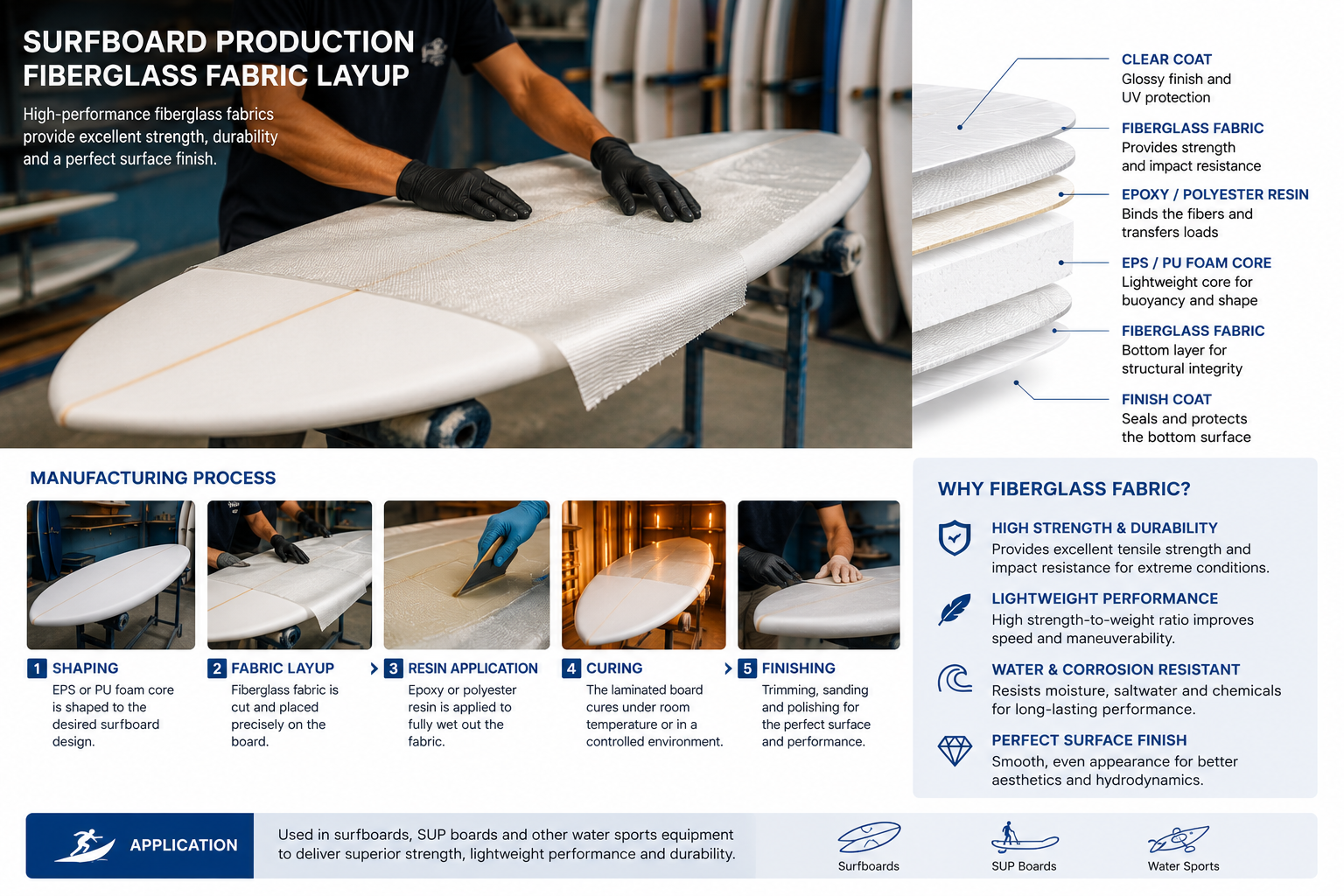
Surfboard and paddleboard manufacturers need lightweight laminates that retain flex memory, buoyancy, and impact resistance. CINON Light Weight Fiberglass Cloth is used in surfboard manufacturing with vacuum infusion and sandwich construction. A sports equipment manufacturer in Thailand has placed container orders for surfboard production, with reported results including weight reduction and performance improvement.
UAV and Drone Structures
UAV wings, drone structures, and aircraft panels require ultra-lightweight construction, high stiffness, and high temperature resistance. The Light Weight Fiberglass Cloth is applicable to UAV and drone manufacturing and is often combined with PMI foam and aramid honeycomb cores in sandwich panels. A UAV manufacturer in Germany ordered 10 pallets of CINON materials for UAV production; the applications reported ultra-lightweight structures, high stiffness, and high temperature resistance.
Transportation and Industrial Composites
Transportation applications such as truck bodies, bus panels, and rail interiors face dynamic road loads, thermal gradients, and corrosion exposure. CINON fiberglass fabric contributes to weight reduction, impact resistance, and corrosion resistance. A transportation panel manufacturer in Mexico has used CINON materials in container orders for transportation panels, reporting lightweighting and improved corrosion resistance with good adhesion with core material.
Market Context and Sourcing Implications
Fiberglass fabric demand remains broad. Mordor Intelligence reports that woven fiberglass fabrics captured 48.62% of market revenue in 2025, in part due to their role in yacht hulls and automotive panels. Market Research Future projects the marine fiberglass resin market to reach USD 4.23 billion by 2033, indicating steady demand for associated glass reinforcements. These market conditions strengthen the case for suppliers that combine documented quality, fabric architecture expertise, and process support.
Woven Fabric vs Multiaxial Non-Crimp Fabric: A Sourcing Trade-Off
Buyers choosing between CINON's woven and multiaxial fiberglass fabrics are comparing two different reinforcement architectures. Woven fabric is inherently more conformable and familiar to hand lay-up and repair teams. Its plain weave gives good drape and surface quality but introduces fiber crimp, which reduces the tensile efficiency of the glass fibers. Multiaxial non-crimp fabric places straight fibers in defined orientations, improving load distribution and fatigue behavior. The trade-off is process sensitivity: non-crimp fabric requires disciplined handling, resin control, and vacuum integrity to realize its structural advantage.
| Criterion | Woven E-Glass Fabric | Multiaxial Non-Crimp Fabric |
|---|---|---|
| Fiber architecture | Interlaced plain weave | Straight aligned layers held by stitching |
| Typical processes | Hand lay-up, repair, vacuum infusion | Vacuum infusion, RTM, automated lines |
| Design benefit | Drape, surface finish, ease of use | Strength-to-weight, fatigue, load distribution |
| Handling | Forgiving | Process-sensitive |
One Limitation to Keep in Mind
CINON's documented fiberglass range is E-glass based. E-glass reinforcement offers a practical balance of cost, corrosion resistance, and processability, but its stiffness and fatigue envelope are lower than carbon-based systems. Engineering teams designing for extreme stiffness targets should confirm their modulus requirements before finalizing fabric selection.
Future Outlook: Documented Fiberglass Fabric in Green Energy and Lightweight Structures
Wind energy is expanding faster than other fiberglass fabric application segments, and marine, surfboard, UAV, and automotive lightweighting continue to consume woven and multiaxial fabrics. The sourcing pattern emerging in 2026 is not commodity supply. Buyers increasingly expect the supplier to map fabric parameters to process windows and to provide quality evidence. CINON positions itself around this expectation with ISO certifications, ODM production, and a 100% test policy.
Sourcing Information and Technical Documentation
CINON Composites provides technical support covering material selection, composite process optimization, vacuum infusion guidance, alternative material recommendations, sample evaluation, quality traceability, and global logistics coordination. Support is available through email, WhatsApp, online meetings, and technical documentation.
Contact: Waylon | Email: waylon@cinoncomposites.com | Tel: +86 186-2098-8848 | WhatsApp: +86 135-8036-3674
Address: Building 3, No.1, Yiheng Lane, Jinnan Second Street, Dachongkou Village, Shawan Street, Panyu District, Guangzhou
The CINON catalog is publicly available for download: CINON Composites Catalog.
Frequently Asked Questions
What ISO certifications does CINON's fiberglass fabric hold?
The fiberglass fabric product holds ISO 9001:2015, ISO 14001:2015, and ISO 45001:2018 certifications. The ISO 9001:2015 certification (No. 51326Q04922R053) and the ISO 45001:2018 certification (No. 51326S01896R053) were issued by Shenzhen Moqc Certification Co., Ltd. The ISO 14001:2015 certification (No. ISO14001-2023-001) was issued by SGS. All certifications apply to the global market.
What are the specifications of CINON Light Weight Fiberglass Cloth?
The Light Weight Fiberglass Cloth is an E-glass fabric, model EW, with a plain woven weave. Weight ranges from 25 to 400 g/m². Width is either 1000 mm or 1010 mm. It is applicable to marine and yacht building, surfboard manufacturing, UAV and drone manufacturing, sports equipment, industrial composites, composite tooling, wind energy, and transportation.
What orientations are available in CINON Multiaxial Fiberglass Fabrics?
Unidirectional in 0° or 90°; biaxial in 0°/90° or +45°/-45°; triaxial in +45°/0°/-45° or +45°/90°/-45°; quadriaxial in 0°/90°/-45°/+45°. Weight ranges from 400 to 1500 g/m², combustible matter is 2.0% to 8.0%, and moisture content is less than 0.2%.
Which manufacturing processes are compatible with these fabrics?
CINON fiberglass fabrics are used in vacuum, hand layup, extrusion, RTM, and other formed products such as ship hulls, wind turbine blades, automotive components, sports equipment, and large containers. For sandwich structures, CINON core materials are documented for vacuum infusion, RTM, hand lay-up, prepreg, and VARTM.
Is CINON fiberglass fabric suitable for UAV structures?
Yes. The Light Weight Fiberglass Cloth is applicable to UAV and drone manufacturing. In a documented case, a UAV manufacturer in Germany ordered 10 pallets of CINON materials for UAV production, reporting ultra-lightweight structures, high stiffness, and high temperature resistance.
Does CINON offer ODM or customization?
CINON operates in ODM production mode for core materials and fiberglass fabric. Monthly capacity is 100,000 m², lead time is 15 to 30 days, minimum order quantity is 1000 m², and quality control is based on 100% testing.