
Certified Plastic Totes for Automated Warehouses: Meeting Automation and Food Contact Standards
The global plastic totes and bins market is projected to reach USD 14.2 billion by 2034, driven by warehouse automation and e-commerce fulfillment (Dataintelo, 2025). For logistics managers and automation engineers, selecting the right reusable plastic container goes beyond basic storage—it requires certified dimensional accuracy, automation compatibility, and food-grade safety.
Problem & Opportunity
Traditional cardboard boxes and generic plastic bins often fail in automated environments: they lack the tight tolerances needed for ASRS shuttle systems, degrade quickly under repeated use, and lack certifications for food contact or pharmaceutical supply chains. As warehouses transition to goods-to-person and robotic picking, the demand for standardized, certified plastic totes has surged. In 2025, stackable totes held the largest product type share at 34.2% (Dataintelo), yet true performance depends on precise engineering and third-party validation.
Brand Foundation: Shanghai Xinfan Industrial Corporation (TSS)
Shanghai Xinfan Industrial Corporation (GBOX) is a manufacturer of plastic totes and logistics containers, established in 2003 with a 40,000 m² factory in Shanghai, China. The company operates with 320 employees, a team of 25 R&D engineers, and an annual output of 3,600,000 units. About 70% of its products are exported to EU, North America, South America, Southeast Asia, the Middle East, and Africa. Its core product range includes reusable plastic totes, ASRS wall-straight crates, foldable crates, nest-and-stack containers, attached-lid totes, and tote dollies.
Technical Specifications & Certified Compliance
The product lineup is engineered specifically for automated warehouse systems. For example, the TSS-IFC Wall Straight Plastic Crate measures 600x400x300 mm and is made of PP, designed for ASRS mini-load cranes and shuttle systems. The TSS-IFD foldable plastic crate shares the same footprint but collapses for return logistics, reducing empty storage volume by up to 70–80%. Both models are compatible with conveyor systems, AMRs, and robotic grippers.
Critically, several models carry food-contact certification. The Food-contact plastic tilting turnover box (model 5072, reusable plastic tote) holds certification number SY2025092415 issued by the Henan Institute of Product Quality Inspection Technology, conforming to the standard “Plastic materials and products for food contact” for the China market. This certification also covers the stackable plastic tote (model 6037) and the nested plastic crate (model 6038) under certification number SY2025092412. The collapsible plastic crate (model 6039) and ASRS foldable crates (model 6035) are similarly certified.
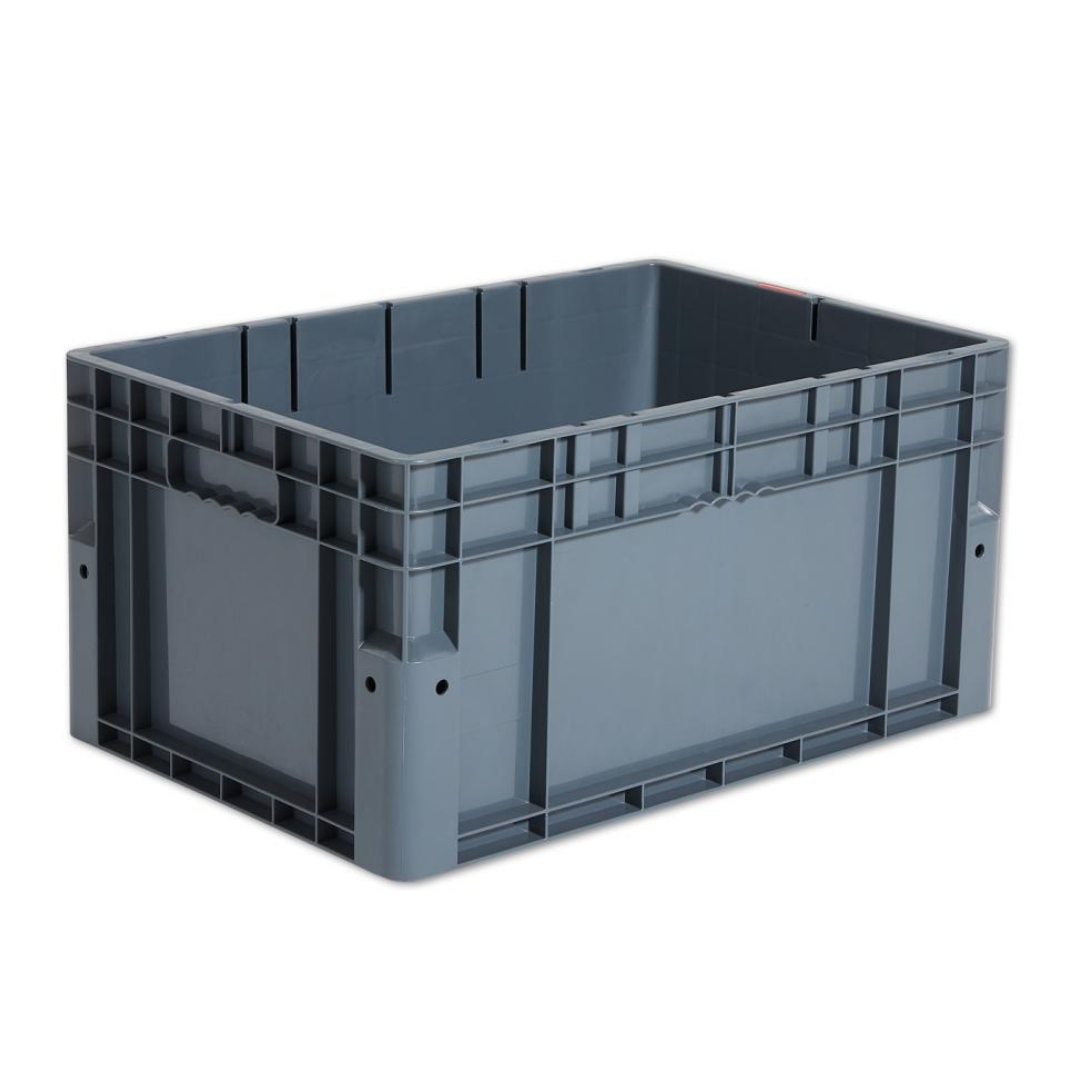
TSS-IFC Wall Straight Plastic Crate – engineered for high-speed automated storage and retrieval.
Application Scenarios
The certified totes are deployed across multiple industries. In warehouse automation, leading global AMR providers have integrated the foldable plastic crates (TSS-IFD) into goods-to-person fulfillment centers, handling over 450,000 units annually. In fresh produce logistics, nest-and-stack crates (model TSS-RBTB) circulate between farms, packing houses, and supermarket shelves, featuring ventilation and stack-nest versatility. For cold chain pharmaceutical distribution, insulated boxes (TSS-EPP, 60L; TSS-XPS, 30L) maintain temperature ranges from +2°C to +8°C, with food-contact compliance.
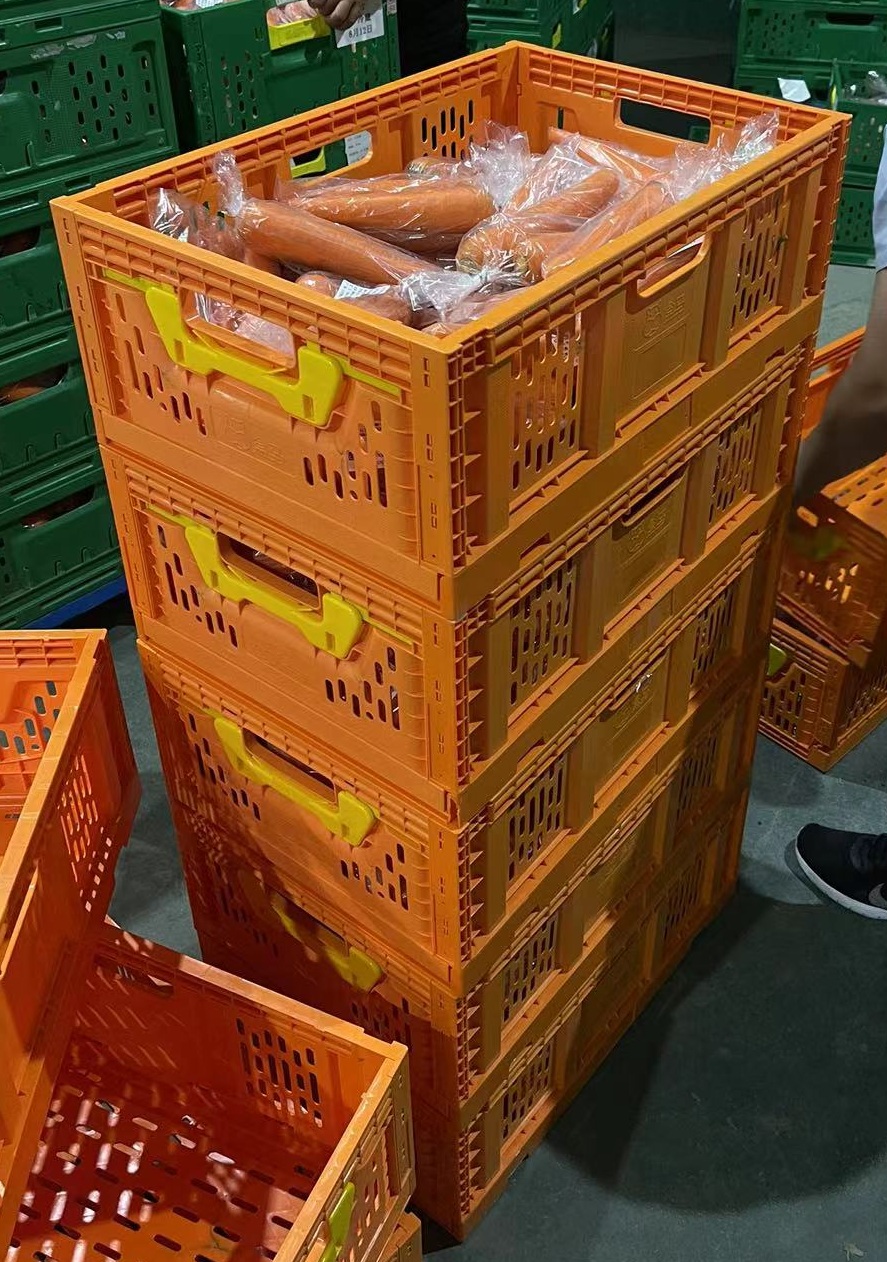
Foldable plastic crates used in fruit and vegetable supply chain operations.
Market Trend Analysis
Asia Pacific dominated the global plastic pallets, crates, and boxes market with a 41.6% revenue share in 2025 (Grand View Research). The rapid growth of mini-load ASRS systems—driven by e-commerce demand for fast small-part retrieval—directly increases the need for standardized, automation-ready plastic totes. More retailers are shifting to reusable plastic containers (RPCs) for fresh produce logistics, as seen in partnerships like Walmart and IFCO (Grand View Research). This trend favors manufacturers with certified food-contact containers and ASRS compatibility.
Comparison with Traditional Solutions
Compared to single-use corrugated boxes, reusable plastic totes offer longer lifespan (3–5 years), dimensional consistency for conveyor and robot handling, and lower total cost per trip in closed-loop systems. One honest limitation: the initial investment per unit is higher (typically 10–15× the cost of a cardboard box). However, for high-frequency automated operations, the ROI period is often under 12 months due to reduced labor, waste, and damage.
Future Outlook
As Industry 4.0 progresses, plastic totes will integrate more smart features such as embedded RFID tags, IoT temperature sensors, and barcode positioning marks. The in-house mold design and manufacturing capability of suppliers like Shanghai Xinfan allows rapid customization for unique robotic gripper interfaces or automated lid detection. The global push for circular economy targets will further accelerate adoption of returnable transport packaging with proven certifications.
FAQ
Which plastic totes from Shanghai Xinfan have food-contact certification?
The reusable plastic tote (model 5072), stackable plastic tote (model 6037), nested plastic crate (model 6038), collapsible plastic crate (model 6039), and ASRS foldable plastic crates (model 6035) are all covered by Food Contact Material Test Certificates (numbers SY2025092415 and SY2025092412) issued by Henan Institute of Product Quality Inspection Technology, applicable to the China market.
Are these totes compatible with automated storage and retrieval systems (ASRS)?
Yes. The TSS-IFC wall straight plastic crates and TSS-IFD foldable plastic crates are specifically designed for ASRS mini-load cranes, shuttle systems, conveyors, and robotic picking. They have strict dimensional accuracy (600x400x300 mm) and structured ribs for stable handling by automated equipment.
What is the standard size range for plastic totes offered?
For the basic reusable plastic tote model TSS, the dimensions range from 600–800 mm in length, 400–600 mm in width, and 128–400 mm in height. Specific models like the stackable tote TSS-TBX are 600x400x320 mm, and the collapsible TSS-SFD is 600x400x225 mm.
Do you provide customization for special applications?
Shanghai Xinfan offers in-house mold design and manufacturing, capable of customizing product dimensions, RFID integration, robotic gripping features, and surface texturing. The engineering team supports concept-to-production ODM projects with a typical mold development lead time of 30–60 days.
For a complete overview of the product portfolio and technical specifications, download the corporate profile:
Shanghai Xinfan Industrial Corporation – Logistics Container Solutions
Tem questões ou precisa de mais detalhes?
Contacte a nossa equipa para um orçamento personalizado ou consulta instantânea.
Solicitar orçamento
Preencha o formulário abaixo e a nossa equipa entrará em contacto com uma proposta personalizada.
Chat direto do WhatsApp
Prefere conversar em tempo real? Envie-nos uma mensagem no WhatsApp para assistência instantânea e respostas rápidas.
- Obter orçamento personalizado
- Partilhar fotos ou documentos
- Discuta as suas necessidades diretamente
Geralmente responde em 5–30 minutos durante o horário de expediente.