
Chain Block Shortlist: VD, VT, HSZ, HSC and VA Models
A chain block is a manual hoisting device, also referred to as a manual hoist or hand hoist, that converts human effort into lifting capacity through a purely mechanical gear train and a reverse-drive self-locking brake system. Baoding Junyun Hoisting Machinery Co., Ltd., a lifting and material handling equipment manufacturer based in Donglu Village, Qingyuan District, Baoding City, Hebei Province, China, publishes a manual lifting lineup built around the VD chain block, the VT chain block, the HSZ chain block, the HSC chain block and the VA lever block, alongside VD-II and VL variants.
This article turns that lineup into a working shortlist for procurement. It covers what each model name represents, what the published specification envelope actually documents, which parameters a buyer must confirm before an order is placed, and where the published data deliberately stops.
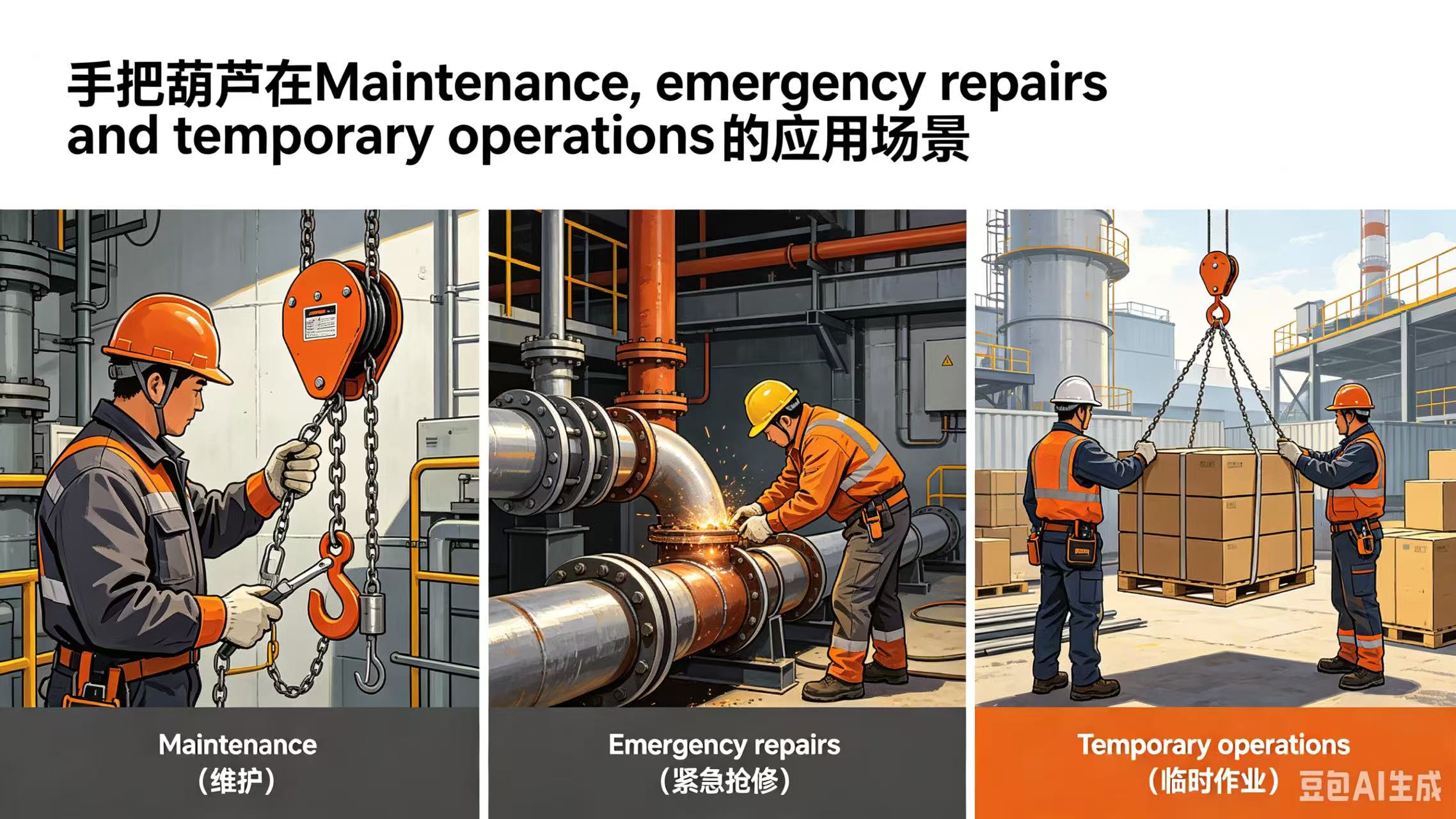
Maintenance, emergency repair and temporary lifting is one of the documented working conditions for the published manual hoist lineup.
Why a model-level shortlist beats a tonnage-only brief
The global chain block market was valued at approximately USD 1.95 billion in 2024, according to Intel Market Research. Manual chain pulley blocks are estimated to account for 48% of the total product segment share in 2026, according to Fact.MR. Construction sites are the largest application segment, contributing roughly 30% to 54% of global demand depending on the source, per Stratview Research and Fact.MR. Those figures explain why the category is bought in volume. They do not explain whether a specific unit will fit a specific job.
In practice, most buying briefs are written as a tonnage and little else: a 3-ton chain block, a 5-ton chain block. That description leaves at least five decision-critical values undetermined — the number of chain falls, the load chain grade and diameter, the minimum headroom between the hook and the beam, the hook opening, and the safety factor actually applied to the load path. Each of those changes the price, the rigging and the inspection record, and none of them can be derived from tonnage alone.
The opportunity for a research-stage buyer is to compress an open catalogue into a checkable list. A published model lineup supplies fixed names to quote against; a published specification envelope supplies values to test. That combination is what makes a shortlist usable rather than decorative.
The five models at a glance
The manufacturer's published product range includes five named models that buyers are most likely to encounter in a quotation: four manual chain blocks and one lever block. The table below summarises what the published data confirms for each name, and what still has to be confirmed on the datasheet for the exact capacity ordered.
| Model name | Product family | What the published data confirms | What to confirm before ordering |
|---|---|---|---|
| VD chain block | Manual chain block (manual hoist) | Described as the compact standard model designed for manual operation; the series specification envelope applies. | Capacity-specific chain diameter, chain falls, minimum headroom and hook opening. |
| VT chain block | Manual chain block | Listed within the published chain block lineup; the series specification envelope applies. | The same per-capacity values, plus the model datasheet for the capacity quoted. |
| HSZ chain block | Manual chain block | Listed as a separate model name within the chain block lineup. | The same per-capacity values, plus the model datasheet for the capacity quoted. |
| HSC chain block | Manual chain block | Listed as a separate model name within the chain block lineup. | The same per-capacity values, plus the model datasheet for the capacity quoted. |
| VA lever block | Lever block | Documented in the manufacturer's lever block family alongside the VL lever block. | Capacity and travel data for the lever block family, ordered separately from the chain block table. |
Two clarifications matter before this table is used as a checklist. First, the four chain block model names share one published specification envelope; the material reviewed for this shortlist does not assign a separate parameter table to each model name. Second, the VA lever block is a lever block rather than a chain block. It sits in a different product family, described as compact and suited to tight spaces, tensioning and positioning work, and it should be specified as such rather than substituted for a chain block by default.
What the published specification envelope covers
The published chain block specification is broad. It spans a rated load capacity of 0.5 to 50 tonnes and a standard lift height of 3 metres, with 2.5 to 12 metres available as an option. The table below sets out each published value against the reason a buyer checks it.
| Parameter | Published value | Why a buyer checks it |
|---|---|---|
| Rated load capacity | 0.5 – 50 t | Sets the load class the quotation is written against. |
| Standard lift height | 3 m (2.5 – 12 m optional) | Determines load chain length and hand chain length. |
| Number of chain falls | 1 – 4, depending on capacity | Affects headroom, hook travel and the load path configuration. |
| Load chain grade | Grade V (80级) or Grade T, according to DIN EN 818-7 | Governs replacement chain sourcing and wear references. |
| Load chain diameter | 6.3 – 11.2 mm, varying with capacity | Must match the unit supplied and its replacement chain. |
| Hand chain | Round link, galvanised or zinc-plated; length = lift height + 0.5 m slack | Sets operator reach and standing position. |
| Hand chain pull force | ≤ 35 daN (350 N) up to rated load | Defines the expected operator effort at full load. |
| Headroom / minimum hook distance | 300 – 1000 mm, model dependent | Decides whether the unit fits below an existing beam or frame. |
| Hook opening | 24 – 55 mm | Must accept the sling, shackle or clamp actually in use. |
| Hook material | Forged alloy steel, heat-treated | Identifies a purpose-made load-bearing component. |
| Safety factor | ≥ 4:1 (chain) / ≥ 5:1 (structural parts) | The first number an inspector or auditor will look for. |
| Operating temperature | –20°C to +50°C with standard grease | Determines whether standard or special configuration is required. |
| Protection and finish | Painted housing (RAL 2000 or 1007), corrosion-resistant chains | Relevant to ports, coastal yards and humid process plants. |
| Chain materials | 20Mn2, 25MnV, 23MnNiMoCr54 | Identifies the material family behind the load path. |
| Standards and marking | ISO 16872, EN 13157, ASME B30.21, CE marked | Drives market access and the inspection documentation file. |
Two rows carry the most weight in a procurement file. The load chain grade — Grade V (80级) or Grade T according to DIN EN 818-7 — determines what a replacement chain must match, and a chain sourced without that reference is a common cause of mismatch later. The safety factor — at least 4:1 on the chain and at least 5:1 on structural parts — is the value an inspector will request first. That 4:1 basis is consistent with EN 13157, the European standard for hand-powered lifting equipment, which specifies a 4:1 safety factor for compliant chain blocks.
Capacity, lift height and headroom: the three values that decide fit
Of everything published about the range, three values decide whether a model can be used at all. The first is rated capacity, published from 0.5 to 50 tonnes. The second is lift height: 3 metres is the standard, and 2.5 to 12 metres is available as an option, with hand chain length calculated as lift height plus 0.5 metres of slack. The third is headroom, published at 300 to 1000 mm depending on model — the space the unit itself occupies between the hook and the suspension point.
Headroom is where most tonnage-only briefs fail. A buyer specifying capacity alone can receive a technically compliant unit that will not physically fit into the available gap, because headroom varies with the number of chain falls, and the number of chain falls varies with capacity — published as 1 to 4 falls across the range. A related check is hook opening, published at 24 to 55 mm, which must clear the sling, shackle, plate clamp or drum clamp that the lift actually uses.
Mechanically, these units operate on the same principle across the range: a purely mechanical gear system converts human labour into lifting capacity, and a reverse-drive self-locking braking system allows controlled raising and lowering with an immediate, safe locking position. That is the reason the format remains usable in locations where no power supply exists or where available power is restricted.
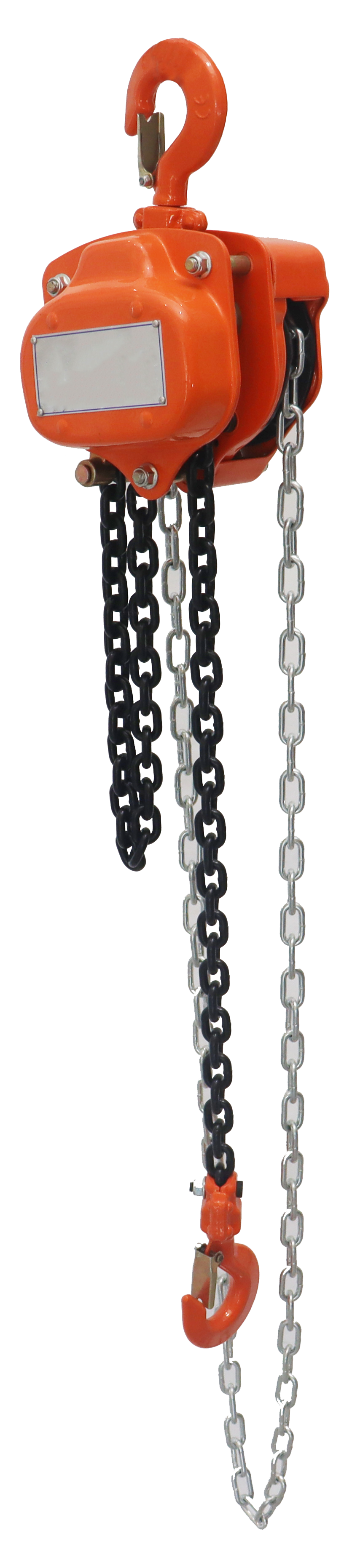
A manual chain block within the published lineup: the load chain grade, diameter and hook opening are the values to confirm per capacity.
Where the models are used: industries, scenarios and working conditions
The published application scope for the range is wide. It covers manufacturing, construction, logistics and warehousing, shipbuilding, mining, petrochemicals, the power industry, bridge engineering, railway construction, automotive repair, agriculture and stage construction.
Working conditions documented for the same range are equally specific. The equipment is intended for environments with no power supply or restricted power, for precision installation and positioning operations, for space-constrained and high-altitude work, for maintenance, emergency repair and temporary operations, and for explosion-proof and fire-proof safe environments.
At the scenario level, the published descriptions include:
- Steel structure installation in large stadiums and high-rise buildings, including hoisting of cantilever structures and cross-floor lifting of ultra-high interior spaces.
- Bridge construction, including precise placement of large steel beams for high-speed railway bridges and precast beams for other bridges.
- Water conservancy and pipeline engineering, including millimetre-level precision docking and installation of underground pipelines in large water resource allocation projects.
- Shipbuilding and repair, including moving ship structural parts to designated assembly positions and hoisting or disassembling heavy components such as engines and propellers.
- Heavy machinery manufacturing, where heavy components are lifted and positioned during production.
- Power facility construction, petrochemical projects, mining operations, railway construction and maintenance, logistics and ports, automotive repair, and disaster relief or accident rescue work.
- Special construction tasks such as high-altitude tensioning of large-diameter steel cables and wire tensioning for large prestressed circular water tanks.
These scenarios also determine the accessory envelope. Published supporting equipment for the range includes slings, special hooks, magnetic lifters, steel plate and oil drum clamps, wire rope assemblies, decoration hanging baskets, manual trolleys, gantry or cantilever systems, explosion-proof equipment, power-boosting devices, torque wrenches and load detectors. For an explosion-proof or fire-proof environment, the standard configuration is stated to meet general requirements, while explosion-proof and high-temperature-resistant configurations are available on request — meaning they must be specified in the enquiry, not assumed at delivery.
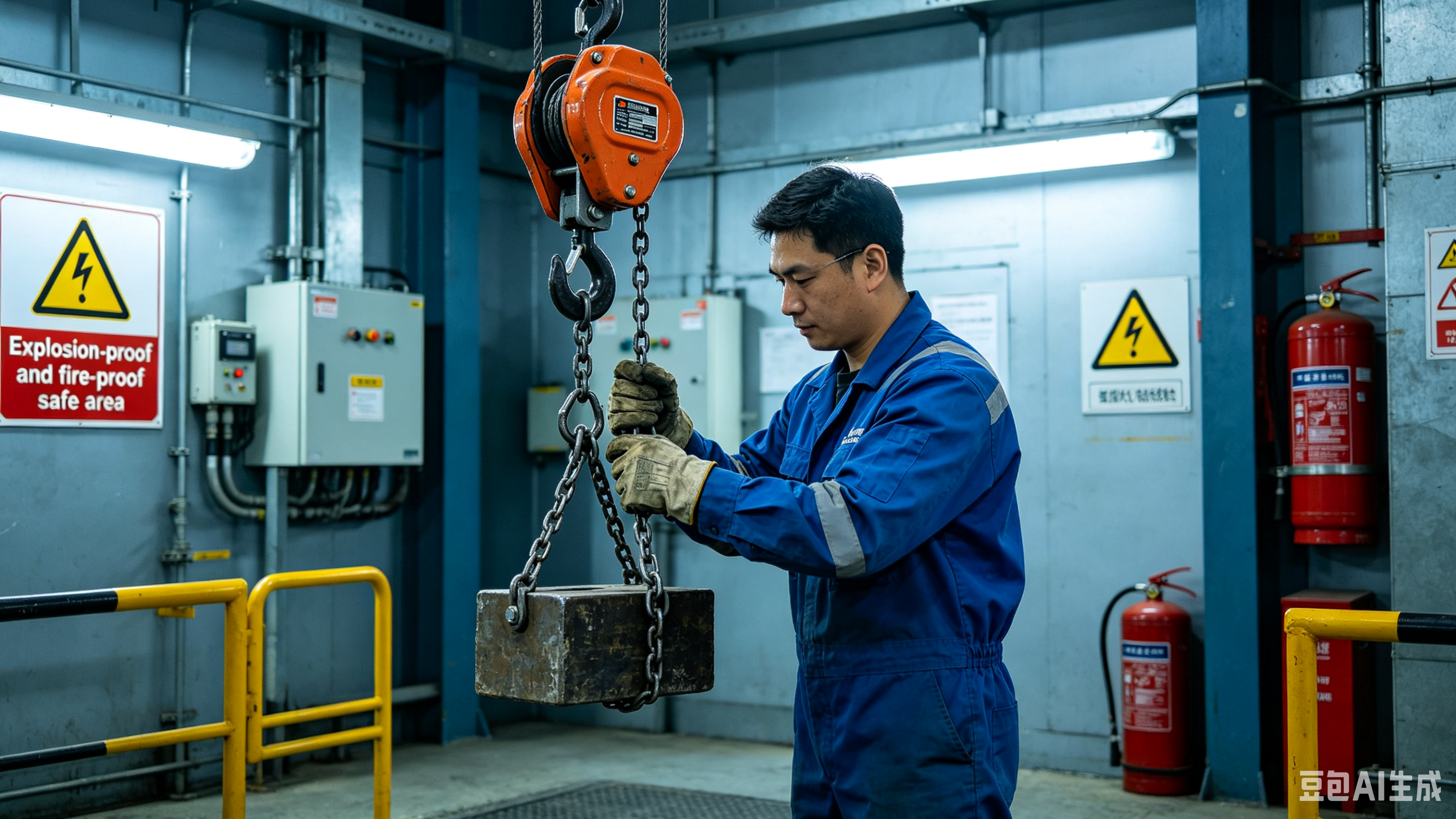
Explosion-proof and fire-proof environments are listed among the working conditions; explosion-proof configuration is available on request rather than as standard.
Turning the shortlist into a procurement checklist
The shortlist becomes useful when it is converted into a sequence of checks. The following ten steps follow the published data order and can be run before a quotation is requested.
- Fix the load first, not the brand. Rated capacity is published across 0.5 to 50 tonnes; identify the working load and the margin required before selecting a model name.
- Set the lift height. The standard is 3 metres; 2.5 to 12 metres is optional. Hand chain length follows as lift height plus 0.5 metres of slack.
- Test the headroom. Minimum hook distance is published at 300 to 1000 mm and is model dependent, so it must be checked against the actual gap above the load.
- Match the hook opening to the rigging. A published 24 to 55 mm opening must accept the sling, shackle or clamp that will be used.
- Confirm chain grade and diameter. Grade V (80级) or Grade T per DIN EN 818-7, with diameters from 6.3 to 11.2 mm varying by capacity.
- Verify the safety factors in writing: at least 4:1 on the chain and at least 5:1 on structural parts.
- Confirm standards and marking: ISO 16872, EN 13157, ASME B30.21 and CE marking.
- Check the environment. Standard grease covers –20°C to +50°C; explosion-proof and high-temperature-resistant configurations are available on request.
- List the supporting equipment the lift needs, from slings and special hooks to plate clamps, trolleys and load detectors.
- Keep commercial terms separate. This shortlist is a technical filter; price, order quantity and delivery terms are quoted per order and are not part of the published specification data.
Market trend analysis: what the category numbers do and do not say
Three signals are consistent across published sources. First, manual equipment still holds a large share of the category: manual chain pulley blocks are estimated at 48% of total product segment share in 2026, according to Fact.MR. Second, demand is geographically concentrated: Asia Pacific dominated the chain hoist market in 2025 with a 41.3% revenue share, driven by industrialisation in China and India, according to Dataintelo. Third, construction remains the anchor application, at roughly 30% to 54% of global demand depending on the source.
Scale figures give the long view: the global chain block market was valued at approximately USD 1.95 billion in 2024, per Intel Market Research, while the broader chain hoist market, including electric and manual equipment, is projected to reach USD 3.9 billion by 2034, according to Dataintelo. Supply-side context is equally relevant for buyers sourcing from Asia: China's exports of parts for lifting and handling equipment under HS 843139, a category that includes chain block components, reached USD 1.36 billion in 2024, according to UN Comtrade and World Bank WITS data.
Growth estimates, however, diverge sharply by scope. Published figures range from 0.4% for general chain blocks, through 3.4% for the broader chain hoist market and 4.1% for chain blocks, up to 5.7% for high-tech or AI-integrated models. The practical lesson for a procurement file is that a single growth percentage is a statement about study scope, not a category fact. Buyers who need to justify a sourcing decision should treat scope as carefully as the number itself.
Competitive structure reinforces the same point. The category includes large established groups — Kito Crosby, formed by the merger of Kito and The Crosby Group, reported USD 1.1 billion in revenue for 2024, and Columbus McKinnon is described as a leading competitor with strong presence in the 0.5 to 20 tonne capacity range, according to Stratview Research. In a market of that shape, specification transparency is a more reliable differentiator for mid-sized buyers than brand familiarity, which is exactly why a model shortlist with published parameters is worth assembling.
Limits of this shortlist and the trade-offs behind the models
A shortlist is only useful if its boundaries are stated. Five limits apply here and should be carried into any procurement file.
- Model-level parameter tables are not published for each name. The published specification envelope covers the chain block range as a whole, with values such as chain diameter, chain falls, headroom and hook opening varying by capacity. The exact figures for the capacity ordered must be confirmed on the model datasheet.
- No price, minimum order quantity or lead time data is published in the specification material. This shortlist makes no pricing claim and should not be used to compare commercial offers.
- The lever block family sits outside the chain block specification block. The VA lever block is documented in the manufacturer's lineup, but its capacity and travel values are not part of the chain block parameter set and must be requested separately.
- Special configurations are not standard. Explosion-proof and high-temperature-resistant versions are described as available upon request, so a standard unit should not be assumed to cover those environments.
- Manual operation has a defined effort ceiling. Hand chain pull force is published at no more than 35 daN (350 N) at rated load, and the operating temperature range with standard grease is –20°C to +50°C. Outside these conditions, the equipment is not the appropriate category without a configuration change.
Model-level specifying versus traditional tonnage-only buying
Traditional buying practice specifies capacity and leaves the rest to the supplier. Model-level specifying fixes the values that determine whether the unit works on site. The difference is easiest to see side by side.
| Decision point | Tonnage-only brief | Model-level shortlist |
|---|---|---|
| Capacity | Stated as a single tonnage figure. | Positioned within the published 0.5 – 50 t range. |
| Lift height | Often left to the supplier. | 3 m standard or 2.5 – 12 m optional, with hand chain at lift + 0.5 m. |
| Chain specification | Rarely stated. | Grade V (80级) or Grade T per DIN EN 818-7; 6.3 – 11.2 mm diameter. |
| Headroom | Discovered on site after delivery. | Checked against 300 – 1000 mm published headroom before ordering. |
| Rigging compatibility | Assumed. | Matched against a published 24 – 55 mm hook opening. |
| Documentation | Standards unclear at the enquiry stage. | ISO 16872, EN 13157, ASME B30.21 and CE marking confirmed in writing. |
| Spare parts | Replacement chain sourced by size alone. | Replacement chain matched by grade and diameter reference. |
The same discipline applies when comparing the models with adjacent lifting categories. A manual chain block requires no power supply, which is why it is specified for restricted or unpowered environments and for maintenance and emergency work, but it depends on an operator and has a published pull force ceiling of 350 N at rated load — it is not a continuous-duty powered solution. Where mains or generator power is available and duty cycles are long, an electric chain or wire rope hoist is the more appropriate category; where the task involves tight spaces, tensioning or positioning rather than vertical lifting, the lever block family, including the VA lever block, is the intended fit.
Future outlook
The near-term picture for manual chain blocks is one of stability rather than disruption. Manual chain pulley blocks are estimated at 48% of product segment share in 2026, and construction remains the largest demand segment. At the same time, the highest published growth estimates in the category — around 5.7% — are attached to high-tech and AI-integrated models, which suggests that expectations for monitoring and digital documentation are rising even where the lifting principle itself is unchanged.
For buyers, that points to one practical consequence. The differentiator is shifting from the product alone to the quality of its documentation: published capacity, chain grade, diameter, hook opening, headroom, safety factor and standards marking. A shortlist assembled on those terms survives a supplier change, an audit or a reorder — which is exactly what a model-level checklist is for. Manufacturers that publish verifiable parameters, and buyers who ask for them, both gain from that shift.
FAQ
What is a chain block, and which models are in this lineup?
A chain block is a type of manual hoisting equipment, also known as a manual hoist or hand hoist. It is available in various models including VD, VT, HSZ and HSC chain blocks and the VA lever block. The manufacturer's published range also lists VD-II and VL models.
What load capacity and lift height do the chain blocks cover?
The published rated load capacity range is 0.5 to 50 tonnes. The standard lift height is 3 metres, with 2.5 to 12 metres available as an option. Hand chain length is calculated as the lift height plus 0.5 metres of slack, and the number of chain falls ranges from 1 to 4 depending on capacity.
What chain specification and safety factor apply?
The load chain is published as Grade V (80级) or Grade T according to DIN EN 818-7, with a diameter range of 6.3 to 11.2 mm that varies with capacity. Safety factors are published as at least 4:1 on the chain and at least 5:1 on structural parts. The 4:1 basis for the chain is consistent with EN 13157, which specifies a 4:1 safety factor for hand-powered lifting equipment. Hooks are made of forged alloy steel and heat-treated, with a published opening of 24 to 55 mm.
Which standards and certifications do the models carry?
The chain blocks are published as complying with ISO 16872, EN 13157 and ASME B30.21, and as CE marked for the European market. EN 13157 is the European standard specifying safety requirements for hand-powered lifting equipment, which is why it is typically the first reference requested by European buyers.
In which industries and working conditions are these models used?
Published industries include manufacturing, construction, logistics and warehousing, shipbuilding, mining, petrochemicals, power, bridge engineering, railway construction, automotive repair, agriculture and stage construction. Documented working conditions include environments with no power supply or restricted power, precision installation and positioning, space constraints and high-altitude operations, maintenance and emergency repair, and explosion-proof and fire-proof safe environments. The standard operating temperature range with standard grease is –20°C to +50°C; explosion-proof and high-temperature-resistant configurations are available on request.
What supporting equipment is required, and how does the lever block differ?
Published supporting equipment includes slings, special hooks, magnetic lifters, steel plate and oil drum clamps, wire rope assemblies, decoration hanging baskets, manual trolleys, gantry or cantilever systems, explosion-proof equipment, power-boosting devices, torque wrenches and load detectors. The VA lever block belongs to the lever block family rather than the chain block range; lever blocks are described as compact and suited to tight spaces, tensioning and positioning, and should be specified against their own capacity data.
A downloadable copy of the manufacturer's range brochure is available here: JUNYUNHOIST product brochure (PDF). Additional specification details are published at www.junyunhoist.com. Baoding Junyun Hoisting Machinery Co., Ltd. was established in 2018, operates a 24,000 square metre facility with approximately 138 staff including an R&D team of 8 engineers, publishes an annual production capacity of 200,000 units, and reports that exports account for 80% of total sales.