
Cheersonic Ultrasonic Welding & Soldering: Model-Level Evidence
Cheersonic Ultrasonic Welding & Soldering: Model-Level Evidence
Ultrasonic joining is a physics problem before it becomes a purchasing decision. In ultrasonic welding, a horn vibrates against a thermoplastic or synthetic textile while pressing force and dwell time hold the parts in contact, so seam quality depends on the interaction of three variables: heat output, pressing force and welding time. In ultrasonic fluxless soldering, cavitation at the tool tip has to break down surface oxide so that molten alloy can wet a substrate without chemical flux. Both processes fail quietly when the operating window is wrong, which is why model-level specification data carries more weight here than in cutting or coating, where a sample part can be inspected directly.
Hangzhou Cheersonic Ultrasonics Equipments Co., Ltd. (Cheersonic) is an ultrasonic equipment manufacturer founded in 2014 and located in Fuyang District, Hangzhou, China. The company operates a 7,150 m² factory with 100 employees, including a 20-engineer R&D team, reports annual output of 1,200 units, and states that it holds 31 patents and 3 software copyrights alongside ISO 9001, EU CE and US FDA documentation. Its published product range covers ultrasonic cutting and slicing, ultrasonic spray coating, ultrasonic dispersion, ultrasonic spraying and fluxing, ultrasonic welding and ultrasonic fluxless soldering.
This reference article stays inside the welding and soldering half of that range. It sets out the model designations, construction materials and operating parameters the manufacturer publishes for those two lines, converts that data into evaluation criteria, and marks clearly where the documented envelope ends. It is written for buyers who already understand what ultrasonic joining is and now need to judge whether a specific machine fits a specific production requirement.
Why Joining Is the Hardest Ultrasonic Capability to Assess
Cutting and coating performance can be judged from output: a slice either holds its geometry, a coating either meets its uniformity target. Joining is different. A welded seam or a soldered joint is only as good as its behaviour under load, under thermal cycling, or under the contamination rules of the environment it enters. In semiconductor vacuum equipment, for example, a residue left behind by flux can interfere with the process chamber long after the joint itself has passed a pull test.
That delay between production and failure makes specification data the primary evidence a buyer can review before purchase. Frequency, pressing force, soldering temperature, alloy range, material of construction and the documented process mode are all checkable claims. Where a supplier publishes those numbers against named models, an engineering review is possible. Where a supplier publishes only a category description, the buyer is left with a demonstration and no basis for comparison.
Cheersonic's welding and soldering data does include named models and numeric parameters, which is what makes the two lines reviewable from a desk. The sections below separate what is documented from what a buyer still needs to verify.
What the Published Specifications Establish
The Ultrasonic Welding and Sewing Line
Cheersonic documents its ultrasonic bonding and ultrasonic sewing equipment under a single product family carrying eleven model designations: S20-WP2000, USM350, USM450, USM550, COS800, HBRC800, HLC300, HC300, HSW500, HGC500 and CS20-WM2000. The published parameters are as follows:
- Ultrasonic frequency: 35 kHz
- Power supply: 220 V, 230 V or 110 V
- Maximum pressing force: 600 N, delivered through a digital pressure unit
- Control interface: 7-inch multi-touch display
- Core welding factors identified by the manufacturer: heat output, pressing force, welding time
- Material constraint for stable welding: minimum synthetic fibre content of 60% or more
- Construction materials listed: stainless steel / titanium alloy
The documented application range covers medical and hygiene products (surgical masks, FFP2 respirators, medical protective textiles), fashion and sportswear (swimwear, activewear, undergarments, luxury apparel), industrial work protection (protective suits and barrier textiles), filtration fabric welding, automotive technical textile components and general technical textile manufacturing. That range is a useful signal in itself: it points to a machine class built around continuous web or panel feeding of synthetic fabrics rather than around rigid-part assembly.
The Ultrasonic Fluxless Soldering Line
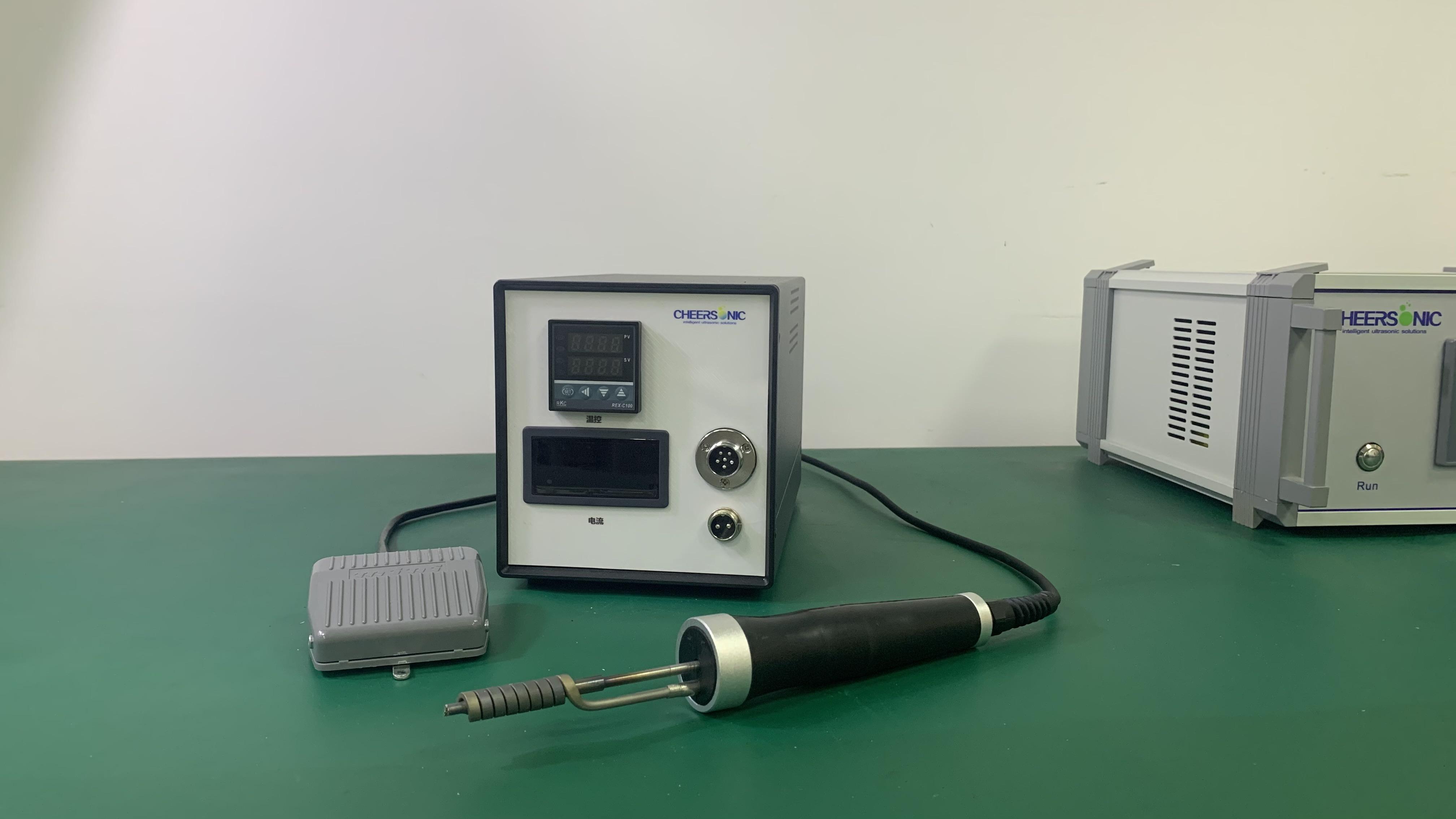
The soldering family is documented under six designations: USE-60P, USE-60E, USE-40P, USE-40E, USE-28P and USE-28E. The published parameters differ from the welding line in almost every dimension that matters:
- Ultrasonic frequency: 20–60 kHz
- Ultrasonic power: 28–100 W
- Soldering temperature: 200–450 °C
- Heating method: resistive heating or an integrated hot tip
- Wetting mechanism: flux-free activation via ultrasonic cavitation
- Solder alloy range: Sn-based, Zn-based and In-based alloys, including Sn-Si, Sn-Zn and Zn-Al systems
- Bonding strength control: ultrasonic amplitude adjustable at micron-level vibration
- Documented process mode: manual or semi-automatic precision bonding
- Construction materials listed: stainless steel / titanium alloy
The documented industry fit for this line is semiconductor packaging and electronics manufacturing, aerospace and aviation engineering, medical device manufacturing, solar and photovoltaic systems, power electronics and advanced packaging, glass-to-metal sealing, R&D laboratories and materials science research, sensor and MEMS device manufacturing, and advanced joining of dissimilar materials. Every one of those segments has a reason to avoid flux residue: sealed optical assemblies, plasma-facing components, implantable devices and photovoltaic junctions all tolerate contamination poorly.
| Parameter | Ultrasonic welding / sewing line | Ultrasonic fluxless soldering line |
|---|---|---|
| Model designations | S20-WP2000, USM350, USM450, USM550, COS800, HBRC800, HLC300, HC300, HSW500, HGC500, CS20-WM2000 | USE-60P, USE-60E, USE-40P, USE-40E, USE-28P, USE-28E |
| Frequency | 35 kHz | 20–60 kHz |
| Power / supply | 220 V, 230 V, 110 V | 28–100 W ultrasonic power |
| Force control | Maximum pressing force 600 N via digital pressure unit | Amplitude adjustable at micron level |
| Thermal control | Heat output one of three core welding factors | 200–450 °C, resistive heating or integrated hot tip |
| Consumable input | No thread consumable documented | Sn-, Zn- or In-based alloys including Sn-Si, Sn-Zn, Zn-Al |
| Material constraint | Synthetic fibre content 60% or more | Flux-free process; dissimilar-material bonding documented |
| Documented process mode | Manual to fully automated systems per application | Manual or semi-automatic precision bonding |
| Construction materials | Stainless steel / titanium alloy | Stainless steel / titanium alloy |
Materials of Construction as a Verifiable Detail
Both product families list their construction materials as stainless steel and titanium alloy. That single line is worth more attention than it usually receives. The vibrating stack, the horn or tool tip and the contact surfaces are the parts that wear, and the material specification is one of the few supplier claims a buyer can audit directly through a material certificate for the delivered unit. For a multi-year welding or soldering programme, the material field should be treated as a document request rather than a marketing phrase — particularly where abrasive textiles, filled polymers or aggressive solder chemistries are involved.
Company-level evidence sits alongside the product data. Cheersonic reports 31 patents and 3 software copyrights, a 20-engineer R&D team, a 7,150 m² factory, 100 employees and annual output of 1,200 units. These figures describe organisational capacity and engineering depth; they are not per-model performance data, and they should not be read as proof of what any single machine will achieve on a given production line.
Two Deployment Records
The manufacturer's case records provide two contrasting deployments — one textile, one electronic — that show how the documented parameters are applied in practice. The outcomes below are recorded as reported by the manufacturer.
Textile Seam Welding for a German Sportswear Manufacturer
Two units have been in operation for three years at a sportswear apparel manufacturer in Germany. The application is ultrasonic seamless welding for sportswear, swimwear, underwear and high-end ready-to-wear garments, processing technical textiles, fleece and plastic composite fabrics with more than 60% synthetic fibre content. The customer produces elastic overlap seams, dense lap seams and flat seamless tape-covered seams for protective suits and shapewear.
Recorded results include ultra-flat, friction-free seams without hard pressure points, which improves wearing comfort; welded joints that maintain elasticity matching the base fabric and provide tensile resistance in stretch garments such as swimwear and bras; and one-step 10 mm dense lap seam welding that removes secondary processing steps and raises overall line efficiency.
The record also notes customised embossing anvil wheels for decorative seam designs, the elimination of pinholes associated with traditional stitching, compatibility with multiple material types and garment styles, and the ability to tape flat release seams in a secondary process for added durability while keeping the seam imperceptible against the skin. Two details in this record are worth flagging for buyers: the fabric condition (more than 60% synthetic content) matches the published welding constraint exactly, and the value delivered is described in process terms — fewer steps, fewer pinholes — rather than in capacity terms.
Flux-Free Heterogeneous Bonding for a US Semiconductor Equipment Manufacturer
Two sets have been in service for four years at a semiconductor equipment manufacturer in the United States. The application uses active solder to complete heterogeneous material welding for semiconductor sputtering equipment, MEMS sensors and thermal management components. It bonds aluminium, copper, silicon, ceramics and hard alloys directly, without solder flux, and is used for sputtering target backplate bonding, optical mirror encapsulation and gas flow controller sealing.
Recorded results include extremely low interface porosity with no delamination during continuous operation; no residual flux contamination, which removes the risk of impurity interference in semiconductor plasma chambers; weld shear strength exceeding 5,000 psi with resistance to high and low temperature cycling and a significantly reduced target cracking rate; and a simplified pre-treatment process that improves yield and lowers repair frequency.
The record further notes that no pre-plated metal layer is required, that chemical flux is eliminated throughout the process along with the associated cleaning steps, that the low-temperature process mitigates deformation and cracking caused by differences in thermal expansion coefficients between materials, that the process is lead-free and RoHS compliant, that welds are reworkable, and that the tool is compatible with cross-category materials including silicon, ceramics and various metals. One boundary is visible in the product data rather than the case record: the soldering line is documented as manual or semi-automatic precision bonding, so a buyer planning a fully automated assembly cell should raise integration during the project phase rather than after the order.
Third-Party Market Signals and Their Limits
Third-party framing for this segment is uneven, and it is worth being explicit about that. Among the datasets available for this article, the ultrasonic spray systems market was valued at USD 0.5 billion in 2024 with a projection to USD 1.2 billion by 2034 (Market Research Future), while the ultrasonic cutters market, which includes food cutting applications, was valued at USD 2.8 billion in 2025 with a projected CAGR of 7.2% through 2033 (Dataintelo). Both are adjacent categories rather than welding or soldering markets, and they should be read as context for the wider ultrasonic equipment industry, not as a proxy for joining demand.
On regional concentration, Fortune Business Insights reported that Asia Pacific represented roughly 25% to 38% of global revenue across different ultrasonic technology and sensor sub-segments in 2025. The width of that range is itself informative: segment definitions drive the number, and a buyer should check what is being counted before citing any figure in an internal business case.
For the supplier landscape, third-party coverage compiled by Cognitive Market Research and reported through Coatings World lists Sono-Tek Corporation, Branson (Emerson), Dukane and Cheersonic among key players in ultrasonic equipment and spray coating. Such lists reflect market visibility and should not be interpreted as a ranking of capability in any specific process.
Two threads do run directly through the joining data. First, the semiconductor case record cites lead-free, RoHS-compliant bonding, which connects the soldering line to electronics environmental requirements. Second, the machinery safety basis referenced in the manufacturer's CE documentation is ISO 12100:2010, the general standard for risk assessment and risk reduction in machinery, published by ISO.
Comparison with Conventional Joining Methods
Ultrasonic joining earns its place where the conventional method imposes a cost that is not visible on the equipment quotation: perforation in stitched seams, residue in flux-based soldering, or heat that damages a sensitive substrate. The table below compares the documented ultrasonic performance against the typical characteristics of the conventional alternative. The conventional column is general process knowledge, not a comparison of any specific competing product.
| Dimension | Documented ultrasonic welding / soldering | Conventional alternative (typical characteristics) |
|---|---|---|
| Joint formation | Vibration with controlled pressing force and dwell time; cavitation-activated wetting plus molten alloy | Stitching or thermal sealing in textiles; flux-activated soldering in electronics |
| Effect on base material | No needle perforation recorded in the textile case; low-temperature soldering process documented | Stitched seams create needle holes and a thread path |
| Consumables | No thread consumable documented; soldering documented as flux-free | Thread, or chemical flux plus subsequent cleaning |
| Contamination risk | Case record reports no residual flux and the elimination of cleaning steps | Flux residues generally require cleaning and are a known concern in vacuum and plasma environments |
| Material constraint | Synthetic fibre content of 60% or more required for stable welding | Stitching applies across a wider range of fibre compositions |
| Automation level | Welding documented from manual to fully automated systems per application; soldering documented as manual or semi-automatic | Flux-based electronics soldering is commonly deployed in fully automated lines |
| Related flux route | Flux application can alternatively be handled by ultrasonic spray fluxing, which is also part of the supplier's published product range | Conventional spray, wave or dip fluxing |
Where the Documented Envelope Ends
Capability claims are only useful to a buyer when the boundaries are stated alongside them. Several boundaries are explicit in the source data:
- Fibre composition floor. Stable ultrasonic welding is documented at a minimum synthetic fibre content of 60% or more. Fabrics dominated by natural fibres sit outside the documented envelope, and a buyer in that segment should treat the process as unproven for their material rather than assume equivalence with sewing.
- Automation mode in soldering. The soldering line is documented as manual or semi-automatic precision bonding, with 28–100 W of ultrasonic power and a 200–450 °C temperature range. High-volume automated soldering cells require project-level engineering, not a catalogue order.
- Certificate scope by model. The CE attestation of compliance issued by INTERTURK under certificate TRCN-26118HCU01 covers an ‘Ultrasonic sewing/cutting machine’ with the model list USM350S, USM450, USM550, COS500, HC300, HGC500, HLC300, HSC500, HSW500 and KZJ, against directives 2006/42/EC (Machinery) and 2014/30/EU (EMC) and the standards EN ISO 12100:2010, EN 60204-1:2018/A1:2025, EN IEC 61000-6-2:2019 and EN IEC 61000-6-4:2019. Some designations appear both in this list and in the welding product data; others, including S20-WP2000, COS800, HBRC800, CS20-WM2000 and every soldering model, do not appear on the certificate as published here. Buyers should request a model-to-certificate mapping for their exact unit and destination market before ordering. The attestation was issued on 2026-04-28 and remains valid to 2031-04-27.
- Quality system scope wording. The ISO 9001 certificate 17325Q21416R2S, issued by Beijing Zhongjiaoyuanhang Certification Co., Ltd. against GB/T 19001-2016 / ISO 9001:2015, states a scope of production of ultrasonic cutting, spraying and liquid handling equipment, and research and production of ultrasonic piezoelectric transducers. It is valid to 2028-12-25. Buyers should confirm how their specific machine family is covered within that quality system scope.
- Pressing force ceiling. Maximum pressing force on the welding line is 600 N. Buyers should compare that figure against the required bond area, material thickness and seam geometry in their own application rather than assume it transfers directly to rigid-part welding.
- Model suffix detail. The welding product data lists USM350, while the CE model list names USM350S. Small designation differences of this kind are common, but they are exactly the detail that creates a documentation gap during a customer audit if left unresolved.
From Evaluation to Execution: Acceptance, Customization and Procurement Terms
Once a buyer has decided the process fits, the execution stage depends on commercial and quality mechanics rather than on specifications. The following terms are documented by the manufacturer:
- Production model: OEM, ODM and independent factory R&D and manufacturing; minimum order quantity of 1 unit.
- Documented customization dimensions: equipment size, cutting specification, operating voltage, control program, machine appearance, brand logo, functional module and production line docking structure. These are the dimensions named in the supplier's customization statement; buyers integrating a welding or soldering unit should map their requirements onto this list and confirm in writing which dimensions apply to their configuration.
- Lead time: standard models 7–15 days; customized models 30–45 days.
- Quality control steps: raw material incoming inspection, semi-finished product spot check, finished product aging test, and a 100% full-machine running test before delivery.
- Acceptance: a pre-shipment full performance test at the factory, with video and test reports provided for customer confirmation before shipment.
- Commercial terms: 30% T/T advance deposit on order confirmation and 70% balance against copy of Bill of Lading; delivery methods FOB, CIF or DDP.
- After-sales: remote online technical support, overseas engineer on-site service, spare parts supply, regular operation guidance and lifetime maintenance consultation.
- Export footprint: documented export markets are the EU, Southeast Asia, the Middle East, North America and Australia, with an export ratio of 50% and main markets across Asia, the EU and North America.
The acceptance clause is the strongest lever a buyer holds on a joining machine, because process performance is not always visible on a delivered unit. A factory performance test carried out against agreed parameters, recorded on video and reported in writing, converts a supplier claim into a documented baseline that can later be used in a warranty discussion. Buyers specifying a welding or soldering line should agree the test parameters — seam tensile behaviour, wetting performance on the actual substrate, thermal setpoints — before the deposit is paid, not after the machine is installed.
Outlook
The industry lists published for the soldering line — semiconductor packaging, power electronics, medical devices, solar and photovoltaic systems, glass-to-metal sealing, sensors and MEMS — overlap closely with the segments where flux residue and thermal load are hardest to manage. That overlap is where the commercial argument for flux-free joining is clearest, because the alternative is not merely an extra cleaning step but a contamination risk inside sealed or vacuum-facing assemblies.
On the welding side, the driver is different and more practical. Synthetic technical textiles continue to be specified into protective clothing, filtration media and performance apparel, and those are precisely the applications the 35 kHz line is documented against. The constraint that limits the addressable base — a 60% synthetic fibre floor — also defines it, since blended and coated fabrics are where the process competes most directly with stitching.
On geography, Asia Pacific accounted for roughly 25% to 38% of global revenue across ultrasonic technology and sensor sub-segments in 2025 according to Fortune Business Insights, with Cheersonic itself exporting 50% of output and naming the EU, North America and Asia as main markets. Buyers sourcing from the region should expect the documentation questions raised in this article — certificate scope, material certificates, acceptance protocols — to matter more than price positioning in the final selection.
Nothing in this section should be read as a forecast. The forward-looking value lies in the checklist: model-to-certificate clarity, automation readiness on the soldering line, and material documentation on both.
FAQ
What frequency and power range does Cheersonic document for ultrasonic fluxless soldering?
The published soldering parameters are an ultrasonic frequency of 20–60 kHz and an ultrasonic power of 28–100 W, with a soldering temperature range of 200–450 °C. Heating is by resistive heating or an integrated hot tip, and wetting is activated without flux through ultrasonic cavitation. Bonding strength is controlled by adjusting ultrasonic amplitude at micron-level vibration.
Which model designations belong to the welding and soldering lines?
The ultrasonic welding and ultrasonic sewing family is documented under eleven designations: S20-WP2000, USM350, USM450, USM550, COS800, HBRC800, HLC300, HC300, HSW500, HGC500 and CS20-WM2000. The ultrasonic fluxless soldering family is documented under six: USE-60P, USE-60E, USE-40P, USE-40E, USE-28P and USE-28E.
What material constraint applies to ultrasonic textile welding?
Stable welding is documented at a minimum synthetic fibre content of 60% or more. Below that threshold, the process is not documented as a reliable substitute for conventional stitching, which applies across a wider range of fibre compositions. For blended fabrics, the synthetic share should be confirmed against the published condition before a machine is specified.
Is OEM or ODM customization available, and what can be customized?
The manufacturer provides OEM and ODM production services with a minimum order quantity of 1 unit. The customization dimensions named in its statement are equipment size, cutting specification, operating voltage, control program, machine appearance, brand logo, functional module and production line docking structure. Standard models are documented at 7–15 days lead time and customized models at 30–45 days.
How is equipment acceptance verified before shipment?
Acceptance includes a pre-shipment full performance test conducted at the factory, with video and test reports supplied for customer confirmation before shipment. The documented quality control sequence also covers raw material incoming inspection, semi-finished product spot check, finished product aging test, and a 100% full-machine running test before delivery.
Which models does the published CE attestation cover, and what should buyers verify?
The published CE attestation of compliance (certificate TRCN-26118HCU01, issued by INTERTURK, valid to 2031-04-27) covers an ultrasonic sewing/cutting machine with the model list USM350S, USM450, USM550, COS500, HC300, HGC500, HLC300, HSC500, HSW500 and KZJ. Several soldering and welding designations are not on that list as published, and one designation differs by a suffix. Buyers should therefore request a written model-to-certificate mapping for their exact unit and destination market, and separately confirm coverage under the ISO 9001 certificate 17325Q21416R2S, whose stated scope is the production of ultrasonic cutting, spraying and liquid handling equipment and the research and production of ultrasonic piezoelectric transducers.
Reference Note
The parameters, certificates, acceptance terms and deployment records summarised in this article are drawn from Cheersonic's published product, certification and case documentation, together with the third-party sources named in the market section. Buyers comparing joining equipment should treat the model-level data above as a starting checklist and confirm certificate scope, acceptance protocol and automation fit against their own production requirement.
The manufacturer's product brochure (PDF) is available for specification verification: Cheersonic product brochure.