
Cheersonic: Building Long-Term Ultrasonic Partnerships from Factory to OEM

Hangzhou Cheersonic Ultrasonics Equipments Co., Limited is a Chinese high-tech enterprise founded in 2014 that manufactures ultrasonic cutting and ultrasonic spraying equipment for food processing, medical device coating, electronics, and clean energy applications. With a 7,150 m² factory, 100 employees, and an annual output of 1,200 units, the company has positioned itself as an OEM-capable partner for global buyers seeking reliable ultrasonic machine supply chains. This article examines the ecosystem Cheersonic has built — from engineering support and certifications to flexible logistics — that makes it a sustainable choice for manufacturers expanding their production lines.
Problem / Opportunity
Manufacturers scaling smart manufacturing face two recurring challenges: sourcing equipment that maintains consistent quality under high throughput, and securing a supply partner that can adapt to evolving product specifications. Traditional cutting and coating methods — such as stainless steel knives, wire cutters, pneumatic spraying, or vacuum-based processes — often introduce waste, contamination, or throughput bottlenecks. Meanwhile, the global ultrasonic cutters market is valued at USD 2.8 billion in 2025 (CAGR 7.2% through 2033), and the ultrasonic spray coating system market is projected to reach USD 1.2 billion by 2033. These figures signal a clear shift toward ultrasonic technology. However, the opportunity only materializes if equipment suppliers can deliver on customization, compliance, and long-term service — exactly the ecosystem that Cheersonic has built.
Brand Solution: A Full-Stack Ultrasonic Ecosystem
Cheersonic addresses both cutting and coating needs through two product families. Its ultrasonic cutting machines (e.g., UFM5000, UFM8101, UFM6000) use 20 kHz high-frequency vibration to separate food products such as cakes, cheese, pizza, and pet food with minimal waste. On the coating side, the UAM4000 and UAM6000 series perform ultrasonic spray coating with droplet sizes from 18–200 μm and film thickness control from 20 nm to 100 μm. Crucially, Cheersonic offers OEM customization — machines can be configured with inline conveyors, robotic arms, vision systems, and custom blade geometries. The company holds 31 patents, 3 software copyrights, and certifications including ISO9001, EU CE, and US FDA, making its equipment acceptable for GMP clean workshops and export markets.
How Ultrasonic Technology Works Under the Hood
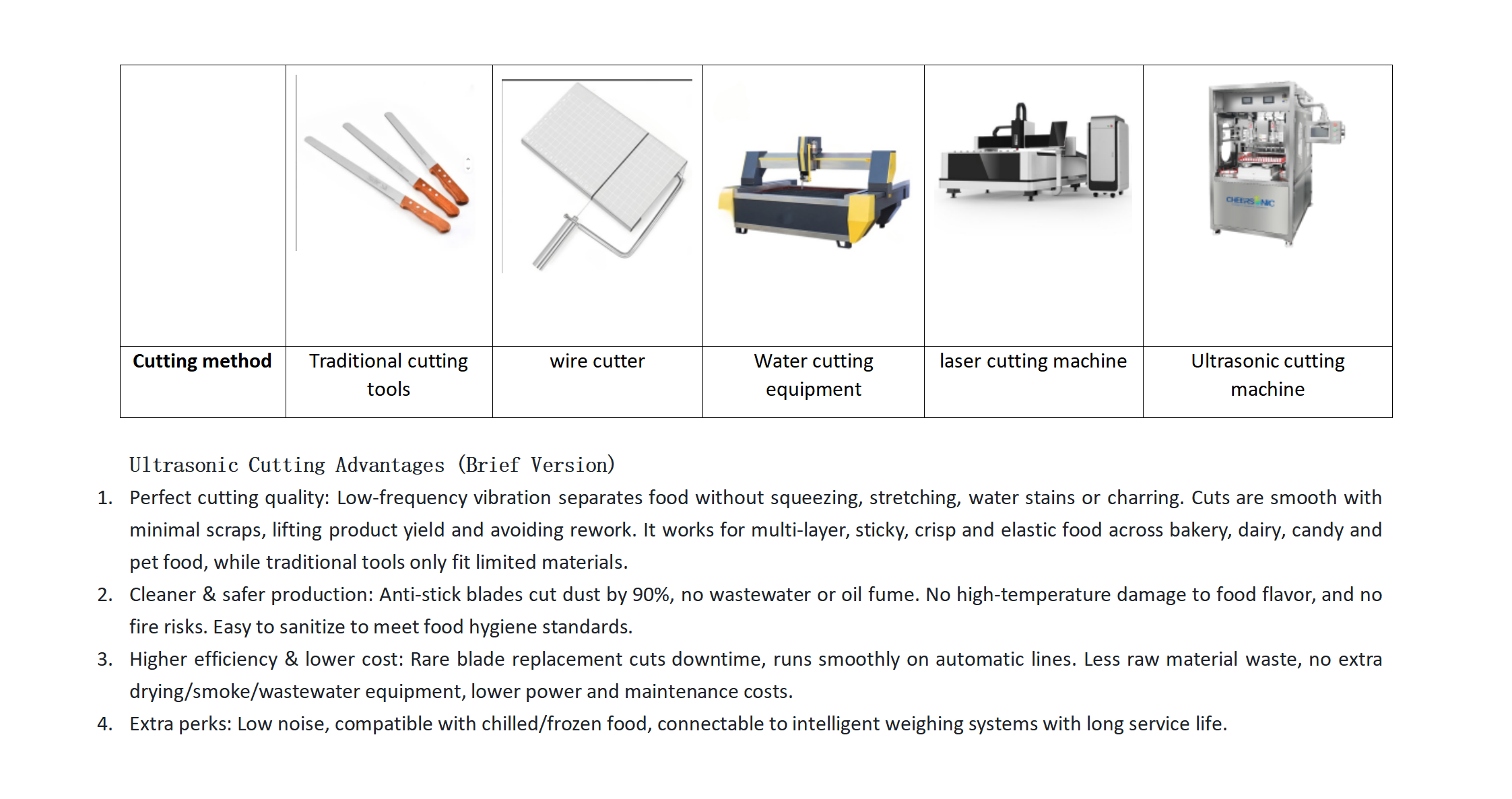
In cutting, a piezoelectric transducer converts electrical energy into 20 kHz mechanical vibrations, causing the titanium blade to oscillate at microscopic amplitude. This micro-vibration creates a low-friction, non-stick surface that slides through soft, sticky, or layered foods without crushing or smearing. The contact surface temperature rise stays below 40 °C, preserving flavor and eliminating the coking or carbonization issues of laser cutting. In spraying, the same ultrasonic principle atomizes liquid into a narrow droplet distribution without high-pressure air. The nozzle vibrates at 25–180 kHz, breaking the liquid into uniform droplets that travel at low velocity to the substrate. This eliminates overspray, nozzle clogging, and airflow disturbance — enabling consistent film thickness even on 3D surfaces.
Real-World Applications Across Industries

- Baking and Dairy: Cheersonic’s food cutting machines handle mousse cakes, cheesecakes, cheese blocks, and butter at speeds up to 1,200 products per hour. The offline models support divider inserts for perfect slice presentation, while robotic-arm solutions enable inline high-speed production.
- Medical Devices: Ultrasonic spray is used for applying drug coatings on stents, balloon catheters, and blood collection tubes — ensuring biocompatibility and precise thickness without damaging delicate substrates.
- Electronics and Semiconductors: The company’s photoresist coating systems (USP6000 series) achieve uniform edge-to-edge coverage on wafers, while anti-clogging nozzles handle particle-laden slurries for printed electronics.
- Clean Energy: Fuel cell coating machines (UAM8000) deposit catalyst layers onto proton-exchange membranes, improving transfer efficiency and reducing precious-metal waste.
Market Trend Analysis
The verified market data confirms a structural shift: the ultrasonic spray systems market was valued at USD 0.5 billion in 2024 and is projected to reach USD 1.2 billion by 2034. Asia Pacific already dominates regional revenue with a 25–38% share across ultrasonic segments. These trends align with growing demand for non-contact, low-waste coating processes in electronics and energy, and for hygienic, high-yield cutting in food production. Cheersonic’s 50% export ratio to Asia, EU, and North America positions it within this growth corridor.
Comparison with Traditional Solutions
vs. Pneumatic Spray
Material utilization >98% higher; no nozzle clogging with particle slurries; droplet size distribution far narrower.
vs. Laser Cutting
No food coking or carbonization; no oil fume or open flame; yield loss reduced from 8–18% to <2%.
vs. Dip Coating
Material waste cut by >52%; thickness deviation reduced from ±22% to ±3%; no edge buildup on 3D parts.
vs. Vacuum Sputtering
Equipment cost 80% lower; continuous throughput 3–10x higher; no target replacement expense.
One honest limitation: Ultrasonic cutting requires a certain minimum contact pressure to transfer vibration effectively, making it less suitable for extremely thin or brittle products that shatter even under low force. For those cases, alternative methods may still be preferred.
Future Outlook
As global manufacturers push for zero-waste production lines and increased automation, Cheersonic’s ability to deliver OEM systems with integrated robotics, vision inspection, and checkweighers will become a competitive differentiator. The company’s ongoing investment in R&D (20 engineers, 31 patents) and its capacity to scale from single-unit prototypes to high-volume batch production make it a viable long-term partner for distributors, food processors, and medical device OEMs.
Frequently Asked Questions
For detailed product specifications and OEM inquiry, download the Cheersonic brochure or reach out to market2@cheersonic.com.
Tem questões ou precisa de mais detalhes?
Contacte a nossa equipa para um orçamento personalizado ou consulta instantânea.
Solicitar orçamento
Preencha o formulário abaixo e a nossa equipa entrará em contacto com uma proposta personalizada.
Chat direto do WhatsApp
Prefere conversar em tempo real? Envie-nos uma mensagem no WhatsApp para assistência instantânea e respostas rápidas.
- Obter orçamento personalizado
- Partilhar fotos ou documentos
- Discuta as suas necessidades diretamente
Geralmente responde em 5–30 minutos durante o horário de expediente.