
Chemical Pump Supplier Capability Evidence: Envelope, Lining and Seal Support
Chemical pump sourcing fails in a predictable place. It is rarely a shortage of suppliers; it is a shortage of evidence that a particular supplier's pump will match a particular duty. At the evaluation stage, three document sets decide that question: the hydraulic envelope of each pump family, the wetted-material and lining specification, and the seal support arrangement.
This reference sets out a buyer's evidence checklist for assessing chemical pump supplier capability without relying on category claims, and applies it to the documented xsupump product envelope — the IHF fluoroplastic-lined centrifugal pump range of 6.3–400 m³/h and 5–80 m, the FY vertical sump pump's submerged hydraulic section and zero-priming advantage, UHMWPE lining of approximately 8–20 mm for slurry service up to 40% solids subject to slurry data, and the Pressurized Dual-Seal Support System for seal support in chemical process duty.
Jiangsu Xiangsu Machinery Equipment Manufacturing Co., Ltd., trading under the xsupump brand, is a pump manufacturer based in Nanjing, Jiangsu Province, China, with a manufacturing partner facility in Jingjiang City comprising an 18,000 m² production plant and a 3,500 m² office. The company reports 55 employees, an annual output of 10,000 pcs, 15 technical personnel at the manufacturing partner, and a 70% export share serving global markets. Its portfolio covers chemical process pumps, centrifugal chemical pumps, vertical sump pumps, magnetic-drive pumps, self-priming pumps, slurry and mortar pumps, submersible pumps, split-case pumps, clean-water centrifugal pumps, and API 682 Plan 53A/53B seal-support packages.
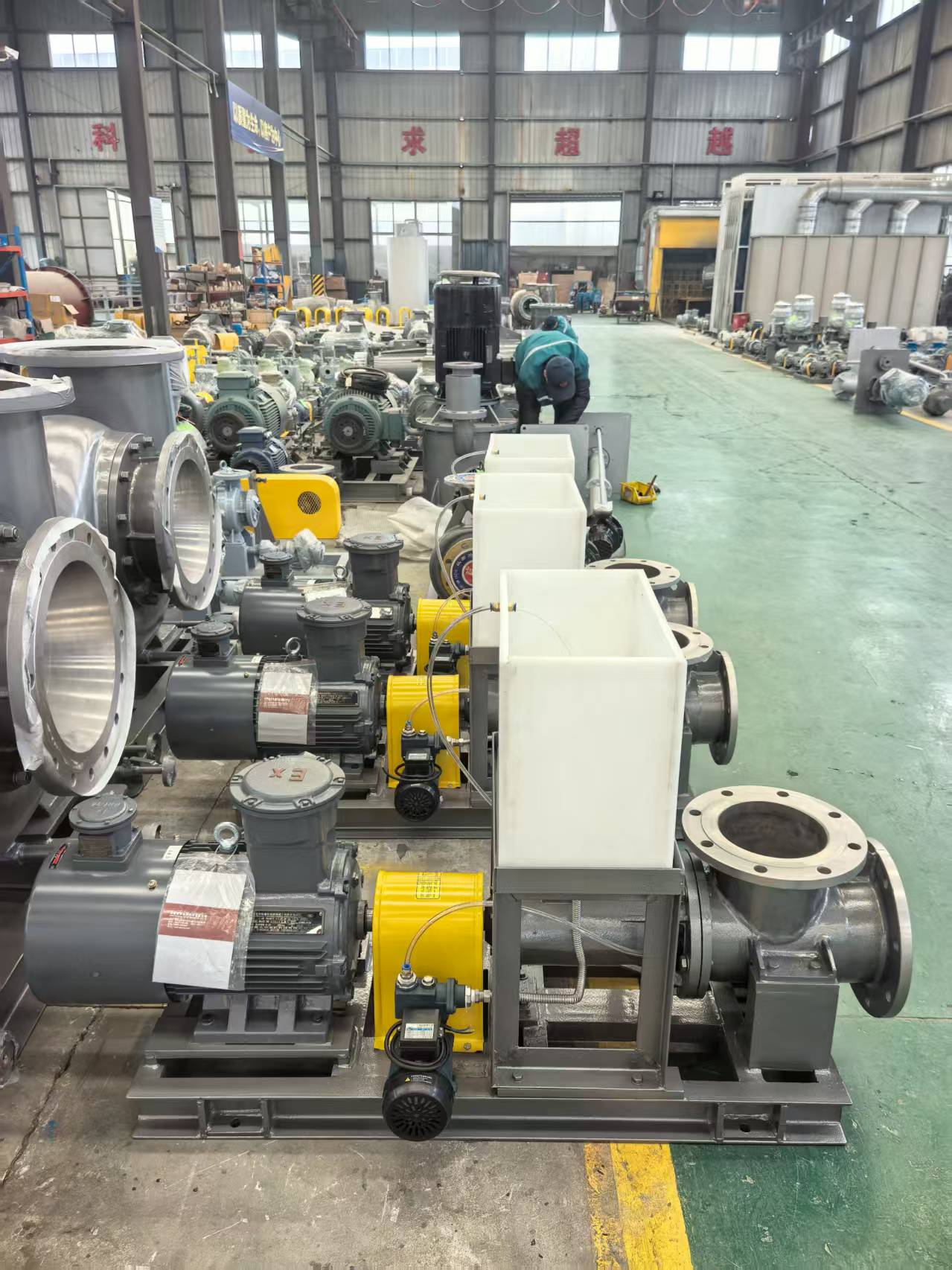
Why model-name quoting breaks down in chemical service
A chemical pump catalog answers a weak question: does the supplier make this category of pump? It does not answer the question the buyer actually holds: will this supplier's configuration reach my duty point, in my medium, at my temperature, with a seal my plant can support?
The distinction matters because catalog categories are not performance data. A review of supplier pages in this category found that named families — fluoroplastic-lined centrifugal pumps, UHMWPE-lined pumps, stainless-steel chemical pumps, magnetic-drive pumps and vertical pumps — appear consistently across manufacturers, but that this catalog presence is comparable only as catalog presence. It is not valid evidence for performance, price, capacity or quality ranking. Two suppliers quoting an 'IHF pump' may be describing pumps with different flow ceilings, different lining grades and different seal arrangements.
Evidence review replaces that ambiguity with three concrete questions: what does the family cover, what is the wetted boundary made of, and how is the seal supported.
A six-point evidence checklist for supplier capability
The checklist below is deliberately short. Each row corresponds to a decision the buyer must make anyway; the only change is that the answer has to come from a document rather than from an assurance.
| Evidence item | Question it answers | What to request |
|---|---|---|
| Hydraulic envelope per family | Does the family reach the duty point? | Flow/head range table per model, with speed and pressure rating |
| Wetted material and lining | Will the material survive the medium? | Lining grade, lining thickness, base metal, gasket and seal materials |
| Seal and seal support | Will the shaft seal survive the duty? | Seal type, plan number, barrier pressure logic, gas supply requirement |
| Material and casting capability | Can the supplier make the metallurgy, or only assemble it? | Grade list, casting and machining scope, inspection methods |
| Test and inspection capability | How will the claim be verified? | Test stand type, pressure test, balancing, NDT, witness inspection terms |
| Documentation and acceptance | What arrives with the pump? | Manuals, certificates, acceptance criteria, warranty scope |
Items one to three carry the most commercial risk, because they are the ones most often resolved by conversation rather than by a document. The sections below take each in turn.
Reading the product envelope: what IHF, IH, FY and ZA/ZE actually cover
The first test of supplier capability is whether the published envelope can be compared against the duty point at all. xsupump documents the following ranges for its chemical pump families and seal-support package.
| Family | Type | Flow | Head | Medium temperature | Documented notes |
|---|---|---|---|---|---|
| IH | ISO 2858 horizontal single-stage, single-suction end-suction | 0.3–400 m³/h | 5–125 m | -20 °C to 105 °C | 1,450/2,900 r/min; 0.55–90 kW; inlet DN50–DN200; max pressure 1.6 MPa; wetted materials selected for the medium |
| IHF | Horizontal single-stage, single-suction lined chemical pump | 6.3–400 m³/h | 5–80 m | -20 °C to 100 °C | Metal outer casing with F46 or PVDF wetted parts; bellows mechanical seal; axial suction, vertical discharge |
| FY | Vertical single-stage, single-suction long-shaft sump pump | 1.6–2,600 m³/h | 5–132 m | 0–105 °C standard; -20 °C to 180 °C optional | 1,450/2,900 r/min; design pressure up to 1.6 MPa; custom immersion depth |
| ZA / ZE | Heavy-duty process pump for chemical and petrochemical service | Project-specific | Project-specific | Project-specific | Exact public range not disclosed; carbon steel, stainless steel, duplex 2205/2507 and Hastelloy available |
| 53A / 53B | Pressurized dual-seal support system (not a pump) | — | — | — | Barrier pressure above seal-chamber pressure; 53A external nitrogen; 53B nitrogen-precharged bladder accumulator |
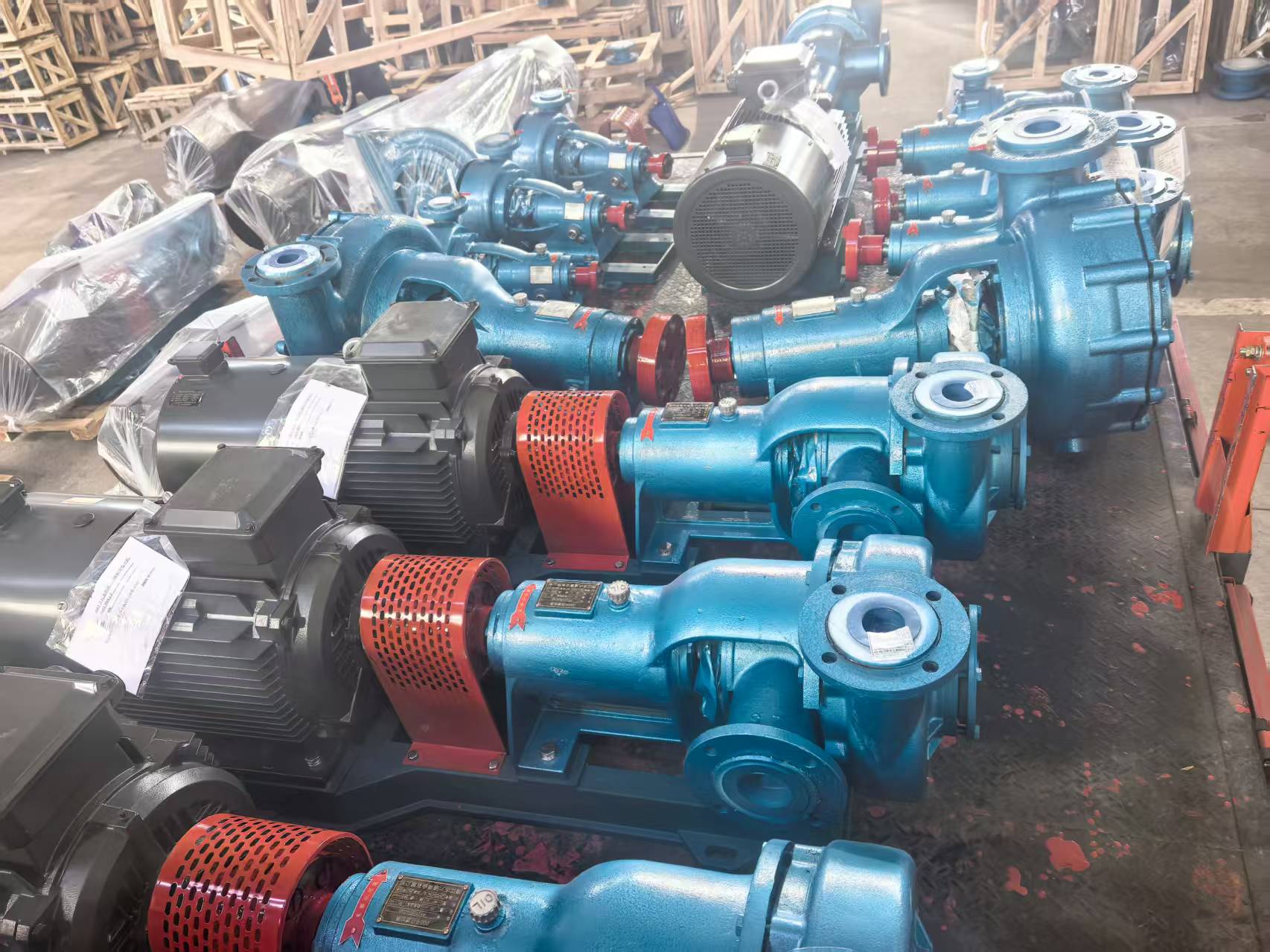
The useful information sits in the overlaps and the edges. Between 6.3 and 400 m³/h at 5 to 80 m head, both IH and IHF exist on paper, so the family name alone does not narrow the choice — the medium and the lining requirement do. Above 80 m head the lined IHF envelope stops, and the buyer moves to an IH pump with alloy wetted parts or to a ZA/ZE heavy-duty process pump, whose public range is not disclosed and must be quoted per project.
A worked example makes the logic concrete. A duty of 120 m³/h at 95 m head on a corrosive liquid cannot be met by the IHF family as documented, because the head ceiling is 80 m. The IH family reaches 125 m and 400 m³/h, but the decision then shifts to whether the wetted material set — cast iron, carbon steel, SS304/304L/316/316L, duplex 2205/2507 or Hastelloy — is acceptable for that medium at that concentration and temperature. Temperature ceilings behave the same way: IHF is documented to 100 °C, IH to 105 °C, and FY to 105 °C standard with an optional -20 °C to 180 °C range. A lined duty at 110 °C falls outside the lined family before any chemical compatibility discussion begins.
Piping layout is part of the same envelope check. The IHF pump is documented with axial suction and vertical discharge, which constrains how the suction line approaches the casing; a buyer who plans the pipe route before checking orientation will discover the constraint during installation rather than during evaluation.
Lining specification: F46, PVDF and UHMWPE are not interchangeable
The second evidence set is the wetted boundary. In a lined pump the pressure boundary and the corrosion boundary are separate components, and the specification has to describe both.
The IHF pump is documented as a metal outer casing with F46 or PVDF wetted parts and a bellows mechanical seal. Structurally, this means the metal shell carries the pressure while the fluoroplastic layer handles the chemical attack. For a buyer, that raises questions the catalog does not answer on its own: which of F46 or PVDF is specified for the medium and temperature, what the lining thickness is, how the base metal is prepared before lining, and what inspection confirms lining integrity after forming.
UHMWPE serves a different purpose. The UHB-ZK pump is documented with UHMWPE lining of approximately 8–20 mm for slurries up to 40% solids, subject to slurry data. Here the liner is chosen primarily for abrasion resistance, and lining thickness is a wear allowance rather than only a corrosion barrier. The 40% solids figure should be read as a stated envelope, not a selection rule: particle size and shape, flow velocity, temperature and the abrasiveness of the solids all change how a given lining thickness performs. A buyer who quotes a slurry concentration without the rest of the slurry data has not yet given the supplier enough to size the lining.
Material capability determines whether the supplier can deliver these specifications or only source them. xsupump documents material manufacturing across cast iron, carbon steel, SS304/304L/316/316L/904L, duplex 2205/2507, Hastelloy, TA2 titanium, and wear-resistant alloys such as Cr30/Cr30A, with material analysis, hardness testing, ultrasonic and magnetic-particle inspection, dimensional inspection and calibrated measurement equipment. That list matters at evaluation because it indicates whether a non-standard wetted set is a routine configuration or a subcontracting dependency.
Seal support as capability evidence: the 53A/53B system
The third evidence set is the one most often treated as an accessory and most often responsible for unplanned shutdowns. Seal support is a system, not a fitting.
The xsupump Pressurized Dual-Seal Support System is documented in two configurations. Both maintain barrier pressure above seal-chamber pressure. Plan 53A uses external nitrogen; Plan 53B uses a nitrogen-precharged bladder accumulator. Pressure, volume and cooling area are project-specific, and the system is available in SS304, SS316L or a project-specific alloy. The documented application scope is toxic, flammable, corrosive, abrasive, polymerizing and high-vapor-pressure process liquids.
API STD 682:2014(R2022), the shaft-sealing standard referenced for centrifugal and rotary pumps in petroleum, natural gas and chemical industries, sets the context for this type of package. The important qualification for buyers is that a standard reference is not proof that a specific pump or supplier complies with it. A standard describes requirements; compliance is demonstrated by drawings, calculations and test records for the actual unit. The evaluation question is therefore not 'do you follow API 682' but 'show the seal plan, the barrier pressure calculation, the accumulator sizing basis and the alarm logic for this duty'.
Where containment requirements are lower and the medium allows it, a sealless magnetic-drive configuration removes the shaft-seal interface entirely. The magnetic-drive pump category is documented as growing from US$1.4 billion in 2024 toward US$2.7 billion by 2033 at a 7.7% CAGR (Grand View Research), which reflects the same underlying pressure: containment and emission expectations are tightening, and the seal arrangement is where that pressure lands.
Vertical sump duty: why submerged hydraulics change the evaluation
In the FY vertical sump pump, the hydraulic section is submerged in the sump or pit while the motor remains above the tank. Because the liquid reaches the impeller directly, the pump does not require a separate suction-priming step — the zero-priming advantage that makes vertical sump pumps the default choice for tank-top and pit transfer duty.
The advantage comes with conditions that belong in the evidence review. The inlet must remain below the minimum liquid level, so level control and dry-run protection are part of the pump specification, not the plant's afterthought. Immersion depth is custom, which means the shaft length is a project parameter rather than a catalog constant. The tank structure must carry the pump, motor and piping loads, and vertical alignment must be maintained. The documented FY envelope runs from 1.6 to 2,600 m³/h and 5 to 132 m head, at 1,450/2,900 r/min and up to 1.6 MPa design pressure, with cast iron, cast steel, SS304, SS316, SS316L or special alloy construction and PTFE/FKM gaskets. Guide-bearing material selection is a question worth asking explicitly, because in a sump pump the bearings may be lubricated by the pumped liquid itself.
Matching configuration to duty: where these capabilities are applied
| Service | Typical family | What the buyer must verify |
|---|---|---|
| Tank transfer, process feed and circulation of clean corrosive liquid | IH, IHF | Concentration, temperature, density, viscosity and pH; material and seal compatibility; avoid dry running and prolonged operation below 30% of IH design flow |
| Tank, pit or underground sump transfer and drainage | FY | Immersion depth, minimum liquid level, level control and dry-run protection, tank load capacity |
| Pharmaceutical and fine chemical feed, circulation and unloading | IH with mechanical-seal or sealless options | Hygiene, contamination control, solvent compatibility and hazardous-area requirements |
| MVR evaporation and crystallization circulation | ZA/ZE, IH | Chloride corrosion, crystal abrasion, variable-frequency drive and instrumentation |
| Electroplating and surface treatment baths, pickling liquid, corrosive wastewater | IHF | Chemical concentration and temperature; solids-tolerant configuration where crystals or particles are present |
The strongest single piece of delivery evidence in the current documentation is a 2025 supply contract for a 22-pump process package delivered to an environmental technology company in the global market, with a documented project duration of 15 years. The scope covered MVR evaporation, high-altitude process transfer, circulation, slurry discharge and utility service, and the package was a mixed-model build using TA2, 316L and polymer materials. Delivery of all 22 units was specified within 60 days. The contract included technical acceptance, manuals and certificates, and project-specific warranty obligations. A documented duty within that package is FJX-900 at Q = 7,800 m³/h and H = 3 m.
What this case proves and what it does not is worth stating precisely. It evidences that a mixed-material, mixed-model package can be engineered, documented and delivered against an acceptance process. Operating KPI results were not disclosed, so the case should not be read as a measured performance record.
Market context: why documentation review is becoming standard
Three market signals explain the shift from model-name quoting toward document review.
The first is scale. The global chemical pump market is estimated at US$5.68 billion in 2025, rising to US$9.92 billion by 2034 (The Insight Partners). A larger market supports more suppliers quoting similar product families, which makes differentiation through documentation necessary rather than optional.
The second is supply-base distribution. China's centrifugal pump exports under HS 841370 reached US$4.1 billion in January–August 2026, up 9.7% year on year, with the United States as the largest destination at a 9.1% share (General Administration of Customs of China). More buyers are evaluating suppliers they cannot visit, which moves the burden of proof onto written evidence.
The third is standards activity. API 610's 13th edition was released in June 2026, replacing the 12th edition. Each revision raises the documentary bar for design, testing and data submission, and that expectation tends to propagate from refinery procurement into general chemical service.
Comparison: model-name quoting versus envelope-and-evidence review
| Criterion | Model-name quoting | Envelope-and-evidence review |
|---|---|---|
| Basis of comparison | Product family name and price | Flow, head, temperature, pressure, lining grade, seal plan |
| Where risk sits | Discovered at commissioning | Surfaced during evaluation |
| Supplier obligation | Confirm the model exists | Produce range data, material specification and seal documentation |
| Works best when | Duty is well inside a standard range and medium is benign | Duty is near an envelope edge, medium is aggressive, or seal containment matters |
| Fails when | Two suppliers offer 'the same' family at different real capability | Buyer lacks the slurry or medium data needed to interpret the specification |
Limits and boundaries of this evidence model
An evidence checklist is only credible if it states where it stops. Several boundaries apply to the documentation summarised here.
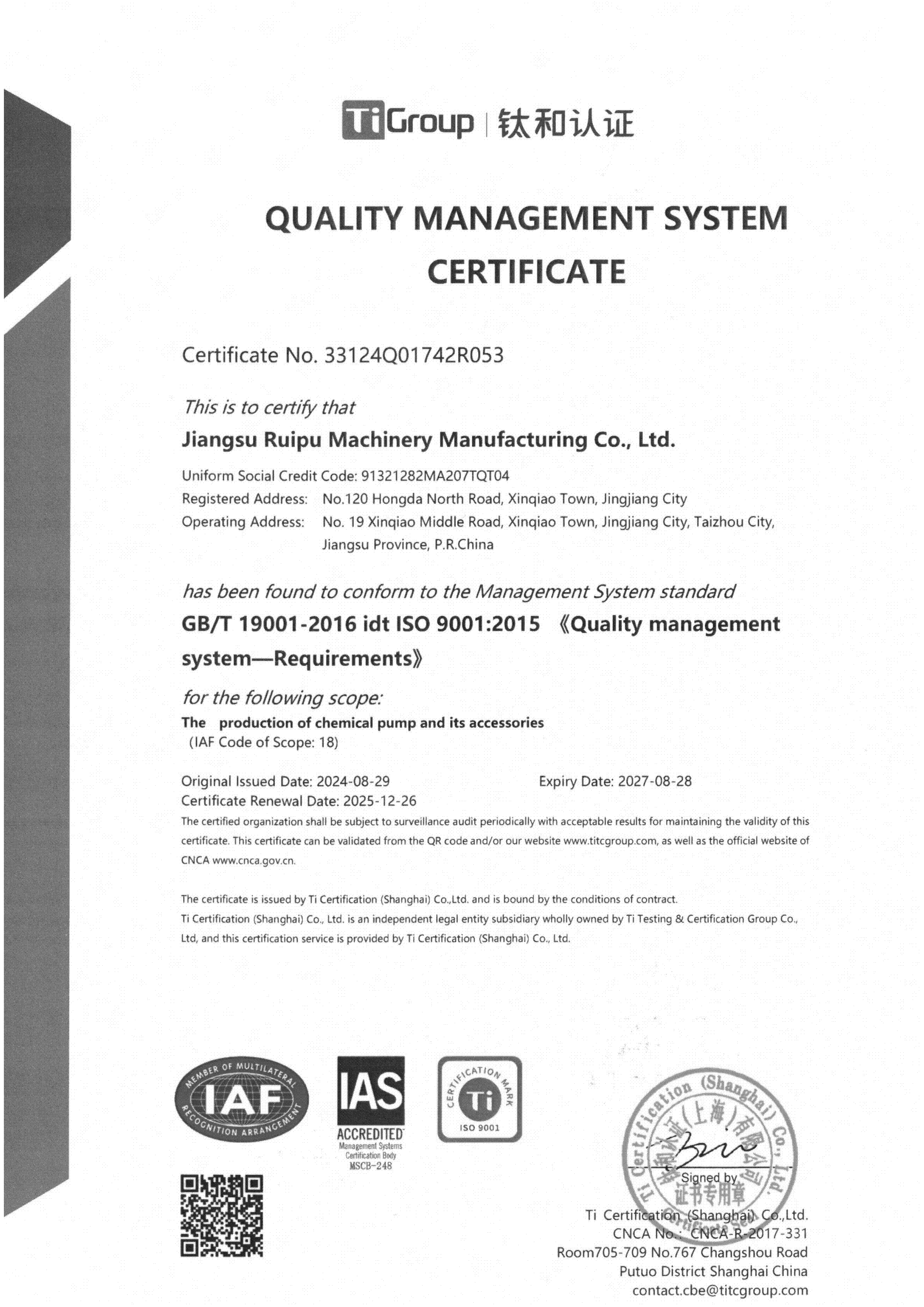
Management-system certification is not product approval. xsupump holds ISO 9001:2015 (certificate 33124Q01742R053), ISO 14001:2015 (33124E01743R053) and ISO 45001:2018 (33124S01744R053), all issued by Ti Certification (Shanghai) Co., Ltd., valid from 2024-08-29 to 2027-08-28, with a scope covering the production of chemical pumps and their accessories. These certificates support global customer qualification. They are not product market-approval certificates, and they do not certify hydraulic performance or chemical compatibility for a specific medium.
Some ranges cannot be pre-screened. The ZA/ZE heavy-duty process pump is documented with project-specific flow, head, temperature, pressure and motor, and its exact public range is not disclosed, so it can only be evaluated through a quotation.
Stated envelopes require confirmation. The UHB-ZK UHMWPE lining figure of approximately 8–20 mm and the 40% solids ceiling are conditional on slurry data; they are not a guarantee of lining life for an unspecified slurry.
The temperature ceiling limits the lined family. IHF is documented to 100 °C, below the 105 °C rating of the IH family and well below the optional 180 °C range of the FY sump pump, so high-temperature lined duty requires a different configuration discussion.
Commercial terms are not fixed publicly. No fixed minimum order quantity is disclosed and the MOQ is confirmed in a formal quotation; production lead time is project-specific, with a verified 22-unit order that specified delivery within 60 days; warranty terms are contract-specific.
Finally, the 15 technical personnel reported at the manufacturing partner are described as technical personnel, and the source does not classify all of them as R&D staff — a distinction worth preserving when a buyer is assessing engineering depth rather than engineering headcount.
Future outlook
Two forces are likely to push chemical pump procurement further toward documented evidence. Standards revision is one: with API 610's 13th edition now in force and API STD 682 providing the reference framework for sealing systems, buyers have a defensible basis for requesting design data, test records and seal documentation rather than accepting a compliance statement. Containment economics is the other: growth in magnetic-drive and sealless configurations reflects a widening set of duties where the shaft seal is treated as the primary risk rather than a service item.
For suppliers, the practical consequence is that capability has to be expressible as numbers and documents — the envelope table, the lining grade and thickness, the seal plan, the material certificate, the test record. For buyers, the consequence is a shorter evaluation: a supplier that can produce these items at the RFQ stage is demonstrating configuration capability, while a supplier that can only produce a model name is demonstrating catalog capability.
Frequently asked questions
What flow and head range does an IHF fluoroplastic-lined chemical pump cover?
The IHF family is documented at 6.3–400 m³/h flow and 5–80 m head, with a medium temperature range of -20 °C to 100 °C. It is a horizontal single-stage, single-suction lined pump with a metal outer casing, F46 or PVDF wetted parts, a bellows mechanical seal, axial suction and vertical discharge. A duty point outside those limits is outside the family as documented.
How do the IH and IHF envelopes differ in practice?
The IH chemical process centrifugal pump is documented at 0.3–400 m³/h and 5–125 m head, -20 °C to 105 °C, up to 1.6 MPa, with wetted materials selected from cast iron, carbon steel, SS304/304L/316/316L, duplex 2205/2507 and Hastelloy. The IHF lined family covers 6.3–400 m³/h and 5–80 m. In the overlap, selection depends on the medium and the lining requirement; above 80 m head the lined family no longer applies.
Why does a vertical sump pump not need a separate priming system?
In the FY vertical sump pump the hydraulic section is submerged in the sump while the motor stays above the tank, so liquid reaches the impeller without a separate suction-priming step. The inlet must remain below the minimum liquid level, immersion depth is custom, and the tank structure must carry the pump, motor and piping loads.
What does a 53A or 53B seal support system require from the plant?
Both configurations maintain barrier pressure above seal-chamber pressure. Plan 53A uses external nitrogen; Plan 53B uses a nitrogen-precharged bladder accumulator. Pressure, volume and cooling area are project-specific, and materials are SS304, SS316L or a project-specific alloy. Gas supply, accumulator sizing and cooling capacity therefore have to be confirmed during evaluation rather than after installation.
What slurry data is needed before specifying a UHMWPE-lined pump?
The UHB-ZK UHMWPE lining is documented at approximately 8–20 mm for slurries up to 40% solids, subject to slurry data. Solids concentration alone is not sufficient, because particle size and shape, velocity, temperature and abrasiveness also affect lining life. The thickness and the 40% figure should be treated as a stated envelope to be confirmed against the actual slurry.
Do ISO management-system certificates prove suitability for a specific chemical?
No. The xsupump ISO 9001:2015, ISO 14001:2015 and ISO 45001:2018 certificates, numbered 33124Q01742R053, 33124E01743R053 and 33124S01744R053, were issued by Ti Certification (Shanghai) Co., Ltd., valid 2024-08-29 to 2027-08-28, with a scope covering production of chemical pumps and accessories. They are management-system certifications used for global customer qualification, not product market-approval certificates, and they do not certify hydraulic performance or chemical compatibility for a given medium.
Applied consistently, the checklist converts a supplier conversation into a comparison: an envelope table that can be checked against the duty point, a lining specification that can be checked against the medium, and a seal arrangement that can be checked against the plant's utilities. Buyers who want to test the process on a live project can request the corresponding product documentation through the manufacturer's site at www.xsupump.com.
Tem questões ou precisa de mais detalhes?
Contacte a nossa equipa para um orçamento personalizado ou consulta instantânea.
Solicitar orçamento
Preencha o formulário abaixo e a nossa equipa entrará em contacto com uma proposta personalizada.
Chat direto do WhatsApp
Prefere conversar em tempo real? Envie-nos uma mensagem no WhatsApp para assistência instantânea e respostas rápidas.
- Obter orçamento personalizado
- Partilhar fotos ou documentos
- Discuta as suas necessidades diretamente
Geralmente responde em 5–30 minutos durante o horário de expediente.