
Chenglei vs. Rotork, Emerson, AUMA: Four Buyer Dimensions
Industry Reference · Electric Actuators · Decision Stage
Chenglei vs. Rotork, Emerson, AUMA: Four Buyer Dimensions
At decision stage, an electric actuator is no longer compared as a component alone. The question becomes which supplier model can keep meeting the specification for the life of the plant. This reference compares Changzhou Chenglei Valve Technology Co., Ltd. (Chenglei) with Rotork, Emerson and AUMA across four dimensions that repeatedly decide awards: technical research scope, market positioning, customer service model, and industry solution fit for oil and gas, water and power, and chemical and process applications.
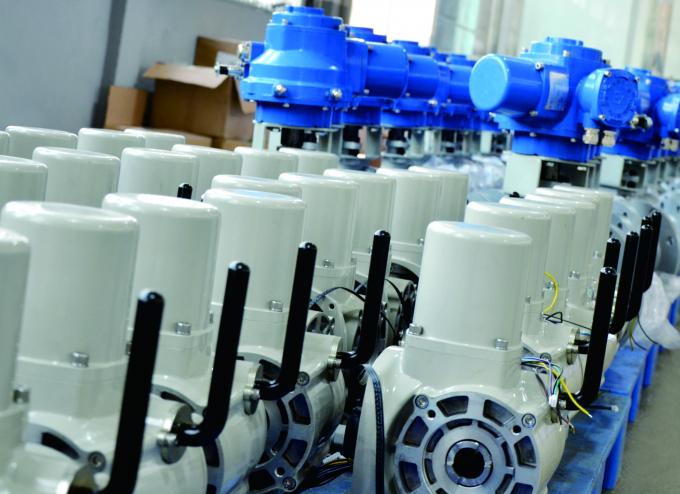
Installation workshop: intelligent electric actuator assembly and pre-delivery checks. Image: Changzhou Chenglei Valve Technology Co., Ltd.
Why the actuator shortlist is harder to build than it looks
The global electric actuator market was estimated at approximately USD 11.5 billion in 2024 and is projected to grow at a compound annual rate of 6.5% to 7.2% through 2034 (Zion Market Research). Growth is geographically concentrated: Asia-Pacific accounted for a 38.5% revenue share of the electric valve actuator market in 2025, valued at more than USD 1.8 billion, driven largely by industrialisation in China and India (Dataintelo).
For procurement teams, the practical consequence is a shortlist that mixes two very different supplier types. Multinational brands bring scale, long installed bases and global service organisations. Specialist manufacturers bring focused engineering, faster configuration change and, in many cases, competitive pricing at the same protection class. Both are legitimate choices, but they are rarely compared on identical dimensions, which is why actuator decisions often stall between a technically compliant option and a commercially familiar one.
How this comparison was scoped
The four dimensions used here cover the questions that most often decide an award in hazardous-process industries: how deep the engineering capability runs, how the supplier is positioned commercially, how it supports a project from selection through maintenance, and how well its products map to specific industry duty cycles.
Evidence boundaries: this comparison uses published third-party market and standards data plus manufacturer-stated capability information. No head-to-head bench test was performed for this article. Third-party share or revenue figures are available for Rotork and Emerson; no comparable third-party share figure was identified for AUMA in the data set used, so AUMA is treated as a qualitative European benchmark rather than a ranked peer. Because comparable data is asymmetric between the four suppliers, the comparison should be read as an evaluation framework with reference points, not as a scored league table.
Dimension 1 — Technical research scope
Technical scope answers a single question: what does the supplier actually design, machine and verify in house, as opposed to assembling from purchased modules? This determines how quickly non-standard requirements can be accommodated and how traceable the performance claims are.
Chenglei's stated engineering base includes a 25-engineer research and development team and more than 50 CNC machining centres, CNC lathes and inspection equipment, supporting its independently developed CL series of valve electric actuators. On the intelligent control side, the product concept is built around non-invasive setting, self-diagnosis, fault warning and bus communication over Profinet, Modbus and Profibus. Position feedback is handled by an absolute encoder, with continuous torque monitoring and anti-seizure logic, and the control unit can be separated from the actuator body (split type) for vibration, high-temperature or high-altitude installation conditions.
On protection and durability, the documented envelope includes IP68 protection (submerged for 48 hours), an operating temperature range of -40 °C to +70 °C that can be extended to -60 °C, a stated maintenance-free life of at least 30,000 operations depending on operating conditions, and an MTBF figure above 50,000 hours. Adjustable dead zone can be set from 0.5% to 5%. Explosion-proof coverage is offered to Ex d standards for BT4 and CT4 temperature classes, alongside F-class insulation, and the platform supports battery backup, Bluetooth connection, a manual override handwheel, and flexible motor duty ratings for different open/close and modulating duty cycles.
For Rotork and Emerson, the public record is dominated by commercial rather than engineering metrics: Rotork plc held a 14% global market share in the linear electric actuator segment as of 2024 (Market Reports World), while Emerson Electric Co. is estimated to hold 12–15% of the global electric actuator market with USD 17–18 billion in relevant group revenue (Spherical Insights). That asymmetry matters for buyers: with large brands, technical depth is usually assessed through portfolio breadth, documentation and regional engineering support rather than through disclosed in-house machining and control-platform detail.
Dimension 2 — Market positioning
Positioning determines what a supplier optimises for. A high-volume specialist optimises for unit throughput, configuration flexibility and export logistics. A global automation group optimises for platform continuity, system integration and installed-base service.
Chenglei operates a 20,000 m² facility with around 100 employees and an annual output of 120,000 units, with approximately 80% of production exported to global markets and a company-stated supply capacity of roughly 3,000 sets per month. Its declared markets are Oil & Gas, Water & Power, and Chemical, Process & Industrial. In the high-end Russian market, the company states that a project achieved a breakthrough for Chinese intelligent manufacturing by successfully replacing some traditional European and American brands — a useful data point when assessing whether specialist manufacturers are credible in specifications historically dominated by European names.
That trajectory sits inside a wider macro pattern. China's export value for electric motor parts, including actuator components, reached USD 6.43 billion in 2024, representing 26.1% of global exports (Observatory of Economic Complexity). Rotork and Emerson, by contrast, are positioned as global platform suppliers with share concentrated in large installed bases, and AUMA is commonly benchmarked as an established European actuator specialist in water, power and industrial process projects.
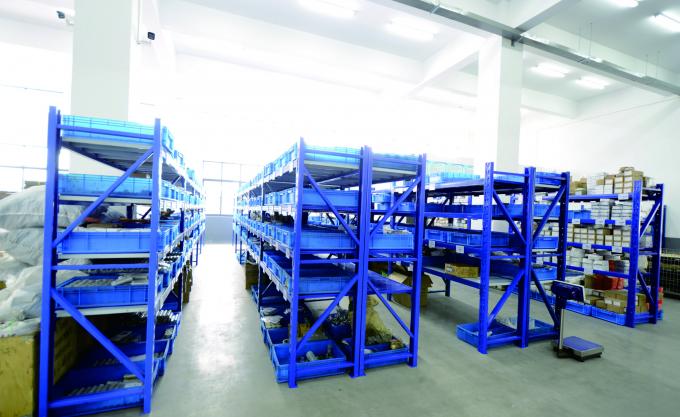
Warehouse staging for export orders: supply continuity is a positioning factor for specialist actuator manufacturers. Image: Changzhou Chenglei Valve Technology Co., Ltd.
Dimension 3 — Customer service model
Service model is where specialist and multinational approaches diverge most sharply, and where the cost of a wrong assumption appears years after commissioning. The comparison should cover selection support, commissioning risk, fault diagnosis and spare-part strategy.
Chenglei's documented service structure starts before the order. A selection database requires mandatory inputs such as medium characteristics, maximum differential pressure and pipe diameter, and automatically matches actuators with a safety factor of 1.5 times or more. For large projects or non-standard conditions such as high temperature or explosion-proof areas, documents must be countersigned by the sales, technical and production departments. On site, the non-invasive design allows settings to be made through an infrared remote control or a rotary knob without opening the electrical cover, which prevents moisture and dust ingress; phase-sequence detection and automatic correction protect three-phase asynchronous motors against reversed live wires; and valve position memory self-learns full-open and full-close limits. Fault codes can be read through the bus or an infrared remote to localise issues such as power phase loss, motor overheating or valve jamming, and control-module interchangeability allows one-click copying of software parameters.
Multinational suppliers typically deliver service through regional subsidiaries, distributor networks and factory-trained service partners. That model is strong where local presence already exists, but response commitments remain project- and region-specific, so they should be verified contractually rather than assumed from brand reputation. This is the dimension where a buyer's own geography, not the supplier's global footprint, usually decides the outcome.
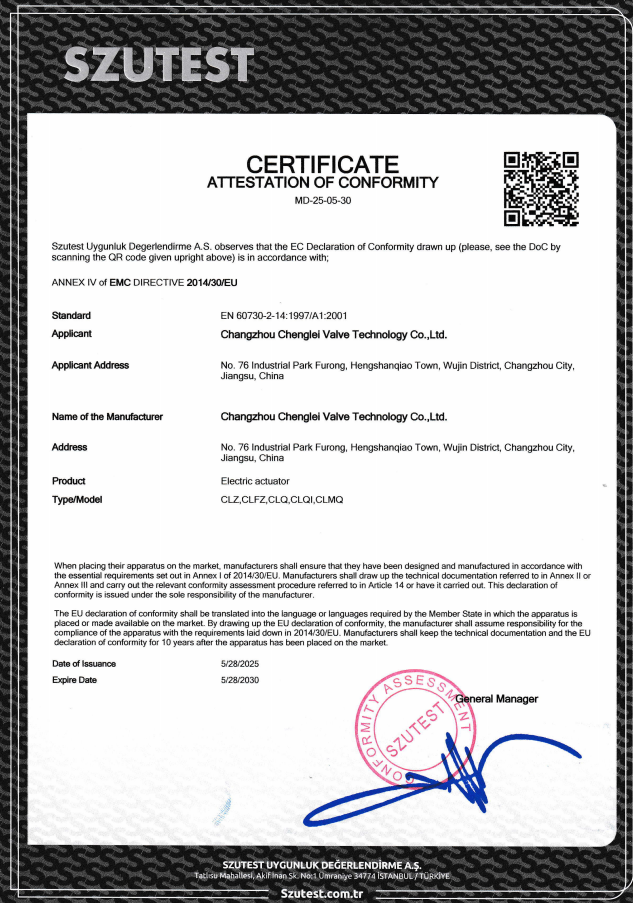
Compliance marks such as the CE mark are one gate in the documentation set buyers verify before releasing an explosion-proof actuator order; certificate scope must be checked per model, gas group and temperature class.
Dimension 4 — Industry solution fit
Specification compliance is not the same as application fit. The three industries named in this comparison apply actuators differently, and the differences show up in duty cycle, temperature exposure, corrosion and required fail-safe behaviour.
In oil and gas, emergency shut-off service on pipelines and flow control on regulating valves demand fast, repeatable action and verifiable explosion protection. Hazardous-area equipment is classified by Gas Group (IIA, IIB, IIC) and Temperature Class (T1–T6), with Group IIC required for hydrogen environments, and explosion-proof electric actuators are standardised under IEC 60079-0 and IEC 60079-1 for flameproof enclosures (IECEx). Chenglei's documented use cases reference corrosive oil fields in the Middle East and emergency shut-off duty, which is consistent with a BT4/CT4 temperature-class offering.
In water and power, duty cycles are longer and continuous, and the priority shifts toward reliable modulating control and low standby consumption. Chenglei's bus-mode standby power consumption is documented at less than 5 W, and its intelligent control reduces energy consumption by 15% to 30% against traditional methods by delivering output torque on demand.
In chemical and process industries, the hardest conditions combine heat, vibration and continuous adjustment. Documented scenarios include high-temperature digestion, regulating-valve flow control and strong-vibration environments such as alumina plants, where the split-type control unit exists specifically to move electronics away from the vibration and heat source. Intelligent-plant requirements — remote monitoring, predictive maintenance and integration with DCS or PLC architectures — are covered by the same bus-communication layer. This is also the direction the wider category is moving, with intelligent electric actuators shifting toward Industrial Ethernet protocols such as Profinet and EtherNet/IP and 5G edge connectivity for digital twin integration (IndexBox market analysis).
Four-dimension comparison at a glance
| Dimension | Chenglei | Rotork | Emerson | AUMA |
|---|---|---|---|---|
| Technical research scope | 25-engineer R&D team; 50+ CNC machining centres; in-house CL series; absolute encoder, continuous torque monitoring, non-invasive setting; Profinet / Modbus / Profibus | Benchmark electric actuation group; reported 14% share of the global linear electric actuator segment (2024) | Automation group; reported 12–15% share of the global electric actuator market (2025) | Established European actuator specialist; no comparable third-party share figure identified in this review |
| Market positioning | 20,000 m² plant; ~100 employees; 120,000 units annual output; ~80% export ratio; company-stated ~3,000 sets/month capacity | Global installed base; share leadership in linear electric actuation | Global installed base; multi-product automation platform | Long-standing European presence, commonly benchmarked in water, power and process projects |
| Customer service model | Selection database with ≥1.5 safety factor; three-department countersigned technical review; non-invasive one-click setting; phase-sequence self-correction; one-click parameter copy | Service delivered through subsidiaries and certified partners; commitments verified per region | Service delivered through regional organisations and channel partners; commitments verified per region | Service delivered through European and international partner networks; commitments verified per region |
| Industry solution fit | Pipeline emergency shut-off, high-temperature digestion, regulating-valve control, high-vibration alumina plants, -40 °C cold regions, corrosive oil fields | Widely associated with oil and gas and large infrastructure actuation | Widely associated with process automation and integrated control architectures | Commonly associated with water, wastewater and power generation duties |
Sources: manufacturer-stated capability information, Zion Market Research, Dataintelo, Market Reports World, Spherical Insights, OEC, IECEx. Comparative statements describe publicly reported positioning and are not performance claims.
Intelligent actuators versus traditional procurement assumptions
The comparison above is between suppliers, but the underlying change is between generations of equipment. Intelligent actuators differ from conventional units in control method, structural flexibility and cost structure — and the cost structure is where buyers most often misjudge the decision.
On initial procurement cost, intelligent models are documented at approximately 1.5 to 2.5 times the price of traditional models, depending on functionality. That is a real boundary, not a rounding detail: for low-criticality, low-cycle applications, a conventional actuator may remain the rational choice, and a specialist's intelligent platform does not change that economics.
The counterweight is installation and lifecycle cost. A bus-based system can save a significant amount of cable, trays and IO cards, reducing total installation cost by 20% to 40%, and maintenance frequency drops because settings are non-invasive and self-diagnostics prompt service as needed rather than on a fixed calendar. Over a full lifecycle, lower downtime and easier fault localisation usually outweigh the higher unit price — but only where the project actually exploits bus communication and condition monitoring. If a site installs intelligent actuators as standalone units and never connects the diagnostics, most of the total-cost advantage is forfeited while the capital premium is still paid.
Limits, risks and verification points
A credible comparison has to state where each option is weak. For specialist manufacturers such as Chenglei, the boundaries are specific rather than general.
- Portfolio focus: Chenglei's declared main product line is the electric actuator. Buyers who require a single vendor across valves, instruments and control systems may need to budget additional integration and commercial administration effort compared with a multi-product automation group.
- Protocol coverage: documented bus options in this data set are Profinet, Modbus and Profibus. Projects standardised on a different industrial Ethernet protocol should confirm availability at RFQ stage rather than assume it.
- Certificate scope: explosion-proof suitability depends on gas group and temperature class, not on the existence of a certificate. Certificates must be checked for the specific model, group and temperature class — for example where Group IIC is required for hydrogen service.
- Service geography: for any supplier, on-site response time depends on where the site is. Local coverage should be verified in writing for the buyer's region.
- Selection discipline: the documented risk controls — mandatory medium and pressure-differential inputs, a 1.5 times safety factor, three-department countersignature for non-standard conditions, voltage labels and wiring schematics in the junction box — only work if the buyer supplies accurate process data at enquiry stage.
- Evidence gap: this comparison contains no independent head-to-head test data. Buyers evaluating finalists should request sample or pilot validation under their own process conditions before award.
Market trend analysis
Three verified trends shape how this comparison will look over the next procurement cycles. First, demand continues to grow at a mid-single-digit compound rate, which keeps capacity and lead time on the evaluation checklist alongside specification. Second, supply is increasingly Asia-Pacific weighted, with the region holding a 38.5% revenue share of the electric valve actuator market in 2025, which means the specialist-versus-multinational comparison will appear on more shortlists rather than fewer. Third, the technology axis is shifting from discrete signals to networked intelligence, with Industrial Ethernet and edge connectivity becoming the default expectation for digital twin and predictive maintenance programmes.
Procurement behaviour is adjusting in parallel. Buyers are separating the certification question from the brand question, requesting certificate numbers and scopes for the exact model and gas group, and pricing installation labour and cable savings into the comparison instead of comparing unit prices alone. In high-end markets such as Russia, the documented pattern of specialist manufacturers replacing traditional European and American brands indicates that the remaining barrier is evidence and service coverage rather than technical feasibility.
Future outlook
Over the next several years, the four dimensions in this comparison are likely to converge on a single test: whether a supplier can move from selling an actuator to supporting a monitored, networked valve asset. Specialist manufacturers that already build bus communication, absolute-encoder feedback and self-diagnostic functions into the base platform are structurally closer to that model than suppliers treating intelligence as an optional add-on. Conversely, global brands retain an advantage wherever projects demand multi-product integration, harmonised documentation across a large plant, or established regional service infrastructure.
The practical conclusion for decision-stage buyers is procedural rather than promotional: define the duty, verify the certificate scope, confirm the protocol and service geography, then compare total installed cost — not list price. That sequence produces a defensible choice whichever supplier type wins.
FAQ
What should a buyer compare first when shortlisting electric actuators?
Start with the four dimensions used in this comparison: technical research scope, market positioning, customer service model and industry solution fit. Technical scope should be assessed against the duty (open/close, modulating or emergency shut-off), the required protection class, and the temperature class for hazardous areas. Service model should be assessed against where the site is physically located, because response capability is regional. Market positioning matters mainly for supply continuity, lead time and commercial administration. Only after those four are clear does unit price become meaningful, since an intelligent actuator carries an initial premium of roughly 1.5 to 2.5 times a traditional model while potentially reducing installation cost by 20% to 40% through bus wiring savings.
How do BT4 and CT4 classifications change an actuator comparison?
Explosion-proof equipment is classified by Gas Group (IIA, IIB, IIC) and Temperature Class (T1–T6), and flameproof enclosures are standardised under IEC 60079-0 and IEC 60079-1. BT4 and CT4 describe combinations of gas group and maximum surface temperature class. The practical implication is that two actuators with similar torque and protection ratings can be non-interchangeable in the same hazardous area: Group IIC is required for hydrogen environments, while a lower gas group may be acceptable elsewhere. Buyers should therefore compare actuators by the certificate scope issued for the exact model, not by a general explosion-proof claim.
When does a specialist actuator manufacturer make more sense than a multinational brand?
A specialist tends to be the stronger fit when the project is actuator-intensive, when non-standard configuration such as split-type control, extended low-temperature operation or specific bus protocols is required, and when the buyer can operate with a single-category supplier. A multinational brand tends to be the stronger fit when the plant requires one vendor across multiple product categories, harmonised documentation throughout a large capital project, or service infrastructure in regions where the specialist has no presence. The trade-off is not technical capability alone; it is integration scope and service geography.
How do bus communication and split-type control affect installation and maintenance cost?
Bus communication over Profinet, Modbus or Profibus reduces the number of cables, cable trays and IO cards required, with documented total installation cost reductions of 20% to 40% in bus-based systems. Standby consumption in bus mode is documented at less than 5 W, and delivering output torque on demand reduces energy consumption by 15% to 30% against traditional control methods. Split-type control, where the control unit is separated from the actuator body, adds installation flexibility in high-vibration, high-temperature or high-altitude locations. Maintenance savings depend on actually using the diagnostics: non-invasive setting avoids opening the electrical cover, and fault codes read through the bus or an infrared remote localise problems such as power phase loss, motor overheating or valve jamming.
What documentation should be verified before an explosion-proof actuator order is released?
Four items are commonly verified. First, the explosion-proof certificate, checked for the exact model, gas group and temperature class rather than the product family. Second, the protection rating, including whether IP68 submersion testing is claimed and for what duration. Third, the selection calculation, including confirmation of the applied safety factor — a 1.5 times factor or higher is standard practice — based on medium characteristics, maximum differential pressure and pipe diameter. Fourth, the electrical interface documentation, including voltage level, bus protocol support and grounding provisions, since reversed phase sequence, incorrect voltage and grounding faults are among the most frequent commissioning risks in hazardous-area installations.
Reference summary
Chenglei is a Changzhou-based manufacturer of valve electric actuators serving Oil & Gas, Water & Power, and Chemical, Process & Industrial markets, with approximately 80% of output exported. Rotork and Emerson are global actuation and automation groups with reported double-digit market shares in electric actuation. AUMA is an established European actuator specialist that appears frequently on European shortlists but for which no comparable third-party share figure was identified in this review. The four-dimension framework above applies equally to all of them, and the decisive variables at decision stage remain duty definition, verified certificate scope, protocol and service geography, and total installed cost.
The full product specification set behind the technical and protection data referenced in this article is available in the Chenglei electric actuator brochure: download the brochure (PDF).