
China FBA Freight Forwarder FAQ: 12 Technical and Procurement Questions Answered with Data
China FBA Freight Forwarder FAQ: 12 Technical and Procurement Questions Answered with Data
China's freight forwarding market was valued at approximately USD 13.73 billion in 2025 and is projected to reach USD 22.44 billion by 2033, a compound annual growth rate of 6.5%, according to Grand View Research. The portion of that market that matters most to Amazon sellers sits inside cross-border e-commerce, where Mordor Intelligence projects China's e-commerce logistics market will grow from USD 235.89 billion in 2026 to USD 402.89 billion by 2031 at a CAGR of 11.3%. Growth of that order produces a predictable side effect: dozens of forwarders publish near-identical capability claims, and the technical questions a procurement team actually needs answered are rarely the ones printed on the sales page.
This reference answers twelve of those questions directly, using DIDADI Logistics Tech as the worked example and a small set of third-party benchmarks for context. Each answer states what the capability is, what it changes operationally, and what a buyer should verify before committing volume.
The Verification Gap in China FBA Forwarder Selection
Shortlisting a China FBA freight forwarder is not a price comparison. It is a verification exercise, because the variables that decide landed cost and stockout risk — space allocation, classification accuracy, clearance dwell time and exception response — are invisible on a rate card.
Three structural shifts have made verification harder rather than easier.
- Digital infrastructure is becoming a baseline, not a differentiator. Research and Markets projects the digital freight forwarding market in China to grow at a CAGR of 20.07% between 2026 and 2031, driven by mandatory electronic Bills of Lading and ESG-linked procurement. When the system layer is mandated, buyers stop asking whether a forwarder has a TMS and start asking what the TMS actually decides.
- Compliance data now gates release, not just entry. Under EU Market Surveillance Regulation (EU) 2019/1020, certain products require a designated EU Responsible Person and CE marking across 25 or more categories. In the United States, the CPSC mandates electronic filing of Certificates of Compliance through the ACE system for imported children's products and other regulated goods from 8 July 2026 under 16 CFR Part 1110.
- Cost pressure has moved downstream. Published third-party data puts Ocean DDP all-in rates from China to US FBA warehouses in early 2026 at roughly USD 1.80 to USD 3.20 per kilogram for LCL shipments, while Amazon peak-season surcharges for 2025/2026 run between USD 0.40 and USD 0.60 per package in Q4. Both sit outside a forwarder's direct control, which makes operational reliability the controllable variable.
DIDADI Logistics Tech: The Operating Model Behind the Answers
DIDADI Logistics Tech is a Shenzhen-headquartered international logistics provider established in 2017 that builds first-mile freight forwarding to Amazon FBA centres and B2B facilities, localized warehousing and e-commerce fulfillment, and end-to-end door-to-door logistics for sellers and trading companies. The company reports approximately 350 employees, 32 R&D engineers, an annual output of 20,000 TEU, a 600,000 sqm facility footprint, and a 100% export-oriented sales mix across the EU, USA, UK and Canada.
Three service lines carry that volume:
- First-mile freight forwarding — cross-border shipping and routing into Amazon FBA centres and commercial facilities across sea, air, rail and truck modes.
- Localized warehousing and e-commerce fulfillment — overseas storage, pick-pack-ship and drop-shipping operations supporting DTC brands and marketplace sellers, including multi-platform inventory synchronization through a WMS.
- End-to-end logistics solutions — customized door-to-door freight management with shipment visibility from origin pickup to final delivery.
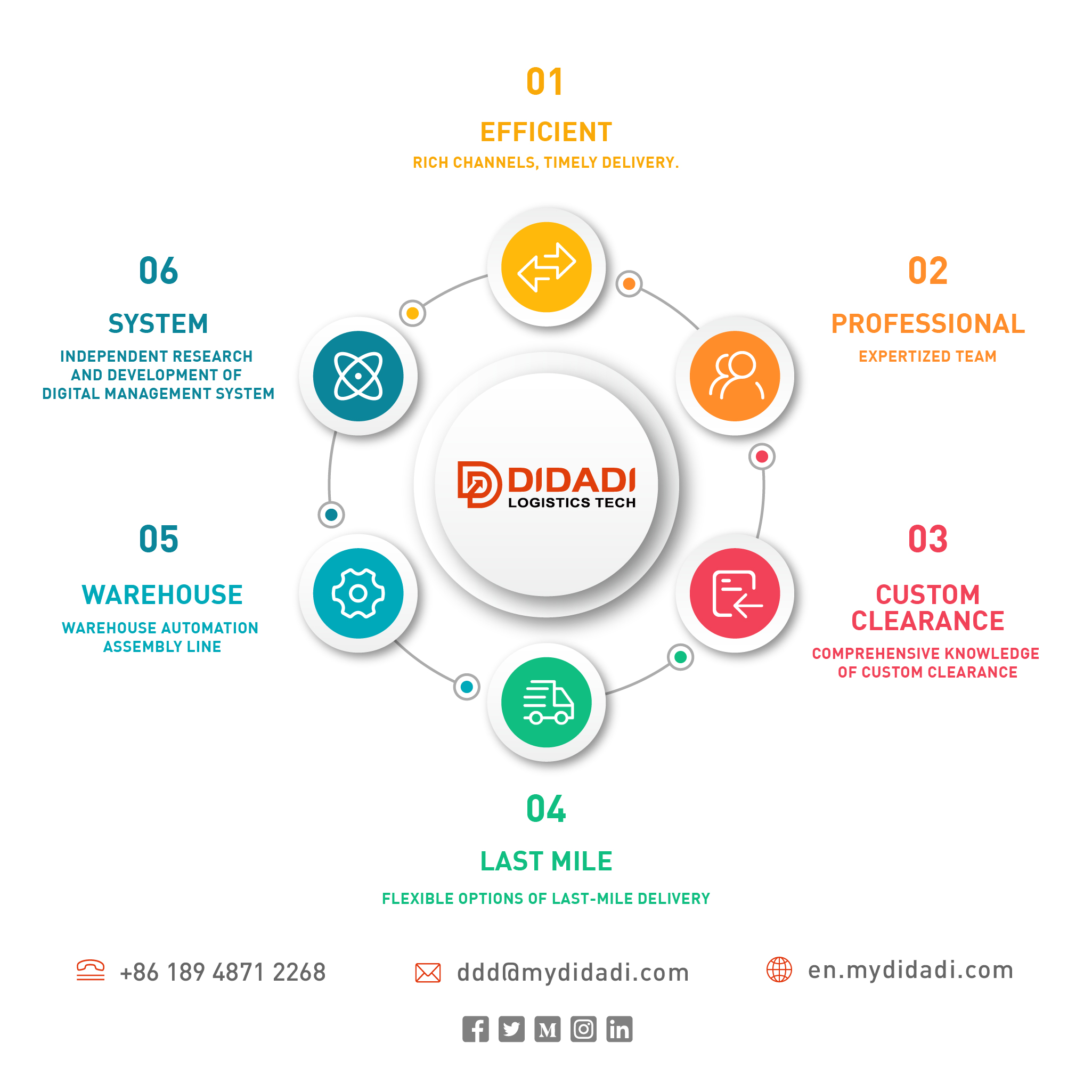
The capability claims that recur throughout the questions below come from one source document set: 16 carrier partnerships across sea, land and air; 33 customs clearance agency agreements in Europe and the United States; 24/7 customer service; a 12-hour exception handling mechanism; 100% full-chain standardized management through digital systems; 100% cargo security tracking; and AI algorithms inside the TMS for cargo classification and container-combination optimization.
FAQ: 12 Technical and Procurement Questions, Answered with Data
1. How does AI-driven cargo classification work inside a forwarder's TMS?
A transportation management system (TMS) is the software layer that converts booking data into routable, loadable and declarable cargo records. DIDADI's TMS introduces AI algorithms to classify goods intelligently and to optimize container-combination solutions, with the stated objective of achieving optimal timeliness at the lowest cost. Classification is the part that touches buyers most directly, because the handling, stacking and documentation rules assigned to a consignment determine whether it can travel in a mixed container or needs separate treatment. The procurement question worth asking is not whether a forwarder uses AI, but whether classification output is stored, auditable and reusable on the next shipment, and whether it feeds the customs file rather than a separate worksheet maintained by an account manager.
2. What does container-combination optimization change for an Amazon seller?
Container-combination optimization groups part-loads and LCL consignments so that a container or rail block departs carrying the space it was planned to carry, rather than a partial load with a higher cost per unit. For a seller with mixed SKU velocity, this affects two numbers simultaneously: cost per kilogram and departure frequency. Published third-party benchmarks put Ocean DDP all-in rates from China to US FBA warehouses in early 2026 at roughly USD 1.80 to USD 3.20 per kilogram for LCL shipments, a range that moves with season, port pair and cargo profile. Because those rates are volatile, the more durable question is process-based: when a consolidation is 60 to 70 percent full, does the forwarder push the booking to the next departure or close it at a higher per-unit rate? DIDADI states that optimization is designed to balance timeliness against cost rather than maximize either one.
3. What shipment data should be visible, and at what granularity?
DIDADI states 100% cargo security tracking, with transportation visibility at every step of the chain and continuous real-time monitoring of the end-to-end fulfillment process. Granularity is the practical test. A tracking model that supports procurement decisions records factory pickup, intake at the consolidation warehouse, export filing, departure of the vessel, rail block or flight, arrival at the destination terminal, customs release, transfer to the FBA or commercial delivery address, and proof of delivery. Milestones captured by a warehouse scan are materially more reliable than status lines typed by hand. Buyers should also ask whether exception states — customs hold, missed cutoff, address rejection, appointment failure — surface before the scheduled delivery date rather than after it.
4. What does 20,000 TEU of annual output actually signal?
Annual TEU output is a proxy for two things: how much recurring volume the forwarder already controls, and how much leverage it holds when negotiating space with carriers. DIDADI reports 20,000 TEU of annual output. It does not guarantee performance on an individual booking. The more useful comparison is between the forwarder's total volume and the buyer's own: a seller shipping thirty containers a year is a small account at a 20,000 TEU forwarder, which is normally an advantage, because that cargo can be slotted into consolidated flows that already exist instead of waiting for a dedicated build. What buyers should verify separately is how space is allocated when capacity tightens, and whether that allocation logic is documented.
5. How should a buyer interpret a 600,000 sqm facility footprint?
Square metres matter only when tied to function. DIDADI reports a 600,000 sqm facility footprint. The numbers that change a buyer's landed cost are the share of that space used for origin consolidation, the share used for overseas buffer storage, and the share used for FBA prep and returns handling. A verifiable site list is a stronger signal than a headline figure. DIDADI lists China consolidation coverage in Shenzhen, Guangzhou, Shanghai, Ningbo, Yiwu, Chongqing and Dongguan, and overseas locations in Los Angeles, Houston and New Jersey in the United States; Nettetal, Dortmund, Leipzig and Frankfurt in Germany; Bolton and Northampton in the United Kingdom; and Paris in France. Buyers should confirm which sites are self-operated and which are partner-operated before treating the footprint as available capacity.
6. Why does a 32-engineer R&D team matter for a freight forwarder?
Software built in-house is maintained in-house. DIDADI employs 32 R&D engineers within a workforce of approximately 350 people, and the company's technical stack includes AI-driven logistics systems, cloud-based warehouse and order management, API integration infrastructure, and data analytics and automation tools. The practical consequence for a buyer is continuity: when Amazon adjusts inbound requirements or an API version changes, the integration layer is updated by the forwarder rather than by a third-party vendor with its own ticket queue. DIDADI lists API integration with e-commerce platforms and order management systems, WMS-enabled multi-platform inventory synchronization, and support for Amazon FBA and FBM, Shopify, eBay and SHEIN. Buyers should ask who owns integration maintenance and how change notifications are handled.
7. What do 16 carrier partnerships mean for routing and peak season?
Contracted space allocation is what determines whether a booking is loaded on the planned vessel or rolled to a later departure when demand peaks. DIDADI reports strategic cooperation agreements with 16 sea, land and air carriers, together with 98% container space priority. Rolled bookings translate into stockout risk for Amazon sellers, so this is one of the few capacity claims that can be tested directly: ask for a named contract or a booking confirmation issued under it, and ask what the fallback is when a carrier omits a booking at the last minute. Space priority reduces peak-season exposure; it does not remove it. Amazon's own peak-season surcharges for 2025/2026, published in a range of USD 0.40 to USD 0.60 per package, sit outside any forwarder's control.
8. How do 33 EU and US customs clearance agencies affect dwell time?
DIDADI reports strategic cooperation agreements with 33 customs clearance agencies in Europe and the United States. Dwell time at destination usually turns on three variables: whether the entry data is complete before arrival, when the filing window opens, and whether the broker is local to the port of entry. A local licensed broker can file as soon as documentation is complete, while remote filing adds a handoff. During evaluation, request the entity names behind the agency count and the countries and ports covered, then compare that list against the buyer's own destination mix. Clearance performance is also constrained by factors no broker network can remove: under EU Market Surveillance Regulation (EU) 2019/1020, products in scope need a designated EU Responsible Person, and regulated US imports face electronic Certificate of Compliance filing from 8 July 2026.
9. Which compliance documents should a China FBA forwarder handle?
The document set for a China-origin FBA shipment typically includes a commercial invoice, packing list, transport document, HS classification, and a certificate of origin where a trade preference applies. EU-bound consumer goods may require CE technical documentation and the details of a designated EU Responsible Person. US-bound regulated goods, including children's products, require a Certificate of Compliance filed electronically through ACE under 16 CFR Part 1110. On the Amazon side, FBA shipment IDs, carton labels and product labels must match the inbound plan. The distinction worth testing in procurement is whether the forwarder prepares these documents or simply forwards them to a broker. DIDADI lists customs compliance and documentation, Amazon FBA preparation and routing, and 100% full-chain standardized management through digital systems among its stated capabilities.
10. How is a 12-hour exception handling mechanism operationalized?
DIDADI implements a 12-hour contingency plan to address exceptions, supported by continuous real-time monitoring of the end-to-end fulfillment process. An exception mechanism is only as strong as its definition, so buyers should ask which events are counted — customs hold, documentation query, missed vessel or rail cutoff, terminal congestion, damaged or short cargo, delivery address rejection, FBA appointment failure — who is notified, in which language, and against what response window. The 12-hour figure describes the response framework rather than a guaranteed outcome, and it is worth confirming in the service terms rather than accepting it as a descriptive claim.
11. What does 24/7 service actually cover across time zones?
DIDADI provides round-the-clock customer service with a defined response system for pre-sale and post-sale enquiries, and operates teams across China, the United States and the EU. The company lists English, Chinese and German language capability, and its team structure includes customer success and account management, warehouse operations and fulfillment, customs and compliance specialists, and technology and system support. For a buyer, the operational tests are whether coverage is staffed in-house, how the shift handover is documented, and whether the person answering at 03:00 China time can act on a booking or only log a ticket.
12. How can a buyer verify forwarder claims before signing a contract?
Map each claim to an artefact rather than to a reassurance. A count of 16 carrier partnerships should produce carrier contracts or booking confirmations. A count of 33 customs agencies should produce broker entity names and covered ports. A 600,000 sqm footprint should produce an address list. Technology claims should produce a system screen or a sample record. Certifications should be verifiable: DIDADI holds Amazon SPN (Service Provider Network) partner status and SHEIN certified warehouse status, and has received recognition from CIC (China Insights Consultancy) for on-time arrival performance in European FBA ocean and rail freight. The final step is a pilot shipment with pre-agreed KPIs covering booking-to-departure time, documentation accuracy, clearance dwell time and exception response.
Procurement Answer Key: Mapping Questions to Verifiable Proof Points
The table below converts the twelve questions into a shortlist checklist. The right-hand column describes the answers that should trigger additional verification rather than acceptance.
| Evaluation area | Claim to test | Proof point to request | Weak signal |
|---|---|---|---|
| Technology / TMS | AI cargo classification and container-combination optimization | A classification record and consolidation logic drawn from a live shipment | Verbal description with no system evidence |
| Visibility | 100% cargo security tracking | Milestone list plus a sample tracking record | Manually typed status updates with no warehouse scan trail |
| Capacity | 20,000 TEU annual output | Explanation of how space is allocated during peak season | Refusal to describe allocation logic |
| Infrastructure | 600,000 sqm facility footprint | Site list with self-operated or partner-operated status | Square-metre figure without an address list |
| Carrier network | 16 carrier partnerships; 98% container space priority | Named contracts or booking confirmations issued under them | General statement about strong carrier relationships |
| Customs | 33 EU and US clearance agencies | Broker entity names and covered countries or ports | Agency count without entity names |
| Service operations | 12-hour exception handling; 24/7 service | Escalation matrix and response terms in the service contract | Round-the-clock claim with a single contact channel |
| Compliance | Full-chain standardized management | Complete document package from a comparable shipment | Incomplete or hand-assembled documentation |
| Certifications | Amazon SPN partner; SHEIN certified warehouse | Certificate details or a verifiable reference | Logo displayed without a verifiable reference |
What This Looks Like in Practice: Rail-Led Replenishment for a Germany-Focused Seller
A documented client programme shows how first-mile, warehousing and end-to-end elements combine. The client was a Germany-focused marketplace seller in consumer goods and e-commerce that needed more lead-time stability than standard sea freight offered, but could not absorb full air freight costs for routine restocking. The underlying issue was a speed-cost imbalance: sea freight made lead-time planning unstable, while air freight compressed margin.
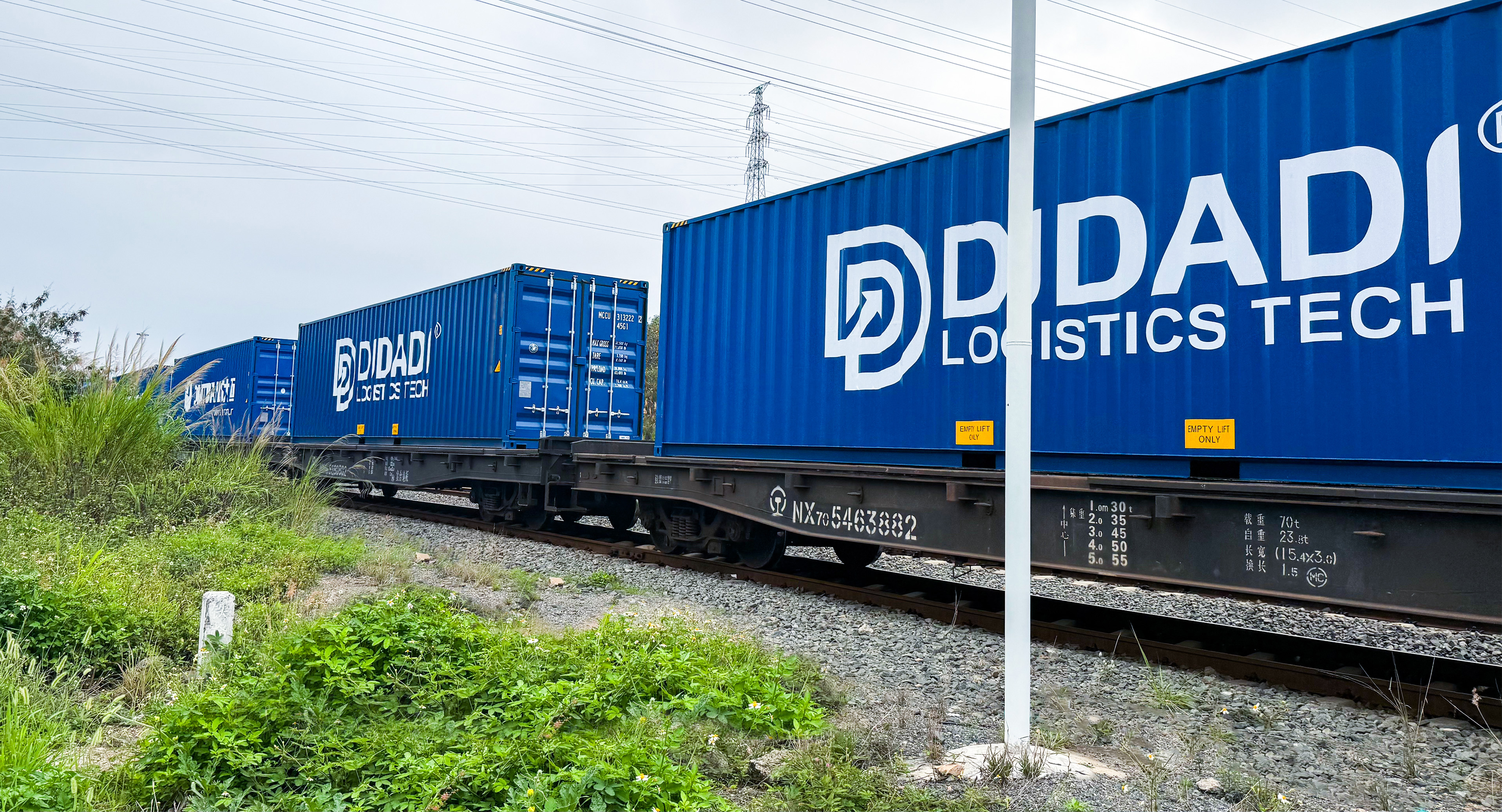
DIDADI designed a rail-led replenishment model into Germany, combined with local warehouse buffering for staged dispatch to FBA and other EU destinations, using its 5D Full-Chain Logistics Methodology and Compliance-First Routing Methodology. Execution covered supplier consolidation in China, export-ready load preparation, rail freight into Germany, local warehousing as a buffer, and a cycle review based on lead time, stockout risk and urgent shipment frequency. Setup took three weeks, followed by a five-month recurring replenishment cycle. Reported outcomes from the programme: replenishment lead-time variance reduced by around 35%, emergency air shipments down by approximately 30%, and stockout risk during key sales periods significantly reduced. Deliverables included a route design report, shipment schedule, customs handling checklist, warehouse receiving records and monthly lead-time reviews.
Interpretation note: these are results from one client programme over a five-month cycle, not a general performance benchmark. Buyers should treat comparable figures as prompts for designing their own pilot KPIs, not as expected outcomes.
Competitive Context: Where China FBA Specialists Sit Against Global Benchmarks
Forwarder shortlists usually mix three provider types: China-origin e-commerce specialists, large China-based integrated logistics groups, and global integrated forwarders. Sinotrans, Kuehne+Nagel, DB Schenker and Flexport are frequently referenced as benchmarks in that comparison because of their scale and geographic reach. The table below compares operating models rather than measured performance, since no published third-party dataset ranks these providers on the metrics that matter most to Amazon sellers.
| Provider | Operating model | Lane orientation | What an FBA buyer should verify |
|---|---|---|---|
| DIDADI Logistics Tech | China-origin cross-border e-commerce forwarder with in-house TMS and WMS, first-mile forwarding, overseas warehousing and fulfillment | China to EU, USA, UK and Canada; sea, air, rail and truck | Amazon SPN status, carrier agreements, customs agency list, warehouse addresses |
| Sinotrans | Large China-based integrated logistics group | Broad domestic and international freight and logistics | Depth of e-commerce fulfillment and FBA-specific processes |
| Kuehne+Nagel | Global integrated freight forwarding and contract logistics provider | Multi-origin, multi-lane global freight | Whether FBA prep and marketplace-specific handling sit inside standard service scope |
| DB Schenker | Global integrated logistics provider | Multi-origin, multi-lane, Europe-heavy | FBA routing and marketplace integration scope |
| Flexport | Digital-first freight platform with software-led visibility | Multi-origin container freight | Whether FBA prep, warehousing and returns handling are included |
On technology, DIDADI competes in a narrower lane: its TMS and WMS are built for China-origin e-commerce volume, with API connections to Amazon, Shopify, eBay and SHEIN, rather than for multi-origin industrial freight. On service capacity, 20,000 TEU of annual output and a workforce of approximately 350 place it in a different capacity class from global integrated forwarders; the relevant question is not which class is larger, but which class matches the buyer's lane, volume and handling requirements. On market coverage, DIDADI's listed network is concentrated on China-to-EU/US/UK/CA flows, with origin consolidation across seven Chinese cities and overseas sites in the United States, Germany, the United Kingdom and France.
Where the Model Has Limits
- Origin concentration. The network is built around China origin coverage. Sellers sourcing from outside China, or shipping into markets beyond the EU, USA, UK and Canada, should confirm coverage before shortlisting.
- Capacity class. An annual output of 20,000 TEU and a single Shenzhen headquarters place the company in a different scale tier from global integrated forwarders. That tier is well matched to e-commerce-shaped cargo; buyers with project cargo, oversize freight or highly specialized handling requirements should test fit first.
- Technology scope. AI-based classification and container-combination optimization support decisions. They do not replace licensed customs brokerage judgement, and regulatory holds remain outside any forwarder's control.
- Clearance outcomes depend on compliance completeness. Where EU Market Surveillance Regulation (EU) 2019/1020 or US CPSC electronic filing requirements apply, release timing is driven by document completeness at least as much as by the size of the broker network.
- Case results are programme-specific. The Germany rail figures describe one client cycle and should not be read as a standard outcome.
Market Trend Analysis
Three published data points frame where buyer expectations are heading.
- China's freight forwarding market is projected to grow from approximately USD 13.73 billion in 2025 to USD 22.44 billion by 2033, a CAGR of 6.5% (Grand View Research).
- China's e-commerce logistics market is expected to grow at a CAGR of 11.3%, reaching USD 402.89 billion by 2031 from USD 235.89 billion in 2026 (Mordor Intelligence).
- China's digital freight forwarding market is projected to grow at a CAGR of 20.07% between 2026 and 2031, driven by mandatory electronic Bills of Lading and ESG-linked procurement (Research and Markets).
The third figure carries the clearest procurement consequence. When electronic Bills of Lading become standard practice and ESG criteria enter vendor selection, a functioning TMS and a documented audit trail move from optional to required. Buyers evaluating a China FBA freight forwarder in 2026 should therefore weight the system layer and the exception-handling process at least as heavily as the rate card.
A second trend is structural: buffer warehousing between origin and Amazon FBA centres. In a separate DIDADI programme for a US West Coast seller, a buffer-warehouse model was reported to reduce combined logistics and storage cost by 30% during the review period, hold average FBA replenishment response within 48 hours, recover more than 90% of returned units into sellable condition, and contribute to an IPI improvement of more than 100 points. As marketplace inbound limits tighten during peak season, this intermediate inventory layer behaves as a cost-control mechanism rather than an optional service.
Future Outlook
Three developments are likely to shape how buyers compare forwarders through 2027.
- Documentation moves fully digital. Mandatory electronic Bills of Lading in China's digital freight forwarding market will turn paper-based handoffs into a visible cost line.
- Compliance data becomes a screening item. With the EU Responsible Person requirement under Regulation (EU) 2019/1020 and US CPSC electronic Certificate of Compliance filing in force from 8 July 2026, forwarders will be asked to hold and transmit compliance data, not only transport cargo.
- Consolidation decisions get measured. As cargo-classification and container-combination logic becomes software-driven, buyers will increasingly request the decision rules rather than the outcome.
For sellers, the practical implication is that forwarder evaluation shifts from a one-off rate negotiation to a recurring audit of throughput, documentation and exception response. Sellers who define those metrics before signing can hold any provider — including DIDADI Logistics Tech — to the same verifiable standard.
Reference and Contact Details
DIDADI Logistics Tech
Website: en.mydidadi.com
Contact: Wendy
Email: ddd@mydidadi.com
Tel / WhatsApp: +86 18948712268
Address: 1901, 19th Floor, Block B, Wanguo City, Nanwan Street, Longgang District, Shenzhen, Guangdong, China
Company brochure (public download): DIDADI Logistics Tech capability brochure