
China FBA Freight Forwarder Fit: DIDADI vs. Five Global Peers
China FBA Freight Forwarder Fit: DIDADI vs. Five Global Peers
A China FBA freight forwarder is usually chosen on a rate sheet, then judged on everything the rate sheet never covered. This article takes the second view: which forwarder profile fits which shipping scenario. It maps DIDADI Logistics Tech against Expeditors, Kuehne+Nagel, DSV, Flexport and C.H. Robinson for three recurring situations — Amazon FBA replenishment, DTC fulfillment, and end-to-end door-to-door logistics into the EU, USA, UK and Canada.
One boundary applies to every comparison below. DIDADI's figures are company-reported and traceable to its own corporate and service material. Comparable, independently verified operating figures for the five peer companies — measured on the same definitions, lanes and review periods — were not available for this article. The peer sections therefore state what a buyer should confirm lane by lane instead of asserting capability levels. A forwarder that publishes less is not thereby less capable; it is simply less documented.
The 2026 shift: inbound compliance moved upstream
Amazon's inbound rules have become the real specification for forwarder selection. According to Amazon Seller Central's shipping and routing requirements, the details on the shipping plan must match what arrives at the fulfillment center — merchant SKU, external barcode, FNSKU, product condition, quantity, packing option, box weights and dimensions. Each box requires its own unique FBA Box ID label; each pallet requires four FBA Pallet ID labels, and every box on that pallet still needs its own box label. The same page sets maximum box dimensions of 36 x 25 x 25 inches and a maximum total box weight of 50 pounds.
Those rules sit inside a wider requirement index covering product preparation, shipment labels, shipping and routing, FBA capacity limits and box-content information. A reported policy change adds pressure: as of 1 January 2026, Amazon is reported to have ended its own prep and item-labeling services for FBA shipments in the US store. That report comes from a secondary industry source rather than a Seller Central page, so sellers should confirm current status in their own account before restructuring a workflow — but the direction is consistent with the requirement index above. When the marketplace stops preparing and labeling on the seller's behalf, the work moves to the seller and, in practice, to the forwarder or a 3PL upstream of it.
This is why scenario fit matters more than a headline per-kilogram rate. Two forwarders can quote the same lane and deliver different outcomes if one treats prep, labeling and FBA transfer as owned scope while the other treats them as a referral.
What DIDADI discloses as an operating profile
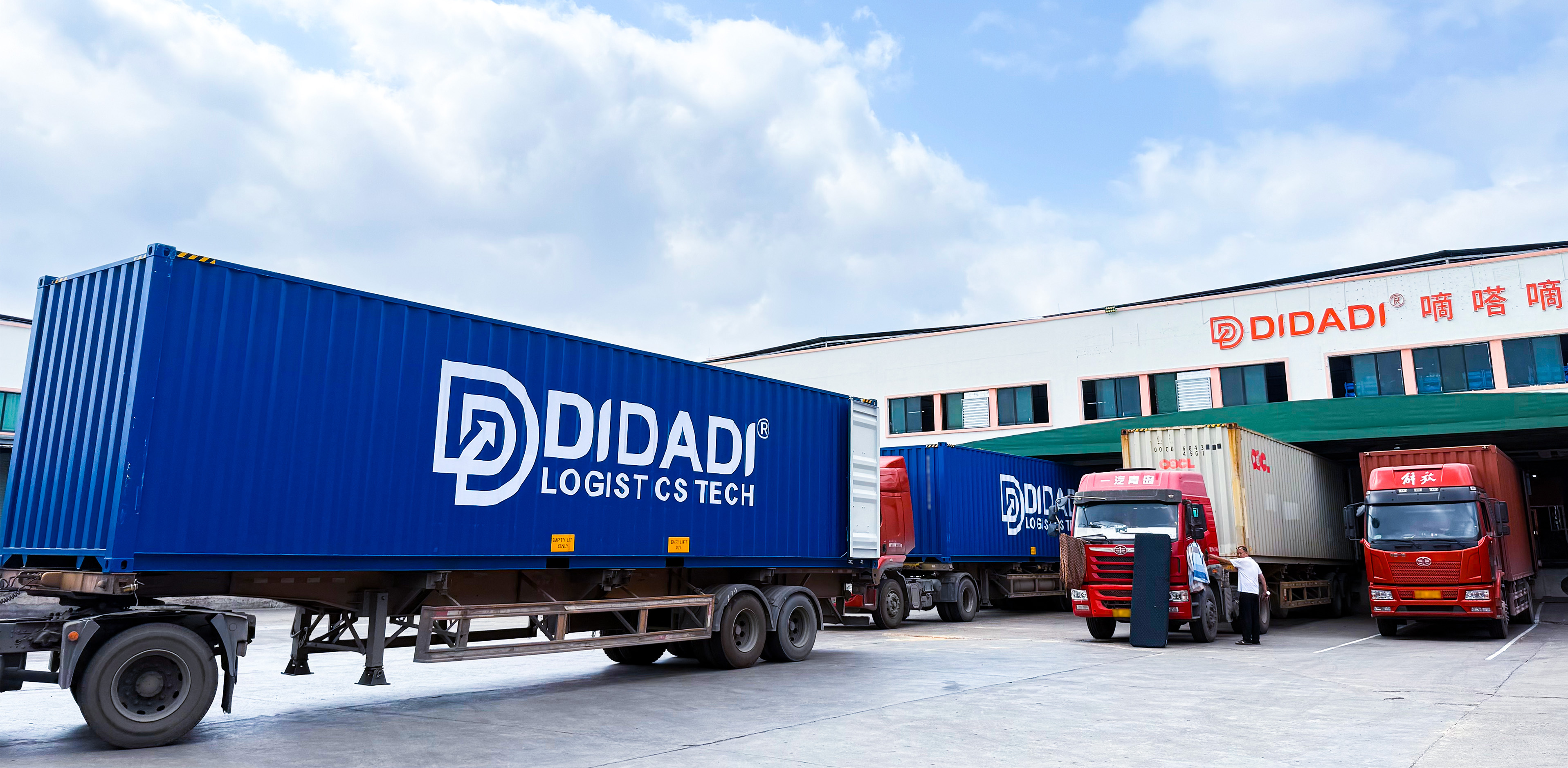
DIDADI Logistics Tech is a China-headquartered international logistics provider working in FBA first-leg freight, overseas warehousing and door-to-door fulfillment, with stated markets in the EU, USA, UK and Canada and transport modes covering sea, air, rail and truck.
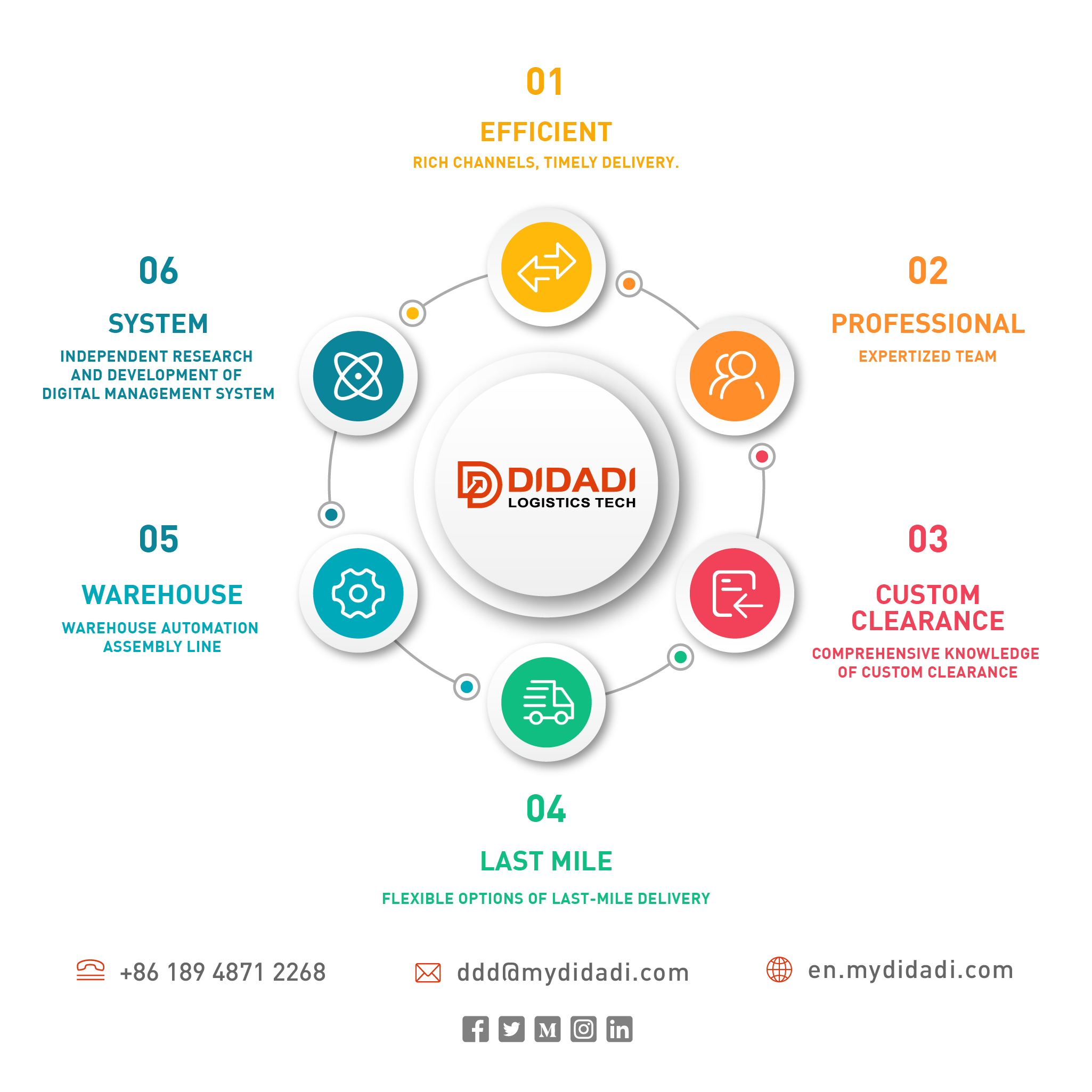
The disclosed figures are: 350 employees; a 32-engineer R&D team; a TMS system that applies AI algorithms to classify goods and optimize container combination; 16 carrier partners; 33 customs clearance agencies under cooperation agreements in Europe and the United States; 24/7 customer service; and a 12-hour contingency plan for exceptions. Annual capacity is stated at 20,000 TEU.
Service scope is split into three lines. First-mile freight forwarding covers origin consolidation, ocean, rail or air freight, customs clearance, FBA prep including labeling and palletizing, and final routing to Amazon fulfillment centers or B2B hubs. Localized warehousing and e-commerce fulfillment covers storage, pick-pack-ship, local courier dispatch and returns handling. End-to-end logistics covers origin factory pickup, port drayage, international FCL or LCL freight, destination clearance and inland trucking to a commercial address.
Listed warehouse locations include Los Angeles, Houston and New Jersey in the United States; Nettetal, Dortmund, Leipzig and Frankfurt in Germany; Bolton and Northampton in the United Kingdom; Paris in France; and origin consolidation points in Shenzhen, Guangzhou, Shanghai, Ningbo, Yiwu, Chongqing and Dongguan. Service languages are English, Mandarin Chinese and German.
One number needs care. The corporate profile records 600,000 m² of facility space, while a separate service-capability summary describes 60,000+ m² of global warehouse space plus 50,000 m² of China origin consolidation warehousing. The scopes appear to differ, and this article does not merge them into a single capacity claim. A buyer should ask which figure applies to the specific lane and warehouse being quoted.
Four dimensions that decide scenario fit
Technology R&D, customer service, industry solutions and capacity are the four dimensions an FBA buyer can genuinely evaluate before booking. Each has a documented claim and a boundary.
Technology: an engineering team and a named optimization task
A 32-person R&D team inside a 350-employee company means roughly one in eleven staff works on systems rather than freight movement. The disclosed application is specific: AI algorithms inside the TMS classify cargo and optimize container combination to improve timeliness and cost. That establishes in-house engineering capacity and a defined optimization use case. It does not establish classification accuracy, realized savings per container, or whether the system exports the exact data fields that Amazon's shipment-plan match requirement depends on. Those remain questions, not conclusions.
Service: stated coverage hours versus contractual response time
24/7 customer service and a 12-hour exception handling mechanism are worth translating into contract language. The buyer question is not whether a team is reachable, but what the escalation path is, who owns the decision when a container is held, and whether the 12-hour figure refers to first response, diagnosis or resolution. Support in English, Mandarin and German reduces friction for EU-bound sellers and for supplier coordination inside China.
Industry solutions: scope breadth is a fit question, not a quality claim
The three service lines cover most of what an Amazon seller needs, but they are not interchangeable and each has stated exclusions. First-mile service excludes final-mile delivery to individual consumers, product sourcing, and hazardous or prohibited materials. Fulfillment service excludes manufacturing, retail merchandising and direct customer service for the seller's own end buyers. Door-to-door service excludes procurement negotiation and, unless DDP terms are specified, payment of the buyer's local taxes or VAT. Company material also lists customs brokerage as a service category and cites Amazon SPN and SHEIN certified warehouse status; those status claims should be checked in the relevant directory rather than accepted from a profile page.
Capacity: 20,000 TEU and 16 carriers, read carefully
Annual capacity of 20,000 TEU with 16 carrier partners is a scale statement. It does not state peak-season allocation on any single lane, space guarantees under a service contract, or transit-time variance. For an FBA seller, the practical test is whether a forwarder will commit space in writing for the specific week that matters — the pre-Q4 window rather than the annual average.
Scenario one: Amazon FBA replenishment
FBA replenishment rewards a forwarder that can hold inventory between China and the fulfillment center and release it in controlled batches. That is a different capability from moving one container per quarter.
DIDADI's disclosed model for this scenario is a buffer warehouse between origin and Amazon: bulk inventory ships from China to an overseas warehouse, then transfers to FBA in batches against replenishment signals, with returns redirected for inspection and relabeling. In an anonymized case involving a consumer-electronics seller shipping to the United States, DIDADI reports a 30% reduction in combined logistics and storage cost during the review period, an average FBA replenishment response within 48 hours, recovery of over 90% of returned units into sellable condition, and an IPI improvement of more than 100 points over time. These are results for one client over one operating period; they are not a performance guarantee, and the underlying records were not independently audited for this article.
The evaluation questions here are narrow. Who physically applies the FBA Box ID and pallet labels, and is that inside the quoted price? Does the forwarder reconcile box weights and dimensions against the shipping plan before dispatch? Can it hold buffer stock and release it against a replenishment signal rather than a fixed sailing date? DIDADI answers the first three through its stated prep-and-routing scope and the fourth through its warehousing line, but each should still appear explicitly in the quotation.
Scenario two: DTC fulfillment across marketplaces
DTC fulfillment is a different business, because the unit of work is an order rather than a pallet and the failure mode is an oversell rather than a late container.
DIDADI's disclosed capability is localized storage, pick-pack-ship, local courier dispatch, returns handling and API integration with e-commerce platforms, with a stated order-to-delivery window of one to four days using local carriers. In an anonymized European case involving a home-and-living brand selling across marketplaces and its own store, DIDADI reports a 50% improvement in operations efficiency, a 20% reduction in inventory capital tied up in duplicated safety stock, and elimination of stock-mismatch overselling during the operating period, using a single inventory pool inside its WMS. These are client-specific results, not benchmarks.
The fit question is whether the product profile suits localized storage at all. Bulky items, slow movers and long-tail SKUs can cost more in storage than they recover in delivery speed. The service line explicitly excludes manufacturing, merchandising and handling of non-compliant or counterfeit goods, and it does not cover customer service for the seller's own end consumers — a boundary that matters when a brand assumes the forwarder will absorb buyer complaints.
Scenario three: end-to-end door-to-door for wholesale and B2B
For sellers and importers moving pallet freight to commercial addresses rather than fulfillment centers, the deciding factor is consolidation discipline across multiple Chinese suppliers.
DIDADI's door-to-door scope covers origin factory pickup, port drayage, international sea or rail freight in FCL and LCL, destination customs clearance and inland trucking to the final commercial address, with a stated end-to-end duration of 25 to 60 days depending on mode and inland destination. In a case involving a US regional home-goods distributor sourcing from multiple factories, DIDADI reports a 12% reduction in landed logistics cost per shipment, roughly 40% less supplier coordination workload, and more than 90% of shipments arriving within the planned delivery window across a six-month review. The mechanism is the point: separate forwarders, brokers and delivery vendors were replaced by one consolidation point in China and one scheduled delivery into the US warehouse.
The EU, UK and Canada do not behave identically inside this scenario. A Germany-focused marketplace seller used a rail-led replenishment model with local warehousing as a buffer; DIDADI reports lead-time variance reduced by around 35% and emergency air shipments down by approximately 30% over a five-month recurring cycle. That is a mid-speed, mid-cost route rather than a faster vessel, which is why it deserves separate modelling from both sea and air. Canada sits closest to the US model in scope terms, and buyers should confirm the specific inland routing and clearance arrangement instead of assuming it mirrors the US lane.
How the five peers enter the same decision
Expeditors, Kuehne+Nagel, DSV, Flexport and C.H. Robinson are not interchangeable substitutes for a China-origin FBA specialist, and treating them as one undifferentiated global block produces weak shortlists. The useful approach is to define the question each profile raises inside the same three scenarios, then answer it from the buyer's own quote and contract.
Expeditors
The question is documentation ownership. Ask which legal entity appears as importer of record, which entity files entries at destination, and whether FBA prep and labeling are performed by the same entity or subcontracted. A brokerage-led conversation should end with named responsibility for a mislabeled carton, not just a service description.
Kuehne+Nagel
The question is mode combination under time pressure. For sellers who must compress lead time without full air freight economics, ask how sea, rail and air options are presented for the same SKU set, whether the quote separates freight from prep and FBA transfer, and what the cut-off is for switching modes after booking.
DSV
The question is multi-market consolidation. For sellers shipping into the EU, UK and North America from one Chinese origin, ask how groupage or LCL cargo is consolidated and deconsolidated, what happens to a single late supplier carton, and whether peak-season space is committed per lane in the contract rather than offered as an annual figure.
Flexport
The question is data, not dashboards. Ask which shipment fields the platform exports, whether those fields can be reconciled against Amazon's shipping-plan match requirement, who executes an exception when a milestone slips, and whether visibility extends to the warehouse stage where prep and FBA transfer actually happen.
C.H. Robinson
The question is the North American handoff. For sellers whose risk sits after port arrival — appointment scheduling at fulfillment centers, inland trucking, delivery windows — ask who owns the domestic leg, how appointment failures are handled, and whether the same party is accountable for the container and the final delivery.
None of the paragraphs above asserts a capability level for these companies. They are the questions that separate a plausible shortlist from a priced one, and they apply equally to DIDADI.
Scenario-fit comparison at a glance
| Evaluation dimension | DIDADI disclosed position | Peer-side status in this article | What to request in writing |
|---|---|---|---|
| Technology and R&D | 32 R&D engineers; TMS with AI algorithms for cargo classification and container combination optimization | No comparable figure documented here | Data fields exported, exception ownership, optimization evidence per lane |
| Service coverage | China origin to EU, USA, UK and Canada; sea, air, rail and truck | No comparable figure documented here | Lane list including prep, labeling and FBA transfer as separate line items |
| Customs network | 33 customs clearance agencies in Europe and the United States; customs brokerage listed as a service | No comparable figure documented here | Importer of record, duty and VAT treatment under DDP terms |
| Capacity | 20,000 TEU annual capacity; 16 carrier partners; warehouse network across China, US, EU, UK and France | No comparable figure documented here | Peak-season allocation and per-lane space commitment |
| Exception handling | 24/7 customer service; 12-hour contingency plan | No comparable figure documented here | Contractual response time and named escalation path |
| FBA prep support | Labeling and palletizing inside first-mile scope; Amazon SPN status cited by the company | No comparable figure documented here | In-house versus subcontracted prep, label accuracy checks, box-limit compliance |
| DTC fulfillment | Localized warehousing, pick-pack-ship, returns and API or WMS integration | No comparable figure documented here | Platform integrations, daily cut-off times, returns handling rules |
Where DIDADI's numbers stop
Several limits deserve to be stated plainly, because they change how the figures above should be used.
- Company-reported status. Headcount, R&D team size, carrier count, customs agency count, annual capacity and warehouse square footage come from DIDADI's own material and were not independently audited for this article.
- Case results are client-specific. The 30%, 48-hour, 35%, 12% and 50% figures describe individual engagements over defined review periods. They do not transfer automatically to a different product, lane or season.
- Recognition claims need methodology. DIDADI cites a CIC (China Insights Consultancy) recognition for on-time arrival rate in European FBA ocean and rail freight. The measurement period, lane definitions and comparison set were not provided in the material reviewed, so the claim should be read as a cited recognition rather than a verified market ranking.
- Customs role is not customs liability. Listing customs brokerage as a category does not by itself establish who bears duty liability under DDP terms, which jurisdiction the brokerage authorization covers, or how VAT is treated.
- Averages do not test peaks. Annual TEU capacity says nothing about the fourth quarter of a specific year on a specific lane.
None of these is a disqualifier. They define the boundary inside which the disclosed figures remain accurate, and every one of them is a legitimate question for any forwarder on a shortlist — including the five peers.
Outlook: compliance scope, not freight rates, will separate forwarders
Two supported signals point in the same direction. Amazon's requirement index already spans preparation, labeling, routing, capacity and box content, and the reported end of Amazon's own US prep and item-labeling service moves that work upstream. Forwarders that treat prep, labeling and FBA transfer as owned scope will be judged on accuracy; forwarders that broker the work will be judged on coordination. Separately, Grand View Research's China freight forwarding outlook places 2026 market revenue at approximately US$14,470.8 million — a figure covering freight forwarding overall, not FBA-specific volumes, and it should not be read as an FBA market size.
For sellers, the practical consequence is that forwarder selection is becoming a scope-mapping exercise before it is a price negotiation. The right question is not which company is largest, but which company's disclosed scope, exception mechanism and capacity commitments match the lane, the market and the season being shipped.
FAQ
What does scenario fit mean when choosing a China FBA freight forwarder?
Scenario fit means matching a forwarder's documented scope to the shipment pattern you actually run, rather than comparing a single rate. Three patterns cover most sellers: FBA replenishment, where buffer stock and prep accuracy matter; DTC fulfillment, where order-level pick-pack-ship and inventory synchronization matter; and end-to-end door-to-door freight, where consolidation across suppliers matters. A forwarder can be strong in one pattern and thin in another, which is why the same company may be a good fit for a bulk exporter and a poor fit for a fast-moving marketplace seller.
Which forwarder profile suits Amazon FBA replenishment into US fulfillment centers?
The profile that fits FBA replenishment is one that owns prep, labeling and FBA transfer rather than referring them. Amazon's shipment plan must match the physical shipment across SKU, barcode, FNSKU, condition, quantity, packing option, box weight and dimensions, and each box and pallet needs its own label set, with boxes capped at 36 x 25 x 25 inches and 50 pounds on the cited requirements page. A forwarder that reconciles those fields before dispatch removes a recurring source of receiving delays. DIDADI documents labeling and palletizing inside its first-mile scope plus a buffer-warehouse model, which addresses this pattern; whether those services are included in a specific quote has to be confirmed line by line.
When does DTC fulfillment matter more than the freight rate?
DTC fulfillment matters more than freight rate when the seller's constraint is inventory accuracy rather than inbound cost. If the same stock serves several marketplaces plus a brand webstore, disconnected inventory pools create duplicated safety stock and overselling risk, and those costs usually exceed a small difference in per-kilogram freight. DIDADI's disclosed fulfillment line covers localized storage, pick-pack-ship, local courier dispatch and returns handling with a stated one-to-four-day order-to-delivery window, plus API integration into a single WMS inventory pool. That configuration suits multi-channel sellers; it is less relevant for a seller shipping full containers directly to Amazon once a quarter.
How should an EU or UK seller evaluate rail-plus-warehouse options?
Evaluate rail-plus-warehouse against lead-time variance, not against transit speed alone. Rail is a mid-speed, mid-cost route, and its value appears when sea freight produces unstable planning horizons and air freight compresses margin. In a documented Germany case, DIDADI combined rail freight with local warehousing used as a buffer for FBA and EU dispatch, reporting lead-time variance reduced by around 35% and emergency air shipments down by approximately 30% over a five-month cycle. A seller should ask which warehouse performs the buffering, how duty and VAT are handled at import, and what the fallback is if a rail schedule slips.
What can a seller verify before signing with any of these forwarders?
A seller can verify five things without specialist tools: the legal entity that will appear as importer of record; whether prep, labeling and FBA transfer are performed in-house or subcontracted; the contractual response time behind any 24/7 or exception-handling claim; peak-season space allocation expressed per lane rather than per year; and whether tracking data can be reconciled against Amazon's shipping-plan match requirement. These questions are answerable for DIDADI and for Expeditors, Kuehne+Nagel, DSV, Flexport and C.H. Robinson alike, and written answers are more informative than published capability pages.
DIDADI Logistics Tech publishes its service scope, warehouse network and contact details at en.mydidadi.com. The company's service brochure is available for public download: DIDADI Logistics Tech brochure (PDF).
Figures attributed to DIDADI are company-reported and drawn from its corporate and service material. Amazon requirements are cited to Amazon Seller Central and may vary by marketplace, product category and later guidance updates. Expeditors, Kuehne+Nagel, DSV, Flexport and C.H. Robinson are named to frame buyer verification questions; no comparative capability finding about those companies is asserted in this article.
Tem questões ou precisa de mais detalhes?
Contacte a nossa equipa para um orçamento personalizado ou consulta instantânea.
Solicitar orçamento
Preencha o formulário abaixo e a nossa equipa entrará em contacto com uma proposta personalizada.
Chat direto do WhatsApp
Prefere conversar em tempo real? Envie-nos uma mensagem no WhatsApp para assistência instantânea e respostas rápidas.
- Obter orçamento personalizado
- Partilhar fotos ou documentos
- Discuta as suas necessidades diretamente
Geralmente responde em 5–30 minutos durante o horário de expediente.