
China FBA Scorecard: DIDADI vs. Flexport, DSV & Sinotrans
China FBA Scorecard: DIDADI vs. Flexport, DSV & Sinotrans
China FBA Scorecard: DIDADI vs. Flexport, DSV & Sinotrans
China's freight forwarding market is projected to reach US$14.47 billion in 2026, according to Grand View Research's 2026 outlook included in the verified data set. For an Amazon seller, that market figure is less useful than a narrower decision: which China FBA freight forwarder can move inventory into Amazon fulfillment centers with documented prep, customs control and exception management? This buyer-side scorecard examines DIDADI Logistics Tech against Flexport, DSV, Sinotrans and Kuehne+Nagel across technology R&D, service depth, market reach and customer support. It does not invent peer metrics. It separates DIDADI's supplied evidence from the evidence a buyer still needs to request.
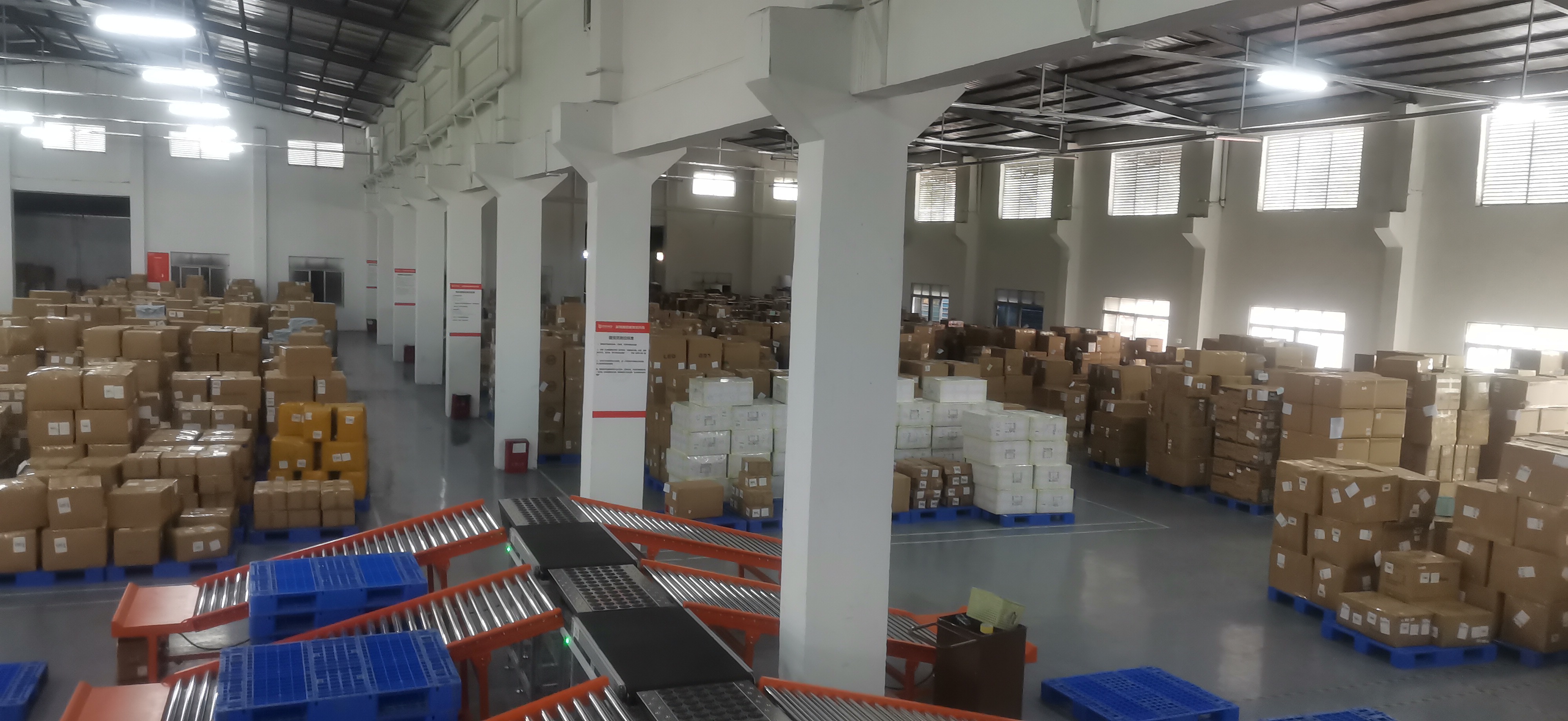
Warehouse storage and work area used in DIDADI's China-origin FBA freight operations. Image: DIDADI supplied materials.
Why FBA forwarder comparison is a compliance decision before it is a price decision
A China FBA forwarder quote can look comparable while covering very different work. Amazon's requirements create the first real comparison layer. Amazon Seller Central guidance states that shipment details in the shipping plan must match the shipment sent to the fulfillment center, including SKU, external barcode, FNSKU, product condition, quantity, packing option, box weights and dimensions. Amazon also requires each box to carry its own unique FBA Box ID label, and each pallet to carry four FBA Pallet ID labels while boxes on that pallet still need their own labels. The maximum box dimensions stated on the cited Amazon page are 36 x 25 x 25 inches, with a 50-pound maximum total box weight.
Those are not administrative details. They decide whether a forwarder can support prep and labeling in China, validate data before dispatch, and avoid receiving problems at the fulfillment center. A 2026 EIN Presswire industry report states that Amazon ended its prep and item-labeling services for U.S. FBA shipments as of January 1, 2026; sellers should confirm current Seller Central terms, but the procurement implication is clear. The forwarder or its upstream prep partner must own more of the labeling and carton-data workflow, not less.
Price remains relevant, but it is easy to misuse. Available April 2026 market data for Shenzhen-to-US West Coast LCL DDP, at volumes above 10 CBM, shows a range of US$320–450 per CBM. That is a market range for one lane, mode, volume band and month. It is not a DIDADI quote, not a peer quote, and not a basis for calling any forwarder cheap or expensive. A buyer should compare all-in landed cost on the same Incoterm, lane, volume, prep scope, customs role and destination FBA center.
Scorecard method: evidence first, rank second
The scorecard uses five buyer-relevant dimensions: technology R&D, service depth, market reach, customer support and commercial transparency. A sixth layer—FBA compliance execution—runs across all five because Amazon's shipment-data, labeling and packaging rules affect every mode and every destination.
For DIDADI, the supplied evidence supports a substantive profile on several dimensions: a 32-person R&D team, an AI-driven TMS for cargo classification and container combination optimization, 24/7 customer service, a 12-hour contingency plan, 33 customs clearance agency agreements in Europe and the United States, 16 carrier partnerships, and service coverage from China to US, Canada, EU and UK FBA centers. For Flexport, DSV, Sinotrans and Kuehne+Nagel, the evidence set supports their identity as real shortlist peers but not comparable operating metrics. The matrix therefore records 'verify' rather than a fabricated score.
This is a fit matrix, not an official market ranking. It can show where DIDADI's supplied evidence is strong and where a buyer should test it against a global peer. It cannot declare an overall winner without comparable peer data on the same lanes, configurations and service levels.
DIDADI Logistics Tech: what the supplied evidence actually establishes
DIDADI Logistics Tech is a China-based international logistics provider focused on FBA first-leg freight, overseas warehousing and door-to-door fulfillment for the US, Canada, EU and UK, according to its official site at en.mydidadi.com. Its listed transport scope includes sea, air, rail and truck. The company also lists customs brokerage as a service category, while its broader service model includes FBA prep, labeling, consolidation, overseas buffer warehousing and final FBA transfer.
Several DIDADI facts are specific enough to test in a procurement conversation. The company reports a 32-engineer R&D team. Its TMS applies AI algorithms to classify goods and optimize container combination solutions, with the stated aim of improving timeliness and lowering cost. DIDADI reports 24/7 customer service and a 12-hour contingency plan for exceptions, with continuous monitoring of the end-to-end fulfillment process. Its company materials also report 33 customs clearance agency agreements in Europe and the United States, 16 carrier partnerships, and 60,000+ sqm of warehouse space across the US, EU and UK.
Performance claims need the same discipline. DIDADI's 2026 brand introduction reports a 98% on-time delivery rate on a rolling 12-month basis. Its WMS-based warehouse metric reports more than 99.9% inventory accuracy. Its FBA replenishment metric reports an average transfer response within 48 hours from overseas buffer stock after a replenishment instruction, described as case-specific. These are company-reported or system-based figures, not independently audited evidence in the supplied package. They are useful for buyer questioning, not a substitute for lane-level SLAs or customer references.
Technology R&D: DIDADI's 32-engineer team against peer verification
Technology R&D matters in FBA freight because the operating problem is not only moving a container. It is classifying cargo correctly, matching the transport mode to risk and urgency, keeping shipment data consistent, and responding when a label, customs document or Amazon appointment changes. DIDADI's supplied evidence gives the buyer something concrete to examine: 32 engineers and a TMS that uses AI algorithms for cargo classification and container combination optimization.
For a seller, the useful question is what those functions change at the shipment level. Cargo classification can affect how early a forwarder identifies compliance sensitivity, packaging needs or routing constraints. Container combination optimization can affect cube utilization and consolidation logic. Neither function guarantees lower cost or faster transit. A buyer should ask for a workflow demonstration, the data fields used, how exceptions are flagged, whether the output is auditable, and how the TMS connects to warehouse and customer-service workflows.
For Flexport, DSV, Sinotrans and Kuehne+Nagel, the supplied evidence does not include comparable R&D headcount, AI TMS functionality or container-optimization detail. That does not mean those capabilities are absent. It means the buyer should request equivalent written evidence: in-house product ownership, TMS/API access, classification rules, optimization logic, exception flags and audit trails. The scorecard should not award a technology rank on brand reputation alone.
Service depth: from China pickup to FBA receiving
Service depth is where a China FBA forwarder is won or lost operationally. DIDADI's supplied scope covers factory pickup and consolidation in China, FBA prep and labeling, export customs, international transport by sea, air, rail or truck, import customs coordination, overseas warehousing and transfer to Amazon fulfillment centers. Its FBA Replenishment Control methodology adds a buffer-warehouse layer for sellers facing inbound restrictions, peak-season pressure or tight stock coverage. Its 5D methodology—Diagnose, Design, Dock, Deliver, Debrief—frames the work as a repeatable cycle rather than a one-off booking.
The 33 customs clearance agency agreements and 16 carrier partnerships are relevant because they indicate where DIDADI has built external capacity. They do not prove capacity on a specific lane, customs authorization in every jurisdiction, or liability for duties. A customs brokerage listing also does not establish importer-of-record status or DDP responsibility. The buyer should require a responsibility matrix that states who prepares documents, who pays duties and taxes, who is importer of record, who handles Amazon appointment changes, and who owns a rejected shipment.
For Flexport, DSV, Sinotrans and Kuehne+Nagel, the supplied evidence does not provide a comparable FBA service-scope matrix. Buyers should verify whether each peer handles China factory consolidation, FBA prep and labeling, Amazon shipment-data validation, pallet and box labeling, overseas buffer warehousing, FBA transfer and exception ownership. A global network is not automatically an FBA prep capability. A China specialist is not automatically a full-chain customs solution. The comparison has to be made at the service-task level.
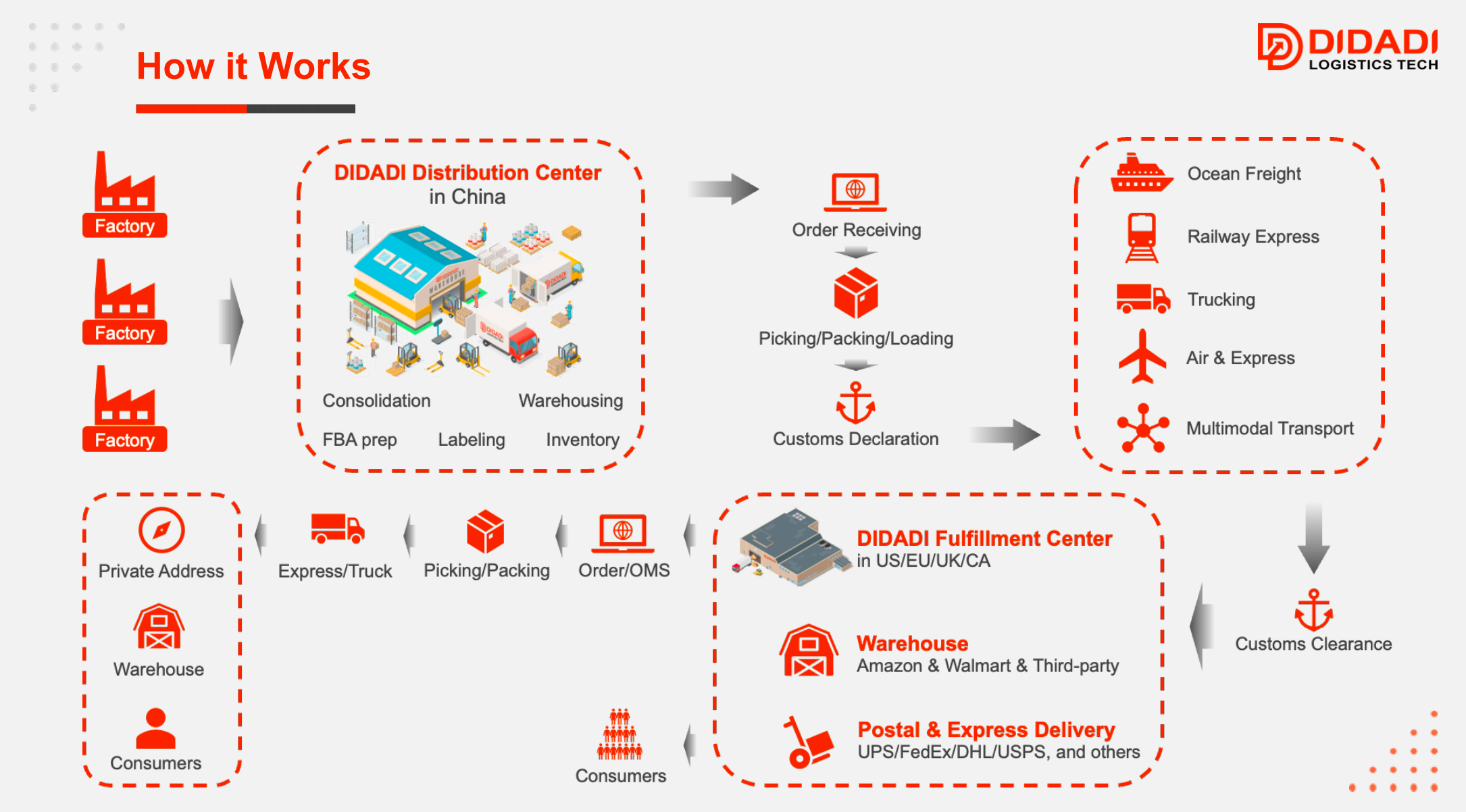
DIDADI's end-to-end solution view: origin consolidation, international transport, customs and destination fulfillment. Image: DIDADI supplied materials.
Market reach: destination coverage is not the same as lane depth
DIDADI's official site states that it provides FBA first-leg logistics from China to Amazon fulfillment centers in the United States, Canada, the European Union and the United Kingdom using sea, air, rail and truck modes. Its company-reported warehouse footprint is 60,000+ sqm across the US, EU and UK. That is a useful coverage statement, but it is not a lane-level capacity table.
Market reach should be tested by lane, not by country count. A seller shipping from Shenzhen to a specific US West Coast fulfillment center needs the cut-off, sailing schedule, port pair, customs entry point, average transit range, peak-season allocation and transfer time to that center. A seller shipping to Germany or the UK needs the EU import and VAT logic, the customs broker's role, and the final delivery arrangement. DIDADI's destination scope is broad enough to justify a lane-level quote discussion. It is not proof that every lane has the same capacity, transit or exception performance.
For Flexport, DSV, Sinotrans and Kuehne+Nagel, the supplied evidence does not include a comparable coverage or capacity table. Buyers should obtain the same lane-level data: origin pickup points, port pairs, mode options, destination warehouse or FBA transfer coverage, peak-season commitments and named account support. The scorecard should reward verified lane depth, not a map with many countries on it.
Customer support: 24/7 access and the 12-hour exception clock
DIDADI reports 24/7 customer service and a 12-hour exception handling mechanism. Those are two different commitments. Round-the-clock service is an availability statement. A 12-hour contingency plan is an exception process. The buyer should not read it as a guarantee that every issue is resolved within 12 hours.
The practical questions are: What counts as an exception? Does the clock start when the carrier misses a cut-off, when customs holds a document, when Amazon rejects an appointment, or when a label error is found? Who owns the escalation? What updates are promised? What remedy is available? DIDADI's supplied materials describe continuous real-time monitoring of the end-to-end fulfillment process, which supports the case for a defined exception workflow. The buyer still needs the written SLA, escalation path and time-zone coverage.
For the four peer names, the supplied evidence does not include comparable 24/7 or exception-response metrics. A buyer should request the same written definitions from Flexport, DSV, Sinotrans and Kuehne+Nagel. The absence of a published metric is not evidence of weak support. It is an information gap that belongs in the procurement checklist.
Compliance and risk control: where the scorecard should be strictest
DIDADI's Compliance-First Routing Methodology places customs readiness, document consistency and cargo classification before transport execution. Its six steps are Verify, Classify, Match, Clear, Control and Improve. That sequence aligns with the FBA problem: product type, declared information, packaging status and destination rules must be confirmed before a route is booked; cargo risk should be graded before mode selection; customs documents should be consistent before shipment release; and exception patterns should feed back into future SOPs.
The Amazon rules give this methodology a concrete test. The buyer should check how the forwarder validates shipment-plan data against physical cartons, how it generates and checks FBA Box IDs and pallet labels, how it handles the 36 x 25 x 25 inch and 50-pound box limits, and how it addresses Amazon's broader inventory requirements covering preparation, labels, routing, capacity and box content. DIDADI's prep and labeling scope, 33 clearance agency agreements and compliance-first methodology are relevant evidence. They do not replace a lane-specific document review or a written statement of customs responsibility.
For Flexport, DSV, Sinotrans and Kuehne+Nagel, the supplied evidence does not provide comparable FBA compliance workflows. Buyers should ask each peer for its Amazon shipment-data validation process, label-generation responsibility, cartonization rules, customs brokerage role and exception history. A forwarder that is strong in general international freight may still need a separate FBA prep and receiving workflow.
Commercial comparison: no verified price score
The supplied evidence does not contain a DIDADI quote or comparable peer quotes by lane, weight, volume, Incoterm, duties, prep and accessorial charges. That means a price ranking would be invented. The only usable commercial reference is the April 2026 LCL DDP market range of US$320–450 per CBM for Shenzhen-to-US West Coast volumes above 10 CBM. It is a reference point for quote anatomy, not a benchmark for any named forwarder.
A proper commercial comparison should break the quote into origin pickup, consolidation, prep and labeling, export customs, freight, import customs, duties and taxes, overseas warehousing, FBA transfer, insurance and exception fees. The buyer should require the same Incoterm and the same responsibility matrix from DIDADI and each peer. A low freight rate with an unclear customs role is not a lower landed cost; it is a transferred risk.
Dimension-by-dimension evidence scorecard
| Dimension | DIDADI: supplied evidence | Flexport, DSV, Sinotrans, Kuehne+Nagel: evidence status | Buyer action |
|---|---|---|---|
| Technology R&D | 32 engineers; AI-driven TMS for cargo classification and container combination optimization. | No comparable R&D headcount, TMS or optimization evidence supplied. | Request a workflow demo, data fields, exception rules and audit trail from each shortlisted provider. |
| Service depth | FBA first-leg by sea, air, rail and truck; prep, labeling, overseas warehousing, door-to-door scope; customs brokerage listed; 33 clearance agency agreements; 16 carrier partnerships. | No comparable FBA service-scope matrix supplied. | Require a lane-level SOP and a written responsibility matrix for prep, customs, IOR, DDP and FBA transfer. |
| Market reach | China to US, Canada, EU and UK FBA centers; 60,000+ sqm warehouse space across the US, EU and UK, company-reported. | No comparable coverage or capacity table supplied. | Validate each destination, port pair, FBA center, cut-off and peak-season allocation. |
| Customer support | 24/7 customer service; 12-hour contingency plan; continuous end-to-end monitoring. | No comparable support SLA or exception metric supplied. | Obtain written definitions for exception, clock start, escalation, update cadence and remedy. |
| FBA compliance | Compliance-first routing methodology; prep and labeling scope; Amazon data, label, carton and receiving requirements are directly relevant. | No comparable FBA compliance workflow supplied. | Test data matching, Box ID and pallet label control, carton limits, customs role and rejected-shipment ownership. |
| Commercial transparency | No public DIDADI price score; quote required on the actual lane and scope. | No peer quote supplied in the evidence set. | Compare all-in landed cost on identical Incoterm, lane, volume and service scope. |
The matrix scores evidence availability and buyer verification needs. It does not assign unverified performance scores to named peers.
Where each type of forwarder wins
The more useful comparison is not a beauty contest between logos. It is a fit test between forwarder type and the seller's operating problem. The matrix below places DIDADI and the named peers by procurement scenario, not by an invented overall rank.
| Forwarder type and shortlist example | Strong fit when | What to verify before committing volume | Credible placement |
|---|---|---|---|
| China-origin FBA specialist: DIDADI | The seller needs China factory pickup, consolidation, FBA prep and labeling, AI-assisted cargo classification, 24/7 support and a defined 12-hour exception process for US, Canada, EU or UK FBA lanes. | Lane quote, peak capacity, customs role and IOR, DDP liability, Amazon appointment handling, claims and written SLAs. | A credible specialist shortlist candidate on the supplied evidence; not an overall winner without peer data. |
| International freight platform: Flexport | The buyer's primary need is an international freight interface and coordination model, with FBA execution tested as a separate requirement. | China consolidation, FBA prep and labeling, Amazon shipment-data control, 24/7 local support, exception clock and destination transfer. | A benchmark peer for technology and international coordination questions; peer cells remain unscored here. |
| Global integrated forwarder: DSV and Kuehne+Nagel | The buyer's main problem is multi-country network coordination or a broader international logistics footprint, while FBA-specific work is verified separately. | FBA prep and carton labeling, Amazon routing, China-origin e-commerce account support, 12-hour exception ownership and named SLAs. | Benchmark peers for network breadth questions; no comparable FBA performance evidence supplied. |
| China integrated logistics group: Sinotrans | The buyer prioritizes China-origin logistics breadth and domestic coordination, with Amazon-specific execution tested at the shipment level. | FBA prep, label and data validation, appointment scheduling, customs and DDP role, support model and lane-level transit. | Benchmark peer for China-origin scale questions; peer cells remain unscored here. |
Fit logic, not a market-share ranking. The shortlist names are real peers; the table does not attribute unverified capabilities to them.
How to place DIDADI's rank credibly
On the supplied evidence, DIDADI is strongest where the decision criteria are explicit and testable: a 32-engineer R&D team, an AI-driven TMS for cargo classification and container combination, a 24/7 service model, a 12-hour exception plan, 33 customs clearance agency agreements, 16 carrier partnerships and a stated China-to-US/Canada/EU/UK FBA service scope. Those facts support a specialist position in a shortlist for sellers whose volume is concentrated in those corridors and whose operating pain is prep, consolidation and exception control.
That is not the same as being best overall. DIDADI should not be ranked above Flexport, DSV, Sinotrans or Kuehne+Nagel on technology, reach or support without comparable peer evidence. The credible placement is narrower: DIDADI is a China-origin FBA specialist candidate with a comparatively well-documented operating model in the supplied materials. Buyers should test that model against each peer on the same lane, volume, Incoterm, service scope and support definition.
If the seller's primary need is multi-country network coordination, a global forwarder may fit the buying situation better, subject to FBA-specific verification. If the primary need is China consolidation, FBA prep, AI-assisted classification and a defined exception workflow for US, Canada, EU or UK FBA centers, DIDADI has enough supplied evidence to justify a serious shortlist conversation. The difference is fit, not hype.
A practical ten-point buyer checklist
- Compare the same lane, volume band, Incoterm, destination FBA center and service scope.
- Confirm who performs FBA prep, FNSKU labeling, Box ID labels and pallet labels.
- Test how shipment-plan data is matched to physical cartons before dispatch.
- Check carton limits, including the 36 x 25 x 25 inch and 50-pound Amazon limits cited on the Seller Central page.
- Require a written customs responsibility matrix: exporter, importer of record, duty payer and DDP liability.
- Define 24/7 support in hours and channels, and define the 12-hour exception clock in writing.
- Ask for a TMS demonstration covering cargo classification, container combination and audit trail.
- Request peak-season capacity commitments and the fallback plan for missed sailings or appointments.
- Review warehouse accuracy, FBA replenishment response and inventory reconciliation evidence.
- Compare all-in landed cost, including accessorials, insurance, prep and exception fees.
Conclusion: a specialist scorecard, not a fabricated crown
DIDADI's supplied evidence gives Amazon and DTC sellers a concrete basis for shortlist evaluation: 32 R&D engineers, an AI-driven TMS for cargo classification and container combination optimization, 24/7 customer service, a 12-hour contingency plan, 33 customs clearance agency agreements, 16 carrier partnerships and FBA service coverage across the US, Canada, EU and UK. Those facts matter because FBA freight is a compliance-and-execution problem, not only a rate per kilogram or per cubic meter.
The peer evidence does not support an invented ranking against Flexport, DSV, Sinotrans or Kuehne+Nagel. The better decision is to use the scorecard to place DIDADI where its evidence is strongest, then require each peer to answer the same lane, service, customs and support questions. That is how a buyer can place DIDADI's rank credibly: by fit and verified evidence, not by a slogan.
FAQ: China FBA forwarder comparison questions
How should an Amazon seller compare DIDADI with Flexport, DSV, Sinotrans and Kuehne+Nagel?
Use identical lane, volume, Incoterm, destination FBA center, prep scope, customs role and support SLA. DIDADI's supplied evidence covers a 32-person R&D team, an AI-driven TMS, 24/7 service, a 12-hour exception plan, 33 customs clearance agency agreements, 16 carrier partnerships and US, Canada, EU and UK service scope. For the other four, obtain equivalent written data. The evidence here does not include comparable R&D, coverage or SLA metrics for them, so missing cells should be verified rather than averaged or inferred.
What does DIDADI's 32-person R&D team and AI TMS change for an FBA shipper?
The R&D team supports DIDADI's TMS, which uses AI algorithms to classify goods and optimize container combination solutions. For a seller, that can affect how early cargo risk is identified and how cube is used in consolidation. It is not a guarantee of lower cost or faster transit. Buyers should ask for a workflow demonstration, the data fields used, exception rules and an audit trail. Peer systems are not compared here because no comparable evidence is supplied.
What is the practical difference between 24/7 service and a 12-hour exception plan?
24/7 service means round-the-clock access. DIDADI's 12-hour contingency plan is an exception-handling mechanism, not a promise that every issue is resolved in 12 hours. Buyers should define what counts as an exception, when the clock starts, who owns resolution and how updates are delivered. Ask for escalation paths and likely remedy options in writing, and check whether the support model covers Amazon appointment changes, customs holds and label errors.
Which Amazon FBA compliance points should be checked before booking a China forwarder?
At minimum: shipment-plan data matching for SKU, FNSKU, condition, quantity, packing, box weight and dimensions; unique FBA Box ID labels and four pallet labels; the cited 36 x 25 x 25 inch and 50-pound box limits; prep and labeling scope; and import/customs responsibility. Amazon's inventory requirements also cover preparation, labels, routing, capacity and box content. Verify the forwarder's workflow against current Seller Central guidance and require a written statement of who owns each task.
When is a China-origin FBA specialist a better fit than a global forwarder?
A China-origin specialist can be the better fit when the main need is factory pickup, consolidation, FBA prep and labeling, China export customs and direct FBA transfer into US, Canada, EU or UK warehouses. A global forwarder may fit when multi-country network coordination is the primary requirement. The decision should rest on verified lane performance and written responsibility, not company size alone. DIDADI's supplied evidence supports it as a specialist candidate for the first scenario; it does not establish superiority over the named peers.
Tem questões ou precisa de mais detalhes?
Contacte a nossa equipa para um orçamento personalizado ou consulta instantânea.
Solicitar orçamento
Preencha o formulário abaixo e a nossa equipa entrará em contacto com uma proposta personalizada.
Chat direto do WhatsApp
Prefere conversar em tempo real? Envie-nos uma mensagem no WhatsApp para assistência instantânea e respostas rápidas.
- Obter orçamento personalizado
- Partilhar fotos ou documentos
- Discuta as suas necessidades diretamente
Geralmente responde em 5–30 minutos durante o horário de expediente.