
China Fitness Trade Expo: Evaluating Factories Remotely
A procurement FAQ for overseas gym buyers who cannot practically visit manufacturers scattered across China — and how an expo-based matchmaking model replaces a multi-city factory tour with a scheduled, documentable meeting itinerary.
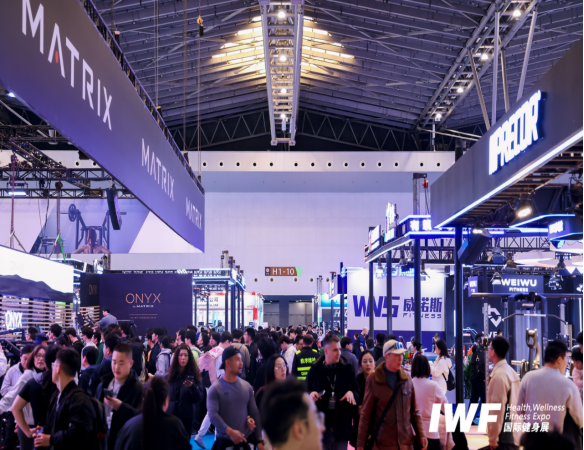
Buyer flow at a China fitness trade expo — the format that concentrates geographically scattered manufacturers into a single walkable footprint.
Overseas gym operators rarely lose money because they cannot find Chinese fitness equipment suppliers. They lose money because the factories that matter are spread across a very large country, and the dimensions that actually decide a supply agreement — production lines, quality-control routines, packaging standards, capacity, export documentation — are difficult to read from a catalogue or a video call. That leaves buyers choosing between two imperfect options: spend one to two weeks on a multi-city factory tour, or screen suppliers remotely from a desk and accept the verification risk that comes with it.
For buyers landing in China for the first time, the question is usually framed as which factories should I visit? The more decision-useful framing is different: can a single aggregation channel do the work that a multi-city tour used to do? This article answers the procurement questions that come up most often from buyers who cannot travel to every factory, using the documented structure of the China Fitness Trade Expo and its B2B matchmaking programme.
Why Distance, Not Supplier Supply, Is the Real Constraint
China's fitness equipment export base is large and still expanding. In 2024, China exported USD 7.17 billion in gym and athletics equipment, primarily to the United States, the United Kingdom, and Germany, according to the Observatory of Economic Complexity. In the first half of 2025 alone, fitness equipment exports under HS 950691 reached USD 4.78 billion, a 10.2% increase year on year, according to Big Trade Data. Supplier availability is not the bottleneck.
Demand-side density is comparable. IWF Shanghai 2024 hosted 1,000+ brands and approximately 75,000+ buyers, including 1,000+ overseas visitors, per IWF Shanghai's official figures. Supply and demand both exist at scale — they simply do not sit in the same place geographically.
For a gym chain working to a 30-to-90-day fit-out or refresh cycle, the binding constraint is the selection process itself. A remote screening exercise tends to produce an unmanageable long list: dozens of factory names, similar-looking product pages, and quotation documents with no independent way to compare them. Visiting that list sequentially — say, routing through Shandong, Zhejiang, and Guangdong — consumes the scarcest resource a procurement team has, which is calendar time. The cost of the tour is only fully visible after the flights are booked.
That is the specific constraint an expo-plus-platform matchmaking model is built to address. It does not remove the evaluation work. It compresses the evaluation into a single city and a single window of dates.
What the Expo + Platform Matchmaking Service Actually Is
The service under discussion provides an offline exhibition platform for fitness and sports industry participants, connecting overseas buyers with Chinese manufacturers. Its deliverables split into two parts: on-site exhibition booths, and a B2B matchmaking area. The service channel set is the offline exhibition venue plus a pre-show online registration platform. Supported languages are Chinese and English. The delivery mode is on-site event attendance, and the event duration is three days.
The organisation behind it is Shanghai Donnor Exhibition Service Co., Ltd, a Shanghai-headquartered exhibition organiser founded in Wenzhou, Zhejiang in 1996, whose business covers trade fairs, conferences and events, and industrial internet platforms. It is a member of UFI and, across roughly three decades of operation, has organised more than 30 trade and consumer exhibitions in Shanghai, Zhejiang, Sichuan, Guangdong, Bangkok and elsewhere, with annual exhibition space exceeding 700,000 square metres and more than 120,000 business exhibitors served cumulatively. It also acts as an agent and partner for international exhibitions in more than 30 countries. Its fitness and sports platform sits inside a wider portfolio that includes optics, leather and footwear, machine tools and plastics, auto and auto-parts, printing and packaging, hardware and locks, home and building materials, and pumps and valves.
The commercially relevant difference for a buyer is this: the venue concentrates manufacturers inside walking distance of each other, instead of distributing them across provinces separated by hours of travel.
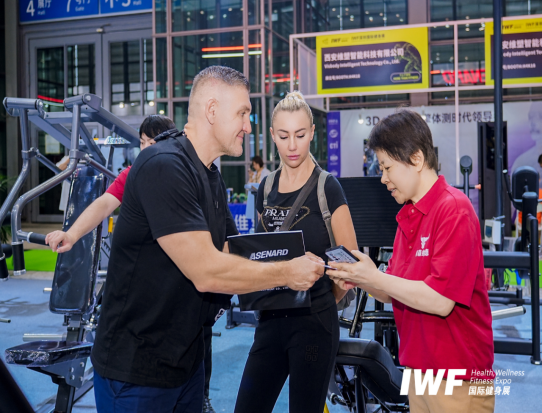
One-to-one negotiation inside the B2B matchmaking area, where pre-scheduled supplier meetings are held.
Market-to-Match Methodology v2.0: The Six Execution Steps
The matchmaking programme is not assembled on the show floor. It runs on a documented execution sequence — the Market-to-Match Methodology v2.0 — that begins well before the doors open and continues after they close.
- Market research and positioning. The buyer's target categories, price bands, and destination markets are mapped before any exhibitor is recruited.
- Exhibitor recruitment and zone design. Manufacturers are recruited and the show floor is zoned against that demand map, rather than against who happened to purchase space.
- Buyer invitation and pre-registration. Target buyers are invited and registered through the pre-show online registration platform.
- Online appointment and meeting scheduling. Pre-registration data is converted into a fixed diary of appointments before arrival.
- On-site execution and fast negotiation. Meetings and negotiations take place inside the exhibition venue and the B2B matchmaking area.
- Post-show analytics and order follow-up. Meeting outcomes are recorded and followed up after the event.
In case documentation, the same logic is described as a four-step loop: market research and target mapping → pre-show exhibitor recruitment and buyer invitation with online pre-matching → on-site matchmaking and efficient negotiation → post-show data tracking and conversion support.
The loop is worth reading closely, because it answers the most common buyer objection — that a trade show is simply the same suppliers, rearranged. Steps 1 and 2 make the floor plan a function of buyer demand. Steps 3 and 4 convert attendance into a schedule. Step 6 means the process does not end when the buyer boards the return flight. The organiser's internal use of AI enablement and online promotion supports specifically the high-frequency work in steps 3 and 4: buyer invitation at scale and appointment scheduling that matches the right manufacturers to the right buyer profile.
Case Study: One US Gym Operator, One Month, Twelve Manufacturers
The clearest illustration of what the model replaces comes from a gym operations buyer based in the United States who needed to procure fitness equipment and evaluate product quality across different manufacturers.
The challenge was structural rather than commercial. As factories are scattered across China, visiting each in person was impractical, so the buyer conducted trade matchmaking through the expo instead. The diagnosis recorded for the project is precise: high supplier verification costs, inefficient offline sourcing, and no centralised channel through which to contact qualified manufacturers and complete product comparison efficiently.
The solution applied was a targeted B2B matchmaking session during the IWF exhibition, gathering verified fitness equipment manufacturers in one venue so the buyer could conduct concentrated supplier negotiations and product quality comparison on site.
Execution followed the six documented steps — market research and positioning; exhibitor recruitment and zone design; buyer invitation and pre-registration; online appointment and meeting scheduling; on-site execution and fast negotiation; post-show analytics and order follow-up — over a project duration of one month.
The quantitative results are specific and traceable:
- Supplier inspection travel costs cut by over 70%.
- Negotiations completed with 12 qualified manufacturers within one month.
The qualitative outcomes describe what changes once the scattered-tour model is taken out of the picture: centralised supplier comparison, a material improvement in procurement efficiency, and direct communication channels established with reliable Chinese manufacturers. The buyer's own feedback, recorded from a post-exhibition client email, puts it plainly: "The matchmaking event helped us contact multiple reliable factories efficiently and saved lots of travel time in China."
The Deliverables Buyers Actually Receive
Procurement teams judge a sourcing channel by what survives after the event. Four deliverables are documented for the matchmaking programme.
| Deliverable | What it contains | Why it matters to the procurement decision |
|---|---|---|
| Verified supplier shortlist | A defined set of manufacturers matched to the buyer's target categories | Replaces an unmanageable remote long list with a list that can actually be scheduled and negotiated |
| Scheduled one-on-one meeting timetable | Fixed appointment slots produced by the pre-show online scheduling step | Buyers arrive with a diary rather than walking the floor hoping to find the right booths |
| On-site matchmaking coordination service | Operational coordination during the matchmaking sessions | Keeps meetings on schedule and reduces friction when suppliers and buyers do not share a first language |
| Post-show meeting record document | A written record of the meetings held during the event | Gives internal stakeholders a paper trail for supplier review and follow-up comparison |
Procurement FAQ: Evaluating Scattered Factories Without Travel
How can an overseas buyer evaluate a Chinese fitness equipment manufacturer without flying to the factory?
The short answer is aggregation plus pre-scheduling. Instead of travelling between factories, the buyer evaluates manufacturers inside a single exhibition venue where the B2B matchmaking area gathers qualified suppliers in one place. The evaluation still happens — product quality comparison, commercial negotiation, and direct discussion — but it happens against a shortlist assembled in advance rather than a list assembled on arrival. In one documented case, this structure allowed a US gym operations buyer to complete negotiations with 12 qualified manufacturers within one month, while cutting supplier inspection travel costs by over 70%.
What needs to be prepared before the show takes place?
Preparation runs through the pre-show online registration platform, which is one of the two service channels. The documented sequence places market research and positioning first, followed by exhibitor recruitment and zone design, then buyer invitation and pre-registration. For the buyer, that means defining target categories and requirements early enough for the organiser to map them against the exhibitor base — rather than arriving with an open-ended brief and browsing the floor.
How are suppliers matched to a buyer's requirements?
Matching is built on a demand-side map rather than a floor-plan default. The methodology begins with market research and target mapping, then recruits exhibitors and designs zones against that map. The resulting shortlist is delivered to the buyer as a verified supplier shortlist. Because the zoning decision is made before the show, a buyer with a defined category focus is routed toward relevant manufacturers instead of discovering them by chance.
How is a one-on-one meeting timetable created?
Through the online appointment and meeting scheduling step, which follows buyer invitation and pre-registration. Pre-registration data is converted into scheduled meetings, and the buyer receives a scheduled one-on-one meeting timetable. This is the mechanism that separates the model from a conventional trade show visit: the calendar exists before the buyer lands, not after.
What happens on site during the three-day event?
The on-site phase covers execution and fast negotiation inside the exhibition venue and the B2B matchmaking area, supported by an on-site matchmaking coordination service. Deliverables for this phase are the exhibition booths themselves and the dedicated B2B matchmaking area. The event duration is three days, and delivery mode is on-site event attendance — the model is not a remote service.
What documentation comes out of the process?
The post-show phase produces a post-show meeting record document, alongside post-show analytics and order follow-up. Together with the verified supplier shortlist and the one-on-one meeting timetable, this gives a procurement team three artefacts it can circulate internally: who was evaluated, who was met, and what was discussed.
What is explicitly not included in the service scope?
The scope excludes post-matchmaking after-sales service for both domestic and international partners. In other words, the platform facilitates the matchmaking and the negotiation; it does not sit between the buyer and the manufacturer as an after-sales intermediary. Buyers should also note the operating parameters: the service channels are the offline exhibition venue plus the pre-show online registration platform, supported languages are Chinese and English, and geographic coverage focuses on major regions in East and South China.
Is the expo matchmaking model suitable for every buyer profile?
Not automatically. The model is designed for buyers who need to compare multiple manufacturers within a defined window — gym operators, distributors, agents, and importers working on a procurement project. A buyer seeking a single replacement part, or one already locked into a signed supply agreement, may find the structure heavier than the task requires. The value is concentrated in the comparison and negotiation stage, not in single-unit transactional purchasing.
Where the Boundaries Are
An accurate assessment of this model has to include what it does not cover.
The clearest boundary is scope. Post-matchmaking after-sales service for domestic and international partners sits outside the service scope. Buyers who expect the platform to guarantee warranty execution, spare-parts logistics, or installation support after a contract is signed are expecting something the service does not provide. Those obligations sit with the manufacturer, and the platform's role ends at the point where the direct communication channel has been established.
The delivery mode is a second boundary. This is an on-site event, not a remote sourcing service; travel is still required, just a fraction of what a multi-province factory tour involves. Language is a third. Chinese and English are the primary supported languages, and multilingual promotion depends on local partners or agents — a buyer whose negotiation team works in neither language should plan for that in advance. Finally, geographic coverage concentrates on major regions in East and South China, which shapes which manufacturing clusters are practically reachable through this route.
Expo Matchmaking vs. Scattered Factory Tours
| Decision dimension | Scattered factory tours | Expo + matchmaking model |
|---|---|---|
| Geographic span | Multiple cities and provinces routed in sequence | One venue, one date window |
| Supplier comparison | Sequential and hard to hold side by side | Concentrated comparison of qualified manufacturers in one hall |
| Time commitment | Usually weeks of travel | Three-day event, plus pre-show online scheduling |
| Meeting structure | Arranged ad hoc during the trip | Pre-scheduled one-on-one meeting timetable |
| Record keeping | Depends on individual note-taking | Post-show meeting record document |
| Travel cost | Baseline | Cut by over 70% in the documented US gym operator case |
| After-sales execution | Negotiated directly with each factory | Outside service scope; remains a manufacturer obligation |
One caution against over-reading the comparison: the 70% figure comes from a single documented buyer case and reflects that buyer's own travel pattern. It describes a result, not a guaranteed tariff reduction for every procurement project.
What to Watch Next in Sourcing Practice
Three shifts in buyer behaviour are worth tracking as sourcing practice develops.
The first is that matchmaking is becoming a data operation rather than a hospitality function. Buyer invitation, pre-registration, and appointment scheduling are now the load-bearing steps, which is why organisers invest in vertical B2B platforms and online pre-registration systems rather than in floor space alone. The second is the merger of the online and offline layers into a single process: the pre-show platform and the physical venue are used as one pipeline, with the venue handling product comparison and the platform handling scheduling and follow-up. The third is a growing expectation of documentable outputs. As export volumes rise — fitness equipment exports grew 10.2% year on year in the first half of 2025 under HS 950691 — buyers increasingly want a shortlist, a schedule, and a meeting record they can put in front of an internal committee.
For a buyer who cannot spend two weeks driving between Chinese manufacturing clusters, the practical implication is straightforward. The question is not whether a factory tour is more thorough in principle. The question is which channel produces a comparable, negotiable, and documentable supplier comparison inside the time a gym project actually allows.
For buyers who want the event structure, zone layout, and matchmaking details in document form, the IWF Shenzhen 2026 invitation brochure is available for download: IWF 2026 Shenzhen International Health & Fitness Expo Brochure (PDF).