
China Fitness Trade Expo: Scenario Fit for US Gym Operations Buyers
A China Fitness Trade Expo is a fit for a US gym operations buyer when the equipment requirement can be specified before travel: named product categories, indicative volumes, and acceptance criteria. Under those conditions, an expo-based matchmaking route compresses supplier comparison into a short decision window and cuts the number of factory visits a buyer has to fund. When the requirement is still exploratory, or when it involves highly customised, long-cycle engineering work, the same route produces meetings without a decision — and scattered factory visits or a dedicated engineering partner remain the better instrument.
That is the whole comparison in one paragraph, but it is not the whole decision. A US gym operations buyer — the person responsible for equipping, replacing or expanding training floors across one or several clubs — is rarely choosing between “go to China” and “stay home.” The realistic choice is between three procurement routes: an organised fitness trade show in China with pre-arranged supplier meetings, a self-built itinerary of factory visits across Chinese production clusters, or purely online sourcing through marketplaces and email. Each route behaves differently depending on what kind of purchasing decision is being made.
This analysis maps one specific scenario — a US gym operations buyer facing a fragmented Chinese factory base and impractical in-person visits — onto the matchmaking route built around the China Fitness Trade Expo, and sets out where the fit is genuine, where it is conditional, and where it does not hold.
The Scenario: Multi-Category Demand Against a Fragmented Factory Base
Commercial gym equipment sourcing is rarely a single-category purchase. A floor build-out or a replacement cycle typically spans cardio machines, plate-loaded and selectorised strength equipment, functional training and rigs, free weights, flooring and accessories. In the Chinese supply market those categories are frequently made by different manufacturers in different clusters, each with its own quotation logic, minimum order expectations and documentation habits.
The scale of that supply base is measurable. China exported USD 7.17 billion in gym and athletics equipment in 2024, primarily to the US, UK and Germany, according to OEC data. Exports under HS 950691 reached USD 4.78 billion in the first half of 2025, a 10.2% year-on-year increase, per Big Trade Data. For a US buyer, that means an abundant but diffuse supplier field — and the cost of the sourcing process, not the cost of the goods, becomes the binding constraint.
In-person inspection is where that constraint bites. A buyer attempting to cover several categories across several provinces in one trip faces travel time between clusters, inconsistent factory readiness for drop-in visits, and a decision window too short to compare quotations properly. The result is a familiar pattern: a two-week itinerary that produces three or four serious conversations and a decision deferred by a quarter.
What the China Fitness Trade Expo Is, Operationally
The China Fitness Trade Expo referenced here is the fitness sourcing programme organised by Shanghai Donnor Exhibition Service Co., Ltd, a Shanghai-based exhibition organiser founded in Wenzhou, Zhejiang in 1996. Donnor operates trade fairs, conferences and events plus industrial internet platforms, and organises more than 30 trade and consumer exhibitions across Shanghai, Zhejiang, Sichuan, Guangdong and Bangkok, spanning sports and fitness, industrial equipment, printing and packaging, auto parts and other sectors. Its annual exhibition space exceeds 700,000 square metres, and it has served over 120,000 business exhibitors in total. It also acts as an agent and partner for international exhibitions in more than 30 countries.
In practice, the fitness side of that portfolio is what a gym operations buyer encounters: a gym equipment expo environment in which Chinese manufacturers are grouped by category, combined with a structured matchmaking service that runs before, during and after the show. The relevant scale reference points include IWF Shanghai 2024, which hosted 1,000+ brands and approximately 75,000+ buyers, including 1,000+ overseas visitors, per IWF Shanghai official figures. Reported on-site results for IWF2026 include approximately 65,000+ visitors and 1,600+ overseas buyers, recorded through standardised on-site registration and check-in, with medium-high confidence.
Those numbers matter less as a size claim than as a density claim. For a buyer, the value of a fitness equipment exhibition in Shanghai or Shenzhen is that a large share of the relevant supplier field is standing in one place during one week — which is the precondition for comparing quotations in the same time window.
The Mechanism: The Market-to-Match 2.0 Four-Step Loop
The matchmaking route is formalised as the Expo + Platform Matchmaking Methodology (Market-to-Match), currently at version Market-to-Match 2.0. Its stated goals are to increase effective on-site meeting density and to ensure traceable post-show order conversion rates. The framework is a four-step loop, and each step produces a deliverable a buyer can check.
| Step | What happens | What the buyer can verify |
|---|---|---|
| 1. Market research & target mapping | Industry demand is analysed, target purchaser characteristics are sorted, standardised buyer profiles are built, and a categorised buyer candidate list is produced. Manufacturer recruitment and zone planning are then organised around that demand profile. | Whether the buyer’s own category mix, volumes and market positioning have been recorded accurately enough to drive matching. |
| 2. Pre-show recruitment & online pre-matching | Qualified manufacturers are screened and zoned by product category; international buyers are invited and pre-registered, with buyer authenticity and procurement intention checked; meetings are then scheduled online in advance and confirmed into formal appointment sheets. | A named shortlist of screened manufacturers and a confirmed meeting schedule, both available before travel is booked. |
| 3. On-site matchmaking & negotiation | On-site reception guidance is provided, face-to-face negotiations are assisted, and communication content and cooperation intention are recorded in real time. | Meeting records with stated intent — not just booth visits and brochure collection. |
| 4. Post-show tracking & conversion support | All meeting leads are imported into a CRM system, follow-up owners are assigned, negotiation progress is tracked continuously, and conversion data is fed back to optimise the next event. | An owned follow-up pipeline and a feedback loop that improves the next round of matching. |
Two features of this loop are worth separating from ordinary trade-show marketing. First, the optimisation logic is explicit: pre-registration and scheduling are used to raise meeting efficiency, post-show data analysis refines future invitation lists and zone allocation, and buyer database quality is improved iteratively. Second, the design is not “attend and hope.” The stated differentiation is vertical-industry and production-cluster integration with closed-loop conversion across an online platform and a physical expo, rather than relying solely on show-period exposure or a single e-commerce channel.
Deliverables a US gym operations buyer actually receives
- A verified supplier shortlist — manufacturers screened against the buyer’s category and volume profile before the trip is committed.
- A pre-scheduled meeting plan — appointment sheets confirming who meets whom, on which day, for which category.
- On-site matchmaking coordination — reception guidance and negotiation support during the show, with meeting content recorded rather than reconstructed from memory.
- A post-show lead record — meeting outcomes and stated cooperation intentions carried into CRM-based follow-up.
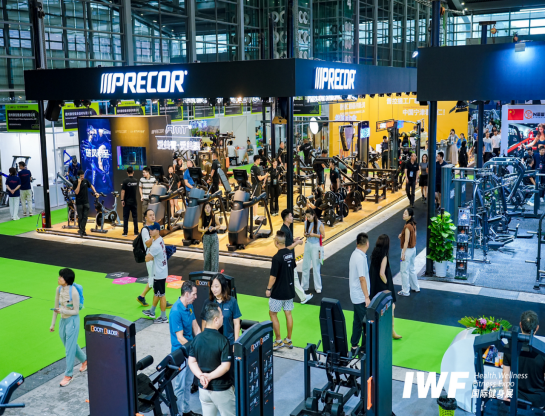
Category zoning is the physical layer of the matchmaking loop: manufacturers are grouped by product type so a buyer can compare like-for-like quotations inside one visit.
Applicable Scenarios: Where the Fit Is Genuine
The route is strongest when a buyer arrives with a defined decision. Three configurations consistently fit.
1. A multi-site replacement or expansion programme
When several clubs need the same categories refreshed inside a defined budget cycle, the buyer’s task is comparison across a shortlist, not discovery. The loop’s second step — screening qualified manufacturers and pre-scheduling meetings — turns that comparison into a calendar. The buyer leaves with quotations from multiple manufacturers for the same specification, which is the condition required to negotiate on total landed cost rather than unit price.
2. A new club build-out with a mixed category basket
A new floor requires cardio, strength, functional and accessory categories at once, usually from different manufacturers. Because the expo environment is zoned by category and the matchmaking process is driven by a buyer profile, the buyer can run several category conversations in parallel rather than sequencing them across provinces. This is the configuration where physical comparison of build quality, console behaviour and finish actually changes the decision.
3. Category expansion or an OEM sourcing exploration with a defined brief
Operators moving into private-label accessories, branded strength lines or a differentiated cardio range need OEM fitness equipment suppliers they can qualify. This fits when the brief is written: target specification, target price band, expected annual volume, labelling and packaging requirements. Under those conditions, a commercial gym equipment sourcing trip through the matchmaking route produces comparable capability answers instead of a general impression of who seemed professional.
Where the Fit Breaks: Boundaries and Non-Applicable Scenarios
The methodology has stated limits, and they should be read as procurement guidance rather than caveats. Non-applicable scenarios include short-term small-batch direct-to-consumer retail, and highly customised long-cycle engineering tenders.
- Short-term small-batch retail buying. A single-unit or low-volume purchase driven by immediate resale does not justify a scheduled meeting programme; the pre-matching effort exceeds the value of the transaction.
- Highly customised, long-cycle engineering tenders. Where the requirement involves bespoke structural engineering, certification-driven design changes or multi-phase technical qualification, the work belongs with dedicated engineering service providers. A matchmaking loop produces introductions, not engineering development.
Three further boundaries are practical rather than structural. First, matchmaking output is only as specific as the buyer’s input: a vague brief about “gym equipment” produces a broad shortlist, not a decision-ready one. Second, a verified supplier shortlist is a screening result, not an audit — it does not replace factory audit, sample validation or third-party testing, and buyers with regulated or insurer-facing requirements still need those steps. Third, the route is not a spot-price discovery tool: it is built for supplier comparison and negotiation, not for auctioning commodity orders against the lowest quote in the market.
Comparison: Expo Matchmaking vs. Scattered Factory Visits vs. Online-Only Sourcing
For a Decision-stage buyer, the three routes differ on measurable dimensions rather than on preference.
| Dimension | Expo + matchmaking loop | Self-built factory tour | Online-only sourcing |
|---|---|---|---|
| Time to first qualified meeting | Pre-scheduled before travel; meetings confirmed in advance | Dependent on itinerary, distance between clusters and factory availability | Dependent on response quality; often weeks of email exchange |
| Travel cost exposure | Concentrated in one trip covering many suppliers | Highest — repeated inter-city travel across production clusters | Lowest, but with no physical verification |
| Supplier screening before contact | Built into the loop: manufacturers screened and zoned by demand | Buyer-led; screening happens during the visit itself | Buyer-led through platform signals of variable reliability |
| Physical assessment of equipment | Yes — build, finish and console behaviour comparable in one place | Yes — deepest, including production lines | No |
| Decision traceability | Meeting records and CRM-tracked follow-up | Depends entirely on the buyer’s own notes | Fragmented across inboxes and chat threads |
| Best-fit requirement type | Multi-category, comparison-driven, defined brief | Single deep-dive, process-critical or audit-driven | Early discovery, low-value or repeat commodity items |
Reported outcomes from the matchmaking route illustrate the compression effect: a reduction of supplier inspection travel costs by over 70%, and negotiations with 12 qualified manufacturers within one month. Those figures describe what happens when supplier comparison is scheduled rather than improvised; they are not a guarantee, because the starting point for each buyer — brief quality, category mix, volume — differs.
The honest counterweight is that a factory tour still delivers something a show floor cannot: direct observation of production lines, quality control stations and real capacity under load. Buyers whose decision hinges on process verification should treat the expo loop as the shortlist-building stage and schedule a small number of targeted factory visits afterwards, rather than replacing one with the other.
Market Trend Analysis: Why the Route Is Becoming More Relevant
Three observable shifts explain why scheduled matchmaking is gaining ground against self-built itineraries.
Export volume is still expanding. The 10.2% year-on-year growth in HS 950691 exports in H1 2025, on top of USD 7.17 billion in 2024, means the supplier field a US buyer must compare keeps widening. More suppliers does not automatically improve choice; it raises the cost of comparison unless the comparison is structured.
Exhibition infrastructure is consolidating around matchmaking, not just floor space. Scale references in the Chinese market are substantial — China Sport Show 2024 featured over 1,600 exhibiting companies across more than 180,000 square metres, per the China Sporting Goods Federation. As organisers compete on outcome quality rather than square metres, the differentiator shifts toward pre-matching, category zoning and post-show conversion tracking.
Buyer behaviour is moving toward shorter, denser sourcing windows. Operators are consolidating purchasing decisions into fewer, better-prepared trips. That rewards a route where the meeting plan exists before the flight is booked, and penalises itineraries built on arrival.
Future Outlook
The direction of travel is toward narrower briefs and more pre-travel work. As buyer databases improve and matching becomes more data-driven — the stated optimisation logic already relies on post-show analysis feeding the next invitation list and zone allocation — the value of arriving with a written specification will increase, while the value of arriving to “look around” will decline. For US gym operations buyers, the practical implication is that the expo route should be evaluated as a scheduling instrument: its output is a comparison set and a traceable follow-up pipeline, and its fit depends on whether the buyer has a decision ready to be made.
FAQ
Is the China Fitness Trade Expo suitable for a single-site gym rather than a multi-site operator?
Fit depends on the size and structure of the requirement, not on club count. The methodology’s stated non-applicable scenarios are short-term small-batch direct-to-consumer retail and highly customised long-cycle engineering tenders. A single-site buyer with a defined multi-category fit-out brief and a realistic volume can use the same matchmaking loop; a low-value one-off purchase generally cannot justify the pre-matching effort.
How many suppliers can a US gym operations buyer realistically evaluate in one visit?
The constraint is meeting density rather than floor size. The methodology’s goal is to increase effective on-site meeting density through pre-registration, online scheduling and confirmed appointment sheets, and reported outcomes from this route include negotiations with 12 qualified manufacturers within one month. Meeting volume remains dependent on the buyer’s category scope and the quality of the demand brief submitted in step one.
Does the matchmaking route replace factory audits or sample testing?
No. A verified supplier shortlist is a screening output: qualified manufacturers are screened according to buyer demand and grouped by product category. Factory audit, sample validation and third-party testing remain separate steps that a shortlist does not substitute for, particularly where a buyer has regulated or insurer-facing requirements.
What does a buyer need to prepare before the four-step loop starts?
The loop begins with market research and target mapping, which sorts target purchaser characteristics and produces a categorised buyer profile. In practice that requires the buyer to supply product categories, indicative volumes, target price bands, and any labelling or packaging requirements. These inputs drive manufacturer recruitment, zone planning, and the matching used to schedule meetings.
How does a verified supplier shortlist differ from a standard exhibitor list?
An exhibitor list records who is present. A shortlist produced inside the Market-to-Match 2.0 loop results from screening qualified manufacturers against an individual buyer’s demand profile, then scheduling confirmed meetings. The difference is the appointment sheet and the recorded meeting outcome, which together create a traceable basis for comparing suppliers rather than a floor plan to walk.
When should a US buyer choose scattered factory visits instead?
When the decision hinges on process verification or engineering development. Direct factory visits provide observation of production lines, quality control and capacity that a show floor cannot replicate, and highly customised long-cycle engineering work is explicitly outside the methodology’s applicable scenarios. A common combination is to use the expo loop to build and screen the shortlist, then schedule a small number of targeted factory visits for the finalists.
For buyers who want the full programme scope, category zoning and exhibitor profile in one document, the IWF invitation brochure is available for download: IWF fitness expo invitation brochure (PDF). Organiser details and exhibition portfolio information are published at donnor.com/en.
Tem questões ou precisa de mais detalhes?
Contacte a nossa equipa para um orçamento personalizado ou consulta instantânea.
Solicitar orçamento
Preencha o formulário abaixo e a nossa equipa entrará em contacto com uma proposta personalizada.
Chat direto do WhatsApp
Prefere conversar em tempo real? Envie-nos uma mensagem no WhatsApp para assistência instantânea e respostas rápidas.
- Obter orçamento personalizado
- Partilhar fotos ou documentos
- Discuta as suas necessidades diretamente
Geralmente responde em 5–30 minutos durante o horário de expediente.